As usual, concerts by Tafelmusik Baroque Orchestra & Baroque Chorus are exercises in creative programming. Their latest (premiered last night, running until the weekend, and announced as completely sold out) isn’t simply a presentation of the Mozart Requiem, but a study of the composer’s psychology.
They seemed to be asking us how to frame this work, how to understand Mozart’s musical journey. Conductor Ivars Taurins & the Tafelmusik Chamber choir presented it in context with Mozart’s influences. He reputedly played a lot of JS Bach’s Well-tempered Clavier (a work supposedly to be found open on any given day, on his keyboard). And so we’re led to make connections to the contrapuntal writing in the Reqiuem.
We were also told that while the young Mozart had written some religious works, such works were infrequent once he came to Vienna.
The first half was an intriguing experiment, one that Taurins was honest enough to explain to us, whereby they’d originally thought to alternate Bach family motets with orchestrated fugues; but opted instead to cluster the fugues together, followed by the pious choral works.
The first half closed with a shimmering reading of the familiar Ave Verum Corpus.
In the second half we heard the Requiem. I found myself feeling the edginess of the Requiem, which may not have been what was intended. I did not see the work arising within the context of the opening works, whose genuine piety is in contrast to the theatricality of Mozart’s writing. I couldn’t help thinking that maybe Mozart was unable to finish the work because he had writer’s block, a lack of connection to the text. Much as I love parts of the Requiem (the first half much more so than the latter portion: whose authorship is not so clear to me), I feel a closer connection to the operas written in Mozart’s last year than anything religious or contrapuntal.
I feel pleased that Tafelmusik and I seem to be on a similar wavelength, exploring musical journeys (as I have been doing the past few weeks, taking us from Troyens to Tristan, and soon on to Parsifal). I realize now just how fortunate we are in Toronto, currently exploring Mozart’s last year.
La Clemenza di Tito closes tonight at the COC. Mozart’s Requiem is currently being presented by Tafelmusik. And in a few short weeks Tafelmusik will collaborate with Opera Atelier to bring us the other opera of Mozart’s last year, namely The Magic Flute. It’s a remarkable fluke, one that I am determined to explore & enjoy.
I couldn’t help hearing connections, by the way. Listen to Sesto’s “parto, parto” with its big intervals in the vocal line (so typical of opera seria), and the clarinet.
Now listen to the bass soloist’s “tuba mirum” from the Requiem.
I was struck by this and other parallels, thinking of how daringly theatrical Mozart was in his composition.
Tafelmusik Baroque Choir, led by Ivars Taurins, get completely inside this music, particularly the Mozart. Taurins kept everything moving at a brisk pace, conducting with more modest gestures than what we used in his recent Messiah, but every bit as genuine.
Nathalie Paulin was especially spirited in her delivery of the soprano part, although the quartet (including Laura Pudwell, Lawrence Wiliford and Nathaniel Watson) were solid throughout.
We’re very lucky in Toronto. I felt a small-town innocence to the presentation that belies the world-wide reputation this ensemble enjoys. From the energy of the conductor & orchestra, to the joyful reception from the audience it’s clear that there’s a huge appetite for this music in our city, and an appreciation for our artists.
McLuhan’s dictum “the medium is the message” has some curious ramifications in the fourth dimension (the dimension of time). An archive gathered across any significant period will function not just as a record for the subject(s) portrayed in the images, but also testify to the history of the medium.
Sometimes that testimony is so strong that our understanding of the past is completely tied to the medium: as when we listen to recordings of singers from the past. While Jussi Björling’s voice is heard very clearly in recordings made at the end of his career (he died in 1960), the orchestra isn’t so clear in his early recording (1930s); the star of the previous generation, Beniamino Gigli isn’t captured quite so perfectly in the recordings from his time, while with Enrico Caruso, the recordings are sufficiently imperfect that we begin to wonder just how good he truly was, and how he would have sounded. And further back? The rest is silence, because we have no record.
This is a preamble to considering the photographs of Franz Liszt. So many of the great media icons of recent history are, alas, dead. While it’s true that Marilyn Monroe and Jimi Hendrix and James Dean died young, we have wonderful records of other stars who lasted at least as long as Liszt’s three quarters of a century. But none of them made their mark in the 19th century. The long-lived Hungarian pianist, composer, and (eventual) abbé was one of the first great artist-celebrities in history. While you may not think much of Ken Russell’s film Lisztomania (1975), I love this suggestive title, ahead of its time in deconstructing a classical icon. While it’s imprecise to see a 19th century pianist through the lens of a rock band (that is, to imagine Liszt as an early prototype of the Beatles or Elvis), there are still many parallels to consider. For example, as a result of the feverish attention the pianist generated, photographers were eager to take portraits, knowing they’d be hugely in demand. Again, we need to see past our prejudices; while portraits were already largely irrelevant as historic evidence in the days of Karsh, in a time of primitive photographic technology (ie the middle of the 19th century), the formal staged portrait was one of the key documentary sources.
Franz Liszt nelle fotografie d’epoca della collezione Ernst Burger is a handsome over-sized book recently acquired at the Edward Johnson Building’s music library, containing a wonderful collection of portraits of Liszt. Googling the title shows that it’s available from Amazon in several countries as well as the NY Public Library.
Burger’s book was partly occasioned by the Liszt bicentennial (in 2011), but driven principally by another (and for me, unexpected) motivation. In the prefaces we discover that the book records an exhibition held in Italy, where the great virtuoso frequently made his home: Villa d’Este.
Yes of course, I remember the Villa d’Este from L’Années de Pelerinage (“Years of Pilgrimage”).
More about the music in a moment.
The exhibit was an opportunity for the proud inhabitants to celebrate Liszt’s connection to a small part of Italy that the composer-pianist used to frequent throughout his life, in an exhibition of photographic portraits, recorded in this wonderful collection.
These compositions are like travelogues, although the word really doesn’t do them justice. They’re arguably derivative, from Byron’s Childe Harold’s Pilgrimage and Berlioz’s program symphony Harolde en Italie. What Berlioz & Liszt accomplished has about as much to do with Byron, as Columbus’s exploits have to do with China (his original objective). Year One includes some remarkable mood pieces that resemble paintings, as though recording travels through the landscapes of Switzerland.
Year Two takes us to Italy, including the famous Petrarchan Sonnets.
You may say that I digress, but I am talking about Liszt. I can’t show you the pictures, can i..? I can only speak of their subject, this fascinating fellow who went through several interesting incarnations. The earlier photos show the handsome pianist, clearly accustomed to public acclaim & attention. And then in this enormous collection of portraits, we see him morph into the figure he’d become, the abbé withdrawn from public life, aging but still strikingly handsome. Because of his fame, people often asked to be photographed with him: leading to many charming group photos.
No, these are not photos of a man playing a piano: which by the way could have been useful. How did Liszt sit? While we do see him pose politely at a piano, that’s not the same as a picture of how he looked while playing. Yet we do have sketches showing us his attitudes at the piano, so it’s not as though we’re in the dark about this.
I can’t be objective, as I am the Lisztomaniac I spoke of in the title. I am so totally fascinated by the man that I find each of these photos intriguing.
Milica the Bride, in Ana Sokolovic’s Svadba-Wedding
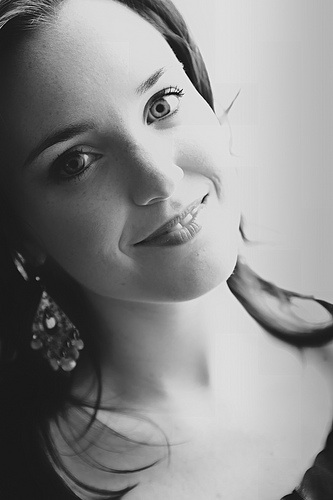
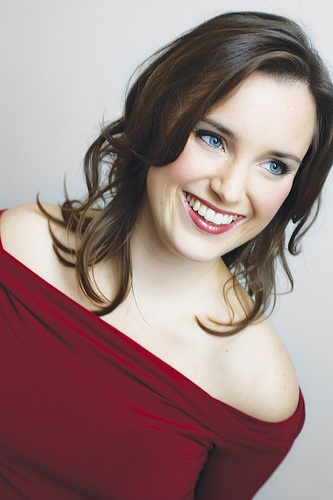
Soprano Jacqueline Woodley is as comfortable undertaking original music as she is taking on well-known classics.
Modern? Woodley created the role of Milica the bride in Ana Sokolovic’s Svadba with Queen of Puddings. This past year she sang Arvo Pärt’s Stabat Mater, works by Tavener and Kancheli, Judith Wier, and music by Kaija Saariaho (re-mounted in Washington D.C.), and that doesn’t include her current project (see below…)
Older? Via the Canadian Opera Company, Woodley sang Papagena in the COC Magic Flute, Iris in Semele, and First Priestess in Iphigenie en Tauride. Concert and oratorio work has included Bach’s St. John Passion, Handel’s Messiah and Dixit Dominus, Fauré’s Requiem, Mozart’s Vesperae solennes de confessore, Saint-Saëns’ Christmas Oratorio and Vaughan Williams’ Dona Nobis Pacem.
With her masters in opera from McGill & an ARCT in piano it’s no wonder Woodley is ready to undertake just about anything.
Composer György Kurtág (b 1926)
March 1st and 2nd, Woodley undertakes the monodrama Kafka Fragments, a haunting song cycle composed by György Kurtág, performed with violinist Kerry DuWors. In 40 excerpts of varying length from Franz Kafka’s letters and diaries, the work muses on the human condition.
I ask Woodley Ten questions: five about herself, and five about Kafka Fragments.
1) Which of your parents do you resemble (what’s your nationality / ethnic background)?
Soprano Jacqueline Woodley
Well I’m Canadian for many, many generations and before then, British/Scottish, so we’re about as white anglo-saxon as they come! (I always dreamed about being more exotic…alas…)
As a kid, I was a “spitting image of my father” as my Mom always said, but now I look a lot more like my Mom. Personality-wise, I have a lot of both of them I think. I hate to talk on the phone like my Dad but I have a lot of my Mom’s ticks too (like the dishwasher and fridge always having to be organized in the same way)!
2) What is the best thing / worst thing about being an opera singer?
Hard to pick one of each. I think that the most important thing about opera is the collaboration that goes into the work. I grew up in the choral tradition and it’s that love of making great music and getting into story and character with others that makes it all worth-while. We get to meet so many interesting stage directors, musicians, stage managers, etc. that work hard to make something beautiful and it’s that joint collective that keeps it interesting. We work and sing with such great friends and colleagues that it hardly ever feels like work. Then on top of it, when you get to the performance part, there’s the added energy and co-operation with the audience that adds another layer. It’s pretty exciting.
The worst thing I guess is a double answer. I love that we get to travel a lot (I LOVE to travel…this season I’ve visited 5 or 6 cities that I’ve never before seen amongst others that I was so excited to go back to!) but it can be hard to balance family life amidst that. In order to make a living, there are so many auditions and gigs away from home and I don’t think that ever gets easier on a couple or a family. It requires a very patient and supportive network which I am very grateful to have!!
3) Who do you like to listen to or watch?
I listen to a real mix of music. In the car or for cleaning I listen to dance music like Madonna, Lady Gaga, Michael Jackson, ABBA. At home we listen to a lot of “oldies”: a lot of Beatles, Brel (I think Jacques Brel is my favourite singer/performer!), Juliette Gréco, Joni Mitchell. For classical I love Mahler, Strauss and Brahms, especially Janet Baker and Maureen Forrester, Bach cello suites, and a lot of early music when I need to relax and be inspired.
4) What ability or skill do you wish you had, that you don’t have?
So many things come to mind! I wish I were better at sports so that I would enjoy them and I would get way more exercise!! I hate and am terrible at pretty much every sport. My siblings got that talent and I envy their inspiration and love of physical activity! On a non-serious note, I wish I had the talent to close my eyes and click my heels and be instantly in another place. It would be so handy on long rides home at the end of a day, or to be able to eat dinner with my husband in Montreal when I am away!!
5) When you’re just relaxing and not working what is your favourite thing to do?
I love to be with family and friends. Whether it’s going on long bike rides with my husband, or catching up with friends over coffee and shopping, or seeing my nephews and nieces or my siblings and parents over dinner, I cherish those moments. At the end of the night, I usually watch TV or read in bed with a glass of wine or a cup of tea and my husband, and that is bliss!
~~~~~~~
Five more about Kafka Fragments
1) How does Kafka Fragments challenge you?
How does it not?! I think, although I’ve done quite a few contemporary works now, and some weird early music pieces, that this is the hardest score I’ve ever prepared. I haven’t yet met Kerry, the violinist, but it seems to be as hard to play as it is to sing. The music is very disjointed and I often finish rehearsing wishing I had perfect pitch to help sing the jumps that are well over an octave or against the violin’s notes which are often very dissonant to mine.
Pianist Christopher Mokrzewski aka “Topher”
Sometimes I rehearse one excerpt for 3 hours then go back the next day and it’s like I’ve never seen it before!! It’s a slower process for me than I’m used to and of course we can’t go on YouTube and listen to 10 different singers sing it in different ways. But now that I’ve listened to more of Kurtag’s works, and the more I practice this, the more impressed I am that it is very closely linked to the text and so I’m trying to go about it that way. Although it can be a hair-puller to learn, it can be so much more rewarding putting something like this together with great musicians and people like Kerry, Topher and Joel than a work that has been performed for 300 years. After the struggle to get it on its feet and to find the meaning and story, to try to relay and share that with an audience is pretty exciting once all the work has been done.
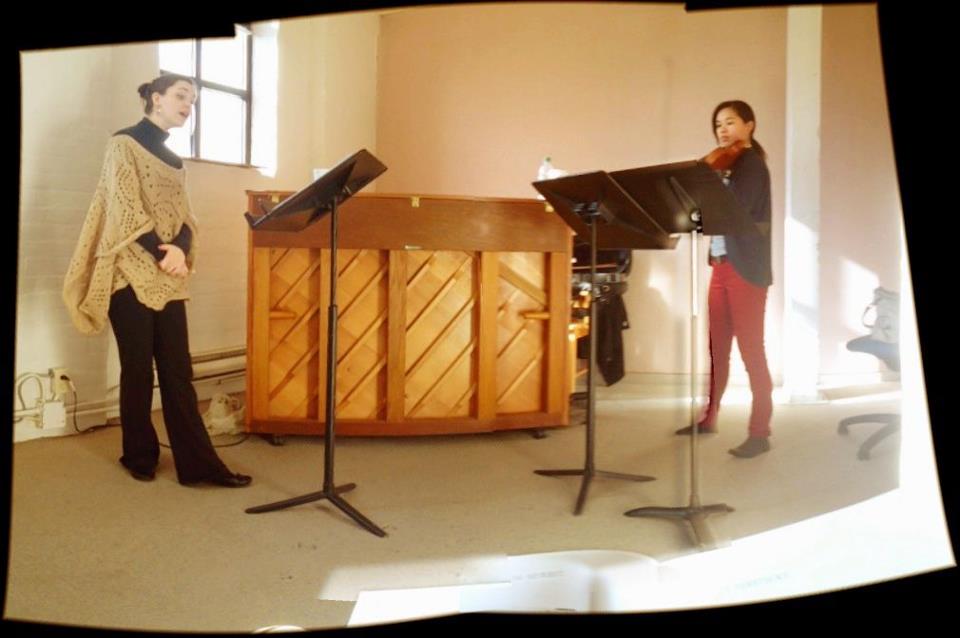
Jacqueline Woodley and Kerry DuWors rehearsing Kurtág’s Kafka Fragments. (photo by Joel Ivany)
2) What do you love about Kafka Fragments?
I love the texts. The piece is made up of many excerpts of Kafka’s diaries and letters, most numbers lasting around a minute, a few more developed, but all musings ranging from the apparently ridiculous to the mundane. I love the idea that these were Kafka’s private thoughts and yet any writer must know that they might likely be published one day so I’m fascinated by the stories behind each of these “fragments”. It’s the kind of material that can be dissected for hours and your take on it can change daily no matter how simple the sentence. On the other hand, some are more observational and amusing and you just wonder what prompted the thoughts. Kurtag really clearly bases the music on his interpretation of the text: sometimes the music alone is description of the text. For example, I love the violin solo in the last piece, it is so evocative and haunting. Throughout, the violin is as much a narrator as the voice. The fun is in interpreting both Kafka and Kurtag. I love the challenge of finding the depth and character behind each musing and musical narrative.
This is often what I love about modern works, there are so few recordings and performances available that we as performers are truly free to find our own voice and with our colleagues, to create our own performance without audiences leaving saying “you know, I heard Maria Callas do this at La Scala years ago…” or “I just hate what she did with her Susanna!” Just knowing that I don’t have to do the exact same phrasing or cadenza as someone else in order to be enjoyed is very freeing for me, and I love the added challenge of trying to make a phrase that can begin so strangely in someone’s ear sound beautiful and logical.
For example, I loved doing Svadba with Queen of Puddings for the reaction, the over-arching sweep from audible eyebrow raising and uncertainty at the end of the first section to the sigh and emotion after the last chord as people got used to and familiar with the texture and strange narrative and musical language. It’s the same with every modern piece that is enjoyed for the first time, there’s a period where you need to acclimatize to the musical language and then you can start to appreciate it and that’s the exciting part, hearing it for the first time! I hope it will be the same with the Kurtag for our audience!
3) Do you have a favourite moment in Kafka Fragments?
Oh my gosh, so many great moments. I love the humour and sarcasm of so many of the excerpts, but I’m always a sentimentalist, so I think my favourite is the last number. The music is beautiful, and it talks about a pair of snakes crawling through the dust in the moonlit night. Apparently Kurtag thought of himself and his wife as these two snakes, and I find it quite moving.
4) How do you relate to Kafka Fragments as a modern woman?
Well you know, that’s a good question. I have often wondered what prompted Kurtag to write these for a soprano instead of a tenor or bass. But Kafka’s words ring so true and are so humanistic that I think they can be understood and interpreted by anyone. Sometimes I feel that I am the voice experiencing, and other times, it’s almost like I’m reading the text instead of feeling it. Some are narrative and I really feel like I’m sitting on a bench as Kafka, observing the happenings around me, and I feel quite gender-less. These observations are rather timeless and so can be very modern or as old as the times. Sometimes I feel rather schizophrenic singing them which I tend to love as each character and voice can feel so different. Kurtag has really given specific voices to each piece and I love shifting from woman to man to cat to Schumann. In that way, I feel like I don’t have one overall idea or personality so I can actually experience each piece in a different way, sometimes personally, sometimes removed. That’s a rare opportunity. Usually in opera, we work so hard to create one full, well-developed character that it’s fun to play so many different characters or voices within a work.
5) Is there an influence you’d care to name that you especially admire?
Soprano Jacqueline Woodley
I can’t say there’s only one. It started with Jeanette Steeves and Jackie Hawley when I was a kid, who were my first voice teachers and choir conductors. They instilled a real respect and excitement for music and creating music with others, and married singing and acting for me that has most definitely continued to fuel me and allowed me to truly enjoy this career. Then there have been people like Wendy Nielsen, who has inspired me to try to be a good, down-to-earth person as well as a polished, interesting singer, to “have it all” while always keeping integrity in life and singing. In lessons she always searches to hear my voice in each note, and in my opinion, I feel it’s also reflected in how she encourages us to live our life as well as sing. To find myrep and to challenge myvoice and to be happy in mylife. That to me is more important than super-fame and I always try to keep a happy balance. It is never perfect or finished but it’s always a work in progress!
~~~~~~~
Against the Grain Theatre (AtG) presents Kafka/Janáček/Kurtág, a double bill of two daring song cycles on March 1 and 2, 2013at 8 p.m.
Tickets are $30 and are available at www.againstthegraintheatre.com. The Extension Room is located at 30 Eastern Ave., Toronto, ON.
For more information on AtG’s 2012/2013 season and to view artists’ biographies, please visit www.againstthegraintheatre.com.
I’m a father with grown children. I encountered Mary Pipher’s book Reviving Ophelia in the 1990s. The title might give you an idea of what sort of book it is, and why I would have read it.
Ophelia? Collateral damage in Hamlet’s struggle. She becomes mad, eventually drowning, after her father dies & Hamlet pushes her away.
The perils she faces –parents & peers influencing her—are not so different from those encountered by girls growing up in the 21st century, sometimes with similar results. Drowning is sometimes just a metaphor, the girl losing her authentic self in the stream of pressure to change. As I never had a son I never bothered looking for books about parenting male children.
I keep getting jolted by the evidence in front of me. Earlier this winter I was at a memorial celebration where I could clearly see cohorts of talented people. Those who were in that school in the early 1970s stood together in one part of the room, those from the mid-80s in another part, and so on. And yes the current students were also there in an especially cute cluster.
More recently I watched young actors perform at Ryerson Theatre School. Then today, in church I again observed members of the congregation growing up before my eyes.
When my eyes fell on the copy of Pipher’s book on the shelf today, I decided to lend it to one of my relatives. She has a young daughter, but maybe the mother herself was beneficiary of the wisdom of the book.
Mary Pipher: whose new book appears in June
I hope Pipher’s book has been influential, because—if I don’t miss my guess—the world is a safer place for daughters and the parents of daughters than it was almost twenty years ago, when the book appeared. Feminism is so much more than equal pay or reproductive rights.
I’d like to believe that the current generation of girls are growing up stronger and safer from the currents that might endanger them or their authenticity, at least partially thanks to Pipher.
Shay Loya’s book Liszt’s Transcultural Modernism and the Hungarian-Gypsy Tradition
During the production of Feydeau’s The Girl From Maxim’s at Ryerson Theatre School—just concluded last night—I had lots of opportunities to sit and read, between cues. I read most of a book recently arrived in the EJB library namely Shay Loya’s Liszt’s Transcultural Modernism, and the Hungarian-Gypsy Tradition.
I’d grabbed it, mindful of a recent series of questions to Topher Mokrzewski, who performed the Liszt transcription of the Liebestod at the Wagner Exchange recently. I tend to speak in Liszt’s defense to anyone who’ll listen even if it flies in the face of the conventional wisdom, which has long tarred him with several different brushes.
As I’d hoped this new book –part of the Liszt centennial buzz—digs deeply into the complexity of the man and his work. While it may not seem to most people that he needs rehabilitation, that’s because they’re naturally happy with the little corner they’ve driven him to:
Virtuoso
Second-rate composer of trashy music
Loyal supporter of Wagner
I don’t think Loya’s book has an agenda to defend Liszt, but it does problematize the old assumptions, the stereotypes about him and his music. His relationship to modernism –aka “the music of the future”—is itself a complex nut to crack. When we add in Liszt’s other musical activities, it’s that much more complex. In a nutshell, Loya makes me feel much better about being a Lisztomaniac.
I will write more about the book later (haha when I FINISH might be a good idea). But for now I find it illuminates elements in the music I’ve been playing this week. For the Feydeau play, we’ve been using three tunes from Die Fledermaus (J. Strauss) and one each from La Belle Hélène (Offenbach) and Das Land des Lächelns (Lehar). In each case the composer incorporated a style from another medium in a manner somewhat reminiscent of what Loya speaks of. While the Offenbach number (utilizing march rhythms) has little connection to Loya’s book, the other four in various ways seem to parallel some of the trans-cultural phenomena found in Liszt, a composer whose allegiances are hard to know. He’s a Hungarian, which is not to be confused with a “gypsy” (more properly the Roma a people persecuted throughout the world) even though so-called gypsy music is strongly associated with Liszt. Nothing captures this ambivalence better for me than his name: which is “Ferenc” rather than “Franz”. Liszt is both a Hungarian nationalist but also part of the movement surrounding Wagner, which is at least one reason he’s regularly treated as though he were German. The Austro-Hungarian empire (later Austria-Hungary) was a fascinating and complex place that i don’t pretend to understand. I suspect that a Hungarian in this world would face some of the same choices that a Francophone Quebecois faces in Canada, seeking an authentic relationship with their heritage, balanced with possible career aspirations that might lead them to learn English.
Notice how the rhythmic ornaments in this song (“chacun a son gout”) resemble some of the figures found in gypsy music, and the song –now that i look at it–is built in two parts that resemble a dance (perhaps a csardas?), with a slow start and faster finish. Hearing this after reading Loya makes me want to somehow unpack the exotic assumptions of a listener of the time. I can’t help wondering how different this is from more recent conversations about cultural assimilation in our own time.
And yes, I say this recognizing how politically fraught the word & the culture of Roma people are even now, let alone in the 19th century. Their music was regularly imitated and appropriated. I put the parenthetical in the headline to distinguish “appropriate” (the verb) from “appropriate” (the noun). I suppose i was concerned because the noun usage is exactly the opposite of what i feel: that it’s inappropriate to appropropriate.
You hear some of the same type of thing going on in the famous overture.
It’s been a fun couple of weeks chez les étudiants de Ryerson, playing La Dame de Chez Maxim. Due to snow Friday night we’ve played six consecutive nights.
I feel I am cheating to say “we” because I am mostly a spectator at the piano, enjoying the performances of the talented students at Ryerson Theatre School. What a lark… and what an ego trip!
I looked in Francisque Sarcey’s Quarante ans de theatre last night. Sarcey is someone I know from my research on Maeterlinck’s Pelléas et Mélisande. He has no patience for the work, wondering how one can bother with someone who repeats herself so much (and those of you who know the play will realize he’s not necessarily being unkind, even if he refused to meet the work on its own terms, did not precisely enter into the spirit of the play or its style).
But Sarcey is crazy for Feydeau, suggesting that this play is so perfect that you wouldn’t change a word or a gesture. Speaking of laughs, i giggled to notice that this great critic’s review takes us through the work in a way that nowadays would be considered a guaranteed spoiler, giving away several jokes. His critical assessment is the tiniest part of the review. But then again he is shrewd, a commercial success in his own right, in distilling key moments of the play into his writing.
This must seem rather amazing considering that we see so little of Feydeau on our stages. Is the life depicted so different from what we see in our plays and films? Do we no longer have marital infidelity? Nobody believes in ghosts? Everyone now tells the truth?
Sure…
But there are some things that have changed. There are a lot of people in this play, which means lots of actors to hire, and no easy parts to play. It’s a long piece of work, coming in at over three hours of break-neck energy and wackiness. In a big theatre without amplification the performances likely call for a different skillset than what we see now. Considering that the Ryerson theatre has sold out every night perhaps Feydeau deserves another look (although it did help that the show has a huge cast, which equates to lots of family & friends coming to see). In an adaptation –translated into a modern idiom — I suspect the length & number of parts could probably be dealt with (if someone hasn’t already thought of this…).
I am in any case, grateful for what I’ve seen, honoured to be of some use for such a capable & gifted bunch. Dr Cynthia Ashperger didn’t allow her charges to take any shortcuts that I could see. Every night they worked their butts off, seeking perfection in the next performance.
Tonight’s show is the last one. I am very grateful. It’s been huge fun.
I must read more Feydeau, although it suffers without the physical element, the voices and machinations onstage.
“Press releases and announcements” are presented verbatim without comment.
Against the Grain Theatre throws down the gauntlet with program of rarely performed song cycles
TORONTO—Against the Grain Theatre (AtG), the young company that has received critical acclaim for bringing unconventionally staged works to Toronto audiences since its launch in 2010, presents Kafka/Janáček/Kurtág, a double bill of two daring song cycles on March 1 and 2, 2013at 8 p.m. Taking place at the Extension Room, a Leslieville yoga and dance studio, the program issues a challenge to audiences to embrace the intensity of two rarely performed works by Leoš Janáček and György Kurtág.
Kurtág’s Kafka Fragments, a haunting song cycle based on excerpts from Franz Kafka’s letters and diaries, features soprano Jacqueline Woodley, a recent graduate of the Canadian Opera Company Ensemble Studio, and violinist Kerry DuWors. The work is comprised of 40 extracts from Kafka’s personal missives — ranging in length from several seconds to several minutes — that illustrate the writer’s musings on the human condition both in simple and complex ways.
Rounding out the double bill is The Diary of One Who Disappeared, a song cycle by Leoš Janáček that tells the story of a farmer’s son who leaves home for the love of a gypsy woman. AtG is proud to present tenor Colin Ainsworth, mezzo-soprano Lauren Segal and sopranos Lesley Bouza, Eugenia Dermentzis and Sarah Halmerson, accompanied on the piano by AtG music director Christopher Mokrzewski.
Staged by AtG artistic director Joel Ivany, the presentation of Kafka/Janáček/Kurtág is designed by Stratford Festival regular Michael Gianfrancesco and musically directed by Mokrzewski.
“Each of these two pieces concentrates on text, words and the search for meaning in everyday life,” said Ivany. “No doubt about it: this evening of music and drama will be heavy, but we’re challenging our audiences to embrace the intensity. Let’s take a risk together! It’s what Toronto needs.”
“Repertoire like Kafka Fragments and The Diary of One Who Disappeared is the stuff AtG dreams are made of,” said Mokrzewski. “It’s not often that one comes across an opportunity to present works that are so challenging both to the artists and the audience, so I’m chuffed that we’ve created our own.”
Tickets are $30 and are available at www.againstthegraintheatre.com. The Extension Room is located at 30 Eastern Ave., Toronto, ON.
For more information on AtG’s 2012/2013 season and to view artists’ biographies, please visit www.againstthegraintheatre.com.
About AtG
Against the Grain Theatre is a five-person collective comprising Joel Ivany, Christopher Mokrzewski, Nancy Hitzig, Caitlin Coull and Cecily Carver. The wider but closely-knit AtG community includes musicians, actors, dancers, visual artists, photographers, and arts professionals who come together to turn the classics sideways. AtG’s inaugural season in 2010/2011 included three critically acclaimed concert presentations and a fully staged production of La Bohème. Last year’s highlights include sold-out concert performances of The Seven Deadly Sins (and Holier Fare) and a four-run production of Britten’s The Turn of the Screw.
“Press releases and announcements” are presented verbatim without comment.
The Canadian Sinfonietta has commissioned a new chamber opera, Northern Lights, Eastern Fire, by Canadian composer Erik Ross, and Chinese-Canadian librettist Phoebe Tsang, which will be directed by D. Jeremy Smith. With a synopsis steeped in Chinese mythological intrigue, this work will be presented as part of our Chinese New Year Celebration on Saturday February 16 at 8 PM at the Glenn Gould Studio (250 Front St. W).
The Canadian Sinfonietta celebrates the Chinese New Year with a world premiere of the
chamber opera Northern Lights, Eastern Fire. Anna Guo and the Dunhuang Ensemble of
Chinese Instrumentalists will open the evening. Join the Canadian Sinfonietta as they ring in the year of the snake!
Northern Lights, Eastern Fire
music by Erik Ross, libretto by Phoebe Tsang
Charlene Santoni – Soprano – Fox
Xin Wang – Soprano – Taizhen
D. Jeremy Smith – Director and Designer
Erik Ross – Music Director
Clare Preuss – Movement Director
Costumes executed by Laura Gardner
Scenic elements executed by Angela Lim
Joyce Lai and Alain Bouvier – Violins
Tim Fitzgerald – Double Bass, Stephen Tam – Flute
Olivia Esther – Horn, Ira Zingraff – Trumpet
Scott Good – Bass Trombone, Erik Ross – Piano
Synopsis
The Fox Spirit—in the new opera Northern Lights, Eastern Fire—is obsessed with the
alluring Consort Yang. This legendary concubine of the Tang Dynasty is killed through
intrigue. The Fox’s magic allows her to take over the dead beauty’s corpse. However, after a thousand years, the corpse is rapidly disintegrating.
Then the Fox meets the Taoist nun Taizhen, and becomes convinced that this novice is the
reincarnation of the Consort’s spirit. The Fox’s desire to possess both Taizhen’s body and the Consort’s spirit leads her to a fatal seduction.
Canadian Sinfonietta
“Reintroducing live chamber music to the growing Toronto communities.”
Tak-Ng Lai, Artistic Director and Founder
Joyce Lai, Executive Director and Concertmaster www.canadiansinfonietta.com
169 Highgate Avenue North York, ON M2N 5G9
canadiansinfonietta@gmail.com 416 221-3623
How apt that in the week of Valentine’s Day, between performances of Tristan und Isolde, a paean to love, that the Canadian Opera Company should present a concert program titled “Love’s Dark Shore” in the Richard Bradshaw Auditorium. We heard Franz-Josef Selig accompanied by the COC’s Rachel Andrist at the piano in a program of songs by Franz Schubert & Richard Strauss.
Chamber music is sometimes a refuge from opera. It can be a place where audiences go for direct communication, something subtler than the virtuoso display that is sometimes at the heart of opera.
And it’s a place where singers also go, a well-spring of truth, a crucible for pure ideas to be generated without any costumes, sets or orchestra to conceal the naked soul of the singer. In the harsh glare of the mutually intimate stare between the artist and the audience, there is no room for fakery or tricks.
Selig has nothing to prove as far as his instrument is concerned. The COC production was largely sold out because of the drama surrounding Ben Heppner, both as the most impressive current Tristan in the world, but also as a singer who has had his difficulties; and so I kept getting asked online “will he cancel?” “Can he do it”….and now thank goodness it appears yes he’s back. Whew…
Selig in the meantime was a rock upon whom the COC could lean, a dependable artist with a fabulous timbre, remarkable technique and the commitment to match.
On this occasion, I had a chance to see just how impressive Selig’s technique really is. He sounds like a baritone much of the time, without the growly lower register one sometimes associates with German basses (thinking of Crass, Greindl or Frick). This voice is so big and powerful that—if we were to think of the members of the band Spinal Tap, choosing his setting on the volume control—it’s as though he regularly dialled his voice down to 1 out of 10, a super-smooth pianissimo. But even at that delicate volume there was never dryness or lack of warmth, the legato was breath-taking, and the colour was like cognac or honey.
The RBA is a remarkable place to hear a concert, as one looks out at the world through glass on three sides, as though we –artists & the audience—were suspended in a cube above Toronto’s traffic. At one magical moment in Schubert’s Prometheus, Selig extended his hand to mime the effect he was singing (very much like this picture, but with a piano rather than another singer).
Franz-Josef Selig with Ryan McKinny from the COC’s Tristan und Isolde (Photo: Chris Hutcheson)
In the translation, we’re nearing the song’s climax as the singer –Prometheus—defies Zeus, says “Here I sit, shaping men in my image.” By a curious coincidence, my eye picked up the stream of traffic on University Avenue as though just beyond the titan’s reach. We were all there on this mountain in awe. The space is a rarefied place, as though we were in Valhalla, feasting with the gods. Pick your favourite religion (Greek or Nordic) as to which metaphor you prefer.
While I heard some very impressive notes, both low ones and high ones, this wasn’t to be confused with virtuoso display. Selig’s sincerity is blessed indeed, direct and unaffected. I feel very fortunate to have heard him sing today.
January 16th I promised to explore connections between Berlioz’s Les Troyens (an opera I’d been obsessing over) to Wagner’s Tristan und Isolde, currently sharing the Canadian Opera Company stage with Mozart’s La Clemenza di Tito. When music stays inside your head it’s sometimes natural to see links with what follows, as though our experiences were a journey.
Sorry I’m late. I wasn’t waylaid on that path, just distracted by the show I’m in.
I also associate Troyens to my current craze, namely Clemenza di Tito. You see something you love, wondering why it wasn’t more influential. Clemenza is another cul-de-sac rather than a seminal creation, just like Troyens. For whatever reason, composers have looked elsewhere for influences, possibly because neither opera was presented enough to become truly popular (indeed Troyens was not presented in its completed form in the century after its composition). “Classical” is a word apt for the subjects (Titus and Aeneas), the sources (Suetonius for Mozart, Vergil for Berlioz) but also the retro treatment of the materials. Tristan of course is hugely influential and modernist rather than neo-classical.
Today will be the first of the series connecting Troyens to Tristan. Thursday is Valentine’s Day, when we declare our love for one another with the help of the greeting card industry. Or we could turn to one of these composers.
Berlioz had the oddest relationship to Shakespeare’s Romeo and Juliet. He’d seen Harrriet Smithson as Juliet, a woman who consumed him on and off for years. This is the woman who inspired the composer to write Symphonie Fantastique, a piece celebrating an obsessive love affair. When Berlioz composed his own version of Romeo and Juliet there’s a lot more Romeo than Juliet. His romantic imagination celebrates the story through his identification with this tale, and I can’t help thinking that this means Berlioz sitting in the audience staring at Smithson’s beauty.
But the love music Berlioz wrote –titled “scène d’amour”—is among the most convincing non-verbal depictions of the intimate moments between lovers I’ve ever encountered in classical musical. While there are parts of this dramatic symphony that are sung, I like the fact that Berlioz chose not to attempt anything vocal for such a delicate portrait.
Wagner? It’s hard to compare, because of course Tristan und Isolde is an opera. Here’s a chance to hear something roughly comparable in the story, namely a moment of intimacy.
I wrote about it awhile ago (and notice that Wagner acknowledges his debt to Berlioz). I’d thought i would say much more here, but no, I’ve said enough.

 As usual, concerts by Tafelmusik Baroque Orchestra & Baroque Chorus are exercises in creative programming. Their latest (premiered last night, running until the weekend, and announced as completely sold out) isn’t simply a presentation of the Mozart Requiem, but a study of the composer’s psychology.






 barczablog