CBC has a new television series called Cracked. “Cherry Blossoms”, the ninth episode of the new series aired last night, while “The Thump Parade”, episode #8 aired last week.
Over the years, CBC have had regular TV series, some identified as “comedy”, some as “drama”. When I think of comedy, i cringe a bit. Sketch programming was practically invented in this country. Currently we have This Hour Has 22 Minutes, or Rick Mercer Report, building on the down-east heritage of Codco. The links between SNL and Canadian sketch comedy (Second Citybeing just the most prominent export in the category) are known and acknowledged. As good as we are at sketch comedy, though, we seem to freeze up doing comedy series. Yes I know that Little Mosque on the Prairie lasted several years; but that doesn’t mean it was in the same league as the sketch comedy programming i alluded to.
David Sutcliffe as Detective Aidan Black (click the picture for more info about CRACKED characters)
And the series in the “drama” category? While there are amazing programs further back in time —Street Legal, Quentin Durgens and perhaps best of all, Wojeck, starring John Vernon–it’s been rougher sledding for the CBC since that time. Being Erika was a very inconsistent series, getting me hooked for a few weeks at a time, then lapsing into periods of writing that seemed gelded, if you’ll excuse me for being blunt.
Compounding the challenge for anyone undertaking a new series on CBC is the low expectations. While it’s easy to commit to a half-hour comedy sitcom, and ridiculously easy to commit to a portion of a sketch program, drama usually requires more of an investment, not just to get through a single episode, but to learn the characters and the quirks of the series.
I am writing not just because i watched and liked a couple of episodes of Cracked, the new drama series. I feel i have to write because one of the major dailies took the easy path of taking a shot at the series. Regular readers of this blog will know that i have little patience for that kind of thing.
No program appeals to everyone. Some have a bigger slice than others, but there’s always going to be a segmentation of the market. What part of the market does Cracked seek to capture? It’s early days, and I am not a typical viewer.
Cracked is a hybrid sort of show. On the surface it’s a police show, something like CSI. Something happens and the protagonists of Cracked investigate. But the formula is a bit different, as the two key players are a partnership between a policeman and a psychiatrist. Knowing that i liked Being Erika, a program that was built around the conceit of psycho-therapy as a framework for the dramas of Erika’s life, this shouldn’t be a surprise. But this is a harsher version of B.E., as though it was given an infusion of testosterone. There’s a troubled undertone to Cracked, because the police are sometimes as stressed and upset as the people they’re investigating. Of course there are no clear good guys or bad guys, but the show is refreshingly direct & honest. See for yourself.
The storyline last week –The Thump Parade– concerned a hockey enforcer getting locked into a life of crime. I watched parts of it with my mouth open simply because i hadn’t expected the plot-turns, at least until the last few minutes of the episode when the show reverts to a more typical CBC show, and a gentler ending. But this week’s episode –Cherry Blossoms–blew me away with a strong guest appearance from Lisa Ryder. One tiny part of the plot was predictable, even as there was a moment that brought me to tears, way beyond what i expected when i tuned in. But i was totally disoriented, as if i had rented a movie. In the one hour of Cracked there’s tons going on. The show has a very sophisticated texture, hopefully one that will appeal to enough viewers so that i don’t end up lamenting the brilliant show that was cancelled before anyone saw it. Yes I have a vested interest: as a fan.
If you’d like to see for yourself the show is available online, or live Tuesday nights. I was already guaranteed to tune in —22 Minutes is not just my favourite show on TV, but until now the only show i watch–so it’s handy that Cracked is also broadcast on Tuesday nights.
2013 is not even one quarter gone yet already I’m sure we’ve seen the cleverest title to promote a pair of one-act operas (partly because they don’t exactly grow on trees). Essential Opera’s program is called Two Weddings and a Funeral.
I suppose I am aware of the cleverness of the promotion because suddenly Toronto’s opera market is getting competitive. Ten years ago? We had two opera companies, plus the regional wannabes in the suburbs.
And now? There are so many companies I can honestly say I can’t remember them all even with google’s help. I saw a singer from one of those companies turning pages for the piano player tonight, while another singer I’ve reviewed with yet another company sang capably tonight, for Essential Opera. I bring this up because of the lovely collegiality on display. These companies aren’t fighting, but happily supporting one another. If it’s not a love-in they’ve completely got me fooled. Everyone is Facebook friends with each other, coming out in support of the operas being presented by the other companies. And in the process the standards keep improving.
Tonight?
Major laughs. I found a great deal more humour in Essential Opera’s Gianni Schicchi than in the recent –modernized—production from the COC. There are of course always trade-offs in theatre & opera. In a big house with an orchestra you get big effects, but details get blown away by all that sound. The COC’s Schicchi was played by the Wagnerian Alan Held –recently Kurwenal in Tristan und Isolde—easily commanding the stage and the powerful orchestra when necessary. When he throws the greedy relatives out his voice has the authority to make it happen.
But those twenty seconds are the only time the unsubtle and blustering Held might be preferable over the subtleties of Essential Opera’s lyric baritone James Levesque. Tonight’s portrayal –which I saw up close in the wonderful intimacy of the Heliconian Hall—had wonderful nuances. The family was fully fleshed out, from the strident Zita of Catherin Carew to the squeaky doctor of Keith Lam. Levesque gave us a stylish schemer of a Schicchi, including a fun turn as Buoso Donati. Ryan Allen and Maureen Batt were a believable pair of young lovers, Batt delivering an understated reading of the famous aria “Oh mio babbino caro”.
The backbone of both operas was pianist & music director Michael Rose, who matched the style of each composer. I heard a concert Schicchi a year or so ago, played correctly but without such a strong sense of style or so much drama. Rose gave us a very Wagnerian reading, holding the huge ensembles together, while playing Puccini’s bold textures fearlessly, always adding to the comic tension .
Beginning the program, Rose showed us a different personality in the bubbly score of Donizetti’s Il campanello. Again, the ensemble work was rock solid, perfectly tight and with a delicacy that was a complete contrast to what we heard in the Puccini.
Fabián Arciniegas (left) and James Levesque
While I had expected to laugh during Schicchi I laughed much more at the Donizetti, a work that’s brand new to me. Levesque made a solid contribution to this opera as well, this time as the straight man. The comic star of the evening was Fabián Arciniegas, a most impressive performance on several fronts. He started out seeming to be a parody of a romantic tenor, mugging shamelessly while singing with great intensity, but Arciniegas was just getting started. We saw him in disguises, taking on different voices, and never ceasing to be hysterically funny, while offering the clearest articulation of his Italian text. At times he could have been giving a master class on how to use your voice in opera buffa.
As I said, the bar keeps getting raised higher. Essential Opera gave us great music and side-splitting comedy. I wonder what they’ll do next time.
Lauren Yee’s Ching Chong Chinaman is the latest offering from Toronto’s fu-Gen Theatre, a satirical expose of the hypocrisy at the heart of the American Dream. While there are some differences between the US & Canada, it’s a tale that could just as easily unfold in Toronto. And while CCC displays fu-Gen’s usual focus upon the Asian-American experience, the issues are just as pertinent to other immigrant communities.
I laughed loud & long throughout, recognizing the same dynamic one finds in first and second generation immigrant families of European heritage. Because the first generation wants to assimilate, the dream is defined in terms of the effacement of ethnicity, while subsequent generations struggle to find out who they really are underneath that surface. And so one generation faces off against the next, a war between competing visions, at least two possible identities battling it out. That’s just one sense in which one looks at what’s inside the box; no wonder that the image is central to Camellia Koo’s clever set design, when the metaphor runs through Yee’s play. We’re interrogating their authenticity in this new place, and laughing the whole time.
As I try to put it into words, I know I make CCC sound far more serious than what I experienced in the theatre tonight. But I laughed so hard, at times I worried that I was being disrespectful, even though the play is a high-spirited comedy calling attention to the vanity of our dreams in the new world. Yet we do dream and thank goodness this is not one of those plays telling us that it’s all futile. Success and happiness may be possible, but in this manners comedy–mocking our illusion–everyone is fair game. While no one is safe from Yee’s satire it’s a very laid-back kind of comedy leavened with dance & wit.
Once I stopped worrying, my only concern was that my laughs might drown out some of the clever lines. I don’t want to spoil the surprises of the story, other than to hint at the broad outline of Yee’s play, of an Asian-American nuclear family who each come face to face with their own self-delusion with the help of an unexpected visitor from abroad. The situations are up to date yet universal.
Nina Lee Aquino’s direction is wonderfully fluid & physical, fast-paced but pausing from time to time for a moment’s reflection.
CCC aka Ching Chong Chinaman runs until March 31st at the Aki Studio on Dundas St East. Go see it, and come prepared to laugh.
There’s something magical about getting a glimpse of someone famous in their youth. Seeing a great leader or film-star as a child, we recognize some of the qualities that will emerge, even as we see a version of that person before they matured. It may be the clearest look we ever get at their genuine essence.
I feel a little overwhelmed with what I’ve seen.
I have just been to the Art Gallery of Ontario to see the preview of their new show Revealing the Early Renaissance: Stories and Secrets in Florentine Art, that opens this Saturday March 16th, a show created in collaboration with the J Paul Getty Museum in Los Angeles. I’d already been thinking a great deal about the state of the Christian Church:
because of the ongoing controversies underlying the drama of the papal conclave
because of the thoughts raised by François Girard’s production of Parsifal at the Metropolitan Opera, that seemed to make Wagner’s merging of the grail legend & Christianity into a very contemporary myth (my review suggested that Wagner’s opera seems timely in its depiction of a church in crisis, and in need of redemption).
and because I continue to attend church both as a musician and one who has not given up hope (it helps that I go to an exceptional church: but that’s another story)
What must it have been like in a simpler era, when belief was the norm, when no one doubted the church…? One can ask. Or one can seek a direct experience of such a culture.
Imagine my experience, then, today at the AGO. I feel as though I stepped into a time machine, going back to a time before Jesus became the cliché in so many Biblical epics, before anything religious was circumscribed by Dürer or Rubens or Michaelangelo. Conventions don’t spring out of nowhere, but require generations of articulation and refinement.
At the beginning of the Renaissance? Artists of any century take their inheritance –perhaps the images & stories they see around them in stained glass, illuminated in books, and in the paintings they had seen—and then seek to elaborate upon that tradition. I don’t pretend to understand how this works, only that before things become too coded, there must be freedom, which includes the possibility to make “mistakes”. In the 1300s, before conventions had hardened into the painterly equivalent of dogma, artists had a great deal of freedom. The Jesus painted by The Master of the Codex of St George, staring dramatically at Mary Magdelene beside a yawning tomb, is expressive in ways we don’t see in later centuries. The angels surrounding God the Father in Giotto’s Apparition of God the Father are the most human angels I’ve ever seen, bemused, awestruck, and yes, very vulnerable. Similarly, in Giotto’s Peruzzi Altarpiece we see simply human individuality.
Giotto: the Peruzzi Altarpiece (click to go to the AGO website for more information & images)
It’s as though we’ve had the good fortune to meet Jesus & his angels before they became famous, back when they were still people with human expressions & emotions.
It’s really something one needs to see to grasp. I am grateful for the explanations & background from the AGO programmers, creating a multi-disciplinary show. We’re not just seeing art but the background & the reasons why the art was created. They explained to us that the powers-that-be in Florence had the wisdom to create a standard currency, something called the “florin”, in 1252 AD. This paved the way for great prosperity, as trade boomed, the people going to church began to reflect, considering what they might do with their wealth. Art was a way to possibly gain intercession. And so, with prosperity came art.
Among the many things you can see, make sure you see the short documentary film that shows something of the process of making a canvas, paint and its gilding. I never realized before that the gold-leaf (usually in the background) needs to be done first, and that the figure in the foreground is actually a kind of after-thought in some respects, considering how difficult it is to make a proper halo surrounding the head of the saint or angel being depicted. If you can manage it, see this first, and only then wander through the exhibit, because you’ll have valuable insight into the processes.
The collection assembled for Revealing the Early Renaissance is remarkable, mostly consisting of rare pieces that are not usually allowed to venture outside of Italy. In his welcome message, Matthew Teitelbaum told us that the show is “the greatest exhibit of italian art to come to Canada.”
This show is paintings and sculpture and stained glass. And it includes the Laudario of Sant’Agnese which is something like an illuminated hymnal, although to call it that doesn’t do it justice. The exhibit not only allows us to see the pages, but we hear the music sung as well. But our relationship with books has become so Spartan, so focused only on the transmission of content that we have perhaps forgotten what books and indeed what art can be.
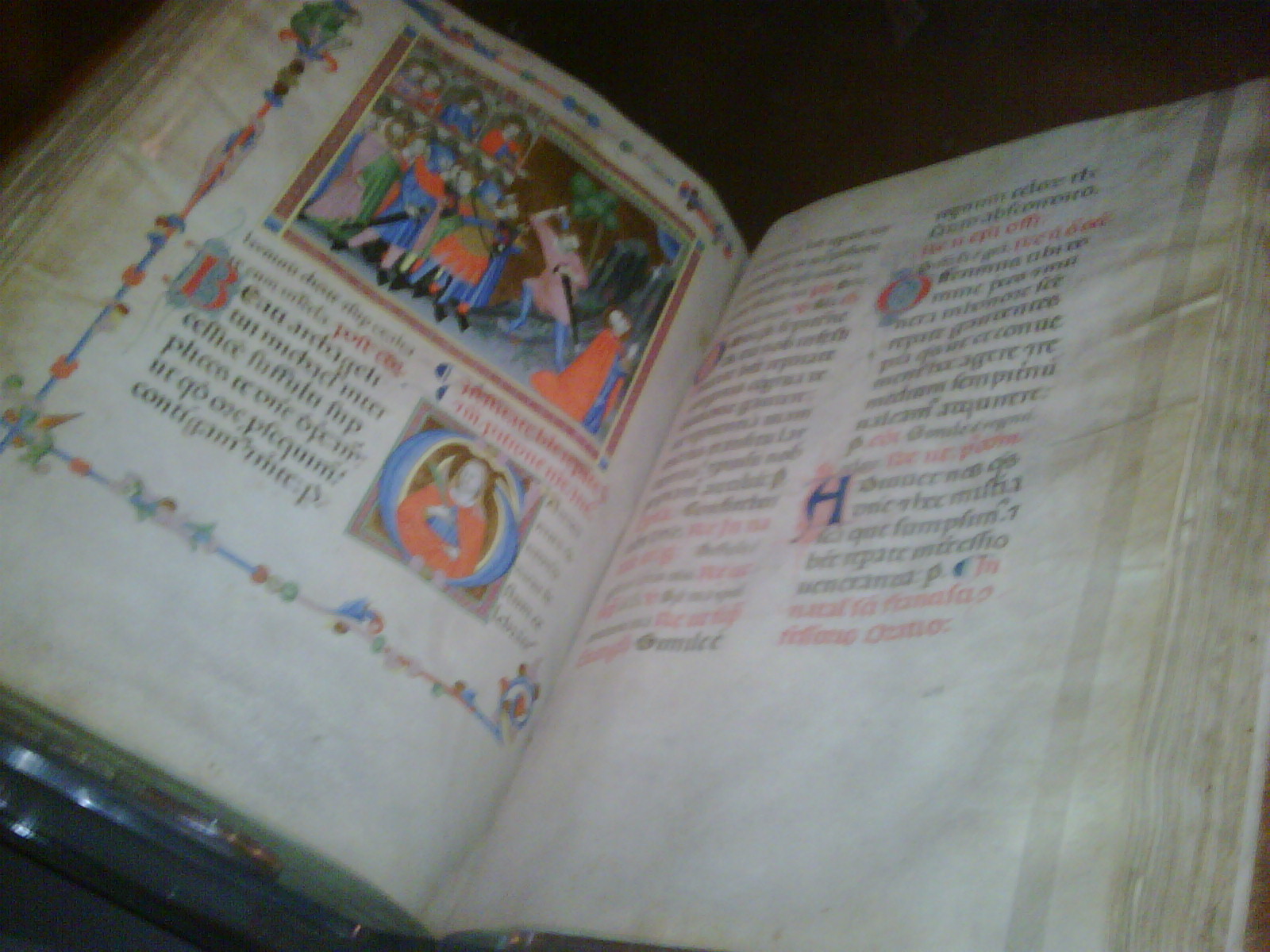
For example I took this picture to attempt to capture the view of a Messale (an illuminated book of the mass) as if I were looking out at a congregation. I remember how children’s books always had to have pictures. As I grew, that became the exception rather than the norm, although –thankfully—art books are a wonderful exception to that dismal rule.
Imagine that you are a priest, celebrating Mass, and now, instead of simply looking at one of our modern books containing only words, imagine instead that you look upon an illuminated volume like this one.
Illuminated Messale (photo: Leslie Barcza)
As you look out from your pulpit upon a church of faithful, the pictures seem to peer out of the book, as though the book itself were alive, seeking to inform what you sing or say to the congregation.
In the week following the high-profile opening of Patti Smith’s show that drew worldwide attention, it’s a great pleasure to see the AGO crowded today for the preview of this exhibit. And no wonder.
“Press releases and announcements” are presented verbatim without comment.
Six Hundred Year Anniversaries
Saturday April 6, 2013 at 8PM at Gallery 345
For Immediate Release – Toronto, March 11, 2013: 1912 and 1913 were auspicious years in the history of the music of our time, marking the birth of some of the most significant composers of the era. To celebrate the centenaries of John Cage, Barbara Pentland, John Weinzweig, Witold Lutosławski, Henry Brant and Conlon Nancarrow, New Music Concerts has organized a very special event. Harpist Erica Goodman, pianist Stephen Clarke, cellist David Hetherington, clarinetist Max Christie, accordionist Joseph Macerollo, percussionist Rick Sacks and of course flutist and artistic director Robert Aitken will perform and reminisce about these giants of 20th century composition. The event will also celebrate the 70th birthday of New Music Concerts’ photographer André Leduc with a display and sale of his photographs from NMC’s archives. There will be door prizes and raffles with plenty of fine food and wine. As a special bonus every full price admission includes a numbered limited edition poster of John Weinzweig created for his 70th birthday by Harold Town, signed by both the artist and the composer. Tickets are $100 (or 2 for $150) and a charitable receipt will be issued for the amount eligible under CRA guidelines.
New Music Concerts has been bringing the world’s most noted contemporary musical art forms to Toronto since its founding in 1971 by internationally acclaimed Canadian musicians Robert Aitken and Norma Beecroft. English Canada’s longest-running contemporary music series, NMC presents recent works of Canadian and international composers in concerts covering many styles and genres, reflecting the face of contemporary music throughout the world.
John Weinzweig (Canada 1913-2006) – Belaria (1992) for solo cello
Witold Lutosławski (Poland 1913-1994) – Dance Preludes (1954) for clarinet and piano
Barbara Pentland (Canada 1912-2000) – Commenta (1981) for solo harp
John Cage (USA 1912) – Etudes Australes No. 31 (1974) for solo piano
John Cage – Ryoanji (1983) for bamboo flute(s) and percussion
Conlon Nancarrow (USA 1912 – Mexico 1997) – Selected Studies for Player Piano
Henry Brant (Canada 1913 – USA 2008) – Mobiles 2 (1932, rev. 1984) for solo flute and six spatially dispersed accompanying instruments.
Six Hundred Year Anniversaries
Saturday April 6, 2013 at 8PM at Gallery 345: 345 Sorauren Avenue
TICKET INFORMATION
Individual Tickets: $100 (2 for $150)
A charitable receipt will be issued for the maximum allowed under CRA guidelines.
Box Office: 416 961-9594
New Music Concerts: 157 Carlton Street, Suite 203 Toronto ON M5A 2K3
416.961.9594 / fax 416.961.9508 nmc@interlog.com / http://www.NewMusicConcerts.com
New Music Concerts gratefully acknowledges the support of The Canada Council for the Arts; Toronto Arts Council; The Department of Heritage through the Canadian Arts Presentation Fund; The Province of Ontario through the Ontario Arts Council, the Ontario Arts Foundation Endowment Fund and the Ontario Arts Investment Fund; The Koerner Foundation; The Mary-Margaret Webb Foundation; The Max Clarkson Family Foundation; The McLean Foundation; The SOCAN Foundation; The Amphion Foundation Inc.; Roger D. Moore; Edward Epstein and Gallery 345.
I don’t believe there’s anyone who was involved in more aspects of Canadian operatic performance than Stuart Hamilton. I say “was” because many of those are in the past now, but even so, let’s make a list.
Hamilton founded Opera in Concert, playing most of the operas between its inception in 1974 and his last appearance in the 1990s.
Hamilton was the first music director –albeit briefly—of the Canadian Opera Company’s Ensemble Studio
Hamilton was the host for the opera quiz for roughly a quarter of a century of broadcasts of CBC’s Saturday Afternoon at the Opera
In more than half a century of coaching and accompanying singers, Hamilton played with all the great singers of this country, often before anyone else had recognized the singer’s potential
Of the four major opera programs in Canada –UBC, U of Toronto, the Royal Conservatory & McGill—he’s worked with (if not actually having mentored) most of their teachers.
Ditto for summer programs such as Summer Opera Lyric Theatre
I just finished reading Opening Windows, Stuart Hamilton’s delightful memoir. I laughed out loud many times. It’s fun in a way that stands in stark contrast to the other book about a Toronto opera icon, namely Lotfi Mansouri: An Operatic Journey. I suppose the chief difference is really a reflection of the people writing their memoirs. One of the joys of Mansouri’s book, by one of the most powerful figures in the opera world is the dirt it dishes where Hamilton’s story, coming from a much more modest & self-effacing figure, is true to the title of his book, a fun book that never has to work hard for its laughs.
The title goes back to Hamilton’s piano teacher Alberto Guerrero, who also taught Glenn Gould. Hamilton figured he must have been proud of this achievement, but Guerrero said
“Glenn would have been great no matter with whom he had studied. If I’m proud of anything in my life, it is that I was able to open a few windows onto the world of music for the less talented students who worked with me.”
That’s the spirit not just of the book, but of Hamilton’s life.
I can’t imagine how many people Hamilton has known and worked with, but when I surveyed the index (before beginning to read) it seemed that the author worked studiously to include a great many people even in the tiniest roles. He manages to mention everyone and I mean everyone, which is no mean feat, likely because he knew they’d be hoping to be mentioned.
After a charming account of his childhood & his music education, we’re taken on an odyssey that parallels the growth of many of the big musical institutions in this country. We find out a great deal about the challenges of preparing and touring vocal music through small towns across this enormous country of ours, about the performing life of singers such as Lois Marshall, Maureen Forrester, and to a lesser extent, tenors Ben Heppner & Richard Margison. We read about the beginnings of such institutions as Opera in Concert, the COC Ensemble and the Opera Quiz. And throughout, Hamilton is at his witty best.
If you have no interest in opera you might still enjoy this memoir of a modest Canadian whose career regularly brought him into contact with greatness, especially because of the author’s charming anecdotes. The book is as likeable as its author.
Ambur Braid may have a catchy name, but the reason you remember it is because of what she does with her opportunities.
The voice gets mentioned almost in passing (a secure dramatic coloratura that allows her to undertake challenging roles such as Semele and the Queen of the Night), because of the extras Braid brings to everything she does, an actor of remarkable depth. I think I missed it at first (the acting) because I was so carried away with her visual impact whenever i saw her onstage.
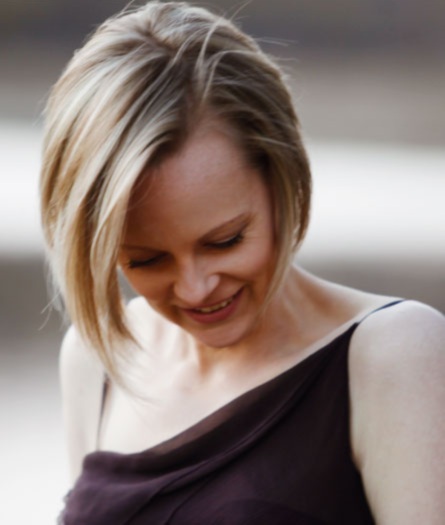
Soprano Ambur Braid (clicking the photo takes you to her bio at the time of her first year at the COC)
My first review–with the Canadian Opera Company–almost sounds resentful, because I literally couldn’t take my eyes off of her.
If success can be understood as the greatest applause for the briefest appearance, then Ambur Braid was champ as the Queen of the Night, earning huge applause for both of her arias. She brought a seductive presence to the stage with every entrance, always the focus whenever she appeared.
Later that season, the COC presented Robert Carsen’s production of Orfeo ed Euridice in May 2011, a reading that was much deeper than what I might have expected. I was somewhat perplexed by what I saw, and again, Braid was at its centre. With hindsight I realize now that underlying this was the subtlety of Braid’s portrayal of a character with two different genders, as first the male then female version of Love.
I am still trying to decode an interesting approach to Amore from Carsen/Hoheisel. Love is both God and Goddess, changeable and all-powerful in this world. Ambur Braid’s portrayal of Love first appears in an apparently male aspect in the first act, reappearing in a female guise in the last act. I am not sure I understand the rationale; perhaps Love has no gender, or is a shape-shifter able to do anything?
This past autumn I saw her most impressive recent performance, as Adele in Die Fledermaus.
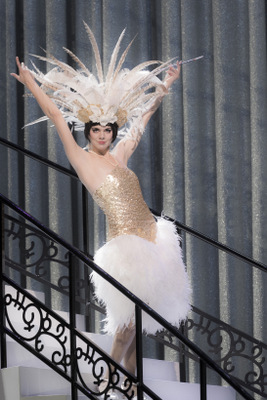
Ambur Braid as Adele, directed by Christopher Alden, set designed by Allen Moyer, costume designed by Constance Hoffman (Photo: Chris Hutcheson)
In the first scene Tamara Wilson & Ambur Braid are instantly real, their German dialogue compelling as we’re instantly plunged into their dramas. Although the stage will fill with personnel and imagery, we never really lose our interest in them. While there will be diversions throughout, it’s their show through and through. I wasn’t at all surprised by the excellence Tamara Wilson brought to Rosalinde, a young woman with a wonderful voice that can be powerful or delicate, and with a genuine flair for comedy. But Wilson was matched by her maid Adele as portrayed by Ambur Braid. I’d been expecting to enjoy this portrayal, but was not prepared for how fully she inhabited the maid- who- becomes –Olga. While I’d seen the photos in the publicity, I was unprepared for the power (and comedy) of her transformation from the ugly duckling of Act I into the seductive Olga in Act II Her rendition of the laughing song had a delightfully angry edge to it.
Graduate of the Glenn Gould School of the Royal Conservatory of Music and San Francisco Conservatory of Music, Braid is in her last season with the COC ensemble. I am sorry I missed her epic Vitellia in Clemenza di Tito just a few weeks ago, a production hit by flu indispositions (although the virus didn’t stop her). Next season Braid sings Konstanze in Die entfuhrung aus dem Serail for Opera Atelier.
Rehearsals have just begun for Opera Atelier’s Magic Flute, with Braid singing the Queen of the Night. I ask her Ten questions: five about herself and five about her role in the Mozart opera.
1) Are you more like your father or your mother?
Both of my parents have a brilliant work ethic and I am so thankful to have had such great role models to learn from. They loved travelling, and would take my brothers and me on fantastic trips!
I would say that I am a bit more like my father in that he’s very goal oriented, and driven to be successful in the business ventures he undertakes. I may also get my love of food and wine from him.
My mother is a social worker and thanks to her, I met and hung out with people with mental and physical disabilities as a child and teenager, and I am so grateful to have had those experiences. It is pretty amazing to have a job where you make peoples lives better!
2) What is the best thing or worst thing about being a singer?
The amazing part about being a singer is that the work is never done. (That phrase is beginning to be a bit of a mantra for me.) Things are never going to be “perfect”, despite all one’s attempts in practice.
You get to work with people who push you emotionally, mentally, and physically.
You will never know a score well enough.
Your voice will never be flawless on a show day.
You don’t know where the next contract is going to come from.
You don’t know where you are going to live next.
I love all of those things because I love a challenge!
It is pretty annoying to not know when you’re going to see your family
next, though.
3) Who do you like to listen to or watch?
I adore watching Wes Anderson movies and Formula 1 auto races. Most of the people I spend my days with remind me of Wes Anderson characters; dry, sarcastic, quirky, sensitive, dark, and overly-educated. There are many movie nights in my apartment watching films by Quentin Tarantino, Paul Thomas Anderson, Francis Ford Coppola and David Fincher. A couple of years ago I went through a Hitchcock and Fellini phase, and ended up dressing like the women in those films. I should do that again!
If I’m learning a role, I like to watch every film related to the character as I can, and potentially use other movie characters as my touchstone. For Adele, I channeled Mrs. Danvers in Rebecca, Margot Tanenbaum in The Royal Tanenbaums,…
…Lulu in Pandoras Box, and switched up accents impersonating Sarah Bernhardt. For Vitellia, I thought of Lolita and Justine in Melancholia. These days I’m watching (and reading) everything on the Tudors and Elisabeth I of England. This part of my job is really fun for me!
4) What ability or skill do you wish you had, that you don’t have?
Being a mermaid would be pretty great.
5) When you’re just relaxing and not working what is your favourite thing to do?
I am a neat freak, so I tend to clean and organize my apartment to relax and decompress. The excitement that I get from cleaning products is probably not sane, but it is so satisfying!
Being on the water is ideal. If there is a beach, a boat, sunshine, bubbly and loved ones involved – I’m blissfully happy!
~~~~~~~
Soprano Ambur Braid (photo: Helene Cyr)
Five more about portraying the Queen of the Night in Opera Atelier’s
production of The Magic Flute.
1) How does portraying the role of the Queen of the Night for Opera Atelier challenge you?
Singing anything at Opera Atelier is interesting because Marshall has such a clear, focused vision of the production, and the choreography is quite stylized. Today in rehearsal, Marshall was holding my hips and making sure that my balance was directed on the proper foot at the right time. Do you know how hard it is to control my 6 foot wing-span in a controlled, danceresque and beautifully stylized (but angry!) manner while singing the most famous coloratura of all time?
Yeah, that’s what challenges me.
The amazing part of this choreographed business is that I can FINALLY be aware of my long limbs! Relaxing into it all is the tough part.
This production is also in English, which is brilliant for the audience but makes me feel silly sometimes. Things seem so much more profound and beautifully ambiguous in foreign languages…
Technically speaking, singing the Queen of the Night is like Tennis; there is a HUGE mental component. It is quite the mind game singing two arias where all anyone cares about are the high F’s. The second aria is so well known, and sung by so many coloratura sopranos, that people expect it to be a certain way, and always have something to say about what the singer did or did not do. My challenge is to stay focused, just relax, and have fun with it. I have things that most other coloraturas don’t have (you’ll have to see and hear it to find out what) but that throws some people off because they don’t understand what’s happening and I’m not a “robot”. The vocal range of the role doesn’t concern me, but I do not like singing staccati notes.
Character-wise, she’s a delightful character to portray. She’s me before my espresso in the morning: “Stay back!”
It is always more fun to play the villain, and it seems to come pretty naturally to me. Sigh. My stature helps as it seems to give people the idea that I’m confident (even when I’m not) and this works onstage as well. I don’t believe that the Queen is evil, (obviously she does not), but I do think that she loves herself a bit too much. Yes, her disregard for anyone but herself borders on sociopathic, and she seduces young men, but that’s why she’s fun!
She is just a seductive lady with a bit of a temper trying to get ahead.
3) Do you have a favourite moment in the opera?
My favorite part of any opera is the overture. You have no idea how amped I get backstage and it is just the most fun! This is often the time where I am dancing in the dressing room, or in the wings with some other members of the cast.
Oh the memories…
Musically, The Magic Flute can blow your mind. I love all of Sarastro’s music, including the hymn his guards sing.
4) How do you relate to the Queen of the Night as a modern woman?
The Queen of the Night is so modern it hurts. She might enter on a flying mechanic cloud, but she has pain, anger, career goals and a weakness for tenors. She uses her feminine charm and seductive manner (high notes) to get people to do her bidding and when things don’t go her way, she has a bit of a tantrum. A very, very famous tantrum.
5) Is there a teacher, singer, actor or an influence that you especially admire?
It is part of my job to be influenced by as many things as possible, and that is one of the things I love about this business. The work is never done. Anybody in the theatre business should experience as many things, in all forms, as possible in order to create something interesting onstage. I’ve lived a VERY full life in my (almost) thirty years, and am so thankful to draw on those experiences and all of the incredible people that I have met. It is incredibly therapeutic, and I know that some people get a kick out of seeing bits of themselves in the characters that I create.
My teachers, bosses, coaches, family and friends all know how brilliant I think they are and how important they are to me. I am nothing without them.
“Press releases and announcements” are presented verbatim without comment.
SOUP CAN THEATRE
Presents
Samuel Barber’s
A Hand of Bridge
(Libretto by Gian Carlo Menotti)
&
Jean Paul Sartre’s NO EXIT
(Translation by Stuart Gilbert)
A Special Double Bill Presentation!
March 27th to 30th at the Tapestry New Opera Studio in the Historic Distillery District
“… Hell is Other People …”
Soup Can Theatre is proud to present a bold and genre-blending double bill: Celebrated American composer Samuel Barber’s playful, compact, and contemporary opera A Hand of Bridge (libretto by Gian Carlo Menotti), and renowned existential philosopher and Nobel Prize-winning playwright Jean Paul Sartre’s dark and groundbreaking masterpiece No Exit (translation by Stuart Gilbert).
Barber (best known for his stirring Adagio for Strings) premiered this tuneful and bite-sized opera in 1959 in Spoleto, Italy as part of the ‘Festival of New Worlds’. Set in the midst of a game of bridge being played by two emotionally-strained, upper middle-class couples, A Hand of Bridge weaves together quintessential operatic themes, such as jealousy, envy, and unrequited love, with unexpected and unapologetically intimate topics (for the time), such as marital infidelity and bisexuality. Director and Music Director Pratik Gandhi comments, “The music is quite charming and is a great example of mid-20th century eclecticism, bridging centuries-old traditions with new and unconventional ideas – including some drawn from popular music. The approachable nature of Barber’s score belies the more poignant and striking moments that form the core of the libretto, giving their delivery a surprisingly strong impact.”
In Sartre’s No Exit, three recently deceased strangers with shadowy pasts find themselves trapped together in a room in Hell with only three chairs and a grotesque bronze sculpture as the sum total of their new existence. The trio quickly realize that torture and eternal torment do not come at the hands of demons with hot pokers, but rather from each other’s words, thoughts, urges, and actions. Even though No Exit was written in 1944, it still manages to reflect present day issues with chilling accuracy. Director Sarah Thorpe elaborates: “With bullying frequently making front page news, and the realm of social media acting as a playground for anonymous harassment, Sartre’s central idea that “Hell is other people” is, sadly, just as true today as it was six decades ago. The psychological universality of this works is a testament to its importance and insight – and one of the reasons we are excited to share it with the public.”
Bringing these classic works to life is a remarkable cast – all rising stars in their respective fields of opera and theatre – backed by a live fourteen piece orchestra. Enhancing the emotionally claustrophobic flavour of the two pieces, Soup Can Theatre’s production will be performed in the round on a custom built stage in the Tapestry New Opera Studio, located in Toronto’s beautiful and historic Distillery District.
Two genres, two classic works, one unforgettable evening.
Past praise for Soup Can Theatre includes:
“Daring … Entertaining and heady theatre … It’s Hard not to be Blown Away by this Young Company’s Strength and Ambition … ★★★★★” – Theatromania “Powerful … Elegant … Expertly Staged … ★★★★★” – Torontoist “Impressive … Seductive … Uniformly delectable … N N N N N” – NOW Magazine “Stellar … Thoroughly Entertaining … Constantly delights … ★★★★” – Eye Weekly “Breathtaking … Impeccable … Outstanding” – Mooney on Theatre
Performance Details:
Tapestry New Opera Studio
9 Trinity Street, Studio 315
Distillery Historic District
Toronto, Ontario, M5A 3C4
Wednesday March 27th, 7:30 pm
Thursday March 28th, 7:30 pm
Friday March 29th (Good Friday), 2:00 pm*
Friday March 29th, 7:30 pm
Saturday March 30th, 2:00 pm
Saturday March 30th, 7:30 pm
Tickets range from $16 to $25. Student/Senior/Arts Worker discounts are available.
Tickets can be purchased at www.soupcantheatre.com
*This performance does not include A Hand of Bridge and has been discounted accordingly.
Contact:
Alvaro Vazquez Robles – ‘Bill’ (A Hand of Bridge)
Carolyn Hall – ‘Estelle’ (No Exit)
Daniel Pagett – ‘Garcin’ (No Exit)
Keith O’Brien* – ‘David’ (A Hand of Bridge)
Ryan Anning – ‘The Valet’ (No Exit)
Shilpa Sharma – ‘Sally’ (A Hand of Bridge)
Taylor Strande – ‘Geraldine’ (A Hand of Bridge)
Tennille Read – ‘Inez’ (No Exit)
*Keith O’Brien appears courtesy of the Canadian Actors’ Equity Association
Pratik Gandhi – Director / Music Director (A Hand of Bridge)
Sarah Thorpe – Director (No Exit), Co-Producer
Justin Haigh – Dramaturge / Sound Designer / Set Co-Designer (No Exit), Co-Producer
Randy Lee – Lighting Designer, Set Co-Designer (No Exit)
Katherine Belyea – Stage Manager (A Hand of Bridge)
Elle Mills – Stage Manager (No Exit)
Nick MacInnes – Co-Producer
Leslie Thorpe-Dermody – Props Manager
Scott Dermody – Executive Producer
Pratik Gandhi – Conductor
Laura Bolt – Flute
Joanna Shuster – Oboe
Katie Arnup – Clarinet
Elena Cimolai – Bassoon
Erika Schengili-Roberts – Trumpet
Suzan Kim – Piano
Justin Han – Percussion
Kevin Wong, Lindsay Naft – Violins
Daniela Gassi, Kevin Belvedere – Violas
Cory Latkovich, Danielle Weber-Adrian – Cello
Liam Gallagher – Bass
About Soup Can Theatre:
Soup Can Theatre is a vibrant Toronto-based theatre company dedicated to the reinterpretation of classic theatre for a twenty-first century audience. Our aim is to use existing works as a means to explore and comment on contemporary issues and societal challenges, and in so doing, to offer our audiences a theatrical experience that is both entertaining and enriching.
Talisker Players offer the latest in a series of investigations of the meaning of life. What is it about this time of year? I pondered it a bit the other day, musing on February-phobia. In this country we’re driven in by the short days and cold weather. Into the house, into the mind, and rarely encouraged to be extroverted. Fat Tuesday notwithstanding, it’s Lent, and atheists too seem to be battered into a kind of passive submission by the SAD-ness of it all.
Saturday afternoon I saw the high-definition broadcast of Parsifal , presenting one formulation of the problem and its solutions. Saturday night was the turn of Against the Grain, in their double bill of Kurtág’s Kafka Fragments and Janáček’s The Diary of One Who Disappeared. Tonight, in the first of two presentations from Talisker Players, Time & Tide presents a series of reflections on the passing of seasons & persons. Forgive me if I try to link it all together.
Talisker’s world is not quite the one I sensed on the weekend, the modernist arc running from Tristan via Parsifal to Kurtág. There are other pathways, some dissonant, some still redolent with melody and the celebration of the voice.
We began with a crystalline reading of Solveig’s Song by soprano Carla Huhtanen, in a minimalist arrangement for string quartet by Laura Jones that filled the intimate space of Trinity St Paul’s Centre the way a diamond snugly fits against its velvet case. The Scandanavian connection—Huhtanen is Finnish rather than Norwegian like the composer—was an additional inspiration. That sense of contrasts and clarity was a wonderful omen for the evening.
Soprano Carla Huhtanen (photo: Tobin Grimshaw)
Baritone Peter McGillivray sang two very different sets of songs. The first, Ernst Toch’s Poems to Martha, present a fascinating mix of melody and dense harmonies. At times the quartet created a stunning and vibrant sound, leaving the singer on the sidelines. There’s a song called “Spring” that is the mirror image to Richard Strauss’s better known song of the same name, a lovely backward glance to youth and the spring we remember. Toch refers back to these youthful images in the last song, a fervent affirmation of faith and rebirth. McGillivray showed flashes of brass, but was mostly a gently honey coloured baritone, dripping with legato. This was a thoughtful reading, nicely contextualized by Talisker’s inward looking framework for the concert.
His second set of songs, to close the concert, was a set which I am delighted to have discovered, Finzi’s setting of Thomas Hardy poems Footpath and Stile. McGillivray’s masterful reading easily blended with the transparent play of the Talisker Quartet (five players rotating in various parts of the evening; sorry that I don’t know which is which, although the five: Rona Goldensher, Elizabeth Loewen Andrews and Elyssa Lefurgey-Smith , violins; Mary McGeer, viola; and Laura Jones, cello). While Hardy sometimes points to darkness, Finzi’s folk-inspired idiom is never so dark that we can’t see the British landscape underneath.
Huhtanen also sang a pair of cycles, beginning with Deuil angoisseux, a powerful text from Christine de Pisan set by Scott Good in a kind of neo-baroque idiom. In places one feels the comfortable and familiar patterns of counter-point, episodes and the back and forth between voices as if this were a much older piece. And then just when you think you know where you are, Good throws a contemporary harmony or a syncopation at you to remind you that you’re not in Leipzig anymore. Huhtanen seemed at one point to be so overcome with the text that i thought she was crying: and then I remembered what a great actress she was, when I looked a little closer.
Huhtanen’s other cycle was a bit of a revelation, from Canadian Walter Buczynski. I met him once long ago, and have heard some of his music before. I know that he’s a wonderfully kind man from our meeting. What I heard tonight was lucidity. There’s a terrific phrase in one of the songs, where the soprano sings “is my purpose made large”. I couldn’t help thinking that this could be Buczynski, interrogating himself throughout, playing with forces even on this tiny and intimate scale of a singer with a quartet. So many times in the songs, he pushes us to listen ever closer, sometimes with a kind of back and forth between soprano & quartet where Huhtanen’s soft, clear delivery hung gloriously in the church space, like silver droplets between the chords from the quartet.
While it may be true that Time and Tide wait for no man, the program –Time & Tide—will be presented again Wednesday night at 8 pm at Trinity St Paul’s Centre. You should come hear it if at all possible.
Wednesday, March 6, 2013 at 8 PM
Trinity St. Paul’s Centre: 427 Bloor Street West
TICKET INFORMATION
Individual tickets: $30 / $20 (seniors) / $10 (students)
Box office: 416-978-8849
Email: words.music@taliskerplayers.ca
Information: 416-466-1800 www.taliskerplayers.ca
There have been many reviews published already, some in exquisite detail, so I assume that if you want to know about the new Metropolitan Opera Parsifal, the François Girard co-production with Opera Lyon (2012) & the Canadian Opera Company (TBA), you’ll simply read one of those other reviews.
I had to giggle watching the broadcast in high definition today, where one might wonder if all Quebecois directors seek to bankrupt the Met. Of course Girard “only” pushed them to the biggest onstage waterworks in recent memory, partly filled with fake blood, not the colossal expenses of their last venture into La Belle Province, aka Robert Lepage’s Ring Cycle. Perhaps Girard did not want to be outdone by the man who also flooded orchestra pits at BAM and Toronto? Pardon my national pride, taking in all the Canadians directing in the USA these days, what with Lepage, Girard, Des McAnuff, and Robert Carsen, to name the first four who pop into my head. And come to think of it, no matter what Girard’s waterworks might have cost, the reviews are the closest thing I have ever seen to a unanimous rave review for a production that might be called “Regietheater”.
The title calls attention to a line in Wagner’s opera that is to some people among the most controversial. “Redemption for the redeemer” is a translation of “Erlösung dem Erlöser”. What struck me about this production is that in some respects it seems that the world has caught up to Richard Wagner.
When Parsifal is presented in a conservative staging –complete with all the trappings of religion & the Grail ritual—the effect does not really capture all the radical ideas in Wagner’s text. Some people mistake this opera for something religious and respectful, whereas I think it’s much more radical than that, a passion play for a new religion. The phrase I quote is the completion of an idea that comes up in Act II: when Parsifal suggests that Jesus is still on the cross, and requiring a kind of redemption. Yet if you were the most conservative Christian, and then were to turn on the television, and hear of the various atrocities done by members of the church in various guises, such as priests abusing children, schools pushing aboriginal children away from their own culture, one simply wishes that Christians would practice what they preach, and live up to the Bible. And a corrupt church needs saving, doesn’t it?
The design concept of Girard’s Parsifal (designed by Michael Levine) draws on the deep subtext of Wagner’s opera, a work populated mostly by men, while women are pushed aside. Girard and Levine address this imbalance, such that the second act is set deep in a vaginal cleft flooded with the aforementioned blood and the apocalyptic conclusion of the work finally reconciles the genders. For me this is a simple and elegant Parsifal. After mores complex approaches such as Syberberg’s densely imaged film (which I love) this one is a breath of fresh air.
It’s impossible to know for sure, but I thought that maybe Girard / Levine were influenced by a production of Pelléas et Mélisande I saw in Montreal about ten years ago, where there was a small creek running through the middle of the stage, and where the servants –who silently come to the fore in the last ten minutes of the work—are quietly visible from the beginning of the opera. Similarly, Girard/Levine have water (or blood) running onstage for much of the work, and an unexpected female population who are usually invisible.
I’d heard complaints about the conducting. But I was blown away by conductor Danielle Gatti, who seemed to put all the singers at ease, whose sense of flow & proportion were effortless. In places the pacing was wonderfully urgent & tense, and I never felt the work drag.
My favourite vocal performances? Ha, it’s hard to choose with such a talented group. Jonas Kaufmann has been acknowledged, both for his subtle characterization that changes over the three acts, including a heart-breaking appearance in Act III for which I was totally unprepared even though I had read about it. Rene Pape’s Gurnemanz was wonderful singing from beginning to end, subtly acted in a role that can be thankless. I’d heard that Peter Mattei’s Amfortas was well-sung & acted, but still did not expect the subtleties he brought to the role. Evgeny Nikitin was the big surprise to me, sounding like a young Gustav Neidlinger, playing up the lurid aspects of his role (and costume).
As far as I can tell, the encore presentation is April 20th in Canada.