Media Release from Tafelmusik: Jeanne Lamon to step down

“Press releases and announcements” are presented verbatim without comment.

Jeanne Lamon to step down as Tafelmusik’s Music Director in 2014

Tafelmusik’s Board of Directors applauds Lamon’s three remarkable decades of leadership; will launch international search for successor

Jeanne Lamon, Music Director of Tafelmusik Baroque Orchestra and Chamber Choir since 1981, announced today that she plans to step down from that role in 2014, ending what will be a remarkable 33-year tenure at the helm of one of Canada’s most successful international performing arts organizations. Lamon will assume the role of Music Director Emerita and will continue to work on the creation of the Tafelmusik International Baroque Academy.

“Jeanne Lamon is a national treasure; she is a talented leader who has touched millions of people throughout Canada and the world. We all feel very privileged to work with such a gifted artist, leader and friend. Her generous spirit and warmth has touched us all so deeply, and she is choosing to leave Tafelmusik on a high note. We’re thrilled that she will continue to inspire the next generation of talented young musicians involved in Tafelmusik’s growing artist training programmes. She has set the bar high, and we have no doubt that we will be choosing her successor from among the best in the world,” said Andy Kenins, Chair of Tafelmusik’s Board of Directors.

Under Lamon’s artistic direction, Tafelmusik has achieved an enviable international stature and is considered “one of the world’s top baroque orchestras” (Gramophone Magazine). During Lamon’s tenure, Tafelmusik has grown from its modest beginnings to the world-renowned, cutting-edge period ensemble it is today, reaching millions of people through extensive touring, critically-acclaimed recordings, broadcasts, new media, and artistic/community partnerships.

“After more than three terrific and musically memorable decades at Tafelmusik, I have decided to step down as full-time Music Director in 2014. It has been an honour and a privilege to have served in this role these past 30-plus years, and to work with such a fabulous orchestra and choir. There is such talent, commitment and integrity throughout Tafelmusik. I continue to be inspired by the amazing musicians around me and am proud of what we have achieved together,” said Jeanne Lamon.

“There is still a lot we wish to accomplish over the next few years, including acoustical and audience comfort improvements to our beloved home venue, more new recordings and films on our Tafelmusik Media label, and some very exciting national and international tours. I am especially excited about creating the new Tafelmusik International Baroque Academy for the training of talented young musicians in period performance.”

Described as “a toweringly influential figure in the musical life of Canada” by the Canada Council for the Arts, Jeanne Lamon began to specialize in baroque violin in the early 1970s, during her studies in Amsterdam with Sigiswald Kuijken. From 1972 to 1981 she was engaged as concertmaster of many period orchestras, both European and North American, including Il Complesso Barocco, Boston Baroque, Studio de Musique Ancienne de Montréal, and The Smithsonian Chamber Players of Washington, among others. In 1980, Lamon was invited to Toronto by Tafelmusik’s founders, Kenneth Solway and Susan Graves, and was appointed Music Director in 1981.

In 2000, Lamon was named to the Order of Canada. She has won numerous other awards and distinctions, including honorary degrees from York University and Mount Saint Vincent University, the Muriel Sherrin Award, the Prix Alliance, the Joan Chalmers Award, the Canada Council’s Molson Prize, the Toronto Musicians’ Association’s Musician of the Year Award, the Roy Thomson Hall Award of Recognition, and the Betty Webster Award for Musical Leadership. She is also a renowned soloist in her own right: “Lamon is a true virtuoso – there are few better Baroque violinists in the world today … ” (Continuo Magazine)

The Jeanne Lamon Instrument Bank was created by the orchestra in honour of her 25th anniversary at Tafelmusik in 2006. Last season Lamon marked her 30th anniversary season as Tafelmusik’s Music Director by leading a semi-staged production of Handel’s opera Hercules featuring Tafelmusik Baroque Orchestra and Chamber Choir. Hercules included stage direction and choreography Marshall Pynkoski and Jeannette Lajeunesse Zingg, the Co‐Artistic Directors of Toronto’s renowned Opera Atelier, with whom Tafelmusik has celebrated a 27-year artistic partnership.

In addition to her duties at the helm of Tafelmusik, Lamon is a passionate educator and is on the faculty of the Glenn Gould School at The Royal Conservatory and the Faculty of Music, University of Toronto. National and international masterclass and teaching engagements have taken her to universities and conservatories around the world, from Stanford University to the Central Conservatory of Beijing.

Lamon’s dedication to music education and that of her colleagues Charlotte Nediger and Ivars Taurins is reflected in Tafelmusik’s education, outreach and artist training initiatives such as the

Tafelmusik Baroque Summer Institute, and the orchestra’s appointment as Baroque Orchestra-in-Residence at the University of Toronto.

Lamon is in demand as a guest director/conductor in Canada and abroad, and has appeared with, among others, Symphony Nova Scotia, Victoria Symphony, Orchestra London, Calgary Philharmonic, Edmonton Symphony, Vancouver Symphony, Windsor Symphony, Orchestre Metropolitain, Les Violons du Roy, Arion Baroque Orchestra, the Detroit Symphony, and Le Jeune Orchestre Atlantique (France).

Over the course of its 33 year history, Tafelmusik has achieved a remarkable number of accomplishments: the orchestra has enjoyed a prolific reign on the world stage with regular invitations to perform in the most prestigious concert halls on many continents, including Carnegie Hall in New York City, the Walt Disney Concert Hall in Los Angeles, Maison Symphonique in Montréal, the Concertgebouw in Amsterdam, the Musikverein in Vienna, the Forbidden City Concert Hall in Beijing and City Recital Hall Angel Place in Sydney. Remarkable programmes such as Alison Mackay’s The Galileo Project and House of Dreams have taken Tafelmusik around the world.

Tafelmusik appears at many respected international festivals such as the Klang und Raum Festival in Germany, where for 19 years Tafelmusik was Orchestra-in-Residence under Artistic Director Bruno Weil. Other festivals include the New Zealand International Arts Festival, the Beijing Music Festival and Shanghai International Arts Festival in China, the Aspen and Ravinia festivals in the USA, the BBC Proms Festival in Britain, and the Festival Internacional Cervantino in Mexico.

Tafelmusik Baroque Orchestra and Chamber Choir have created a discography of more than 80 recordings on such labels as SONY, CBC Records, BMG, and Analekta. In January 2012, Tafelmusik celebrated a successful international launch of its own multi-platform record label, Tafelmusik Media.

“Jeanne will be leaving at a high point, when Tafelmusik is looking towards a future that couldn’t be more promising. Nothing would make her happier than to see Tafelmusik continue to succeed well into the future – that is the nature of Jeanne. She is a person of great honour and integrity. Jeanne is an absolute joy to work with, and I know this sentiment was shared by former Managing Director Ottie Lockey and her team. Jeanne has created an environment at Tafelmusik where many brilliant and diverse talents thrive. There has always been strength throughout the organization with robust artistic, management and board leadership and this tradition will continue. We all are grateful for Jeanne’s genuine warmth, friendship, partnership, frankness and wisdom, not to mention her terrific sense of humour,” said Managing Director Tricia Baldwin.

Andy Kenins also announced today that Tafelmusik will immediately form a search committee and engage a search consultant to begin the process of appointing the Tafelmusik’s next Music Director.

Posted in Press Releases and Announcements | Leave a comment

Frida and Diego @ the AGO

AGOIf you only read one sentence please read this one.  The new exhibit Frida & Diego: Passion, Politics and Painting at the Art Gallery of Ontario is the best art exhibit I’ve ever experienced.

How so?  Nothing (including my statement) can mean anything without a framework.  Jokes are only funny in a context.  Art—whether political, spiritual or personal –decodes with some reference to the magic moments in time from whence they arise.  Whether you’re talking about Bach or the Beatles, Gaugin or Gatsby, our experience is enriched by placing creations within the background of a cultural time & place.  I am grateful for the vision of Dot Tuer, OCAD University professor and cultural historian who guest-curated the show for AGO, bringing me into intimate contact with Frida Kahlo and Diego Rivera.  After going through the exhibit, I feel as though I am on a first-name basis with these two extraordinary individuals.

AGOWalking into AGO’s spacious display of over 80 works accompanied by over 60 photographs of the artists, you encounter this fascinating pair, first separately then gradually more and more closely intertwined and inter-connected.  You see pictures of them and their influences, and can’t help noticing where they come from creatively, and perhaps how they might influence or react to one another.  As anyone who’s seen the film Frida (2002) noticed, this was a tumultuous relationship, a marriage full of drama.  How could it be otherwise with these two giants?

I think it’s worth repeating that at the time of their passing in the 1950s, it was Diego Rivera rather than Frida Kahlo who was the famous artist of the couple.  Whether it is due to sexism (that old assumption that the man is more important) or Kahlo’s frequent confinement to home due to her health issues (keeping her out of the public eye), or the slowness of the recognition of her unique voice (encompassing concepts new to the artworld, such as sexual & gender politics and the reappraisal of aboriginal and folk elements in her work previously dismissed by chauvinistic first world criticism), Rivera was recognized throughout his life, whereas the appreciation of Kahlo’s work has only begun in the past few decades, reversing the previous understanding of this couple.

The meteoric rise of Kahlo’s stock in the past few decades coincides with a colossal series of shifts in our own culture, each connected to this rare woman and her husband.  In addition to the two I mentioned already (sexual & gender politics, and aboriginal vs first world cultures: if I dare reduce such colossal conversations to only “two”), I’d add at least three more:

  • Fertility, disability and travesty
  • Socialism & the worker’s utopia
  • Their original voice, encompassing (Diego) symbolism, cubism, social realism, (Frida) surrealism & magic realism

These categories are not to be thought of as distinct, not when so many profound issues swirl in any one painting of either artist.  There will be commentaries from art critics far more accomplished than I who’ll remark upon the significance of their work as artists.  I’m more interested in their roles as revolutionary provocateurs, stirring up new and dangerous ideas in those encountering their work.  I invite you to see these works in the context of Tuer’s marvellous exhibit, immersing you in their milieu and their preoccupations.

I will only add a few additional thoughts, mostly concerning Kahlo; but first a bit about Rivera.

Coming through the show, Rivera put me in mind of Hanns Eisler, the composer of the East German national anthem.  I am a Hungarian, so please spare me your cynicism.  Some communists –like Eisler, like Imre Nagy, like Rivera–believed in something more than thuggery and authoritarianism, a beautiful ideal, even if the sun has set on that dream.  Some of Rivera’s works invoke a kind of workers utopia that seems especially poignant now that the official story is that the USSR’s demise proves that socialism & Marxism are wrong, that workers only work when they have bosses and capital involved.  We’ve come a long way from the world these two artists departed in mid-century, when class-struggle was central to the lives of many people, at least in the Soviet-Communist sphere of influence.  I was struck by echoes of much older influences.  For example a painting such as The Cabbage Seller gives us the same iconic image of a faceless worker as in Millet’s The Gleaners. You’ll see an echo of the Soviet social-realist style of inspirational poster in Rivera’s posters, but also in smaller works such as the lithograph Fruits of Labor, a work of great dignity.

We see Rivera move through a series of stages, from neo-classical portraits before the First World War, through flirtations with symbolism (a word I use very carefully, to invoke European influences such as Gaugin & van Gogh) and cubism (especially in his Parisian encounter with Picasso, a fellow Hispanic after all), to a mature didactic style mostly void of stylization (except the sort dignifying the human form as in Fruits of Labor), likely in the interest of clarity of expression.

~~~~~

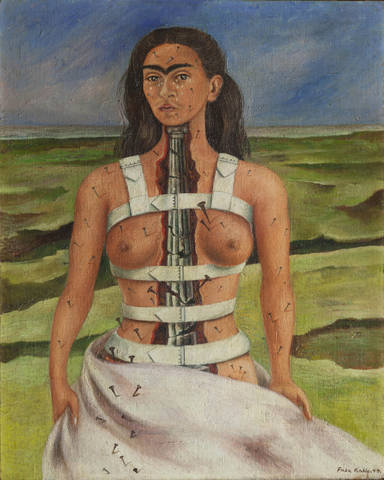
The Broken Column

The Broken Column

Kahlo speaks to me as a fellow traveller on the lonely road of disability.  A painting such as The Broken Column is much more than just a self-portrait, verging on a kind of declaration.  Even if one didn’t know about the bus accident in her youth that left her partially crippled, followed by several surgeries, the painting is one of a kind, a testimony to her suffering.  The painting suggests her self-image as a kind of cyborg (a combination of a human and machine, such as what we see in Terminator), decades before anyone had coined the word.  But unlike the film images with heroes such as Arnold Schwarzanegger, there’s nothing especially powerful or heroic in the image, which is closer to an invocation of the suffering of a holy martyr, complete with nails penetrating the skin.

Ford Hospital

Henry Ford Hospital

Kahlo’s frequent use of mechanical imagery –and what is Henry Ford Hospital if not a kind of declaration of her mechanical- human symbiosis—is more than just ironic or alienating.  She is in the foreground with the factory on the horizon, as if her bed were another assembly line, a body another place to produce products – for she was sadly unable to reproduce—like factory widgets floating above on the end of umbilical cords.  I started to cry in front of this painting, especially when I watched a fellow traveler wince at the sight as if she’d been struck a body-blow.

I suppose she had. I read that Kahlo had one of her miscarriages in Detroit, so the personal mythology underlying this painting must have been extremely deep for her.  This is only one of several images suggesting a fascination with the clinical & the anatomical, even if her use of gory reds are as likely to invoke terror & fear as compassion and empathy.

Let that scary interface between human and machine, between flesh and metal, be the departure point for Kahlo’s preoccupation with the organic & the living.  The Portrait of Luther Burbank for example—every bit as utopian as Rivera’s images of workers & the Mexican peasantry—posits a continuum of life, a realm of polytheistic possibilities.  Against the backdrop of bleakly ironic works such as Henry Ford Hospital or A Few Small Nips, Kahlo offers many more affirmations than negations, more encouraging pats on our collective back than body blows like the one I alluded to above.

Many discursive streams seem to originate or at least encompass Kahlo.  Magic realism and surrealism seem to be naturally connected to her sensibility.  Hers is a sophisticated art invoking simplicity without being simplistic.  One doesn’t have to know the life-story to feel the complexities, the encoded pain & longing, the dream imagery.

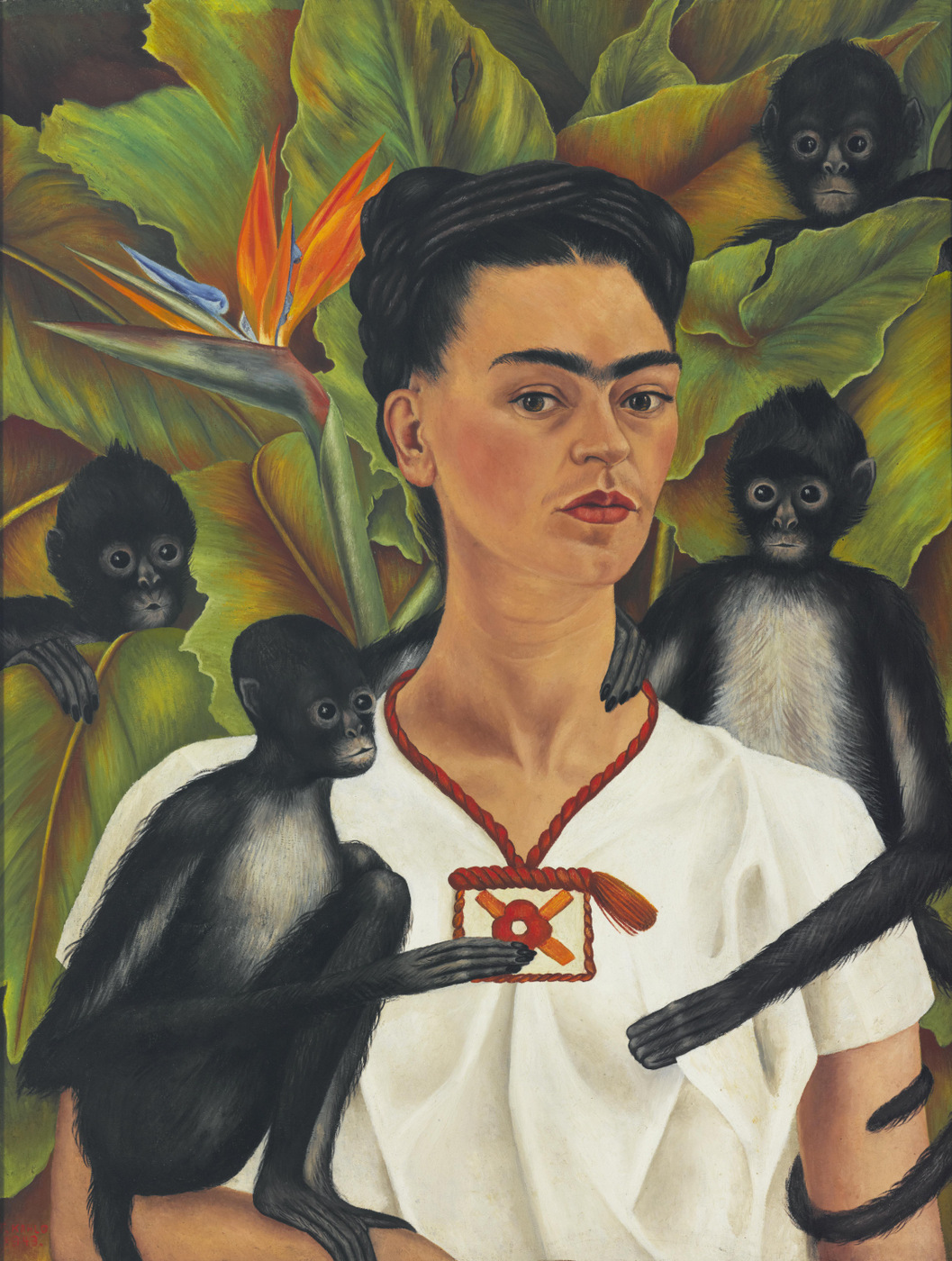
If nothing else you have the opportunity to come face to face with The Face.  Frida Kahlo’s face is often her subject in several self-portraits.  Many of the best known are here.  It’s quite extraordinary to stand before one of these iconic works, looking into her eyes.

The paintings, alongside so many photos and other artefacts of this exhibit lure you very deeply into the world of Kahlo and Rivera.  Frida & Diego: Passion, Politics and Painting will be on view at the Art Gallery of Ontario from October 20th until January 20th 2013.

See it.

Self portrait with Monkeys

Posted in Reviews | Tagged , , , , , , , , , , , | 8 Comments

Esprit Tunes the World

Tonight Esprit Orchestra, led by Conductor & Music Director Alex Pauk, marked the beginning of their 30th season with a program celebrating the excellence of Canadian music, a concert titled “The Tuning of the World”.  Of the five items presented by EO, two were world premieres of works commissioned for the occasion, with the three living composers present to accept the audience’s grateful applause.

wolf-manIf commitment is the measure of an orchestra, Esprit are the finest ensemble in Toronto.  Every moment of performance was urgent and intense, sometimes leavened with humour, and spiced with an affectionate rapport between the players and their public.

Koerner Hall was already energized by the launch of R Murray Schafer’s autobiography My Life on Earth & Elsewhere before the concert began.  The centrepiece of the evening was the premiere of Schafer’s Wolf Returns, a composition lending a sense of occasion to Esprit’s celebration.

Wolf Returns brought some of Schafer’s site-specific energy into Koerner Hall, with five sections:

  1. Wolf Chant
  2. Chant for the Spirits of Hunted Animals
  3. Mosquito Chant
  4. Healing Chant
  5. Rain Chant

Each chant was supplied from the upper rear of the auditorium by a chorus often chanting unaccompanied.  While Schafer has sometimes written edgy dissonant music, that’s not what you get with Wolf Returns, a composition feeling like a happy valedictory from a mature composer.  The first few minutes are like a powerful toccata for full orchestra, tonal but syncopated.  The voices from the back came and went throughout, deconstructing the formality of our concert experience, making the performance feel like a happening.  While it may seem like an irrelevant consideration, I can’t help but think that Schafer’s fun and boisterous composition deserves to be heard and played by orchestras all over the world.  I would think the aboriginal overtones of the chants and the frequent pentatonic sound make this a wonderfully accessible piece, especially congenial for an American audience, although I’d think the piece would be welcome anywhere.  I hope to hear it again.

The most reflective composition of the evening came from Pauk’s partner Alexina Louie, namely O Magnum Mysterium: In Memoriam Glenn Gould, a 1982 composition presented in a 1999 re-orchestration.  Originally conceived as a work for 44 soloists, I couldn’t help thinking of a similar piece, namely Richard Strauss’s Metamorphosen.  Like Strauss’s work, Louie’s composition is powerfully inter-textual, pushing our buttons with poignant quotes from other compositions.  I may have been especially softened up, sitting 5 feet away from Louie, watching her face for much of the performance; I didn’t know the piece, so when it’s tranquil but profound ending snuck up on me, I was moved to tears, amplified by her reactions.

When I first read the program for the concert, the thing that won me over most emphatically was seeing Colin McPhee on the program.  Sandy Thorburn posted a whimsical question on Facebook a year or two ago, asking us to nominate the greatest Canadian composer.  After a few people posted some of the famous composer names I said Mychael Danna (nobody had posted a film music composer and HELLO Mr Danna isn’t just alive, he’s a colossal success). Then i posted McPhee, who may be relatively unknown but he’s my personal favourite.

McPhee is perhaps the most under-rated Canadian composer, known to have influenced Benjamin Britten’s composition of Death in Venice.  He seems like a missing link in mid-century connecting Debussy (known to have been influenced by hearing Javanese gamelan music) and Glass, even if an unknown unheard composer can’t really be much of an influence, can he…(?)

This is my first time hearing Tabuh-Tabuhan in person, a piece i love to pieces.  And maybe i am not the only one, as EO took up this score with visible delight.  I always treasure moments when you see players’ heads bobbing or smiling; I don’t think I’ve ever seen so many such moments as I did tonight.  I couldn’t help thinking that Pauk gave us this bon bon as a special treat: one of the sweetest pieces I’ve ever heard, and by that I mean, phrases as cute as bunnies or kittens frolicking, endlessly curling arabesques of cuteness.  EO played every note lovingly as if sprinkling us in icing sugar.

I don’t want to ignore the first two items on the program, although they were good rather than the ecstatic level I experienced in the last three items presented.

Icarus

Icarus

We began with John Rea’s marvellous Ikaros agog…Daidalos on edge, a work that is more symbolist than impressionist, taking us to the heart of some fascinating images.  Daidalos is the great constructor who sadly lost his son when he flew too close to the sun, a kind of early Faustian bargain involving science.  Speaking as one who is sometimes infatuated with technology, I believe I understand what Rea was hinting at in his program note and in his composition, that began with organic phrases in the strings resembling wind or breathing (both the outer and inner world at once) overcome more and more with mechanical rhythms and clockwork sounds.  This understated work does feel like a cautionary tale, one that is contemporary yet universal.

Xenakis’ brief For the Whales followed, a wonderful etude for the strings, sounding very similar to the organic parts of Rea’s composition and therefore a logical work to follow it on the program.

Esprit’s season at a glance | My interview with Alex Pauk

Posted in Reviews | Tagged , , , , , , , , , , , | 1 Comment

Second At Bat

I raved about the new Canadian Opera Company Die Fledermaus when it opened last week.  Tonight I had the privilege of another look with a slightly different cast.

Some things inevitably work best the first time.  A joke with a surprise can’t get the same response if you know that it’s coming.

Opening night of Christopher Alden’s production felt edgy, a combination of fin-de-siècle hedonism, the psychology of wish-fulfilment with a dark authoritarian side to it and Strauss’s original froth.  From where I sat I was particularly captivated by the two women wearing the same clothes, namely Rosalinde and her maid Adele.

James Westman (seated) as Frank, Jan Pohl as Frosch and Mireille Asselin as Adele (Photo: Michael Cooper)

Tonight I felt quite a bit different.  Mireille Asselin assumed the role of Adele on a night I attended in the company of my wife.  I wonder if my more conservative take on the piece might be owing to the unconscious context I had brought with me…(?)

Where opening night I saw Adele as a site for class-warfare, and pondered the empowerment of women as I watched, Asselin’s Adele was less the revolutionary, and more the charming imposter at a party (in other words, more or less the way the role is written).  Did I see less edge because I was caught up in the most bourgeois elements of the story this time?  I was watching how Eisenstein & Rosalinde played out, noticing how they went opposite directions in the so-called reconciliation at the end of the operetta (when it’s all blamed on champagne).

If I were to contrast Braid & Asselin, it’s to acknowledge that each has a particular strength that is the lynch-pin of their performance, influencing how everyone else comes across.  I think Asselin is more operatic than Braid, tossing off her coloratura perfectly, the high notes like dots of whipped cream arcing through the air.  Braid’s focus is more dramatic, her facial expresssions and delivery more extreme, and her reading more intense than Asselin’s, changing her relationship to Eisenstein (her boss) and the drama around her.  I was surprised at how different they felt, and how viable each one is.  The show with Ambur Braid has more instances of dark truth, while Asselin’s is lilting Viennese operetta, light and frothy in the usual ways without any genuine threat.  I think the fan of operetta coming to Fledermaus might be more comfortable with Asselin and her stunning vocalism.  I think the COC brass chose Braid for opening night because the charisma of her performance is electrifying.

Hm, or is the difference me, sitting alone opening night (and totally smitten by the parallel tales of gorgeous women and their empowerment?) vs sitting with my wife tonight (and so, caught up in the sad story of a failed marriage rather than the parallel stories of women)…? I don’t know. But isn’t it wonderful to have two wonderful performers each taking the role & the operetta in a different direction as a result.

Tonight I must again credit the COC Chorus as the other ‘star’ of this production, particularly once they’re decorated by Constance Hoffman’s costumes.  Their energy levels tell us what Alden is trying to do, whether he’s seeking the mad joys of hedonism, the pathos of travesty or world-weary sadness.  His Fledermausketeers sound & look marvellous.

Tamara Wilson sounded quite good in spite of having announced a cold via Facebook.  The one tiny bit of evidence was her brief visit to the high note at the end of her Csardas (held longer last week); otherwise she again sounded magnificent, with a big powerful sound, a fluid line, and an uncanny ability to play comedy.  My biggest laugh tonight was over one of her lines, which I won’t give away (stealing that from you if you might see the show), except it’s a brilliant exchange with Asselin in the first part of the work, when Adele is still in maid’s attire.

I have to mention three other performers.

James Westman is a pleasure to watch and to hear in a role that I’ve hardly noticed in the past.  Singing the part of Frank, it must have been a shock to be told he’d have to cross-dress for part of the role.  While I’ve superficially given away a bit of a gag, it doesn’t in any way prepare you for Westman’s subtle performance, excellent delivery of his lines, and superb chemistry with everyone else on stage.

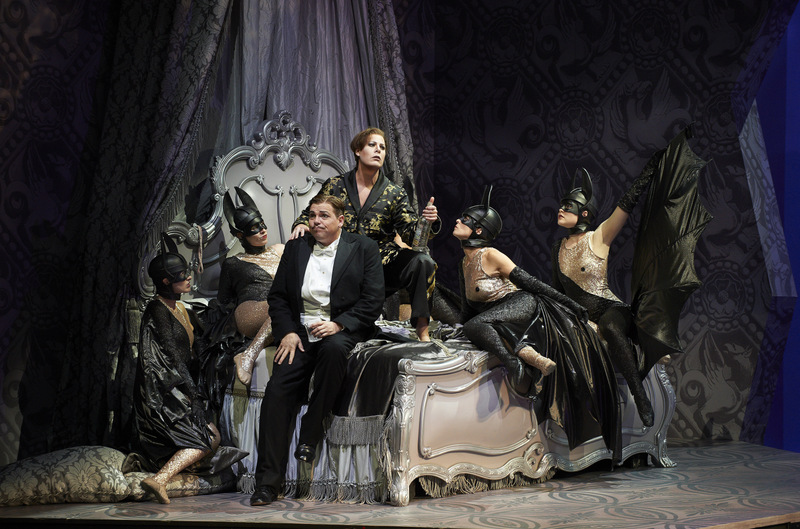
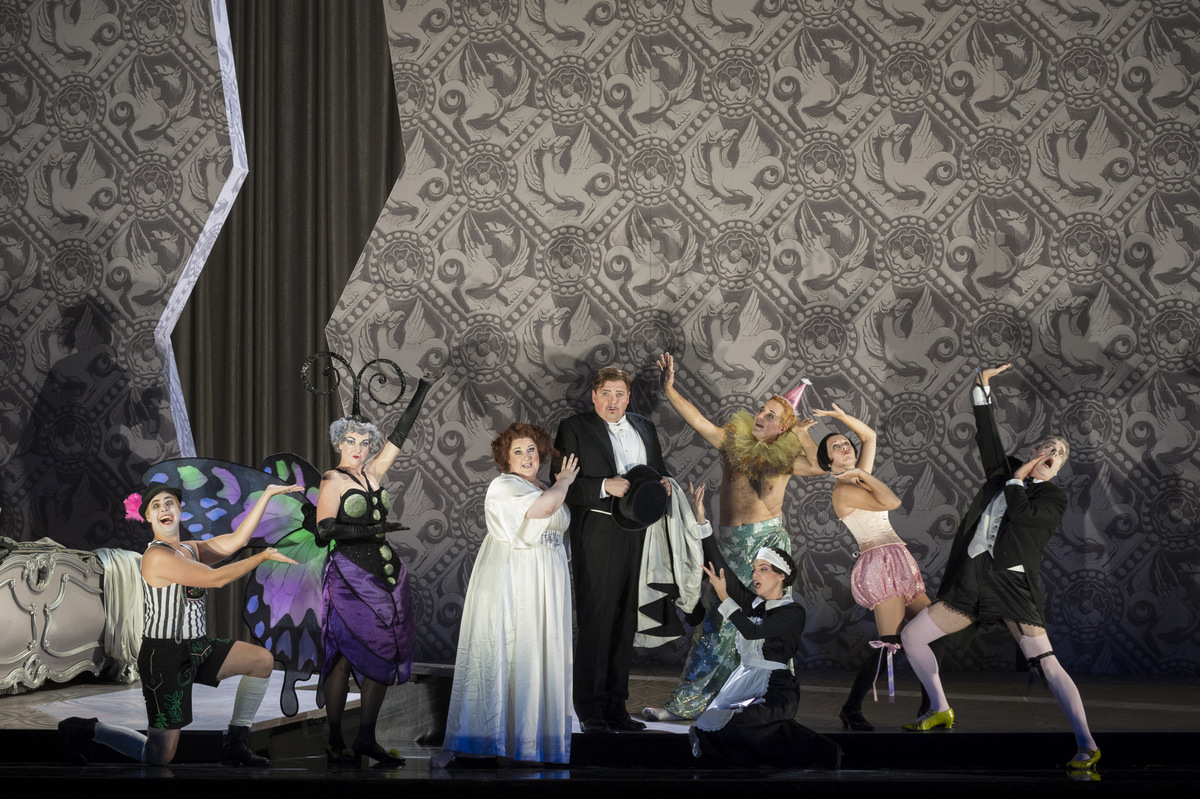
Michael Schade (Eisenstein) and Laura Tucker (Prince Orlofsky) plus bat girls. (Photo: Michael Cooper)

Speaking of travesty, I want to speak a bit more about Laura Tucker as Prince Orlofsky.  Tucker raised her comic intensity much higher tonight from the comparative subtlety of opening night.   I have to wonder if this is simply a matter of getting comfortable in a role, finding her way and discovering new nuances, but Tucker was always fascinating to watch and quite lovely to hear.

Similarly Michael Schade is also getting comfortable with his Eisenstein, a role that’s not terribly flattering in this production, and lacking the conventional closure of a happily ever after.  Schade makes Eisenstein genuinely three-dimensional, a fascinating & quirky beast who’s a likable scoundrel, even as he’s caught red-handed by his wife.  That intangible aura he brings –making us LIKE Eisenstein–is essential (although again, with the feminist reading i brought to opening night perhaps i wasn’t so sympathetic); otherwise we won’t care about the couple, won’t worry about their possible reconciliation at the end.

Hm, tonight’s show was a gentler comedy. While husband and wife do not kiss and arrive at happily ever after (if that’s a spoiler i gave it away already), curiously this configuration (with Asselin as Adele) makes eventual reconciliation feel possible, whereas the other cast with its edgier humour and in-your-face politics (the women but also Jan Pohl’s quirky Frosch) aren’t just funny, but have serious undertones as well (as noted in a pair of earlier reviews of the first cast: Fledermaus: just like our century | The bat came back ).

Die Fledermaus continues until November 3rd at the Four Seasons Centre.

Posted in Reviews | Tagged , , , , , , , , | 2 Comments

10 Questions for David Fallis

David Fallis is surely one of the most important musical minds in Canada.  He is Music Director for Opera Atelier, a long-time member and Artistic Director of the Toronto Consort, and director of Choir 21 (a choir specializing in 21st century compositions).

Fallis teaches in the Graduate Department of the Faculty of Music at the University of Toronto.  On the one hand Fallis is an important scholar-conductor, leading Opera Atelier’s productions of Lully’s Armide (including its tour to Versailles and later, Glimmerglass this past summer), and historically informed Mozart operas encompassing Die Entführung aus dem Serail, The Marriage of Figaro, Don Giovanni, The Magic Flute, and La Clemenza di Tito.  But Fallis has also commissioned contemporary composers with the Toronto Consort,  led Christopher Butterfield’s Contes pour enfants pas sages this past spring, and leads R Murray Schafer’s The Love that Moves the Universe with Soundstreams tonight in Toronto (a concert I’m sorry to miss). And Fallis is also the historical music producer for the TV series “The Tudors” and for “The Borgias”

The occasion for this interview might be the most interesting operatic project in the Toronto area this season, namely the Opera Atelier production of Weber‘s Der Freischütz.

I ask Fallis ten questions: five about himself and five about his role in preparing the Opera Atelier production of Der Freischütz.

1) Which of your parents do you resemble (what s your nationality / ethnic background)?

David Fallis

Conductor David Fallis

A bit of both, really. People say they see my Dad in me, but they’ll see my Mum’s brothers in me too. A bit of a mix – mostly Irish, some English. Way back, a little bit of German.

2) What is the BEST thing / worst thing about being a music-director?

Best: Chance to work with great musicians – great singers and players – and to do great
music!

Worst: Sometimes you have to make decisions that won’t keep everyone happy.

It’s a good life.

3) Who do you listen to or watch?  

Wow. Well, I don’t have much time for watching TV as much as I’d like to get into these series. Listening to relax all together – I love the Jazz bassist Ron Carter, a great player. I like going to live concerts. I don’t listen around the house. If I have time off, I’ll go to a live concert. If I really need calming down, I listen to Bach organ music.

4) What ability or skill do you wish you had, that you don’t have?

Oh, well. One always wishes you could have even better ears – people talk about having perfect pitch, which is a nuisance really. I’d love to be able to hear music even better. You stand in awe of people who can understand music perfectly. It’s a good exercise to try to write a piece, for any musician, because you really understand how difficult it is.

5) When you’re just relaxing (and not working) what is your favorite thing to do?

In the summertime, my favourite thing is to get outside. Even as simple as getting out to the garden, or out of the city. I love tramping around ponds and all sorts of places. In the wintertime, I’m not a great winter camper, so I do enjoy going to live theatre – straight theatre. Since there’s so much musical theater in my business, I like to go see straight theatre a lot.

Five more about being the music-director for the upcoming period production of Weber’s Der Freischütz with Opera Atelier.

1) How does preparing & conducting an opera in period performance (particularly of an opera you’re performing for the first time) challenge you?

Of course you really have to know it from the inside. I spend a lot of time with the text – with the words – so I get to know exactly what’s going on.  I’ve done this many times; I go to a native speaker because they can catch innuendo or implications I miss.  In Italian or German operas there are a lot of Dante or Biblical references that are lost in translation. If you don’t know the original it doesn’t pop out at you. You don’t always get it as a non-native speaker.  Passages have a variety of meaning.

This is a bigger orchestral piece and you have to know how all the parts are going to fit together. All the tricky connecting points where you go from one tempo to another or one mood to another. And there is a lot of this in this piece.

The Wolf’s Glen scene has a lot of short bits and the singers actually speak over music at this point.  Usually the orchestra stops when there is spoken dialogue. They call this melodrama; where the orchestra plays through the spoken passages. The music has to synchronize with the talking.

Here’s an example of the melodrama from an old recording.

I also listened to Weber’s other operas Euryanthe and Oberon. I listened to them years ago but didn’t know them very well, so I listen to them and some of his contemporaries too. You like to have context for the piece. I spent quite a bit of time reading about 19th century performance practice – e.g. how they handled trills and how they handled the staccato marks. There’s quite a bit of change in this period. And of course, this is something Tafelmusik is interested in too. We want to make it sound plausible from the 19th century point of view. In the so-called early music movement, we started out by spending quite a bit of time on the Baroque. It was so far away that nobody knew what it was like at the time.

But now, people are saying that about the 19th century. Just because it’s closer to us in time doesn’t mean we know more about the performance practice. We can’t assume that the way we play it is what they had in mind. Even the size of the orchestra. The size in Dresden (where Weber worked) is a bit smaller than some other Romantic orchestras of the time so it worked out for us.

2) What do you love about historically informed performance?

Well, I’m curious I guess, really, about how things might have sounded. I should say it doesn’t mean that’s the only way to play it. You stand in awe of the genius of the great composers, so naturally you wonder what was in their minds. And of course, Mozart didn’t have in mind a modern piano. They had in their mind’s ear the instruments and sounds of their period. I want to see if I can get inside the mind of the composer, so understanding what was available at the time and how the instruments sounded and all those kinds of things are important in understanding what the composers wanted to say.

3) Do you have a favourite work that you’ve conducted?

I got asked once at a Q&A at the end of a lecture what my favourite piece was. And I said, “I try and love the one I’m with.” I have a list of favourite composers and a list of favourite pieces, but I wouldn’t want to have to choose one.

4) How do you relate to period performance as a modern man?

Well again, it arises out of curiosity. If you travel geographically around the world and you hear music from India or Egypt or Mali and you think, “Wow, this is incredible music” and it’s wonderful to be taken into this other world. With this, you’re having fun travelling to another world chronologically. And, if you’re interested in music you’re interested in different kinds of music, and there are lost of different kinds across the globe and across the ages. And you start to notice differences and similarities. Chinese opera sounds

J E Gardiner

John Eliot Gardiner

quite different from German opera.

5) Is there anyone out there who you particularly admire, and who has influenced you?

I’m not sure I would think of anyone particularly. I love to hear great singers, great pianists,… in terms of this repertoire: John Elliot Gardiner has done a lot of recording of this type of period.

My first piano teacher was a man named Court Stone and I had a choral instructor Lloyd Bradshaw – they both had a lot to do with why I went in to music at all.

~~~~~~~~~~~~~~~~~

David Fallis leads Opera Atelier’s new period production of Der Freischütz in Toronto at the Elgin Theatre opening October 27th, running until November 3rd.

Posted in Interviews | Tagged , , , , , , , | 6 Comments

Dichterliebe

rebuilding Regent Park

A picture from the ground-breaking for the Regent Park Project

Are you seeing Dichterliebe from Coleman Lemieux & Compagnie (CLC) at the Citadel this week?  It’s a multi-media collaboration, and excuse me if that description is so common that it’s almost unintelligible; I’ll decode it in a moment.

But you notice I said “see” and not “hear”? if you’re going to see Dichterliebe the best preparation you can make is to first hear Schumann’s song cycle.  That’s because Dichterliebe  is an adaptation of the song cycle using a dancer, and at times asking both the singer and even the pianist to move.  Employing a different choreographer for each of the sixteen songs, I interpret this piece as a kind of celebration of the new space created on Parliament Street adjacent to Regent Park, a neighbourhood struggling to be reborn.

Baritone Alex Dobson

Baritone Alex Dobson

Schumann’s Dichterliebe (a title that translates as “A Poet’s Love”) based on poems of Heinrich Heine, is a high-water mark in the genre of the song cycle.  The words tell a story in a series of static snapshots, progressing from anticipation and new love through a kind of satisfaction & bliss through a period of disappointment, heartbreak, traumatic struggle, and eventual recovery.  The unity of words & music were unprecedented, the composition pointing to the imminent invention by Wagner in the next decade of the Gesamtkunstwerk: the total artwork unified across multiple disciplines.  We take it for granted that the set & costumes, direction, text & music should all pursue the same strategic objectives –and by the way, this translates to most modern media such as films or computer games .  In Wagner’s time this was a new ambition that hadn’t been put into words.  How much stranger –and more brilliant—Schumann’s achievement, that he took the words of this series of poems and gave them musical settings that describe a perfect emotional arc to match.  Wagner’s ideal for opera that he articulated in the 1850s was already there in Schumann’s 1840 cycle.

It’s already a bit radical to imagine Dichterliebe turned into a dance piece, where –in the Wagnerian tradition—you get a single vision from a choreographer imposing their ideas on everyone else, who then function as the puppets under that domination (and maybe you can see why Hitler was so attracted to Wagner).  But why hand the choreography of the sixteen songs to a group of choreographers, rather than one man or woman?  why turn this unified song cycle into something else?

Because CLC sought to celebrate the building of the new space as a microcosm of the new Regent Park.  Here’s what I read about the Citadel on the CLC website:

The Citadel has been chosen by Bill Coleman and Laurence Lemieux as a place to research, create, learn and welcome dancers from around the world. A former dispensary of the Salvation Army, located in the middle of Regent Park in Toronto, The Citadel has been carefully renovated by CLC to create an inspiring work environment for the choreographers of the company and the dance community. The Citadel is also home to the The YogaBeat, an initiative offering pay-what-you-can yoga classes to the community.

The production embodies the Regent Park ideal in miniature, where instead of one boss, everyone shares the leadership roles.  Among the sixteen choreographers, they used the new building’s Project Manager & its Architect, a student from First Nations School, a playwright, a theatre director, and a pair of fashion designers, to go with a series of dancers & choreographers.  Some of the names are well-known, lending lustre to the proceedings.

  • Alex Poch-Goldin
  • Ken Gass
  • James Kudelka
  • David Earle

But the stars work as equals alongside those who are not so well-known.

Forgive me if a parse the message in such obvious terms, but it’s quite lovely and deserving to spread much further than this small neighbourhood in the process of being re-built and re-imagined.  The sharing of disparate visions in collaboration is a kind of enactment of community at work rather than one where a solitary vision is imposed upon everyone.  This implies a tolerance of diversity.  Everyone works together even though the roles bring different skills and perspectives to the table.    And yes, it’s a multi-media piece because it’s part-dance, part-drama, part-song cycle.  That Dichterliebe works so well may be an indication that this adaptation is a brilliant idea.  I made the earlier suggestion about coming with the music echoing inside your head because there’s so much to look at.

There’s baritone Alex Dobson, singing most delicately in this small space, but occasionally popping out full-sized notes that take one by surprise.  Dobson is note perfect, mostly gentle & ultra-refined with a gorgeous rich tone that I’ve missed.  I last heard him in The Midnight Court by Ana Sokolovic, although I understand he’s been singing a lot in Montreal.  But his operatic sound is something different; this is a chamber sound, modulated to match the accompaniment and the intimacy of the space.

Pianist Jeanie Chung more than held her own in this unorthodox version of the Schumann cycle that challenges the pianist in a few of the songs.  Her usual role was complicated by the need to supply music not just for a singer but for dance as well.

Laurence Lemieux

Laurence Lemieux, co-artistic director and co-founder of Coleman Lemieux & Compagnie (click image for more)

I mention Laurence Lemieux third only because of my own prejudices, coming to Dichterliebe as a lifelong accompanist of baritones (there’s one in my family) and as a pianist.  Her contribution in collaboration with the assembly of choreographic talent is perhaps the most remarkable part of the work, something genuinely new.

I found myself thinking of François Girard’s 32 Short Films About Glenn Gould, or Wallace Steven’s poem Thirteen Ways of Looking at a Blackbird.

There’s so much going on at times –given that one could watch the piano player, the singer or the dancer—that I regret that I couldn’t take in the most physical, the most genuinely new part of the performance.  Meaning no disrespect to either Chung or Dobson, but what they did in Dichterliebe is not so very different from what they would likely do in a “normal” presentation of the cycle.  Lemieux’s part is so much newer, yet i couldn’t help regularly watching piano and singer.

I suppose that’s normal, but it means I am not competent to do more than ohh and ahh over the fascinating combinations, the variegated surface of this multi-faceted jewel.  Sometimes I felt pathos, other times exhilaration, and a few times, I laughed out loud.

There’s a kind of inter-disciplinary thing I thought I saw, when at one point Lemieux sneered “singers!”, ironically dissing the oh so serious Dobson.  She was coming from a modern place of commentary & in effect creating a gloss on the older piano-vocal text.  The audience –listeners and watchers alike—were surely divided, because often we didn’t know whether to watch or listen, and in the end we tried to do both.  Considering that there are three performers, the piece is astonishingly rich.

The program, to be repeated Thursday Oct 11th through Saturday Oct 13th, also includes Dobson’s presentation of some of the songs from Schubert’s Schwanengesang (literally “Swan Song”) accompanied by Chung, and Chung playing solo in the soulful last movement from Schumann’s C major Fantasy as a kind of overture.  The work bears repeated watching.  I know I’d have a better appreciation if I saw it again.

http://www.colemanlemieux.com/ for more info about the artists & a link to buy tickets.

Posted in Reviews | Tagged , , , , , , , , , , | 2 Comments

Thanksgiving and sanity

According to the proponents of Positive Psychology –a relatively new movement in mental health—gratitude is useful if not essential to mental health.

Martin Seligman, author of Authentic Happiness, is one of the key figures in this movement that seeks to place the focus on psychology on understanding the nature of happiness and wellness instead of the usual focus in dysfunction.  This feels especially apt after watching Dr Falke floating above the stage in the COC Die Fledermaus, a community of unhappy people unable to find or even define “happiness,” seeking solace in pleasure.

One might ask, to quote Peggy Lee: “is that all there is”? 

While i want to be respectful of Peggy Lee (wherever she might be) and the people who wrote this song, the sentiment “Is that all there is” is about as far away from my sensibility as you can get.  The subtext for this song is a kind of fundamental boredom.  I love the circus, and would never say “is that all there is to the circus”.   Even when it’s not life and death, artists put themselves on the line, and it’s a beautiful thing: so long as you take a moment to notice.

So while I like a good drink as much as the next boy/girl (although I prefer beer and single malts to champagne), lots of people are listening to Seligman, an aging population seeking the meaning of life in something more enduring than food, drink & real estate investments.  Or in other words, if that’s all there is –the material pleasures of life– then of course, eat drink and be merry: because you’re already dead, not really living.

I’d like to think that we don’t just say “thank you” because it’s good for us.  I have no doubt that gratitude is healthy, just as I have no doubt that a sense of entitlement (being bored and expecting to be entertained)or perpetual rage (a nasty variation on entitlement) can’t be healthy.  Saying thank you, being grateful and feeling it from the bottom of one’s heart is a way of being alive, of knowing you are connected to something.  Do it at first because Dr Seligman tells you, as a pathway to rediscover your humanity.  But ultimately do it because you mean it.

So please, don’t think I am doing this –what follows in this space—because it might lower my blood pressure or win me brownie points with The Man Upstairs.  I am actually inclined to gratitude because I think it’s fundamental, the one sacrament from which all others proceed.  I never feel more alive than when i am connected to the sacred fire of artists creating, the colours and sounds of life.

I am alive, and that’s a miracle.  I take in the beauty around me, also miraculous.  Whether it’s sitting in a concert hall or in the presence of one of my kids, gratitude is the pathway to the miraculous.

With that in mind I am going to say thank you for a few blessings (among many) from this past year, in no particular order.

  • Stewart Goodyear…  I don’t know where he’s been all my life, and no we don’t have a romantic relationship even if it may seem that way.  But for me he burst on the scene with his plan to play all the Beethoven sonatas in a day.  I spent a good chunk of the late spring and summer playing Beethoven sonatas, measuring the feat by trying it myself (haha NOT nearly as well). As a result I changed the way I look at these pieces, as well as the music of many other people.  I am not sure about the way we currently program concerts, except that the newness of his Marathon was one of the most exciting things I’ve ever encountered on the concert stage.  His set of Beethoven sonatas –that I first encountered with a pair of youtube performances of the Hammerklavier sonata—are very original, and as far as I can tell, the best versions out there.  I wish more people would discover these, and I am eager to hear what else Goodyear might play in the years to come.  He’s so young,…!
    Thank you Stewart.
  • Against the Grain Theatre..  I like the excitement they brought to their projects.  Their La boheme in the Tranzac (a pub) gave me a word that I have been over-using.  I apologize for this –it’s a bad habit—that once I latch onto a new concept I beat it to death, looking for it everywhere.  Buzz has been my word for 2012.  Who managed to create buzz?  AtG didn’t just do it, they created the template, with interesting ideas in new places, with breathless audiences jammed into tight spaces.  Other people are now imitating them, but even so, they’re the prototype, and I am sure people continue to watch their every move.  Thanks for making theatre exciting.
  • Robert Lepage… Some people want to reduce him to his Vegas achievements, to see his Ring through that very narrow lens.  I am eager to see his production of Thomas Adès’ operatic setting of Shakespeare’s The Tempest, coming up in a High Definition broadcast in November.  I love that he challenges us with new ideas.  Thank you Robert for refusing to do it the way everyone wants you to do it.

    Tempete

    One of the flamboyant designs from Robert Lepage’s production of Ades’s opera The Tempest.

  • I am thinking again of Glenn Gould, whose 80th birthday was celebrated recently, 30 years after his untimely passing.  He’s still my prototype for the iconoclast, the daring artist.  Hunched over his piano he looks all wrong playing.  He fled the concert stage for whatever reason, to the privacy of the studio.  He makes it okay to be a nerdy artist.  Thank you Glenn wherever you are.
  • David Warrack is a national treasure.  I can’t possibly sum him up, but will only speak to the tiny window I have on his life, a man who has written 100 musicals or more, who conducts classical music, plays jazz, leads my church choir/plays the organ with no more effort than a walk in the park on Sunday morning –speaking of doing nice things to keep you sane—and is a brilliant teacher and mentor. Being around him is a chance to learn something, if not through a well-delivered anecdote, then through the example of his gentle musicianship.    Thank you David.

And thank you anyone kind enough to read my rantings in this space.  If you’re here reading: THANK YOU.

Posted in Personal ruminations & essays | 2 Comments

The bat came back

The bat came back: from the dead that is. Forgive me for invoking one of my very favorite animated cartoons (and Richard Condie). I said BAT not CAT.  

After many mediocre bats –productions of Die Fledermaus from the Canadian Opera Company over the years—my expectations were low.  While I expected an improvement this time I still was thinking of a frothy bit of fun.

The COC gave us much more than that.

Prominent among the resurrections is the laughing song.  While there are many versions, the one that has stayed with me longest in some respects summed up my low opinion of the operetta, namely Florence Foster Jenkins’ laughable laughing song.  She amuses me, ha ha ha. 

Ambur Braid has brought Adele back from the dead, banishing Florence once and for all because of the way the song is staged.  It’s full of defiance and could almost be sub-titled Adele Occupies the Stairway (Wall Street being a bit too far away for her).

Richard Bradshaw

Richard Bradshaw (photo by Michael Cooper)

I am reminded of Richard Bradshaw’s stated objective, which was to offer the best theatre in Toronto.  I’ve always found the goal impressive for its audacity.  For much of the past decade he did just that in a very competitive theatre town (until his untimely death…).  Fledermaus is in that tradition: tight, challenging, and easily the best thing I’ve seen on a stage in 2012, in a year that also included Einstein on the Beach.

I find myself unable to get certain moments out of my head.

The fluidity of the sets ties in to the psychological theme underpinning Christopher Alden’s interpretation.  Dr Falke is like Freud, his swinging pocket-watch a talisman of hypnosis and wish-fulfillment.  When the walls and floor (designed by Allen Moyer) are ripped asunder as if by an earthquake, Rosalinde’s bedroom –where we begin the adventures—is problematized.  Where are we?  Inside Rosalinde’s head, I would suppose.

The locations in the story itself are wonderful departure points for Alden’s symbolism, considering that we go from bedroom –site of futility & frustration—to a wild party, and from there to a jail, and maybe more futility one might fear, especially because once in the jail we see Rosalinde’s bed again.  Or did they make a break-through? If we don’t get a happily-ever-after I’m pleased precisely because it’s not a glibly superficial ending to this problematic tale.  But Rosalinde and Eisenstein appear to have more clarity, more insight into themselves and one another.  Falke/Freud couldn’t ask for any more than that, nor could a couple going for counselling.

I’m noticing this partly because I’ve been playing with a young child, noticing how we erect walls in our lives that children don’t perceive unless taught to do so.  The limitations are in our own heads, as are the solutions to our self-imposed problems .

And identity is just as fluid in this world, among so many travesties.  In addition to Orlofsky –the only one who’s actually scripted that way—Alden (aided by costume designer Constance Hoffman) populates the stage with a world of ambiguities.  There’s Frank, played by James Westman, gradually showing us another side of himself at the party, in a lovely dress.  So too with several nameless figures in the chorus.  We’re in a place where you can be anything you dream of.  It’s a place where –as Frank seems to demonstrate—one may not even know who one is until one lets loose: to find oneself.  This is not in any way a portrayal that would ridicule travesty, but rather a place of great dignity, that seems to honour and respect difference & exploration.  Dr Falke’s laboratory –that I alluded to in my earlier review—is a highly sympathetic place, and one that is empowering even if one of the individuals finding himself –Frosch—is himself a colossal threat to everyone else.

While I suspect some may not have liked the ending, I think it made great sense precisely because there is no neat answer.  Frosch is the dark underside of human nature, and unlike the bat, is the real nightmare lurking in the dark.  I was happy to laugh it all off at the end because there is no simple answer.    Jan Pohl as Frosch includes a twitchy series of uncontrollable body parts in his movement vocabulary, echoing what we saw in Dr Strangelove (creepy! but funny).

I’m looking forward to seeing the other Adele in this production, namely Mireille Asselin, and having another listen to everyone else.

Posted in Essays, Reviews | Tagged , , , , , , , | 3 Comments

The Gehry-Mirvish Legacy will not be outsourced culture

It’s counter-intuitive for Torontonians.  We’ve become a bit shell-shocked with all the new condos.  More condos must be bad.

Someone knocking down a theatre? surely a bad person.

Mirvish Gehry project

The Mirvish Gehry project for King St in Toronto

If anyone in Toronto has the right to knock down a theatre to build a money-maker instead it’s David Mirvish.  Mirvish is the son of Honest Ed Mirvish, the proprietor of Honest Ed’s, and the owner-rescuer of the Royal Alexandra and the Old Vic in London.

No, I don’t mean that after one generation of philanthropy we can now allow David to stomp on what his father has done and reap some profits.  Nope.  I think those who made knee-jerk reactions against David Mirvish and his announced plan to demolish the Princess of Wales Theatre should look again.

There are several reasons I’m inclined to trust David Mirvish.

First of all, I am no fan of the Princess of Wales Theatre.  Like so many other big theatres in Toronto it’s a glorified Walmart, housing imported products from abroad.  Okay, maybe the PoW is not a dollar store, but its wares are essentially outsourced culture.  Where a Walmart is full of cheap goo-gahs made in China or India, a theatre like the PoW fill its seats employing foreign creative talent, occasionally putting a few of our actors to work.  But I don’t like a theatre presenting American musicals produced abroad to compete with Canadian theatres, because I fear there are simply too few dollars from consumers to easily absorb this kind of import.

That Mirvish proposes to put up an art gallery on the site is a wonderful bonus, as it says in the project press release:

The new 60,000‐square‐foot Mirvish Collection will be a destination for viewing contemporary abstract art from the exemplary collection of Audrey and David Mirvish. The collection was built over 50 years, beginning when David Mirvish ran a globally recognized art gallery in Toronto from 1963‐1978. The Mirvish Collection comprises works by leading artists including Jack Bush, Anthony Caro, Helen Frankenthaler, Morris Louis, Robert Motherwell, Kenneth Noland, Jules Olitski, Larry Poons, David Smith and Frank Stella. The nonprofit Mirvish Collection, which will be free and open to the public, will present curated artist‐focused exhibitions that leverage the depth of the Mirvish holdings and will be available to other institutions. It will also host traveling exhibitions.

Wow…

King St

Podium, Courtesy of Gehry International, Inc. (click to read feature on the development in an OCADU publication)

There’s so much to it, including The Gallery, those gorgeous buildings (that Gehry called “sculptures”), and “a new multi‐floor facility for the OCAD University Public Learning Centre for Visual Art, Curatorial Studies and Art History, including exhibition galleries, studios, seminar rooms, and a public lecture hall.”

I believe both Mirvish and Gehry are looking at their legacy, the way they’ll be remembered.  This could be a bit like the Rockefeller Centre in Toronto, a natural nexus for the local culture.

I am a bit concerned about the infrastructure questions; do we have the wherewithal to take care of those additional thousands of people plunked down in the middle of the city?  Are there schools for the children, adequate services for the new condo-dwellers who will arrive?  I suppose there will have to be, won’t there (and people who know a whole lot more about such things will certainly think about it).  These people will suddenly represent some of the missing bodies in the seats that kept the PoW from being profitable, so Mirvish will share his profits with his (former) competitors, although I suppose many will go straight to the Royal Alex.

I have a very good feeling about this, a project unlike anything I can recall in the GTA.  We have had some lovely institutional construction recently (the AGO, the ROM, the RCM, several charming buildings at the U of T).  But a big gorgeous building from an entrepreneur, expressing faith in the city without benefit of a fund-raising drive or government help? That’s unheard of.

Mirvish believes in us.  Gehry believes in us.

And so do I.

Posted in Essays | Tagged , , , , , , | Leave a comment

Fledermaus: just like our century

No matter how well they may sing, Johann Strauss Jr’s operetta Die Fledermaus requires its singers to act.  Although the music may be irresistible, I haven’t fully surrendered to any of the Fledermice I’ve seen.  No wonder it was usually done in English in the past (if memory serves: as it was a long time ago), as the skills were probably beyond the casts assembled here.

It’s therefore a great pleasure to be able to proclaim the excellence of the Canadian Opera Company production that opened tonight at the Four Seasons Centre.  It’s deep and it’s funny, it feels a bit decadent, and has undertones of madness & violence: just like our century.  Director Christopher Alden rips off the surface of this comedy of class disparity, exposing the disturbing psychological underpinnings of that wild & wacky period between the rise of Freud on the one hand, and the onset of fascist madness on the other.   While these images have been seen before, Alden, working with set designer Allen Moyer and Costume Designer Constance Hoffman, give us just enough gravitas to make these deeply satisfying laughs.  This is the best production from the COC in awhile, and possibly the best thing I’ve ever seen on the Four Seasons Centre stage.

Moyer dangles the key image above the stage, namely a pocket watch.  The watch signifies time of course, where the chronological framework of the story sets up a dreamlike assumption of new identities.  We’ve seen this sort of thing in stories such as Cinderella, where the dream represents a kind of wish-fulfilment, ended again by the arbitrary passage of time.

The watch signifies at least two other things.  Eisenstein carries a pocket watch, which plays an important part in the intrigue.  But for me the most powerful –and additional –meaning Moyer and Alden find in the watch is the association to psychiatry.

Are there bats in heaven? there ought to be. Michael Schade as Gabriel von Eisenstein and Laura Tucker as Prince Orlofsky (Photo: Michael Cooper)

Alden says in his program note (although it’s beautifully clear in the staging) that “Dr Falke seems a lot like Dr Freud as he invites Rosalinde, Eisenstein, Adele and Frank to the dreamy libidinous party”.  Falke wields his watch at key moments even though his control is as unnecessary as the superficial plot mechanisms Wagner uses of a love potion (Tristan und Isolde) or a curse (the Ring cycle).  We are watching a story about dreams & wish-fulfillment, where the good doctor helps each of these people explore their hopes & expectations.  No wonder, then, that Alden employs more bats than the Toronto Blue Jays, exploiting the overtones of something nightmarish and scary to probe deeply into this pleasure-seeking milieu.

But don’t get the wrong idea.  I would say it’s Constance Hoffman’s costumes as much as Moyer’s sets that set up this story, pulling it all into a wonderful parable about repression and truth.    Aided by the most impressive performance from the COC chorus since War & Peace, we visit a laboratory of dreams, where all our modern ills are grown for study or perhaps amusement.  I hope I haven’t given too much away, because the show is full of surprises, a few of which I stumbled upon via social media.

There are several wonderful portrayals with two upon which the entire evening rests.

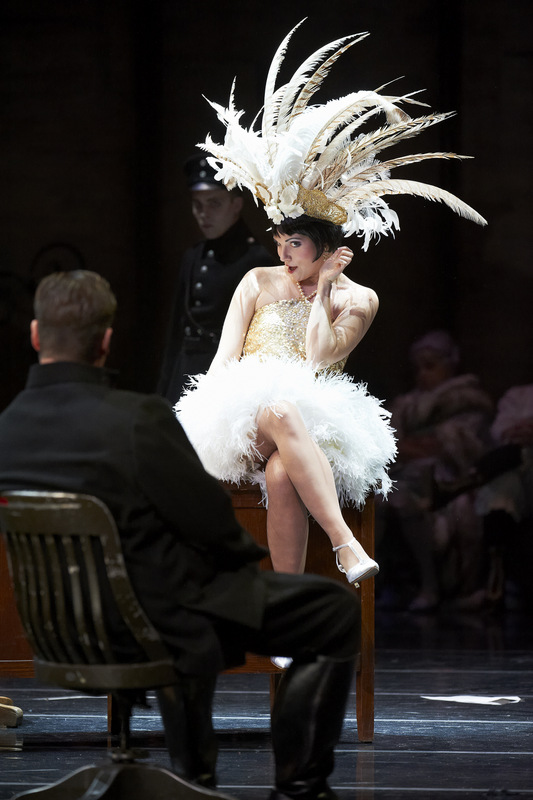
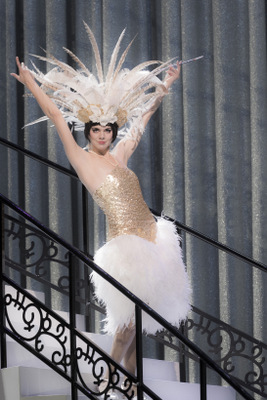
Ambur Braid as Adele as “Olga”, directed by Christopher Alden, set designed by Allen Moyer, costume designed by Constance Hoffman (Photo: Chris Hutcheson)

In the first scene Tamara Wilson & Ambur Braid are instantly real, their German dialogue compelling as we’re instantly plunged into their dramas.  Although the stage will fill with personnel and imagery, we never really lose our interest in them.  While there will be diversions throughout, it’s their show through and through.

I wasn’t at all surprised by the excellence Tamara Wilson brought to Rosalinde, a young woman with a wonderful voice that can be powerful or delicate, and with a genuine flair for comedy.  But Wilson was matched by her maid Adele as portrayed by Ambur Braid.  I’d been expecting to enjoy this portrayal, but was not prepared for how fully she inhabited the maid- who- becomes –Olga.  While I’d seen the photos in the publicity, I was unprepared for the power (and comedy) of her transformation from the ugly duckling of Act I into the seductive Olga in Act II   Her rendition of the laughing song had a delightfully angry edge to it.

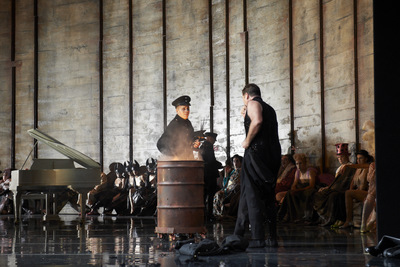
Jan Pohl as Frosch and James Westman as Frank (photo Michael Cooper)

But the excellence doesn’t end there.  Michael Schade brought his usual fluid German and effortless singing to Eisenstein.  James Westman was a suitably embarrassed Frank, Peter Barrett, a constant presence (especially when he was hanging above the stage) as Dr Falke, and Jan Pohl, able to steal the show whenever he wanted to as Frosch the jailer; he was a troubling spectre of what was to come, giving the part a decidedly brown-shirted aura.

Laura Tucker’s Prince Orlofsky was among the most successful among several examples of performed travesty, on a stage full of ambiguities.  Sets blended one room with the next, costumes were flipped off or pulled on at will, aiding Alden in creating the sense of subjectivity & dreams.

Conductor Johannes Debus & the COC Orchestra are their usual excellent selves, ably supporting a reading that never let the serious moments onstage hijack this joyful score.  We never forget for a moment that this work is all about fun & enjoyment.

I am expecting Die Fledermaus to be a huge hit, and look forward to seeing it again with  Mireille Asselin who assumes the role of Adele for half the remaining performances.

Further information

Tamara Wilson as Rosalinde, Michael Schade as Eisenstein and Ambur Braid (kneeling) as Adele (Photo: Chris Hutcheson)

Posted in Reviews | Tagged , , , , , | 3 Comments