What’s under the tree?

Alexander Neef

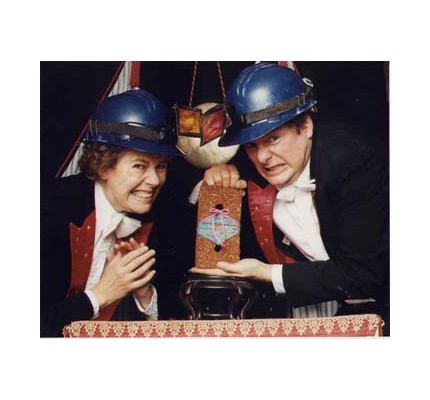
Canadian Opera Company General Director Alexander Neef, aka Santa Claus (Photo: Michael Cooper © 2008 )

The recent High Definition Metropolitan Opera broadcast of Philip Glass’s Satyagraha offered another look at one of the most popular operas of the past few decades.  I am posting this the night before the Canadian Opera Company announces their 2012-2013 season, like a kid wondering what he’s gonna get for Christmas.  I know Santa needs to make sure the company stays solvent, no matter how risky the programming he offers his kids, er I mean subscribers.  I was hoping Santa (aka Alexander Neef) would offer something edgy and exciting:

  • Satyagraha would be my first choice, but I’d settle for anything by Philip Glass.  Akhnaten?  Yes please! Or barring that something from John Adams such as Doctor Atomic.  Okay, the items on this bullet are perhaps a long-shot, although i believe either of the Glass operas would draw a big crowd.
  • Something that’s mostly theatrical in its conception.  The Nightingale & Other Tales was another wonderful showcase for both Robert Lepage and the youthful talents of the COC.  Whether or not Lepage is part of the package, there are many other works that could exploit the COC’s strengths.  I am still remembering the Met’s Damnation of Faust, a showcase for the orchestra & chorus, a work that’s not really an opera at all, and a fabulous template for a designer to show us what they can do.
  • A revival of a great COC production!  How about War & Peace, so powerful & so accomplished just a few years ago.  Or maybe one of the Ring operas?  Das Rheingold would probably be the easiest from a talent stand-point, whereas the other three operas are much tougher sledding as far as finding the talent.
  • Louis Riel

    A double threat: an opera not just by Canadians, but an opera that tells us about a Canadian icon

    Ah but if we are really talking about a radical wishlist, there should be an opera by a Canadian composer somewhere on the list, whether it’s a new work or a production of an existing work.   Actually any Canadian opera that has been revived must be understood as a success, considering how many only manage a single production.  Louis Riel, Nigredo Hotel, Heloise and Abelard…. I can’t think of any other Canadian operas that have been produced multiple times.

And of course there would have to be something from the standard repertoire to balance it all out, ideally in a new production.

  • Mozart?  We’ve recently seen The Magic Flute, Idomeneo, Don Giovanni and Marriage of Figaro from the COC, so why not Clemenza di Tito or Abduction from the Seraglio?
  • Verdi? We’ve had recent productions of Rigoletto, Don Carlos, Aida, and Otello, all heavily dependent on a few key singers.  I’d love to see their Falstaff and Ballo again.
  • Puccini?  I suppose the one I am hoping for is Girl of the Golden West, admittedly another opera that can be difficult to cast.
  • Rossini?  Ah yes, this could be a promising composer to exploit, with so many fabulous compositions both popular and unfamiliar.

I’m going to post this, and then go to bed.  In the morning, I’ll see what Santa brings.  By the time anyone reads this, I suspect you’ll know what the COC are producing next year.

Cross your fingers.

Posted in Essays, Opera | Tagged , , , , | Leave a comment

Thank you, Rob Ford

Seligman's book

Seligman’s book Authentic Happiness

I learned about gratitude in Martin Seligman’s book Authentic Happiness.  Dr. Seligman is a key figure in a new kind of psychology, called “Positive Psychology”, positive because it’s oriented not on disorders and dysfunctions, but on happiness.  I am not saying I was never thankful before, but I now actually use gratitude as part of a deliberate practice, hoping to feel better by appreciating the blessings of this world.

At bedtime–although one can do it anytime you wish—I like to look back on my day, remembering people who have done something helpful, and then feeling gratitude for what they did.  It might be a good deed.  It might be something indirect, like remembering your mom who brought you into this world, or the choir who sang so well in church, or the joy you felt with some member of the family.  I try to say five “gratefuls” each day, and am especially pleased when I take something I might have found aggravating or upsetting, and reframe it as a reason to be thankful.

It occurs to me today that I should be thankful to Rob Ford, the Mayor of Toronto.  Depending on which Torontonians you speak to, you’d get some very different answers about how Mr Ford might inspire gratitude.  Conservatives seem to like him, but I am not a Conservative.

For a person who thinks of himself as left of centre, though, it might seem like a stretch, that I say “Thank you, Rob Ford”.  But I mean it sincerely.

Ford came into office as a kind of crusader against the “gravy” of over-paid workers & excessive taxes.  The Toronto Public Library emerged as a likely target for cuts.  The local media delighted in the bizarre battle between Rob Ford and his brother Doug (also a Toronto city councillor), against defenders of the Toronto Library system, especially Margaret Atwood, an especially articulate champion of books & literacy.

It’s too early for me to report a happy ending in that battle between the forces interested in promoting the reading of books, and those who seek to balance the books.  But it’s at this point that I realized I wanted to thank Rob & Doug Ford for their gift.

I thank them for making me think about libraries.  Don’t get me wrong, I am not a big user of the Toronto Public Library: because I have privileges at the University of Toronto Library system.  But I am thankful for libraries, for the books I have in my home, for the books I dream of reading, and the blessed privilege i possess to look at a page and read.

Earlier this week I took out a copy of the score to Saariaho’s Amour de Loin, the new opera (composed about a decade ago) to be presented by the Canadian Opera Company, and that I watched on a DVD a little while ago.  Yes I can go see the opera in the theatre.  But it’s in the piano-vocal score that I actually see what the composer has notated, shedding light on sounds I haven’t previously encountered from an opera singer.  I can play through the score –although in places it looks very challenging to execute—or follow along with the DVD.  It’s a kind of magic, to look at a score, and ponder the interpretive choices one sees or hears, springing to life on a stage or in my TV, that came to life on a page covered with words & lines and dots.

In The Dragons of Eden Carl Sagan spoke of extra-somatic memory, in other words memory outside the body.  I can remember things by trying to hold those images or thoughts in my head.  Or I can take notes, sketch a picture, and thereby recall what I notated or drew.  A camera or a tape-recorder enlarges my ability to recall.  These are all ways to help me remember, tools that enlarge our abilities.

Books?  They up the ante, being a kind of social memory that offers humanity the ability to remember together, as we recall what we never saw or felt through the virtual eyes of authors, composers, poets, painters, and so many others.

Before there were DVDs or CDs, before anyone had heard a Victrola, music was still made available to an eager public for home consumption.  Great works were made smaller, transcribed for instruments people could play in their parlour, if not in a concert hall.  It’s enormous fun to chase down a reduction of a large-scale composition (i.e. orchestral or operatic works), and then plunk it out on a piano.

This morning I renewed a few books that I had out over the Christmas holiday (when one has extra time for fun):

  • Shchelkunchik, which never seems to go out of the library possibly because the title doesn’t betray the contents: a piano arrangement of the entire Nutcracker ballet.  Some parts are silly & dramatic, such as the battle with the mice, other parts are lyrical and remarkably lovely even for solo piano.  Often the textures are greatly reduced, because there’s just so much going on in the orchestra that the transcription had to choose what to paraphrase from the much denser whole. As this version was likely meant for a rehearsal pianist, it’s not very challenging, but that doesn’t stop Tchaikowsky’s melodies from coming across.
  • The library recently acquired a solo piano transcription of the first two Nocturnes in Debussy’s triptych, namely Nuages and Fêtes.  I had previously taken out the four-handed transcription by Maurice Ravel, attempting to fathom Debussy’s composition.
Gustave Samazeuilh

Composer and pianist Gustave Samazeuilh, 1877-1067

This reduction by Gustave Samazeuilh led me to ask: who is this man? I found a Wikipedia page in French only, describing him as a composer & pianist, who died in 1967 at the age of 90, a student of Debussy’s intimate friend Chausson, and known for reductions of some of the works of his contemporaries.

My extra-somatic memory is enlarged by Google and Wikipedia, telling me of Gustave Samazeuilh, but nothing can enlarge my appreciation for him as much as opening his score.  When I play through his exquisite reduction of Nuages and Fêtes, I am surely playing notes that he played, a paraphrase he made as he puzzled over Debussy’s complexities, wondering which notes to include and which to omit.

We have access to a hive-brain whereby we are all able to hear what the hive has produced, feeding off the honey of our brilliant forebears, as well as the poisons of madmen who are also part of our heritage.  Painful as it can sometimes be, we must listen and read, or fail to learn the important lessons.  I repeat my thank you to Rob and Doug Ford: thanks for reminding me of the treasure of our libraries, more than i can sample in my lifetime.

I’ll add one last little bit of gratitude.  Alexis Weissenberg passed away this week, a fascinating soul.  I am so glad I was able to hear some of his wisdom online, preserved even though he’s now gone.  I shared one of his performances of Jesu Joy of Man’s Desire on Facebook while musing a bit sentimentally that he has gone to another salon where he’s playing in the presence of JS & Jesu, and being critiqued by both the author and the subject.  Or listen to his amazing versions of the Trois Movements de Petrouschka, a work that seems to have been an unending source of fascination to him, filmed when he was still at the height of his powers.

Years later, we get a wonderful retrospective commentary on Weissenberg’s process, and a lovely glimpse of the man recalling  his magical first encounters with music

Posted in Books & Literature, Essays | Tagged , , , , , , , , , , , , , , , , , | 1 Comment

The Descent of Psycho

Charles Darwin

Charles Darwin

I don’t know very much about Charles Darwin, but have always been fascinated by the profound reverberations set off in my head by the title The Descent of Man.  I am not a naturalist.  I understood that Darwin meant “descent” in the same way that I might speak of genealogy and my own descent within my family, speaking of the people (or animals) from whom I am descended.  I can’t help but wonder whether he also meant that second sense that inevitably resulted from dethroning humankind?  I don’t know whether he recognized that his work seemed to necessitate our descent from our throne from whence we rule over nature & the animal kingdom, to a place much more equal to that of other creatures on this planet: but that’s what the title’s “descent” first suggested to me and still suggestsPerhaps I am not the only one, considering Jacob Bronowski’s Ascent of Man…?

So even as I continue this digressive preamble, I should mention that when I speak of Psycho I am speaking neither of family relationships nor evolutionary ones.  As so often happens in criticism, I am employing a metaphor borrowed from the sciences to lend a certain credibility to the analysis.

Bernard Herrmann

Composer Bernard Herrmann

And any film scholar coming to this essay expecting a discussion about Hitchcock will be surprised that he’s completely absent from this essay, because I am concerned with the real star of Psycho, namely composer Bernard Herrmann.  Can it be disputed at this point?  Without those strident strings Psycho would never have been so powerful.  I believe the effect is mutual, by the way; if one listens to the score without any accompanying visuals, the dissonance cannot move you in quite the same way, even as one involuntarily remembers imagery from the film.  Herrmann & Hitchcock were a magical partnership in several films (such as North by Northwest and Vertigo), and never quite as good when they went their separate ways.

As I look at the lineage of Herrmann’s score for Psycho I can’t help thinking about the family relationships in the most literal sense.  Would the grandparents be proud of the young rebel?  And how does the upstart view the generation that came before?  This latter question –really a question about Herrmann himself—is also a question of influence and inter-textuality.  I can’t help wondering whether Herrmann wanted someone to notice family resemblances, because they offer additional ways of decoding the film.

I suppose I should apologize for this introduction which promises more than I can deliver.  I am not really proposing to unpack all of Herrmann’s influences: which would be a huge job.  But I did think it might be fun to point out some prominent influences in one small part of Psycho.

First, let’s listen to the introduction to the film, as a reminder of what Herrmann’s music sounds like.  The film is  scored entirely for string orchestra, but in this brief sample you can hear the quality of the writing in a transcription for string quartet.

This corresponds to the music in the titles.

Herrmann’s next cue is very different.  Where the “prologue” is a fast composition full of repeated figures, the following passage is much slower, and more lyrical.

While there is less urgency, I’m hesitant about how to describe this passage.  Instead, perhaps I should play the music that it always suggests to me, music so similar –to parts of Herrmann’s score—that I can’t help but think that the American film composer was consciously emulating this influence, one of two.

Notice that this composition–much longer than the passage from Psycho— is the first of Debussy’s Nocturnes titled Nuages or “clouds,” or in other words a skyscape.  Pay attention especially to the passage roughly 60 seconds into the piece, where the descending parrallel chords are almost identical to what Herrmann employs, except that the film’s music has a few extra accidentals, further clouding its harmonies.  Whereas Debussy’s sky feels like an organic portrayal of natural phenomena undulating in the wind, Herrmann is showing us the urban sky, which is neither natural nor organic.  If you go back and listen again to Herrmann’s skyscape, the contrast is quite pronounced.

In comparison, you might think the difference is so large that I’m deluded to even mention Debussy, whose clouds float without any of the troubled human energies one feels in Herrmann’s score, as if emanating from those buildings in Psycho before we see our first human being.

Let’s hear the other influence, representing not just the subtext for Herrmann, but a composer who influenced Debussy himself, namely Richard Wagner.  In the orchestral opening of the last act of Tristan und Isolde we encounter another skyscape, setting the tone for the act, in its evocation of loneliness and frustrated sexual desire. Tristan waits for death, longing for one last encounter with his beloved Isolde.  The lookout stares at the empty sea, hoping for the appearance of a sail on the horizon.

Will Isolde come back?  A shepherd looks out, and utters a line that TS Eliot quotes in The Waste Land, namely “öd und leer das meer” (barren and empty the sea), as if to sum up the human condition.

Herrmann finds something that is suggestive of the two compositions, as though Tristan’s desperation had transformed Debussy’s organic sky into one of permanent sexual frustration and futility.

Whatever their relationships, it’s remarkable how one composition transforms the experience of the other.  Remembering the two senses of “descent” –both lineage and a physical trip downwards– I believe the only relevant descent in Psycho is that of the car going into the water.  With every decade, I believe the estimation of Herrmann and his film rises ever higher.

Posted in Cinema, video & DVDs, Essays, Opera | Tagged , , , , , , , , , , , , | 2 Comments

10 Questions for Britta Hansen

Britta Hansen is the Leader of the Technocratic Party of Canada.  The role of the “technocrat” has been getting a fair amount of attention lately, particularly in Europe during its debt crisis.  Is a government run by technocrats –the most technically skilled and knowledgeable among us–on technocratic (fact-based) principles the answer?  That’s what Hansen and the TPC believe.

I ask Hansen ten questions: five about herself, and five about her work.

1) Which of your parents do you resemble (what’s your nationality / ethnic background)?   

Britta Hansen

Britta Hansen, Leader of the Technocratic Party of Canada

In terms of interests and activities I most resemble my father. We are both very interested in science and politics, and myself being the leader of a political party and a student of science, I have certainly endeavoured in both. My father is Danish and my mother is Canadian.

2) What is the best thing / worst thing about what you do?

The best thing: I love speaking to people. No matter where I am, somehow politics comes up and I get the opportunity to converse with them with respect to current affairs, technocracy, and how politics affects their everyday lives. I think it’s of paramount importance to get everyone’s perspective on the same issues.

The worst thing: dealing with apathy from my peers. Many people don’t care to involve themselves, for whatever reasons, and it takes a lot of work and persistence in order to gain and retain their interest.

3) Who do you like to listen to or watch?

Dr Strangelove

Stanley Kubrick's Dr Strangelove (or How I Learned to Stop Worrying and Love the Bomb)

Mr. Bungle and Primus are two of my biggest musical influences, and I don’t think I could ever get sick of them. On the radio I almost only listen to CBC Radio 2.

For films I adore Dr. Strangelove and the works of David Lynch. I’ve recently been watching alot of Robot Chicken.

4) What ability or skill do you wish you had, that you don’t have?

Sticking to just one project at a time! I can’t help but wear myself thin with too much on the go; hard work is an addiction.

5) When you’re just relaxing (and not working) what is your favourite  thing to do?

Play video games.

logo5 more questions concerning leadership of the Technocratic Party of Canada

1)How does leading a political party challenge you?

The most challenging aspect so far is having an answer to every single question on the spot. People will ask me questions out of the blue that I may feel have absolutely no relevance or that I really don’t want to answer, but when  I’m prompted, I only have a few seconds to gain their confidence, so I must think on my feet and be prepared.

2) What do you love about being leader of the Technocratic Party of Canada?

Learning. I am constantly learning about the history, current affairs, and structure of the country, as well as any details I should make myself familiar with on specific issues. For instance, in order to properly defend our stance on alternative energy, I studied a multitude of energy sources and implementations and compared their efficiency, safety, ease of use etc.

3) Do you have a favourite plank in your party’s platform or some goal you dream of fulfilling if you come to power?

Absolutely! I would love to reduce the validity of patents on drugs from 20 years to 5 years. Other countries that have done this (namely Brazil and India) are able to distribute medicine for one tenth of the price. This would save our healthcare system millions of dollars, save families hundreds of dollars, help lift people out of poverty, and would have virtually no effect on our economy.

4) How do you relate to contemporary politics as a modern citizen of the world?

From my perspective, the biggest change in contemporary politics is the introduction of social media. Everyone’s on Twitter and Facebook, so if people are to keep up with politics we need politicians to be organizing via social media outlets. I’ve been slowly learning the ropes of social media, but it’s hard to wear your heart on your sleeve in 140 characters or less!

Wikileaks and other whistle blowing outlets have also become highly influential as of late, which is teaching everyone we have to be open and up front about politics, not sneaky and subversive. There is increasing demand for accountability in politics thanks to Wikileaks, and I endeavour to be accountable and transparent in my politics with the Technocratic Party of Canada.

5) Is there a political figure you especially admire?

Lester Pearson

Lester B Pearson; click the picture to see Pearson's bio on the Nobel Prize website

Lester B Pearson. He showed us that you don’t need a majority government to get things done, although modern politicians are telling us elsewise. With just a minority his government was responsible for universal health care, the flag, Canada Pension and student loans. Not to mention that he won a Nobel Peace Prize.

~~~~~

Britta Hansen and the Technocratic Party of Canada will continue their efforts to win the hearts & minds of Canadians.

Posted in Interviews | Tagged , , , , | 2 Comments

L’Amour de loin DVD

COC logoAs the Canada Opera Company’s February production of Kaija Saariaho’s Love From Afar gets closer my curiosity grows.  I’ve seen several new operas in my time, both the ones that vanished, and the ones that have stayed in the repertoire.

What is the secret of success?  I suppose the simplest (and perhaps most obvious) thing to observe is that unless the opera is good it is unlikely to survive.  But being “good” is such an elusive quality –and yes you can be forgiven for saying that what I’ve said is close to useless—that producers don’t necessarily know what they have when they commission or program a contemporary opera.  All I meant was that it’s not enough to be trendy or a flavour of the month.  Survival is Darwinistic in the fullest sense.

DVD L'Amour de loin

DVD L’Amour de loin

With such thoughts in my head –wondering for example what motivated the COC to program Love From Afar –I watched the Finnish National Opera’s 2004 DVD of L’Amour de loin, as Saariaho’s opera is actually called.  With libretto by Amin Maalouf it’s a work of many contradictions if not actual paradoxes.  Its style is both modern yet grounded in what came before, premiered in 2000, yet concerning figures from long ago.

Let’s momentarily set aside the review of the DVD, directed by Peter Sellars, conducted by Esa-Pekka Salonen, and starring Gerald Finley, Dawn Upshaw, and Monica Groop.  My chief focus at the moment is this new opera that we’ll be discovering soon at the Four Seasons Centre in Toronto.

Now that I have heard and seen L’Amour de Loin once all the way through, plus a few re-hearings, I feel if anything a little premature in giving anything like a commentary.  I have seen a lot, and am delighted at the depths I am plumbing.  But I am confident that my positive response is genuine and not likely to change in the years to come.  I am hopeful of seeing this opera repeatedly, first here in Toronto, sometime thereafter at the Metropolitan Opera, and in future productions.

When I first heard about the subject matter of Saariaho’s opera and the small cast, I wondered –especially in the first scene—whether it was genuinely operatic, rather than a series of solipsistic moments.  But I didn’t expect the many layers of meaning I would encounter.

“Love From Afar” –a fairly literal translation of the French title—encapsulates the opera on many levels.

  • there’s the physical reality of the story:
    Jaufré Rudel, sung by a baritone, is a Troubadour and Prince of Blaye in Europe, while Clémence, sung by a soprano, is Countess of Tripoli. A pilgrim serves to pass messages between them across the gulf that separates them.
  • there are the spiritual overtones of the story:
    the militant actions of the Crusades and the passionate pilgrimages both underlie this period, when men went across the world to fight for their faith, or surrender themselves to higher powers.  Jaufré speaks of pilgrimage, but at the centre of this tale is the trouser role of the pilgrim, a genderless figure serving as a curious mirror to the gendered lovers whose messages are carried back and forth.
  • love itself is problematized:
    I find myself thinking that indeed all love is from afar, given the existential gulf between people, the gulf of faith required to make any connection with certainty.  Each of the lovers deconstructs their own experience, in internal monologues questioning the meaning of love, debating different aspects of love.   This makes L’Amour de loin marvellous to watch, as if each of the lovers were enacting a kind of opera within an opera.  These lovers undaunted by distance enact a parable of Platonic love.

L’Amour de Loin is a very accomplished piece of work.  It’s always pretty to hear, even as it flirts with noise and dissonance, so careful to ensure we’re never tired of the sweetness at the core of this work.  The voices are clearly audible, never drowned by an orchestra capable of swelling powerfully but usually very wisely deployed to allow the softest nuances of vocal expression.  At times the singing tiptoes into parlando (or Sprechstimme?) teasing us with the intimacy of the sentiments; we are inside the heads of our protagonists, and so we have no need for anything bombastic or forced.  If your idea of “operatic” is “overblown” or “grandiose” this won’t seem operatic to you, because every moment is well-conceived and never out of proportion.  In this respect Saariaho’s opera is modern even as it probes pre-modern sentiments.

Saariaho’s influences are one of the pleasures of her opera, as we hear hints and intimations of where she’s been as a sensibility.  Having studied in France, it’s entirely to be expected that we hear echoes of Debussy’s Pelléas et Mélisande or Poulenc’s Dialogues des Carmelites.  I read in the program notes that Saariaho changed her mind about opera after seeing Messiaen’s St François d’Assise; I don’t know that opera at all, but did hear several clusters and combinations reminiscent of Messiaen-ic sonorities.  I was also reminded powerfully of the last act of Wagner’s Tristan und Isolde, although that is perhaps only by the implications of the scenario rather than any musical allusions.

The DVD?  Those of you who read these postings may have already heard me express admiration for Gerald Finley, who inhabits Jaufré with great intensity, and offers his usual suave, clean vocalism.  Who else to play a singer, if not a genuine mastersinger?  I am not sure I understand the subtleties of Dawn Upshaw’s performance as the Countess; she is sympathetic, musical, but I was not in any respect overwhelmed by her performance, perhaps (for me) overshadowed by the edgy performance of her lover.  Monica Groop’s Pilgrim was possibly subtler and more profound than Finley’s Jaufré; but that may be my misplaced admiration for this ambiguous role itself, which is wonderfully well-conceived, beautifully directed (credit to Sellars) and captured by the camera.  Even so, I must express my enthusiasm for the opera and the DVD, unsure whether it was Saariaho who has won my heart or the performance.

There’s a great deal more to study, beginning with another look at the DVD, and later the pleasures of seeing this opera produced by the COC in Toronto in about a month’s time.  I am curious to hear what Russell Braun will make of this role, considering the depth of Gerald Finley’s wonderful portrayal.  Braun has assembled an impressive recent body of work, both in his Toronto appearances (including Pelléas, Prince Andrei in War & Peace, and most recently as Orestes in Iphigenie in Tauris) and abroad (Chou En Lai in the Met’s Nixon In China). Jaufré’s passing is perhaps not as transcendentally beautiful as Mélisande’s, which I consider the sine qua non, but still among the most beautiful such moments in all opera.  I am eager to see what the COC and Braun can do.

Russell Braun and Joseph Kaiser in the COC's Iphigenia in Tauris

Russell Braun and Joseph Kaiser in the COC’s 2011 production of Iphigenia in Tauris (photo by Michael Cooper)

Posted in Cinema, video & DVDs, Opera, Reviews | Tagged , , , , , , , | 4 Comments

Ministers of Music

December 30th is a day of reflection in my family.  My father passed away on this date long ago, forever casting a shadow over this festive season.  It doesn’t mean one can’t celebrate.  If one occasionally eats & drinks oneself into a place where one is blissfully in the here and now of sensations, surely one can be forgiven, whether that hedonism is to escape or celebrate.  Christmas is a time of rebirth and new beginnings, and by association invites us to contemplate our good fortune, our blessings, and to give thanks.

Liszt

A portrait of Franz Liszt

The musical world commemorates anniversaries of composers long-dead, but hopefully not forgotten.  2010 was the year of the Chopin bicentennial, whereas 2011 has seen at least two great composers celebrated, both of whom mean far more to me than Chopin.  This is the end of a year celebrating Liszt and Mahler.  Franz Liszt was born 200 years ago, while Gustav Mahler died a century ago.

As a young child I was regularly taken to a Lutheran Church in Scarborough, particularly in the years when my father was diagnosed and gradually dying, and of course also after his passing.  Near the end, the pastor’s family took in the children while my mother sat by my father in a hospital.  I was so young that I remember almost nothing, so that this has passed into the family mythology, an amalgam of tales re-told.  The time spent with the generous pastor was a kind of purgatory, given what was taking place in the hospital, before returning to a family radically changed.  I have a dim sense of what came before, but only know that there was always warmth and kindness, my father having providentially made arrangements for his widow & children.   And the church was part of this blurry memory.

It shouldn’t be surprising that after awhile we drifted away from the church.   Each family member had their own story, but mine goes something like this.  I started to question, particularly given that we were not going every Sunday morning.  I came to think of myself as an agnostic, recognizing that I couldn’t really know one way or another.  I was not an atheist, and feel very strongly that atheism is really another faith category.  No, I was just in a kind of agnostic limbo, perhaps unaware that I was waiting for something to catch my attention, win me over.

The title for this piece may seem odd, considering that I have been rambling on about my childhood, while mentioning Mahler & Liszt in passing, without making any connection.  I recall being reminded in various church choirs that we are ministers, not just because we put on funny gowns that take away our individuality, while making us seem somewhat symbolic in the ritual space of a church.  It begins with the idea that many eyes may be upon us.  We shouldn’t pick our noses or behave in a manner to wreck the experience of those coming to the church in search of some kind of solace or comfort.  We may not recognize the roles we play, but we’re privileged to be part of this sacred process.  Music is one part of the service, right? it occurs to me that music and musicians minister to us whether we’re in church or not.

Gustav Mahler

Gustav Mahler

There are many pathways that can lead one back to the church after one has lost their way, as I had.  During the intervening years before I came back, I found something spiritual in the works of Gustav Mahler.  His Second, Third and Fourth Symphonies were particularly illuminating for me, in various ways rekindling a long-dormant process of meditation.  Dead embers came back to life gradually.  The vivid moments in the last movement of the Second Symphony encouraged me to visualize the Resurrection in my mind’s eye.  It’s counter-intuitive, but this quirky composer, tormented by the anti-semitism he faced throughout his career seemed like a messenger showing me the path.

Did Mahler convert to Christianity to get a job as conductor of the Vienna Opera?  It’s a matter that’s not known with certainty.  What we do encounter, embodied in his symphonies, is an unconditional theology that is a perfect match for that current demographic that self-identifies as “spiritual but not religious.”  There is no hell in Mahler, just Heaven.  For those who are lost Mahler is as welcoming as Alcoholics Anonymous or a homeless shelter, a warm & fuzzy pathway back towards faith.

Liszt may seem less likely as a pathway, but I believe that’s because his reputation as a virtuoso overshadows other notable achievements over a wonderful long life, and one of the most under-rated figures in the history of music.   The Liszt of “Lisztomania”, a friend & champion to other artists?  In modern culture, collaboration is the norm, especially in multi-disciplinary forms such as theatre and film, but it’s hard to imagine life before artists learned how to work together.  I believe a lot of this begins with Liszt.  Berlioz’s fame spread via Liszt’s piano transcription of Symphonie Fantastique, whereby the world discovered music that otherwise was not being programmed, and would therefore have remained unknown.  We can’t really grasp this nowadays, when music is ubiquitous and cheap via radio, CD, and other media.  But when there were no recordings, how else would someone discover new music?

Liszt made so much money as a concert artist that he became a philanthropist, helping the poor, funding new schools and academies, and taking artists under his wing.  When Wagner was in exile following the failed 1849 uprising in Dresden, Liszt not only gave him a place to shelter his family but produced and conducted Wagner’s romantic operas in his theatre.

In addition to his generosity & mentoring spirit, Liszt showed me something very simple and fundamental.  His transcriptions of Beethoven, Berlioz, Wagner, Verdi, Schubert, alongside his own compositions are sometimes dismissed as virtuoso trifles.  I am not proposing to evaluate anyone’s achievements, only to speak of a joyful pathway.  Sometimes we sit down to make music following the procedures set before us, fearful of playing wrong notes and infused with the negativity that pedagogy and music teachers condition into us, a lack of independence of spirit drilled into us by too much respect and awe for those who came before.

Liszt showed me the fun, channelling selflessly what was in the score.  I am not saying I am a good composer, only that I would never have found any confidence or self-knowledge without first having felt the bravery in Liszt’s own handling of the music of others.  I felt better about my arrangements of Christmas carols, my versions of Beatles tunes or my own various attempts to transcribe symphonies, after playing through some of Liszt’s transcriptions.  I felt similar joy with transcriptions by Rachmaninoff (his Mendelssohn, Tchaikowsky and Schubert) and Busoni (his Bach!!).  I lost my fear when i felt that joy.  When I sat down to accompany singers I stopped worrying about notes and started to think about making music, which became a spiritual channel.  Every year music has become more and more enjoyable.    How ironic that the man most closely identified with the role of the romantic virtuoso transcended the egotism of that role in his maturity.

I may seem to be retrospective as I face the new year.  It’s funny to think that I know where I am going because I am looking behind me.  Thank you Gustav & Ferenc, for what you gave us, the delights and the lessons, the examples you set and the wonderful compositions still reminding us of you.

Posted in Essays, Spirituality & Religion | Tagged , , , , , | Leave a comment

10 Questions for Rick Sacks

Rick Sacks

An older photo of Rick Sacks

Richard Sacks has been a force on the Toronto creative scene for more than 25 years, as a composer & sound-designer, percussionist, mentor, and likely a few others roles i didn’t think of.  He performs with Arraymusic, Art of Time, Aventa, The Evergreen Club Gamelan, The Glass Orchestra, New Music Concerts, Red Sky Performance, and others.  Sacks also works as both a performer and a composer/sound-designer in contemporary dance and theatre productions. He has toured extensively through Europe and Asia. Sacks also works as both a performer and a composer/sound-designer in contemporary dance and theatre productions. He has performed with Robert Desrosiers, Dancemakers, Le Group de la Place Royal, Bill James, Carbon 14, and Toronto Dance Theatre. In theatre, recent work has been as composer/performer for Canadian Stage’s Midsummer Night’s Dream in the Park at High Park, Midsummer Night’s Dream at Passe Muraille, the hit show ‘Sibs’ (Tarragon), and the award winning children’s shows, “Dib and Dob” and “Danny, King of the Basement” and “Rocket and the Queen of Dreams” (Roseneath). In 2010 Sacks received a DORA award for music creation of TONO for Red Sky Performance.  “Rick Sacks Solo Electronic Show” is coming up on January 14th 2012.

I ask Sacks ten questions: five about himself and five about his work.

1) Which of your parents do you resemble (what’s your nationality / ethnic background)?

Rick Sacks

Rick Sacks' current photo from Array New Music's site

I probably most resemble my father. I can hear his voice when I speak.  People from my hometown who haven’t seen me for a long time say, “You’re just like your father.” I know I have traits from my mother, but I think my dad’s stamp is predominant. There’s some question as to whether my great grandfather on my father’s side came from Russia but my grandfather was born in Palestine before it became Israel.

As a teenager, with a couple of uncles, at the turn of the century, my grandfather, traveled from Palestine, by horse and buggy, to South Africa.  In Capetown, he met my Lithuanian grandmother. It seems there was migration by Lithuanians to South Africa and Australia while the Polish Jews went from Europe to North America.

Rick Sacks once more

Rick Sacks' picture from the Evergreen Club site

I asked my grandmother on my mother’s side where her family was from and she answered,, “The Austro-Hungarian Empire. Traced that to a small town in Poland. Her father was a “woodsman”.  He owned a saloon that served flavoured vodkas and would travel the forests reporting to the Emperor’s men on where the good hunting, berries and timber could be found.

2) What is the best thing / worst thing about what you do?

The challenge of new works for percussion has been a great adventure. Works by Boulez or Wuorinen that require great concentration and stamina (both physical and mental) gives the player a sense of accomplishment and a sort of Zen sense of refreshing your life daily, a rebirth with each performance. Other works, the gentler or slower compositions, require a delicacy of approach, a maturity and ability to let go of those activities that call on the ego to be in the moment, propelled by a history of ‘hearing’.

Traveling the world as part of what I do has also been a great joy. Recent travels to Mongolia and China have led to new friendships and a view of a world broader and more beautiful than I could have imagined. Trips to Europe, the “old World” are so fulfilling in the way the Europeans celebrate their artists and Art that it refreshes the spirit.  New Music in North America is often looked at as superfluous or too hard to understand.

What’s the worst thing? At some point, a freelance artist is convinced to “take every gig”. This can lead to getting stretched too thin. The balance between paying the rent and playing at your best is compromised. The constant pull to justify Art with audiences and sales that can only apply to popular music is frustrating. The desire to advertise with hype and manipulative ‘spin’ degrades the real reason for composing, listening to and performing new music.

3) Who do you like to listen to or watch?

Arraymusic, Continuum, New Music Concerts, Trio Fibonacci, SMCQ, Berlin Phil, Ian Desouza, Dixie Chicks, Jimi Hendrix, Zappa, Miles, George Russel’s Othello Ballet Suite, Stravinsky, anything by Linda Catlin Smith, Martin Arnold, Morton Feldman, Boulez, violinist Mark Fewer…

4) What ability or skill do you wish you had, that you don’t have?

reading minds, invisibility, flying.

5) When you’re just relaxing (and not working) what is your favourite thing to do?

Watching movies, having good food and drink, reading books. playing computer games.

5 more questions concerning Rick Sacks’ solo Electronic Show Jan 14th.

1) How does working with an electronic drumkit challenge you?

It’s easy to be cool on an electronic drum kit, and the MaletKat is a compelling midi controller that can impress a viewer easily. The challenge is to get good compositions that use these instruments in ways other than the ways they were meant to be used (primarily for pop and jazz).  I  have been soliciting and commissioning new works for these instruments for some time.  This concert will bring together the first batch.

2) What do you love about the compositions in your January 14th concert?

Each composition requires a different set of performance elements.

  • David Lidov and Luke Nickel use MAX, the programming language to bring text into play in different ways.
  • Darren Copeland uses MAX as well but through Kenaxis, a ‘MAX front end’ developed by Stefan Smulovitz, himself an electronic music composer.  Darren’s piece is very complex, requiring the performer to understand different banks of keyboard configurations that enable the MalletKat to control, using only the keys, volume, transposition, granular synthesis, pan, looping, recording and playback of folders of pre-recorded material. Very challenging.
  • My own works are ‘sketches’, one using mbira samples and recorded sequences, the other, using a piano and string sound tuned to the Bolen-Pierce scale, a microtonal scale used by Peter Hannon in a piece that I performed in Boston last year. Peter configured the MalletKat with this scale, claps of thunder and a bass ostinato and gave me permission to improvise using his compositional elements.

I had been commissioned by Red Sky Performance, Toronto’s premiere theatre and dance company focusing on the world’s indigenous peoples to create music for a collaboration between Red Sky and New Zealand’s Black Grace Dance Ensemble. For this project I bought a set of Roland V-Drums. With the MalletKat I was able to become a one-man-band switching between the drum kit and the mallet instrument, triggering sequences and soloing along, following the dancer’s movements with punctuations and grooves, occasionally listening to a discreet ‘click track’  programmed to make tempo changes along with pre-recorded bed tracks, filling with huge samples from Native Instruments and East West technologies. I have been collecting and creating sound libraries for years now and have almost unlimited choices in various hard drives accessed by a laptop. The pleasures of an electronic percussion geek.

Red SKy

Rick Sacks with Red Sky friends / collaborators. Click on the picture to get to the Red Sky page including a video sample.

3) Do you have a favourite composition?

I have favourite pieces to listen to and favourite pieces to perform. Last year, with Aventa, I learned the vibraphone part to Boulez’s Derive II. It was a tremendous challenge to learn, and performing it was the closest I will get to jumping off an airplane and skimming a mountain with webbing between arms and chest. This year I also performed in Charles Wuorinen’s Percussion Symphony produced by Robert Aitken’s New Music Ensemble. These works require extreme concentration, stamina and preparation.

As for listening to music there’s a lot that I love: Ives and Feldman are American transcendentalists. Linda Catlin Smith’s music has elements of this genre but includes a layer of beauty sculpted using an intuitive, yet meticulous, technique.

I can listen to country music, minimalist pattern pieces, electronic music, baroque and romantic works, all channeling into slightly different places in my brain, triggering memories, oddly familiar emotional ‘places’ or new insights into the immediate place and time I am experiencing them in.

4) How do you relate to new music as a modern citizen of he world?

No matter when a person lives, there is good and bad music.  Music that panders to popular trends or the supposed requirements of the genre are destined to be unsuccessful or worse, distracting and detracting from the truer forms of expression required to reflect or propel a culture. As a musician, I have a responsibility to perform even the most obvious travesty to the best of my ability. Tiring and frustrating, I try to avoid taking jobs with music I can’t feel committed to. However, the freelance life sometimes makes this impossible. So I do my best and hope to realize the composer’s work in the way they envisioned. New Music is a catalyst for cultural growth and a way to awaken the aspirations and thought processes that can be otherwise anaesthetized by the bombardment of market forces and easy listening. This is not to say that new music cannot be a source of comfort or distraction. Sentiment, humour and irony are not forbidden areas. My main relationship to new music is more exploratory. Arraymusic, for example is much more of an R&D organization than one which pursues ‘known’ works that have been already been successfully tested.

5) Is there a composer you especially admire?

I admire all composers.  This is not a field that brings popular appreciation or monetary wealth. To be a composer is to dedicate oneself to a life of solitude, risk and constant critical observation by (hopefully) a discerning audience.

Rick Sacks in motion

Rick Sacks in motion

Rick Sacks Solo Electronic Show” is coming up on January 14th 2012.  Saturday, January 14th,
8:00 pm
The Array Studio
60 Atlantic Avenue
Suite 218
INFO: 416-532-3019

Posted in Interviews | Tagged , , , , , , , , , , , , , , , , , , , , , , , , , , , , , , , , , , , , | 1 Comment

Super 8

I just saw Super 8, a film with Steven Spielberg’s name on it as producer, written and directed by JJ Abrams.  While Abrams has amassed an impressive resume (as a writer, producer, director or combination thereof for Armageddon, Regarding Henry, the 2009 Star Trek, Cloverfield, Mission Impossible III, and the brand-new Mission: Impossible – Ghost Protocol), it feels like Abrams’ tribute to Spielberg.

Start with the simple fact that this is a film about making film.  When I think about it there are an immense number of films about film-making.  There are films like Singin’ In the Rain, or Sunset Boulevard that invoke various aspects of the Hollywood film industry.  I can’t recall one that framed a larger action with such a humble frame-work.

The super 8 medium is not to be confused with the big-budget CGI-filled products one finds at the Cineplex.  One points the camera, hopefully mounted on a tripod, because without a steady-cam you get a very messy finished product.  If you’re not careful your film is gone before you know it.  As I watched I was reminded of the current crusade to preserve film-stock, spear-headed by Martin Scorsese.   Spielberg is also prominent in this movement.  I can’t help but think that film preservation and the irreplaceable treasure of film stock is a key subtext of Super 8.

I want to take a moment to list echoes I heard of Spielberg films.

  • At least three Spielberg films come to mind with references to extra-terrestrials, namely ET, Close Encounters of the Third Kind and War of the Worlds.  While we’re at it, allow me to state up front that I never liked ET, a film that I found very grandiose in its mission to be great, particularly John Williams pompous pounding score at the conclusion when Spielberg blasts us with the film’s self-importance.  Close Encounters, in contrast, is as sweet and delicate at the end as ET is pretentious.  As in Close Encounters we see machines spontaneously start up, and as in both films, we again watch an alien vessel ascend majestically into the sky.  As in War of the Worlds we watch the collapse of the social contract, people pushed beyond neighbourly limits by fear. And as in Close Encounters, some of the authorities issue bogus evacuation instructions to a gullible populace who are manipulated without scruple.  And the labyrinthine military apparatus is also back once more, as in Close Encounters and ET.  As in War of the Worlds we expect to encounter death in the alien corridors.
  • Jaws is not just about sharks.  We watch an overmatched bureaucrat struggling manfully to reconcile truth with responsibility, pressured by his town and charged with protecting his friends, family and neighbours.  We see the same dynamic again, complete with the questions of conspiracy, freedom, and corruption.
  • Empire of the Sun shows us a child struggling to survive in a place where civilization has collapsed.  In that case it’s a prison camp during WW II, but the resonances are powerful.
  • ET and Hook call for extraordinary ensemble performances from groups of children.  In both films, as in Empire of the Sun, we see some kind of rupture between children and adults, leading to some kind of break-through or reconciliation.  While I complained about ET above, and Hook too has heavy-handed moments, I love Spielberg’s ambitions.

I don’t want to say any more for fear of spoiling the film for anyone seeing it.  But the funniest thing is to recognize that the trailer profoundly misrepresents the film.  Yes it has scary and suspenseful moments.  But it’s also a meditation on film, as the children making their film continually mirror the bizarre discourse of cinema.  We look at their reality through several lenses, none of which are reliable.  But cinema is simply another way of thinking about life.

Yes it’s true we’re in a peculiar kind of discourse, where the gender balance is crazily out of whack, whether in the gang of boys with a token girl in their midst, or the soldiers and police stomping through a testosterone-heavy world.  Abrams’ films seem to be like that (thinking of Armageddon for instance), colossal playgrounds full of overgrown boys with overgrown toys.

But the absent female is perhaps the most important element of the film.  I am not spoiling the film if I tell you that the story concerns a boy whose mother has died, a boy clinging to a necklace she left behind as a kind of magic talisman that figures in the town’s struggle for redemption.

Another thing i totally love about this film is how much happens that we can’t quite see on the screen.  In a film about film, how wonderful that the story rarely gives us a clear view of anything, from the opening train-crash on; and that by the way, was my inspiration to post this review without any photos or video, in a quiet echo of the film.  The strength of this film is not the CGI or the effects but the ensemble playing of the children, and how much we care about each of them.  At one point the child doing makeup on the film-within-the-film picks up his kit containing fake blood, calling attention again to the artifice of film.  While Super 8 is still a big budget film with several huge set-pieces, it’s most powerful in what’s left to the imagination.  I love that it makes us believe often without seeing anything clearly.

There, I don’t think I’ve really given it away.

Posted in Cinema, video & DVDs, Reviews | Leave a comment

10 Questions for Jeanne Lamon

Music Director of Tafelmusik since 1981, Jeanne Lamon is praised for her virtuosity as a violinist and her strong musical leadership.  Under her direction, Tafelmusik has achieved international stature and is considered “one of the world’s top baroque orchestras” (Gramophone Magazine).  To celebrate Jeanne Lamon’s 30th anniversary as Music Director, Tafelmusik presents a special concert staging of Handel’s dramatic and rarely performed Hercules, featuring a stellar cast and dancers from Atelier Ballet at Koerner Hall from January 19 to 22.

I ask Lamon ten questions: five about herself and five about her work.

Jeanne Lamon

Jeanne Lamon, Music Director of Tafelmusik (Photographer: Sian Richards)

1) Which of your parents do you resemble (what’s your nationality / ethnic background)?

I think I resemble both my parents. Physically and perhaps personality-wise, I resemble my father more, but I got the music gene from my mother. She was a passionate music-lover and an amateur pianist. Had she lived in other circumstances and in another era, she might very well have become a professional. She helped me in my musically formative years in so many ways; she accompanied me on the piano, taught me how to practice and even in some ways, how to listen to music.

2) What is the best thing / worst thing about what you do?

What a difficult question that is! The best part is that I get to play the music I most love with people I love. The worst part has to be the heavy load of administrative work that goes with the job. There seem to be endless meetings, emails, programming questions, personnel matters, and so on. We have a wonderful staff at Tafelmusik who organize everything, but there are still many administrative things that only the music director can do.

3) Who do you like to listen to or watch?

I have to admit that I seldom listen to music in my down time. Not that “down time” is something I have very much of. But I’m busy with music so much of the time, that to relax I mostly crave silence. I do have to admit to a weakness for CBC Radio One (preferred car listening) and on holidays, Chopin piano music and Cesaria Evora.

4) What ability or skill do you wish you had, that you don’t have?

I wish I had good keyboard skills to facilitate score study. And I wish I
were taller!

5) When you’re just relaxing (and not working) what is your favourite thing to do?

Be outdoors, either walking, canoeing, swimming or just reading a book.

5 more questions concerning the presentation of Handel’s Hercules with Tafelmusik Baroque Orchestra & Chamber Choir.

1)    How does conducting Hercules challenge you?

It’s a work I didn’t know at all, so as is the case with any completely new work, there is a challenge in getting to know it intimately so that you can begin to make it your own. That’s when the creative fun part starts! Also, the choir will be in the balcony way up high, so I imagine that conducting them from the stage might be challenging! And I will be switching off between playing my violin and conducting the choruses. Doing that with grace and ease might be challenging.

2) What do you love about Handel’s Hercules?

Allyson Mchardy

Soprano Allyson Mchardy as Dejanira

The plot is full of dramatic tension and there is amazing character development, especially on the part of the lead female role, Dejanira, sung by Allyson McHardy. The music is truly Handel at his best. It has everything from beautiful laments to dramatic mad scenes to happy duets. I love how Handel can capture an emotional moment unfailingly with the simplest musical gesture. It’s a masterpiece.

3) Do you have a favourite piece or aria in Hercules, something you’re looking forward to interpreting and hearing with Tafelmusik?

The whole thing! Iöle’s lament, Hyllus’ final aria where he’s upset about
his father (Hercules) dying, but for all the wrong reasons (“I hope his
enemies don’t hear about this; they might celebrate”), to the amazingly
profound and timeless chorus about “Jealousy” and its uselessness. Ah, the
human condition!

4) How do you relate to Handel’s Hercules as a modern woman?

The women in Hercules are central and they are strong. I find the male
characters a bit less interesting, perhaps a bit more two-dimensional. True,
Dejanira is crazed with jealousy, but she is also remarkably self-aware and
willing to grow, change, learn and suffer along the way. Her openness
emotionally is something to emulate (what I really wish is that I could sing
like her!)

5) Is there a performance or a recording of Hercules that you especially admire (whether it’s a historically informed version or not)?

There are two good ones that I know of, one directed by John Elliot Gardiner and the other by Marc Minkowski. Now that I know the work, I have some strong differences of opinion with both, but they are certainly well done and worth hearing, at least until there is a Tafelmusik version!

Handel’s Hercules will be presented in a semi-staged production, with Stage direction by Marshall Pynkoski and Choreography by Jeannette Lajeunesse Zingg, at Koerner Hall, The Royal Conservatory of Music TELUS Centre Thurs Jan 19 – Sat Jan 21 at 8 PM and Sunday Jan 22 at 3:30 PM.
Box Office: 416.408.0208 or www.tafelmusik.org

Jeanne Lamon with her colleagues

Tafelmusik Music Director Jeanne Lamon (Photographer: Sian Richards)

Posted in Interviews | 5 Comments

Dublin Messiah

Kevin Mallon

Aradia Ensemble conductor Kevin Mallon

The second annual Dublin Messiah presented by Aradia Ensemble was not sold out.  I wish I could comfort Aradia conductor & Artistic Director Kevin Mallon, considering that the competition — Toronto Symphony who are 90 years old, and Tafelmusik more than 30 years old–seem to draw more people.  They have had a bit of a head start.  Even so Glenn Gould studio was quite full even if not 100% sold-out: and it certainly deserved to be, based on what I heard tonight.

I feel much clearer about this than I did last year when I first heard Aradia & Mallon undertake this score, which aims to emulate the Messiah in its earliest incarnation, as opposed to the ones usually encountered (as there are many options and possibilities), whether in the choices of text & instrumentation, or in the simple (if somewhat ironical) insistence that we remain seated for the Hallelujah Chorus.

And while we’re talking about that famous number, I think I get it now.  I’ve been listening to the piece all my life, and sang the tenor part in my choir as we performed it a few times.  There used to be an expectation that everyone will sing it loudly and enthusiastically from beginning to end: which not only makes no sense, but come to think of it, begins to be offensive if those words are to have any meaning.  A “Hallelujah” that is brayed or shouted protesteth too much, and therefore becomes a kind of perjury.  The historically informed performances I’ve encountered have problematized so many of the old assumptions that I find myself now wondering.

And of course, while “Hallelujah” is a kind of celebration, it makes no sense that it should begin with the volume control turned to 10 out of 10.  I’d previously encountered a few examples of performances that start more modestly, building over the course of the number.  Mallon and Aradia exemplify such a fascinating choice, bringing great intensity to the beginning of the work, even if they sing the opening phrases more quietly than usual.

That pattern could be writ large through the evening.  The text made sense to me as never before, not just because it was easy to hear, but more importantly, because the shape of phrases was based on the clear enunciation of the words:

  • When Virginia Hatfield sang “I know that my Redeemer liveth” she did not emphasize any syllable in the phrase.  The mistake some make is to make “know” a bit louder than the rest of the phrase.  But if you know that your redeemer liveth, the emphasis paradoxically makes you sound like a liar.  If you really know it, you would say it as casually as if you are telling me the time, affirming something central to your being, and not exhorting me and assuming that i am an atheist in need of conversion. Hatfield, perhaps with Mallon’s help, gets it, and won me over because she sounds so convinced herself.
  • When the chorus sang “Worthy Is the Lamb”, or come to think of it, any other phrase, they could have been talking rather than singing difficult music.  Every phrase was shaped like a sentence, as clear and as lucid as Handel could wish.
Virginia Hatfield

Soprano Virginia Hatfield

There’s a lot more to historically informed performance than merely playing quickly on the old instruments.

I think after reading Mallon’s answers to the questions posed in a recent interview, I understand his interpretations in an entirely different way.  While it’s a truism that music based on a text requires a clear understanding of that text, one rarely finds such integrity when the texts in question are religious.  Mallon gets his chorus & soloists beyond mere enunciation and musicianship.

I was especially curious to hear “He was despised”, considering Mallon’s comments in the interview.  (see the second question three concerning Mallon’s favourite number).  When someone has told you their favourite number, you listen more closely.  And we should not be surprised that this was perhaps the highlight of the evening, as sung by counter-tenor Scott Belluz.  The number contains two wildly divergent and contrasting sections.  It begins with a slow and pathetic complaint, interrupted by portrayal of torture in the middle section, Mallon driving this section more than I’ve ever heard.

Indeed, each of the soloists had their opportunity to not only shine, but to carry the work on their back.  Hatfield was radiant in the nativity section, and again at the opening of Part III.  Joseph Schnurr was gripping through the torments of Section II when the tenor is like a narrator.  Belluz sang his numbers with great clarity and exceptional decorations in his da capo verses, always seeming to be the calm at the eye of the storm.  And Giles Tompkins used his warm rich tone to great effect, lending authority whenever he stepped forward.  I don’t believe I’ve ever seen a Messiah with such strength in the soloists.

Mallon made the Messiah come to life for me, vivid as a reading of Biblical texts through a series of virtuoso vocal performances.  This man is always having fun up there, leading a very relaxed group of artists who played without fear but never without conviction & passion.  Every now and then Mallon threw us a curve, right up to the final page of the score, when he gave us a drum solo at the very close of the Amen: a brilliant, stagey touch.

One of these days Aradia & Mallon will offer a CD version of the Dublin Messiah, hopefully with the same soloists we heard tonight.  But in the meantime, these performances are precious and rare, in a city over-flowing with Messiahs. 

Posted in Reviews | Tagged , , , , , , , | Leave a comment