A genuine Bali high

Rick Sacks

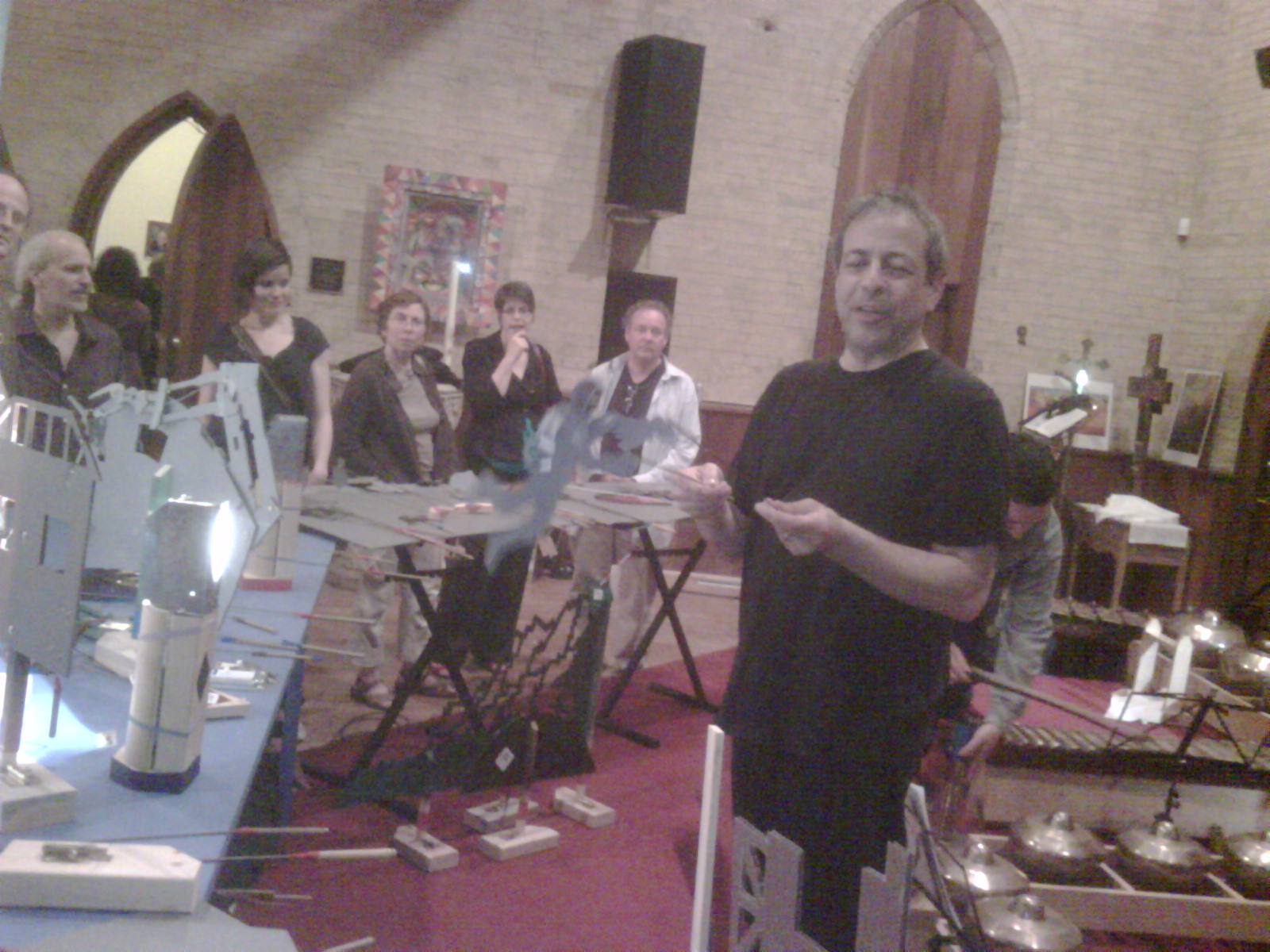
Playwright, puppeteer & percussionist Rick Sacks, showing us the magic behind his Smoid. David Powell, the puppet master, is immediately beside him.

There are nine musicians in Evergreen Club Contemporary Gamelan(aka “ECCG”), and judging by the works presented tonight, this is an ambitious group eagerly embracing new disciplines & styles, while welcoming a diverse assortment of collaborators.

I was drawn to this week’s program by the concluding item on the bill, namely The Adventures of the Smoid, a new dramatic work by Rick Sacks. I’d heard that David Powell of Puppetmongers had assisted Sacks, not only in designing shadow puppets to tell his story, but in training some of the ECCG musicians in shadow puppetry.

It reminded me of what I’d seen from the Canadian Opera Company in 2009. Just as Robert Lepage’s production of Stravinsky works had led the COC to employ opera singers as puppet manipulators, so too with Sacks’ work for ECCG.

Evergreen Club Contemporary Gamelan

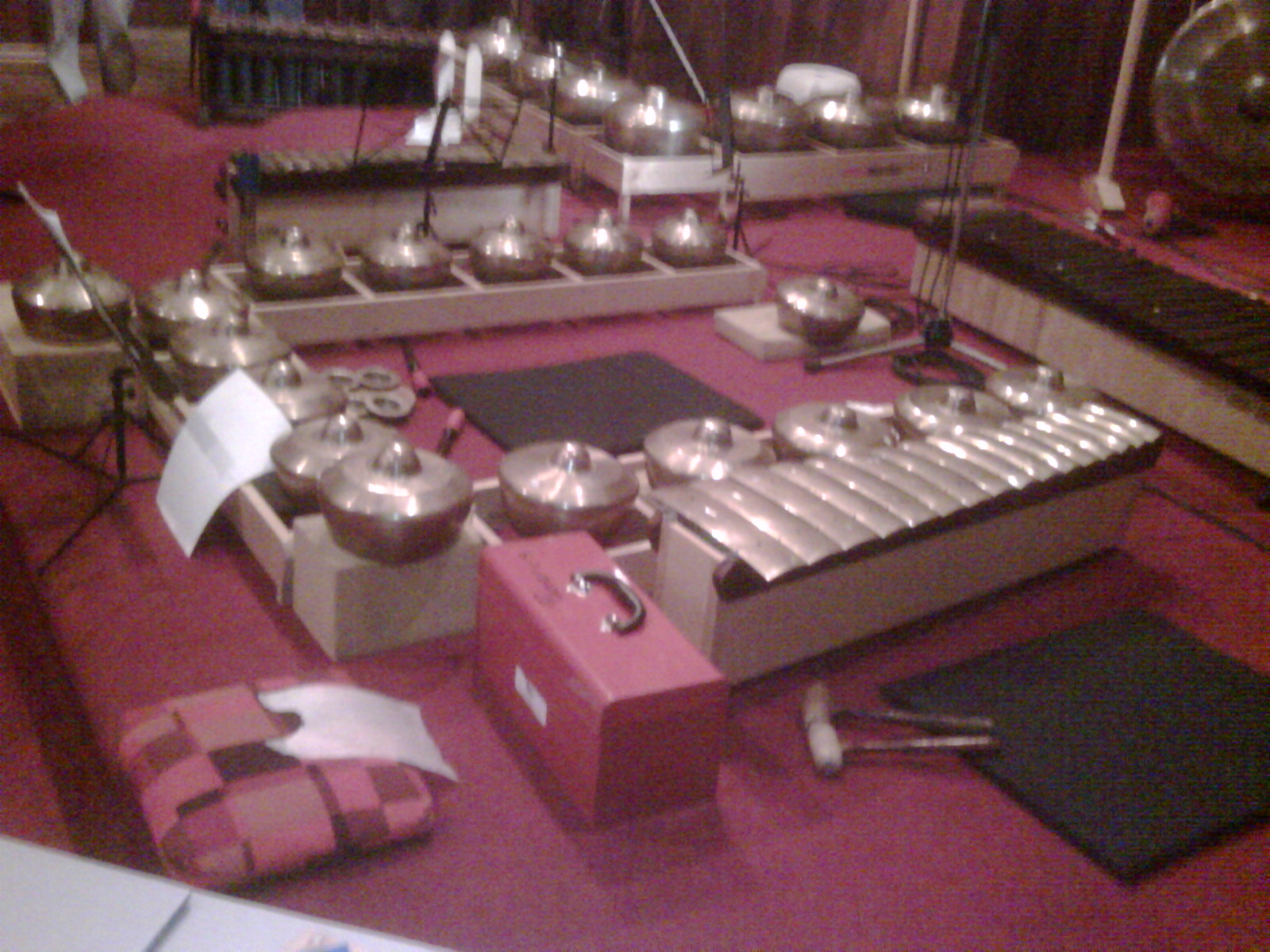
A glimpse of some of the Evergreen Club Contemporary Gamelan instruments.

Without giving too much away, let’s just say that The Adventures of the Smoidis an unpretentious tale suitable for children but sophisticated enough for adults. This shadow puppetry will wow any audience, particularly with the gamelan accompaniment. While it’s a simple story, there are picturesque moments throughout that keep you riveted. I was as excited as a small child.

After the performance Sacks and company invited us behind the projection screen for a question –answer session whereby we could see how it was all done. In some respects the illusions seemed more rather than less impressive when we saw the simplicity of the design & execution.

The remainder of the evening was completely different. Titled “Tribute to Nano S.” the first half of the programme consisted of a series of songs honouring the master Nano Suratno. The five songs married the acoustic subtleties of ECCG, including some microphones, with the electronic wizardry of turntable duo INSiDEaMiND.

INSiDEaMiND aT WoRK

Four of the five songs began with something electronic –a drone, or an ostinato—supplying a rhythmic hook for the song that followed. The nine members of ECCG joined in with the electronic rhythms of INSiDEaMiND, a pulsing hybrid that wouldn’t be out of place in a dance-club yet one still sufficiently artsy for a Music Gallery crowd. After having experienced La Bohemelast week in the Tranzac Club, I couldn’t help but wonder how a site-specific performance might galvanize ECCG with INSiDEaMiND. The last item in the first half—a traditional Palestinian song with an infectious rhythmic hook—had me wondering how people could keep their seats, given my own impulse to get up and dance.

The vocals by Jennifer Moore and Maryem Tollar were almost subliminal. When I consciously attempted to decipher the lyrics I was somewhat frustrated, but when I relaxed and surrendered to the dense texture I found myself presented with gifts of a clear phrase here and there, in several languages. As with so much on this occasion, I let it all wash over me, not too worried about making sense out of the proceedings, so much as to revel in the sensations. Our ears were in safe hands, as there wasn’t a moment that wasn’t beautiful.

The ECCG program –the five song Tribute to Nano S, and The Adventures of the Smoid—is to be repeated 8:00 pm Tuesday June 14th at the Music Gallery.

Posted in Reviews | Tagged , , , , , , , , , , | Leave a comment

Placido and Sondra

 Placido Domingo

Tenor, baritone, conductor, and impressario, Placido Domingo

Tonight’s Toronto concert by Placido Domingo with Sondra Radvanosvky was the proverbial “happening”. Held in a converted tennis stadium enjoying its christening as a musical venue, we were watching their faces on a jumbotron, hearing a wall of amplified sound, in a mix of opera & popular songs. I was reminded a few times of the first Three Tenors concert, on the eve of the World Cup in 1994, whether via the repertoire of songs, or the genial tone.

While the concert was not without its glitches the crowd (I’d estimate it at somewhere around ten thousand) was in a forgiving mood. Jet planes coming to and from the nearby airport regularly piped up, as if auditioning for parts, occasionally in the right key. A cold breeze that might have helped carry homerun balls to the outfield did nothing to dampen the enthusiasm of the crowd.

Placido Domingo is a seventy year old man with at least four operatic incarnations:
• Tenor
• Conductor
• Impresario (artistic director first in Washington, then Los Angeles)
• Baritone…(!?)

On this occasion we mostly saw and heard the baritone, as the tenor isn’t available very often. The opening aria (from Le Cid) was the one genuine tenor aria. In addition Domingo sang the duet at the conclusion of Act I of Otello, although partway through they modulated down a semitone, so that the high note was now less of a challenge.

But that’s all quibbling. The man is 70, and is already defying the calendar & the odds, and he has been living in this borderland for awhile now. Heldentenor roles like Siegmund require more of a baritone’s colour with the occasional high note thrown in.

While the audience was thrilled, to me the baritone rep sounds a bit odd. In the duet from Simon Boccanegra, where father sings to his daughter, although the visual impression was right, the sound is different than what we’re accustomed to hearing from a baritone. In ”Nemico della patria” the notes come out almost too easily, but they’re not aligned in the usual ways. Those at the bottom are hard to hear, while those at the top of a baritone’s natural range sound relatively easy. While I dislike stereotyping, I’d have to say that Domingo is still a tenor, but unable to hit the high notes any longer.

Even so the audience ate it up, and I have to admit i thoroughly enjoyed myself.

a picture of Sondra Radvanovsky

Soprano Sondra Radvanovsky

I had already had a day of Radvanovsky, hearing her Aida on CBC this afternoon (recorded months ago); she gave us the vocal highlight of the evening during the encores. After saying how good it felt to sing in front of the hometown audience, to a warm ovation, she sang a very impressive ”vissi d’arte,” from Tosca.

Radvanovsky & Domingo were so generous with their encores that I lost count (somewhere around six i believe!), watching them happily return to the stage over and over again. The other big moment was clearly understood to be the finale of the evening, when Domingo unexpectedly took up the baton to conduct the Black Creek Festival Orchestra and Chorus in a brisk “Hallelujah” from Messiah, climaxing with fireworks.

Wow.

Posted in Reviews | Tagged , , , | 2 Comments

Bohème against the grain

composer Giacomo Puccini

composer Giacomo Puccini

It’s been attempted before: taking that well-known and perhaps overly-familiar opera, Puccini’s La bohème, and reinventing it. Baz Luhrmann tried it with some success. So did Jonathan Larson, with Rent (another success).

You can’t blame people for wanting to attempt to tease something new out of Bohème, when it’s already one of the most popular operas.

Arguably an opera this familiar needs a makeover. As far as I can tell, that’s the raison d’être for Against the Grain Theatre, a new company that has sprung to life in the past few months.

If you know the Tranzac Club on Brunswick Ave you might wonder how opera could be presented there.

The Tranzac Club

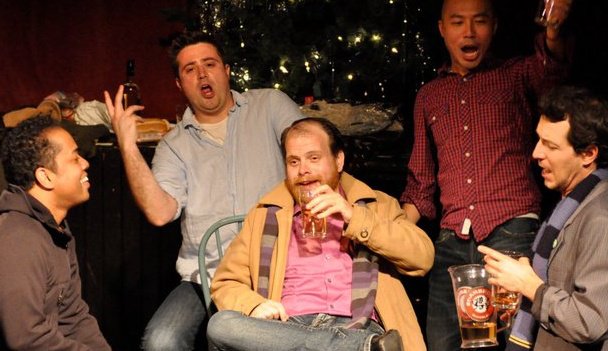
How? A purist might be aghast at the idea of sitting with your beer, listening to Bluegrass (a charming ensemble called Houndstooth) just before the opera. The Tranzac club is a very unpretentious establishment, not to be confused with an opera house. Does the word “opera” conjure people dressed up for the evening? And please excuse me, that’s not what opera is to me, particularly considering the many attempts by directors & producers to break free from that image; but the stereotype is still a useful and relevant departure point. If you understand opera as a precious flower too delicate to be uprooted from its native soil in the opera house among the usual audience, perhaps the Tranzac club won’t work for you. It’s ironic considering that La bohème is above all, an opera about poverty, about people unable to afford heat in their home with barely enough to eat. Trucking out Rodolfo and Mimi in fake rags in a splendid theatre before rich patrons is a rather troubling notion when you think about it.

Happily we have another option. Against the Grain gave us something completely different.

We brought our drinks into the performance space –more of a beerhall than a theatre—seating perhaps 100, with a full house of sympathetic patrons. The Spartan set & costumes suggested poverty before we heard the first words from Rodolfo & Marcello, cold & hungry before our very eyes. Sung with piano accompaniment, we heard a very edgy new English translation adapted by director Joel Ivany. Marcello’s declaration, I’m freezing cold here” becomes “it’s fucking cold in here.” Benoit gets called a man-whore. These aren’t gratuitous, but rather attempts to make the opera live. And so our bohemians have an instantaneous authenticity in the grungy old bar.

Photograph of the bohemians and their landlord

Hearing the romantic exploits of Benoit: (L-R) Justin Welsh (Marcello), Adam Luther (Rodolfo), Gregory Finney (Benoit), Keith Lam (Schaunard) and Stephen Hegedus (Colline)

It doesn’t hurt, also, that the singers are young and attractive. Adam Luther is a handsome young Rodolfo capable of a lovely sound and reaching all the high notes with ease, surrounded by an equally youthful group of bohemians, . Laura Albino plays a darkly serious Mimi, unpretentious and still. When her passion comes to the surface, as it does in her arias, she gives us something extraordinary. She’s a Mimi who finds the delicate balance between the humble seamstress only wishing her artificial flowers could live, and the bubbly exuberance of a woman newly in love.

Justin Welsh’s Marcello was a likeable fellow, with a mellow sound and no malice, reminding me a bit of Anthony Quinn as Gaugin (in Lust for Life). Lindsay Sutherland Boal brought a genuine glamour to Musetta. I came to this show, knowing it was to be set in this bar-space, hoping that the scene in the Café Momus would be especially lively when played to an audience also sitting at tables with drinks. When the café scene really clicks, we should be unable to take our eyes off Musetta in her big scene in Act II, and that’s precisely how it was. While Musetta seductively toyed with Marcello, Ivany was playing with us, making the entire audience crane their necks to follow Boal around the room.

Against the Grain’s production of La bohème continues for three more performances this week, namely Friday-Sunday, June 3, 4, and 5 at 8 pm, at The Tranzac Club.

Posted in Opera, Reviews | Tagged , , , , , , , , | 1 Comment

Che faro senza COC?

COC logoTonight, my last opera of the Canadian Opera Company 2010-2011 season, was my second trip into the special world of Robert Carsen’s Orfeo ed Euridice.

I didn’t talk about the visuals in my review (awhile ago) because I strive to be spoiler-free, so that I don’t ruin any special surprises in the staging.  Now that the run is ending I can safely talk about Carsen’s collaboration with designer Tobias Hoheisel.

At the opening Euridice’s body is borne by the chorus upon a bleak, flat landscape of ashes and sky.  It doesn’t get much more minimal than this:

  • The chorus in their plain black and white clothes
  • Fire burning in a pot
  • A hole in the ground

Lawrence Zazzo as Orfeo; Photo Credit: © 2011 Michael Cooper.

Orfeo, portrayed by Lawrence Zazzo, waits at her graveside, issuing the most heart-rending “Euridice” I’ve ever heard.  Clearly this is not to be the refined, rational Orfeo we usually encounter, mastering his grief in orderly verses & song, but a man so grief-stricken as to attempt suicide: prevented first by chorus members, and later by Amor him/herself.

In a world of such restraint (when we remember both the terse vocabulary of this reform opera and the minimal mise-en-scène) a tiny gesture can be powerful.  In the underworld, the dead shake off their grave-clothes like butterflies being reborn as Blessed Spirits, a moment for once matching the eloquence of Gluck’s music.  The clean images of the first scene start to resemble theology, when we see these spirits lifting pots of fire and ash.

Isabel Bayrakdarian and Michael Schade

Isabel Bayrakdarian and Michael Schade; photo credit: Michael Cooper.

Aside from Zazzo, the most impressive performance by a character was that chameleon providing the backbone for so many operas this season, namely the COC chorus.  Carsen foregrounded individual members of the chorus without fear, because they’re so strong dramatically.

The excellence that’s now becoming the COC norm has me wondering: can they live up to this high standard? Am I now permanently spoiled, expecting near-perfection every time out? and what will I do until next season?

Thankfully the CBC Radio2 are ready to satisfy my withdrawal symptoms.  Saturday May 28th we get a flashback to the COC’s winter production of The Magic Flute, starring Michael Schade, Isabel Bayrakdarian and Aline Kutan.

Posted in Opera, Reviews | Tagged , , , , , , , , | Leave a comment

Always the Bridesmaid

 in Time Magazine

Kristen Wiig photographed by Peter Hapak for TIME

I saw Bridesmaids tonight.

If you watch Saturday Night Live you know Kristen Wiig.

In passing, I’ll acknowledge that you might be one of those people who used to watch SNL.   Fine, you don’t want to admit that you watch the show anymore.  Saturday at midnight alone, without any sort of surveillance, who knew if you were surreptitiously watching the monologue or the fake news…?

I make no bones about it. When I am awake on a Saturday Night I watch SNL, and don’t waste time comparing it to previous casts.  When I simply want a laugh, SNL has been a good friend over the years.

And so, whether you’re a closet SNL watcher or honest about it, chances are you know Kisten Wiig and her recurring characters:

  • Target Lady
  • Penelope, the champion of one-upmanship
  • Gilly, the troubled schoolgirl
  • Doonese, the backup singer with deformed hands
  • The actress (Google tells me her name is “Mindy Grayson”) on Secret Word (a show parodying the old show Password) who is too dense to play the game

While SNL has been a springboard for many careers, it’s also true that some of the biggest TV stars failed to make the transition to film.  For all the success of those such as Mike Myers and Adam Sandler, there are also those like Dana Carvey who failed on the big screen.  Tina Fey is among the first of the female SNL regulars to hit it big, whether with her own show 30 Rock or in such films as Date Night and Baby Mama.

The secret to their success may be that Myers, Sandler & Fey produce and/or write their material.   And so, too with Wiig in Bridesmaids, a film currently enjoying a triumphant success all over North America. How successful?

  1. Pirates of the Caribbean  took in $91 million in its first weekend, having cost an estimated $250 million to produce
  2. Bridesmaids has taken $21 million in this its second weekend, for a total of $59 million, but having cost only $32.5 million to produce
  3. Thor dropped from top spot with a take of only $15.5 million, for a two week total of $145 million, having cost $150 million to produce.

While the expensive juggernauts should manage to cover their expenses (Thor likely will do so within a few days), Bridesmaids has already returned double on the investment, and shows no signs of running out of steam.

In some ways it’s a disturbing film.  Wiig’s character  –Annie— like so many others she has portrayed before, is once again an oddball.  This time we’re not watching sketch comedy, but a fairly realistic film.  Yet we’re laughing.  I can’t pretend to understand this – perhaps something about Wiig herself? – that somehow makes us feel okay about laughing at someone going through a series of unpleasant experiences.

Watching the film –in a theatre full of patrons laughing uproariously—I hoped this meant success for Wiig.

IMDB tells me she has another film in the works for 2012, namely Friends with Kids.  Among the stars named for the film are fellow SNL alum Maya Rudolph, whose chemistry with Wiig is one of the special pleasures of Bridesmaids and Mad Men star John Hamm, also in Bridesmaids playing an uncredited role (and one of the funniest people in the film).  While Hollywood seems to be a place of big-budget contracts & deals, it’s nice to see actors appearing in projects with one another, suggesting that they’re simply friends.  First Hamm appears in Wiig’s film.   Hamm & Wiig will then co-star in Friends with Kids, written and directed by Jennifer Westfeldt, identified a few places online as Hamm’s girlfriend.

I can’t wait.

Posted in Cinema, video & DVDs, Popular music & culture, Reviews | 1 Comment

Lepage’s Walküre, or “Welcome to The Machine, part two”

It doesn’t matter how big they are.  Whether we’re speaking of fame or stature, every singer in the current Metropolitan Opera productions (both Das Rheingold and Die Walküre) directed by Robert Lepage & his Ex Machina group shares the stage with a bigger star.

Bryn Terfel

Bryn Terfel as he appeared in the publicity for last year’s Das Rheingold at the Met.

Bryn Terfel may be six foot four, but he is dwarfed by The Machine: the burly forty-five ton behemoth of a thousand shapes and configurations.  The Machine can impersonate mountains, trees, or any shape in a landscape.  The Machine can be a troop of flying horses, ridden by Valkyries.  The Machine can be a projection surface for slides, flickering fire, avalanches, or shadow puppetry.

And The Machine can be temperamental as a Prima Donna, it seems.  Saturday’s High Definition broadcast was delayed for about 40 minutes.  From what we were told on air technicians were being careful and so had to be certain that the device would perform as required.  Given the recent high-profile scandal centering on stunts and safety surrounding the production of Spiderman: Take Back the Dark such cautions are perhaps a good idea.  A falling singer quickly inspires gossip and scandal, although i do believe there’s a genuine concern at the Met for the safety of the performers.

One of the magical moments in Das Rheingold

That Magical Ex Machina Machine

Please don’t mistake me for some sort of purist, defending the good old days of opera against the onslaught of modern technology & design.  In fact I am thrilled with Lepage’s work, and not via the partisan loyalty of a Canadian supporting a Canadian artist.  I was merely calling attention to a detail that’s inescapable to those of us who sat through that 40 minute delay.

Before I write my review, I want to also call attention to the inescapable fact that I wasn’t there.  The operas being presented for High Definition broadcast are now receiving a larger audience in worldwide theatre presentations than in person.  I do not know how the comparison works in terms of revenue given that I only paid a tiny sum at my Cineplex, whereas tickets at the Met are considerably more, meaning that one body in person is likely equivalent to several cinema bodies.  But even so, we’d have to assume that the process of opera is being changed by these theatrical showings.

The ideal style of presentation in a big huge venue such as the Met Opera  House is different than what we’d want to see and hear in a camera close-up.  Whereas big gestures and big loud voices are a requirement in the big theatre, those would become a liability on the small screen.  I can’t help but think someone has been thinking of this, considering the subtlety of some of the portrayals seen in the Ring so far.  Both Richard Croft and Bryn Terfel, who sang with great subtlety in Das Rheingold, received boos from their opening night audience, portrayals that were pure magic in the cinematic version.  I felt I had to make that substantial digression because this review concerns the theatre broadcast, and not the version seen in the opera house.

At this point roughly half-way through I am happy to express my admiration without reservation.  Of the Ring cycles presented since the premiere in 1876, the trend in the first half-century was predominantly conservative representational design; a great many since have gone off on conceptual tangents, turning the Ring into a treatise or an abstract template of some sort.  Lepage’s Ring is neither, and I am not sure that there’s an easy label ready for us to apply to what they—Lepage and his collaborative team Ex Machina—have been doing.  I’d like to simply notice the things that work, and give myself permission to enjoy it.  I had a good time at the theatre today, even with the delay.

In the first scene I am sure I wasn’t the only one delighted by the action unfolding as Siegmund escaped his pursuit.  The Machine impersonated a forest admirably.  Once Siegmund came through the wall into Hunding’s dwelling—a flexible presentational space—The Machine seemed to disappear.  So many details seemed right.  For example, if you were in a house with a tree growing through your ceiling, and someone had then stuck a sword into that tree—possibly a normal state of affairs for hobbits or Volsungs, but certainly nothing with which I have any real experience—it seems totally reasonable that after awhile you would get over the oddness of having that sword sticking out of the tree.  Eventually you’d start hanging clothes on it, as Hunding and his wife had been doing.  And because the normal courtship procedure for Hunding and his clan was forcible abduction, it stands to reason that if his wife were to contradict him in front of a stranger that he’d have a tantrum and throw dishes around the table, terrorizing his wife (like the wife-beating scum he probably was).

Lepage’s treatment of Hunding reminds me a bit of his treatment of Fasolt (from the previous opera).  In both cases, I believe we see something a bit different than usual.  Fasolt is the one in love with Freia, the goddess for whom the giants build Valhalla as part of the bargain at the centre of the plot of Rheingold.  Lepage offered us something a bit unexpected, namely a bit of eye contact between Freia and Fasolt suggesting that in fact the relationship might have been at least a little bit mutual.   Similarly, Hunding seems genuinely interested in Siegmund’s story-telling, at least until he gets to the part close to home, involving the recent deaths of relatives.  Both of these are problematic precisely because they’re subtler than the usual two-dimensional portrayals we tend to get.

And there are other examples of human relationships that Lepage explores in unexpected ways.  The brief appearance by the goddess Fricka in Act II of Die Walküre is a key moment in the plot of the opera.  Wotan and Brünnhilde had been happy about the plot developments we’d seen in the first act, namely the flight of Siegmund and Sieglinde away from her husband Hunding; Fricka, goddess of the hearth & home, is outraged and comes to Wotan demanding that Hunding’s rights be upheld.  Even worse in her eyes is the fact that Siegmund & Sieglinde are twins.  Most times Fricka is a rhetorical powerhouse, which is to say, that it’s assumed that any love that might have existed between Wotan and Fricka is long dead.

But that’s not what Lepage gave us.  Bryn Terfel’s Wotan and Stephanie Blythe’s Fricka are more than mere rhetorical antagonists.  At times Blythe is tearful, and hurt; and this current gambit is an error because she pushes him away thereby.  She seems genuinely surprised by how her demands have upset him, and not at all triumphant.  Yes she’s won; but she is now slamming the door on the relationship, and realizes it belatedly.

Ex Machina design

The eyes have it. Photo: Ken Howard/Metropolitan Opera.

In the scene that follows, we encounter a new scenic device.  Wotan is a one-eyed god because he sacrificed an eye as part of the bargain whereby he obtains his power.  During Wotan’s introspective monologue, a gigantic eye appears.  At times it’s used as a surface for the projection of shadow images, at other times  simply a focal point (excuse the pun) for this powerful scene.

Speaking of which, the Valkyries were perhaps the biggest eye-opener for me.  I have never liked the set piece that opens Act III (the celebrated Ride of the you know who) partly because it always felt like a hunk of filler in the opera, bringing the plot to a dead stop in an act where precious little happens otherwise.  Lepage again shows us something very different.  The Machine portrays flying horses, albeit in a somewhat abstracted form closer to a teeter-totter than anything genuinely equine.  Even so, I would say this is easily the closest I’ve come to seeing the Valkyries do their job of riding & collecting the dead (we also saw that in a somewhat grisly decomposed form).  I never expected to like it so much.

But the Valkyries really come into their own after the arrival of Brünnhilde and Sieglinde, again riding an abstract flying beast.  One subtle thing that impressed me was that although Voigt is nowhere near as young as the women playing her sister Valkyries, we still believed the relationship, partly because of the horseplay we’d seen in Act II between father & daughter, partly because of the way Voigt moved.  Given the close-up camerawork, that’s no mean feat.  I have seen so many other productions where a combination of diva body-language, size and age, or simply bad staging conspire to make Brünnhilde seem different from her sisters.

What follows is a scene working in a way I have never seen before, a display of genuine passion and tears that serve as a perfect counter-balance to Wotan’s anger.  Instead of a sudden abrupt tonal change with Sieglinde’s mournful lines, there was a logical through-line I’d never seen before.

And I found the last scene between Brünnhilde and Wotan especially effective.  I say that even though I was not fond of Deborah Voigt’s Brünnhilde; all the more reason to be fascinated at the magic in the final scene.  The third star onstage with Terfel & Voigt –The Machine—was not a scene-stealer, just a subtle contributor to the magic that left me wiping my eyes afterwards.

Terfel played the scene as if he is torn throughout, and at one moment seems to be on the verge of hugging –and possibly forgiving—Brünnhilde: but stops himself.  Playing it this way –not a stern bogeyman who goes all mushy at the end, but rather, someone who is conflicted, has all along loved her, just as he loved Siegmund—makes his final compromise seem inevitable.

Jonas Kaufmann is Siegmund, Eva-Maria Westbroek is Sieglinde: they even look a bit like they could be twins

I haven’t spoken of the excellent performers, which I think are covered in all the many reviews you can find online.  I was amazed at their subtlety in close-up, where many performances are confounded.  I found Jonas Kaufmann as Siegmund & Bryn Terfel were especially believable.

When they offer the encore presentation of the high-def broadcast I wonder whether it will include the 40 minute delay intact?  In Toronto the encore is scheduled for June 18th.  Live? The Met season is over, but after the 2011-2012 season, the Met will be presenting three complete Ring Cycles.  If you’re interested you might consider buying tickets now; but so far at least, tickets are only available to Met subscribers or contributors.  Hmmmm….

Posted in Opera, Reviews | Tagged , , , , , , , | 5 Comments

Rheingold by Request

Rhine-maiden Rage

Rhine-maiden rage: they want their Rheingold back.

A concert performance of Wagner’s Das Rheingold can be many things, but above all, it’s a colossal job.  For almost three hours, a group of singers breathes life into Gods, giants, dwarves, and Rhine-maidens, while a pianist impersonates a huge orchestra playing possibly the most colourful score of any opera ever written.  And just to make it really interesting, Wagner doesn’t put any intermissions into that near three-hour test.

Tonight the audience for Opera by Request’s Das Rheingold watched and heard Bill Shookhoff  impersonate a  giant, providing the backbone for the performance.  The undulations of the river, the pounding of the Nibelungen hammers, the thunderstorm and rainbow that followed, were all conjured from the piano by the magician Shookhoff.  He was the true star of the show.

William Shookhoff

William Shookhoff

In the cast, there were several impressive performances.  As Wotan, Andrew Tees’s voice definitely has the appropriate heft and power for Wagner, powerful top to bottom, and especially bright at the top.  Alla Ossipova made a wonderful impression in the dual role of Fricka, and an especially powerful Erda.  Lenard Whiting showed a broad range of vocal colour as Loge.

John Holland was a very theatrical Alberich, while Nick Gough was persuasive as his brother Mime.  Dolores Tjart anchored the Rhine-maidens as Woglinde, and also made a sympathetic Freia.

Opera by Request return June 10th for Verdi’s Un Ballo in Maschera.

Posted in Opera, Reviews | Tagged , , , , , , , | 1 Comment

Adrianne’s Ariadne

Adrianne Pieczonka

Soprano Adrianne Pieczonka

You know you’re an opera fan when___ .  There are lots of ways to complete the sentence, but how about this one(….?): you know you’re an opera fan when you come out of the Lion King, humming Ariadne auf Naxos.  True I saw Lion King Tuesday night.  I saw Ariadne April 30th .  Richard Strauss stayed with me better than Elton John.

Of course I was also buzzing because I knew I’d be seeing it again: tonight in fact.  The cast was slightly different, as I got a look at Adrianne Pieczonka as Ariadne.

I have to wonder.  Has she been resting? Or on a  different regimen?  Not only did I find that her face looks a bit different, but she sounds different.  I’ve never seen an Ariadne smile so much;  the first half of the role especially, often gets a gloomy interpretation, but not Pieczonka.

 I last saw her as Leonora in Fidelio back in 2009, opposite Richard Margison, with whom she again takes the stage.  The voice sounds stronger and more self-assured.  Granted, Ariadne is not a long role, but even so, I was amazed at how easy the whole thing seemed.  At times she seemed to be holding back, with lots of voice in reserve.  I wonder whether she’s now ready to undertake more demanding roles?  The Siegfried Brünnhilde for example (the smallest of the three Brünnhildes) seems easily within her reach.  The voice had a kind of pop to it that I haven’t heard before.

Deeper into the run, Neil Armfield’s production ran better than it had on opening night, starting with Pieczonka, who managed a couple of comic moments with the commedia folk upstaging her, yet brought a noble stance to her Ariadne.  Her smile–which i mentioned– really added a dimension, so that even in the passages where she wasn’t singing, she was always interesting to watch.

The commedia figures(John Easterlin, Peter Barrett, Michael Uloth and Christopher Enns) didn’t try quite so hard this time, which made them funnier.  When there was a lazzo, we got lotso silliness, but I felt there was less of the scrambly energy that I saw on the opening night when I felt they inadvertently upstaged one another.  While they’re all better, Barrett in particular has improved as Arlecchino, simply by relaxing.

Jane Archibald as Zerbinetta, surrounded by her adoring admirers

Jane Archibald as Zerbinetta, surrounded by her adoring admirers

The commedia quartet are a  great backdrop for Jane Archibald’s Zerbinetta, owning the stage whenever she wanted it.

The trio of nymphs (Simone Osborne, Lauren Segal and Teiya Kasahara) sounded more musical, absolutely perfect in their pitch tonight, and blending wonderfully with one another.  I am a complete sucker for Echo’s lines.  Echo repeats what others have said as if she were a little bit demented: because she IS Echo.  Kasahara brought a touching naivete to her delivery, adding a wonderful pathos throughout.

And it was a special pleasure to once again watch and hear Andrew Davis lead the orchestra.  His pacing is brave to say the least, with a breath-taking tempo in the nymphs’ set-piece introducing Bacchus, and always brisk & energetic.

It’s a bit shocking to look at the calendar, and recognize that May isn’t half over yet.  The COC still have until May 29th:

  • Four Cinderellas (May 13, 19, 22 & 25)
  • Six Orfeos (May 14, 17, 20, 24, 26, 28)
    and
  • Five Ariadnes (May 15, 18, 21, 27 & 29)

I am seeing Orfeo again.  I wonder if I can resist the other two operas.

Posted in Opera, Reviews | Tagged , , , , , , , , , , | 2 Comments

Lion Taymor

Director Julie Taymor

Director Julie Taymor

I knew I was going to use a punny headline of some sort, this was perhaps the least offensive among my options.  I saw The Lion King tonight, admittedly years after its opening, and awhile after its first appearance in Toronto (this is the King’s second coming).  Everyone’s already seen it so what’s the point of a review?

I noticed a couple of things tonight, and they’re the subject I’ll talk about.

A lot of ink has been spilled concerning Julie Taymor’s Spider-Man: Turn Off the Dark, a hugely expensive musical that drew negative reviews.  I couldn’t help but notice that Taymor seemed to take a lot of flak, something I wondered about.

Has Taymor earned the right to flop? The Lion King is one of several successes.  At the Metropolitan Opera, her production of The Magic Flute does for opera during the Christmas season what The Nutcracker does for ballet companies: cha-ching!  And there are films as well, some (Frida) more successful than others (The Tempest).  I’m particularly fond of Across the Universe, by the way.

I have been thinking about a connection I keep making in my head between Taymor and Robert Lepage.  It crystallized today, when I noticed some interesting parallels.

Man + machine = animal

Man + machine = animal

Both of them seem to like puppets and odd constructions attached to the human body.  Taymor? Tonight I was struck in Lion King by all those fabulous contraptions attached to the characters.  I believe the Spiderman musical was a more daring version going in the same general direction, which is to say, promoting spectacle and theatricality.  Frida, by the way, also explores similar themes of a very different sort; whereas the animals in Lion King are almost cyborgs in their marriage of man & machine, in Frida it’s the human-machine interface in the presence of catastrophic injury and disability. How weird, I think, that we seem to have this parallel thing happening.

From Damnation de Faust

From Damnation de Faust (follow link for more images)

Lepage also is playing with things attached to humans.  In Damnation de Faust we see soldiers climbing walls attached to wires, then –as if slain—hanging on those wires.  Demons dance with sylphs on similar wires, while multiple Jesuses climb the walls in a re-enactment of a crucifixion (not my favourite part of his staging by the way).  In Das Rheingold we watched gods dancing on the end of wires, particularly Loge the trickster god, walking backwards up a wall.  The Rhine Maidens were virtually puppets who could sing, floating high above the stage.

There’s a similarity, too, in some of the critical noises I am hearing.  We heard about the injuries to cast-members in the Spiderman musical, due to the risky aerial manoeuvres.  Something similar—on a smaller scale—happened with Lepage and Die Walküre.  There have been reports of singers slipping on the set.

And I think that’s where I see the parallel.  Both Lepage & Taymor are directors with a heavy investment in elaborate mise-en-scène (both in terms of time and money).  Among the headlines I considered before discarding were “actor envy” and “those who can’t act direct”.   I was trying to identify the conflict I sense between the performers and these two directors.  Both Taymor & Lepage seem to be the stars of their respective work, so much so that it’s almost inconceivable to conceive of a star appearing in one of their shows (and I set Lepage’s Ring cycle aside because of course the Metropolitan will cast their shows with stars regardless of who directs).

Robert Lepage (Canadian Press photo)

Robert Lepage (Canadian Press photo)

I wonder if that explains the flak coming at Taymor & Lepage.  Yes, actors were injured in the Spiderman musical, and someone might have been hurt in Walkuere.   I wonder, though if maybe there’s something else at work, considering especially how gleeful some of the reports became concerning Taymor’s failure.

These two directors seem to supplant the actors / singers one expects to see starring in their works.  I can see how that might put a few noses out of joint.

I am seeing Lepage’s Walküre Saturday afternoon in a Scarborough movie theatre, one of many thousands who’ll also see it live from a theatre somewhere in the world.

Posted in Dance, theatre & musicals, Essays, Opera | Tagged , , , , , , , , , | 3 Comments

COC Orfeo ed Euridice

Isabel Bayrakdarian as Euridice

Isabel Bayrakdarian as Euridice: ashes to ashes. Photo Credit: © 2006 Dan Rest/Lyric Opera of Chicago

Some subjects are so immense that the only way to put them onstage is by making them into opera.  Gluck‘s Orfeo ed Euridice takes on all the major topics—love, death and art –in a concise 90 minute plot.  They don’t get any bigger than this.

Calzabigi’s libretto opens with Orfeo mourning Euridice’s recent death.  Amore (Love) appears to him to suggest that he bring his wife back from the underworld: so long as he does not look back while he leads her forth nor explain the reason for his refusal to look.  Inevitably Euridice is heart-broken by Orfeo’s refusal, leading him to glance fatally upon her.  But Amore accepts this as proof of his/her power, and brings Euridice back a second time, for a celebration of Love Triumphant.

For this tale Director Robert Carsen and Designer Tobias Hoheisel present a world whose very essence reminds us of myth.  We see individuals carrying pots of fire in a colourless landscape of ashes.  In this grey world only Orfeo cries out in passion, an artist and a lover.  The power of beauty is central to the tale, both in Orfeo’s compelling song that calms the savage underworld, and in his inability to resist Euridice’s heart-break.

My favourite moments were Orfeo’s Act II encounter with the Furies and the Blessed Spirits.  Carsen’s underworld is breath-takingly simple, largely due to Hoheisel’s stark design.  Once again the COC chorus are standouts, not just musically, but also as an ensemble of compelling actors.  Credit also belongs to Conductor Harry Bicket and the COC Orchestra, who were all to be commended for their–wait for it–  heavenly sweetness.   I am looking forward to seeing this again.

Ambur Braid

Ambur Braid, who portrays Amore (Love)

I am still trying to decode an interesting approach to Amore from Carsen/Hoheisel.  Love is both God and Goddess, changeable and all-powerful in this world.  Ambur Braid’s portrayal of Love first appears in an apparently male aspect in the first act, reappearing in a female guise in the last act.  I am not sure I understand the rationale; perhaps Love has no gender, or is a shape-shifter able to do anything? I am admittedly fascinated by the question of gender as it has presented itself to me in several operas over the past few weeks.

When we encounter an opera without benefit of visuals—as we might with an audio recording, or if we were blind—some of the voices are ambiguous in their gender coding.  We usually assume low voices, particularly basses and baritones, are male, while high voices are female.  But some characters are much harder to decode without visuals.

  • The Composer in Ariadne auf Naxos and Annio in La Clemenza di Tito are males that are played by women, singing mezzo-soprano: in so-called “trouser roles”.  Visuals do not fully repair the confusion caused by the counter-intuitive sound of a  high voice portraying a male unless the portrayal is as excellent as those seen recently in Toronto (Mireille Lebel making it especially easy with her six-foot swaggering Annio, Alice Coote also persuasive as the Composer).  Needless to say there is great pleasure to be had in that space of ambiguity, whereby we may explore aspects of gender identity.
  • Tito’s friend Sesto, like Orfeo, is a male character who was originally written to be sung by a castrato (an extinct vocal species).  My first encounter with Orfeo was for a baritone with the music transposed.  My first video encounter with this opera starred Janet Baker as Orfeo, although I have since happily met counter-tenor Orfeos.

I have to wonder whether an 18th century audience would be as confused as their modern counterpart at some of the approaches that are used.  And so, I believe the origins of the gender flexibility Carsen/Hoheisel bring to the character of Love arise from the stylistic conventions of the 18th century and the indeterminacy arising from different approaches to the score.

Counter-tenor Lawrence Zazzo

Counter-tenor Lawrence Zazzo, starring as Orfeo

The COC production stars counter-tenor Lawrence Zazzo as Orfeo.  It’s a phenomenal challenge, given that there are few moments in the opera when he isn’t at the centre of the action.  Zazzo offers himself up with complete conviction, singing with wonderful accuracy, his passion carefully balanced with reason.  Isabel Bayrakdarian, who begins to sing comparatively late in the opera, is a beautiful Euridice, convincingly barraging Orfeo with her emotion to the point where he does the unthinkable, thereby causing her death.

With Orfeo sharing the stage with Ariadne and Cenerentola, the current season feels very much like a new plateau for the COC.  I thought of Alexander Neef & Richard Bradshaw.  At this point we can genuinely say that what we’re seeing reflects Neef, almost four years after Bradshaw’s passing in the summer of 2007.  Neef was hired in June 2008, assuming his post in the fall of that year.  That season (2008-2009) as well as the next (2009-2010) still bear the stamp of those who came before.  Only now in the present season (2010-2011) can we say that Neef has really started to show us his true colours.

And what colours.  With Aida and Death in Venice in the fall, The Magic Flute and Nixon in China in the winter, a brief interlude in Brooklyn to export Lepage’s take on Stravinsky’s Nightingale, the season closes with the current group.   This month has been an exquisite month for opera in Toronto.

We shouldn’t be surprised that Neef surpasses Bradshaw, who was both the COC artistic director & chief conductor.  With Johannes Debus to supervise his orchestra & matters musical, Neef is able to concentrate on programming & running the company.

But before we close the book on this season, I’m looking forward to seeing more performances during the month of May.  Orfeo shares the stage with excellent productions of La Cenerentola and Ariadne auf Naxos, the most amazing month I’ve ever experienced from the COC.

Posted in Opera, Reviews | Tagged , , , , , , , , | 3 Comments