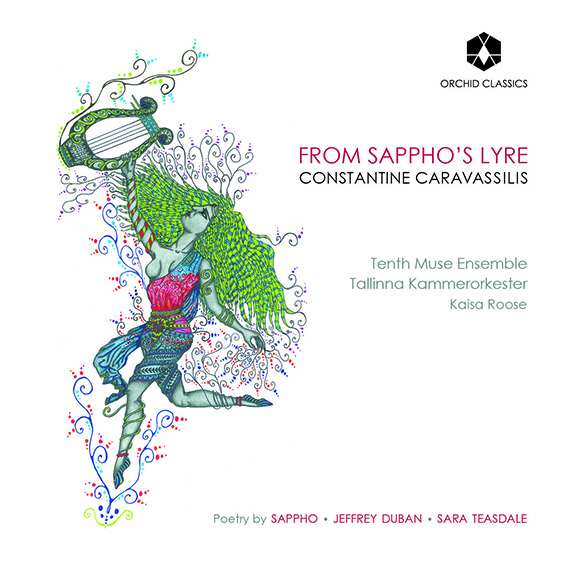
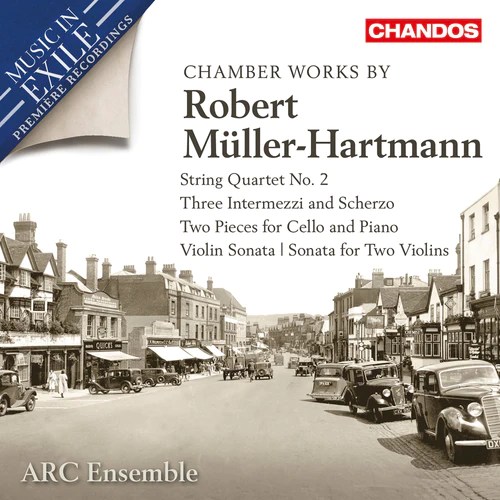
Constantine Caravassilis is the composer of From Sappho’s Lyre, a recording from Orchid Classics of original music played by Tallinna Kammerorkester and Tenth Muse Ensemble and vocal soloists, setting poetry by Sappho, Jeffrey Duban and Sara Teasdale, that might make a good gift for the classically minded listener at this time of year.
When I saw the cover and the sources I was immediately reminded of Pierre Louÿs and his Chansons de Bilitis (Songs of Bilitis), known to readers and perhaps even more famous via Claude Debussy’s settings of the poems of his friend and room-mate. Louÿs was playing games with his audience via the claims of the authorship of the songs, which in fact were his modern compositions rather than discoveries of ancient texts.
In case you’re wondering why I’d be reminded immediately, it’s both as a pianist practitioner, as a Debussy scholar and as a fan of Louÿs having adapted his novel Aphrodite for the stage back in the 1990s. This entire discursive space of the classical poetic realm, whether real or fake, has intrigued me for literally decades.
So it was with some eagerness that I put Caravassilis’ music onto the CD player of my car to have a listen. It’s compelling listening.
Please note, these are modern compositions employing different groups of instruments, vocals and some narration. This is a mammoth recording, including some more modern sounding pieces. But I was especially captivated by the music inhabiting a middle ground between new-age meditative music and songs with more than a few hints of ancient days. Caravassilis shifts back and forth, employing a few different styles and idioms. When he’s in this one that seems like an evocation of the Ancient Mediterranean culture? I’m hooked. No it’s not as if we know what that music sounded like, nor does this really imitate that, but we’re not jarred, not disturbed from allusions and fantasies of the past. Yet it’s as ambiguous and poetic as the wind blowing through an empty amphitheatre. We are in a tonal realm, melodic without being overly virtuosic. The voices address us in a curious middle-ground between passion and ritual, as we might expect for what we know of Sappho.
The music of From Sappho’s Lyre is often very beautiful. These songs have made a pleasant accompaniment to my driving, that I recommend.
For the fan of chamber music seeking something beautiful but unlike their usual music, for the collector who needs something new and different, this is an ideal gift.
About a year ago I was thrilled to attend a concert by the ARC Ensemble playing the music of Robert Müller-Hartmann, a composer who was unknown to me. There’s a European angst lurking beneath the suave surfaces of his compositions. But except for a friendship with Ralph Vaughan Williams he was unappreciated when he came from Germany to the British Isles. Had his life not been so disrupted he’d likely be much more well-known, possibly famous. That’s where the ARC Ensemble comes in.
“ARC” signifies the Artists of The Royal Conservatory in Toronto established in 2003 as The Conservatory’s ensemble-in-residence and now among Canada’s most distinguished cultural ambassadors. Their “Music in Exile” series is the thoughtful work of their artistic director Simon Wynberg finding composers whose music has been suppressed or lost, and thoughtfully bringing it before the public. It feels like a combination of research and activism.
I remember wishing to have a recording of what we heard on that November afternoon at the RCM, recognizing that the ARC team would likely be the first if not the only ones likely to bother bringing this unknown composer to our attention.
Wish granted!
The music heard on that program of November 2022 is reproduced on the new CD. The only difference is a slight change of the order of pieces. Instead of aiming for the kind of climactic effects just before and after intermission that make a live performance a bit more dramatic, the recording flows in a sequence reflecting something closer to the actual chronology of their creation by the composer.
We open with the sonata for Violin and Piano Op 5 (c 1923). That’s exactly a century, something I only noticed by reading earlier today about Maria Callas’s hundredth birthday, on Saturday December 2nd 2023. The sonata has a mournful soulful quality running through its three movements, sometimes racing along but suddenly pausing as if to ruminate on the meaning of life for a moment.
The Two pieces for cello and piano that follow begin gently, the piano softly in support of the exquisite sounds make by Thomas Wiebe. This is not some quick virtuoso piece but rather a gentler exploration of the instrument, probing & passionate reflections as if to say “look what this instrument can do”.
After the restraint of the two cello pieces, the Sonata for Two Violins Op 32 races away from a starting gate powered by a kind of animal adrenaline, the passionate energy of dialogue. After a pair of works with piano, this time it’s a pair of similar instruments sounding remarkably dense in their sound. While I didn’t need to be persuaded when I saw this live, playing it on the CD it sounds like more than just two violins. Müller-Hartmann gives them real meat to chew on with this remarkable piece. At times I’m reminded of the word “counterpoint” even if the imitation isn’t really like that at all. There are phrases that might be a bit like Bach, but no it’s not taking a theme and using it that way. There’s a back and forth that’s at times more of a call and response, sometimes playing with rhythms and shapes, and just when it seems they’re fighting they work together establishing harmonies, playing off of as much as against one another. This work of four movements is deliciously deep.
The next piece had been my absolute favorite in the live concert, the Three Intermezzi and Scherzo Op 22, a revelation at the piano from soloist Kevin Ahfat. There’s a Brahmsian weight to the pianism for the three intermezzi, sometimes taking its sweet time to unfold its ideas as in the first, sometimes deciding to zoom along in fierce patterns tightly organized around a simple concept as in the second or third. That Scherzo is magnificently clean in organization, reminding me a bit of Saint-Saens or Liszt for its demonic energies yet much more modern in its harmonies and tastes. While it’s contemporary with Rachmaninoff it’s more economical, far more direct in its writing. The virtuosity this requires is more like what you find in the Chopin Scherzi, broad gestures requiring octaves and fast movements with both hands. I must find the score somehow even if I’m fairly sure I will not be able to play it up to speed. But even playing it slowly helps me understand what I’m hearing, to appreciate what Müller-Hartmann has achieved. And also to get a glimpse of the back of that passing express train, aka Kevin Ahfat flashing by as he zips through the piece without missing a note.
Finally we come to the String Quartet No 2, Op 38 this time played by everyone but Kevin, namely violins Erika Raum and Marie Bérard, Steven Dann viola and Thomas Wiebe cello. There are four very different movements, the work of a mature composer who, were it not for the work of the ARC virtuosi, would have slipped through the cracks of history, forgotten. I’m especially enamored of the dance rhythms of the second and the drama of the fourth movements, all four contributing to a beautiful whole.
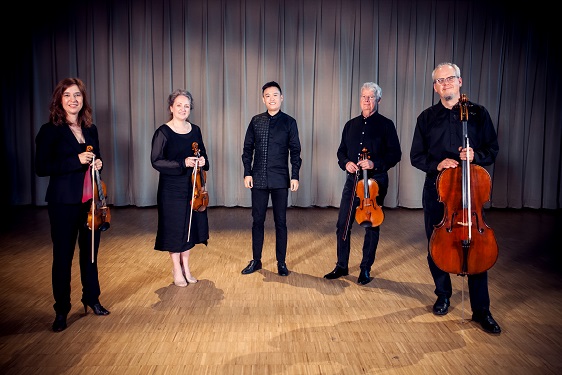
ARC Ensemble: Erika Raum and Marie Bérard (violins), Kevin Ahfat (piano), Steven Dann (viola), and Thomas Wiebe (cello). (photo: Suane Hupa)
The recording is over an hour of music, available through the RCM’s website (click here).
Thursday Nov 23rd felt like a Thanksgiving celebration.
I found a free parking spot on Bernard for one hour. The first 15 minutes were spent walking down Bedford Rd & then Philosopher’s Walk to the Edward Johnson Building for my first visit to the music library since my retirement in October 2020.
Outside the EJB I ran into Peter Johnston the Grounds Supervisor, looking ageless while toiling away in his usual hands on style of work. The whole university seems to be under construction, which can’t be fun for students and is an extra challenge for support staff like Peter. It’s not the first time I feel lucky, grateful to have retired.
The library at the EJB is a treasure.
There I was the morning after a TSO concert that included Mahler’s Fifth and seven songs of Alban Berg. Sure you can find orchestral scores. But I was able to find the piano versions of the songs and a piano reduction of the symphony. That is crazy, insanely useful.
I am thereby able to play the whole massive thing at a piano.
First page of the score
I also found the Liszt transcription of Berlioz’s Harold in Italy, the complete piano score to the Nutcracker, and piano reductions of Night on the Bald Mountain & Les Preludes by Liszt. The collection never ceases to amaze me.
I was headed for home to write the review then play the piano.
But first at the checkout I ran into Jay Lambie, who sang the role of Mozart in both casts of a production of Rimsky-Korsakov’s Mozart and Salieri that we did 25 years ago at the Drama Centre. Moments later I ran into one of the two Salieris, Alex Dobson, still looking as youthful as ever. I briefly showed him my huge haul, almost more scores than I could carry, but Alex told me he had to run to teach at the EJB.
Baritone Alexander Dobson (photo: Melissa Tremblay)
At home I would quickly grab dinner (thank you Erika), write a quick review of the TSO concert, then go play parts 1 and 2 of the Mahler at the piano.
The amazing thing about a piano transcription is how it’s a fantasy. While anyone else may hear the piano, when I do that opening phrase (fantasy) I hear that trumpet in my head. The crescendo that follows is still on a scale of piano solo, but one dreams of the huge tutti, at least in one’s own mind. Ditto playing other transcriptions. It’s quite a trip.
While TPL are having computer problems, this other library is a dream come true. I was able to find the call numbers in advance, knowing where to look so that I could scoop everything up, and make it back to my parking spot within an hour.
Thank you to the UTL web and IT gurus, and the librarians like Jay, who make it all possible.
The Toronto Symphony’s program for this week is a surprisingly powerful combination.
We open with 17 minutes of passionate singing by mezzo-soprano Emily D’Angelo, seven songs composed by Alban Berg (1885-1935) between 1905 and 1908.
Mezzo-soprano Emily D’Angelo
After intermission we settle in for the hour and a quarter of the Fifth Symphony of Gustav Mahler (1860-1911) composed in 1901–1903, the last decade of his life.
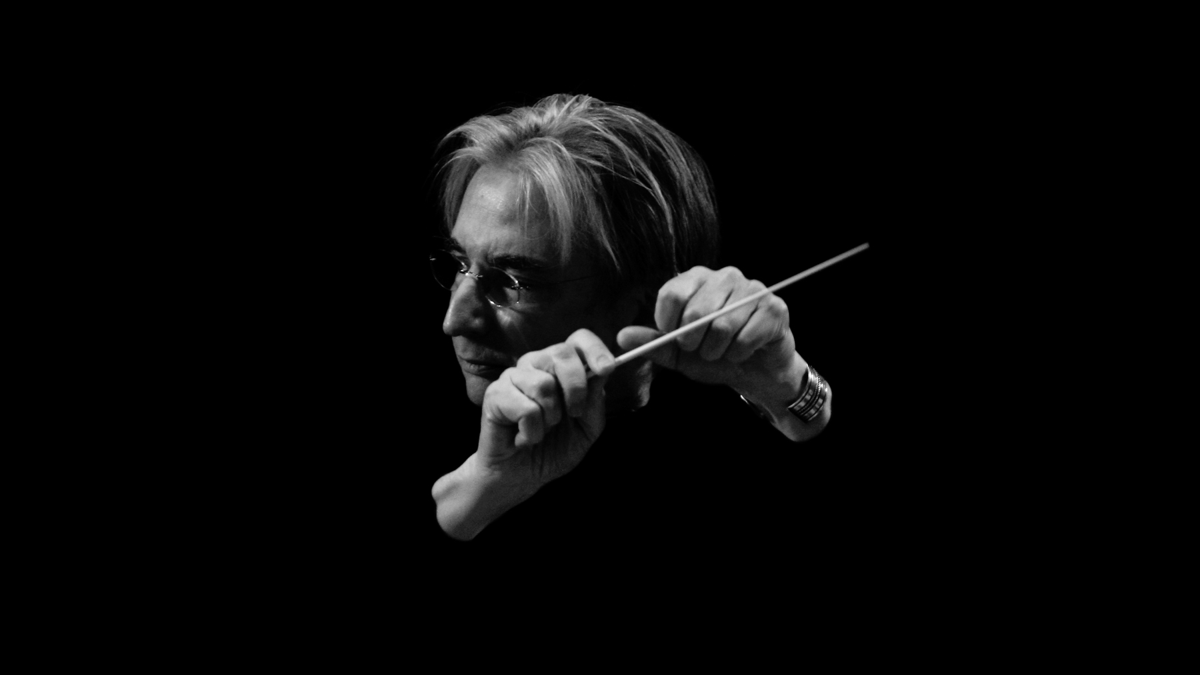
Although Michael Tilson Thomas was to conduct I gather he had to cancel due to his ongoing health concerns, alas.
Michael Tilson Thomas
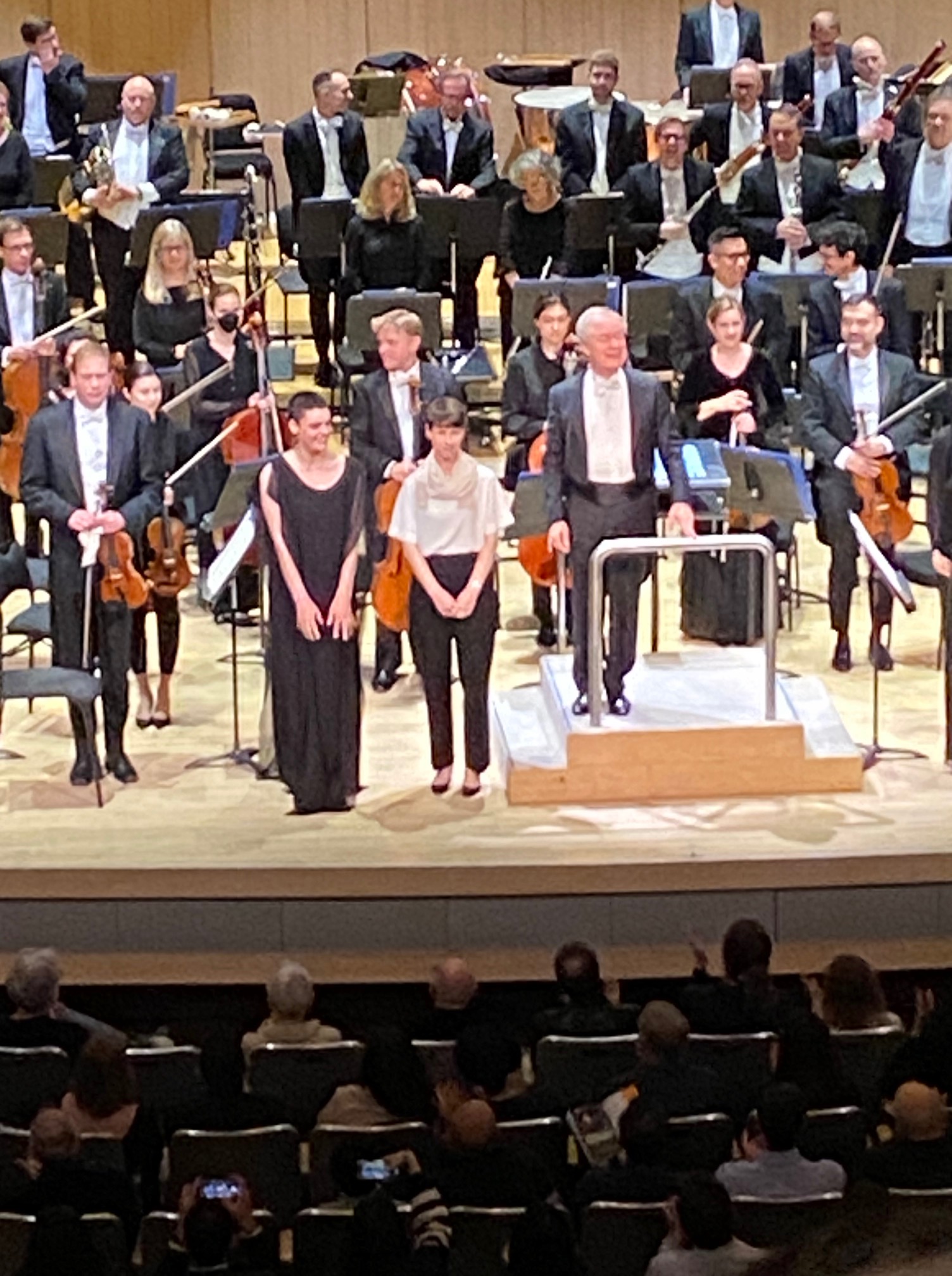
Guest conductor David Robertson made his TSO debut. I didn’t know him or his work but after seeing him last night I was very impressed. In the songs David was as self-effacing as an accompanist, a word that we rarely hear anymore even if those of us of a certain vintage still recall the concept, perhaps best captured in the title to Gerald Moore’s memoir “Am I too loud?” When we came to the Mahler Symphony we saw a different side to him.
Let me speak first of the songs, a version of a pattern the TSO regularly follow, where they put something more challenging to begin with a crowd pleaser afterwards. What’s different this week is that the opener was not just spectacular but in every way the peer of the popular piece that followed. I believe the verdict on Berg’s songs is shifting with time, as programmers stop worrying about how the works fit with the rest of the composer’s output. Who cares what Berg was to become if he could write such spectacular music at this point in his career? It’s a bit mind-boggling that Berg could compose this way in his early 20s (although they were not orchestrated by Berg until much later) the songs showing another less dissonant side to a composer associated with atonality through a pair of operas Wozzeck (1925) and Lulu (unfinished at the time of Berg’s death in 1935).
I’ve had the pleasure of watching and hearing Emily before, a standout in Canadian Opera Company productions of Cosi fan tutte in 2019 and Barber of Seville in 2020. I couldn’t resist listening to her sing Berg songs on YouTube, where their treacherous ambiguities lead some other singers astray. Let’s just say that the best versions you will find are by this brilliant young Canadian, and last night she was again spectacular.
Mezzo-soprano Emily D’Angelo with the TSO and guest conductor David Robertson (photo: Stelth Ng)
I have one small quibble, but it’s not with Emily. I wish that when we’re watching a hybrid work for music with text such as this one at Roy Thomson Hall , that we would have the titles projected with a translation. Sorry if I sound demanding. As Emily started, I saw heads going into the program to figure out what we were hearing. Even a printed text of the songs would be better than nothing. Would you expect to see a foreign film at TIFF without subtitles? Every little opera company in the area (Opera by request, Voicebox, and others I could mention) let alone the COC and Opera Atelier give us translations. How could it be otherwise, when we are listening to singers interpreting words in another language? While Berg does offer us nice music to go with the Mahler, we insult Emily when we are unable to understand the nuances of her splendid singing, even if we did scream our approval.
Mezzo-soprano Emily D’Angelo with the TSO and guest conductor David Robertson (photo: Stelth Ng)
There was an encore that wasn’t in the program. I asked Cecilia Livingston through social media. She was brought up onto the stage for applause after Emily sang the song: a Clara Schumann lied of the poem “Lorelei” (presumably Heine, although I could be wrong), in an original arrangement by Livingston getting its TSO premiere (I mistakenly said “Canadian premiere” but Cecilia tells me that was with the NACO, as I badly paraphrased what Emily said announcing her encore). Again, I wish I had the text before me as I watched Emily’s urgent performance. While we’ve twice seen her in comedy in the two COC shows I mentioned above her intensity in this serious repertoire was hair-raising.
I wonder if there’s anything she can’t sing.
Emily, Cecilia Livingston, David and the TSO accepting our applause
And so we went from the gently supportive work by David in the Berg songs, to something entirely different for the Mahler. There was something to give me genuine shivers running down my spine in every movement. I say that as a devoted lover of this piece. The opening movement fanfares lead us to a softer than usual reading of the string responses, gradually building to some tremendous climaxes. The second movement was urgently spine-tingling, as David seemed to stir up something in the ensemble. The TSO respond to him, playing crisply. As a fan of quicker Mahler I’m grateful how powerfully David urged the orchestra on.
TSO guest conductor David Robertson (photo: Stelth Ng)
We paused before the third movement as horn player Neil Deland took up a position to properly foreground what was to come, his powerful solo work. I’ve heard this symphony all my life, but never seen it done with such a sense of poignant drama. Mahler was a man of the theatre, writing flamboyant moments, ironic passages apt for satyrs or satire (if they’re not the same thing) just waiting for an ensemble to properly seize the moment and take the stage. After allowing Neil to return to his usual seat, giving us another ostentatious pause (useful also in delineating Mahler’s structure dividing the symphony into parts 1, 2 and 3), we were into the gentle Adagietto, which may begin softly but does find its way to its own sort of climaxes. I find it mildly irritating that the part of this symphony that seems to be most popular is the movement that I believe was designed to give the wind players a rest, the soft Adagietto fourth movement. It’s a bit like thinking that the Grave Digger is the most important character in Hamlet, charming as his appearance may be. The Adagietto is that delightful piece of baguette to clean your palate between spicy courses that might otherwise overwhelm you. Of course for those who find Mahler too rich and prefer some Vivaldi the Adagietto is a gentle oasis, a lifeline when you’re drowning in big sounds. I grew up on big sounds so pardon me.
And without pause (observing the composer’s division into three parts rather than five) we were into a more restrained and controlled reading of the finale, one that built up gradually to the silliness of the last phrase. As in Shakespeare, comedy was always lurking.
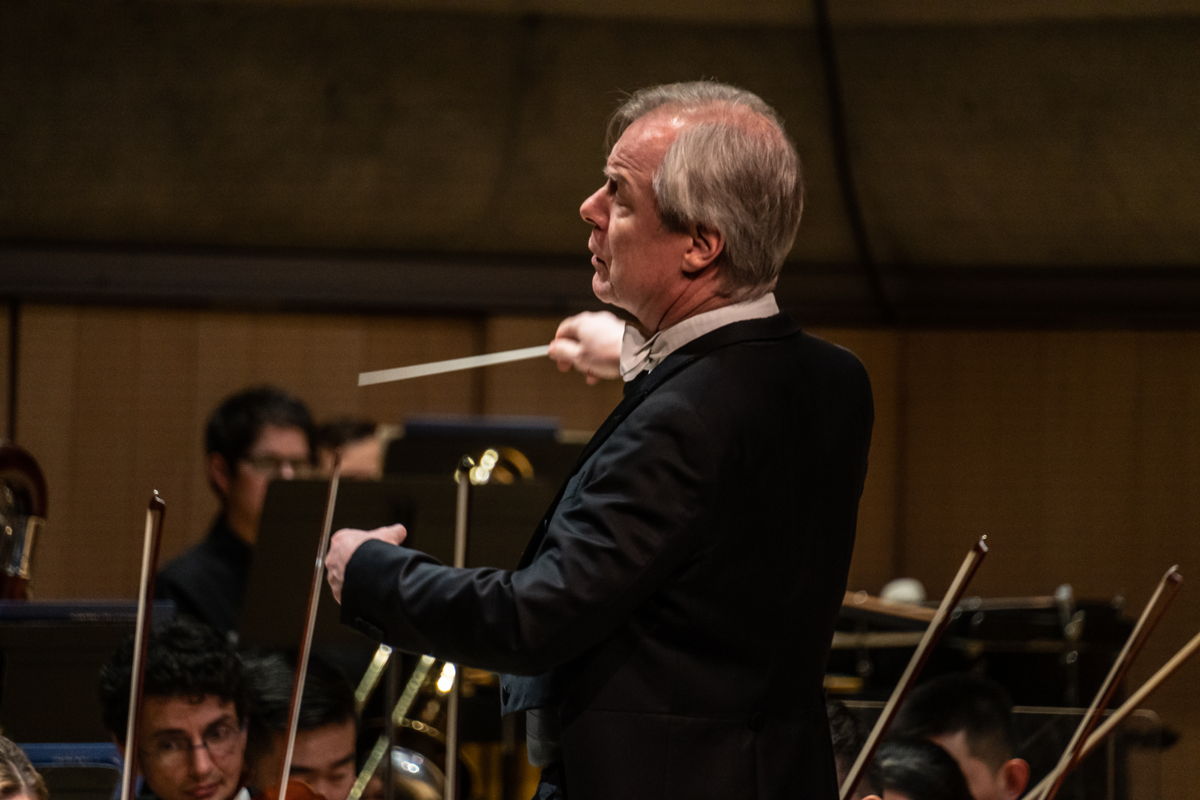
TSO guest conductor David Robertson (photo: Stelth Ng). You can see his perfect posture in this photo.
Athletic? Agile? I’m impressed that David was able to turn his head to face any section of the orchestra while keeping his body aligned in the middle, his feet still square to the podium even as he turns wherever he needs to turn. The last conductor I saw with this kind of flamboyant response to the music was Leonard Bernstein, except David manages to do it without any of the overdone showmanship, working in support even when the orchestra was triple forte. He has the clearest beat I think I’ve ever seen. When the symphony was over David dutifully went about the orchestra congratulating each section, drawing applause. He was like a servant, or maybe a teacher caring for his pupils. But the bond seemed genuine.
I hope the TSO bring him back, he’s a great artist and a lovely man.
The TSO repeat this concert Friday & Saturday night. If you can make it you really should go!
David Robertson photographed in New York City by Chris Lee, 12/13/17.
I’m already wearing a mask every time I go to a store or a show. I’ve had my shots.
For the next little while on this blog I have to be extra careful. I will be changing the focus, seeing fewer live events. Instead I’ll do more interviews, write about books, films, recordings due to persons in my acquaintance who are immunocompromised.
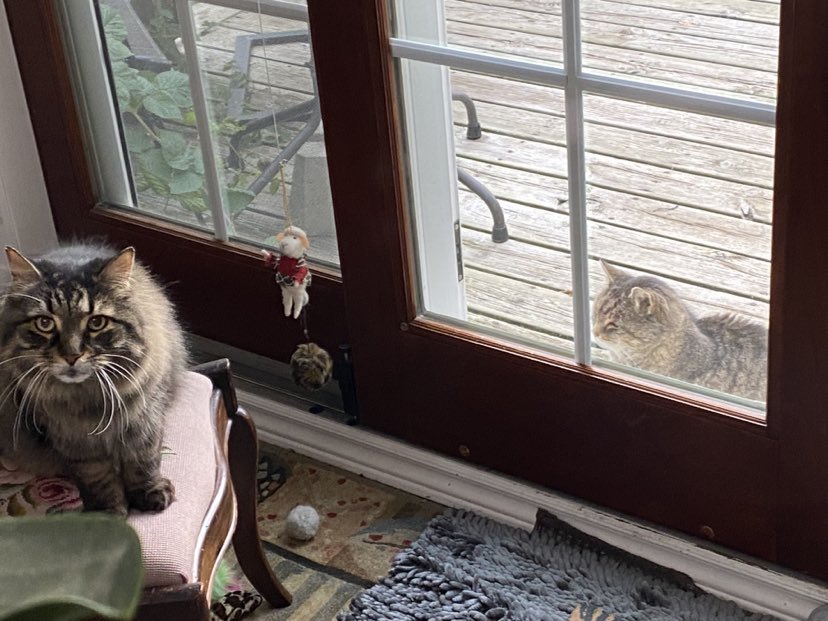
My saggy cheeks tend to look grumpy. Thank goodness for pets who cheer us up.
I played the organ at Hillcrest Church last Sunday.
Some years All Saints (November 1st) and Remembrance Day (November 11th) get separate commemorations. In 2023 Remembrance Day (Nov 11th) falls on a Saturday, making it logical to combine the All Saints celebration of Nov 1st with Remembrance Day Sunday November 5th. It makes sense though, as they’re fundamentally similar in some ways.
The Saints we remember on November 1st aren’t just the biblical celebrities who we know as a name plus the word “Saint”. It’s also a time to recall the pillars of a church, the older members who have built and sustained the community.
For Remembrance Day we’re speaking of those who participated in wars, perhaps in support roles, driving, nursing, helping, perhaps in active combat, at sea, in the air or in the trenches.
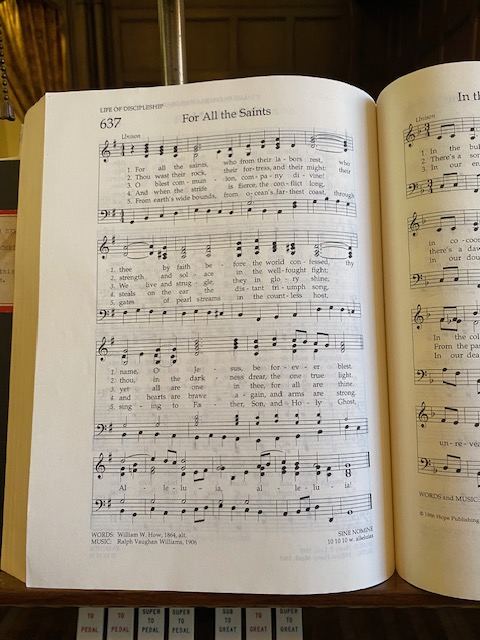
Perhaps it’s because of this funny combination celebration in 2023, that I notice how the hymn For All the Saints hints at a kind of spiritual war in sainthood, speaking to both kinds of sainthood. The tune from Ralph Vaughan Williams lures the organist to play quickly. I believe the congregation appreciate my restraint in not rushing, as it’s not a race. And the words are more intelligible if we don’t go too fast. We lose the opportunity to meditate on the text when we go too fast.
Hillcrest Order of Worship for Sunday November 5th includes the names of congregation members who served in the wars. It brought tears to my eyes realizing that this was the first service in awhile that I would see so many names of friends who were gone, people who were both the pillars of the church and those in active service in wartime.
I remember Bruce Carruthers, with his big handshake and deep voice.
I recall Wally Legge, a friendly photographer with a gentle voice and a ready smile.
And Henry Condie, whose wife Rae regularly read from the pulpit including services where she read In Flanders Fields.
I miss them and others whose voices made music reading from the pulpit, stirring us while reminding us of so much. The Saints of a congregation are also the saints we recall for their service on Remembrance Day. Bruce, Wally, Henry (aka “Hank”) served in WW II, served at Hillcrest where they were friends and avid supporters of the church. And they are now gone.
My mind wanders in the corridors of memory, recalling University of Toronto Schools (UTS) History and English teacher Stewart H Bull, long associated with our cadet corps, but truly inseparable in my understanding of November 11th and Remembrance Day. You could see evidence of his service, one eye that was real. One that was not. I see on his obituary that he was “severely wounded in Normandy in 1944”.
On November 5th in church we had no trumpet for The Last Post or Reveille, so I played these pieces on the organ during the service, with Mr Bull’s lecture in my heart, when he explained the ritual to us in Christian terms. When The Last Post sounds you are going to bed, going to sleep: with no certainty that you will be there in the morning. In wartime, bombardments might prevent you from seeing the sun in the morning. Mr Bull spoke of the meanings of silence, as one waits. It was my first taste of real meditation.
When you hear Reveille you’re called to wake up. It is a typological echo of resurrection, as we’ll hear in Mahler’s 2nd Symphony, the signal not just of the next morning but rebirths.
Playing these pieces one might wish to imitate a trumpet. I did my best last Sunday not to sound too much like an organ, and thank goodness there’s a cornet stop and a trumpet stop to choose from. I found the Hillcrest organ’s “cornet’ sounds like an organ, while the “trumpet” stop is closer. The way I phrase it is also a factor. If I play too quickly I’m sounding like a keyboardist showing off. Slower is more like a trumpet.
My lesson from Barkley was in June.
I made a silly mistake in the yard. He’s so cute when he’s chasing chipmunks or squirrels or mice. He’s a cute carnivore with sharp teeth. I made the mistake of trying to stop him while hunting.
He sank his teeth into my hand, reminding me of the value of patience. I sat patiently in the emergency ward at Scarborough General, waiting quietly for someone to patch me up, even though this wasn’t war merely foolishness with my beloved pet. And since June I’ve been working to recapture my speed at the keyboard, while discovering other ways to be musical.
On Sunday November 5th I played an organ reduction of Nimrod by Elgar as the postlude, a slow piece that doesn’t require quick fingers. Our prelude was a slow improvisation on Eternal Father Strong to Save, a hymn that always reminds me of JFK’s funeral. Slower music is better for remembrance and meditation.
Barkley’s teeth forced me to rethink how I play. In the process I’m being less of a show-off and more of a curator of thoughtful music, while I wait to see if I will ever get my chops back.
Playing the Last Post a bit slower made it more meditative which seems appropriate for Remembrance Day.
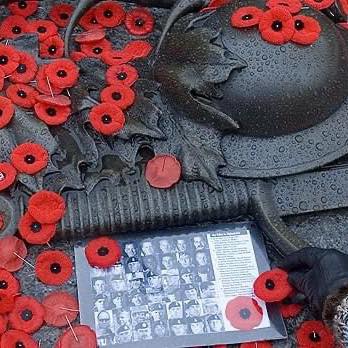
Photo from CBC website: “makeshift memorial to Canadian soldiers killed in Afghanistan on the Tomb of the Unknown Soldier following Remembrance Day ceremonies in Ottawa, Nov. 11, 2006. (Tom Hanson/The Canadian Press)”
Last night Powerhouse Opera presented an abridged version of Wagner’s Tristan und Isolde at Jeanne Lamon Hall.
Powerhouse Opera is a new company begun by soprano Susan Tsagkaris in March 2022, aiming to showcase dramatic / large sized voices with a focus on the works of Richard Strauss and Richard Wagner, two composers especially known for this kind of vocal writing.
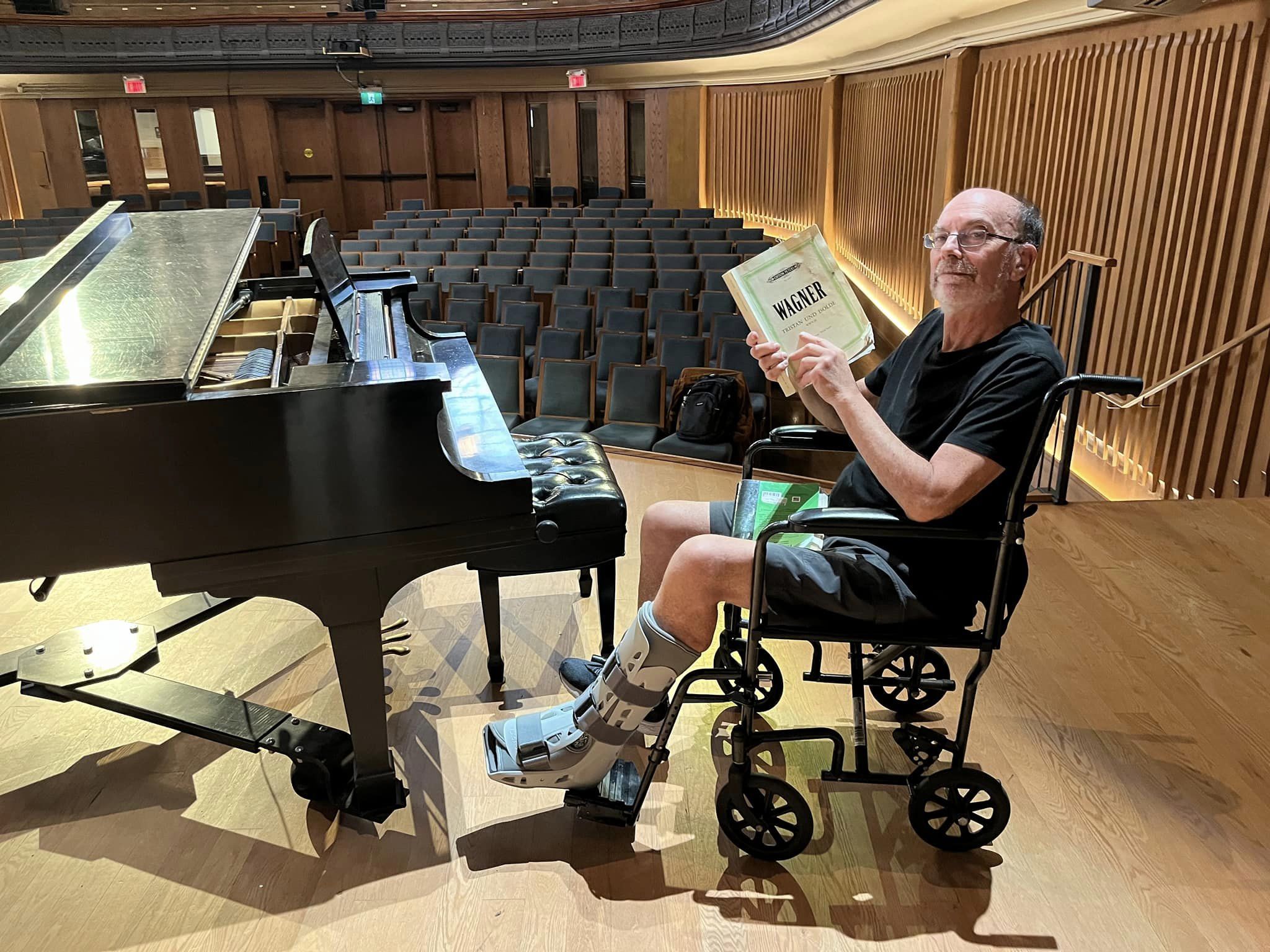
We heard pianist Brahm Goldhamer, playing in spite of an injury to his leg.
Susan said the following during rehearsals, with the following photo: “Nothing can stop a Wagner lover from getting to rehearsal, not even a messed up Achilles tendon! We’re thrilled to have Brahm as our pianist and also thrilled it was his left leg not his right!:-)“
Achilles tendon? Although he came and went in a wheelchair, a cast on one foot that prevented it from using pedal it was brave work from Brahm, whose playing made the bolder choice, often playing the fearless octave passages with big dynamics to match the voices.
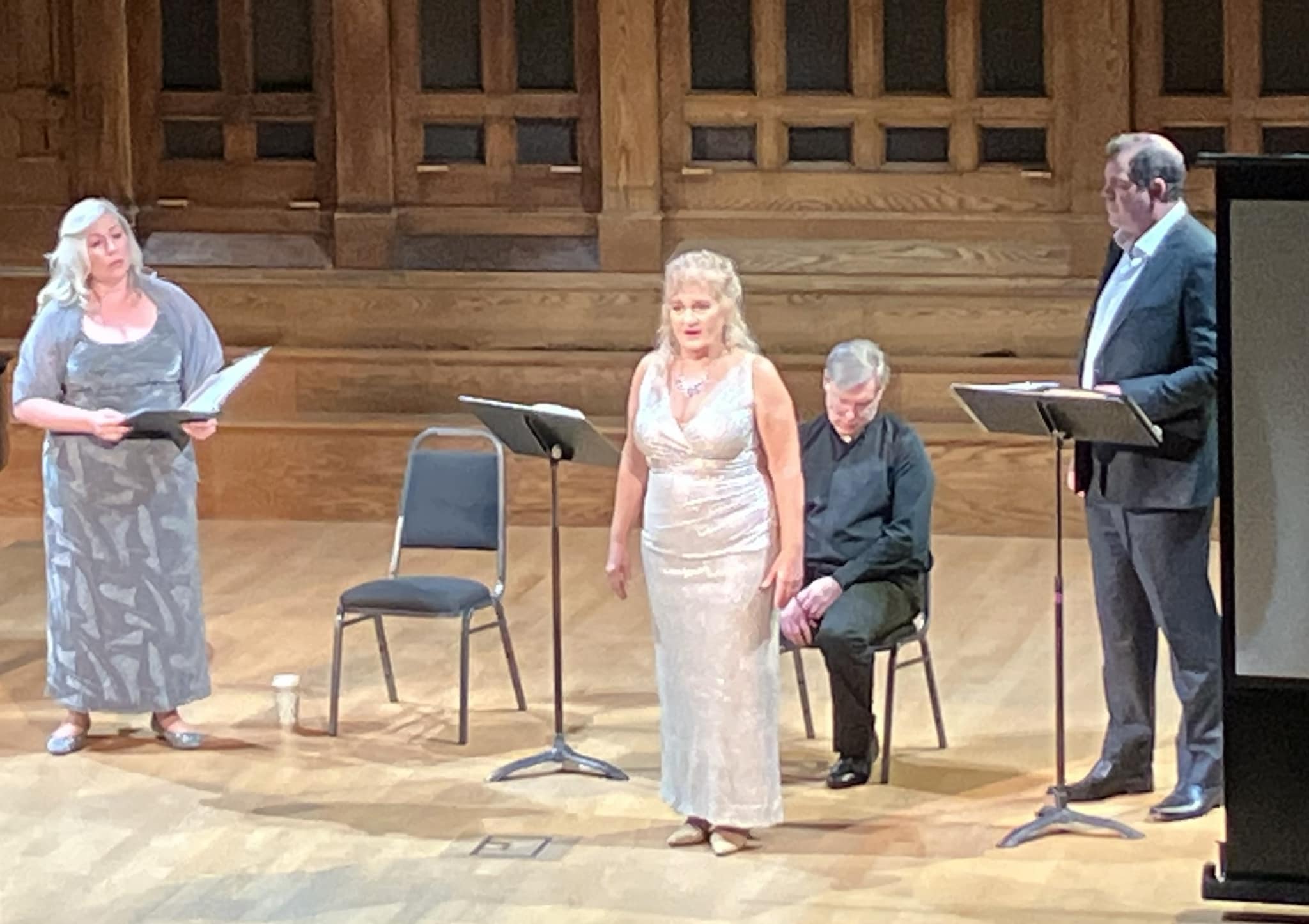
It was a concert performance, gestures and expressions but no real dramatic action enacted. We saw and heard tenor Peter Furlong as Tristan, Susan as Isolde, Catherin Carew as Brangäne, Andrew Tees as King Marke, and Alexander Cappellazzo as the young sailor. The sailors’ chorus we hear a few times in Act I was also accomplished from offstage, perhaps Alexander and Andrew? I don’t know as it wasn’t mentioned in the program.
(Left to right) Catherin Carew, Susan Tsagkaris, Peter Furlong and Andrew Tees.
It was fascinating to watch this shorter version of the music drama widely understood as the beginning of modernism even though it premiered way back in 1865, a story associated with love and the pessimistic philosophy of Schopenhauer. Instead of a running time of four hours plus (with a little less than four hours of music but normally pushed past the four hour mark by a pair of intermissions), this version shared by the Tasmanian Symphony Orchestra came in around two hours (we were done around 9:30, having begun at 7 with a 20 minutes intermission).
That’s a mixed blessing. For those who find Wagner’s operas too long this looks like an improvement. But I had two big concerns, one dramatic, one vocal.
My drama concern? As a nerdy purist you may roll your eyes at my concerns with the story-telling. I merely want to mention that the theatrical side is sacrificed to the need for speed, a main character (Kurwenal) cut out who is important in the advancement of the story. There were moments that were a bit perplexing, and it’s not the fault of any of the performers, given the radical alteration in the story. I would far prefer that the cuts be made and –given the use of projected titles—the use of a screen to tell us what’s missing. When King Marke comes in and says his heart-broken “Tod alles tod” it makes a lot less sense if the battle scene (where Kurwenal dies, and perhaps has also killed some while defending Tristan) is removed, and there’s merely one person slumped in his chair, dead. We don’t see the fight at the end of Act II either –when Melot wounds Tristan so badly he’s almost dead— and therefore Tristan’s action when he mimes pulling off his bandages is a bit confusing. It’s tough enough for any Tristan to play this at it is, singing some of the most difficult dramatic tenor music there is, then dying before us. There’s more I could say but I already sound like a whiner, right? The piece as written is full of details that support the action, so in cutting you are making compromises. And it’s really a concert performance, not dramatized.
The vocal concern is likely unexpected, perhaps for the singers in the show. Let’s begin by stating something really important, that the roles of Tristan and Isolde include some of the most difficult singing ever written for dramatic tenor & soprano. I‘m going to make a couple of analogies to illustrate. When you walk or run, your energy expenditures are different. The roles are already like marathon runs. Ludwig Schnorr the first Tristan supposedly died after singing the part (a stroke or heart attack), although maybe he was unwell anyway. These are fiendishly difficult roles under the best of circumstances. Isolde gets several opportunities to rest and recover when others –such as Kurwenal and Tristan in Act I—are singing; when you remove that music Isolde goes from being a bit of a marathon to being more of a sprint. In this version Isolde gets fewer breaks. Act III is a big long series of scenes between Kurwenal and Tristan that are all cut, leaving just the little bit when Tristan pulls off his bandages in expectation of Isoldes arrival. Instead of that 60 minute break that would normally include all of King Marke’s confrontation of the lovers plus the intermission between Acts II and III that we didn’t have last night (sorry just speaking off the top of my head, it might actually be a longer break than that), Isolde has a shorter break, with some of Marke’s music and the tiny scene of Tristan’s death. I think this version is very difficult for any Isolde, tougher than what Wagner wrote. As for the tenor his role has been reduced substantially. The missing music at the beginning of Act III is some of my favorite music in the opera. Oh well.
So with that caveat, I did enjoy the performance, a fascinating opportunity to look closely at one of my favorite operas.
Susan’s Isolde was especially good at the ending, a Liebestod to bring the audience to their feet. Peter Furlong’s Tristan was a wonderfully dark sound, the true heldentenor blend of baritone and tenor that reaches up to all the necessary high notes with a very macho timbre. I hope to hear him again, but wish he could be given the chance to dramatize in costume, as he also seems to have acting ability to go with the voice. Catherin Carew as Brangäne had some of the most beautiful moments of the night, and Andrew Tees was a vocal and dramatic standout for a subtly underplayed portrayal of King Marke.
I will be eagerly watching to see what Powerhouse Opera offers next.
Erika and I watched the Canadian Opera Company’s la bohème today at the Four Seasons Centre using our subscription tickets, a revival of John Caird’s production that we saw in 2013 and again in 2019. As it was the closing performance this may seem pointless. It’s not really a review. In point of fact productions like this one are the best argument for renewing our subscription. Although she saw Fidelio with me two weeks ago, this was the one that really works for her. Puccini is her favourite and judging by the full house, rapturous at the end, she’s not alone.
Director John Caird
Driving home under a full moon, it was inevitable that Moonstruck would find its way to the television. As Erika watched with the soundtrack drifting down to me, I thought I’d share some thoughts.
I could hear Loretta (Cher) lambasting Ronnie (Nicholas Cage).
This opera is indestructible, so well written that it always works whether the cast are as young as the characters they portray or much older. It helps if they sing well.
The COC gave us a wonderfully inclusive cast, persons of colour. Tenor Kang Wang faced a special challenge, singing but one performance near the end of the run with each of the Mimis (Amina Edris this week, Jonelle Sills last week). He sang well (as did they all) fitting into the ensemble shenanigans as though he had been there all along.
Speaking of Jonelle whose work I admire, I recently watched Against the Grain’s youtube version that was originally broadcast in 2019, a translation / adaptation (or what they call a “transladaptation”) into modern English by Joel Ivany employing a really young cast playing the opera in a tavern setting. It’s available online until tomorrow. Although they cut out some parts, it mostly works.
I was impressed by a couple of Canadians. Conductor Jordan de Souza created a superb interpretation. When there were big set-pieces such as in the Second Act with the toy seller, or in the last act dances and play-fights, he whipped up the orchestral sound, brisk and energized. For arias and duets, he sometimes proceeded very slowly showing great care and sensitivity, allowing silences and following soloists. It was the best sounding boheme I’ve heard in awhile.
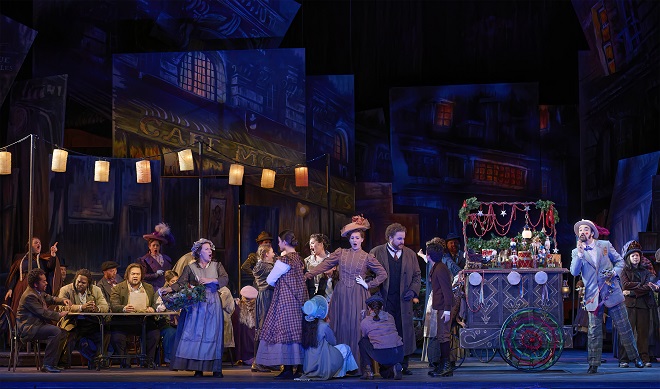
0588 – A scene from the Canadian Opera Company’s production of La Bohème, 2023. Conductor Jordan de Souza, original director John Caird, revival director Katherine M. Carter, set and costume designer David Farley, lighting designer Michael James Clark, revival lighting designer Nick Andison, and fight and intimacy director Siobhan Richardson. Photo: Michael Cooper
I’m conflicted.
Speaking of inclusivity, the Canadian Opera Company are not as Canadian as they could be if they really put their minds to it. Yes the orchestra and the chorus did amazing work. Charlotte Siegel (Canadian) was a superb Musetta vocally and dramatically. Justin Welsh (Canadian), the Schaunard today in COC’s bohème, has played the larger role of Marcello in the AtG boheme that we saw a few years ago in Toronto. Maybe I’m old-fashioned but I remember when Canadians progressed at the COC, when a singer who sang Schaunard would later sing Marcello.
I feel I can say this as a long-time COC subscriber, who puts his money where his mouth is. There are singers who have left the profession because there’s not enough work. That the COC gets funding from arts councils while bringing in foreign talent really bugs me. When there’s no competent singer available to sing the role, sure, you need to import. But that’s not the case with this opera. It’s especially true when you consider that the bohemians are supposed to be young, yet in this production many of the singers are looking somewhat long in the tooth (not naming names). Please give me young Canadians. Stratford Festival is almost completely Canadian talent. National Ballet is mostly Canadian talent. If those companies –who began with the colonial model of bringing in European mentors and teachers —could do it, surely the COC can too. Speaking of colonial, it doesn’t help that the COC keep hiring foreigners for their management. I’m looking forward to the day that the COC make the bold step of putting a Canadian into the role of General Director. I don’t believe these goals have been properly articulated to the powers that be at the COC.
I understand that the COC has a charter stating that the company is supposed to employ Canadians when possible. But perhaps the piece of paper is stuck in a filing cabinet somewhere, that is if it wasn’t shredded.
I’m wishing the COC would follow through a bit more with their Ensemble Studio, a concept begun under Lotfi Mansouri that offers training and employment opportunities to young singers. It’s a bit like the internships we see at universities, where teaching assistants are paid to work in supporting roles, as they train in hopes of being professors. It’s definitely a win-win, in the sense that both sides benefit. The university saves money with these young teaching assistants, who don’t cost nearly as much as professors, and take some of the load off the professors, and the TAs get paid for work that serves as part of their training.
But it’s an imperfect analogy if we recall that Teaching Assistants are on a path to becoming professors. The COC Ensemble Studio train people who may work elsewhere but rarely seem to come back to the COC except in small roles, OR after making it big elsewhere.
John Gilks of Opera Ramblings said the following, in his write-up of the recent Ensemble Studio event.
Realistically, success at Centre Stage is less a guarantee of stardom than an opportunity to get a grip on the very bottom of the long, greasy pole that may, sometimes, lead to stardom.
I know far too many singers who have to take a day-job, who give up their dream, who are struggling. The pathway currently being taken by the COC makes me sad and frustrated.
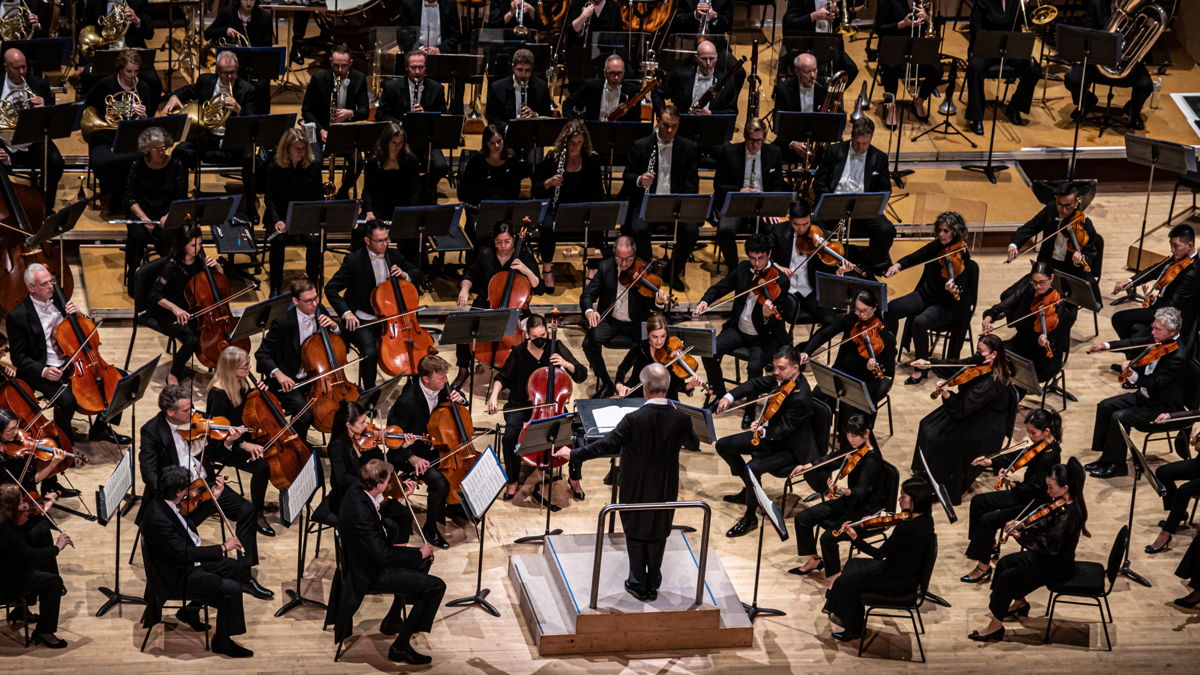
Last night’s Toronto Symphony concert titled “Beethoven’s Seventh” was another chance to watch the ongoing romance between the TSO and their new music director Gustavo Gimeno.
Gustavo Gimeno leading the Toronto Symphony (photo: Gerard Richardson)
Whether it’s a love of Beethoven or delight in the ongoing lovefest between orchestra & music director, we had a full house midweek, a knowledgeable crowd without any phone phaux pas, enormously enthusiastic applause for every piece regardless of its century, and so much stillness during quiet parts to suggest something approaching rapture.
After a break for two nights of Carmina Burana with the Toronto Mendelssohn Choir tonight & Friday they’re back to repeat the program Saturday night at Roy Thomson Hall and a Sunday matinee at North York’s George Weston Recital Hall with one piece excluded as noted: -Dreydl – Olga Neuwirth (not included Sunday) -Violin concerto – György Ligeti –intermission– -Plumes – Tansy Davies -Symphony #7—Ludwig van Beethoven
Virtuosity was front and centre in each half of this remarkable concert.
We began with Olga Neuwirth’s exotic Dreydl in its Canadian premiere. The title connotes the spinning tops we know from Chanukkah. Neuwirth’s eleven minute curtain-raiser was my favorite piece on the entire program, making me want to find more of her music. I was reminded of the flamboyance of Bolero, the exotic suggestion of other cultures hinted at through long melodic lines and simple repeated patterns and rhythms. Dreydl isn’t as rigid in its shape as Ravel’s piece, which is another way of saying it’s far more interesting, its ethnicity elusive: or maybe that should be “allusive”. We have percussion as a backbone with synthesizer, guitar and eventual orchestral passages too, building something quite hypnotic. I think there were some odd bar lengths (or so it seemed as I watched Gimeno’s baton), but I’m not certain. It was a fabulous preparation for the Ligeti concerto that followed, getting everyone leaning forward in their seat for a piece that begins on the very threshold of audibility.
Jonathan Crow has assumed a higher profile as concertmaster than what we’ve been accustomed to in Toronto, between his artistic directorship of the Toronto Summer Music Festival, and his regular appearances as a soloist. With Ligeti’s challenging concerto Crow took an even bigger step.
Concertmaster Jonathan Crow (photo: Gerard Richardson)
Ligeti gives us a simple repeated group of notes in an open fifth that I found suggestive of the ambiguities of the beginning of time, something like the way Beethoven opens the 9th Symphony out of a kind of blank void. Before long Crow is playing lots of notes, but this isn’t the usual concerto by any means. After the short introductory movement the second movement gives us a plaintive aria from the violin that’s tonal, lyrical, reserved. Considering the edgy modernism we heard from Ligeti in the 1960s, that gave us the famous compositions heard in the film 2001 A Space Odyssey, this 1990s version of Ligeti seems considerably mellower, a mature thoughtful voice. The orchestra at times will pick up the thread, at times will seem to parody what the violin is doing, as for instance in a cohort of ocarina players making mockery of serious conservatory discipline. At one point, in turn, the violinist seems to be rebelling against what the orchestra is doing or saying in blunt forceful attacks on his instrument that are not the only time the orchestra and soloist seem to be in conflict. But there are also sections that look back at older forms, a theme passed between sections, sometimes compressed sometimes slower. In the last movement we’re hearing echoes of earlier movements not unlike what Beethoven gives us to open his 9th symphony, but not as a simple recapitulation. And perhaps to remind us that yes this is still a concerto, we end with a long cadenza. Crow is equal to the task of this virtuoso composition, one that is a million miles away from Paganini and the old idea of a concerto.
Jonathan Crow, Gustavo Gimeno and the TSO (photo: Gerard Richardson)
After intermission we had another new work, Tansy Davies’ Plumes in its North American premiere. While its five minutes went by quickly its elemental dissonance made a perfect setup for the pastoral splendors that open the Beethoven symphony that followed.
Full disclosure: I was very uncomfortable in the second half of the Beethoven symphony, trying not to be too much of a nuisance to those sitting nearby as I writhed with extreme pain from the sciatica I sometimes experience. It’s my own fault. should have stood up at intermission to walk around, instead of feverishly making notes. But I was also very grateful to Gustavo Gimeno for the fastest tempi I have ever encountered for these movements. How do you spell relief? “P-r-e-s-t-o.“
The first two movements were more conventional yet still on the quick side. It’s in the scherzo (presto) and the allegro finale that I was pondering virtuosity, pondering the way the performance was embraced by the audience. Yes quick readings are impressive. But there’s more to it than that. The conductor can’t simply put his foot on the gas pedal. At this pace, the articulation becomes harder, the risks of mishap are greater. Yet this orchestra again responded to Gimeno’s leadership, following him on the roller-coaster ride that is the last half of this symphony.
I found that I was thinking of my mom, who is hard of hearing. If I speak too quickly, or if there’s a family gathering where too many of us speak at once, she won’t understand. The experience of music is really the same, as it’s not so much a matter of what you hear as what you are able to discern / understand as far as the notes and voices. While symphonic music doesn’t have words (Beethoven’s Ode to Joy notwithstanding), it is still a kind of discourse, a series of notes from different voices that we hear and comprehend after a fashion. I remember the jarring impact when I first encountered historically informed performances of Mozart and Beethoven (thinking of Norrington, John Eliot Gardner, or Tafelmusik led by Bruno Weil) with their fast interpretations, wondering how it was understood back in the day of the original performances when the pieces were premiered. At first I wondered whether our hearing had changed, but then, especially noticing different approaches to romantics such as Mahler, Wagner and Strauss, it was clear that it was more a matter of taste (meaning the preferences of artists and their consensus about the music) that had changed. And of course that meant that tastes could change again.
All that is meant as a kind of preamble to my thoughts about Gimeno’s Beethoven. While I grew up listening to Klemperer and von Karajan, who were not just slower but more Wagnerian in their approach, that’s an old approach. They’re obsolete now. Their brass in the old days seemed to be more important possibly because in their interpretations that’s where they placed their emphasis, as if Mozart or Beethoven were early exponents of Wagner’s philosophies. Devoted Wagnerians seemed to see his influence everywhere, and played their Handel differently as well. But there are other ways to play this music, and maybe Beethoven wasn’t as Wagnerian as all that, not when one recalls Rossini and the Italian masters such as Domenico Scarlatti (who has his birthday today). Toscanini sometimes took the tempo very fast. I remember being a bit confused upon hearing his Beethoven 7th presto, which was faster than any I had ever encountered, even in its trio. The brass are still there but no longer treated like a climactic nugget of gold, but merely one voice among several. Perhaps Gimeno is true to his Latin roots, less German and more in the direction of a Toscanini. It’s certainly a legitimate option, and the audience ate it up, giving the orchestra a huge ovation afterwards.
But as I said, I was grateful for the brisk tempi of the last two movements, rescuing me from my sciatica.
Speaking of back, the TSO will be back, Thursday and Friday with the Toronto Mendelssohn Choir, then back for this program Saturday & Sunday as noted above.