Robert Wilson’s Turandot

While the music is very much Puccini’s Turandot, a regular opera fan attending the premiere of the Canadian Opera Company’s new production might have trouble recognizing it. That’s why the headline proclaims it as Robert Wilson’s Turandot.

Two words lurk in my head at the moment.

The first is kitsch. Some critics have a problem with Puccini,  his popularity, his blatant sentimentality. If you love Puccini of course, you go see Butterfly or Boheme without a trace of guilt in your pleasures, and embrace the tears he pumps out of your eyes.

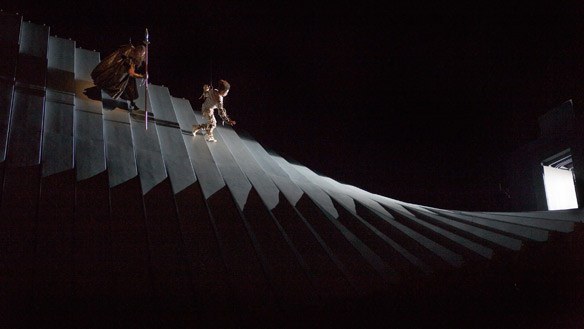
Robert Wilson’s Turandot seems to be meant as an answer to the kitsch, to the jerking of your tears. You won’t cry at this production.  It’s a modern work of art, the set & singers like a colossal installation a tableau with human puppets dodging the kitsch or any excessive emotion.

The other word is orientalism. Some people find operas such as Turandot problematic in their appropriation of folk music from China, the reproduction of cultural stereotypes. While I am not sure that this opera offends anyone, it’s especially intriguing to consider what the COC gave us.

  • The characters of Ping, Pang & Pong are renamed “Jim”, “Bob” and “Bill” ostensibly to fix this problem
  • A program note explains the rationale
  • Meanwhile, Wilson gave the three singers a movement vocabulary to rival Mickey Rooney’s outrageous performance in Breakfast at Tiffany’s, hopping and mugging and cavorting as though they were cliché figures.

Was this meant to be done with a knowing wink at the audience? Perhaps. I did hear a few weak titters of laughter. But I suspect that the result may have been even more offensive than the original. I’m the wrong person to ask, as I’m Hungarian.

But perhaps this show is safe from any sense of kitsch, genuinely modern and therefore not guilty of appropriation.

I can only shake my head at the predicament of the COC in the modern day, and their perpetual position of apology for the sins of past generations:

  • The defects of Louis Riel that led to apologies & corrective composition
  • The sins of emperor Hadrian that led to a bizarre conclusion to the opera we saw last year about that emperor, the scourge of the Jews
  • And tonight, a program note that would apologize for Ping Pang & Pong, renaming them: even as the surtitles and sung lines continued to identify them as before.

So no it’s not the Turandot you may know if you’re a conservative opera-goer. At the end when Calaf and The Princess sing together and he supposedly kisses her, they never get close enough for anything more than perhaps a blown kiss, a gesture. And as they sing she is radiant bright red in powerful lights while he languishes in the shadows, eventually disappearing into the crowd at the end. The surtitles say that Liu dies, but it’s again some sort of gestural thing. She walks about for awhile, as indeed the chorus expresses fear that her soul will haunt them. Is she haunting them? If so she’s doing so in the company of Timur, who is still alive.

But maybe the expectations of the usual opera audience aren’t relevant, not when we saw one of the youngest audiences I’ve seen coming out for a Canadian Opera Company premiere. And that bodes well, considering that the subscription audience for most of the performing arts companies in the GTA is getting older. They embraced this production, including big applause for Wilson at the end.

Pardon me if I sound like a conservative myself.  I laid out some of this conflict in the earlier piece I wrote about Turandot (and Wilson).  The person I was sitting with was fuming about what they felt had been done to the original.

Wilson’s minimalist aesthetic has its pros and cons.

Turandot’s first appearance is electrifying, the colours and stage composition matching the big orchestral climax.

And the opening of Act II is brilliant, as Ping Pang & Pong…
(sorry but I refuse to call them by names that aren’t sung in the performance… if Ping can sing “Ola Pang Ola Pong”, that’s good enough for me!)
…make more sense of this scene than usual, even as a couple of the usual cuts were restored. Ah but then again at this moment? the opera came closest to resembling what we see in other productions, diverging hardly at all from the usual.  So thank you for that crumb Mr Wilson. It is my favourite scene of the opera.

TURANDOT - CANADIAN OPERA COMPANY

Joseph Hu as Bill / Pong, Sergey Skorokhodov as Calaf, Julius Ahn as Bob / Pang, Adrian Timpau as Jim / Ping, in Act III of Turandot (photo: Michael Cooper)

Turandot is a messy opera about messy emotions. Wilson tidies it up considerably. The chorus stand still so that we can deal with the chorus in the abstract, and never mind if people don’t usually do that. Hey, people don’t usually sing either.  If you can buy the stylizations you’ll have a much happier experience. If you show up with stipulations & requirements, you’ll be frustrated.  No you don’t get the usual contact between characters. At times it resembles an oratorio. And I don’t say this as a consolation, but the musical side of this production is astonishingly good. You won’t hear it sung any better than this.

Tamara Wilson is in my second consecutive production where I am feeling sorry for her predicament. Just as her Desdemona was a standout in the Otello last season  (the best singer & actor onstage) so too this time.  Her vocalism is 99% of her role, as she gets very little opportunity to show us the usual character arc (so maybe I’m feeling sorry for myself? the production makes her character an even bigger mystery than usual).

Sergey Skorokhodov is a very capable Calaf, somewhat dry in tone but accurate. Again, we don’t get to see any evidence of character interaction, no opportunity to get terribly attached to our hero, as that might be too much kitsch for us to handle. No, Wilson saves us from that unhealthy sentiment.

Similarly Joyce El-Khoury sings an impeccable Liu, and David Leigh a strong Timur, even if nobody hugs or makes a real human gesture.

Adrian Timpau was a standout as Ping especially given that Wilson gave him & his cohorts (Julius Ahn as Pang, Joseph Hu as Pong) so much physical business & hopping about, in addition to some very challenging music.  They were superb throughout the evening.

To make matters even harder, conductor Carlo Rizzi is sometimes going very quickly. Don’t get me wrong, I loved it. But this is tough music, especially for the trio that opens Act II. As far as I could tell Rizzi got perfect entrances from his soloists even while at times putting the pedal to the floor.

One of the intriguing subtexts is in watching Rizzi, a brilliant musician leading this production. One wonders what he’s thinking.

The COC chorus were wonderful both onstage & off.

Turandot continues at the Four Seasons Centre until October 27th.

Posted in Music and musicology, Opera, Reviews | Tagged , , , , , , , , , | Leave a comment

Imagining the unimaginable or why we need a #GlobalClimateStrike

I boarded this train of thought last week in preparation for church. I was the substitute music director in a Sunday without the choir, seeking joy while pondering darker thoughts.

I don’t pretend to know how I happened to be so preoccupied with music associated with water, only noticing it after the fact. But I played one of Mendelssohn’s Songs without Words titled “Venetianisches Gondellied”, which probably means “Song of the Venetian Gondolier”. It’s a stunning solemn piece that I first encountered in a comical transcription by Korngold in his film music for Reinhardt’s adaptation of A Midsummernight’s Dream (1935).

I’ve never been to Venice. It comes up as place of importance in the history of opera, a place of importance in the history of theatre, and currently: as a city facing the onslaught of nature.

Is it sinking?

And by a curious chain of unconscious association, I pulled out a piece by Claude Debussy that also suggests water. That’s not so unlikely when one recalls titles such as “Reflets dans l’eau” (reflections in the water) or “Poissons d’or” (fish of gold: more likely to be koi rather than goldfish), to give you two titles from a CD I’ve been listening to lately.

This one is another prelude, namely La Cathédrale engloutie or “the submerged cathedral.” I’ve played it in church before. I always understood it as a very moving piece that affirms something immortal. It’s program music as the piano tells a story based on various legends of a cathedral submerged off the coast of France. Whatever the legend might say, Debussy’s prelude suggests something mystical. It gets louder building to a climax that might signify the emergence of the cathedral from the water in all its glory, and then eventually fading until at the end we hear music coming to us as though from under water, a cathedral that’s submerged or engulfed in water.

In 2019 it’s a very troubling image.

I especially like this version from youtube, that shows us exactly how the composer wanted his piece to sound, a piano roll of Debussy himself playing the piece. That it’s faster than anyone else’s version, lacking the extra schmaltz that mars other performances, should by now be a clear indication of how the piece should be played.

What struck me this weekend in prep for the church service was something I’ve never really thought about before. At one time when the population of France was universally Catholic Christians the idea of a cathedral off-shore in the sea was just a quaint legend. But I see it in a different light this week, in context with #GlobalClimateStrike and the realization that not only are the oceans are rising, but I no longer have the confidence that I held as a small child, the certainty that human life will go on. In a world where oceans may inundate islands, cities, even whole civilizations (recalling the myth of Atlantis, suggesting that it’s part of our psychology & even our deepest fear): this isn’t just a quaint legend. The poignant sounds of the cathedral heard at the end as if from under the water become an apocalyptic forecast.

It never hit me before that this piece has a possible dark interpretation. The spirits and voices of that cathedral drift up to the surface, their songs persisting, living on in spite of the relentless sea. If we flash forward to a time when perhaps humanity is no longer so confident, no longer assured of survival, the piece takes on a totally different meaning. Is the song that floats up from underwater a remnant of humanity, spirits that live on in spite of rising sea levels?

That thought led me away from playing the Debussy this past Sunday, and instead to sing and play something more cheerful, namely “What a Wonderful World”. Everyone smiled afterwards.

And so there I was curating the music (as usual, as any music director does), reminded suddenly of music’s power to cheer us or terrify us, lull us or arouse us.  And so too with all the arts.

And so forgive me for raising some prickly questions. In a course I taught called “The Most Popular Operas,” we discussed  popularity, a troubling metric because it is not necessarily an indication of excellence. Would people rather listen to something sentimental that makes them smile, than something that might challenge them? Can humanity handle the truth, or do we prefer lullabies and sentimental songs?
I pose the question as I wonder if the arts have failed humanity as far as this whole question of climate change, opting to pander to public taste rather than to show us what we need to see.

I recall a film called Waterworld starring Kevin Costner, telling us about a future where the ice-caps had melted & the oceans had risen to cover the land. The film was a big-budget flop that lost money at the box-office. And so it was largely dismissed. At times like this –as I contemplate the way we seem to conflate and confuse the amount of money a film earns with its actual quality—I think Greta Thunberg is on to something when she said
“We are in the beginning of a mass extinction, and all you can talk about is money and fairy tales of eternal economic growth. How dare you!”

greta

Greta Thunberg (photo: AP)

Is the only value of Waterworld to be understood in how many dollars the film made for its producers? And please note, it’s just a commercial film & fictional and not to be understood as a treatise on anything like genuine truth.

But in fairness there are other films that have shown some of the effects of climate change and they’ve been far more successful. I’m thinking of the Mad Max series which show us a barren world that’s heating up. Where Waterworld is an expensive failure (again using the money-box office metric), the first Mad Max is one of the most astute & profitable films ever made, a cheap little film that made millions.

But Greta would still be growling at me, that we’re only looking at the $, not the meaning.

So let me ask for a moment, what role should the arts be playing?

There is a group on Facebook called Artists for Real Climate Action (or ARCA). It’s an interesting group that I’ve joined, who are aiming to be active in protests such as the #GlobalClimateStrike that’s on Friday Sept 27th. And perhaps that’s the best thing artists can do.

Perhaps it’s late to be talking about this, but I was thinking of something else. I grew up at a time when I believed in the power of music to change the world, listening to the songs of John Lennon and Bob Dylan. I believed in the relevance if not outright activism in the arts, of the power of the arts to persuade & mobilize public opinion.

It’s a troubling thought when you contemplate creations to reflect our scary future, to hold up a mirror in whatever medium rather than merely aiming to lull or entertain. Can one entertain while in some respect telling the truth about climate change? Or in other words, will anyone listen? Perhaps if we go into something like science fiction, or even horror, the audience will be there.

That truth includes the recognition of how lucky we are in places such as Canada or Sweden (as Greta reminds us), not yet as hot, not yet inundated. That truth includes a future with refugees fleeing their disasters and coming to us.

I see at least two possible avenues for exploration, at least as a blogger who sees mostly classical concerts & theatre performances:
1) Original work
2) Adaptations of existing works

I leave #1 for those who have ideas of how to demonstrate the crisis of our time in the portrayal of the climate emergency or in human responses.  But #2 might be a more commercial pathway, if one imagines employing existing works given an extra spin by directors or adaptors. Just off the top of my head I can think of a few works that already have overtones of ecology & sustainability in their storyline that could become vehicles for at least some politics.

  • Debussy’s opera Pelléas et Mélisande includes scenes that already suggest ecological disaster. Set in “Allemond” (a name to suggest the whole world), it is of the type of the symbolist dead city, with hints that the waters underneath are poisoned, that there are paupers struggling to survive in the vicinity (ignored by the personages of the opera)
  • Rusalka, coming up on the stage of the Canadian Opera Company this fall, tells a fairy-tale of a mermaid who pays a high price to come ashore among humanity, while showing us an unimpressive image of that humanity. It’s not much of a stretch to imagine sets to suggest that this world is out of balance with nature.
  • Wagner’s Ring Cycle, a story suggesting the betrayal of nature, might be the ideal vehicle. It has already been staged to suggest something ecological in Harry Kupfer’s staging at the Bayreuth festival back in the 1980s, and more recently in Francesca Zambello’s production in the USA.
  • King Lear is one of several Shakespeare plays where the weather plays a prominent role, that can be steered towards something more pointed as far as climate change. If you google “ecocriticism Lear” you’ll see that there’s already a conversation underway
  • And the same is true of some film, where you might google “ecocriticism film”.

Meanwhile many doubt that the crisis is real. I see the same effect in the arts that I see on CNN, where we bring our political baggage into the theatre, showing up with our prejudices & positions intact.  For those of us who are believers, our beliefs are reinforced while others are not persuaded.  Surely the arts have a role to play in persuasion, which brings you back to the headline (please re-read it).

I wonder how the story will play out in the world, how bad it will get, but also, how the story will be signified in film & theatre, and how hearts & minds will respond.  We live in interesting times.

Posted in Dance, theatre & musicals, Opera, Personal ruminations & essays, Politics, Spirituality & Religion | Tagged , , , , , | Leave a comment

Amplified Opera: interviewing Teiya Kasahara and Aria Umezawa

I have huge admiration for the two artists behind Amplified Opera (aka AO), namely Aria Umezawa and Teiya Kasahara, a new opera company.

Aria directed L’hiver attend beaucoup de moi in March.

Teiya was larger than life singing in Pomegranate in June.

teiya

Teiya Kasahara in Pomegranate (photo: Dahlia Katz)

AO will mean opportunities to see & hear more of them.

Here’s how they describe themselves on their website.

IT MAY BE CONSIDERED A DIRTY WORD IN OPERA, BUT WE BELIEVE GREAT ART SHOULDN’T BE AFRAID TO

GET LOUD

Raise your voice and be Amplified!

As far as I can tell AO are all about Inclusion. Diversity. Empowerment.

Amplified Opera’s first concert series “AMPLIFY” launches the company October 10, 11 and 12, 7:30 pm at the Ernest Balmer Studio.

big_image_Photo Credit Acme Art and Design and Michael Barker Photography

I asked Teiya & Aria a series of questions to find out more.

Barczablog: Describe the pathway that brought you two –Aria & Teiya—together and led you to this collaboration.

TEIYA: In 2017 Aria and I met for coffee and ice cream to catch up. And I was telling her about my frustrations with auditioning. I wasn’t booking gigs at the time, and on top of that, I was uncomfortable because I was wearing dresses to auditions and trying to present myself in a way that is expected of a soprano.

ARIA: I remember asking Teiya how much energy they were spending thinking about their singing, and how much energy they were spending on how uncomfortable they were in the outfits they were wearing.

TEIYA: And I was like, “Most of my energy is on how I’m dressed.”

ARIA: And I was like, “Teiya. Newsflash. You’re not getting hired now, so what do you have to lose? Why not try expressing yourself in a way that feels honest?”

TEIYA: And that really shifted my thinking. I think in that moment, I think we both saw in each other that there was a spark, and that we wanted something more with our professional paths. There had been moments in each of our lives where had been talking about how to rethink the artform, and it was like, “Wow! There’s something here.” So we began talking about a new type of performance art company where we would start by thinking about what we as artists want, and then expand that to give space for others to tell their stories on their own terms.

ARIA: Could we find a more authentic way to resonate with audiences if empowered artists brought their authentic selves to the process?

Barczablog: Please amplify for us the connotations of the word “Amplify” that underlie the name of your organization “Amplified Opera (AO),” and of your first series of concerts, titled “AMPLIFY!”

ARIA:  My good friend, Sean Waugh at SFO, suggested the name Amplified Opera for a couple of reasons. First, because opera takes great pride in being UN-amplified, so for a company that is trying to shake things up and disrupt the current landscape, it is a deliberately provocative name. Second, because the entire artform is built on showcasing the beauty and power of the human voice, yet we seldom let our artists truly speak their minds.

TEIYA: We want for ourselves, as leaders of this initiative, to really give energy and power into these stories that have been systematically oppressed and pushed to the margins. They’re just blips on our radar. There are so many other stories that aren’t cis, or white, or hetero, or able-bodied that are valuable in knowing and sharing, and we want to tell them loudly, and to give them more life and longevity.

ARIA: While the point of the name is not meant to be taken literally, we’re not particularly hung up on acoustic amplification or non-amplification. We just want to focus on telling stories loudly, and authentically – whatever that means to the artists we work with.

aria photocredit Hayley Andoff Photography

Aria Umezawa (Hayley Andoff Photography)

Barczablog: How do the politics of race & the tensions in the world serve as subtext for your shows, the context for AO? What do you presuppose in your Toronto audience and our anxieties about the world?

TEIYA: I don’t think we want racial tension as a subtext… I think it’s our foretext. We want to put those tensions front and center, and we want to lean into these uncomfortable conversations and highlight them. These conversations will become less difficult the more we have them.

ARIA: One of our artists, Michael Mohammed (who is directing “What’s Known to Me Is Endless”) sent me an article on the idea of Brave Spaces in the world of social justice. The very basic idea being that we need to draw a distinction between harm (which is destructive), and discomfort (which is instructive). We want to hold space for people to have uncomfortable conversations, so they can have opportunities to expand their understanding and gain empathy. What we assume about Toronto audiences is that they are ready and interested in fostering this kind of dialogue.

Barczablog: Let’s talk about the problem with representation in opera… Sexism, imperialism, focus on the 1st world: Are you aiming more for new work as opposed to inclusive productions of existing work..?

TEIYA: Both really. The Canon is wrought in sexism, imperialism, elitism, racism, ableism, the list goes on. In no way is our society of today reflected in these iconic works, yet we continue to put them on. The rise in “Regie-Theater” over the last few decades has shown us that we need a more diverse representation not only in producers and directors and of reimagining these old operas in new ways, but to also create more conversation surrounding why we are putting on these shows, what value a new concept of an old work can give us. Simply doing it because a director or company wants to isn’t a valid enough reason anymore.

New works also need to be better nurtured and given more time, resources, promotion and care going forward. Having a premiere and then being forgotten months later isn’t doing this industry nor for our decreasing audiences.

Representation really needs to start with the artists embracing their inherent agency. They are the face of opera, they are what everyone sees, so if they start to realize that they have a say, that they can use their voices in more ways than one, then we will also start to see change. We need to see this at the top, too, people who are making the big decisions, where money is allocated, who is being hired and what is being put on the stages. It all effects each other.

Version 3

Teiya Kasahara

Barczablog: Are there political subjects missing from the operatic stage (for instance, an opera about climate change or being a refugee)..?

ARIA: We’re starting to see contemporary issues explored on operatic stages, (companies like Heartbeat Opera, Beth Morrison Projects, and the Prix 3 Femmes are doing that really well), but there could always be more. Opera is an artform about the power and abilities of the human voice. So we have these big, powerful voices but what are we doing with them? What are we saying? How are we enriching our communities by existing? How can we use the power of our voices to elevate those issues that are critical to humanity’s/society’s survival? I think in the broadest possible sense, opera is failing to communicate a genuine value to society because we have not landed on a good reason for existing. What can the world learn from opera that would help us to frame some of these crucial, political conversations?

Barczablog: Do you see yourselves representing or offering a pathway to those who are in some sense less able?

TEIYA: I think both being able-bodied people, we don’t begin to know what to offer those differently or less abled, but want to invite conversation to create opportunities for collaboration down the road. We started with people that we know already navigating the opera industry despite their perceived challenges, so with AMPLIFY this is where we are starting and we are excited to create more relationships with those folk within (that we don’t know of yet) and beyond the opera community to create bridges and share experiences, for example the Deaf community.

ARIA: The position we take at AO is not diversity for diversity’s sake. It’s diversity because people who have unique experiences tell unique stories, and those stories are valuable and worthy of sharing with the public. We want to know of all our artists: what leaps out at you about this artform that I miss because I don’t have the same lived experiences as you, and how can we use those insights to build a better society?

Barczablog: And how do you reconcile opera to virtuosity, which is often a showcase for showing an audience what the performer can do that the audience can’t.

TEIYA: I think it’s about broadening the definition of virtuosity, or excellence, or even genius. We need to recognize that these concepts are derived from a Eurocentric mindset that is steeped in a history of colonization and imperialism which only exists to the detriment of others.

ARIA: I agree with Teiya.  In many ways, I feel we’ve weaponized virtuosity as a means of keeping certain groups of people off the stage, away from the podium, and out of the director’s chair. Virtuosity often refers to a technical precision that requires a great investment of resources: education, mentorship, and legitimization from the establishment. Certain communities have much greater difficulty accessing those resources – particularly those crucial mentorship opportunities, and the legitimization that comes from appearing on the world’s greatest stages. In many of these cases diverse talent already exists, but it’s seldom given a platform.  So opera prioritizes so-called virtuosity, and in doing so, limits the types of people who have access to opera as a means of expression, and downplays the role that visibility will play in ensuring a contemporary value for our artform.

I think AO is trying to take two positions: First of all that virtuosity and inclusivity are not mutually exclusive terms. They can co-exist in the same artist, performance, or production. And second that art’s value to society is that it holds space for spectators to engage with profoundly emotional topics in both the beautiful and devastating sense. We will prioritize resonating with audiences, regardless of their background in opera, and will encourage our artists to push themselves to achieve new ways of connecting with people – whatever shape that takes.

Aria+-+HIGH+RES+-+053

Aria Umezawa

Barczablog: Are you open to going beyond opera, for instance to musicals, spoken word, and dance?

ARIA: AO is about breaking things apart. About challenging the existing structures, and proposing new ways of moving forward. I think everything is up for debate. What is opera? What does that mean exactly? I think if we seek to answer those questions, we will naturally open ourselves up to many different mediums through our exploration.

TEIYA: Yes, we want to start with what we know, but we’ve both personally experienced the benefits of diversifying our practices and bringing together disciplines. Opera is supposed to be a culmination of all the artistic practices, but it still operates as a siloed discipline. There is rarely any allowance made for this holistic concept of singer and actor in one person for instance. Singers are known for “park-and-bark”, or for being wooden, etc. Yes, the vocal line must express the emotion, the sub-text, but there is also room for more.

Barczablog: Please talk about your performers: will you be inclusive or are you aiming to redress the balance, showcase persons of colour, and other groups who are under-represented.

ARIA: We will strive to walk-the-walk of inclusivity at AO, and we understand that that means we will have to engage with artists and audience members who may not share our views, and that is going to feel uncomfortable for us. We need some time to figure out how to frame those partnerships so that navigating that conversation benefits not only ourselves, or the artist, but the public.

TEIYA: We are definitely starting our initiative with artists from equity-seeking groups who have systematically been overlooked and who identify with groups who have faced tremendous barriers for years to be able to participate in this artform at the same level as predominantly white privileged folk, so that’s where we are starting. But by no means are we going to not include white artists. We pride ourselves on creating an environment on all levels of operating AO that is respectful, and inclusive. 

Barczablog: Is it too early to ask you about possible future commissions, whether among librettists & composers from the under-represented constituency OR in the content,  stories that might encourage your visibility and representing you in new works..?

TEIYA: Our mission, values and goals for AO is wanting to fill in the gaps of the industry – we hope that with AMPLIFY it will act as springboard for AO to grow its network in helping and serving artists, especially those of equity-seeking groups.

ARIA: I think if we identify a need, we’ll fill it, but for now we’ve observed that we have some amazing colleagues producing some impactful pieces across the country. No immediate plans for new works, but it’s absolutely on the table.

Barczablog: Do you anticipate to be funded and to identify donors from among the population you represent

TEIYA: Yes, and no. We hope that people who don’t identify from equity-seeking groups will see the value in the work we are doing with AO.another_logo

ARIA: I think that’s what it is really about. We believe there is value in the work we’re doing that extends beyond diversity for diversity’s sake. It’s diversity because when you engage with ideas that feel uncomfortable or foreign you stand to benefit from the insights, learning, and growth that accompany that discomfort. Sure, there will be a value for those who love opera (the chance to see new, extraordinary artists you may have otherwise overlooked), and there will be a value to our communities (the space and trust to find their authentic voice within the operatic medium), but there is a value to those who don’t appear to have any skin in the game as well.

Barczablog: Are you considering venues to perform among your target population: to show them what they’re missing, perhaps to get them on board?

ARIA: I think I would offer a reframe of that question, and say that we intend to engage with many communities, not so we can show them what they’re missing, but so that we can listen to them, and learn how we can better serve them.

TEIYA:. We hope that a large number of our projects going forward will be co-productions, in association with, in consultation with, etc. We want to work with existing frameworks and help better support them, not simply create something new on our own.

Barczablog: Is there anyone you can identify who has inspired this mission or energized you to start AO?

TEIYA: So many of our colleagues like Michael Mori and Jaime Martino at Tapestry Opera, artists and leaders in the Theatre community have been inspirations to us over the years: forging ahead to make opera relevant again. There’s a need for so many artists within the industry who are incredibly talented but aren’t getting the opportunities or support that others have, and I think without them, there wouldn’t have been a need to start AO. But our time is crucial. People are starting to voice their truth and people are starting to listen, and we are excited to help make that happen for people in opera!

ARIA: Honestly? Teiya inspired me. Beyond that, Laurie, Kenneth, Rich, Liz, Andrea, Trevor, and Michael inspired me. My colleagues in the Indie Opera Community inspired me. The people I met in San Francisco: Sean Waugh, the singers, administrators, directors, production staff, audience members and donors inspired me. We give ourselves a lot of grief, but there are so many thoughtful, passionate people who have a vision for an opera industry that is innovative, progressive, and inclusive. They are looking for a way forward, and we want to join the exploration team!

Barczablog: Thank you!

*******

For its inaugural series, AO is presenting three concerts:

laurie1

Mezzo-soprano Laurie Rubin

1-October 10, 2019: The Way I See It American mezzo-soprano and author Laurie Rubin (Do You Dream in Color: Insights from a Girl Without Sight), and pianist Liz Upchurch will speak to their unique experiences as individuals with blindness and vision loss navigating the world of opera, and how this element of their identity has informed their creative process. The concert will be directed by Aria Umezawa.

2-October 11, 2019: The Queen in Me An exploration of the ways in which the classical music world tries to control and limit queerness, gender expressions, and identities. This one-person show features soprano Teiya Kasahara as the Queen of the Night who, after 228 years, has finally decided to reclaim their narrative and challenge the patriarchy. The show is accompanied by Trevor Chartrand, and directed by Andrea Donaldson.

liz2

Pianist, vocal coach and pedagogue Liz Upchurch

3-October 12, 2019: What’s Known to Me is Endless A look at the African diaspora, and how experiences of Black identity differ in Canada and the United States. African American baritone Kenneth Overton is joined by Canadian pianist Rich Coburn to speak to how their understanding of Black identity was challenged while working on both sides of the Canadian-US border. Canadian American, Michael Mohammed, will direct the show.

overton2

Baritone Kenneth Overton

Each evening will feature a lecture-recital followed by a talk-back panel with the artists and guest speakers, to give audience members a chance to further explore the themes discussed in each concert. Talk-back panels will be curated and hosted by Margaret Cormier. Audience Activation Points around the venue will be designed by Matthew Vaile, and will create a more interactive experience.

Amplified Opera Concert Series: AMPLIFY!
October 10, 2019 @ 7:30 – The Way I See It
October 11, 2019 @ 7:30 – The Queen in Me
October 12, 2019 @ 7:30 – What’s Known to Me is Endless

Ernest Balmer Studio, 9 Trinity Street Tickets:
$25 at door, or online at www.amplifiedopera.com
More information: www.amplifiedopera.com

Posted in Interviews, Music and musicology, Opera, Politics | Tagged , , , , , , , , , , , , , | 2 Comments

The Book of Life

I needed that.

The Book of Life, a Volcano Production in association with the Woman Cultural Centre, Rwanda, and Why Not Theatre, is currently running at the Berkeley St Theatre, presented by Canadian Stage.

I came into this show wondering meekly, how does one open one’s mouth to discuss the unspeakable, how does one depict the unthinkable? For dramatists who ponder such questions, The Book of Life has more than a few answers.

We’re taken to a relatively blank space that might be a psychiatrist’s office, except we’re not in the presence of a shrink. Instead it’s storyteller Odile Gakire “Kiki” Katese, the performer, writer & co-creator of Book of Life.

8JzVA21Q

Kiki Katese (photo: Dahlia Katz)

Look around. The world needs therapy. Canada has had its TRC and its report on MMIWG, yet one who would-be Prime Minister denies that the latter was a genocide. The events in the former Yugoslavia, in Germany, in Turkey are all since the killing in the Americas.

As someone who spent some time in therapy, some time studying to be a therapist, and as a creator in the theatre, I’ve long noticed the overlap, that art is therapeutic, that artists can be like therapists even as we sometimes are struggling with our own healing.
Pain can make one an expert in healing. I think that’s clearer to me after Robin Williams’ example.

If Kiki ever tires of telling her story or convening her colleagues at rehearsals of Ingoma Nshya (aka the women drummers of Rwanda), I think she would make an excellent therapist.

Book of Life is stories and music and visuals, plus a little bit of activity getting the audience to participate.

blank_page

I won’t spoil it by telling you too much, but I think you will love this part of the show: where you use your pencil.

When I discussed it afterwards with my seat-mate, we found it had been extraordinarily rich in encouraging us to remember family, aiding our memories while emphasizing something fun.  The conversation was magical.

I had thought the Rwandan genocide too bleak, too upsetting, and came to this show balancing trepidation with hope. And I feel I was rewarded by a wonderfully positive experience.

The Book of Life runs at the Berkeley St. Theatre until Sept 29th. You should check it out.

Posted in Dance, theatre & musicals, Politics, Reviews | Tagged , , , , , , | Leave a comment

Tafelmusik meets Tchaikovsky

Finally!

After waiting for decades Tafelmusik’s concert program tonight with works by Tchaikovsky & Mendelssohn plus a brand new composition felt like a political statement. Already last year led by their new Music Director Elisa Citterio, we were experiencing a higher standard both in the programming and the playing.

And tonight’s amazing concert set the bar even higher.

Tafelmusik Meets Tchaikovsky_Seanna Kennedy Photography1

Tafelmusik Meets Tchaikovsky (photo: Seanna Kennedy)

I can’t be alone in this perception. Since the 1980s we’ve been hearing historically informed performances of works from the 19th century. But Tafelmusik Baroque Orchestra have mostly stayed true to their name, rarely venturing past the year 1800.  The thing is, an ensemble can just play a piece without care, or it can investigate what that style requires.  It would be an experiment, but then again: all performances from any ensemble represent a kind of experiment. Citterio is balancing the need for studious care in preparation with a boldness to  confidently take on any music.

Tonight felt like a coming out, as Citterio and the orchestra seemed to lay claim to this music, which sounded so exquisite tonight. I hope they’ll record the works we heard tonight, all for strings:

  • Mendelssohn Sinfoniesatz
  • Mendelssohn Symphony for strings #7
  • Scherzo from A Midsummernight’s Dream arranged for strings
    Intermission
  • Balfour Pyotr’s Dream (world premiere)
  • Tchaikovky Serenade for strings

For Tafelmusik this was a daring venture, and one that I hope they will repeat. It’s funny, while last night I watched a Canadian premiere from the Toronto Symphony, tonight’s concert of works from the 19th century (plus a short world premiere) set more of a precedent, represented a bigger paradigm shift. In a real sense it was new, as they ventured closer to the present day than ever before.

Yes the first half of the concert was wonderful, a series of pieces by Mendelssohn. It struck me as funny as I listened that so much of the Mendelssohn seemed typical for Tafelmusik, given his propensity for counterpoint, a funny cross between Mozart & Bach that shouldn’t bother a Tafelmusik subscriber. The d-minor string symphony #7 is a four movement work that builds in intensity as it goes along. The third movement Menuetto & Trio was especially powerful, at times employing a kind of call & response across the stage between the violins & violas, the phrases so energetic that the stage seemed to come alive with the exchanges of vivid bowings back and forth. This movement was repeated as an encore at the end of the concert in response to our enthusiastic cheers. The fourth movement too was a wild ride, with at times a fragment of melody from section to section.

To conclude the first half Citterio turned to her brother Carlo Citterio for an original transcription for string orchestra of the Scherzo from Mendelssohn’s incidental music for A Midsummernight’s Dream. It’s especially apt when we recall the propensity of composers of the romantic era to transcribe and paraphrase, whether we recall Rachmaninoff’s piano version or Korngold’s more Wagnerian take on the piece in Max Reinhardt’s film from 1935. Elisa Citterio chose a quick tempo that brought the faeries vividly to life.

After intermission we heard a commission that set up the Tchaikovsky nicely. Andrew Balfour’s intriguing Pyotr’s Dream didn’t sound out of place sharing the bill with Mendelssohn & Tchaikovsky, a soulful work at times reminding me of the Barber Adagio in its elegiac weight. It managed to be melodic even while employing second-intervals to create momentary dissonances, an intriguing combination that lent the work true gravitas.

And then the piece we were all waiting for, that gave the evening its title after all, surpassed expectations. Citterio led a reading bursting with confidence, the players often bursting into smiles. You think you know a piece, the melodies running through your head: yet you experience surprise & novelty. The delicate sound of this orchestra’s players lent a new colour to Tchaikovsky that is after all nothing more than the way he must have sounded in his time when the work first appeared. There’s a great excitement in exploring that, to feel you’re in the presence of something new. After the stately processional figure that opens the work, for the most part the tempi were quicker than usual, yet with no loss of accuracy in the playing. I’m filled with confidence for this ensemble.  I feel they can play anything, and hope they’ll give us more of the 19th century.

If they’re reading this, I’m happy to make suggestions.

  • How about the whole suite from A Midsummernight’s Dream?
  • More Schubert, for instance his 9th symphony
  • Anything by Berlioz, for example Harold in Italy (a favorite of mine)
  • Anything by Schumann

I could go on. The point is, I think Citterio has the right idea. Tafelmusik are laying claim to music that sounds extra-special on their instruments with the benefit of their special scholarly insights. And tonight the audience was younger than usual. Is that a coincidence?  I think this is the way to go for the future, broadening their appeal.

This wonderful concert would make a great recording. But for now if you want to hear this remarkable program, you still have a couple of chances to hear Mendelssohn, Tchaikovsky & Balfour Saturday & Sunday at Koerner Hall.

Posted in Music and musicology, Reviews | Tagged , , , , , | 1 Comment

Dynamic Duo: Hannigan & Storgårds

The Toronto Symphony’s opening concert welcomed the “dynamic duo”, soprano Barbara Hannigan and violinist John Storgårds. Each did some conducting, and each took a turn as a soloist. While it was not a long evening it felt like a lot to digest perhaps because so many food groups were represented.

Did you ever dream of singing with Barbara Hannigan? Mission accomplished. Hannigan led us in “Oh Canada”, beginning unaccompanied then asking us to join her with the orchestra completing the ensemble partway through. If you come to the concert Saturday night you can have the same thrill, and that’s just the first couple of minutes.

reszied_Barbara Hannigan Sings & Conducts (@Jag Gundu)_1

Soprano Barbara Hannigan, singing & conducting the Toronto Symphony a few months ago. (photo: Jag Gundu)

For me the highlights were after intermission although there was lots of music before.

  • Beethoven Egmont Overture
  • Dutilleux Sur le même accord: Nocturne for Violin and Orchestra
  • Haydn Symphony No. 96 in D Major “Miracle”
    Intermission
  • Brett Dean And once I played Ophelia for String Orchestra and Soprano (Canadian Première)
  • Sibelius Symphony No. 3
MJ-hi-res

Matthew Jocelyn

Sometimes I prepare for a concert by reading the program notes over, other times I come in unprepared to see how it all hits me. I chose the latter approach for better or worse.
This is especially relevant to Hannigan performing Brett Dean’s piece, a kind of gloss on Hamlet with libretto by Matthew Jocelyn. You may remember Dean for his work curating the TSO’s 2016 New Creations Festival.

You may remember Jocelyn as director of the opera Julie presented in 2015 by Canadian Stage where as Artistic Director he imprinted a multi-disciplinarity into their programming that I’ve found irresistible and that appears to have become their brand, even with his successor.

One can listen with one’s head buried in the program to follow the libretto: and as a result be unable to see the singer or the orchestra. I chose to attempt to follow without the program, watching and listening as well as I could. I’ve said it before and I am saying it again. Come on TSO / Roy Thomson Hall, isn’t it about time you had surtitles projected, the way even Bill Shookhoff manages in his tiny company Opera by Request? Don’t force me to choose between intelligibility and watching a talented actor like Hannigan. Can’t I have both? I saw Alexander Neef of the COC in the audience, where they’ve had surtitles since the 1980s.

The program (where the text is printed) says “Please turn page quietly.”  Surtitles would be even quieter.

The first frenetic minutes of this piece are a compelling beginning, as our Ophelia sings words that were directed at her rather than her own lines, the “get thee to a nunnery” lines sung and then fragmented into bits, sounding genuinely mad. Hannigan physically & vocally gave me something of Ophelia that I’ve never seen before, a kind of disabled and wrecked personage. From there we retreated into something so much softer, I wondered how Dean scored it; how many p’s did he dictate for this amazingly soft texture? We went from a frenzied sound to something suggesting a recollection, as though from afar or from the other side of the barrier between madness & sanity.  Perhaps we’re inside her head (where it seems sane)? The super soft harmonic texture of the strings allowed Hannigan to sing easily, where the first part was much harder to understand. This is a beautiful piece of music to interest anyone intrigued by the Shakespeare or by the possibilities of the human voice.

John Storgårds conducted the works after intermission, both the Dean sung by Hannigan followed by the Sibelius 3rd Symphony. I wonder sometimes what conditions a conductor’s style, what leads them to their particular approach. Storgårds is a violinist whose approach seems very different from Hannigan, persuading the TSO to play very softly with wonderful solos emerging throughout. The TSO responded to him in both works. The Sibelius was built from the inside out, transparent in texture, energetic and committed, as every player seemed to bring their “A game”.

Before intermission we heard Hannigan leading older classical repertoire surrounding Storgårds as soloist in the Dutilleux, a wonderfully angular piece, deconstructing and analysing a pattern of notes over and over. I will have to listen to it again. Before it we heard the Egmont overture of Beethoven in a reading playing up rhetorical phrases & dramatic effects, from the dreamy and thoughtful to the bombastic and revolutionary. And after we then heard a wonderfully idiomatic reading of Hadyn’s Symphony #96. Maybe I read too much into Hannigan’s presence (that champion of new musics), but at times the Haydn felt very new, almost inevitable in its organic unfolding.

The concert will be repeated Saturday September 21st.

Posted in Music and musicology, Reviews | Tagged , , , , , , , , , , , , | 1 Comment

Les sons et les parfums…

Janina Fialkowska has made a delightful new recording of French piano music titled “Les sons et les parfums…”

You might know that phrase from Baudelaire’s Fleurs du mal, in a wonderfully evocative poem “Harmonie du soir”, where music is as fundamental to the evening as a sunset or the air we breathe.  Recalling Walter Pater’s famous saying that “all art aspires to the condition of music”, this poem is practically a sermon, both an invitation & an exhortation.  Of course it’s an uncommon title for an album, perhaps an indication that this is a change of direction for Fialkowska, who I know mostly as an interpreter of Chopin, Liszt, and eastern Europeans with some ventures into German rep.

cover

But I couldn’t help noticing how the opening cut sounded like something Chopin would have written, an easy-going Impromptu by Tailleferre that put me in mind of Chopin’s A-flat Impromptu, with its flowing lyricism. Did Fialkowska mean to open as though making a segue from Chopin into the French rep? Or maybe it’s all in my mind. But of course Chopin himself is a perfect bridge, an exile from Poland who was after all half French. Tailleferre’s easy & melodic textures open the doorway in the gentlest way for what’s to come.

But the liner notes suggest that this is if anything a sentimental journey for the pianist, familiar rep from the past that she has played many times in the past. Perhaps it’s who she has always been even if the French pieces can’t be found in her discography.

Better late than never..!

It’s a fascinating and well-conceived survey that brings us into the 20th century from the final decades of the 19th.

  • Impromptu by Germaine Tailleferre
  • Nocturne #4 by Gabriel Fauré
  • Intermezzo by Francis Poulenc
  • Habanera by Emmanuel Chabrier
  • Poissons d’or by Claude Debussy
  • Les sons et les parfums tournent dans l’air du soir by Claude Debussy
  • Reflets dans l’eau by Claude Debussy
  • Clair de lune by Claude Debussy
  • Jeux d’eau by Maurice Ravel
  • Sonatine by Maurice Ravel

If these works are not well-known to you, the album will persuade you of their importance, very easy to listen to.  There’s variety even though they hang together like a well-curated exhibit of art by several painters.

Fialkowska’s sound is very clear, mostly sparing in the use of the pedal, without any noticeable blur even when many notes are being sounded, as transparent & sparkling as a clean aquarium full of koi.   For the most part this sounds very relaxed, without the kind of drama one associates with virtuoso display. We’re hearing a pianist who is so self-assured that she gets inside the music. The water pieces by Ravel & Debussy have lots of atmospheric effects, decisively coloured and yet ultimately very calm & tranquil. This is pianism of the highest order without struggle or conflict.

I will resist the temptation to use the “I” word that is so often used when speaking of Ravel & Debussy, a descriptor imported from the realm of painting. I don’t use the word because I believe it’s misapplied when speaking of Debussy, and likely as well with Ravel. These evocative compositions conjure visual images of water & fish & moonlight in Fialkowska’s interpretations. If you find it helpful to think of the painterly qualities of music in this period, especially if it reminds you of the colours & effects found in paintings by Renoir or Monet, then by all means, seize the association. However you choose to understand the music, you’ll hear confident and accurate playing inviting you to an encounter of warmth and tenderness.

Posted in Music and musicology, Reviews | Tagged , , , , , , , , | 1 Comment

Cinematic rockstars

I wish I could somehow reclaim my innocence.  Sometimes sophistication & experience get in the way.

No you can’t believe everything you read, especially when you overthink (….guilty). When will I learn?

I came to Rocketman this past weekend more or less accepting what I had heard & read about it.  I heard that “ho-hum another biographical film with music about a rock-star” and tried to get beyond that, to recognize the film on its own terms.  Yes we’d already had Bohemian Rhapsody. Hollywood does lots of imitation, so of course when you get two that seem similar a kind of cynicism about the business takes away much of the lustre. At such times be especially on guard against BS in the press because of course a film is much more than just someone appearing to imitate someone else. Usually one big project has little to do with another big project except in the sense that someone noticed that this subject is marketable, helping to get them a green light. Where the first one of a type might be understood as risky, the second one is suddenly a genre.  I recall that when there was a second film adapting Les Liaisons Dangereuses I heard that Valmont couldn’t be as good as Dangerous Liaisons.

And when I saw it the opposite was true.  And they’re ultimately two very different films. The first one into the theatre isn’t necessarily the better one. And sometimes some film critic takes a short-cut in observing a similarity, that becomes the story.

I wish I had gone to see Rocketman in a theatre during its first run.

A film by an aging rockstar seeking to tell his own story? Nevermind Rocketman, TIFF led off this year with a doc about The Band focusing on Robbie Robertson, so of course this is an idea with lots of interest.  While we’ve seen lots of films about films & actors, the study of the music business hasn’t gone nearly so far, not when we recall that Inside the Actors Studio for example, began 25 years ago. If this is to be a new genre? Welcome! I can’t wait.

I loved Bohemian Rhapsody, a film that won its star Rami Malek a best actor Oscar. I came to Rocketman expecting something similar because, between the trailer and my own expectations, I couldn’t really unsee what I’d seen, which framed the two as in a sense of the same genre. Argh, but they’re not really the same.

During lunchtime today I watched the title track again.

It’s not what I expected. Yes Taron Egerton is the actor portraying Elton John, and that means not just acting but singing too, but he doesn’t begin the song, as you may have noticed watching this video (just now? Or perhaps you already saw it). There are at least two other actors portraying the character, whose name is “Reggie”, namely Matthew Illesley as the younger Reggie and Kit Connor as an older version.  Reggie is the young man who then changes his  name to “Elton”.

From time to time I find insights into human psychology while watching a play or an opera or a movie. The conceit at the heart of this film is pure gold.  Who would have expected that the carefully constructed version of Elton John’s life might offer something of depth?

During his apprenticeship playing keyboards in rock-bands in bars, Reggie (as he was then calling himself) hears something powerful that he took to heart.

Reggie (his real name & persona) had to be killed. He had to die: so that there could be an Elton (the stage name, a new larger than life creation).  Elton gives himself not just a new name but a whole new way of living & behaving, erasing Reggie.

And no wonder then that Elton meets Reggie at the bottom of the pool in the middle of trying to kill himself. At this point has Elton forgotten about Reggie? Estranged from his true self, at war with his inner child (to invoke another idea that has become cliché)?

Doesn’t he look a bit surprised to find himself while losing himself?

I was blind-sided by this image that I have never encountered before, that seems useful at least as a model for what some people do, possibly a cautionary tale: what never to do.  There’s a lot more to this film than I expected. The songs are used less in the style of Bohemian Rhapsody, where the tunes are shown more or less in their historical context, and more in the manner of ABBA’s songs in Mamma Mia or the Beatles songs in Across the Universe, where a plot-point becomes the occasion for a famous song, and never mind whether or not it’s at the right time in the artist’s chronology. “Your Song” may or may not have been written as shown in this film, as a kind of love-song from the gay Elton to Bernie his straight but nonetheless loving lyricist. For that relationship alone –a loving relationship with ups and downs between a straight man and a gay man—I am indebted to the film-makers, something we’ve not seen often enough in film.

There are moments to put alongside the best in Amadeus (thinking of the moments near the end when Mozart sketches the confutatis) to show us inspiration at work. Is this actually a musical that we will someday see done live in theatres? I would love that, even if it is, after all, rated R, which might not work quite as well in a live theatre setting. First and foremost there are a ton of songs in this film, if we include the little snippets and the wonderful allusions in the soundtrack. I saw 22 songs listed when I searched online. No I don’t pretend that I know them all, even if I’m enough of a nerd that I was a fan when many of them appeared in the 1970s. They didn’t use such huge hits as the song “Daniel” or “Candle in the Wind”: but I am pretty sure I heard brief allusions to them in the soundtrack. So when we are watching Bernie & Elton discussing a reconciliation, to resume working together again after a break, we hear some of “Goodbye Yellow Brick Road,” the song that was sung during their big fight earlier in the film.

Perhaps the real star(s) of the film are the songs, arguably the greatest recent body of work from a pop star since the Beatles, and largely under the radar until now.

Of course this is the same Elton John who wrote songs in Lion King, so it’s not as though he’s been invisible. I wonder if that means he will be competing against himself at Oscar time, if say the song “Rocketman” is up against the new song for the recent film (and that doesn’t even include “The Circle of Life”).

Rocketman is surprisingly good.  I was suggesting it to a friend as we talked about varieties of bad parenting.  Chances are you will see yourself or someone you know in this film.  There’s a lot to it, illustrations of every variety of human behaviour.  I’ve only sat through it three times this week via pay TV, which makes me want to see it a few more times.

I guess I’ll have to buy it.

rocketman_DVD

Posted in Cinema, video & DVDs, Dance, theatre & musicals, Music and musicology, Reviews | Tagged , , , , , , | Leave a comment

Robert Wilson and Turandot

I’ve been reading a bit about Robert Wilson in anticipation of the new Canadian Opera Company Turandot that is to launch the 2019-2020 season at the Four Seasons Centre, a co-production with Teatro Real & Lithuanian National Opera. Online pictures (for example this link) from the previous incarnations in Madrid and Vilnius give us a good idea of what to expect, especially considering how much has been written about Wilson’s style.

Wilson is called “a towering figure in the world of experimental theater” on the COC page announcing & promoting the production. He’s been a famous director for such a long time that he likely was already famous before most in the current opera’s cast were even born.

His work has been seen here before.

  • In 2012 Einstein on the Beach, a work premiered in 1976 (43 years ago), came to Toronto as part of a world tour. At the time I wrote about its influence, a seminal piece talked about far out of proportion to the actual number of people who had seen it. I posted a picture while saying
    “I can’t help noticing an echo of Wilson in Robert Lepage’s designs (the compartments of the space-ship scene replicated in Lepage‘s Damnation de Faust, even as Wilson himself paid homage in that scene to Lang’s Metropolis).

    eob_elevator_lc_11x17

    Wilson echoes Lang. (Photo: Charles Erickson 1992)

    • In 2008 another tour brought us The Black Rider (The Casting of the Magic Bullets).
    • In the 1990s Wilson gave a talk in a lecture theatre packed with drama students at the University of Toronto.

The phrase from that talk that still sticks in my head from his lecture, in his bland lecturer voice was “the stage picture”. There were slides showing us how Wilson treated the proscenium arch theatre as a kind of viewer window that he divided quite decisively in his sketchbook, such that we would see certain things to the left or right, as though the actors and the lighting were all nothing more than parts of a flat picture, parts of a strategy to create a particular kind of image. I am reminded of the painter Maurice Denis (whose operatic connection btw is that he painted the cover of the program for the 1893 premiere performance of Maeterlinck’s play Pelléas et Mélisande) who famously said
Remember that a picture, before being a battle horse, a female nude or some sort of anecdote, is essentially a flat surface covered with colors
I can’t help thinking of that when looking at a dramatist showing us pictures of a stage picture, that might be 3-D but is presented to us as a flat picture. Is Wilson’s work the logical mirror image to Denis (the symbolist seeking something transcendental in his work, at least in the 1880s & 90s)?

And Wilson showed little or no concern for what anyone was saying or thinking onstage, no Stanislavskian worries about motivation let alone transcendence. They might move but it was a physical correlative to the mechanical actions we find in Sam Shepard’s play Action or the redundant repetitive texts in the Songs from Liquid Days, words that go so well with the noodling but un-motivated eighth note ostinato in a Philip Glass composition (such as the aforementioned Songs). I was reminded of Edward Gordon Craig & his fascination with puppets and the über-marionette”. Where Craig saw the puppet as a means to a representative end, the ideal vehicle in the presentation of a Wagner opera, what if you strip away all that heavy fraught symbolist baggage and simply let the puppets move or be still? If you can have dance qua dance, movement for the joy of movement without the weight of meaning & storytelling: why not puppets or über-marionettes for the pure exploration & joy of the puppet & its movement of stillness..?

And yet as I look at the pictures from the Madrid & Vilnius productions of Wilson’s take on Puccini’s opera, I want to come at this from a different direction. Let’s back up for a moment and look at Turandot, recalling for a moment two previous productions brought to Toronto by Alexander Neef.

neefLR_SamGaetz

Alexander Neef (Photo: Gaetz Photography)

I’ve been thinking about Wajdi Mouawad’s Abduction from the Seraglio (who interrogates the Mozart Singspiel as a site of what the director might call “caricature or casual racism” ) and Peter Hinton’s Louis Riel (an opera originally conceived as a site for a kind of struggle between French and English, while the Indigenous part of Canada –arguably the key to Riel—was disrespected, both in the appropriation of a song used without permission, and its politics) a pair of redemption projects arguably rescuing operas from their own problematic politics.

Is there any need to save Turandot from itself? (which shouldn’t be confused with Calaf’s project to save the princess from herself and her murderous project of revenge upon males).

You may laugh at the thought that there’s anything especially problematic in Turandot. It’s funny to me recalling my favorite DVD version, in which Eva Marton gives a wonderfully sympathetic account of the princess’s grudge against the male gender, especially the one long ago who raped one of her ancestors, as we watch Placido Domingo of all people portray the prince Calaf, a prince claiming to be different. Do you want to #standbydomingo ?

Not me.

But there is a big gaping problem in the construction of Turandot, an opera Puccini was not able to finish before his death in 1924

In its first performance in 1926 the ending was left open, unfinished. Like the opera itself, which has been completed by at least two composers, there are multiple versions of what happened. It is agreed that the opera stopped partway through the 3rd act, that Toscanini turned to the audience to speak, after which the curtain descended.
1. One reporter present at the occasion quoted Toscanini saying
“Qui finisce l’opera, perché a questo punto il maestro è morto”
(“Here the opera ends, because at this point the maestro died”).
2. Another reporter quoted the conductor saying
“Qui finisce l’opera, rimasta incompiuta per la morte del povero Puccini”
(“Here the opera ends, left incomplete by the death of poor Puccini.”)
3. The version I heard has Toscanini say “Here the Maestro laid down his pen”, which is certainly romantic even if it maybe be nothing more than a loose paraphrase from the two eye-witnesses.

Yes Puccini left pages of sketches with Toscanini, begging him not to let his Turandot die. But it’s not that simple. At the point where Puccini left off composition the slave-girl Liu had died, sacrificing herself to save Calaf’s life. Meanwhile with no Liu left onstage I find I rarely believe in the ending:

  • Because Turandot is heartless, largely responsible for Liu’s death
  • Because the scene where Calaf is left alone with Turandot—using Puccini’s sketches but finished by someone else—feels inauthentic and weak compared to what has come before
  • …as I wonder: are we meant to like or admire Turandot? to like or admire Calaf?
    Do we care about this royal couple?

Why couldn’t Puccini finish it? Of course his health was part of it. But it’s intriguing to notice parallels between life & art. Puccini’s wife accused her husband of having an affair with a servant girl: and the servant committed suicide. Is this not a curious parallel to what we see in the plot of the opera? And how interesting that Puccini was trapped, becalmed in the waters of Liu’s suicide, unable to bring the good ship Turandot into port. Death meant that other composers faced the task of persuading us that Calaf & Turandot belong together at the end.  Did Puccini even believe in the ending of the story or was he stuck? I wonder about his motivation in setting this opera, which may have been a kind of mirror, even a veiled confession.

It’s a funny thing that when I was young Turandot was my favorite opera. I knew it through the RCA recording conducted by Erich Leinsdorf, with Birgit Nilsson, Jussi Björling, Renata Tebaldi, Giorgio Tozzi & Mario Sereni. I knew nothing of problems in the dramaturgy, because for me at this time opera was all about singers hitting high notes, music rather than theatre. I knew opera as a series of arias and set-pieces.

I had not yet discovered Wagner & Gesamtkunstwerk, the ideal you and I embrace in our modern world without properly appreciating its origin. The unified behaviour of your phone is employing the same dramaturgy seen for the first time in the middle of the 19th century. Dramaturgy on a phone? But it’s what all devices do now when they’re sending you a message. Your car may tell a little story, depending on whether you’re being warned of danger or reminded to fill your gas tank. Machines don’t communicate with irony or humor, but with a total unity between the machine and the functions and/or sites we visit. When it works the music is happy to tell me of success, beeping when it’s done or playing a happy little tune. When something is dangerous or prohibited the machine tells me so. That’s something invented in the 1850s for the first time when Donner the god of thunder called up a storm in the last half hour of Das Rheingold: by wielding his hammer. The moment when he strikes, there is a magical event, both in the story and the history of theatre. For the first time there was an instruction in the score where all elements of the mise-en-scène and the text (both the words & the music)  function in complete precise synchronization. We hear the lightning & the ensuing thunder-clap, AND we see the flash as requested in the score. Gesamtkunstwerk is often translated as “total art work”, with the expectation that all of the components work together towards a unified goal.

And so by the time we get to Puccini, he’s doing it too. He’s mickey-mousing

  • to tell us when Rodolfo is sprinkling water on Mimi’s face (to make one smile or even giggle),
    or
  • to show us Angelotti desperately searching for the basket in the first moments of Tosca (to make one feel his indecision & terror, and finally relief when he finds it)
    or
  • giving us the sounds of the cannon fire in Nagasaki harbour in Butterfly’s imagination, during “un bel di” (to make one teary-eyed):
    …right in his orchestral score. It’s Wagnerian, that idea of unity, with the orchestra functioning like a wordless Greek chorus whispering non-verbal messages to inform us of important information that isn’t conveyed in words.

In Puccini one sometimes encounters the dilemma the composer must have faced, between those two impulses:

  • numbers or through-composed
  • arias with climaxes vs something continuous
  • opportunities for singers to show off (aka arias) vs the showcase for composer & librettist

Who do you go to see/hear when you go to the opera, or indeed any play or film? Is it the story or the star? Is it a singer or a song? In Puccini that conversation is especially intriguing, the famous tunes embedded in scenes without the full-stop one usually gets in opera. “Nessun dorma” may get applause but the music is written to go on at the end: unless the conductor holds the orchestra back in expectation of an explosion of appreciation from the audience.

My favourite scene of the opera as a child was one that’s often shortened, phrases cut mercilessly: namely the scene between Ping, Pang & Pong that opens Act II.

Oddly it seems apt for 2019, the powerless observers dreaming of something better while feeling powerless. It reminds me of a Globe & Mail editorial I saw a few days ago. Is there so much difference between what Ping Pang & Pong observe in China (dealing with Turandot’s daddy the Emperor) in the opera, or what the Globe would observe about Brexit & Boris Johnson?

In the opera there are at least three different textures musically, corresponding to something in the story, interconnected like solid plates or quilts sewn into one fabric

  • The heartless chorus and the implacable Mandarin in whole-tone harmonies
  • The romantic leads in melodies that are often pentatonic (recalling how pentatonic Puccini can get even in other operas with no connection to the far east such as Tosca)
  • Ping, Pang & Pong in the discursive space between the two extremes. When we’re in whole-tone mode things are dark if not nihilistic & brutal, while the melodic space is a sentimental and diatonic place where happy endings at least dreamt of, even if they are impossible. This includes some choral moments such as the boys who sing Turandot’s leit-motiv: which articulates the dream of reconciliation between male & female.

RAGAZZI
Là, sui monti dell’est,
la cicogna cantò.
Ma l’april non rifiorì,
ma la neve non sgelò.
Dal deserto al mar
non odi tu mille voci
sospirar: “Principessa,
scendi a me!
Tutto fiorirà,
tutto splenderà! Ah!…”

BOYS
There, on the Eastern mountains,
the stork sang.
But April blossomed no more,
and the snow didn’t thaw.
From the desert to the sea,
can’t you hear a thousand voices
sighing: “Princess,
come down to me!
All will blossom again,
all will be resplendent! Ah!…”

Zeffirelli cast the boys in Buddhist attire in his production, but this is not a Buddhist idea, this attachment to desire. It’s funny how this tune
made me cry (Tutto fiorirà)
before I even understood what it meant (tutto splenderà!),
before I understood desire (Ah!…”).

Do we make a mistake with Turandot in expecting it to work the way other Puccini operas have worked? Where Boheme , Tosca and Butterfly all build up to a catharsis summation on the last page, where there is a combination of the powerful melodramatic action typical of verismo, complete with the orchestra taking over for that final summation–in a Wagnerian approach to story-telling– Turandot perhaps needs to be thought of in other terms. Where those three operas have closure & catharsis on the last page, maybe we should think of Turandot as closed at the moment when “the maestro put down his pen”. While Liu has made her sacrifice and that once savage chorus are now contrite, fearful in asking her spirit for forgiveness, Calaf & Turandot are still glaring at one another across a physical & discursive gulf. While Puccini may have given us his last word at the moment he stopped, that the servant gave her life for love, even so: the story is not concluded and therefore must be thought of as open.

Enter Robert Wilson, who could be on the cover of Umberto Eco’s The Open Work, because of his tendencies coming at theatre & signification.

I see in a review by Polina Lyapustina of the Lithuanian production from earlier this year, she says that
“It seems that the director was not convinced by the dramatic denouement of the work and he seemingly made no attempt to create it.”

Could that be another way of saying that Wilson chose to show us the characters as they’re written, reflecting the open ending Puccini has written? Maybe Wilson dares to offer us an older kind of opera, where we get spectacle, music, singing but without insisting on the total work, and instead offering ambiguity & ambivalence. Instead of the total artwork we get an open work. I can’t help placing this in context with Alexander Neef’s previous redemption projects: Wajdi Mouawad aiming to redeem Abduction from the Seraglio, or Peter Hinton re-thinking Louis Riel. Instead of the usual struggle to make the ending of the unfinished opera work, perhaps Neef saw the match between Wilson, who leaves works open, and Turandot a work that is arguably unfinished even with the endings created by other composers such as Alfano (whose ending is to be used in this production).   Its conclusion is in some respects an oxymoron, a happy ending in spite of everything Turandot tells us she stands for, in spite of Puccini’s attempt to persuade us that Liu should have Calaf. Should Turandot and Calaf end up together or should the ultra-feminist resist Calaf’s attempted seduction? I’m dying to see how it looks and whether it works.  Of course it was likely Wilson’s idea to take on the opera, but at least Neef had the good sense to bring it to Toronto.

Does it work? Or does my younger self still win out, in my former desire for the happy ending? We shall see.  I hope that it does work.

Of course this is my speculation without yet having seen the show. Robert Wilson’s Turandot opens at the Four Seasons Centre on September 28th, presented by the Canadian Opera Company.

Turandot 5513 resized

Irene Theorin as Turandot in Turandot (Teatro Real Madrid, 2018), photo: Javier del Real

Posted in Art, Architecture & Design, Dance, theatre & musicals, Essays, Music and musicology, Opera, Personal ruminations & essays | Tagged , , , , , , , , , , , | 1 Comment

Authentic Encounters

jillcarter_4x4web

Professor Jill Carter, Curator & Director of “Encounters”

Tonight I witnessed the first of the three performances of Encounters at the “Edge of the Woods” being presented at Hart House Theatre, a Storyweaving project in association with Hart House’s 100th Anniversary.  This is a worthy vehicle to commemorate a site that is arguably the cradle of Canadian theatre, a place pre-dating Stratford or Shaw, as noted by Professor Jill Carter in the talkback session afterwards.

It’s both a collective creation and a pedagogical experience for the participants.

I found myself bemused by the recognition that this was theatre when it was also clearly a kind of testimony, each person bringing their own life-stories to be honed & assembled by their Professor Jill Carter: their instructor, director, curator and perhaps also mentor.

Last week I was in Stratford for one of the most powerful pieces of theatre I’ve seen in a long time, yet that was unmistakeably theatre, as we watched actors moving, their wheels turning in their heads as they prepared to deliver a line. It was a piece of art.

This was not freighted with that virtuoso polish, and as a result what we got was much more genuine. Often the delivery was leavened with irony & humour, but sometimes we were in the realm of the confession.

SONY DSC

One of the funnier moments in the Encounters at the “edge of the woods” (Photography by Scott Gorman)

This was 100% authentic and real.

If you’ve been observing the ongoing conversation around reconciliation with our Indigenous populations, you’ll be aware of such things as the recent controversy about the use of the word ”genocide” in the report following the national inquiry into missing & murdered Indigenous women & girls; I wonder if you share my discomfort at this response? surely the word is used correctly. Quibbling over the word adds insult to injury. When we talk about the residential schools, I hope there’s no controversy in calling it cultural genocide, when we remember that children were forcibly taken from their families and force-fed another culture while stripping away their own languages. That “G” word reared its controversial head again tonight. The sadness & anger that we glimpsed were balanced by other feelings, including celebration, appreciation, and some gentle ceremonial moments. I can’t claim to be average, but I believe that for those of us who think of ourselves as allies, an experience like the one I had tonight is very inspiring, very cathartic. I was thinking of how even if one goes to church one doesn’t expect salvation from one trip, but rather from a lifetime of prayer & practice, of thoughtful reflection and careful action. Perhaps works like this can also serve that ritual function, to take us through darkness towards something like reconciliation.

Let me set the content question aside, to properly acknowledge what Jill accomplished with her team of students & collaborators. There were no performances that did not persuade me, indeed they didn’t seem like performances at all. This felt genuine rather than artificial, like a celebration. My admiration for what Jill achieved increased after I heard about the process in the talk-back session. It was a very passionate exchange, with Jill at times so moved as to be unable to speak as she expressed her gratitude. And indeed many of us were tearing up as we listened to her.

I won’t mention any performers except to remark upon the excellence of what we saw, the commitment & the vulnerability.  As a regular observer & participant in student theatre over decades, I was blown away tonight by what I saw.

There are two more performances on Saturday September 7th. For further information or for tickets click here.

Posted in Dance, theatre & musicals, Personal ruminations & essays, Politics, Spirituality & Religion, University life | Tagged , , | Leave a comment