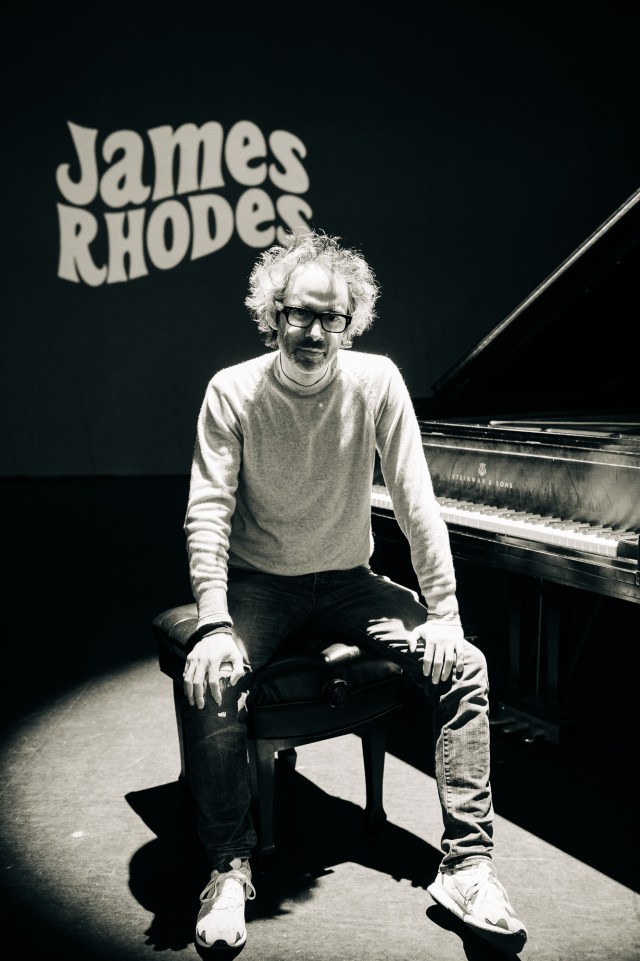
Koerner Hall was jammed full tonight. Apparently everyone wants to hear James Rhodes play Beethoven.
I’m late to the party, having no idea who this guy is, just intrigued by the interest I sense all around me, an electricity. The hall is full of fans & admirers.
Pianist James Rhodes (Kenneth Chou Photography)
The concert was presented by the Glenn Gould Foundation, who made connections between the three artists (Gould & Rhodes but also Gould & Beethoven).
My first look at Rhodes shows me someone who is a breath of fresh air, not immobilized by formal attire, not restrained by pretentious language (he was unafraid to use the F word, which I think is a good sign all in all), and comfortable in addressing us before each item on the program. These were not the words of an academic, but what was especially clear was his passionate connection to the music: especially once he began to play.
While we were scheduled to hear three Beethoven sonatas – in a program titled “The Beethoven Revolution” after all—we began with some Bach, and finished with three additional encores.
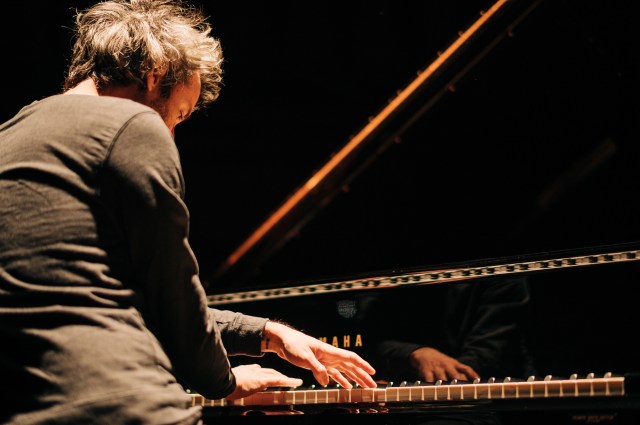
James Rhodes (Kenneth Chou Photography)
The program consisted of three Beethoven Sonatas, namely the Pastoral Op 28 in D major, the Op 90 in E minor and the Waldstein, Op 53 in C major.
This is some of the most original playing I’ve ever heard. The division people sometimes observe is between popular music & classical, where the latter involves performers who play exactly what’s written without any of the ability or willingness to improvise that’s required in popular music.
Rhodes is doing something decidedly different, and while it’s not what most (all?) classical musicians do, it might be more authentic & truer to Beethoven. I got my first sense of it in moments that a stickler might identify as a “mistake”, placed in quotes to emphasize that I’m not one who sees it that way.
What if instead of playing the work with a fanatical adherence to the notes, one instead loosens the score’s grip and begins to mess around a bit, being a bit playful. Suppose in a passage where there are repeated notes in the left hand and a melodic event in the right hand, one were to treat the LH as “vamp until ready”, and approximate the repeated notes while making sure the melody was really done right. In effect this seems to free up the melody from the strict reading and turns it into a kind of performative event, as though your RH were a soloist and the LH were accompanying. Yes of course, that’s what we perceive from the audience, but instead of a machine like rigor you get something three dimensional, and truly alive, organic, and brand new every time.
Similarly, when we get to the Waldstein sonata –a favorite of his and also of mine—instead of worrying excessively about the exact number of notes, the events come in with great drama, as though they were characters, irrespective of what’s happening in the LH. When the melody finally comes in for the final movement Rhodes doesn’t do the usual pianistic thing of worrying about bringing out the melody the way the piano teacher always tells you, but instead lets it float so gently it’s truly pianissimo,…. aetherial…. magical.
James Rhodes (Kenneth Chou Photography)
He has a special gift for melody, for bringing out a voice in the gentlest way. When the music requires pianism he has it. In the bravura passages in the coda to the Waldstein we get the octaves, the hyper-fast version of the melody and a super dramatic finish. It’s not like anyone else’s version because it seems to all come from melodic gestures or dramatic events, a wonderfully theatrical approach to playing. The man is a gifted communicator so it’s no wonder that when he sits at the piano, it’s eloquent and direct.
I find myself thinking about these pieces in a whole new way.
His encores included Liszt’s version of the Schumann song “Spring Evening” ; a transcription (his own perhaps?) of one of the instrumental passages in Gluck’s Orfeo ed Euridice; and a closing Bach piece that I didn’t recognize.
I am going to have to investigate further. I feel so lucky to have heard him tonight..!
As I consider renewing my Canadian Opera Company subscription, it was worth having a look at the other company occupying the Four Seasons Centre. Watching the new program at the National Ballet of Canada was a great way to spend the afternoon.
The leadership is in transition for each company. COC’s General Director Alexander Neef is going soon. Karen Kain is also in her penultimate season.
One can’t help wondering:
who will lead each company in the future?
whither will they go?
It makes great subtext for today’s program.
Chroma choreographed by Wayne McGregor
(he’ll be collaborating next year with Margaret Atwood on MaddAddam a new co-production with the Royal Ballet)
Marguerite and Armand choreographed by Sir Frederick Ashton
(created in the 1960s for Fonteyn & Nureyev, it’s a vehicle marking the farewell of Greta Hodgkinson)
Angels’ Atlas, a world premiere choreographed by Crystal Pite (and the main reason I came this afternoon)
The first and third items were more abstract dance works, while the second tells a story. But they work wonderfully well together, a little over two hours at the theatre including a pair of intermissions.
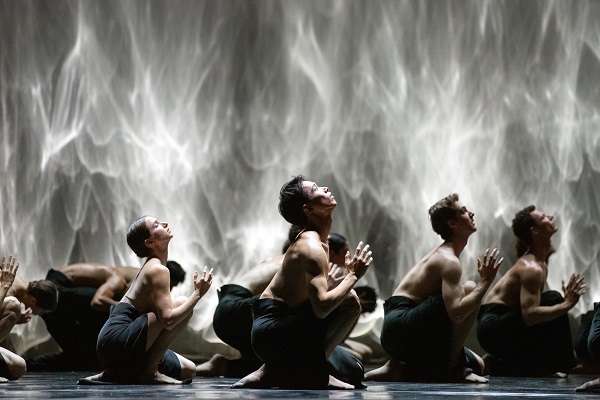
I saw Chroma as a kind of curtain-raiser, a gentle warm-up for the two heavy-weights to follow. Produced in association with the Royal Opera House, and previously seen here in 2010, Chroma creates a big bright performance space with a set by John Pawson & lighting from Lucy Carter, very much dance as dance without the overlaid meanings we’ll experience in the next two pieces. The dancer’s bodies are celebrated whether they’re asked to move quickly or simply to pose for us to stare in wonderment. Much of the music has a minimalist pop music sound, tunes cleverly boiled down to their essence, a series of danceable bass riffs.
I may be the wrong person to talk to about Marguerite and Armand, as someone who didn’t just read the novel & the play as background to Verdi’s opera on the same story, but has been playing and hearing that other music since I was a kid, given that La traviata is literally the single most popular opera of all time. Ashton set his ballet to Liszt’s B-minor sonata in a version orchestrated by Dudley Simpson, so instead of a full evening of opera, we have a little over half an hour to tell the same story. I wonder if this is where Franco Zeffirelli got the idea in his film of the opera to tell the story as Violetta’s flashback from her deathbed.
It’s a good idea.
And it makes for a potent piece of theatre even if you aren’t also soaking up the other drama, watching Greta Hodgkinson play this wonderful role in her farewell. Larger than life roles can work that way, thinking of Greta Garbo in the film Camille (1936), or Theresa Stratas in the aforementioned Zeffirelli film of La traviata (1983). We know every wrinkle in the familiar story but are watching especially to see how the star handles the challenges. Only later did I notice in the program that we were supposed to have Sonia Rodriguez for the March 1st matinee: but there was an announcement before they started, telling us we’d be seeing Hodgkinson after all, and I’m grateful for that.
I was blindsided by tears more than once.
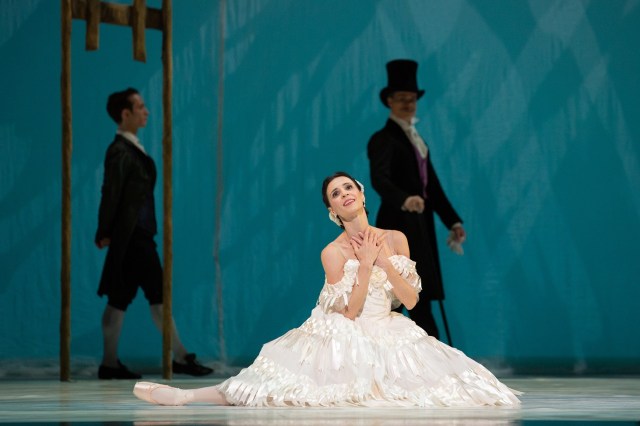
Greta Hodgkinson as Marguerite (photo: Karolina Kuras)
I didn’t expect Hodgkinson to underplay the first scene, so very still & restrained. Her every glance at the passionate Armand of Francesco Gabriele Frola takes us through the progression from curiosity to interest to a new love, and on to the sacrifice she must make at the request of Armand’s father, the humiliating confrontation, and her eventual end. It may sound like sacrilege to say it, but Ashton’s half-hour might be better than Verdi, especially when handled as wisely as this.
There was another drama playing out before me in the orchestra pit. In Simpson’s orchestration, we get something resembling a piano concerto, with the orchestra adding extra drama for the big climaxes, but disappearing when the piano needs to be softly eloquent. Pianist Zhenya Vitort was playing much of Liszt’s sonata, which is tough enough to do without also having to follow a conductor. Perhaps the steadying hand of conductor David Briskin made the sonata more rational,more suitable for dance, less quirky than if a solo pianist were playing Liszt’s big piece. I don’t think I’ve ever liked this music so much, but then again I was captivated by the story-telling onstage. I was very moved –and again all teary eyed—when I realized that Vitort could only see her score on the piano, or the conductor in front leading her, but never saw the action we saw up on the stage.
And then came the final item on the program and the reason I’d decided to come to the ballet today. If you’re a regular reader of this blog you may have noticed that I’m a big fan of Crystal Pite. I’ve been fortunate to see and review five different pieces by Pite over the past decade, including four from Kidd Pivot, her British Columbia dance company:
How good is this work? Each one was just about the best thing I saw that year, especially the last two on the list.
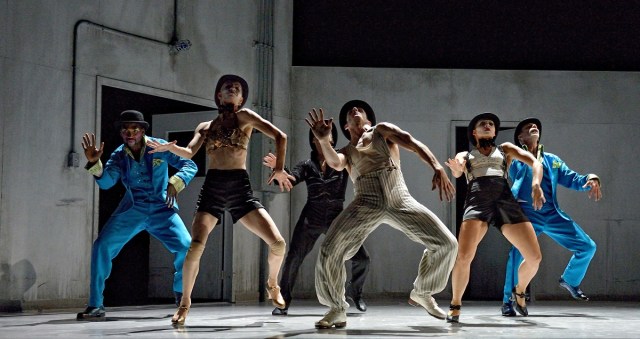
Pite is a choreographer, but the works I see listed here are inter-disciplinary, a brilliant mix of media, work on the boundaries between different disciplines. The first two play explicitly with the limits of our ability to perceive and understand bodies in motion. The Tempest Replica uses a play as a departure point. Betroffenheit takes trauma and addiction as the starting point for an exploration of the drama & roleplay underpinning our personalities, especially in the face of pain & suffering. When I saw it I was so blown away that I never thought that they (Kidd Pivot, Pite and her collaborator Jonathon Young) could ever surpass this profound piece.
Betroffenheit: Jermaine Spivey, Tiffany Tregarthen, Bryan Arias, Daid Raymond, Cindy Salgado, Jonathon Young (photo: Michael Slobodian)
Yet I was just as impressed by Revisor, that takes the lies in Gogol’s Government Inspector and makes them the basis for a whole community of fakers & liars, starting with the simplest of tools, the use of lip-synching.
And so bringing Pite back to the National Ballet is a departure from her recent work (which is theatre and not just ballet). And that would include The Statement, a piece for Nederlands Dans Theater, again with Young & again using lip-synch, to be given a performance March 21st at Meridian Hall.
And yet perhaps coming to the National Ballet is a return to first principles. Young isn’t involved as far as I know although other past collaborators such as composer Owen Belton, Lighting Designer Tom Visser and Jay Gower Taylor, her set designer & partner.
Let me quote from the program notes which are the source of the epithet in the headline:
“The impetus for this creation came from my partner and set designer Jay Gower Taylor. Through our last few creations, Jay has been developing a system that allows him to manipulate reflected light.
[…lots more about the light…]
When I was a little kid, my uncle and my dad talked to me a lot about the cosmos. Sometimes I would experience a dizzying thrill in brief moments of embodied comprehension: it felt like I was falling within the vastness of it all. They inspired me to wonder about colossal ideas tha were, and always will be, beyond my grasp and to approach great unanswerable questions with imagination and creativity. Working with light in this way reminds me of that feeling of wonder and my longing to lean into the unknowable. The light looks intelligent, awesome. The chaos and beauty of it make me feel small in a thrilling, destabilized way. Small, in the face of unanswerable questions about things like love, death and the infinite.
There’s a great deal more and it’s all wonderfully eloquent, suggestive, powerful. Pite speaks of things such as the ephemerality of dance, the impermanence of beauty and by implication our mortality.
I read that during the intermission, but was dubious that anything could be so profound. All performance has that quality of impermanence & ephemerality, right?
And we came to the performance itself.
Artists of the Ballet in Angels’ Atlas. (Photo: Karolina Kuras)
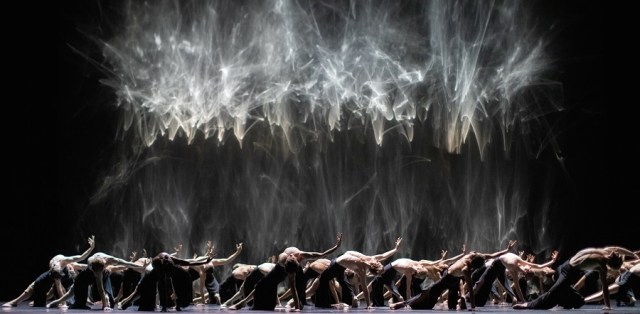
The opening musical segments suggest something spiritual, even religious. I don’t know which one was the Tchaikovsky hymn, or which the Lauridsen “O Magnum Mysterium”. But we were more or less shown a series of fabulous light phenomena projected upon the back wall of the stage, while we listened to pieces that were suggestive of metaphysical questions, profundities. I had not really taken notice of the title of Pite’s new work, only the mysterious & beautiful light images like starry manifestations in the sky.
But afterwards it made great sense when I saw that the title is Angels’ Atlas. I’m still not sure what the title means.
I was gradually aware that I was having the same feelings I had watching the scenes near the end of The Tree of Life, Terrence Malick’s 2011 film, where we see souls wandering as though between lives in some mysterious other place. I don’t know if Pite meant to suggest anything like that, only that what we see onstage are dancers who seem intent on being alive in the most basic sense. At times the score literally pulses, rhythms suggesting our heart-beats, accentuated by hand gestures of the dancers. Twice we see a pair of dancers, where one might be dying or fading, and the other clings to them perhaps to mourn, perhaps seeking to prolong the life.
Forgive me for being ambiguous, but I don’t trouble myself with the precise meaning. I love that I’m being enticed to figure out this wonderfully suggestive imagery. I think it speaks to everyone, especially considering the rapturous response from the audience afterwards.
And so Angels’ Atlas takes Pite back to basics, dance without need of lip-synch or a complex storyline.
These three works from National Ballet of Canada are repeated until March 7th. And there’s also Nederlands Dans Theater in a program that includes Crystal Pite’s The Statement in a single performance March 21st at Meridian Hall.
Artists of the Ballet in Angels’ Atlas. (Photo: Karolina Kuras)
I saw A Nice Day in the Park, a new one-act play written, directed & starring Sky Gilbert, from Lunch-on-the-run productions presented at Chez BonBon. There’s another performance Saturday before they “take it on the road”, wherever that might be.
After the show I chatted briefly with Sky, and must say here what I forgot to tell him, namely “wow what an interesting play”, and “thank you Sky.”
But I did tell him that I felt I was learning a whole lot, watching a kind of interaction that isn’t usual in my world, between a gay man and a trans person. And as usual, I did my impersonation of Mime, the dwarf in Wagner’s opera Siegfried. He’s the one who missed his chance to find out what he needs, because he is so busy showing off. So yeah, I was busy shooting my mouth off. I get a little star-struck sometimes around artists who impress me, and Sky is one of those impressive people. Believable dialogue seems to come out of him without any effort, given how quickly he writes and how perfectly he nails nuances & situational power dynamics, given how prolific he has been.
So yes I was showing off, in observing that in a straight romantic comedy, a Feydeau or a Shaw or a Neil Simon will draw things out by means of lies and miscommunication. A character will avoid saying what they feel, or may not even be clear what they feel. And that can help fill the two or even three hours of a show, gradually leading to the moment when they truthfully declare their love and consummate things, or at least seem sufficiently on the verge of doing so to excite all the voyeurs in the audience. But Sky had no choice really because if you add in the usual lies & deception of romantic comedy: there would be no story, given the factoid at the heart of this story concerning a trans person. We’re in a realm of brutal truths, because of course if we stayed in the realm of lies, the story wouldn’t just be dragging on for 2 or 3 hours, it might never get anywhere.
But Sky gave us a very truthful dialogue between SAM and TESTEr. Sky was playing SAM who is an older gay male, while Harrison Browne played TESTEr, a person who tells us that they are trans even though they appear to be a cute male. And while both are working in what might normally be a very safe tolerant atmosphere for two gay males—a fund-raising organization for HIV & AIDS—there’s more than meets the eye in the dynamics between the two of them. I’m tempted to talk about it at length yet I also don’t want to give out any spoilers.
I asked Sky if that truthfulness was typical of his world (and perhaps I took for granted that we both knew what that meant), and he said yes. It’s a different world from what you see in manners comedy or chick-flicks, where miscommunication & lies are a necessary part of the toolkit. It’s a troubling realization, that the key plot elements from my culture won’t work in such an authentic realm.
Sky Gilbert
This is a very realistic presentation except for one intriguing stylization, one that makes a whole lot more sense to me since I interviewed Sky last year. I never suspected that he likes opera, that is until we were talking about the opera libretto he created, Shakespeare’s Criminal. And so in A Nice Day in the Park we’re listening to a performance of Donizetti’s overture to Semiramide: or at least that’s what the program says although I could have sworn that the opera is by Rossini
(but never mind…).
This overture sits right on the boundary between hysterical comedy & tragedy, a bit of a cartoon not unlike that Bugs Bunny opus inspired by the Barber of Seville overture. And so throughout the show we’re watching histrionics that become extra funny due to the music’s heightened atmosphere, sometimes campy and over the top with horror, sometimes completely ridiculous because the fast music turns them into robots or puppets.
I wanted to be cautious decoding the show, given those ambiguities. But in fact there was lots of laughter throughout. Full disclosure: I had read a piece that was at least partially about the author that had me thinking about “wokeness” (her wonderful word), about discourse and the changes in our society.
I find myself thinking about the meaning of gender, and indeed the future of gender. I wonder if this piece anticipates what we’ll eventually see from Hollywood, & the mainstream film world.
The re-building of University of Toronto Schools gapes at me like an open wound as I walk up Huron St. Today was my second visit to the show that’s at the Istituto Italiano di Cultura Gallery, at 496 Huron Street, just north of Bloor Street West & the University of Toronto.
Of course I had to take a picture as I was again going to confront the artistry of the photographers in “Facing the Camera: 50 Years of Italian Portraits”, an exhibit curated by photographer Marco Delogu.
UTS is under construction, including some adorable graffiti on that exposed wall. Is it art?
Subtext for me is the whole transformation of photography, from something we once did carefully & perhaps even laboriously with
-film, focal lengths, shutter speeds and depth of field,
-flashes and lens.
-ASA
But that’s a lifetime ago. Phones and computers have changed communication, and the camera is collateral damage, almost an afterthought. We have these amazing tools and mostly we’re taking pictures of our dogs, our cats and ourselves.
Coming into this show is to be back in the realm of art, a place I’ve enjoyed recently with trips to the Metropolitan Museum to see Kent Monkman and lots more besides.
In his curatorial statement Delogu tells us…
“In occasione del 500 ° anniversario dalla morte di Raffaello, i suoi splendidi ritratti, che sono stati visti da innumerevoli ammiratori e che hanno influenzato il lavoro di numerosi artisti, sono il punto di riferimento per una riflessione continua sia sul ritratto che sull’identità italiana.”
Or in other words
“Upon the occasion of the 500th anniversary of Raphael’s death, his beautiful portraits, that have been seen by countless admirers and influenced the work of numerous artists, are the reference point for a continuous reflection upon both portraiture & Italian identity.”
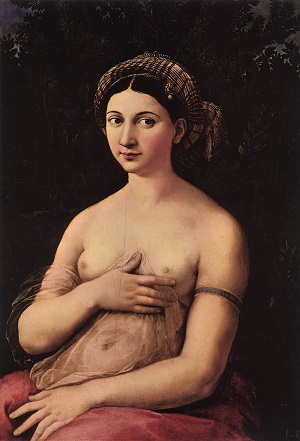
La Fornarina— Raffaello
The photograph that grabbed me the most is one by Delogu, that I’ll feature when I share this on Twitter:
because I think it’s powerful
because it seems to echo Raphael.
I don’t doubt that Delogu’s visual sensibility was shaped by Raffaello’s influence.
I’ve got that comparison thing in my head, possibly simplistic, since I wrote about Monkman & the iconic art that we could see as subtext such as the Hiawatha statue or Washington crossing the Delaware.
Maybe I’m being reductive, simplistic.
Let me show you one of the Raphael pictures that comes to mind, namely La Fornarina. There are of course many paintings one could choose, this one came up because it seems to be relevant to what we see in the show here in Toronto, 500 years later.
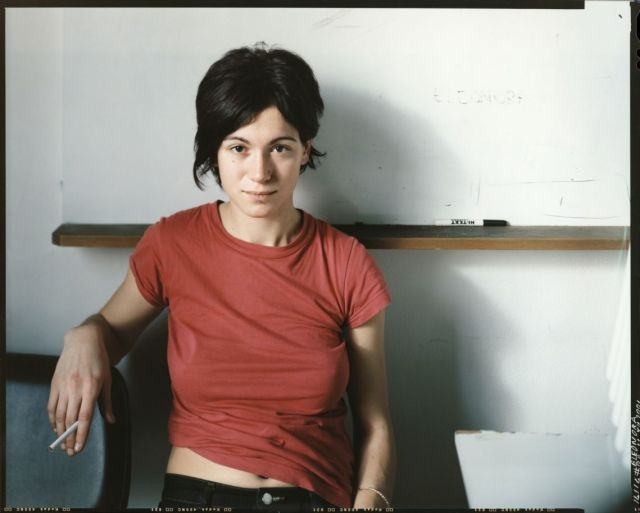
A photographic portrait named “Eleonara” has been promoting this show, one of two that jump out at me, for seeming to demonstrate Raphael’s influence, or at least catching my eye.
Although it may be all in my head. It’s not the Renaissance anymore, that’s for sure.
“Eleonara” (2001) Guido Guidi
And here’s another one, this time a photo from Delogu himself.
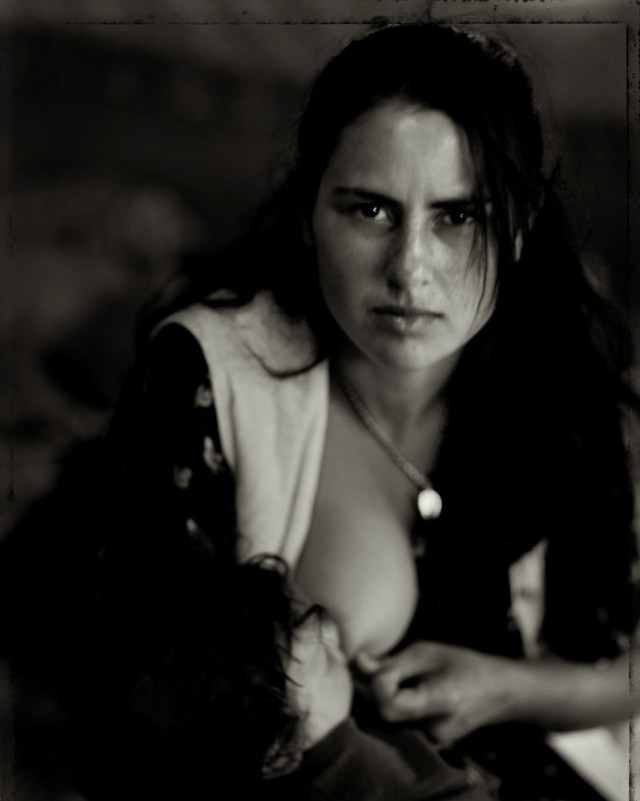
“Senada” (2000), Marco Delogu
As I confront the pictures that Delogu assembled, I wonder, particularly after last night’s concert and its reflections on inter-cultural encounters, just what is it to be Italian? Clearly this show holds up a very different mirror to the Italian viewer than a Hungarian-Canadian like myself.
And of course when I look at the details of “Senada”, Delogu’s picture shown above, I see that it’s not an Italian subject at all, but a series capturing a Roma family. So of course I’m suddenly backing off from making sweeping cultural assumptions as they’re simply not relevant. A better path might be to focus on the faces & how their composition by the photographer might yet show traces of Raffaello.
Yes, this show is mostly faces, most looking directly into the camera. They require no interpreter. Almost exactly half (21 or 40) are black and white, while the other half have varying degrees of colour, including some that have colour added after the camera’s work was done. I’m tempted to use the word “post-production” which of course is mis-applied to this medium but it feels apt at least by analogy. These pictures are formal, suggesting a process between the photographer and the subject that’s a lot like what happens when a cinematic camera engages with actors or documentary subjects. The colours I’m speaking of appear to have been added after printing.
I am really glad I came back. I love being alone in a gallery with the art or the pictures, unrestrained by bodies & undistracted by conversation or noise or temptation (wine and cheese…).
I think I’ll return again to contemplate Raffaello as seen from half a millennium away, at least through these images.
Alison Mackay has a knack for making intriguing connections. Every now and then Tafelmusik Baroque Orchestra turn to their former bass player to curate a concert, and tonight she may have done her best yet with The Indigo Project at the Jeanne Lamon Hall in Trinity-St Paul’s Centre.
Alison Mackay, Suba Sankaran (photo: Kevin King)
It felt a bit like a cross between a TED Talk and a concert, the subject—fabric dye—being her pretense for an unlikely moment of intercultural magic. The part that’s like a lecture concerned the history of indigo, a dye that furnished a pathway to talk about life in different places & centuries, while listening to musics from different places & centuries.
I’ve never found the juxtaposition of western & eastern so stimulating, as it seemed that at first we were going back and forth in the narration, but gradually finding a kind of middle ground where both could be present at the same time, where there was a genuine merging.
You’d have to hear it to understand what I mean, but it’s truly remarkable. There are three more concerts this weekend (Friday & Saturday night plus Sunday afternoon) at Trinity St Paul’s plus another on Tuesday March 3rd at the George Weston Recital Hall in Meridian Arts Centre.
Tafelmusik orchestra were joined by their chamber choir, the choirs of Earl Haig & Unionville Secondary Schools, as well as Suba Sankaran (voice, percussion, solkattu), Trichy Sankaran (mridangam, kanjira, solkattu, voice), and Cynthia Smithers as narrator & vocalist. Ivars Taurins & Suba Sankaran led the choirs.
Smithers added an additional dimension that I didn’t see credited in the program, namely as a dancer. There is a great deal of passionate energy in all these words (not just the lecture but also the texts of the songs), that finally cries out for the physical release of dance, and gets it in the final number of the program.
I hope Tafelmusik will consider doing such a thing again.
If I have one quibble –and it’s a tiny one—it’s that I wish the lights had been on to permit me to follow along with the text of the singing. Yet I was swept along in several places where I have no idea what they were singing.
The great thing about this concert is how it seems to expand the possibilities, knocking down walls of expectation. What will they do next time? I’m looking forward to finding out what Mackay might program next.
I heard a wonderful interview with Vivek Shraya on Q earlier today that gave me some clues as to what I’d be seeing and hearing tonight in her one-woman autobiographical show How to Fail as a Popstar, aka #popstarplay in the realm of the tweet.
In the first moments of the interview we hear a song called “Music Ur the 1”, co-written by Shraya and James Bunton.
I learned to sing to please my mother I learned to sing to please God I learned to sing to please the pretty girls But along the way I fell in love with music
It’s the first of many moments of insight. Without knowing the particulars I knew that Shraya has acquired a great deal of wisdom in her journey.
When I heard this little sample on Q, I was reminded of people I know who might have talent but who have lost their way. Music has become work because they no longer sing or play as though they love the music. Whether you’re singing a pop song or Pagliacci that sense of love is indispensable.
Vivek Shraya’s How to Fail as a Popstar (photo: Dahlia Katz)
It’s funny to be back at the Berkeley St Theatre where I’d been just last night for AF, seeing another show from Canadian Stage that was like a complementary opposite. Where AF is all physicality & rhythmic verve in the now, Shraya’s show is one person’s retrospective. The story-telling & singing take us on the most vulnerable exploration of a sensibility while leading us on a kind of magical mystery tour through recent cultural history. It all seems so effortless & fluid that I want to give all the credit to Shraya although director Brendan Healy must surely have had a hand in it. The time flies by on the wings of song, with lots of explosive laughter along the way.
The way Shraya described it beforehand is a clue as to what you get.
“This is my story growing up in Edmonton as a brown, queer kid and being obsessed with Much Music and wanting to make it as a pop star,” says Vivek Shraya. “The joke I’ve made is that it’s kind of like ‘A Star Isn’t Born.’ That’s what this story is. I was also watching a lot of music biography movies and most of them follow a similar narrative.”
You might never have expected it to go where it went, given that we were listening to Shraya sing bhajans, a kind of devotional song from India: and sing them very beautifully. I was reminded of Leontyne Price & Whitney Houston, two of my favorite singers. Both of them found their true voice in church glorifying God. It may sound obvious but if you sing to please God you can’t go wrong. You may never sound as good as Leontyne or Whitney but at least you will be making a positive sound.
In the interview Shraya worried that the title might sound negative. But if anything the piece might be a bit too positive, upbeat & joyful & fun throughout. How could that be bad? I worry that Shraya might be letting us –mainstream white culture—off too easily, leaving aside the more complex questions of gender, choosing instead to focus on suburban life & our love of popular music, and yes it is a genuine love-in (if you’ll indulge me for using a word that’s half a century old & that’s fallen into disuse). Where AF at times seems to express a kind of visceral rage, touching a nerve what with my guilty white conscience, Shraya lets us off the hook. While we hear of the occasional jerk calling him “faggot” in school, our experience is mostly a happy one, propelled along on a series of wonderful songs and blissful memories of a sweetly supportive family.
Shraya is an amazing singer, whether in the realm of the religious bhajans of childhood, or the wonderful array of songs we hear through the show. There are thirty credits listed for this 80 minute show. Some are tiny, such as the little bit of “Jump” we get, some are much longer. Don’t let the title of the show fool you. Shraya did not fail as a popstar for lack of ability.
There’s merchandise in the lobby including a couple of recordings & a book or two. I’m a sucker for this kind of thing. When I’ve seen a show and I don’t want it to end, I can’t resist the opportunity to prolong the magic at home.
What we brought home
The time flew by, the show was over before we knew it. Even so it’s still there upstairs at Berkeley St Theatre until March 1st.
Vivek Shraya’s How to Fail as a Popstar (photo: Dahlia Katz)
Huge preamble coming. If you want to skip to the review itself, look under the photo. I went to see AF and am daring to review it. I feel I need to say this after having read Yvette Nolan’s piece, responding to Yolanda Bonnell’s injunction.
Did you hear it? Bonnell made a demand that I can’t dispute, that her play bug (on at Theatre Passe Muraille) not be reviewed by white reviewers, but only by reviewers who are Black, Indigenous or people of colour.
And so while I might have thought I could review it fairly I chose to skip it, wanting to respect her wishes.
I came to the opening of AF, a new show created by Red Sky Performance in partnership with Canadian Stage, treading carefully. I could point anyone seeking to take me to task to my critical statement of principles that I put out almost a decade ago, with the title “Steal this thought(?)”, where I think I make it clear I would never be the kind of critic that Nolan speaks of in her piece. I have the highest respect for her work, although I try to be respectful of everyone.
Criticism and dramaturgy are really the same thing in my opinion. I embrace Eugenio Barba’s definition from one of his books that I read back in my days at the U of T’s Drama Centre. He called it “the workings of drama in context”. Isn’t it awesome to have such a clean and concise definition? Any criticism that is helpful and not merely self-serving or destructive must come from the same place as dramaturgy, looking at two things really:
Context (and all that this entails: a huge topic)
How does it work (an even bigger cluster of topics, including the mechanics of the discipline, the choices of the performers and its reception: which connects to #1 of course)
I may dare to speak to how an opera works because I’m fairly confident about the medium, having performed it, coached it, written a couple and studied a whole bunch as well. Even so that doesn’t mean I understand the context, nor that I’d really grasp an original work trying something new. Coming to a piece such as AF which straddles boundaries, I’m mindful of Bonnell’s admonitions, wanting to be careful.
But I’m always careful. I can now say what I really felt about Hansel & Gretel, (now that my words won’t hurt the attendance), that I only hinted at in my 2 reviews + an interview. The dramaturg is supposed to have the director’s back, but clearly let Joel Ivany down, in not observing that his adaptation was getting a bit too loose, was full of inconsistencies (for example if you’re so poor that you’re starving why would there be a pile of Christmas presents? Why not, instead use –for example—tinsel or cheapo ornaments from a dollar store, that might signify wow to a child yet signify poverty to an adult…And then there’s the illogical search for strawberries in an apartment building, which could have been mitigated somewhat by better surtitles). The critic must be careful because they can be destructive, whereas the dramaturg is in the creative realm and therefore can try to fix what’s not quite right.
Eddie Elliott in AF (photo: Dahlia Katz)
I may not understand AF, a daring piece of theatre, but it’s the best thing I’ve seen in 2020 so far. [inserting a morning after correction] I had been under the impression that AF comes from Orwell’s Animal Farm but that’s incorrect I’ve been told, AF means Anishinaabe Fire.
Marrin Jessome, Eddie Elliott, Miyeko Ferguson, Michael Rourke in AF (photo: Dahlia Katz)
The five dancers (and that’s how they are identified in the program even though I’d be just as comfortable calling them “actors” or “performers”) are Eddie Elliott, Miyeko Ferguson, Thomas Fonua, Marrin Kessome, Michael Rourke and Sela Vai (we had five dancers perform tonight, presumably one person is an alternate). This was my second consecutive opening night, inviting all sorts of comparisons in my head. AF sits on the boundary between theatre and dance, the performers employing movement sometimes to signify & represent someone or something, at other times doing dance as dance. The movement vocabulary may be drawing upon something Indigenous, which is something beyond my knowing. I was reminded of all sorts of media, including the expressive hand-gestures you see from the Bolshoi, or the jagged physical movements we saw in Revisor, choreographed by Crystal Pite (whose new work opens at the National Ballet in a few short days… I hope she comes to see this). Director Sandra Laronde & choreographer Thomas Fonua accomplish something bold & new to my eye, encompassing theatre & dance but also ritual. At times the moves remind you of break dancing, but at other moments we’re watching humans moving a bit like animals; or is that just my weak attempt to connect the Orwell story? (AND, please note my assumption about the title was wrong, as noted above)
You will see athleticism to make you want to burst out in applause in the middle, but this nerdy theatre audience stayed quiet & focused until they erupted at the end. There are periods of tension brought about by the extreme physicality, people leaping and gesturing and using immense amounts of energy, followed by calmer reflective moments. The “dancers” are for me on the boundary because they’re more than dancers. At times the athleticism feels like circus performance for its power, its energy, its sculpture of bodies on the stage. This is stunningly beautiful, jaw-dropping work from all five.
There’s a live musical score performed by Rick Sacks & Joyce To, with vocals from Jennifer Brousseau as well as To. We’re told that Eliot Britton & Rick Sacks are the composers. In addition there are recorded performances further enriching the mix. Sometimes it feels Indigenous, especially during the vocals, sometimes it feels more like a highly rhythmic composition that straddles ethnicities & cultures. Whoever is responsible, I’m reminded of Christos Hatzis’ Juno award winning score for Going Home Star, a composition for Royal Winnipeg Ballet encompassing Indigeneity & European music in its story-telling. I hope they record it, as the music & sounds are already a wonderful achievement.
Answering the “why write” question is intimately connected to the “why see it” question, at a time when reconciliation has never seemed so pertinent, so urgent. The conversation with Canada’s Indigenous community must continue. We (speaking as a descendant of immigrants) have much to learn. And there is no society, no community without conversation: meaning especially the listening part.
AF continues at the Berkeley St Theatre until March 1st.
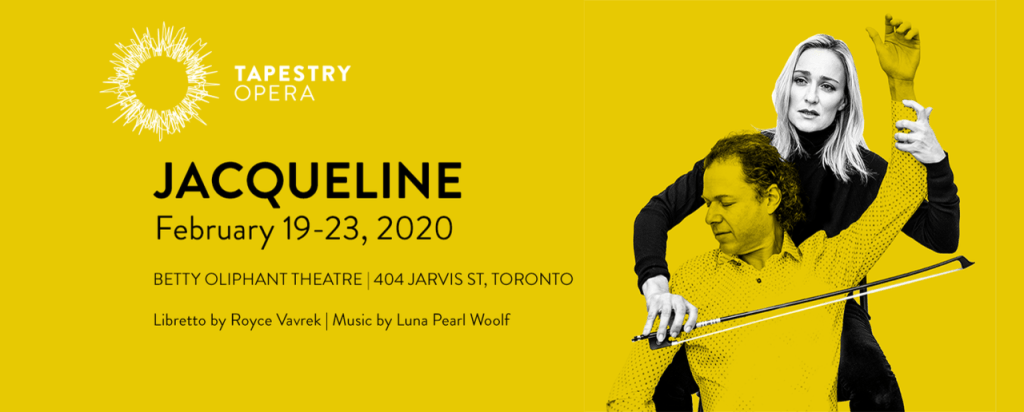
Tonight a rapturous audience welcomed the world premiere of Jacqueline, a new opera from Tapestry Opera at the Betty Oliphant Theatre.
It’s a deceptively simple piece exploring the relationship of cellist Jacqueline du Pré and her instrument.
She was a prodigious talent who had to abandon her performing career at the age of 27 when she developed Multiple Sclerosis, and died at the age of 42. What if that story were told by a singer & a cellist, where the cello were represented as if it were an actual character, given that the instrument was one of the great passions of her life?
We hear of her mother, her sister Hillary, her husband Daniel (Barenboim).
After the applause begins there’s a lovely little film clip of Jacqueline & Daniel. Watch it to the end.
We will hear about an incurable illness.
For close to two hours we were immersed in a poetic world. But I don’t think anyone in the theatre had any trouble making the imaginative leap. The stage is bare, Camellia Koo’s set design wonderfully suggestive as things develop , again through a very simple use of the materials.
I’m tempted to talk about a collaboration between a man and a woman. But whether it’s composer Luna Pearl Woolf working with librettist Royce Vavrek to create the opera, OR soprano Marnie Breckenridge as Jacqueline working with cellist Matt Haimovitz to make music & enact the opera, we’re talking about productive relationships. I think of Director & Dramaturge Michael Hidetoshi Mori as a midwife, bringing both the text & performance to life. The work & the performances are fully formed & mature, well-conceived and in no way seeming incomplete. The tension in each pair whether it was between the words & music, or between the singer & the instrument, was palpable, the root of this very deceptively simple piece.
I’m not sure who had the tougher night, between Breckenridge singing, dancing & crawling about the stage, or Haimovitz playing literally for hours, mostly while seated but also acting as well. Both of them are in virtuoso territory, whether we’re speaking of her high notes & vulnerable portrayal, or his beautiful sound. There are humorous touches, there is a touch of bawdiness and a great deal of romance. If you like cello music you will love this opera, because Haimovitz is making some wonderful music on his instrument, sometimes seeming to go off into long cadenza-like soliloquys, sometimes playing melodic & dissonant phrases, occasionally becoming disjointed as though mirroring the horrific experiences of his owner, cellist Jacqueline. Yet he is mostly in support of the illusion, in support of the story-telling, the expected arc of plot for someone known to have become sick & died young. At times it felt like film music as if Jacqueline were speaking rather than singing, as her vocal line was wonderfully sensitive to the rhythms of speech, and the cello becoming self-effacing.
While there is one big recognizable quote from the Elgar cello concerto –the piece most associated with du Pré –for the most-part we’re listening to fragments, rarely seeming to be in extended musical passages, as the structure seems to come from the text & the words, with the music largely subservient.
I think Jacqueline will be a big success from what I saw & heard tonight in a sold out theatre. It runs only until the 23rd. See it if you can!
I saw the trailer for Wes Anderson’s next film. Google says it opens in the summer.
Argh, I wish I could see it now, but, hmm, …a seed was planted.
And there we were, staying in on a chilly Friday night. What if we watch a movie at home?
I looked at what was available via PPV, doing a search for the director Wes Anderson.
A list came up including films I had seen before.
• Fantastic Mr Fox…Saw it, liked the idea more than the film itself, just like a lot of modern art, where one admires the concept. But I’ve never yet managed to get through the whole film so far. • Isle of Dogs… Ah I loved it to pieces, thinking of it as a thinly veiled allegory of the current American drift to authoritarianism. Bought it, have seen it at least 5 times and will watch it again. And I did buy the book: meaning the Matt Zoller Seitz book that tries to match the film’s creators in its attention to detail. • Moonrise Kingdom…? never seen that one. • Rushmore… My first Wes Anderson. I bought it of course, have found that it grows on me with every successive viewing. • Grand Budapest Hotel… my favorite? I’ve seen it perhaps 7 times, two in the theatre. I haven’t bought it yet perhaps because I find it so powerful, so operatic. But I did buy the book (another Matt Zoller Seitz book) • The Life Aquatic…. Perhaps need to come back to this one. I didn’t fully “get it”. • The Royal Tenenbaums… Another one I don’t fully “get”. I bought it have seen parts of it many times, have sat through it perhaps once. I admire it even if I’m not sure if I even like it.
So…. What about Moonrise Kingdom?
The PPV info tells me…
“MK tells the story of two twelve year olds who fall in love make a secret pact and run away together into the wilderness. As various authorities try to hunt them down…“
One has to click to the next page to see more. But I’d seen enough. I was sold. What could be more appropriate for Valentine’s Day?
How romantic.
And so it unfolds as one of those Wes Anderson films where you see how much fun they’re having filming and playing. Watching one grows envious not just of the magical world they’re creating, but one wishes to be in the film too, part of that fun group of artists. You can see it in the cadre Anderson has assembled, co-conspirators in his plot to have fun & perhaps to recapture the magic of youth, the same coolest people on the planet, the lucky ones who — I suspect– want to come back again and again. Do they pay HIM to be in these films?
Tilda Swinton
Ed Norton
Saoairse Ronan
Adrian Brody
Bill Murray
Harvey Keitel
Anderson seems to be a guy who has a lot of fun, in his stories, in his film-making.
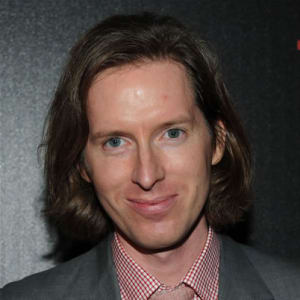
Film-maker Wes Anderson
The children in this film –in all of his films come to think of it– are brilliant while the adults are all somewhat incompetent, hung up on showing us that they know what they’re doing.
The young ones are the hope for our future.
What a perfect metaphor for our world. The romance we see is the civil conduct of 12 year olds.
Do you ever wish you could freeze time and just stay where you are in your development? (of course that’s not so uncommon if you’re in your 60s). Just as I find I wish I could stay inside his films, wishing they wouldn’t end, wish I could prolong the magic.
The wilderness we see is a kind of cartoon landscape, partly as a by-product of Anderson’s compulsive to the point of OCD control of every frame, partly because the story unfolds as a kind of narrated fable, partly because the action is larger than life as people survive the impossible.
Yes (as you can see in the trailer) someone is struck by lightning… and shakes it off. Don’t try this at home, kids. But I won’t break it down further, as I seek to always be spoiler- free, in case you haven’t seen it yet.
There’s some amazing music in the score, not just the ever dependable Alexandre Deplat, but some wonderful subtext in the diagetic music choices. Imagine a film that has a climactic storm & a flood taking place while someone is staging Britten’s Noye’s Fludde..(!?)
Holy cow..!
We’ll watch it again, as there’s lots more to pick up in the parenthetical remarks & in the incidental moments. There are no small parts in Anderson’s movies.
It might be my new favorite, although come July there’s a new one coming out.
It’s not that I’m having a bad day. I just keep hearing news that’s upsetting.
Two very different women I knew, each an avatar of female strength, have passed away. I met each of them, knew them very superficially.
Christie Blatchford has died.
I only met her a couple of times, but she was one of this city’s key voices. While our politics were totally dissimilar –she wrote for the ultra-conservative Sun after all—she had this uncanny ability to make you think about positions you would never normally think about. For my money that’s the most impressive kind of writer, someone who can make me rethink my own beliefs, shake my own convictions, which she did from time to time.
I don’t claim that my sadness about her matches that of the people I’ve been reading today, who admired her tenacity & fearless outlook, especially her dear friends. I admired her, a woman who opened new directions & opportunities for women, doing things we’d never seen a woman writer do. I remember the way she handled herself at a party, totally in the moment, vulnerable.
Anne Kingston has died.
I heard this on As It Happens tonight while driving home. This one hurts a lot more, as our paths crossed a fair bit at one time when we were both at university. Don’t get me wrong, I don’t think I made much of an impression, indeed I’m sure that if she would remember me perhaps it’s for that wedding where I played so terribly at the reception, (a great learning experience).
I bought a copy of The Meaning of Wife, a wonderful book she wrote. I guess I grabbed it mostly because “I knew her when”,
…not expecting to discover the writer. …not expecting to be blown away by the writing.
Each piece of hers I read in Macleans was vying to be the best thing I’d read on the subject, the best thing in that issue, an edgy thinker with wit & style. She was the most impressive writer of my generation, speaking as someone who has several books on my shelves by people I know. It’s cool to look at the books and think of the writers.
Not cool to realize that this young woman is gone, gone much too soon.
Christie B and Anne K were very different in style, in the sorts of things they wrote, polar opposites in their politics. That these two book-ends to women writing in Toronto and Canada should both pass away this week?
Unthinkable.
Upsetting.
I am inserting myself into this conversation as I usually do. I tweeted a question at Alexander Neef, perhaps not a polite question but something that’s bothering me all the same.
The question had come up elsewhere. Opera Canada asked the COC about it and received an answer (which I quote from Twitter), condensing a thread into one paragraph:
@OperaCanada
We also apologize for not giving readers the full coverage they deserve in the matter of @CanadianOpera ‘s hiring of Stephen Lord. We will do better. We have added an update to our coverage of the COC’s hiring of Stephen Lord in our online article about their 20-21 season… We reached out to @CanadianOpera to inquire about their hiring of Lord while still under the cloud of allegations of sexual harassment. Their response: “Upon learning of the allegations against Mr. Lord in June of 2019, the company immediately carried out a detailed review of his engagements with the COC, dating back to 1986; no complaints or records of misconduct were found in our files. The COC also reached out to external organizations, partner unions, and individuals who worked closely with Mr. Lord in order to learn if complaints of any kind named or anonymous, had been formally lodged or otherwise brought forward; our inquiries and follow-up yielded no results.
Having completed a fair and due process, one that included much careful and thorough review of the information available to us, Mr. Lord will conduct La Traviata in spring of 2021.”
Really Opera Canada?
Really COC?
Okay, here’s where my headline came from. In 1973 when I was still a teenager, I had one of the greatest theatre experiences of my life, watching Jon Vickers & Louis Quilico in Verdi’s Otello, conducted by James Levine (who was just beginning his great career). When we went backstage afterwards? I had heard some jokes about James Levine & young boys, and indeed when the Maestro shook my hand and smiled at me I wondered.
No I didn’t have to endure any sort of harassment.
Not #MeToo, in other words. I’m lucky for several reasons.
But please note, people were talking about Levine in 1973. Groundless rumours? Finally they bore fruit when Levine left the Met in 2018 though even now he denies the allegations. Perhaps they are lies? But those “lies” were being told 45 years earlier, when I was just a teen.
While I am sympathetic to Stephen Lord, whose career has been disrupted by the allegations (you can read the report from Opera News) yet I wonder about how the singers & musicians contracted for la traviata must feel.
Fake news? Or perhaps it’s simply that even after decades one can never really confirm such a thing. If you consider that any singers or musicians who step forward with an accusation will more or less end their own career?
No wonder Levine kept his post for decades.
Is it all lies?
Sorry but I tend to think that where there’s smoke there’s fire. It’s very risky for a woman to step forward accusing a powerful authority figure.
Sorry but I can’t help feeling downcast, the way all the bad news today seems to fit together.