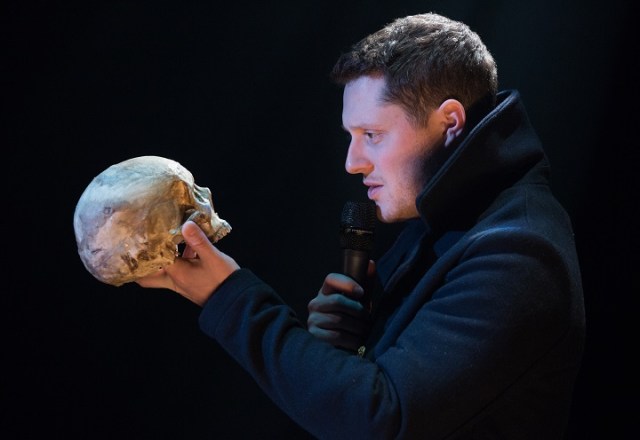
This co-production of The Humans, Stephen Karam’s 2016 Tony Award winner from Citadel Theatre & Canadian Stage has come to the Bluma Appel Theatre. We are functioning in real time for about an hour and a half of a Thanksgiving Day, an average American family melting down before our eyes. It’s just another day in the long descent that is modern American life, rather than the actual end of the world. There are several sorts of pain & conflict featured, and they all ring true, all painted vividly and portrayed with authenticity.
Playwright Stephen Karam (photo: Jessica Antola)
There’s a big impressive set designed by Judith Bowden. a stunning piece of architecture that allows us to see six characters interact on two levels before our eyes. Downstage right there’s a spiral staircase, while in the middle of the upstage walls are doors leading to the corridors taking one to the elevator that’s needed to get Momo –the aging dementia sufferer who uses a wheelchair –up or down. The Humans is like absurd Rossini in the robotic frenzy of a distempered family talking and shouting and living and gradually dying. Sometimes they listen to one another but more often they’re busily racing on to their next gut response. Between Bowden’s design and Jackie Maxwell’s direction there is no mistaking the tour de force that is Karam’s play, at least for the remarkable amount of energy in this passionate human comedy.
My musical ear craves something softer, rebelling against the size of the theatre that compels many of the most tender moments to be louder than I would wish, like Mozart played in a bigger venue or with a bigger ensemble than the piece really should require. And yet when there is a quiet tête-a-tête the dialogue fades away, as the exchanges become too private for us to hear. So no, Karam isn’t Mozart and doesn’t want tender rococo. Much as I might wish that Maxwell and/or Bowden would vouchsafe us something delicate and small—because in spite of myself I’m drawn into the lives of every one of these characters, caring about every damn one of them–the play itself is built to run like a clockwork monstrosity, a Rube Goldberg nightmare of human devolution.
From time to time we hear a trash compactor running in the building, a noisy machine that might be a family member.
The production will get better, as they get more accustomed to playing the lines with a laughing audience and the curious acoustics of this big space. My heart rebels against such intimacy played to such a big audience. I think the size necessitates a certain broadness of delivery to some parts of the play, that undermines its power, making it more generic and less incisive. I wonder if it might be better played in a tiny space. Yet that’s just me, viscerally identifying with the older generation in the play, trying to turn back the clock to another sort of family drama from another century, wanting to MAGA at least onstage rather than face what they (and we) have become. I can’t recall the last time I’ve seen such an accurate snapshot of the American Dream turned nightmare, a human comedy that’s often funny even if the laughs are painful ones.
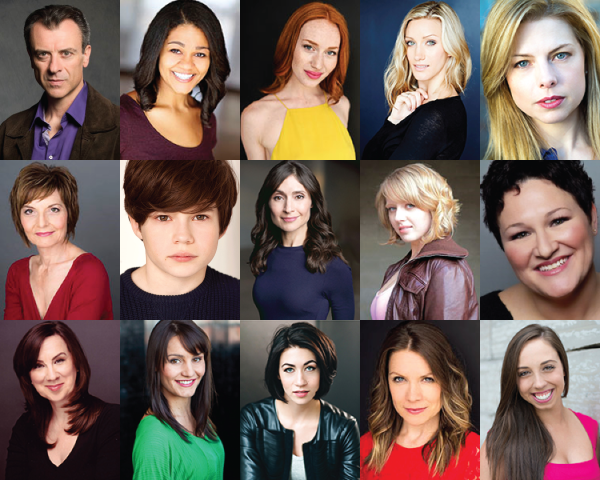
I think you’ll experience the same sort of split that I did, in responding simultaneously to the brilliant writing of the play and the remarkable production, precision performances from a tight ensemble of six actors:
Maralyn Ryan
Ric Reid
Laurie Paton
Alana Hawley Purvis
Sara Farb
Richard Lee
For the first half hour, which cleverly offers exposition, it’s a bit dazzling just coping with the voices coming from up and down, seemingly so alive that their baroque counterpoint of perfectly timed lines seems natural rather than contrived. And for the most part the intense complexity in your face pulls you in, hooking you on several different threads of conflict, plot, character. Once the machine hits its stride – or maybe what I mean is, once you start to understand the dynamics and calibrate the different elements– it just gets better. From time to time the reality acquires a metaphysical layer, especially towards the end: which I won’t spoil.
Whether you’re pulled in by the writing or the performances, it’s unlikely you’ll be indifferent. In places it’s wildly funny but there’s a great deal to jolt you and disturb you. Good thing I’m disturbed. The play speaks my language.
The Humans continues at the Bluma Appel Theatre until February 25th.
Sometimes we read a book to learn something, to discover answers to questions. And sometimes we read simply to get lost in the conversation.
Walter Frisch is taking me on one of those latter sorts of journeys in his 2017 book Arlen & Harburg’s Over the Rainbow, part of Oxford’s Keynote series that explores the canons of western music. Other volumes have explored Alexander Nevsky, Beethoven’s 9th and Carousel.
I’m not aware of a time when I didn’t know this song by Harold Arlen & Yip Harburg. The Wizard of Oz is one of the first films I saw that I have seen over and over, first of many in a lifelong pattern, I realize. Strangely I recall that when I was young there was something about this song that didn’t work for me. It stops the action in the film. It’s emotional, and I didn’t fully understand it. Of course as we grow up our attitudes change.
The film has always been a touchstone, a film encountered young that continues to speak to me and lots of other people.
I didn’t realize how much there was to know:
about the composition of the song: taken apart for us, both the music and lyrics, including alternate versions / variants. I didn’t know that Ira Gershwin even helped with part of the lyric
of its inclusion in the film: it almost didn’t make it. Can you imagine the film without the song?
its subsequent life as a calling card for Judy Garland. The later you get in her life, the slower it gets. The above version is perhaps 2:30 long. Later? No longer the wistful song of a child, hopeful and dreamy but a torch song, regretful, and shadowed by the past.
I read in the book that it’s the most popular song of the century and am not at all surprised.
Arlen is not a typical song-writer, we discover. I thought I knew that, although I never properly explored it before now, as I read about his compositional methods. We hear about Harburg too although that did not interest me as much.
Frisch also traces Garland as an icon for the LGBT world in the 1950s and after, the singer and her various roles functioning as signifiers that shifted decade by decade, culminating in a discussion of Rufus Wainwright’s 2006 Carnegie Hall concert & subsequent album celebrating Garland.
And while we’re told of the many singers who gave “Over the Rainbow” a wide berth, respecting its association with Garland, the same isn’t true of jazz piano, where we read of some of the different approaches to the song minus the text.
There’s Art Tatum.
No we’re not in Kansas anymore.
Or Bud Powell.
And finally, Frisch tells us the story of IZ, aka Israel Kamakawiwo’ole, whose version of the song not only gained fame worldwide, but was a symbol of Indigenous self-determination in Hawaii. IZ died in 1997. This video plays the song, showing the scattering of his ashes.
In the epilogue we hear from Linda Hansen and Salman Rushdie, exploring the meanings of the song. And now I regretfully come to the end of the book. It’s not quite the same as a song, that I might simply play again.
Even so I’m thinking, I want that again. But in the meantime, I will enjoy seeing The Wizard of Oz with the Toronto Symphony performing live. It’s presented February 17th & 18th at Roy Thomson Hall.
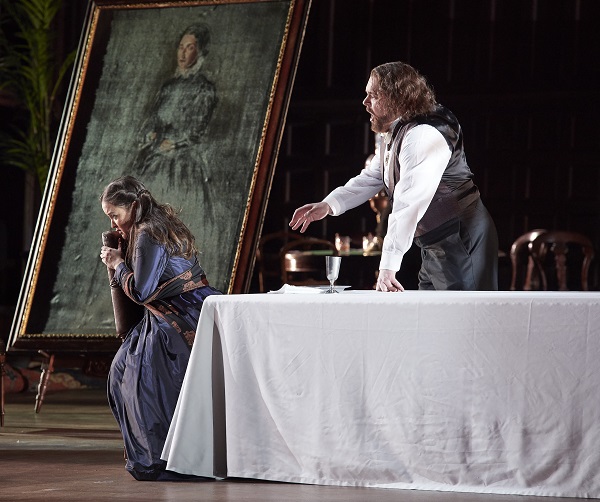
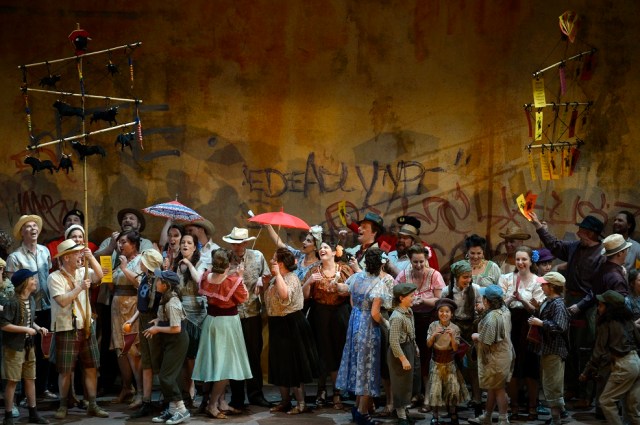
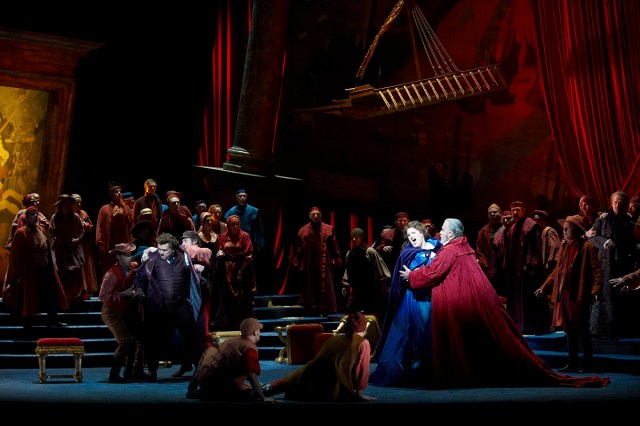
I like the Canadian Opera Company’s Rigoletto, directed by Christopher Alden, starring Roland Wood, Anna Christy and Stephen Costello. Everyone I’ve talked to enthuses about the singing.
Anna Christy as Gilda, Roland Wood as Rigoletto (photo: Michael Cooper)
Ah but I like the production, and I say this, aware (via social media) that the reviews I’ve seen uniformly trash Alden. While I get this (where some do their usual refusal to accept anything new, while others are put out that this is quirky and hard to decipher in places), it seems really unfair, when we remember that the opera they want done faithful to the original score is a wooden melodrama full of scenes that make no sense. I’ve been playing this music at the piano since I was a teenager. I watched Louis Quilico sing the role many times, rolling my eyes at his acting even while I adored his singing. The last scene never worked for me, ultimately a question of which high notes would be sung rather than a genuine believable scene. As the years went by he became more and more melodramatic, which I now see makes a lot of sense, considering that the original is truly melodrama. I used to rationalize all this by seeing Rigoletto’s character –and to a lesser extent Monterone & Sparafucile– as evolutionary hybrids, new creatures who didn’t quite fit in with the older bel canto model as exemplified by Gilda & the Duke. And so while some scenes were wooden or hokey I’d lose myself in the wonderful music written for Rigoletto, while glossing over the clunky dramaturgy, the places where Verdi would grind his gears in seeking to make the thing work.
I feel that Alden’s Rigoletto is in some ways ideal, in its striving to get back in touch with the essence of the story, refusing to gloss over what’s really happening.
No one has any real agency. Gilda makes the closest thing to a choice, in offering herself up in place of the skanky Duke she loves, a choice almost totally devoid of nobility because of the foul stench emanating from the person she saves. Her father, a jester who mocked the father of one of the seducer’s victims partly to curry favour with his boss, partly because mockery and abuse were his stock in trade, begins to be fearful contemplating the curse laid up him. And as the disaster looms closer and closer (a father who mocked another father?), we hear him speak of the curse, but in fear. Not guilt mind you, nor remorse.
Fear.
Let me repeat, true to the form of melodrama, this is a world without any real agency, and as such maybe something we have trouble understanding. I love the way Alden’s production refuses to euphemize, takes away all the hiding places. Some of those are surprising, as for instance, when Rigoletto mocks Monterone –that aforementioned father of the girl who was seduced—not by jumping about like a jester (as the mickey—mousing in the score might seem to indicate), but instead by sitting still and abusing Monterone directly, pointedly.
It’s drier and nastier as a result.
Monterone eventually gets it, but in most other productions, that’s something offstage, something we only imagine. Alden gives it to us, complete with a body swaying on the end of a rope. And instead of the quiet Giovanna in the background Alden gets Megan Latham to portray her as an enabler and the Duke’s creepy collaborator, pulling the curtain open and closed even though neither she nor anyone else is really in control.
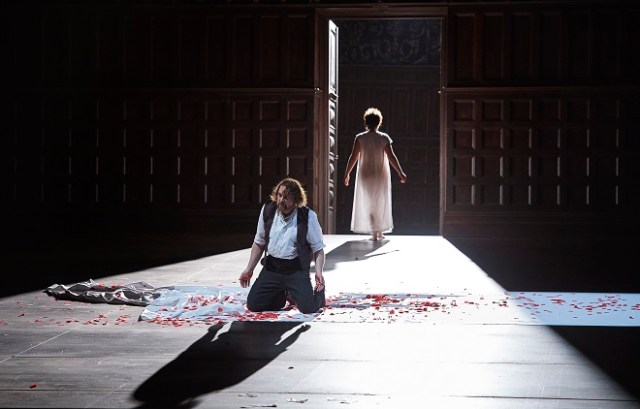
This production, I repeat, works for me and is one I find more successful than the traditional Rigolettos of my youth. The final scene between Gilda & her father moved me for once. But I was especially shocked by the scene where Gilda goes to the killer Sparafucile, in effect offering herself in place of her lover. Intriguingly, she’s dragged by someone who might be Monterone’s daughter or simply the spirit of all the desperate women who loved the Duke. Perhaps she’s choosing, perhaps she is possessed & haunted. It’s mysterious and poetic and original at the moment of greatest melodrama, when the action is all wild passion. I was shocked to find myself tearing up, and swept away as the music moved me more than it has ever done.
Roland Wood & Anna Christy (photo: Michael Cooper)
Some of that I credit to conductor Stephen Lord’s bravura emotion, erupting from the orchestra at the key moments. But he held the show together magnificently, the COC orchestra sounding strong, agile, and above all, beautiful.
I loved this production when I saw it in 2011 (and I said that I liked it too). But I think I get it more clearly now that I have been reading about melodrama. What I see Alden doing is unwrapping the euphemisms and stripping off the genteel façade that has made this very ugly story palatable for over a century and a half. In so doing he’s marching in step with other opera directors whose updates sharpen the dramatic edge of their shows, for instance Robert Carsen’s Iphigenie en Tauride that we saw here in Toronto at the same time that this Rigoletto first appeared here, or Atom Egoyan’s Salome, which takes an ugly story and makes it even uglier in deconstruction.
Oh my so many references to ugliness: but let me explain. Rigoletto is particularly problematic because the nicest music goes to the nastiest character, the serial seducer who leads a charmed life, while the most sympathetic creature is physically grotesque and morally ambiguous. If this were a Hollywood movie that Duke would eventually get his: but not in this film noir of an opera. Alden makes it that much more exasperating. While Verdi writes happy jocular music for the courtiers when they’re abducting Rigoletto’s daughter, and more happy jocular music when they tell their boss about their clever boys club scheme, Alden doesn’t buy in. When the courtiers show up for the abduction, although the music is all fun fun fun, Alden makes them very creepy, very scary. I love that moment. And while Verdi wrote something especially bizarre to open Act III (because of the two part aria convention, the Duke has an abrupt change of heart and manner), Alden with the help of newspapers, conjures something hysterically funny, in the chorus’s response. It’s a melodrama, like a clockwork machine that inexorably runs without remorse to its conclusion. At times it resembles the dark comedy one glimpses in Hitchcock.
Anna Christy and Stephen Costello (photo: Michael Cooper)
On this occasion, we had an announcement that Stephen Costello was unwell yet he finished the performance. There was one high note that had a tiny bit of a crack, confirming his condition (although the omission of a few high notes also served as de facto evidence); even so he was heroic, singing boldly and with a wonderfully Italianate flair. Christy was highly sympathetic in what can be a thankless role, while Wood was especially strong dramatically and vocally.
But there is no tragedy, just sadness here in this strange space, that I called “a man’s world” back in 2011, resembling a kind of men’s club. All are forgiven, none can be blamed in a microcosm that’s so relentless. I can see that some found it unsympathetic as though we’re watching rats in a Skinner Box. No it’s not nice, but then again: neither is Verdi’s opera.
Finally, I offer something to help get inside the world of Alden’s Rigoletto, courtesy of Jessica Chastain & Saturday Night Live. We seem to be in a world with some resemblance to Rigoletto’s world, a world where the rules are different for people like the Duke of Mantua, or the POTUS. When you watch the news and the most outrageous behaviours seem to have no consequence, no logical outcome, and you’re asking yourself “what even matters”? Perhaps one should accept that you have no agency, that there’s nothing you can do.
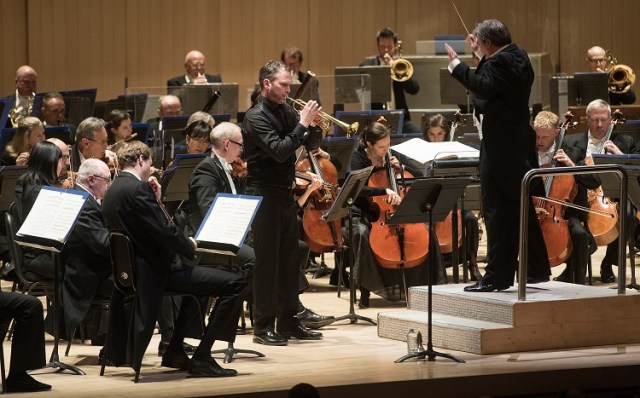
There are many possible ways to interpret great pieces of music. I was struck tonight, listening to the Toronto Symphony led by John Storgårds at Roy Thomson Hall, that sometimes there are more important considerations than the interpretation. I say that because, while I didn’t always agree with Storgårds’ choices, there was no mistaking the rapport between the conductor & the ensemble.
They follow him. They play for him with great passion & commitment. They seem to like him. And as we observe the orchestra in the twilight hours of Peter Oundjian’s tenure as music director, every new wielder of a baton becomes a possible suitor wooing the orchestra and the audience, someone who might be a candidate to take Oundjian’s place.
There were three items on the program tonight:
Igor Stravinsky’s Funeral Song for Orchestra, a youthful work having received its Canadian premiere performance in yesterday’s concert
John Estacio’s Trumpet Concerto, having received its Toronto premiere in yesterday’s concert, co-commissioned with several other Canadian orchestras
Gustav Holst’s familiar suite The Planets
Conductor John Storgårds leads the TSO, including trumpet soloist Andrew McCandless (photo: Jag Gundu)
The Stravinsky piece that began the program is quite a story in and of itself. In 1908 the work received its single performance before being lost. Stravinsky composed it to honour his teacher Rimsky—Korsakov. And it was assumed to have been lost. In wikipedia the composer –speaking decades later of the lost piece he recalled from his youth—is quoted describing it as follows:
all the solo instruments of the orchestra filed past the tomb of the master [one of the great authorities & teachers of orchestration] in succession, each laying down its own melody as its wreath
But of course it has only just been re-assembled from parts that were found in 2015, which is why it received its Canadian premiere this week. I heard it for the first time just yesterday, and confess that this new piece that I had been looking forward to tonight didn’t impress me as expected, a more restrained and polite reading than the one I heard online. I’m inclined to cut Storgårds some slack, as this highly chromatic piece is full of subtleties. Perhaps it will sound better in time, as its nuances are better understood? Or maybe my expectations are unreasonable, and the issue is mine alone.
In contrast, the flamboyant Trumpet Concerto by Jon Estacio was a huge success with the audience (although NB they loved the more sombre Stravinsky piece too). It’s a work of lovely sonorities. Everything I’ve heard by Estacio is beautiful, a composer with a very direct sensuous appeal to the ear. The ease with which soloist Andrew McCandless negotiated the work makes it tricky to determine whether we were experiencing phenomenal virtuosity, or simply a piece making relatively modest demands on the soloist. All I know is that the instrument stayed within its normal range without straining the player with extreme high notes or challenging passages with lots of sweet cantabile passages. I suspect that Estacio made smart & judicious choices, avoiding making his concerto overly difficult, but did make it a stunninglyy attractive piece of music to listen to, which is perhaps the most important consideration.
After the two premieres and the interval we came to the well-known piece on the program, namely Holst’s monumental seven-movement suite The Planets, that’s less about astronomy than astrology, concerning the seven planets nearest to us in the solar system:
Mars The Bringer of War
Venus, The Bringer of Peace
Mercury, The Winged Messenger
Jupiter, The Bringer of Jollity
Saturn, The Bring of Old Age
Uranus, The Magician
Nepture, The Mystic
While my comments about the orchestra’s rapport with their leader apply to the entire concert it especially mattered to me in a work that I know well, and where I have opinions about how I like it to be performed. But no matter, the key –as I said at the outset—is how the orchestra responds to Storgårds’ leadership. Nevermind my preferences. The readings were all very confidently executed, in the sense that Storgårds seemed to know what he wanted, and the orchestra followed faithfully. This was a tight ensemble, especially in the most challenging sections, a parade of beautiful solos from Jonathan Crow, Joseph Johnson, the winds & brass, and the percussion, and many accurate entries when everyone was playing. By the time the women of the Elmer Iseler Singers offered their wordless epilogue to Neptune, I was thoroughly hooked, the audience joining me in a long respectful silence at the end: always a good sign.
Canadian soprano Sara Schabas is the founder of the Electric Bond Opera Ensemble, a group that aims to present classical and operatic works that tell untold stories, reminding audiences and performers of the “electric bond of being” (Thomas Huxley) by which we are united.
In the 2017/2018 season, Ms. Schabas debuted with Tapestry Opera as Henri in Bandits in the Valley, receiving Broadway World Toronto nominations for Best Leading Actress (Musical-Equity). She will sing Yom HaShoah: Holocaust Remembrance, a solo recital with Geoffrey Conquer, piano at noon April 11th at the Richard Bradshaw Auditorium.
But first she performs Krystyna in the Canadian premieres of Jake Heggie’s chamber operas, Another Sunrise, and Farewell, Auschwitz to be staged by the Electric Bond Opera Ensemble at Beth Tzedec with members of the Toronto Symphony Orchestra, February 10th & 11th. Because I wanted to know more about her involvement in the Heggie operas I asked her some questions.
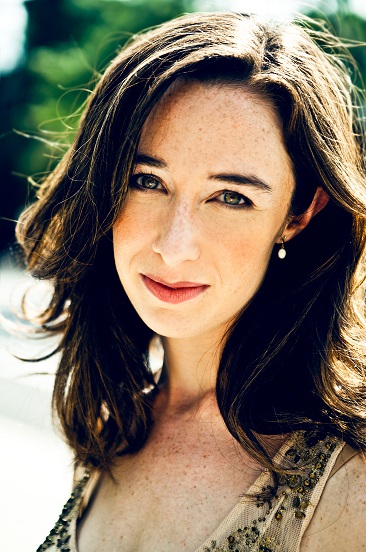
Founder of Electric Bond Opera Ensemble, soprano Sara Schabas (photo: Kirsten Miccoli:)
Are you more like your father or your mother?
I’m lucky to have inherited traits from both my parents. While I certainly look like my mum and share many of her mannerisms, personality traits, habits (including her love of reading) and artistic sensibilities, I also like to think I take many qualities from my father: his jovialness, work ethic and musicality (he was originally a french horn player). Music, art and social justice stretch throughout my family tree, and many of my aunts, uncles, grandparents and cousins are either artists or work in the arts or are engaged in human rights in some way.
What is the best or worst thing about what you do?
The best thing about what I do is I have the opportunity to make an immediate connection and impact on other people. Whether it’s five minutes of joy or a life-changing performance (though of course those are rare!), I get to share something intimate with people I’ve never met before. It’s also a huge privilege to constantly engage with an art form that awakens and inspires all aspects of the human condition. The classical music tradition is so rich and varied that every day I get to learn and discover something new.
Who do you like to listen to or watch?
In my adolescence and during University, I was completely consumed with classical music and happy to listen to classical music and opera all day long! Now that I‘m a professional singer and spend so much time thinking about my craft, I often find that I need a break at the end of the day. I really enjoy listening to podcasts while I’m commuting or at the gym, such as The Daily, Canadaland, On Being and the New York Times’ Modern Love. I also have a soft spot for folk music, such as the Toronto-based band, The Weather Station. I still love listening to classical music – particularly French music (loving Barbara Hannigan singing Satie these days) – and the Met’s Saturday Afternoon at the Opera broadcasts with which I grew up. Oh, and I’m a total CBC Radio junkie.
What ability or skill do you wish you had, that you don’t have?
I absolutely love to watch dance, and in another (more coordinated) life I would love to have been a ballet dancer! I love watching modern works, like the National Ballet’s recent triumph, Nijinsky, and following the New York City Ballet on social media and taking inspiration from the innovative, gorgeous new works they are always putting on. Luckily I can pretend to be a (very clumsy) ballerina every week in my Allegro ballet fitness class at Toronto’s Extension Room.
When you’re just relaxing and not working, what is your favourite thing to do?
I really love to bake. There’s something so meditative about listening to a podcast while measuring cups of flour and separating eggs. I also love being outdoors – I developed a great love for hiking during the two summers I spent at the Aspen Music Festival, and I’ve always loved biking and canoeing.
*******
More questions about Electric Bond Opera Ensemble’s Canadian premiere presentations of Another Sunrise & FarewellAuschwitz, two one-act operas by Jake Heggie.
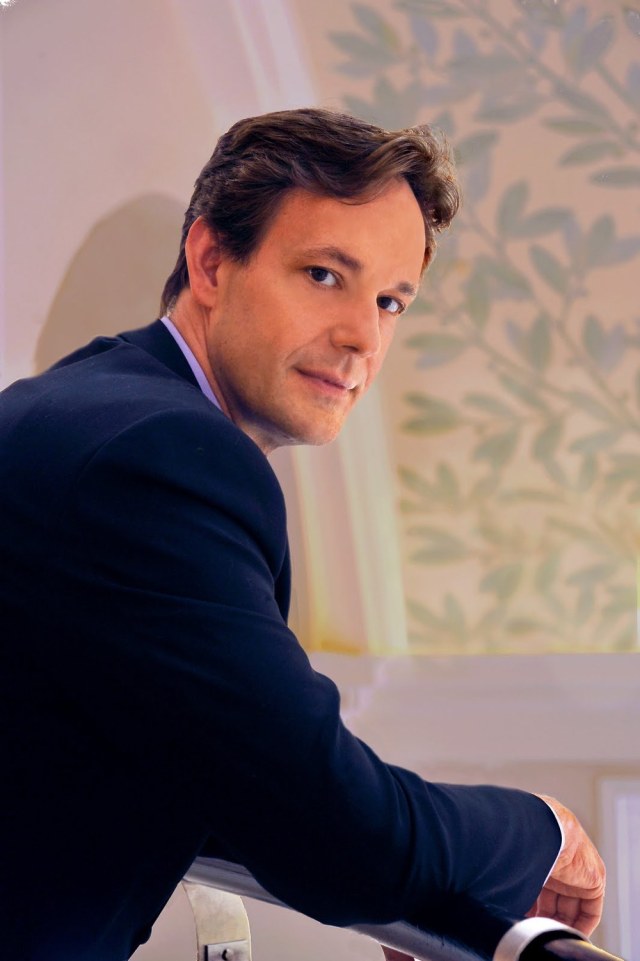
Composer Jake Heggie
Why do you want to present these two operas?
I’ve been a fan of Jake Heggie’s music since I first began studying classical voice. I became even more passionate about his works after performing in his opera, Dead Man Walking, two years ago with the Dayton Opera, as well as doing a concert of his works which he both coached and narrated. Heggie has such a gift for communicating genuine human conflict and emotion, which I think is why his work is so impactful, even on fraught issues like the death penalty in the U.S. (I had a colleague remark to me after our production that the opera had changed his opinion on capital punishment.)
Another Sunrise and Farewell, Auschwitz similarly communicate complicated, deeply human stories around the Holocaust. The protagonist of Another Sunrise is a survivor of the Holocaust who not only clearly struggles with P.T.S.D., but with her identity, her past, and what it means to be a survivor. I’m hoping that our presentations of these works help people to identify more personally with victims of the Holocaust and the implications of genocide and hate worldwide.
What style of music—both in terms of harmony and vocalism—should we expect to hear in these operas?
In these operas, one can expect to hear music that is both familiar and new. Heggie looks to the classical and operatic tradition when composing, and the pieces are full of allusions to Chopin, Jewish folk melodies, moments that feel reminiscent of Puccini and moments that may remind audience members of music theatre. The five-part ensemble of piano, clarinet, violin, cello and bass is almost Klezmer-esque. One can expect impassioned, refined singing and playing, as well as moments of humour amidst the pathos. There are times when the singers vulgarly imitate instruments playing in the style of Kurt Weill cabaret and times where they sing Freedom marches based off of Soviet Nationalist Hymns. Basically, in these operas, you get the gamut!
Please tell me the stories of Another Sunrise & Farewell, Auschwitz
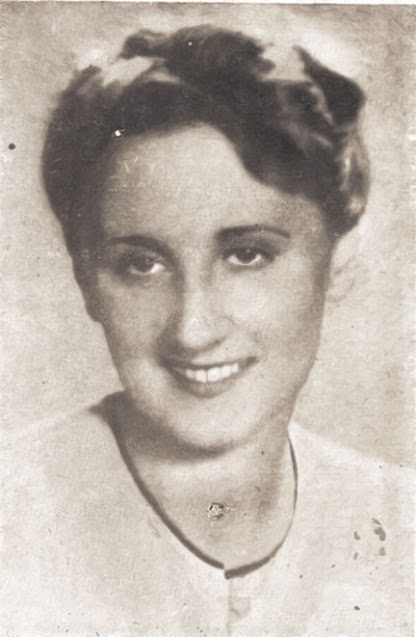
Another Sunrise tells the story of Krystyna Zywulska, a Jewish woman (originally named Sonia Landau) who hid her Jewish identity during World War II. She was arrested as a political prisoner and sent to Auschwitz-Birkenau, where she was given a position in the Effektenkammer, sorting peoples’ belongings while they were sent to be gassed in the room next door. Krystyna Zywulska survived partly because the Nazis enjoyed reading her poetry and the songs she wrote while in the camps. In Another Sunrise, Krystyna looks back on her experiences in Auschwitz, trying to make sense of what it means to be a survivor, as well as her guilt and sorrow, reconciling the past with the present.
Born Jewish with the name Sonia Landau, she became Krystyna Zywulska.
In Farewell, Auschwitz, three singers perform settings of poetry by Krystyna Zywulska (in new poetic translations by Gene Scheer), which were originally written and performed in Auschwitz for the S.S, in cabaret-like style. The poems alternate between humour, sadness, irony, pathos and defiance in character.
Please put Another Sunrise & Farewell, Auschwitz in context vis a vis operatic prototypes of the 21st century. How radical or conservative are these operas?
Heggie’s music is quite tonal and full of lush, wide-ranging melodies and harmonies. There are some moments of dissonance but overall, Heggie’s works are so entrenched in the classical and music theatre traditions of the last two hundred years, I don’t think audience members will be shocked by any of his language.
Music Director Michael Shannon
Please tell us about who’s involved with the project
First of all, this project came to life because Yacov Fruchter and the staff of Beth Tzedec Congregation believed in it so strongly. Many members of the crew are new to me, and it’s been a joy getting to know them and share in their creative energy. Michael Shannon and I knew each other from our work on Tapestry Opera’s Bandits in the Valley, so I knew his enthusiasm, musicality, leadership and talent would put our musical ensemble in the right hands.
Aaron Willis, our director, was introduced to me through his wife, Julie Tepperman – librettist for Bandits in the Valley. Aaron and Julie are the co-artistic directors of Convergence Theatre, and Aaron has directed for numerous esteemed companies around Toronto including Soulpepper and Theatre Passe Muraille. He’s also involved in the Toronto Jewish community, and he and Julie wrote and starred in a comedy called Yichud about an Orthodox Jewish couple a few years ago, which received wide-ranging praise. We also have the award-winning set, costume and lighting designer Jennifer Goodman transforming Beth Tzedec’s Herman Hall and creating brand new sets and costumes for this production. The other two singers, Georgia Burashko and Sean Watson, are extremely talented Toronto-based singers who connect to the material on multiple levels. Georgia and I have the connection of both being Canadian Children’s Opera Company, Earl Haig Secondary School and University of Toronto Faculty of Music alumni, although this will be our first time singing together (!), while Sean Watson and I have sung together in the Beth Sholom Synagogue choir. The instrumental ensemble is made up of Toronto Symphony Orchestra musicians who all connected to the material and made time to perform in this work despite their very busy schedules!
Tell us about Electric Bond Opera Ensemble
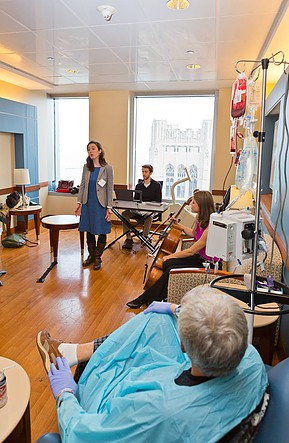
Sara at a hospital in Chicago
The name for the Electric Bond Opera Ensemble came to me during a lecture Adrienne Clarkson gave at the Six Degrees Festival in Toronto. She quoted the 19th century biologist Thomas Huxley, who said that we are all connected by an “electric bond of being.” This quotation struck a chord with me, as it taps into the essence of why I think music is important and has the power to unite people. Music reminds us of our common humanity. Through the shared experience of listening to a performance or making music together, we are united, despite our differences in cultures and backgrounds. Over the past few years, I have become more and more aware of the opportunity musicians have to make a difference in people’s lives. While I lived in the United States, I was involved in the charities Sharing Notes and Songs by Heart, where I performed in hospitals and for people with Alzheimer’s, work I continued at Baycrest Hospital after returning to Toronto. I also helped organize and performed in three Syrian refugee fundraising recitals over the past couple of years. Another Sunrise and Farewell, Auschwitz fit well into my theme of performing untold stories that remind us of our common humanity.
Is there a teacher or an influence you’d care to name that you especially admire?
I have been lucky enough to be surrounded by role models, in both my industry and my personal life. My husband works in non-profit and constantly inspires me with his work around poverty and social justice. I’m extremely inspired by the many incredible women in Toronto who have started their own opera companies, such as Aria Umezawa (another Earl Haig alumna) and Rachel Krehm, Larissa Koniuk, Alaina Viau, Stephanie and Kate Applin, Maureen Batt and Erin Bardua and others, and by my friend Allegra Montanari, who started the non-profit Sharing Notes in Chicago that first inspired me to give back through music.
*****
Electric Bond Opera Ensemble present the Canadian premieres of two Holocaust-themed operas by Jake Heggie, Another Sunrise and Farewell, Auschwitz, February 10th at 8:00 pm and 11th at 2:00 pm, at Beth Tzedec. For more information or for tickets, please visit: www.anothersunrise.ca or call 416-781-3511.
The concept is exactly as it sounds. If you’re a singer wanting to do a role, Opera by Request is the place for you. William Shookhoff is a busy man, the pianist & music director responsible for making those requests happen.
I can’t pretend that I understand the conversations that go into the choice of repertoire, but I would assume that the chief conversations surround the big roles in an opera, the difficult parts.
Naomi Eberhard sang Salome
Ryan Harper sang Herod
Michael Robert-Broder sang Jochanaan
Leah Giselle Field sang Herodias
I didn’t ask, but I wonder. Did Shookhoff begin with a request from one or two people, and then approached likely candidates for the other parts? I do know that Ryan Harper came to his role relatively late in place of someone else.
None of the music was cut, although the ObR concept is virtual, along the lines of opera in concert rather than fully staged.
No dance
No costumes
But there was a severed head!
And while there is no orchestra, just the grand piano at College St United Church, Shookhoff did admirably in emulating the Straussian sound.
William Shookhoff, Opera by Request music director and pianist
The funny thing is, I seem to have come full circle. Back when I wrote for the University of Toronto student newspaper The Varsity in the 1970s I interviewed Bill Shookhoff, then a coach with the Canadian Opera Company in the Mansouri era. I remember that he spoke about the challenges of playing Salome. I had always hoped to hear him play it and now I got my wish.
To get through two hours of playing this score one has to make a few judicious choices. It’s not as loud as Strauss with his full orchestra: and how could it be? But that’s a good thing for the singers.
The singers we hear with Opera By Request are sometimes ex-members of the COC ensemble, sometimes singers who have not been admitted. Some of these performances are good enough to merit at least consideration by the powers that be with the big companies.
Michael Robert-Broder’s Jochanaan was a stunningly lyrical reading of this role, one that can sometimes be misread as a prudish fundamentalist, which is to distort the drama and the music. If it’s done right we should be seduced by this, the original evangelist. And I think that’s what we got from Michael, singing a smoothly lyrical line throughout, putting out a fabulous wall of sound from time to time, always on pitch and never harsh sounding. But most important he seemed to believe everything he was saying, to sing with a fervent love for his subject rather than like a fake preacher who has secrets in his closet.
Ryan Harper? Different kind of challenge. I’ve known this voice awhile, watching him develop as an artist, from a light tenor who sang in the Richmond Hill production of Cosi fan tutte, where he showed a gift for comedy, then as the second of the Rodolfos in Against the Grain’s La boheme, where his comic gift again took me by surprise. A Rodolfo who isn’t just a self-centred poet, but can actually bring something to the horseplay in Acts I & IV? Excellent! And surprising. His Don José for Loose Tea Music Theatre’s Tragédie de Carmen showed not just a growing heft in the voice, but acting chops as well. And so I wasn’t surprised at all to see him taking on Herod in Salome, at the last minute I found out in an after-the-show conversation. It’s a role that sometimes is done in a manner that escapes singing full out, thinking of the approach of Gerhard Stolze (on the Solti recording with Nilsson) where it’s a light sound that often verges on falsetto. We heard Richard Margison sing the pants off this role not so long ago with the COC. Harper gave us something between Margison’s full-out singing and Stolze’s faux production, as he sometimes put his voice into something very delicate and light –suitable for the ironic delivery we sometimes must have from Herod, and sometimes a very Wagnerian sound such as what we got from Margison, as in his hallucination sequence, or when the story turns dark in the last half hour.
Cian Horrobin had everything you want in a Narraboth. He’s young and exuberant sounding, he sang powerfully, and is attractive onstage. And Leah Giselle Field gave us the kind of sardonic delivery you want from your Herodias, the core of this dysfunctional family feud.
Opera by Request return Feb 10th at 7:30 pm with Bellini’s Norma. Further information.
The headline is meant to convey an enthusiastic response to something I’ll attempt to analyze. I liked it.
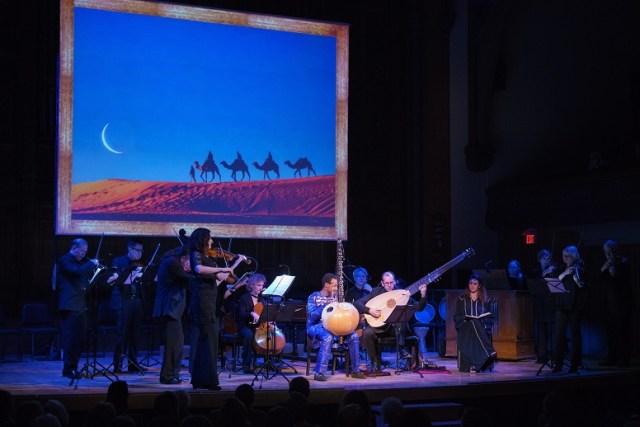
Alison Mackay has grown from her role playing violone & double bass with Tafelmusik into their programmer extraordinaire, creating a series of inter-disciplinary programs over the past decade. I thought that last year’s Sesquicentennial project Visions & Voyages: Canada 1663 – 1763 raised the bar, in its integration of politically charged cultural history, employing music, text and images to explore the relationships between Indigenous Peoples and settlers. In that concert I felt Mackay was going beyond her previous role as a curator of images, words & music to venture something deeper & more ambitious. While it’s not opera nor fiction it begins to resemble a kind of documentary, opening a very special kind of conversational space.
And now Safe Haven has taken us further, a remarkable combination of elements that for me succeeds admirably. The title reflects a kind of mission I sense in this piece and among the performers. I call it a piece because I think we’re again beyond the realm of curated content and into something resembling an inter-disciplinary performance. Where Visions & Voyages was likely commissioned in context with the Sesquicentennial and as such had a kind of formal guise in a desire to explore the very meaning of “Canada”, this is I believe an even deeper venture.
But we’re not exploring because of some abstract date on a calendar. I think there’s a genuine concern underlying this piece drawn from the headlines and arrivals of refugees in the past year. We are exploring the phenomenon of exile, the motivations and experiences of the refugee in different centuries in diverse circumstances. While we discover instances in the first half of the evening, of the fertilization accomplished by displacements –as if to present us with the historical evidence that refugees are good for a society—in the second half we’re much more into a pure celebration grounded in musical terms, the actual experience of the encounter itself. Where the first half was intellectual and linear, as we move towards the end of the concert, we could be in any century, watching the cross-fertilization of musics and musicians meeting not so much face to face, as sound to sound, at times in a kind of intercultural jam session. We revisit Vivaldi with some new exotic instruments.
So yes, I thought I sensed Mackay pushing the envelope even further this time. Where the first half felt like the documentary, recounting history through the use of musical performance, images and text but carefully narrated and logically unfolding, the second half went in a slightly more reflective and purely emotional direction –not unlike what we’d seen last year—as the purely musical and celebratory side came to the fore. The intellectual edge of the first half was balanced by a more purely abstract exploration.
I recall a conversation with Eliot Hayes many years ago, when my operatic ideas got shot down on the premise that I was hazarding “big ideas”. The word was spoken with a kind of embarrassment, as though I should have known not to believe I should ever undertake such complex topics.
Yes big ideas are hard to present. Last year’s Visions & Voyages was important precisely because of ambition, of daring to undertake impossibly complex and abstract subjects. And yet this year dares even more, going further. I can’t think of a more thorny topic than the images we’ve seen in this country showing families in boats, hearing of children drowning. For me this is what is so astonishing, as Mackay in her last two programs for Tafelmusik dared to undertake something far beyond mere music.
I’ll be thinking of these composers in some new ways as a result of this program and the fascinating links. I already knew of Vivaldi as an inspiration for JS Bach, but discovered more tonight. I would never have connected Lully to the Huguenots and their exodus from France.
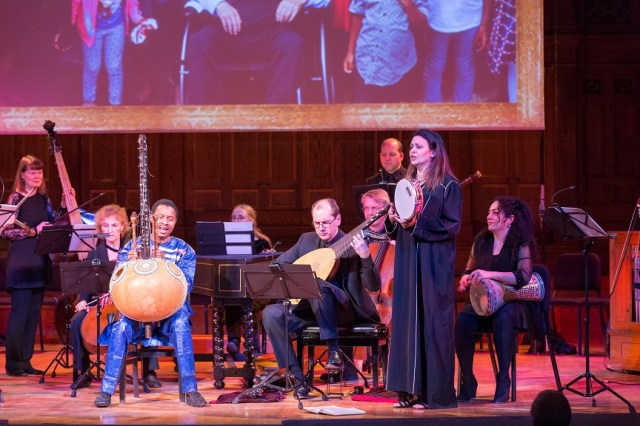
Tafelmusik’s Safe Haven, with creator Alison Mackay at left, Diely Mori Tounkara kora, Lucas Harris, lute, Maryem Tollar, vocals, and Naghmeh Farahmand, percussion (photo: Jeff Higgins)
I can describe some of the participants for you, but my words can’t nearly create the effect you have when you hear Diely Mori Tounkara’s kora, whether gently intoning a solo or played as part of the Four Seasons. Or I can mention Maryem Tollar’s narration & singing, or the percussion of Naghmeh Farahmand. As much as this presentation concerns welcoming people into cultures, it was also a concert enacting a welcome to musicians on the stage at the Jeanne Lamon Hall at Trinity St Paul’s Centre, Tafelmusik showing us what a welcome looks and sounds like.
I’m eagerly anticipating the time when they put this onto a DVD, as I really want to be able to watch this and absorb it further, a creation of wonderful richness, and great beauty. And of course I cried in a few places. That’s the thing with big ideas. They’re unwieldy and dangerous but they must be addressed. I feel I must add as a sort of afterthought (the morning after, still in awe), that for some of us this is pushing very personal buttons, recalling family escaping Budapest and other Hungarians hazarding the mountains, having parts amputated from the cold, but still grateful for finding this particular safe haven, Canada. I’m running that Biblical passage through my head in a slightly different version, impressed with the empathy at the core of Mackay’s imagination (thinking of doubting Thomas & faith). Blessed are they who see suffering and offer refuge. But especially blessed, to empathize without having seen or lived through it.
So of course, tears.
Safe Haven continues Jan 20 & 21 at Jeanne Lamon Hall, and Jan 23rd at George Weston Recital Hall.
Tafelmusik’s Safe Haven showing one of Rava Javanfar’s stunning projections (photo: Jeff Higgins)
I went to a small school where hero-worship was natural, given that we were all boys (that changed as they admitted girls for the first time in the very year I left, and yes I wish it had been sooner). We were taught to look to the older students for their example, and the older boys naturally tried to set a good example. Yes, in those days alumni were “Old Boys” because of course they were all boys and they were old in at least two senses of the word:
Former students
Old people, “old boys” being a nicer euphemism than “old men”
We would hear of the exploits of our Old Boys, going on to do great things as adults after graduation.
I used to read John’s pieces in the Globe & Mail, among the most interesting & best written you’d find in that paper, whether you fancy food, poetry or ideas on how to fix the sport & business of ice hockey, (still one of the most interesting things I’ve ever seen written on the topic). I want to be very careful as I publish his responses to my questions in this space, given that he’s a better writer than I’ll ever be, and want to be sure to honour his thoughtful choice of words.
Why am I interviewing him? Because John was and is an extra—or to use the fancy word, a “supernumerary” –in productions with the Canadian Opera Company over a period of decades. That makes him both a participant and an observer. I sought to capture some of that for the blog, timing it for the week of the opening performance of his next appearance, namely Rigoletto. John will be onstage with Gilda & the Duke & Monterone & Rigoletto himself. He won’t be singing, but he is up there onstage, as he has been so often. I’ve got some questions that I ask him but first, let’s find out a bit more about who he is. While I usually assemble a kind of biographical sketch, I couldn’t do any better than to let my interview subject tell his own story. Trust me, it will eventually segue into Rigoletto as neatly as that loud C-minor chord by Verdi.
Stefan Vinke in the title role in the Canadian Opera Company production of Siegfried, 2016 fearlessly meeting the magic fire (photo: Michael Cooper)
*******
I’m from Toronto, and grew up in the new subdivisions of North York as a sports-crazed outdoorsy kid before being packed off to the downtown all-male academic hothouse known as University of Toronto Schools (UTS) at the age of 11. That was life-changing, as much for the strange and interesting brainiacs I encountered every day for the next seven years as for the slightly gritty and always stimulating urban environment that became my new norm. I was much more of the jock type than an A-student scholar, but I belatedly discovered some academic skills and found my way to University of Toronto, where I studied Latin and Greek, partly as an extreme assertion of non-conformity, mainly because it seemed like the richest and purest pursuit of knowledge I could imagine. From Toronto I went to Oxford for another three years, and for better or for worse spent more time on broader cultural pursuits – travel, museums, cooking, journalism, playing what the British call ice hockey – than on serious academic slogging.
I came back to Canada thinking I might like to write but not knowing how to get started. I worked at U of T for a bit, went to law school and dropped out fairly quickly, picked up some freelance editing work that kept me alive, got married and had a child in very short order and after a number of curt telephone rejections eventually persuaded someone at The Globe and Mail to let me write a sample article on wine and food. That developed into an unlikely summer internship, and 32 years later I retired from what was an extremely varied if highly eccentric career in journalism. For much of the time I was a feature writer, which meant I was a generalist who could be expected to write about almost anything, but I also wrote columns about food, TV, family life, language and being a sports fan, as well as turning out a daily book review over a crazy 18-month period and writing a weekly deadline poem. In the middle of all that I managed to add annual bouts of supering for the COC, and the amazing thing is that, apart from one very tense night cutting and editing my massive obituary of Rob Ford during brief rehearsal breaks, these parallel lives rarely came into conflict – they even dovetailed neatly when I chronicled my work in Siegfried for the Globe Arts section at the same time that I was sitting on the Globe editorial board. I left The Globe in 2016 and now spend my days as an urban vagabond, wandering the city’s ravines and getting in shape for long, hilly walks in Europe.
*******
And now for some questions.
Are you more like your father or your mother?
My father was a smart and passionate obstetrician and gynecologist who also taught medical students at the University of Toronto. When I took my newborn son to our pediatrician, a former student, the first thing he said to me was, “People either loved or hated your father. I loved him.” I don’t think I inspire nearly as strong a reaction in either direction, but I share my father’s extremely critical manner and direct way of making my views known. In my kindergarten report card, I was criticized for my over-eagerness in telling other children how to do things right. My friends at university predicted, not always kindly, that I would become a judge. Clearly this is a quality that you need to rein in as an opera super — my colleagues would say I’m not always successful. But there’s a good side to this candour that I hope I also got from my father: He was afraid of nothing and no one, and would never hesitate to call out bad behaviour and hypocrisy, no matter what the consequences.
My father always wanted to be an actor. Oddly, his ambition for me was that I would become a hockey player. He wasn’t around much when I was growing up, given the time-consuming, unpredictable nature of obstetrics in those days, and it was my mother who did a lot of the minute-by-minute parenting. So I had a rather distant relationship with him for many years, and it wasn’t helped by his not always welcome criticism of my on-ice performance when he came to my games. I didn’t take hockey seriously enough as a result and it cost me as a player – though after a lot of conflict and torment, I found my way to what I think was a more stimulating and rewarding life of the mind. But it’s interesting to reflect back on this choice when I work in opera and observe the extreme dedication that aspiring singers bring to their craft – what if I’d applied myself with the same determination way back when, what could I have achieved by following my father’s overly opinionated guidance?
What is the best or worst thing about what you do?
When I was a journalist, at least on the good days, I was lucky enough to get paid to learn new things and meet fascinating people. I was surrounded by clever, quirky, irreverent colleagues at The Globe who cared deeply about their work and talked with quick-witted eagerness about anything and everything. One of our problems with the outside world was how slowly it seemed to move in comparison with the impatient, accelerated newsroom style where everyone was a step or two ahead in their thinking. I miss that chatter, though of course when you finally sat down to start a 5,000-word profile of a political leader that was going to run on the weekend, the last thing you wanted was your colleagues arguing about bike lanes three feet from your churning brain. I always found writing hard, and what I loved about shaping words and ideas into an article that would hold people’s attention, make them think new thoughts and give them some ephemeral pleasure was also what I feared – at any given point in the writing process, there’s an infinite number of possible choices but only a finite amount of time in which to make them. In daily journalism, you have to accept that you can never be as good as you want to be, and that went strongly against my somewhat paralysing perfectionist streak. As a methodical stylist who tended to work week to week rather than moment to moment, I feared the short deadlines that were the norm in my business, and I missed out on some good opportunities because I didn’t think I could write to my standards against a ticking clock. But whenever I was forced into that situation, I realized that I loved the adrenalin rush as much as anyone, and enjoyed the challenge of performing within seemingly impossible conditions. My all-time favourite was trying to write a piece about the infamous Jose Bautista bat-flip game during the 2016 baseball playoffs – I had the luxury of filing from the Rogers Centre press box within an hour of the game’s ending, but there were so many crazy twists and turns that I had to wait until the on-field dramatics were finally done before I could begin to figure out what I’d just seen.
I’ll just add as an afterthought, because not many people have these experiences in common, that being present when Jose Bautista hit his game-changing home run and 50,000 people erupted into a single stadium-shaking scream was not so different from being on stage and in the centre of the action during the thrilling Council Chamber scene in Simon Boccanegra. You can feel the excitement in your body.
Who do you like to listen to or watch?
Well I have three cats, so I don’t feel like I need to spend a lot of time on cat videos. Compared to most people, I have a soft spot for real life, and try to avoid phones and computer screens as time-consuming distractions. But if I’m working at my desk, I’ll often listen with varying degrees of attention to the on-line opera streams (which are more the aria/overture streams) on CBC Music and ICI Musique as well as full-length operas on BBC. I tend not to watch operas on YouTube, though when I get a supering role I might study scenes so I can become familiar with the way words, music and action all combine. I record the Met operas when they turn up on PBS and the wackier range of European productions on the more obscure Mezzo channel (including a Rameau opera set in a giant refrigerator, Hippolyte et Aricie).
One of my tasks at home is to have recorded TV ready for post-dinner viewing, so I keep an eye out for uncut old movies that might pass the time nicely and bear repeated watching – Casablanca, The Third Man, Singin’ in the Rain. Classic TV comedies like 30 Rock, the early Simpsons, Larry Sanders, some Seinfeld are also popular. My taste in film comedies is a bit too boyish for the household, so I tend not to get to watch Animal House and Slap Shot as often as I’d like. Ditto suspense/adventure, though I can sometimes get away with classics like The Great Escape or The Guns of Navarone but never anything with Bruce Willis, Mel Gibson or Steven Seagal. When I was recovering from hernia surgery a few years ago, my wife unexpectedly brought me all the great Jean-Pierre Melville movies in the Criterion Collection to pass the time – which turned my recuperation into two of the happiest weeks in my life.
Not surprisingly, I like stylized Hitchcock movies, especially when I can persuade a younger person like my daughter to see their appeal – Rear Window and North by Northwest in particular. Christopher Guest’s satires are a shared pleasure, particularly A Mighty Wind (which mocks the folk craze of my very early youth) though I think my wife has seen Spinal Tap at least once too often. My Favourite Year with Peter O’Toole is probably our favourite movie together.
Obviously I skew old and nostalgic.
I became addicted to a vivid French series on TV5 about regional heritage called Les racines et les ailes, that takes me to remote places I could imagine walking to someday. In a similar vein, my wife and I are devotees of the Tour de France, and any other beautiful bike races that find their way onto Canadian TV. She also likes baseball, so Blue Jays games are a godsend.
If I’m alone in the house, I’ll sometimes listen to an entire opera and try to follow along in the original language – Cosi and Boheme are particularly good for my languishing Italian. Live opera on radio conjures up the excitement of being a super, but I can’t stand the prolonged Met intermission chatter so that’s a trade-off. I really miss the recorded COC productions that CBC once aired, particularly those where I thought I could hear my heavy-footed noisemaking on the stage (as a tottering plague victim in Idomeneo, as a tightly drilled marching soldier in the same show). I love to listen to Bach, a reflection of my contrapuntal Lutheran upbringing. We seem to have a lot of Baroque music around the house, and Cecilia Bartoli’s melancholy Italian love songs are at the top of the pantheon. The music critic at The Globe introduced me to Suzie LeBlanc’s Acadian songs and I’m eternally grateful. A classmate who played guitar when we were unsuccessfully rebellious teenagers discovered John Dowland’s lute music via Julian Bream (whose concerts we used to sneak into at Massey Hall), and I’ve been a fan ever since. I eventually sang a Dowland song at a student performance when I briefly took singing lessons. When I was young, I spent too much time for my own good in downtown clubs listening to blues, and I still get a thrill out of hearing the likes of Junior Wells and Buddy Guy. Somewhere I developed a taste for the songs of Charles Trenet, and I memorized a few of them (Je suis heureux, j’ai tout et j’ai rien) so I could pass the time on the gym treadmill by singing them to myself. My head is filled with old, really bad rock and roll from my childhood that I’m told I should never sing out loud, but that doesn’t stop me.
What ability or skill do you wish you had, that you don’t have?
Of course I wish I could really sing. Apart from not having the discipline to learn technique, I was always too inhibited about how I’d sound. I took lessons briefly in my 20s, and got to the point of performing Cole Porter’s Night and Day for a small well-disposed crowd, so at least I conquered some of my fears.
When you’re just relaxing and not working, what is your favourite thing to do?
I do a little too much relaxing now that I’m retired, so the key for me is to find relaxation that still has an element of work involved. My idea of taking it easy is to go on long, fast walks through Toronto ravines with a talkative friend, shovel snow for hours on end, try to solve cryptic crosswords and reclaim my lost youth by doing chin-ups and dips at the gym. But my favourite activity is my weekly reading group (which my son attends, bussing in from Hamilton, an added pleasure) where we do our best to translate and make sense of Homer, Ovid and Moliere – as good as literature gets.
*******
More questions about life as an extra with the Canadian Opera Company, including the upcoming Rigoletto
Does a supernumerary (aka “extra”) need to know how to act?
We’re certainly asked to act by our directors, and when we do our jobs well we’re using our faces and our gestures to make the larger stage action more convincing and layered. It’s a tricky balance, of course, because often as a super your job is not to draw attention to yourself and away from the principal singers – you may be part of a crowd scene or an impassive henchman or a lowly servant, and it’s necessary to accept that the spotlight is definitely not on you. At the same time, you need to show fear, surprise, delight, disgust, vendetta-like fury and all those other oversized operatic emotions where the words and music call for it. As a small body on a big stage in a large theatre, you may have to overstate your reactions to reach your audience – directors will be sure to tell you when they think you’ve gone too far.
I used to be shy but I think I’ve learned over the years to risk doing more rather than playing it safe with less. The turning point might have been in La Boheme where those of us brought in as super soldiers were initially asked just to be a part of the troop that marches on-stage at the end of the street scene in Act II. But the director decided that since we were hanging around rehearsal anyway, we might as well join the Parisian crowd from the start of the act. And then we were left to our own devices to act like soldiers hanging out in Paris, eyeing the ladies, keeping the local urchins in line, bartering for second-hand musical instruments. In those situations, you might develop a bit of dialogue to make the pantomime more credible, while making sure not to talk over the singing – and generally you can count on one of the COC choristers to make you laugh and break character. I remember in Carmen, hawking my souvenir bulls in the middle of the crowds, when one of the female chorus looked up and said with faux-innocent wonder, “Oh look, the bulls are anatomically correct.” In my memory, one young member of the children’s chorus then said, “What’s anatomically correct mean?”
But improvising has its limits with complex staging – you think you’re the most natural boulevardier in all of Paris and suddenly you’re tripping over Mimi. It’s quite shaming to be called out by the director in front of the entire cast, so it’s also important as a super to have huge reserves of humility. There’s no talking back.
Super roles, and the skill-sets required, vary hugely. The first requirement, we’re always told, is that we fit the costume. Size matters. I lost a role in a recent opera because my waist was too small for the trousers that went with the part – damned with faint praise! There are many physically imposing roles I won’t get because I’m too short, and it doesn’t always help my cause that I’m getting older and balder. Of course, that made me useful as an old servant in Madama Butterfly – the one who looked genuinely shocked the first time Goro, our overseer, cuffed me across the head for daring to steal a glance at the visiting Americans. But even in the character of a rickety old man, the real me still needed the ability to fall suddenly down to my (padded) knees on a severely sloped stage, hold that tough posture without moving for several minutes, and then rise up on cue in a sudden movement without tottering and scuttle quickly off stage on legs that had probably fallen asleep.
On a crowded stage with constant movement, it’s important to have a hyper-acute sense of your surroundings and anticipate the unexpected – eyes in the back of your head, we always say. But don’t get too self-congratulatory about your superhuman Gretzky-like vigilance: You still have to watch the action in front of you and not be in the way if the tenor suddenly veers left instead of right. And if someone forgets to take a cup or a plate off stage at the end of a banquet scene, a careful super will do some instant housekeeping and take the offending item away so it’s not interfering with the next scene. Of course, you can be too smart for your own good – I spotted a scarf on the floor in Tosca and carried it off triumphantly, only to be called out for removing a crucial plot device. Fortunately, it was a rehearsal, where goofing up is part of the process.
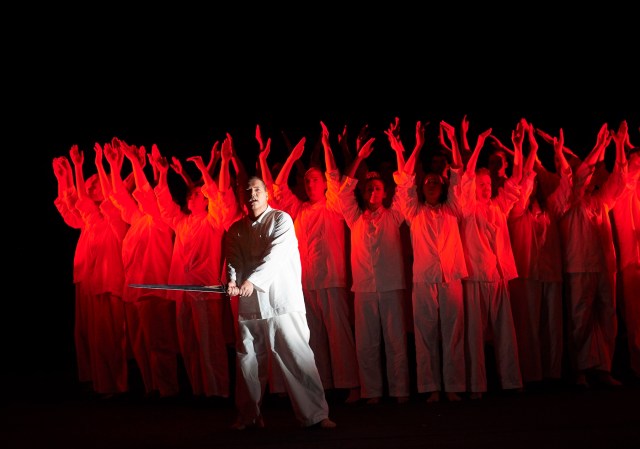
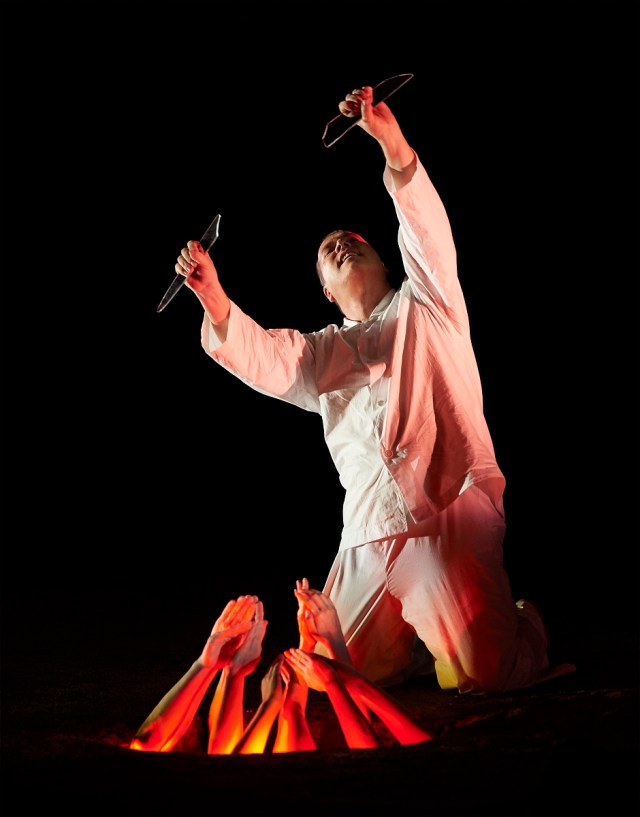
I like super roles with an element of physicality, and when directors ask for volunteers my hand will shoot up. In Fidelio (“Is there anyone who’s not afraid of heights?”) I got to descend from a very tall ladder at the start of the show carrying files from the drawers that stretched up to the top of the stage. In Simon Boccanegra, I was part of the mob that disrupted the formal council meeting. I not only got to toss chairs, trusting that they would stop short of the orchestra pit, but engaged in a carefully choreographed fight scene that involved several throws and falls on the stage, all synched with the rising clamour of the chorus. The most demanding role of all was in the highly abstract production of Siegfried where supers and professional dancers combined into a choreographed ring of fire in Act III, using our hands to portray flame. Several of us – smaller, more nimble, possessed of huge stamina, unaffected by claustrophobia, slightly mad – were also chosen to lie tightly together in a small hole under the stage and over 20-plus minutes of awesomely dramatic music, using only our rising and falling arms, simulate the fire in which Siegfried forges his sword, just inches from our hidden faces. We gave ourselves a quiet round of weary applause every time we pulled off that feat.
There’s nothing quite that demanding in Rigoletto, although a few of us do act out the brutalizing of Monterone (played by Robert Pomakov) with some carefully choreographed punches. For the most part, we’re somewhat louche gentlemen in a club playing cards with the choristers, reading newspapers, sipping espresso and reacting to their singing, while trying to avoid thinking too hard about the nasty patriarchal world we’re a part of — registering disgust and contempt and delight where appropriate but looking the other way when necessary. This is harder than a physical role, at least for me, because it’s so dramatically nuanced and carefully timed to the words and music. But the director, Christopher Alden, has been very good about keeping us attentive to the sudden mood swings and sudden stylized freezes. Our final contribution is in what we’ve been calling the orgy scene toward the end of the opera – given my age, and the fact that my daughter plays one of the women in the Duke’s court, I’m happy to hide out at the back of the stage and writhe on my chair in blissful solitude.
When the COC prepares an opera, usually it’s well-known and available on records, such as Verdi’s Rigoletto. While it may not be required, do you ever listen to recordings or watch DVDs in anticipation of an opera you’re preparing?
That’s an essential part of the extended supering experience for me, getting to know an opera better while at the same time allaying my pre-performance anxiety. As a word person, I like to read the libretto both for the pleasure of the language, which is too often ignored or belittled by music-lovers – Nixon in China is amazing — but also to have a better sense of what is going on all around me while I’m smiling or frowning. Directors really don’t like a toothy grin when the words say you’ve turned morose. Video can be highly misleading, since productions vary so completely – I really had second thoughts about doing Siegfried after seeing a creaky, glacial Bayreuth production, but ours turned out to be a lot more fun and energetic. A vintage Pavarotti Rigoletto I watched to get a sense of pacing was also discouraging because it was too formal and elaborate in the old style – ours feels brisker and more relatable. So maybe, now that I think about it, it’s better to come into a show without preconceptions or too much advance knowledge. Opera buffs don’t seem to make good supers. I know that some of the operas I’ve enjoyed the most were those that were unfamiliar to me – Nixon in China, Roberto Devereux, Idomeneo, Simon Boccanegra (which I listened to in advance with some disappointment, only to realize in rehearsals that Verdi wrote two versions and I’d heard the wrong one). You have to remember that over several months of rehearsal and performance, there’s plenty of time for the music to grow on you, and maybe it’s better to experience the thrill of discovery and feel like you’re performing in the moment.
Do you ever listen to your scenes on record afterwards, as for instance the last act procession in Carmen or the fire music in Siegfried?
My wife is always on the lookout for Christmas and birthday presents for me, because I’m pretty indifferent to material things, so souvenir opera CDs became the go-to gift. My favourite was probably Simon Boccanegra: At any given moment as I hear the music, I can still visualize where I was, what I was doing, how we worked together so seamlessly across the crowded stage as we waved torches and herded choristers (don’t let them hear me say that!) in the conspiratorial darkness. This powerful and wonderful sensation of instant displacement has no comparison in any other part of my life. When I hear the bullfighters marching in near the end of Carmen, in my head I’m once again a souvenir-seller looking out into the aisles of the Four Seasons Centre and pointing out the picadors to some pocket-picking kids because our innovative director Joel Ivany decided to bring in the procession through the theatre. Sometimes I’ll be sitting at my desk, lost in the distant wanderings of Odysseus, and suddenly my flame-hands music from Siegfried will pop up on Radio-Canada’s online opera station and I’ll be right there under the stage, staring up at Stefan Vinke and preparing to give my fingers a sudden shake. Even thinking about it now, I get a frisson of fully committed pleasure. Wow.
Stefan Vinke in the title role in the Canadian Opera Company production of Siegfried, 2016 including John’s “flame-hands”. (photo: Michael Cooper)
Can you tell us about your many different appearances with the COC (the operas & who you were playing)?
Okay, here goes. I did a couple of shows when I was young and intrigued by this strange, new dramatic form called opera I’d discovered while a student in England. In Werther (the 1979-80 season) I was a very nervous, possibly even terrified, villager in the joyful Christmas scene at the top of the show. That led to an amazing Otello directed by Lotfi Mansouri and starring James McCracken (1980-81), where I was one of many worried citizens in the opening storm scene, which was followed by some drunken carousing where I convincingly waved a drinking mug and less successfully tried to dance with my female counterpart. My vow: Never dance in an opera again.
Then that long break called life. I made my unheralded comeback in Fidelio (2008-9), lured in by my daughter who was between jobs and decided that she’d like to try supering based on the stories I’d told her about my youthful experiences. As it turned out, we both were selected to play cold-hearted bureaucrats in a Kafkaesque dystopia – must be a genetic thing. From which followed:
Simon Boccanegra (2008-9). At various points I was a pro-Boccanegra conspirator and late-night torch-carrier, a court official, a bearer of treasure-chests, a rioter and a brawler, and a wedding attendant, again with the torches. Talk about versatility.
Carmen (2009-10). I ogled the girls from the cigarette factory, then admired the testosterone-fuelled matador Escamillo. Too much enraptured staring for my taste.
Idomeneo (2009-10). One of the all-time great super experiences. I got to strip the clothing off poor Trojan prisoners, march in step and salute on cue with fellow Cretan guards, lift very heavy dead people onto stretchers and carry them off, stagger through the chorus as a scary plague victim, do some heavy-duty stage-shifting (at the dress rehearsal, I managed to fall into a suddenly exposed hole in the floor), perform carefully timed wedding ceremonials, and witness some amazing Mozart arias without looking like a fan. The only drawback was that the production seemed to take its style from early Star Trek and as soldiers we wore three layers of early space-age synthetic materials – on hot days, under hot lights, we were soaked with sweat.
Nixon in China (2010-11). I was the dad in a typical TV-watching American family that witnessed Richard Nixon’s trip to China, first by wolfing down TV dinners and then, transformed, by trying to eat chow mein with chopsticks. I wore an Elvis wig and garish bell-bottoms. My daughter had a blonde bouffant wig and played my wife. My actual wife still finds this creepy.
Trovatore (2012-13). As a soldier, I walked in the retinue of Russell Braun’s Count di Luna. At one point I made the fundamental super mistake of trying to push him on-stage after I thought he hadn’t heard his entrance cue. It turned out that he was just being a pro and waiting for the applause to die down from the previous aria. Fellow-supers who were there still won’t let me forget this. As a gypsy, I got to carry a gun and get into a show-down with some terrified, outnumbered chorister-soldiers, which is always fun. During the Anvil Chorus, I helped manufacture a wagon wheel (which I then had to wheel off-stage through the chorus – not easy) and tossed around celebratory wine-skins. My baseball experience came in handy, but some supers outright refused to play catch because no one wants to screw up in front of 2,000 people. I feel the same way about dancing.
La Boheme (2013-14). As well as walking around Paris at leisure, we soldiers had to march more formally with the military band that crashes the crowd scene, which involved hours of rehearsal for a few moments of well-drilled stage time. I got to carry and wave the regimental flag, a good way to get the attention of friends in the audience.
Roberto Devereux (2013-14). Among other tasks as guards in elaborate Elizabethan dress, two of us had the job of hauling around the imprisoned Roberto Devereux (or Bobby D. as he was known). Four different tenors played the role during the run, and we had to adjust our level of hands-on faux-brutality depending on the preferences of each performer. Our favourite was Leonardo Capalbo who turned to us when we first met and said simply, “Be rough.”
Madama Butterfly (2014/15). As a humble servant at the wedding ceremonials, I didn’t have to do much beyond working my way through the chorus serving tea and rice crackers. Except that at a single precise moment, I had to make a mad dash from the back of the stage to the front through the milling crowd (whispering “Coming through, watch out!”), carrying a cup of tea on a tray and dropping expertly to my knees centre-stage on a musical cue to meet Butterfly and Pinkerton. We had two Butterflys, and the first time I did my moves with Butterfly 2, I lifted up my tray from my reverent kneeling position – and she was nowhere to be seen.. “What’s he doing over there?”, she proclaimed in an angry whisper from stage right. I was in a state of heightened anxiety for the rest of the run.
Siegfried (2015-16). We supers played the role of fire – as hard as it sounds. We also writhed on the floor a lot, whether as a sort of abstract, metaphorical image of Siegfried’s brain, or as the extension of the dragon Fafner, whose gesticulating core was played by amazing dancers hanging in the air. My hardest task was to lie immobile for 40 minutes in Act II, and then repeat my motionlessness for seemingly interminable Wagnerian stretches in Act III, this time while kneeling and then standing at attention. We were given instructions on the best ways to slink off-stage if we started to faint.
Carmen (2015-16). In the first act, I played a soldier carrying documents back and forth across the square, meeting with fellow-soldiers for a brief chat, getting orders from desk-bound officers – so lots of mimed conversations and animated gestures. The second act took place in a sleazy bar, where I consorted with women of the night (not my strength, but we all have to try). Souvenir-selling in the Act IV bullfight scene was the high point – I got to walk down the aisles of the packed Four Season Centre waving my anatomically correct bulls on a giant pole and shouting (with tutelage from the COC’s French-language coach) “Les taureaux! Les beaux taureaux!”.
A scene from the Canadian Opera Company’s 2016 Carmen. John is proudly holding his anatomically correct bulls near the left edge of the photo (photo: Gary Beechey)
Tosca (2016-17). I was a natural playing a fussy priest, running on stage as the harried leader of a crowd scene. I managed to do a flip onto the floor in the final show and no one noticed – that’s how convincingly chaotic we were. We priests also had to march on-stage carrying a towering four-poled canopy in the elaborate Te Deum scene, and I don’t think we ever managed to be completely symmetrical, though not from lack of practice. Fellow supers would watch our awkward performance and score us out of 10 in post-scene criticism sessions. We were more successful as guards in the firing squad that disposed of Cavaradossi – helped by the director’s glass-half-filled observation that since we were meant to be Italian soldiers, the sloppiness of our moves actually seemed more convincing.
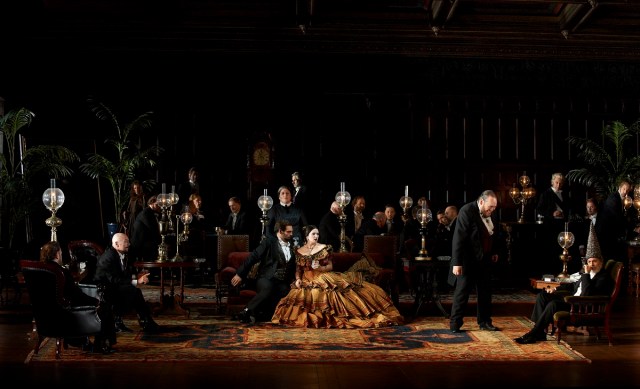
Rigoletto (2017-18). What don’t we do? In elaborate Victorian dress, we play cards, hoist drinks, admire ladies, disdain Rigoletto, look cool, give Monterone a thrashing, eventually hang him, kidnap a pretty girl, lounge around reading newspapers, admire the Duke’s lovemaking from a few centimetres away, writhe orgiastically ourselves – there’s so much to like about this one.
Looking back on your appearances with the COC, what was the toughest assignment, either for you or for extras around you?
Many assignments seem hard at the beginning and almost effortless by the end – so looking back, I don’t always see the toughness that seemed harrowing at the time. But the one scene that never got easy was lying outstretched and immobile on the sloped stage throughout most of Act II in Siegfried. If you somehow set yourself into an awkward position, you had to hold it no matter what the pain, and of course an itch became unbearable over 40 minutes. Fortunately, we had a small break partway through where we got to wake up, writhe forward and then retreat to our original resting-place – but you couldn’t always find your exact way back while writhing in reverse with other pyjama-clad bodies in the darkness. And then you’d discover yourself splayed awkwardly and painfully over an uneven surface while waiting for the beautiful singing of the Forest Bird that meant relief was in sight.
What’s your favourite opera that you’ve ever done, and which show made you most proud of your role?
Hard call, but Simon Boccanegra probably demanded the most of my supering skills at a stage when I didn’t even know I had them. The old-school English director, Ian Judge, was a demanding taskmaster who would always bring us to order by shouting “Boys, boys, boys!” He used us extensively throughout the opera and entrusted us with a leadership role on stage – where we ran around with gangs of chorus members waving torches that in my case always seemed to flicker out (you’d then cadge a light from your nearest fellow-super, though one overly dramatic colleague would only oblige if I asked him politely in Italian). The slightly dangerous live-action nature of these scenes was a thrill, as was the intricate fight scene at the front of the stage that was the culmination of a very carefully planned riot we supers instigated in the formal Council Chamber setting. But we also had quieter, more formalized moments, and got to work extensively alongside a very genial group of principal singers over the course of an unusually long rehearsal phase. Normally supers are part-timers who are called to rehearse only at nights and on weekends, but Ian Judge insisted that we work days as well and I happened to have four weeks of paid vacation that I had to burn up. So the entire experience, even allowing for a lot of hard, repetitive work and the occasional outbursts of directorial criticism, was supering paradise.
When you’re in an opera, I’d expect that you’re listening closely to the performances, perhaps thrilling to the voices. Who impressed you the most?
In fact we’re not always listening closely to the performances, at least not with full attention. Part of doing my job properly is being immersed in the task at hand – playing cards in Rigoletto, we’re throwing our money into the pot, accusing the dealer of cheating, pouring a shot of brandy from the decanter, no matter what the Duke is saying about questa or quella. And meanwhile another part of the brain is thinking ahead to our next move, the upcoming cues that will prompt us to change focus (and not screw up). The only time we really get to experience voices and performances like an audience does is when we’re standing in the wings, waiting for our next entrance, or when we’re dropped into a scene where our actual job is to focus attention on the singer. And then I find myself suddenly savouring the amazing powers of the human voice and thinking how lucky I am.
Okay, that’s the preamble. Almost all singers are impressive to me, so it’s invidious to pick out a few, but you asked. Paolo Gavanelli in Boccanegra was such a touching, tortured father-figure as an actor-singer with a huge dramatic range of lyricism and high emotion. He was close to us supers and we knew he was suffering from gout during the run, which made his work even more impressive. We also worked extensively with the Canadian bass Alain Coulombe, and as much as I enjoy his singing, I really like to watch his face – he’s expressive but never hammy, the definition of cool and suave, even when he’s about to meet his end in Carmen.
I first encountered the wonderful Tamara Wilson in Boccanegra but still wasn’t prepared for the fireworks when she sang an astonishing drama-queen aria inches from my ears as the crazed Elettra in Idomeneo.
Simon Boccanegra – (l – r) Mikhail Agafonov as Gabriele Adorno, Tamara Wilson as Maria Boccanegra and Paolo Gavanelli as Simon Boccanegra in the Canadian Opera Company’s production of Simon Boccanegra, 2009, (photo: Michael Cooper)
We had a number of Rodolfos in La Boheme, but I remember waiting to go on stage for the start of Act II as the young Michael Fabiano, who arrived late in the production cycle, was singing near the end of Act I – I can’t pretend to be a music critic, but I knew right away I was hearing a voice that was powerful, beautiful, tender and effortless.
How could I not be impressed by Stefan Vinke in Siegfried, especially because he spent a large part of Act I staring into the fire pit where we supers were lurking, and singing directly to our oscillating flame-hands with unlimited exuberance? He said at the time that we were as important to him as he was to us, which told me a lot about the role we supers play in conveying action and reaction – the more energy we supply, the better our singing counterparts can perform. But it only just occurred to me now that our fire-pit faces were veiled with a black mesh hood, so he must have been talking more precisely about our darting hands and fingers.
I have a soft spot for tragedy-tinged, guilt-ridden, silken-voiced mezzos and Allyson McHardy brought me to a halt every time I was passing through the wings backstage at Roberto Devereux. You’re just doing your job, thinking about an upcoming costume change, and suddenly you’re transfixed. Devereux generally was a great show for musical appreciation – two of us lucky supers got to stand guard throughout an astonishing high-tension scene between Russell Braun, Leonardo Capalbo and Sondra Radvanovsky, and we had to remind each other not to get lulled by the amazing sounds and forget our synchronized yanking of a giant on-stage carpet – look, the opera is still standing!
Of all the individual performances I’ve seen, Sondra’s in Devereux was the most awesome. She ranged from girlish and flirtatious to embittered old hag as Queen Elizabeth I, and she invested every moment with uninhibited dramatic intensity. Her face is wonderfully mobile, always expanding the emotional range of her singing. And she wasn’t afraid to make jarring, unpleasant sounds when her character and situation called for it, which made me realize a little late in my career that great opera is about real life, not abstracted beauty. My son had never seen an opera before I gave him tickets to Devereux. To this day he still talks about Sondra’s performance.
I get to be in the middle of a lot of good operas, and one revelation for me has been the greatness of the COC chorus. People are people in rehearsals — chatty, thoughtful, goofy, friendly, aloof — and you sometimes forget the artistry they can produce as a massed voice in a dramatic context, especially with all that added body language. There have been too many good moments to mention – the swelling street scene in Boheme, the excited bullfight crowd in Carmen, the prisoners’ chorus in Fidelio, the haunting Miserere in Trovatore, the humming chorus in Butterfly, Fuoco di gioia in Otello – but one I’ll never forget is the mass disruption of the Council Chamber in Boccanegra which starts in the cramped wings and builds inexorably to a fit of fury when the chorus invades the stage. As a marauding super, I always had to humble myself by remembering that everything I was proud of doing would be a lot harder if I also had to watch the conductor and sing perfectly.
You’ve done so many: but is there any opera you are especially wishing you could do?
I’d like to do Otello again – so much great music, crowd scenes that are supering-magnets and with luck I’m too old to dance. Failing that, any other big Verdi opera, maybe Don Carlo (I think I’d make a great condemned heretic). The upcoming Anna Bolena with Sondra Radvanovsky would be a great experience – if nothing else, I know my way around the Tudor costumes. And Hadrian by Rufus Wainwright is very intriguing, though I’m guessing that even at the super level, it might skew towards the young and beautiful.
Do you recall any director especially for what he or she showed you about acting, about opera, about what you could do?
It’s rare that supers go one on one with directors, unless we’ve stood out by doing something horribly wrong. Generally we work more closely with assistant directors who are especially skilled and patient at plotting out the intricacies of crowd scenes and teaching individuals to work as a group – great people such as Graham Cozzubbo who put us soldiers through our paces in La Boheme, and Marilyn Gronsdal who coached me as priest and firing-squad member last season in Tosca and now has perfected my timing as one of the Duke’s smooth henchmen in Rigoletto. James Binkley is an extremely amiable, safety-conscious, verisimilitude-crafting fight director who makes mild-mannered novices like me look convincing as thugs – watch for my back-handed thumping of Monterone in Act I of Rigoletto. As supers, we wouldn’t exist without the tireless, good-humoured women who co-ordinate our work with the COC, Elizabeth Walker and Analee Stein. And once we’re on the job, we rapidly come to realize what a complex team we’re a part of – the frighteningly competent yet still good-humoured stage managers and assistant stage managers are our moment-to-moment bosses, and they manage to see and know everything without losing their patience with adults who sometimes act like small children.
We’re always learning, but the one person who taught me the most in the shortest time was Donna Feore, our choreographer in Siegfried. In a matter of weeks, she turned a rag-tag bunch of random supers into a Wagnerian drill team, teaching us how to turn our arms and fingers into abstract flames, coaching us on music-cued formation walking around the severely raked stage, giving us the confidence to feel like we were an integral part of the highly visual production, and generally making us happy to come to work for long hours of physical labour. More personally, she praised my improvised crawling/writhing technique to the rest of the gang and gave me the confidence to lie under the stage more or less on top of four other crazies like me and wave my hands rhythmically for the length of a TV sitcom. Who wouldn’t admire a woman like that? Where else could I have such an amazing experience?
*******
The Canadian Opera Company winter season begins Saturday January 20th with Rigoletto, including the chorus, the orchestra, the singers: and supernumeraries such as John Allemang. For further information.
A scene from the Canadian Opera Company’s Rigoletto, 2011 (photo: Michael Cooper)
The musical Nine is a bit of a virtuoso vehicle, putting thirteen women, a man and a boy onstage together. The music & lyrics by Maury Yeston are never easy but quite rewarding, particularly if you have an actual orchestra, as we did tonight for the Podium Concert Productions presentation at the Trinity St Paul’s Centre, conducted by Mark Camilleri. Musicals with a full-sized orchestra and a big chorus seem to be an endangered species, considering how many times I’ve seen shows done with fewer than a dozen orchestral players, augmented by a keyboardist or two.
And no wonder that Nine isn’t presented very often. It’s hard, with several challenging roles & complex music. Based on Fellini’s film 8 ½ , this is a musical one can truly love: but one that isn’t yet well-known. Ah but the theatre was packed tonight, because getting a chance to hear this score is such a treat, including the numbers that were cut for the film. I saw lots of theatre people, including at least two directors who –if I don’t miss my guess—are thinking of ways to adapt this brilliant piece. Can it be reduced from its epic size? Perhaps, perhaps not (I don’t know). All I know is, that a chance to see it with all those people on stage – brilliant talented singers & actors –is a rarity, an opportunity that you must not miss if you’re an aficionado of musical theatre.
In 1982 I saw Nine on Broadway starring Raul Julia as the film director Guido Contini. Nine was adapted as a film in 2009 as a starring vehicle for Daniel Day Lewis. I swear that we get smarter the more often we put on a musical or opera, because the interpretative options are always greater the more times a work is staged, the more times we see solutions to the problems posed by a book and its score. I remember being irritated by a number in the Broadway production called “The Germans at the Spa”. It’s a definite tour de force, as the music is fast with lots of quick lines and oh my God suddenly we’re hearing the opening theme from Tristan und Isolde played by the orchestra. The Broadway solution was to have lots of movement, a frenetic moment onstage to match all the energy in the music: with the result that it was kind of stupid and unintelligible, as though the director was simultaneously showing off (“look at us! aren’t we impressive with the complex music we’re doing!”) while mocking the whole thing at the same time. If ever there were an argument for a concert performance that was it. Tonight I heard every note and every word of this wacky number, a piece that’s one of the ones missing from the film. Of course it’s cut from the film because it is a bit of a show-off piece that doesn’t advance the plot terribly much. And ditto for the operatic set-pieces in the second act, when Guido starts digging his way out of his predicament, attempting to make something to film. What an assortment of stunning pieces.
Juan Chioran is a three dimensional Guido. We get a flamboyant larger than life personality at the centre of the production, one who happens to sing better than I had expected. He has two more performances tomorrow, but I didn’t notice him holding anything back whatsoever. It’s a huge part. His self-portrait song is quite a marvelous creation, emerging conversationally in gentle singing, that gradually builds with more voice, more passion as it builds to sparkling high-notes, always clearly intelligible. The sound technicians had their work cut out for them, given the incredible range of vocal outputs, and orchestral accompaniments.
Sharing the stage with Chioran’s Guido are thirteen beautiful women. As this is done in concert it’s a very theatrical effect. When he’s soliloquizing sometimes they’re listening, heckling and even laughing at him, like a womanizer’s karma personified as though he’s on trial with this jury taking it all in. And yet they’re all admirers of varying degrees, mostly looking with affection rather than judgement, and at various points in the story, still responding in character even though they may be silent at that moment.
Kira Guloien portrays Carla Albanese
So if you have this visual, of thirteen beautiful women seated across the stage in front of the orchestra, it seems very disciplined, very orderly. And then early on we’re watching Kira Guloien sing Carla’s seductive song, wearing a tight dress and within short order, upside down on her little chair. And as a live performance, she had her own drama when her amplification fell loose from her dress – there was really nowhere to hide it, especially when she flipped upside down—and on top of all the skills on display (singing and enunciating while upside down performing acrobatics), she also had to catch the device, stay in character and keep singing as though it was all planned. That’s why we love live theatre.
Tracy Michailidis as Luisa Contini had the audience in the palm of her hand every time she sang, although her silent moments watching the performance were every bit as powerful. Rebecca Poff was one of the scary challenging presences onstage as Lillian la Feur first seeming to be his nemesis as his producer demanding results, then showing us her fantasies & her vulnerable side, in a voice perfectly suited to her Folies Bergere song, one of several highlights. Gabriel Mattka as the young Guido gets to sing a simple but powerful song near the end, a fabulous display of musicianship in one so young; no wonder he’s cast, both for his sympathetic portrayal but also his perfect intonation. There are no weak spots anywhere in this cast, a powerful group of voices all carefully prepared to sing this music idiomatically and with inspiration.
There are two performances Saturday January 13th –a matinee and evening performance—that I am unable to attend although I wish I could be there. The orchestra’s playing is magnificent especially in the warm confines of the Trinity St Paul’s space. This is a challenging score that needs lots of players to be properly heard. Oh how I wish Stratford or Shaw or Soulpepper or SOMEONE would notice what an amazing score this is, and produce it. It’s a challenging work requiring lots of talent. Podium Concert Productions didn’t take short-cuts that I could see or hear. Saturday’s performances are a rare opportunity that any music theatre fan, indeed any music fan, should seize if at all possible.
On the program it’s Hamlet but the font is struck through like this: H̶a̶m̶l̶e̶t̶.
I wondered, was this to be a musical? The advance description said
“Shakespeare’s best-known tragedy is reimagined on the Tarragon stage through the powerful lens of rock and roll.”
As someone who’s looking around like Diogenes for an honest piece of music theatre, looking under every rock, I’m open to just about anything, whether it’s
a musical like Nine (which I’ll be seeing this weekend),
an operetta like Candide which I saw twice in December,
an opera (what I was brought up on, what I still try to write),
a film using music in some capacity
or perhaps a play with music.
Before I attempt to describe Tarragon’s H̶a̶m̶l̶e̶t̶ (forgive me, but if I am going to speak about it, I need to put it into some context, right?), let me simply say, wow it works. That’s the best piece of theatre I’ve seen in awhile, and a very successful telling of the story. While Fortinbras’ framing is cut, nobody bids the soldiers [to] shoot, and there are no flights of angels singing anyone to their rest: but almost everything works at least as well or better than usual.
Noah Reid (Photo: Cylla von Tiedemann)
We’re watching something that might be called melodrama. Don’t let the word scare you, as I am simply invoking a technical term that is regularly misused. The lines are spoken with music underneath, much as we often encounter in film, and as theatres were wont to do in past centuries but not so much lately.
One reason that the practice likely stopped? Aha! because the popular music of the day wasn’t adequate to the task. This production features a happy marriage of our musical vernacular – the music that most people really know and love—with a story we also know and love. Topher Mokrzewski was talking about this not long ago, a theme I cited, in what’s perhaps wrong with some classical music. In a nutshell? H̶a̶m̶l̶e̶t̶ succeeds where so many modern compositions fail, because it connects in this way:
The reason pop music resonates with people is because it resonates with their personhood and experience….Music is, at its heart, the communication of the universal humanity which we all share and must be engaged at that crucial level, where all the senses we have at our disposal allow us to love it at our most common level.The two threads can be connected.
I’ll have to get Topher to come see this show.
Before I talk about the music, there’s a feature central to the mise-en-scène, that’s enormously interesting as a kind of symbol. Everyone steps to a microphone to sing or speak, sometimes walking with a hand-held, sometimes in a stand, not unlike your classic rock-band. It resembles a concert, or a musical or opera presented in concert. Whether it’s those first moments looking at the ghost from the battlements or Claudius & his court, or anyone else, the entire show is through a microphone: except for “to be or not to be”. Ostentation and the need to dissemble is front and centre, especially when it’s slick Claudius at the microphone.
Yes there are places where we have singing, particularly in the appearances of the players, the grave-digger, and Ophelia. Most other places the rock band underscores the delivery of lines, a broad range of different self-effacing feels, vamping and repeating, without calling too much attention to themselves, not unlike a good film score. At the ends of some scenes, the emotion suddenly explode in a climactic statement. I came prepared –that is with Kleenex to stuff in my ears if they were too loud—but the levels were perfect, just loud enough to grab you.
It might depend on how you understand this story, as to who would be your favourite: but I was mightily impressed that this rock-n-roll take on Shakespeare felt profoundly authentic, in the spirit of Meagher’s book Shakespeare’s Shakespeare. The musicians aren’t a bunch of bored technicians, outside the show. Nope. They’re integrated into the play, so much so that one can’t really tell which came first. Our grave-digger, played by Cliff Saunders, for instance was very much a Shakespearean clown, hollering and singing right into the audience, and doubled as Polonius, a broad portrayal of great fun. Our players? There’s a band onstage who turn up from beginning to end. Marcellus and Bernardo, solemnly helping spot the ghost from the battlements, but then showing us that yes they really can sing: as the Player and his Queen. Beau Dixon was maybe a bit more over-the-top in his heavy-metal screaming in The Murder of Gonzago, whereas Jack Nicholsen’s player was less rock idol and more the sympathetic actor. Tiffany Ayalik’s Ophelia is the most successful incarnation of that character I’ve seen in a very long time. Director Richard Rose gives everyone space to have their moment, but it’s especially clear with Ophelia, and in the last scene of the play.
Noah Reid and Tiffany Ayalik (Photo: Cylla von Tiedemann)
Let the audience look to their eyes.
Any Hamlet really sinks or swims on the backs of two people, and in fairness, this production leans heavily upon them. Noah Reid’s Hamlet feels very young, very vulnerable, rides the soliloquys when the music requires, but backs off and gives the lines a moment for us to hear what he’s saying. This is not a frenetic Hamlet but one where you seem to hear everything clearly. Is that perhaps because the score helps us focus on the lines that matter? That’s Rose’s doing and certainly the work of the composers (credited to the ensemble, so I’m not sure whom to credit) & performers. And Nigel Shawn Williams is a fascinating Claudius, not as threatening or scary as some I’ve seen, but indeed believable as the one who wins Gertrude, who has a sure hold on Denmark. I found the prayer sequence totally convincing, his occasional eruptions of fury beautifully connected to the person we’d come to know. Their interaction –Hamlet & Claudius—is endlessly fascinating to watch.
There are lots of other performers I could cite, but the main thing is to observe that this ensemble is tight, the music seeming to be emerging from the text rather than a latter-day addition.
H̶a̶m̶l̶e̶t̶ continues at Tarragon Theatre until February 11th . I would strongly recommend that you see it.

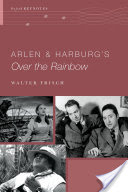 Walter Frisch is taking me on one of those latter sorts of journeys in his 2017 book Arlen & Harburg’s Over the Rainbow, part of Oxford’s Keynote series that explores the canons of western music. Other volumes have explored Alexander Nevsky, Beethoven’s 9th and Carousel.