Straub & Huillet’s History Lesson

I saw History Lesson (or Geschichtsunterricht ) at TIFF tonight, a 1972 film by Jean-Marie Straub and Danièle Huillet that’s my latest instalment in the retrospective “Not Reconciled”.

Straub & Huillet adapted an incomplete fragment of a novel by Bertolt Brecht. In a recent interview James Quandt (who programmed this series for TIFF) said

“Straub-Huillet repeatedly refuted characterizations of their cinema as one thing: severe, difficult, Brechtian, cerebral, etc.”

Difficulty is in the eye of the beholder of course. Sometimes people are stopped by the simplest things, such as a language barrier: because the films may not be available with the right subtitles. Thankfully this retrospective goes a long way to answering charges arising in a vacuum. There’s really no substitute for seeing the films.

And so, speaking of translations, the Brecht fragment is titled Die Geschäfte des Herrn Julius Caesar which can be translated as The business (or the business affairs?) of Mr. Julius Caesar. Oh how I wish I had read the Brecht so I could get a better handle on the adaptation, to discern how far Straub-Huillet (who co-wrote the script as well as directing it) might have strayed from the original. How much is Brecht, how much is them? i’ll know better once i get my hands on the book: although i don’t know if i can find it in English.

We’re in the presence of something deconstructive, as there is a kind of irony in the disparity between what we might expect, given what we’ve been taught about Rome and its history, and what Straub-Huillet give us instead. Modern Rome is the site for a series of conversations, apparently with ancient Romans –and I don’t mean senior citizens but rather figures brought to us from history– somehow brought before a camera and speaking German. And so when the film concludes, why not have a burst of Bach after all? These are not choices one might immediately think of as Brechtian: yet they are powerful reminders that we were not seeing real Romans in their context, not unless one allows some supernatural agency whereby they’re back from the dead, in modern Rome, and speaking German. I can’t be objective about this, as to whether these choices are designed to distance us or not. More Brechtian are the occasional abrupt pauses in the film during the conversations (reminders of the artificiality of the situation), or the shot of a face, staring directly at the camera for several minutes, as we hear the birds singing in the background: and nothing happens.

A man drives around Rome, interviewing different personages, who appear to be historical although we don’t actually find out their proper names. One is a business man, one is an ex-soldier who is now a peasant, one is a lawyer and the other one is a poet. The day after International Women’s Day, I can’t help noticing the preponderance of the male gender: but perhaps that’s unavoidable and surely a reflection of Brecht’s original. (but I am just speculating).

I glanced at a few commentaries and couldn’t help noticing that the things catching my eye aren’t mentioned by anyone. Am I off track? We are watching a series of interviews, conversations between a wanderer and the four subjects from different social strata, driving through the narrow streets of Rome. This is no Aston Martin, no wild car-chase. No, this is a beat-up old car that stalls at least twice, and is honked at regularly because it’s kind of slow. We are slowly descending through Rome, in a kind of labyrinth. Am I crazy to want to think of this listener as Dante? But there is no redemption or religion here. At one point a big truck crosses our path with the huge words EPIPHANI: suggesting that spirit and religion are just another business even in the Eternal City. But whether the listener reminds you of Dante or perhaps Diogenes (another D who came to mind), simply seeking an honest man, this is a very oblique sort of enquiry. The questions aren’t ever clearly stated. We are getting answers to unstated questions, long narrations that are alternatives to the usual explanations.

straub

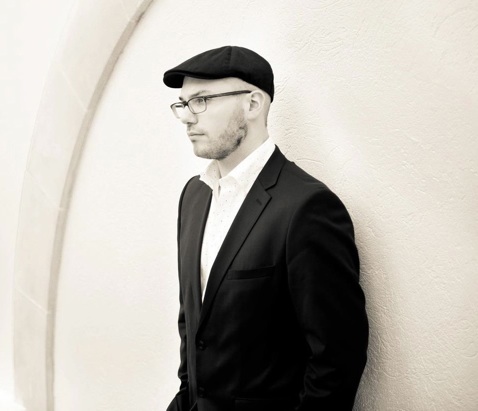
Director Jean-Marie Straub

That is a part of the history lesson. Our listener is hearing testimony from those who know,  or would be expected to know. A soldier who twice saw Caesar in the distance more or less confirms that none of the soldiers gave a damn, they simply wanted something to eat. It’s a classic Marxian reading, where the material conditions inform anything theoretical that one might surmise. The capitalist speaks of war and observes how commerce is like war, a very ironic series of assertions.

Another aspect of our history lesson is the meta-question, the matter of historiography that was such a central preoccupation for the New German Cinema. Now of course I’m not sure I should be lumping Straub – Huillet into that group, a huge and sometimes contradictory series of film-makers, but I see some clear parallels, or if you prefer, techniques and preoccupations in common with those German film-makers of roughly the same period.  Straub & Huillet were Germans who left the country behind, but likely had similar aspirations.

When we’re looking at historiography in this film it’s a matter of rejecting the usual approach to history. No we won’t study it via the great men, although this film does revolve around the big names –Crassus, Pompey etc surrounding Julius Caesar—but this is a deconstruction rather than a faithful study. The great men maybe weren’t so great, or not who we thought they were. That kind of project, revisiting assumptions especially sacred cows, is typical of the New German Cinema.

There are two very different sorts of discourse in this film, just as I saw with The Chronicle of Anna Magdalena Bach that opened the retrospective last week. Straub-Huillet offer two very different sorts of content, juxtaposed against one another, namely on the one hand the words in the diaries of AMB, read aloud  and on the other hand the musical performances of the compositions of her husband, JSBach, that are performed. For History Lesson, we again have two almost irreconcilable discourses. The listener drives through Rome, meandering through crowds of people. And then we have the interviews, the verbiage from those who would tell us what it means. But maybe we see history not just in those words, but just as much in that stream of people in the narrow streets of Rome, blocking the movement of the car, sometimes lugging food, sometimes leading their children, sometimes honking horns: while little or nothing happens.

And speaking of lessons, Brecht & Marx suggest something nostalgic to me if not to everyone watching the film. The Cold War was supposedly won, Marxism conveniently buried. The insights of this film feel remote indeed from a world where the 1% are poised to take an even bigger share of the wealth with the help of their orange haired champion to the south. The rigor of the film both formally & ideologically seems like a remnant from another time when –thinking for example of the composer at the centre of Sunday’s films, Arnold Schönberg—matters of form and principle commanded our attention, and when audiences had a longer attention span. It’s refreshing being in the presence of film-makers expecting their audience to think.

The retrospective continues:

  • Friday: A Visit to the Louvre and Cézanne: Conversation with Joachim Gasquet
  • Saturday: Antigone
  • Sunday: Moses and Aaron, including a live performance by Against the Grain Theatre.
  • More information about the retrospective
 

Posted in Reviews | 1 Comment

Louis Riel returns to Canadian Opera Company

LOUIS RIEL RETURNS TO CANADIAN OPERA COMPANY WITH  INCLUSIVE AND EXPANSIVE HISTORY RESTORED

A Contentious and Provocative Celebratory Work to Honour Canada’s History

rielToronto – Canadian history comes to life on the stage of the Four Seasons Centre for the Performing Arts this spring when Harry Somers’ Louis Riel returns to the Canadian Opera Company. A new production of this uniquely Canadian contribution to the opera world is being conceived by one of Canadian theatre’s most acclaimed and inventive directors, Peter Hinton, with the COC’s celebrated music director, Johannes Debus, conducting. This production of Louis Riel is proudly presented by the COC and its co-producer, National Arts Centre (NAC), in anticipation of Canada’s sesquicentennial and the 50th anniversary of the opera’s premiere. Louis Riel is sung in English, French, Michif and Cree with English, French, Michif and Cree SURTITLES TM, and runs for seven performances by the COC on April 20, 23, 26, 29, May 2, 5, 13, 2017 at Toronto’s Four Seasons Centre for the Performing Arts. It will premiere in Ottawa by the NAC on June 15 and 17, 2017.

The 2017 production of Louis Riel is made possible through the financial support of individuals, corporations and charitable foundations and trusts. The COC gratefully acknowledges its underwriters: The Catherine and Maxwell Meighen Foundation, Philip Deck and Kimberley Bozak, Asper Foundation, and The Max Clarkson Family Foundation in honour of Harry Somers; with additional support from Mark and Gail Appel, Margaret Harriett Cameron, Catherine Fauquier, Sally Holton, Michiel Horn and Cornelia Schuh, Michael and Linda Hutcheon, The Michael and Sonja Koerner Charitable Foundation, Peter Levitt and Mai Why, John D. McKellar, Trina McQueen, Roger D. Moore, Sue Mortimer, Dr. Shirley C. Neuman, Tim and Frances Price, Dr. Joseph So, Philip Somerville, Françoise Sutton, Dr. John Stanley and Dr. Helmut Reichenbächer, The Stratton Trust, and John Wright and Chung-Wai Chow. Louis Riel has also been made possible by generous donors to the National Arts Centre Foundation, who believe in investing in Canadian creators, including Kimberley Bozak and Philip Deck, Earlaine Collins and TD Bank Group.

Composed by Harry Somers for Canada’s centennial in 1967, Louis Riel was described as “big, efficient, exciting” (Toronto Evening Telegram) when the COC gave the opera its world premiere. Louis Riel, and its story of the Métis leader and Canada’s westward expansion, went on to be called “one of the most imaginative and powerful scores to have been written in this century” (Washington Star) after its 1975 US premiere at the Kennedy Center. More recently, on the occasion of its 2011 DVD release, it was hailed as “both a personal story and a national epic…the libretto is as taut and thrilling as a well-written play” (Globe and Mail).

Telling the history of Louis Riel is ever more important in this period of Truth and Reconciliation. It is the COC’s intention that an inclusive and expansive history shall be restored with the 2017 production. Throughout the conceptualization of the 2017 production of Louis Riel and in preparation for the rehearsal period, Hinton and his creative team have followed the guidance and wisdom of members of the Indigenous community.

“What struck me from the very beginning about this piece is the motivation for its creation. It is a contentious and provocative ‘celebratory’ work,” says Louis Riel director Peter Hinton. “When composer Harry Somers and librettist Mavor Moore were commissioned in 1966 by the Floyd S. Chalmers Foundation to write an opera to commemorate the centennial of Canada, Somers and Moore chose the subject of Louis Riel. Their choice to show Canada’s history of struggle and representation in the west, against colonialist and centralist objectives, is not only a metaphor for the conflicts which forged the idea of confederation, but also serves as a challenge for present and future understandings of our country.”

“We asked Peter Hinton to direct this production of Louis Riel because of his long-standing relationship and involvement with Indigenous artists and his knowledge and experience in mounting a theatrical project of this scale,” says COC General Director Alexander Neef. “His involvement brings an informed and culturally sensitive approach to the interpretation of Louis Riel that we are sharing on the stage.”

“The National Arts Centre is thrilled to be the co-producer of Louis Riel. It’s one of the great Canadian operas—an epic story about our country,” says Peter Herrndorf the President and CEO of the National Arts Centre. “When Alexander Neef approached us a number of years ago about a partnership, our immediate answer was ‘yes’, and we both agreed that Peter Hinton had the sensitivity and vision to bring this story to the stage as our director.”

Since 1985, Peter Hinton has directed over 75 productions of new plays, classical texts and operas as well as written the librettos for two operas with composer Peter Hannan, working across Canada and with many theatre companies. He has been the associate artistic director at Theatre Passe Muraille and the Canadian Stage Company in Toronto, artistic director of the Playwrights Theatre Centre in Vancouver, the dramaturg-in-residence at Playwrights’ Workshop Montréal, and artistic associate of the Stratford Festival. From 2005 to 2012, he was artistic director of English theatre at the National Arts Centre, where he created a resident English theatre company, with actors from across the country, and programmed the NAC’s first season of Canadian plays. It was in this role at the NAC where Hinton initiated a commitment to producing the work of Indigenous theatre artists every season during his tenure. Hinton’s directorial work has included premiere works by Métis playwright Marie Clements, as well as producing plays by Kevin Loring, Waawaate Fobister, Yvette Nolan and George Ryga. In 2012, he directed an adaptation of Shakespeare’s King Lear with 40 First Nations/Métis actors and starring August Schellenberg in the title role. He has directed works by Tomson Highway and, in the fall of 2017, Hinton directs the world premiere of City Opera Vancouver’s much anticipated production of Missing by Brian Current, with a libretto by Marie Clements about the Highway of Tears.

“Our challenge is taking an artifact from the 1960s and reviving it for today within a contemporary and inclusive practice,” adds Hinton. “It is a delicate balance of renewing the original spirit of the piece with contemporary perspectives in order to revise the opera’s colonial biases and bring forward its inherent strengths and power.”

Working alongside Hinton is assistant director Estelle Shook, a Métis artist from British Columbia. Artistic director of Caravan Farm Theatre from 1998 to 2010, and current interim artistic and managing director, she recently directed the Dora Award-winning Sunday in Sodom for Canadian Stage. Shook is also a descendant of Saskatchewan pioneer Thomas McKay, who testified at the trial of Louis Riel in 1885. Shook makes her opera debut with Louis Riel, bringing personal, professional and cultural perspectives to the production.

Joining Louis Riel as a cultural liaison is Bruce Sinclair, a Métis artist originally from Meadow Lake-The Battlefords, Sask. An actor, director, playwright and producer for numerous First Nations and Métis theatre works since 1986, Sinclair has worked with Twenty-Fifth Theatre, Persephone Theatre, Native Earth Performing Arts, 4th Line Theatre, Waweyekisik Theatre, The Batoche Theatre Co., Undercurrents Theatre and Jumblies Theatre.

Santee Smith makes her COC debut as the choreographer for Louis Riel. Smith is a member of the Mohawk Nation, Turtle Clan from Six Nations of the Grand, Ont. One of Canada’s most exciting choreographers, she is the founding artistic director/choreographer for Kaha:wi Dance Theatre and has propelled her company to international acclaim. In Louis Riel, she re-imagines and re-stages a number of dances, including the Buffalo Hunt.

Canadian Michael Gianfrancesco, who previously designed sets and costumes for COC school tour productions of The Magic Flute, La serva padrona and The Barber of Seville, makes his COC mainstage debut as the set designer for Louis Riel. His work has been seen across Canada in productions of theatre, opera and dance, with the Stratford and Shaw festivals, Canadian Stage, Neptune Theatre, Theatre New Brunswick, Theatre Passe Muraille, Theatre Aquarius and Pleiades Theatre, among others.

In Louis Riel, Gianfrancesco has created a single set with the flexibility to convey the epic-scale of the events being told as well as the more intimate moments of quiet reflection. The physical space sits atop a solid wood floor into which the topography of the Red River Valley has been carved. Set pieces will come in and out as needed to suggest interior and exterior spaces, transporting the audience from the Parliament Buildings of Ottawa to Fort Garry in Manitoba to Riel’s home in exile in Montana.

Dora Award winning Canadian designer Gillian Gallow makes her COC debut as the costume designer for Louis Riel. Her work in set and costumes has been seen across Canada in productions for Thousand Islands Playhouse, the Stratford Festival, Theatre Calgary, Vancouver Playhouse, Soulpepper and National Arts Centre, to name but a few.

Gallow’s costume design for Louis Riel is inspired by the drive for historical authenticity while also communicating a modern-day sensibility. The resulting aesthetic realizes the visual contradiction between truth and misconception and what is being lived out in the East versus in the West, as well as offers an opportunity for audiences today to see themselves reflected back in the onstage action.

Canadian lighting designer Bonnie Beecher returns to the COC with Louis Riel, last with the company in the 2008 Ensemble Studio double-bill presentation of Giuseppe Gazzaniga’s Don Giovanni and Igor Stravinsky’s Renard. A multiple Dora Award winner and frequent nominee, Beecher’s work has lit the stages of theatres across Canada, including the Shaw and Stratford festivals, Opera Atelier, Soulpepper, National Arts Centre, National Ballet of Canada and Tarragon Theatre, as well as internationally for the Dutch National Ballet, American Ballet Theatre, Glimmerglass Opera, The Royal Shakespeare Company, New Zealand Opera, Stuttgart Ballet and Kevin O’Day Ballet. The lighting design for Louis Riel will serve the range of experiences and spaces playing out on stage, from epic and intimate, to interior and exterior, to realistic and magical.

Louis Riel was the first opera written by a Canadian to be presented by the COC, and the COC is the only professional opera company to date to have ever performed it.

The NAC presents Louis Riel on June 15 and 17, 2017 as part of its Canada Scene festival in Ottawa. For more information on the NAC’s performances of this production of Louis Riel, please visit http://www.nac-cna.ca.

Additional information about the libretto and score of Louis Riel, as well as complete casting, and a series of public education and outreach events will be forthcoming in separate press materials issued in the coming weeks.

TICKET INFORMATION
Single tickets for Louis Riel range from $35 – $235 and box seats, when available, are $350. Tickets are now on sale, available online at coc.ca, by calling 416-363-8231, or in person at the Four Seasons Centre for the Performing Arts Box Office (145 Queen St. W.). For more information on specially priced tickets available to young people under the age of 15, standing room, Opera Under 30 presented by TD Bank Group, student groups and rush seating, visit coc.ca.

About the Canadian Opera Company
Based in Toronto, the Canadian Opera Company is the largest producer of opera in Canada and one of the largest in North America. The COC enjoys a loyal audience support-base and one of the highest attendance and subscription rates in North America. Under its leadership team of General Director Alexander Neef and Music Director Johannes Debus, the COC is increasingly capturing the opera world’s attention. The COC maintains its international reputation for artistic excellence and creative innovation by creating new productions within its diverse repertoire, collaborating with leading opera companies and festivals, and attracting the world’s foremost Canadian and international artists. The COC performs in its own opera house, the Four Seasons Centre for the Performing Arts, hailed internationally as one of the finest in the world. Designed by Diamond Schmitt Architects, the Four Seasons Centre opened in 2006. For more information on the Canadian Opera Company, please visit coc.ca.

~~~~~~~

“Press releases and announcements” are presented verbatim without comment.

Posted in Opera, Press Releases and Announcements | Leave a comment

Pallett – Ehnes TSO #NCF17

Tonight’s New Creations Festival Concert by the Toronto Symphony gave us a closer look at the co-curator Owen Pallett, who stepped into the spotlight with a premiere of his own, alongside two other world premieres and a recent composition from south of the border.  We sampled three substantial works of diverse flavours, after another Sesquie.

The more I encounter these short pieces –commissions designed as two minute celebrations of our Sesquicentennial, and therefore called “Sesquies” – the more I see in them.  Restrictions can be an incentive to creativity, as I’m finding in every one of these lovely little works.  Harry Stafylakis called his offering “Shadows Radiant: Sesquie for Canada’s 150th” and I’d have to say that it’s the most celebratory one I’ve heard so far.  While we did hear a trace of Oh Canada, the main thing was to let loose joyfully.  Nevermind misgivings we may have at this point in time, carpe diem on July 1st 2017.

kernis-200x301

Composer Aaron Jay Kernis

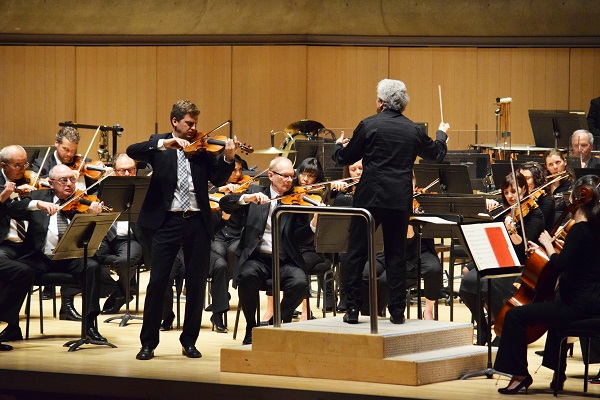
Then, as promised yesterday, it was time to hear what James Ehnes could do, in a new violin concerto written just for him.  And while I had an eye-opening experience last night hearing Ehnes’s Bach solos –both up close and personal in the intimacy of the RBA, and as I binge listened on youtube—it’s as though composer Aaron Jay Kernis wanted to build on that, knowing the violinist’s strengths.  In the first and last movements we heard wonderful solos. In the first movement there was more than a hint of the baroque even if the orchestra burst forth with a post-romantic barrage, at times overwhelming the subtleties of Ehnes’s violin.

Kernis fills me with optimism, hearing a piece that sounds so fresh, full of new sounds & ideas.  At times there was a kind of irony to the self-reflexive texture in the orchestra, chopping up phrases in response to short phrases from the soloist. The orchestral sound could be big and dissonant, or softly reflective, mellow but still very new sounding in its invocation of quasi-jazzy sonorities.  The moods were varied, and chosen with a solid sense of authority, in the clear delineation of movements that were at least following a familiar template, right up to the rhythmically vigorous closing movement. And then a few minutes before the end, I watched Ehnes play a cadenza, creating sounds I’ve never heard from a violin before, as much a treat to hear, as to watch Peter Oundjian smiling like a cherub at this amazing performance right in front of him (lucky guy). I have to think that Kernis set out to challenge Ehnes: who more than met the challenge in the amazing passage at the end.  I must hear it again!

After the interval came more distinctive voices. First came heard Owen Pallett’s song cycle Songs From An Island, featuring bass-baritone Daniel Okulitch.

owen_pallett_by_brian_vu

New Creations Festival Curator Owen Pallett (photo: Brian Vu)

After the overpowering intensity of the concerto, Pallett’s songs made a welcome contrast: but of course he knew that when he assembled the program.  Pallett’s texts are a surreal triptych on the edge of dystopian horror, litanies of delicately phrased nightmares underplayed in Pallett’s setting and delicately voiced by Okulitch’s mellifluous reading of the songs, like the gentle radio host inside your head.  I’d be tempted to call them minimalist, perhaps thinking of the way Philip Glass tippy-toed on the boundary dividing art song from pop song in his “Songs From Liquid Days” back in the 80s, but Pallett’s texts are much wilder, his settings closer to pop music than art-song from where I sat. This was a very accessible music, housing explosive imagery in the text, not unlike the way a bottle of nitroglycerine is packed in soft fabric.  Argh again I feel I must hear this again. There’s a great deal to unpack in those songs, which don’t reveal themselves readily in one listening (or so I felt).

And to close, the piece that made me smile throughout, Nick Muhly’s extraordinary Mixed Messages.  The program notes led me to believe that the piece was concerned about communication: and so it was.  I felt I was hearing a sonic picture of a brain, synapses firing, then mis-firing, an aural model of discourse, complete with the pulsing electricity of our nerves and the occasional pause before renewing the flow.  This too was a highly accomplished piece of such perfection I didn’t want it to end, yet felt totally contented when it did finally stop.

Pallett gave us four delightfully contrasting pieces, all wonderfully executed. The first two were conducted by Oundjian, the latter two boldly led by André de Ridder.  The TSO sounded fantastic throughout, particularly the brass, who were given a fair workout in the second half of the program.

Although today might be International Women’s Day, the TSO will celebrate it Saturday night, when three of the four compositions programmed by Pallett will be by women composers.  I can’t wait.

Posted in Music and musicology, Reviews | Leave a comment

Schoenberg: live performances reconciled with Straub-Huillet films

The title of the TIFF retrospective is NOT RECONCILED: THE FILMS OF JEAN-MARIE STRAUB AND DANIÈLE HUILLET.

Sunday afternoon March 12th at 3:15 pm, Against the Grain Theatre will be offering a live performance alongside a screening of a film that I’ve heard described as the greatest opera film ever made, namely Moses and Aaron, directed by Jean-Marie Straub & Danièle Huillet. It’s one part of TIFF’s retrospective of these hard-nosed and exacting film-makers. It will be interesting to see just how live singing is reconciled with a film of a performance.

I asked the artists involved – soprano Adanya Dunn, pianist & music director Topher Mokrzewski and stage director Joel Ivany—to discuss their upcoming performance.

topher_adanya

Pianist Topher Mokrzewski and soprano Adanya Dunn

Here is the program:

  • Hymnen an die Nacht (Claude Vivier)
  • Extracts from Pierrot lunaire (Schoenberg)
    I- Mondestrunken
    II- Colombine
    IX- Gebet an Pierrot
    X- Raub
    XIV- Die Kreuze

1- Tell us about the pieces & why you selected them.

Christopher Mokrzewski headshot

Music Director Topher Mokrzewski

TOPHER:
When we were approached about the possibility of partnering with TIFF on this project, the idea of performing some Schoenberg seemed a no brainer- the difficulty was in the selection. Our aim has been, in the end, to employ these extracts of Pierrot (which have been selected for purposes of internal cohesion, thematic unity AND diversity, along with the simple fact that we have an affinity for them) to demonstrate the link between this pivotal work in Schoenberg’s canon and the stylistic elements which went on to be more prominently employed in later works, like Moses und Aron. Pierrot lunaire, while revolutionary in its own right, contains within it the traits and tendencies- think Sprechstimme, expressionist angst, alienation- that culminated in the drastic departure from western art music tradition which is the twelve tone system.

ADANYA:
Completed in 1912, Schoenberg’s melodrama Pierrot lunaire, Op. 21 has the official title of Dreimal sieben Gedichte aus Albert Girauds Pierrot lunaire, meaning Three times Seven Poems from Albert Giraud’s Pierrot lunaire. In 1884, Belgian poet Albert Giraud wrote Pierrot lunaire, a cycle of fifty poems, which was later translated into German by Otto Erich Hartleben. Schoenberg chose to set 21 of these poems divided into three sections consisting of seven songs each.

The order of the pieces in Pierrot is not the order in which they were composed, nor does it reflect the published order of the poems. Though Schoenberg’s Pierrot does not present a conventional narrative, each part has a distinct dramatic tone which can be distilled down to the following:
Part 1 – lighthearted despair and intoxicating sensations
Part 2 – grotesque and mad images
Part 3 – reflection and haunting nostalgia
Musically the “instrumental textures tend to become fuller as the work progress”. (Alan Lessem, Music and Text in the Works of Arnold Schoenberg: The Critical Years 1908-1922).

The five pieces we will be performing are selected from Parts 1 and 2: Mondestrunken (no. 1) which starts the piece;  (no. 2); Gebet an Pierrot (no. 9), the first piece Schoenberg composed for the Pierrot melodrama; Raub (no. 10); and Die Kreuze (no. 14), the last song of Part 2 and where our performance will end. Though we have experienced an internal finale, a sense of mystery still lingers – what will happen to our protagonist, Pierrot, in Part 3?

Originally scored for a chamber ensemble consisting of piano, clarinet (and bass clarinet), flute (and piccolo), violin (and viola), cello, and voice (the Sprechstimme), our Pierrot performance is for voice and a piano reduction of the instrumental parts. While the individual instrumental timbres will not be heard in our rendition, Schoenberg’s rich and eclectic musical palate is ever-present.

2- will there be any staging?

JOEL

NEWER_joel

Against the Grain Theatre Artistic Director Joel Ivany

Any staging will come out of the music. There is enough movement in both the Vivier and Schoenberg to accomplish the desired effect. Adanya is a beautifully vivid performer and this will be more of a focus on the music.

3- is there any connection to the film(s), other than the composer?

JOEL
The connection is in an aesthetic and style. What they were accomplishing on film, we are attempting to accomplish through our site specific performances. We’re always trying to get to the heart of a work and if that means that we need to find a venue that supports what the piece is after, then we will go after it.

Straub-Huillet were after the same impulses and that’s how I connect to them.

4- is this an interlude that contrasts / takes us away from the aesthetic of the films (and Straub / Huillet), or is it in some sense a continuation / more of the same?

JOEL
As commented above, it’s more of the same. This music needs to be done more and this aesthetic needs to be explored more. If we had more hours in the day and more days in the week, we could certainly accomplish more! This collaboration has opened our eyes and ears to a new way to integrate, collaborate and share opera with a cross over audience.

5-: Atonality / polytonality can be among the most difficult types of music both for the artists & audience alike. Do you find this rep difficult in any way?
ADANYA:
Perhaps another time I can comment on the concept of “difficult” music and share the steps I took in preparing Pierrot. What I will say however, is that being prepared in a systematic yet non-rigid way, gives one permission to release self-conscious dispositions. Such uninhibited access to the authentic self can then allow for the composer’s creation to be fully realized within and with-out.

~~~~~~~atg

Against the Grain Theatre perform live as part of TIFF’s presentation of Schoenberg as filmed by Straub-Huillet March 12th at 3:15 pm.

Posted in Interviews, Music and musicology | 1 Comment

Toronto Summer Music: Passing the Torch

jonathan-crow

Violinist Jonathan Crow, Artistic Director of Toronto Summer Music Festival & Toronto Symphony Concertmaster

Toronto Summer Music Festival had their first ever launch event tonight in the Richard Bradshaw Amphitheatre, signifying the beginning of a new era: violinist & Toronto Symphony Concertmaster Jonathan Crow succeeding Douglas McNabney as Artistic Director.

And to properly celebrate the moment we had performances to go with the announcements.

I have to think the event was scheduled around violinist James Ehnes, who is in town to premiere a new concerto by Aaron Jay Kernis with the Toronto Symphony as part of New Creations Festival tomorrow night, where he’ll stand alongside the TSO Concertmaster.

James Ehnes, Peter Oundjian 3 (Emma Badame photo)

James Ehnes violin, with Peter Oundjian leading the Toronto Symphony (photo: Emma Badame) 

Tonight Ehnes and Crow stood side by side to play the opening movement of JS Bach’s concerto for two violins, accompanied by a small ensemble of strings and harpsichord. Ehnes returned to close off the event with the Gigue from Bach’s Partita #2: a few minutes of exquisite solo perfection, and a delicious teaser considering that we were told that he’ll be back to play a solo recital during the festival.

Ehnes is all over youtube with his wonderful solo playing. Here’s one gorgeous example from a piece he will be playing at his July 17th recital.


Canada is the focus in celebration of our Sesquicentennial, both in the artists and the composers showcased in the programs, including new commissions from Carmen Braden and Jordan Pal. Each year TSM produce another new idea, adding a little more. They keep raising the bar ever higher as the festival keeps growing and becoming more and more central to summer in this city. Wonderful soloists like Ehnes participate in mentorship of the TSM Academy and in masterclasses. A new feature this year will be a series of free Kids Concerts, held on Wednesday mornings, designed to introduce children to music.

Passes will go on sale Wednesday March 8th, while individual tickets become available a week later, on March 15th. Here’s the link to their website where you can find out more and where you can get passes and/or tickets.
Sesqui

Posted in Music and musicology, Press Releases and Announcements | 1 Comment

#NCF17 begins

The Toronto Symphony’s 2017 New Creations Festival aka #NCF17 co-curated by Owen Pallett and Peter Oundjian began tonight.

And I couldn’t help feeling, this is what it should feel like when I go to the symphony.  Usually? The place is full of baby boomers like myself (although I think that’s normal for any of the serious performance experiences such as theatre, opera or symphonic music, some even more extreme in their demographic).  But tonight my wife and I were by far the oldest in our section, surrounded by 20- and 30-somethings.

The girl to my left –and I say “girl” without meaning to demean her, as I’m speaking of a female younger than my own daughter—was crying at the end.  The prevailing language in the applause was hoots and woots rather than bravo and brava.  And the place was surprisingly full considering how cold it is tonight.

I think most of that youthful cohort were there for the final piece on the program, an ambitious collaborative creation featuring Tanya Tagaq.

tanya_tagaq_by_katrin_naleid

Tanya Tagaq (photo: Katrin Naleid)

At one point I almost said “pinch me”.  There we were at a concert featuring four pieces,  three actual world premieres, plus the fourth was a TSO co-commission, getting its Toronto premiere.  Heady stuff indeed:

  • Reflection on “O Canada” After Truth and Reconciliation: Sesquie for Canada’s 150th by Andrew Staniland
    (world premiere/TSO co-commission) 
  • Trauermarsch by Jörg Widmann for Piano and Orchestra
    (Canadian premiere /TSO co-commission)
  • Iris by Jordan Pal
    (World premiere /TSO Commission)
  • Qiksaaktuq by Tanya Tagaq, Christine Duncan, Jean Martin / Orchestrated by Christopher Mayo
    (World premiere /TSO Commission)

It felt genuinely festive, a buzz in the air.

owen_pallett_by_brian_vu

New Creations Festival Curator Owen Pallett (photo: Brian Vu)

The first and last items on the program attempt to address profound injustices, while the second is a sort of funeral march.  Pal’s Iris  was a welcome change of pace in a provocative program from Pallett & Oundjian.  I look forward to the next two concerts in the series featuring James Ehnes, Kronos Quartet and the music of Nicole Lizée as well as that of Pallett himself.

Staniland’s Sesquie is an ambitious two minute work.  The sesquies are a series of co-commissions whereby orchestras all over the country are celebrating our sesquicentennial: in two-minute fanfares.  At first glance I wondered if the subject was too much for two minutes, but no.  Staniland does something of great simplicity and directness in taking Oh Canada and reframing it as a tune in minor, complete with the pompous sonorities of a fanfare to conclude.  No you can’t really talk about Truth and Reconciliation in two minutes, and yet one can at least call attention to the incompleteness of our national dream.

Trauermarsch was for me the most thoroughly realized idea of the evening.  I searched just now for an allusion to Gustav Mahler that must have been made in Peter Oundjian’s introductory remarks, given that I can’t find it in the printed program.  The title is the German word for Funeral March, that I can’t help thinking was transformed by Widmann, the composer, in many of the same ways that Mahler transformed the scherzo in his own symphonies: making a simple form into something almost unrecognizable and much more profound as a result.  The opening theme in the piano coalesces into a two-note motif that reminds me of the main theme of the opening movement of Mahler’s Ninth, except this one stays in minor throughout (whereas that one goes from major to minor): that is if it’s accurate to shoe-horn this music into that relatively conservative pigeonhole.  The suggestions of a minor key are sometimes strong, but there’s a lot more to the piece than that, including a piano part at times very lyrical and even tuneful, at other times verging on the percussive keyboard playing found in the concerti of Bartok or Khatchaturian.  I mention them also because while we were sometimes in ambiguous territory as far as tonalities were concerned, I don’t think we ever fully lost the tonal dimension in this wonderfully soulful piece.  And with pianist Yefim Bronfman, for whom the piece was written, there’s an ethnic dimension I couldn’t help feeling (particularly with his performance alongside Tagaq, and a pair of pieces alluding to the Indigenous Holocaust) as though Bronfman’s soulful playing were channeling Widmann’s central European angst through his fingers. At times the music was stunningly beautiful.

After the interval Jordan Pal offered something in a different colour –literally—in his bright explorations of timbres titled Iris, a work that seems thinly conceived in comparison to the apparent depths of the other three pieces, but still offered a terrific bit of contrast to the weight in the other pieces, cleansing our aural pallettes (and forgive me if that pun is unforgivable).

The five movement closing collaboration, is one I want to describe with care, given that it’s a collective creation, incorporating improvisation by orchestra players led by Christine Duncan as well as the impromptu vocal heroics of Tagaq.  And the subject is grief, the unutterable pain and loss of the missing and murdered aboriginal women. Here we ventured into the territory of the inexpressible, a daring exploration that felt genuinely risky to the life of the performer at the centre of the stage. It feels apt that attempting to express such pain should suggest a painful difficult process of expression, leaving me wondering (not for the first time), if Tagaq’s singing is painful. She was and is unafraid of making sounds that are like an exploration of every feeling, traversing the boundaries between lyrical beauty and visceral agony and back again.  I was taken back to my early operatic experiences before surtitles, where one didn’t  know nor necessarily care about precise meanings of  the words being sung: because one could still have a powerful emotional response to the body language, the tones, the music and the story being told.  The subject in this case is grief, explored via the stages enumerated by Kübler-Ross.  I found that I was a bit lost in the abstraction of it all, not quite sure what was meant to be said (at least speaking as one who came with the intention of writing about the experience): yet carried away by the power of the voice and the music all the same.  I’m not sure one needs to know, so long as one is feeling and responding.  And indeed the experience of Tagaq in her TSO debut–so many sounds, such a stunning and vulnerable performance–  was overwhelming.

The TSO’s #NCF17 continues Wednesday night at Roy Thomson Hall and concludes next Saturday.

poster

Posted in Music and musicology, Reviews | 1 Comment

Immolation Nation

The morning after the end of the world feels pretty good, especially if you’re one of the little people and not one of the old gods swept aside.

16-17-04-MC-D-2112

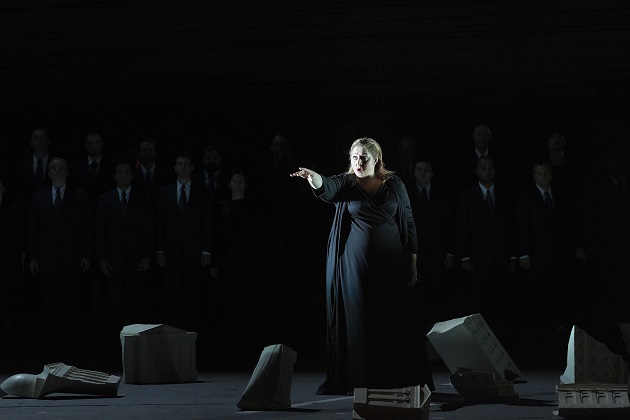
Christine Goerke as Brünnhilde in the Canadian Opera Company’s production of Götterdämmerung, 2017 (photo: Michael Cooper)

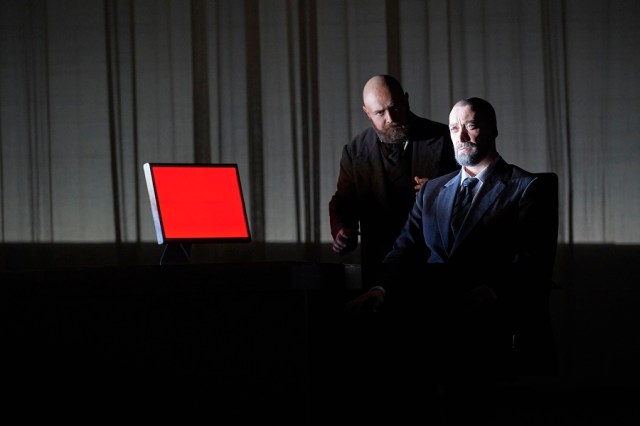
I am not Barack or Hillary, just one of the little people who can’t stop reading tweets and CNN, WaPo and NY Times, fascinated by the unfolding conflicts between the great & powerful forces on either side. I found solace immersing myself in the Canadian Opera Company’s Götterdämmerung, one of many templates where I could watch my own story unfold. In this production, does Hagen remind you of a more manly and handsome Steve Bannon, as he commands the vassals, in support of Gunther, the corrupt CEO figurehead? And does it matter whether the fraud and fakery come from a potion, the tarnhelm or Spicer, Conway and alternative facts? Truth is stranger than opera.

16-17-04-MC-D-0488

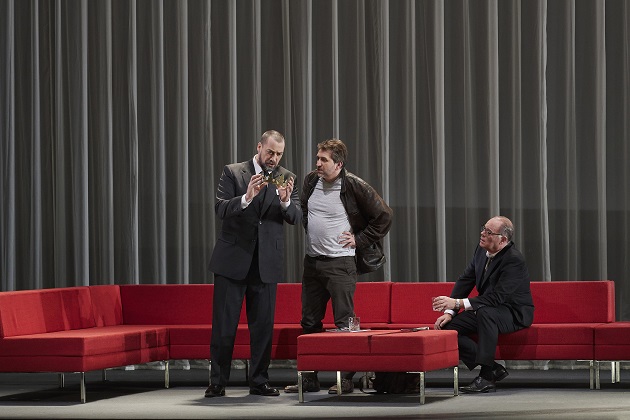
(l-r) Ain Anger as Hagen, Andreas Schager as Siegfried and Martin Gantner as Gunther in the Canadian Opera Company’s production of Götterdämmerung, 2017 (photo: Michael Cooper)

I saw the first and last performances, fascinated by how it changed since its Groundhog Day opening. On that occasion there were unfortunately empty seats as the last act began, perhaps daunted by the length of the show. Last night was a different story, the most intense audience response I’ve heard in Toronto in many years. Suddenly it was as though everybody in the house had bought their tickets from a scalper, had a personal stake in the show: and nobody left early. I’ve never heard such a wave of yelling and bravos in this city, both in response to the principals and to the orchestra, who were brought onstage for the applause.

Everyone seemed much more comfortable this time, less nervous than on the opening night.

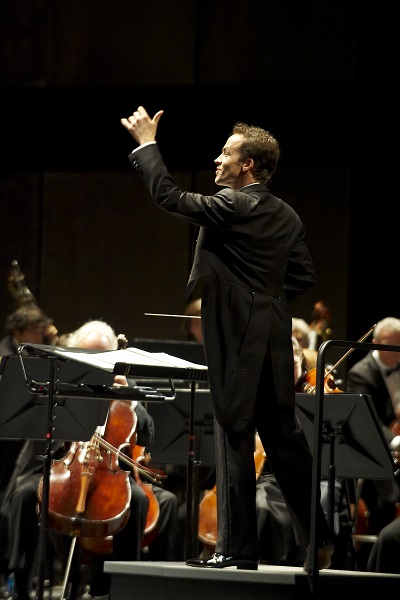
Johannes Debus is still a young conductor, which might be the reason Toronto basks in the riches of his performances with the COC.

09-10-S-01-MC-D-

The COC Orchestra and Conductor Johannes Debus. (Photo – Michael Cooper)

I’ve enjoyed watching his first encounters with great scores over the past few years, getting impossibly polished performances from the COC orchestra. One of the great joys of my 2nd row seat is watching Debus lead the COC orchestra, the chorus and soloists through each opera, immersed in an orchestral sound that can make it challenging to hear the singers (and the worst place to assess voices). But I had a perplexing time last night, struggling to see the first downbeat of each act due to a front row all leaning forward rather than the usual mix of interest and apathy. Even so I managed to find him for key moments. At the end of the first of the three sunrise sequences, he’s singing that opening brass salvo in E-flat that greets Siegfried & Brunnhilde as they enter in the Prologue. He’s faithfully probing the drama of that lengthy interlude between Hagen’s watch and the scene back on the rocks with Brunnhilde, as the drama of the hero’s forgetfulness is laid out for us in the orchestra. He appears to be launching an army into battle as the vassals respond to Hagen and the immense sound thrown back and forth, and again, on a more intimate scale, in the plotting between Gunther, Hagen and Brunnhilde that brings Act II to its perplexing & ironic conclusion. After all the powerful moments, Act III offers a lyrical respite, a resting place both for our ears and the wind-players’ chops in the delicacy of the Rhine-maidens scene and Siegfried’s reminiscences from the forest-bird, before Debus turns them loose in the full catharsis of the funeral music for Siegfried.

Christine Goerke is in some ways every bit as young as Debus. As he has conducted his very first Walküre (2015), Siegfried (2016) and now Götterdämmerung, she assayed the role of Brunnhilde with us in Toronto for the very first time in each of those Ring operas. Sitting up close gives me the privilege to see the performer coping, the wheels turning, responding. Sometimes you see a singer trip over a hem, (as we saw just last month ) or struggle with a messy stage (as she and Heidi Melton did with the Walküre set). I am a bit of a sucker for histrionics and drama, which means that if I find one singer doing more than the other, I’ll lock in on that one. It meant that for the scene between Waltraute and Brunnhilde, I watched Goerke even when Karen Cargill was singing, as there is a huge amount of drama enacted on the stage of Brunnhilde’s face. She begins, believing that this visit is good news. But we get all sorts of nuances I haven’t seen before, some anguished, some triumphant, and overall, quite unlike what I’m accustomed to in this scene. I’m not sure if the part that excited me most (and left me staring through a mini-Niagara Falls down my cheeks) was there the first time, as I’m pretty sure I was watching Cargill last time, whereas this time I watched Goerke go all to pieces during Cargill’s narration (and I followed suit: monkey see monkey do).

There was a nagging question that emerged with the force of a revelation with Brunnhilde’s re-appearance upstage, at the climax of the opera, namely “but where have I heard this sound before”? It crystalized a short while later in her clear and confident singing of the commands “starke scheite schichtet mir dort” that begin the Immolation Scene. The dark colour here sounded more than a bit like the great American soprano Jessye Norman, or perhaps like Helen Traubel (another great American) except there was none of that tendency both Norman & Traubel displayed, that the voice often sang a fraction of a tone flat throughout the entire range. Rich tone like Norman or perhaps Traubel: but precisely on pitch. Where there had been some humble caution on opening night, in the closing performance she seemed to lose herself completely in Brunnhilde, a rich warm portrayal that seemed so easy and natural that there was no longer any question of whether she could handle the role. There’s voice to spare, as it’s clear that Goerke really owns this role. Next time she’ll be able to build on this experience, adding additional richness to a portrayal (or should I call it portrayals? Three very different parts actually) that is already the most profound Brunnhilde I’ve ever seen. She’s not just singing, she’s acting and reacting.

Andreas Schager gave us a Siegfried to put me in mind of the challenges of this role. Few tenors can sing all the high notes in the role, let alone sing them with such a ringing tone that you always hear him cut through the orchestra. Once you have the person with the voice, it’s a bonus if the tenor looks halfway heroic in his physique, while offering a convincing portrayal. In this respect Schager is a genuine triple threat, in his attractive look and powerful sound. Having seen him twice, I was intrigued that he seemed to be free-lancing a bit more on closing night, singing notes that weren’t notated, while appearing to have a whale of a good time. He brought a wonderful swagger to the part, but there was a bit of Danny Zuko preening in his leather jacket before he sings “Summer Lovin’”, that might be some of the reason I found him unsympathetic. I’ve seen productions where the Siegfried stares at Brunnhilde in Act II with true innocence and without any apparent guile, whereas this interpretation brings out a sneaky conspiratorial side, as for instance in the tete-a-tete with Gunther. Maybe that explains why I wasn’t as upset as usual, at his demise, left without any sense of tragedy or loss in his murder.

Ain Anger as Hagen presented us with one of the other rock solid elements in this production. Along with Robert Pomakov as Alberich, Hagen was that most curious phenomenon, the portrayal that seemed so absolutely timeless, that it fit the modern production while seeming to be the enactment of the role as Wagner wrote it.

16-17-04-MC-D-0932

(l-r) Robert Pomakov as Alberich and Ain Anger as Hagen in the Canadian Opera Company’s production of Götterdämmerung, 2017 (photo: Michael Cooper)

Anger & Pomakov are in modern dress, but informed by the ageless obsessions ruling their envy and hatred. While Anger has the vocal credentials to offer up the black bass sounds of a Greindl or a Frick, he scaled it back for most of the portrayal, giving us the subtleties you see in Karl Ridderbusch’s quicksilver Hagen on the von Karajan Ring. The advantage of this approach onstage is that we see a Hagen who –like a good Iago—can be trusted by those around him, and whose villainy is well concealed rather than so obvious as to make everyone else on stage look foolish (for having trusted such an obvious bad guy).

Martin Gantner and Ileana Montalbetti present us with the unfulfilled brother and sister Gunther & Gutrune, proof that money can’t buy love or happiness. Gantner presents a figure all too familiar to us from television, a man conflicted & compromised, tormented by his awareness of his weaknesses. Montalbetti sounded much better tonight (perhaps she was unwell on the opening?), in a part that does see some growth; unlike her brother she has the one genuine moment of heart-breaking recognition in the last scene.

As the show is now closed I can mutter a few comments that may sound like complaints under my breath. Does it make sense that Brunnhilde has wine on her table on her mountain? Presumably one of the amazon drones delivered it, as no human can get through the impenetrable fire that tends to disrupt her social calendar. When Brunnhilde thinks Siegfried has come back (Act I) I think it’s adorable that someone (Goerke?) believes the Valkyrie-turned-human would tidy her table: because her man has come home. And then when Siegfried-as-Gunther turns the table upside down, and the wine and glasses go flying how is it that after all that, he picks up a plastic glass and sips more wine? But I suppose in this realm of fluorescent lights, ties & office furniture, we accept that the glasses are really plastic and therefore as immortal as Grane.

And now, what? Cast-members fly off to gigs elsewhere and/or back to waiting families. In their spring season the COC offer Tosca and Louis Riel. Next season we take a bit of a break from Wagner. And in the meantime the tunes continue to play inside my head.

Posted in Opera, Reviews | Leave a comment

Mackay’s Visions & Voyages

My own little reconciliation journey continues.

Last year I saw the Royal Winnipeg Ballet’s Going Home Star, a ballet aiming to probe the history behind the Truth and Reconciliation Commission, a powerful piece about the trauma associated with the residential schools.

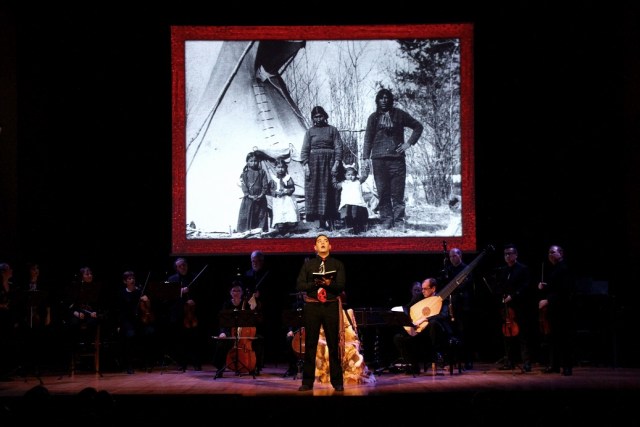
A few weeks ago I saw and heard Toronto Consort’s utopian Kanatha/Canada: First Encounters, taking us back to a Montreal peace conference in 1701.  Imagine a time when our indigenous peoples were addressed truthfully as equals.  Is that even something you can imagine, with so many lies in the last century and a half?

Where Toronto Consort is led by and curated by David Fallis, Tafelmusik’s Visions & Voyages: Canada 1663 – 1763 is another multi-media piece conceived & created by his wife and Tafelmusik bass player Alison Mackay.  I knew I’d be seeing her show, and pondered their influence upon one another.  That led me to rush over to UC Art Centre to catch Kent Monkman’s “Shame and Prejudice: A Story of Resilience”.  I didn’t expect to be shaken to my core.  Just as Jesse Wente said that to make Canada’s 150th Anniversary meaningful, we must include the stories of indigenous peoples, so too Monkman, who demanded to know: where are the

“…history paintings that conveyed or authorized Indigenous experience into the canon of art history..? Where were the paintings from the nineteenth century that recounted, with passion and empathy, the dispossession, starvation, incarceration and genocide?”

Where Fallis presents us with something peaceful that I called “prelapsarian” in its evocation of  a perfect Canada before it fell from grace, in our later inability to keep faith with indigenous peoples, Mackay’s project is somewhat different.

visions-voyages-artists

Alison Mackay, Ryan Cunningham, Brian Solomon

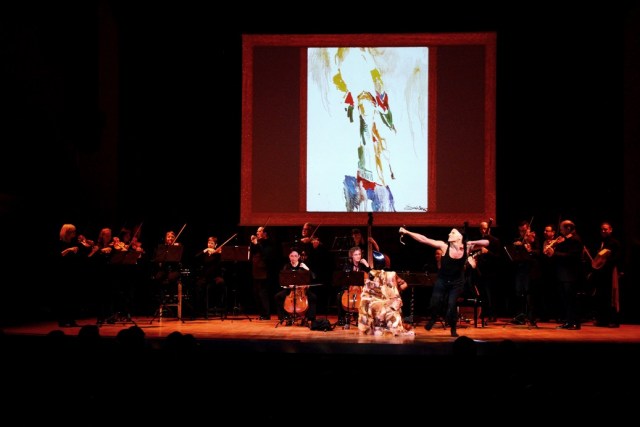
Visions & Voyages is an epic presentation, communicating on multiple channels as we hear music and words, see photos & art projected, watching musicians and actors and dance.  The word “historiography” was in my head as I pondered the ways in which our history was not just being told, but explored, articulated, and re-imagined.  The first half places a focus on New France and the francophone culture and music, while the second half shifts to Rupert’s Land and the music that goes with the English side of our early history.  As with Fallis’s account, sticking to the earlier part of the story means we can mostly avoid hearing about genocide, epidemics and death.  Mackay does venture into the 19th century briefly to talk about the Indian Act & residential schools.  We do not focus on the things you usually get in history books, which is why I bring up historiography, as it could be argued that we largely went astray (Canadians and Americans too) by how he decided to frame our national narratives, including the story of the indigenous peoples.  I saw someone arguing on social media just a couple of days ago that Riel was a criminal who couldn’t be treated as a hero, a person trapped by their ultra-conservative view of history.  But that’s one tiny part of the bigger story.  Happily Mackay is not bothering  to tell the usual story. We are instead hearing of dignified encounters between peoples and the music that was part of those encounters, whether in the cultural encounter of aboriginal Canadians brought to England complete with baroque pomp & dignity, or the funeral of a Wendat Chief in Montreal.  When we notice that history and our assumptions have led us astray, it’s time to jettison the old story and find a new way to tell it.  I think that’s the impulse behind Mackay’s work, and it’s a very healthy one.

dancer_brian_solomon_in_tafelmusik_visionsvoyages_by_jeremy_chan

Dancer Brian Solomon, Tafelmusik “Visions and Voyages” (photo Jeremy Chan)


Where Fallis offers a concert from a time before we screwed it all up, Mackay dares something beyond that.  We are experiencing art with a narrator, Ryan Cunningham lending a certain authenticity to the story-telling.

narrator_ryan_cunningham_in_tafelmusik_visionsvoyages

Narrator Ryan Cunninham with Tafelmusik (photo: Jeremy Chan)

The events of the past 150 + years are hinted at only.  Mackay seems to presuppose that we know it, and the educated crowd gathered in Jeanne Lamon Hall would accuse me of being perversely difficult for suggesting anything different.

But I’m wary, at least because of identity politics.  Tales of such sensitivity can make people very upset, when treated without due sensitivity.  This is not our turf, these are not our wounds to heal.  Yes, as a guilty liberal, I want to make my pain go away.  And the indigenous participants in this concert are very generous.  I was moved past the ability to speak for awhile at the end, as we went from history to a kind of healing-catharsis dance, a celebration of sorts.  But while I was exultant at the end, almost delirious with joy listening to what Mackay created and what Brian Solomon danced to bring the concert to its conclusion,  I feel that I’m being let off the hook, absolved: and I am not sure I have the right to feel this way.

As I ponder what I feel, I’m tempted to ascribe the key difference between the Fallis and Mackay programs to gender (and hope that this doesn’t sound simplistic, reductive or worse), to a generous and loving sensibility that seeks to focus on life and relationships as reflected in music-making: rather than politics.  The redemptive and hopeful ending that Mackay spoke of in her introductory words before the concert began were fulfilled for me in Solomon’s dance.  In short order he took us from a kind of pained disability, staggering about with such aching pathos, blinded by a book literally stuck across his eyes, (not unlike so many people I see immersed in their electronic devices on the streets of this city), and then finding a vocabulary that seemed so genuinely Canadian in its invocation of the old folk dances.  It’s not for me to permit the celebration, welcome as it is.  But yes I am grateful for the way Solomon’s joyful movements were like a magic wand, blessing and absolving us of our guilt for the moment at least.

Mackay has been doing this for awhile, combining music and ideas and images, to make a whole greater than the sum of its parts.  I think this is her best yet, something truly redemptive and healing, even if lately I am overwhelmed with how much we have to answer for.  Chances are Tafelmusik will gather the talent and the music together into a DVD, one that I know I will buy and enjoy.

Visions & voyages: Canada 1663-1763 continues Saturday night at 8 pm and Sunday afternoon 3:30pm Trinity-St. Paul’s Centre, Jeanne Lamon Hall.

Posted in Music and musicology | 2 Comments

An Evening with the Ensemble Studio

Institutions are like buildings. They have structures.  They’re solid, which means they resist change, and offer shelter to those who rely upon them. A change in an institution may be bewildering and hard to understand, but is ultimately inevitable, even in an institution, and usually leads to a new normal.

Tonight represented something new & different for the Canadian Opera Company’s Ensemble Studio. Instead of offering their members roles in a special performance of one of the season’s operas, we saw something new, titled “An Evening with the Ensemble Studio.”

I wondered: why the change? but of course I don’t know the answer, so I can only speculate. There are three obvious reasons I would offer, that are only guesses of course:

  1. The past practice may have been too expensive. Imagine a whole set of costumes and all those rehearsals for one performance. And has it been worth it (meaning the shows from past years): in terms of what it might offer the members of the Ensemble Studio? I can’t say.
  2. The past practice may have other problems leading to its elimination. There was the year that the lead had the flu but went on anyway, something I wish I’d seen for the heroics involved but still: hardly a recommendation for the practice. Maybe Alexander Neef and the rest of the COC brass breathed a colossal sigh of relief that they survived that particular ordeal, and looked at coming up with something safer.
  3. And looking at the complement of singers this year, maybe they simply had no choice.

Tonight we saw five female ensemble members + a female guest sharing the stage with three men, suggesting that maybe the Ensemble Studio had no other option given their current complement.

I’m guessing that this experiment will become the norm. Instead of a fully staged opera we had semi-staged scenes, the singers in evening attire. That didn’t stop us from having a great time.

I suspect –speaking of cost—that one of the underlying factors in assembling the program is familiarity. We heard excerpts from Mozart’s la finta giardiniera; Bellini’s Norma; and Handel’s Ariodante. Two of the three items on tonight’s program are relatively familiar to the COC orchestra, meaning that less rehearsal dollars would be required.

There were some wonderful moments tonight, anchored by Johannes Debus leading the COC Orchestra.

Mireille Asselin showed her versatility, undertaking fragments of two totally different roles tonight. First she was a very funny Serpetta in the Mozart, then the contrite Dalinda from the last act of the Handel.

resized-ensemble-bs-0326

(l-r) Mezzo-soprano Emily D’Angelo and Ensemble Studio alumna soprano Mireille Asselin perform in the Canadian Opera Company’s An Evening with the Ensemble Studio on February 23, 2017, with the COC Orchestra conducted by COC Music Director Johannes Debus. (Photo: Bronwen Sharp)

There were several highlights:

  • Arias by Lauren Eberwein, Charles Sy and Danika Loren in the Mozart
  • A full-out old fashioned sing from Megan Quick and Samantha Pickett in a wonderful excerpt from Norma
  • More fireworks from Emily D’Angelo & Danika Loren in the Handel

My one disappointment is that the hall wasn’t fuller, but I recall the same issue with the Ensemble performances of full operas. I don’t know if it’s a matter of how they’re promoted, so much as timing: falling near the end of the runs of The Magic Flute & Götterdämmerung (closing Friday & Saturday respectively). I wonder if they set this up in a week when there’s not so much going on, whether they could fill the hall? Perhaps at the very end of the season? I believe this can be another occasion for celebration.

But in fairness, this is the first time they’ve done this. The COC are an institution and one of the great things about institutions is that they’ll learn how to do this better every time they repeat the pattern.

Posted in Opera | Leave a comment

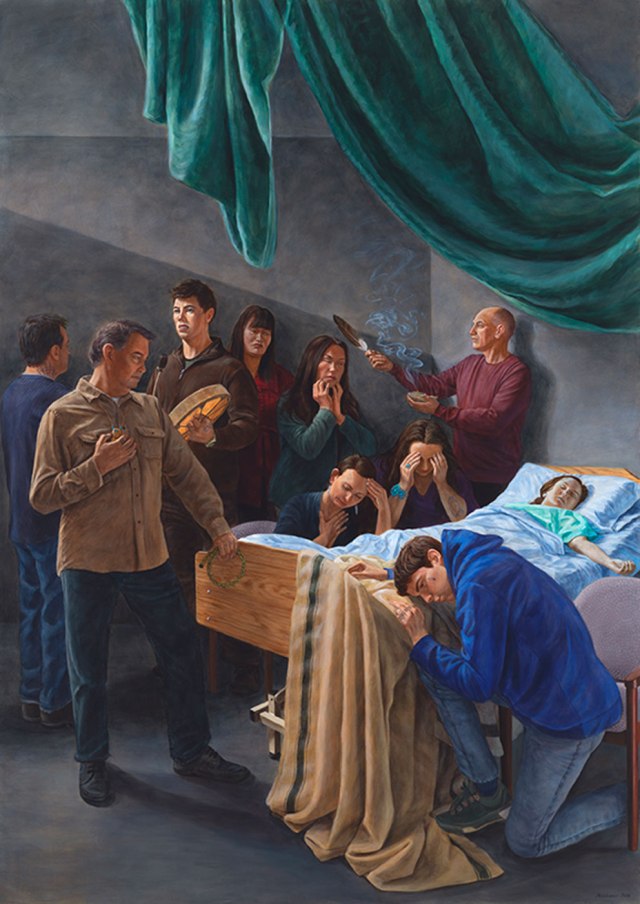
Kent Monkman: Our Shame, Our Prejudice, Their Resilience

I have just experienced Kent Monkman‘s show at the University of Toronto Art Museum, a series of paintings, textual passages and installations proposing something quite ambitious. As he observed in the Foreword (in a little brochure I picked up as I entered the exhibit):

“I could not think of any history paintings that conveyed or authorized Indigenous experience into the canon of art history. Where were the paintings from the nineteenth century that recounted, with passion and empathy, the dispossession, starvation, incarceration and genocide of Indigenous people here on Turtle Island?”

Coincidentally I read something on social media today, Jesse Wente’s call to make Canada’s 150th Anniversary meaningful, by including the stories of Indigenous peoples and not just the European conquerors.

2017_monkman_secondary3_light

Kent Monkman Death of The Virgin (After Caravagio) 2016. Acrylic on canvas. 183 X 130cm.

Reality is made from a series of assumptions. What if your reality requires you to deny truths that, were we to face them, might leave us unhinged?  Richard Wagner famously suggested that anyone seeing a good performance of his Tristan und Isolde should leave the theatre mad. As I walked around in this overpowering show, listening to at least one person say they couldn’t take it anymore, I wondered. Are we – that is, the descendants of Europeans—lying to ourselves, denying what really happened? These paintings should be upsetting, should strip away the false pretense.

It’s as though you’re up on a bridge and suddenly walking on a glass floor, seeing how far you might fall, that maybe there’s really nothing under you.

I went to this show with a quaint idea. I’d seen Kanatha/Canada: First Encounters earlier in February, David Fallis’s marvelous collaboration between western & indigenous musicians re-creating an intercultural peace conference from over 300 years ago: when the Europeans had not yet subjugated local populations, when a dignified relationship was still possible. Tonight it’s his partner’s turn as Alison Mackay premieres her latest multi-media concert with Tafelmusik, namely Visions & Voyages: Canada 1663- 1763. I wanted to insert something edgy into the mix, knowing that Monkman’s art pulls no punches. Since November 2016 I have an endless appetite for political art & commentary: or so I thought.

But I have no handy analogy or conceptual pigeonhole for Monkman’s art. A sensitive person should be squirming, disturbed, upset. This is a reminder of a holocaust, yet we walk about in the midst of their Auschwitzes (to make a crude analogy), blindly ignoring their traumas or paying lip service at best. I mentioned Wagner because this show left me feeling unhinged from reality. I was reminded a little bit of the catharsis I felt at the end of Go Home Star, the ballet from Royal Winnipeg Ballet that I saw about a year ago when they set fire to the residential school. And I am now recalling that they had counselors present for those who might be traumatized by the work. Of course as a Canadian with a European background, I was intrigued but had no trauma.

Or maybe I’ve been sleep-walking.

In Monkman’s show there’s a painting –one of the most tranquil and even utopian—titled “Reincarceration” (2013). It’s several things at once. In the furthest background I am pretty sure there’s a residential school, given that it’s the same shape of building we saw on the ballet stage. Figures emerge from the distance, who cross the water in the foreground, and join a dance circle.

Monkman’s project is no delicate dance however. Prepare to encounter the history of his peoples as seen in juxtaposition with our collective unconscious, the inherited storehouse of images from western art, parodied and turned on their head. I like his sense of humour although I didn’t laugh once. Speaking as someone who has spent a lot of time in church, I feel as though I’m more in touch with reality after seeing this show.

There are several huge canvases, including one room that is overpowering in its imagery.

The title of the show is “Shame and Prejudice: A Story of Resilience”. While it’s true that the residential schools induced shame in the inmates, the shame I speak of is mine, ours as Canadians. We may have had the TRC, but our truth isn’t yet faced, the reconciliation is barely begun. I’m grateful to Monkman aka Miss Chief Eagle Testickle, for offering the occasional laugh along the way.

“Shame and Prejudice: A Story of Resilience” runs just until March 5th. For a Sesquicentennial that is truthful, don’t miss this show at the U of T’s Art Museum.

Here’s the show’s brochure.

Posted in Art, Architecture & Design, Politics | 3 Comments