Balancing on the Edge: of…(?)

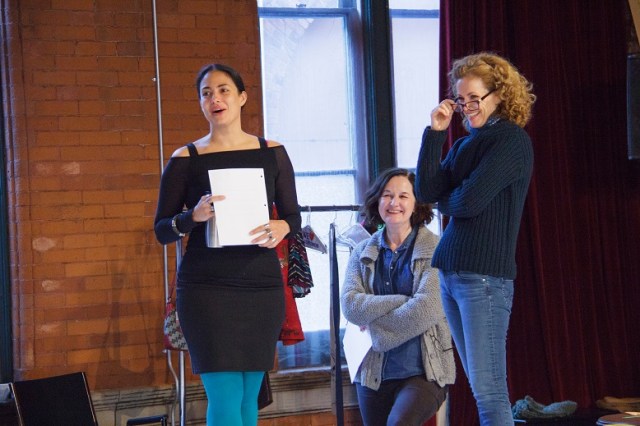
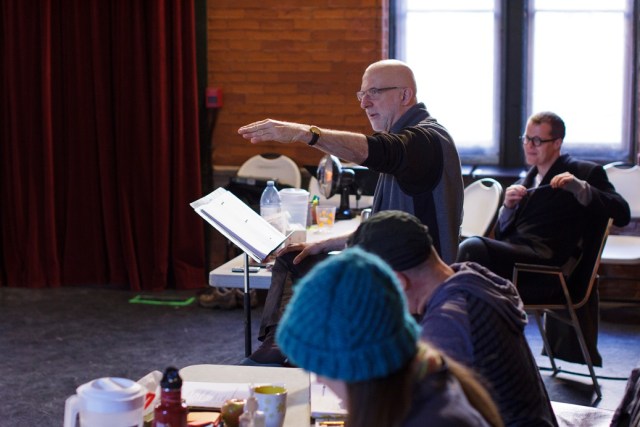
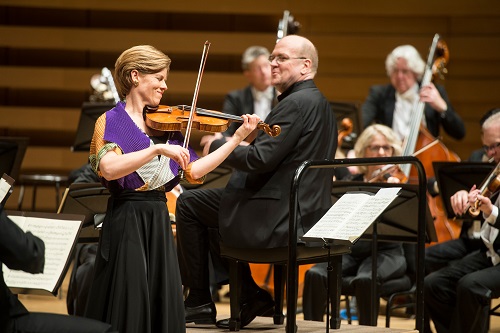
At Harbourfront Centre I had the pleasure of attending a christening, for Balancing on the Edge is the tender infant resulting from a romance. Thin Edge Musical Collective met A Girl in the Sky Productions. New Circus and New Music flirted with one another. The immediate result? Balancing on the Edge, which might be understood as a series of children resulting from the encounter. It’s no shotgun wedding, indeed they don’t have a ring (excuse the pun).

By “new circus” I hope you understand the cluster of disciplines that used to be housed under the big top or perhaps clustered with Cirque du Soleil at a venue in Vegas or elsewhere. The animals are missing, possibly because that’s just too expensive to contemplate, but the aerial disciplines + clowns seem to be present and accounted for.

By “new music” I think we’re talking about something that’s sometimes not so new. Some may recall a television program from the last century on CITY-TV that co-opted the name from the conservatory-classical realm for the purpose of showing us new rock music: so the phrase is more than a quarter century old, and at least in romantic terms is older than the partner.

If my extended metaphors don’t drive you nuts, I hope you’ll see what I’m driving at. But let me quote the “message from the artistic directors” printed in the program to show you what I’m suggesting.

Welcome to Balancing on the Edge! Tonight’s synthesis of New Circus and New Music was inspired by an encounter where the producers of each discipline saw the creative work of each other for the first time and fell in love with the risk taking and visceral physicality being expressed. It sparked the recognition that these two unique art forms could come together to form a singular and powerful vessel with which to express transformative stories that are part of the human experience and investigate questions we don’t always have the answer to such as: What happens when we die? How do we cope? Are we alone? How can we connect in a world of technology? Where do we belong?

In a time of increasing precarity these concepts seem more pressing than ever to explore. We are so grateful to have had the chance to work closely with such an incredibly talented team of visionary artists over the past three years to realize this project! Tonight’s show will explore themes as diverse as motherhood, tectonic plates bicycle accidents, communication, helping hands, and deconstructing social formulas all underpinned and conversing with sound explorations on turntable, grand piano, string quartet, saxophone/bass clarinet, voice, live electronics and a batter of percussion instruments while breath-taking high-flying circus artists dance and juggle, on floating rocks, silks, rope, ladders & bicycles in columns of light against arresting images.

On behalf of the entire team, We’re thrilled to have you join us to experience first hand 6 incredibly personal expressions of what it means to be ‘balancing on the edge’!
Rebecca, Cheryl + Ilana

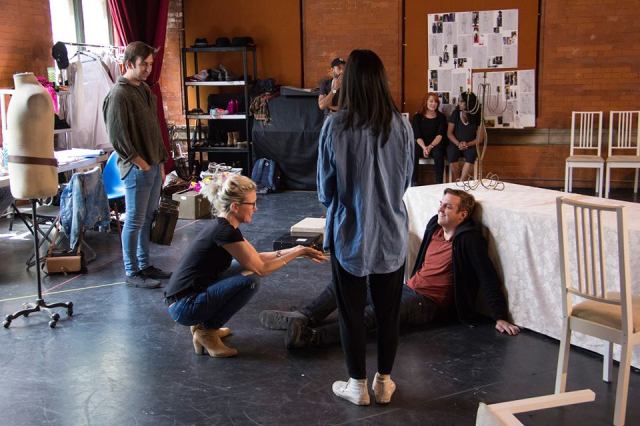
And so as a family outing we took in the six pieces. There were eight segments in all interrupted by an intermission. Each half consisted of three attempts at hybrid creation plus a “transition” from clowns Erin Ball and Sonia Norris:

  • Magma – Rebecca Carney & Diana Lopez, music: Phonengraphenlieder(2014) Nicole Lizée
  • Naked to the Sky –Manuel Cyr & Louis Barbier, music: Naked to the Sky (commissioned for this occasion) Scott Rubin
  • Transition (Ball & Norris hysterically funny cleaning up /getting the audience to clean up the mess from the previous item)
  • Underneath—Emily Hughes, music: Okho (1989), Iannis Xenakis

–INTERMISSION–

  • Ascension—Holly Treddenik, Angola Murdoch, Stacie Dunlop, music: Aria & Fontana Mix (1958/59), John Cage
  • Excavating Meaning—Brandy Leary, music: Amanha (commissioned for this occasion), Nick Storing
  • Transition (Ball & Norris diverting us while a bit of tidying occurs. I got to dance with Norris when she pulled me out of the front row)
  • Ghost Bicycle—Rebecca Leonard & Natasha Danchenko, music: Cheating, Lying, Stealing (1993), David Lang

The family outing was a huge success, I’m a hero for suggesting it. While their favourites were not my favourites we loved the clown transitions, and agree that Erin Ball is hugely inspiring to watch, an aerialist and clown who won’t let a little thing like an amputation come between her and performance.  And she was funny.

So forgive me as I do my usual perambulation through the dramaturgy question, as I ask myself just what I’ve seen and how it works, and in the process see if there’s anything that can be learned.

I am no expert by any means in circus, just an eager and omnivorous aficionado. No that sounds pretentious. I like circus in everything, whether it’s opera, music-theatre, or a la carte. My background in music is more secure, even if the realm of music is just so huge that it’s impossible to know it all. After the dance piece I saw last night at CanStage from Bill Coleman, I’m inclined to think that maybe it’s time to come up with new terminology. What Coleman did might not be recognizable as dance, and similarly, much of what I saw today might not meet the criteria some people usually assign to “circus”, new or otherwise. Let me say that I am a bit of an agnostic about names, that disciplines, as a set of rules & procedures, can sometimes be huge impediments to creation. Of the six pieces, some were more conventional than others, or in other words, some did not really seem to be a marriage of new music and new circus after all, so much as a bit of polite hand-holding or smiling from across the room. The ones I thought of as the most daring and radical for their brave and vulnerable submission to the invasive ways of that bold suitor, weren’t necessarily what my family liked.

Is the desire to be popular perhaps an impediment? But maybe I’m using the wrong word, when “popular” can sometimes be synonymous with “intelligible”. The most daring pieces today were the hardest to understand. Two pieces were lovely aerial solos that, as far as I could tell, could just as easily have been done with something picked out of the record collection at home: or in other words, there was no real marriage of the two disciplines, no penetration (and you can take that rude word any way you want).
Three of the six were most problematic when they were ambiguous: when they were neither this nor that. And at those moments they were genuinely daring because they were new, perplexing, and adventurous.

  • Louis Barbier (if I’ve identified the right artist) portrays something resembling a mad Tudor King, rolling and roiling about the stage, at one point furiously ripping the music from the performers music stands (I was the only one who laughed but wow what a funny moment of insanity, and what does it say that i identify?), eventually resolving our wonderment by becoming a juggler. The music going with this by Scott Rubin, one of the original works for this event, was at times, jazzy, at times soulful and subtle. For this piece we did seem to see symbiosis, something bigger than the sum of the parts, and an inter-penetration of the two media.
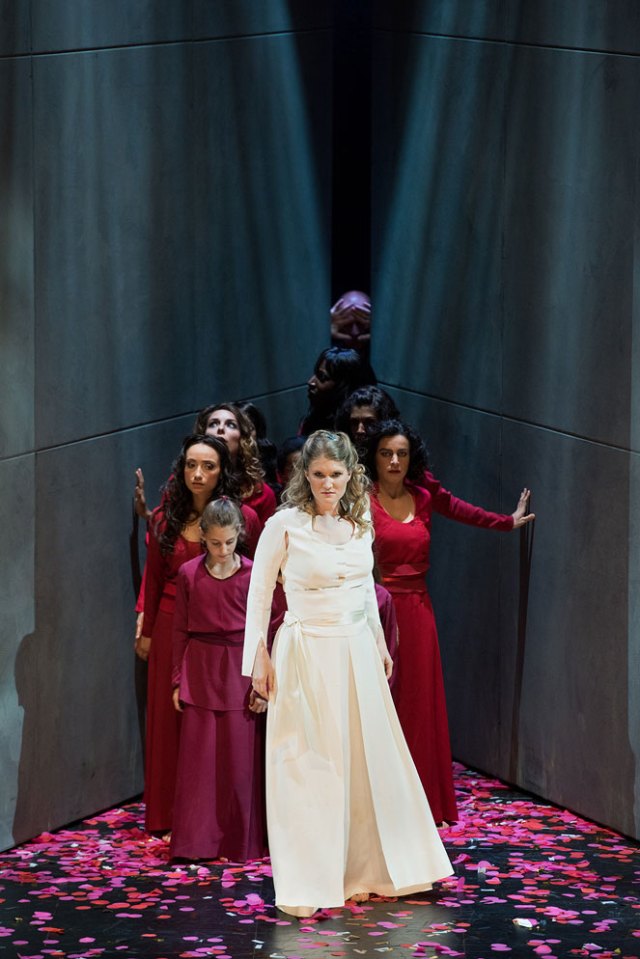
  • The fullest integration between disciplines was surely in Ascension, the only piece where the aerialists (Holly Treddenick & Angola Murdoch) made sounds, and a singer (Stacie Dunlop) did acrobatics and some aerials. We were in John Cage’s bizarre sound-world, sounds and phonation resembling a language or meta-language, presented with all the trappings of meaningful speech in a mysterious social context.Processed with Snapseed.
  • Ghost Bicycle was the one that raised the most questions for me, something I’m inclined to call an aerial dance piece, as I watched two performers do a pas de deux in the air. Again, I’m not sure if the music for this piece is really anything more than accompaniment, but the result is so magnificently inspired, I think it must be seen as a step forward.

reized-ghost-bicycle-planchesm

Is disciplinarity safety? Or in other words, when we recognize procedures and codes, when we know where we are and what’s being done, does that allow us to relax a bit, removing ambiguities by offering a predictable horizon of expectation? are we being in some sense protected, given a kind of safety by the creator? Their choice may indeed by designed to offer them – the composer, the scenarist, the musician, and/or the aerialist—the rest and not us, by allowing them to be predictable for a moment. I joked in yesterday’s review about dance that, in doing what dance usually does, for instance flaunting a physique, in moving in ways that dancers habitually move (and I cited The Producers great line´”one two kick turn”), that gives our minds a break. I have this insight, that as far as information theory goes, thinking specifically about music, that redundancy brings us calmness, and by that I mean for example, the repetition of a Philip Glass or the lyricism of a composer of bygone times. More information, as in surprise or discord or drama takes us away from calmness. The same sort of calm can be found in familiar procedures, in knowing what’s going on, whereas ambiguity can cause tension; indeed it freaks some people out.

And so, the ones where the music is predictable in seeming to be subservient –and need I add, doing what music usually does with dance or opera—were all beautiful, were the ones that my companions loved. And maybe I ask too much, hungering for that old chestnut of the 20th century, namely significant form.

Maybe I ask too much.

I was thinking back to Fred and Ginger. What was it that they said? “He gives her class. She gives him sex.” Perhaps something very similar is going on when you pair New Circus with New Music. New Music needs the physical appeal that circus brings, the half-clothed figures twisting in silks above our heads are at least as sexy as Ginger Rogers. And similarly, New Music legitimizes circus with its intellectual appeal, indeed with an audience of intellectuals likely hungry for beautiful bodies to stare at.

Forgive me if anything I say sounds cynical. I would love to see more such encounters. So far we’re still at the flirtation stage. I’d like to see if future experiments are as fertile as these. Read more about A Girl in the Sky (here) and Thin Edge Music Collective (here).

Posted in Dance, theatre & musicals, Music and musicology | 3 Comments

Chaotic Dollhouse all too real

Here’s what I found on the Coleman Lemieux website concerning Dollhouse, their new work currently being presented by Canadian Stage:

Dollhouse is a work created for galleries, cross-disciplinary exhibitions, music centres, theatres, and all manner of other places of learning and discovery. One day set up, two performers, one technician.

Dancer/choreographer Bill Coleman inhabits the experimental music installation of avant-garde composer Gordon Monahan. Tap dancing, performance art and action intermingle with mechanical and electronic manipulated objects, handmade and found, rendering rhythms equally sonic and visual. Disruptive and surprising Dollhouse walks a unique line of Artaudan fiction and slapstick with the performer acting simultaneously as instrument and conductor.

Considering the situation we find ourselves in today the visual metaphor of a man drowning in his surroundings is timely. Bill Coleman, a master performer plays the role of modern fakir as he suffers through what at times are almost comic situations on his way to a symphonic chaos of sight and sound.

I am glad I didn’t see any of that until later, as I came without any expectations, wide open for what I experienced tonight.  It’s about an hour long, and yes it does straddle the boundary between serious and comical, a bit of a challenge to interpret, but in the best sense.  At times I felt we were experiencing Butoh, but without any Buddhism.  This is a very slow & patient examination of the here and now, sometimes slow and gentle, sometimes as urgently disordered and stormy (to insert a context onto something abstract in its disorder) as if we were out on the heath with mad old King Lear.

dollhouse-witch-doctor7c-dancer-bill-coleman-photo-paul-antoine-taillefer-390x390

Bill Coleman (photo: Paul-Antoine Taillefer)

We may tend to take for granted that music or sound functions in support of action or dance or singing, that the conventional aim is Gesamtkunstwerk, or in other words a total art that employs all media strategically together.  In a scary movie, the music tells you when to be scared, while in a romantic movie we can tell when to have warm fuzzy feelings.

But what if one disrupts or ignores those usual relationships & procedures?

What if the sound were generated by the performer’s movements?

What if the sound wasn’t easily amenable to explanation, but instead seemed to be a complex, even an independent phenomenon without any clear purpose or function, seemingly autonomous?

What if what you saw onstage resembled real life? It’s almost inconceivable in a world where dance is always purposeful, virtuosic, strategic.

I don’t want to give things away, as a believer in spoiler free reviews, but you should know that we’re in a realm of serious performance art, that for me was extremely powerful. The fact that we aren’t in the usual place of virtuosity means a great deal.  This is not one-two kick-turn dancing and pardon me if I invoke the director brought in for Springtime for Hitler, in The Producers.  But dance is sometimes so dreadfully unwilling to let go of its fetish for bodies and showing off.

Sure (to quote The Producers again), “if you’ve got it flaunt it”.  But dance can be so much more.

Or less.

The most important touchstone I can mention is one seen in Toronto in June 2012,  during Stewart Goodyear’s Beethoven sonata marathon in 2012. You may recall that  Melati Suryodarmo danced on butter, deconstructing the whole idea of virtuosity.

Watching her you recognize a whole other set of co-ordinates for dance beyond Olympian ideals such as higher-faster-stronger, or the notion of beauty & elegance.  She’s falling down! ….and that is her dance.  Speaking as an older guy, who sat in a theatre full of older people, it’s fabulous to watch someone slipping and falling, struggling not to fall, or coping with real hazards and obstacles.  For a disabled person, for an older person (recalling my conversations recently with my mom about a friend who has fallen and hurt herself): this is the most urgent drama of all.

This is the most realistic and life-like thing I’ve ever seen danced.  Disability is something dance seems to hate (recalling the time I was trying to talk to a couple of choreographers back in the 90s and they seemed grossed out by my bad posture, which btw is caused by arthritis, and unable to even converse without trying to lay hands on me to adjust my stance….which is hysterically funny in retrospect), perhaps troubled fundamentally by the ultimate insult to the instrument, that the body breaks down.

But it does break down. It ages.

dollhouse-witch-doctor-dancer-bill-coleman-photo-paul-antoine-taillefer-5-390x390

Bill Coleman (photo: Paul-Antoine Taillefer)

And Bill Coleman was speaking to this older audience, in his struggles to move.  At the beginning I was shocked that he had his body making noises (I won’t tell you how, as this is something you discover, part of the magic of the show), reminding me gulp of my own joints that sometimes make crackling noises.  We are imperfect instruments all of us, and even those who are close to perfect are aging and losing their virtuosity to the ravages of Father Time.  Not me, i lost any notion of perfection a very long time ago.

There’s an image in this show that I will give away, because knowing about it can’t prepare you for the visceral experience of seeing it.  Coleman at one point steps forward in a jacket with a bunch of arrows in his back, as though he were Achilles the moment before death.  How does one take the stage, when riddled with arrows?  I suppose you’ll have to see the show to find out. But don’t expect one-two kick-turn.

Some of it is funny, some of it poignant, peaceful, painful.  It gets pretty loud at times.  For me this is the most genuine dance piece I’ve ever experienced, possibly because it isn’t really dance.  It’s music that is –to use composer Gordon Monahan’s concept—sculptural.  Some of the sound comes from noisy objects, some from the creations he’s put onstage, reminding me of Rowland Emett or Rube Goldberg in his gadgetry.  The stage is alive de facto, making its own noises and movements, and Coleman moves and makes sounds himself.

This isn’t the Nutcracker.

You may be put off if you dislike art or theatre that resists telling a story and instead requires you to think, as this is a challenging piece. I quite love it.  In places I laughed although it was nervous laughter from someone who saw fragile humanity onstage tonight.

Dollhouse continues at the Berkeley Street Theatre this weekend until Sunday November 20th.

Posted in Dance, theatre & musicals, Reviews | Leave a comment

Looking back across the Bridge to the Future

It was a concert to commemorate the 60th Anniversary of the Hungarian Revolution as well as the 135th Anniversary of the Birth of Béla Bartók, presented by CHAMP: the Canadian Hungarian Association for Music Performance. While the title of the event was an optimistic “Bridge to the Future”, we were all looking back.

I couldn’t help wishing that some members of my family –both living and dead—had been able to attend, to hear and see performances that likely meant more to them, (Hungarians who had at one time lived in Hungary) than to me (a Canadian of Hungarian origin).
This morning I heard a very cute little promo as part of the regular morning conversation one sometimes encounters between Mike Duncan of Classical 96.3 FM and Tom Mihalik of “Tom’s Place” usually offering deals on men’s suits, but this time promoting the concert & pianist Mary Kenedi. The concert was under the patronage of the Consul General, Dr Stefánia Szabó who spoke at the beginning, also crediting Kenedi, who not only organized and promoted the event, but whose music presence recurred throughout the fascinating program.

photo3_resized

Mezzo-soprano Krisztina Szabo (photo: Bo Huang)

  • Liszt –“Les Jeux d’Eaux a la Villa d’Este”: Mary Kenedi, piano
  • Von Dohnányi—“Serenade” (string trio): Sharon Lee, violin, Laurence Schaufele, viola, Sybil Shanahan, cello
  • Kodály—Four Hungarian songs: Krisztina Szabó, mezzo-soprano, William Shookhoff, piano

–intermission–

  • Kodály—Cello Sonata Op 4: Sybil Shanahan, cello, Mary Kenedi, piano
  • Lehár—“Vilia” from The Merry Widow, sung in Hungarian: Krisztina Szabó, mezzo-soprano, William Shookhoff, piano
  • Kálmán—“Luck is a Golden Dream” from Countess Maritza sung in English: Krisztina Szabó, mezzo-soprano, William Shookhoff, piano
  • Lehár—“Meine Lippen” from Giuditta sung in German: Krisztina Szabó, mezzo-soprano, William Shookhoff, piano
  • De Fries—“Honvágy” sung in Hungarian: Krisztina Szabó, mezzo-soprano, William Shookhoff, piano
  • Bartók—3 Folksongs from the District of Csik: Mary Kenedi, piano
  • Bartók—15 Hungarian Peasant Songs (No 6, nos. 7-15): Mary Kenedi, piano
  • Bartók—Roumanian Dance 8/a No.1 : Mary Kenedi, piano

While events such as this can be fraught with speeches and thank you’s, it was a genuine celebration, mostly music in the end, and a very full program.

champ-200x198I couldn’t help being intrigued by the evening’s title, thinking that however much some composers seemed to be A Bridge to the “Future” that’s all past now.

Kodály and Bartók were featured in Kenedi’s playing, wonderfully idiomatic sounds full of rhythmic life that seemed firmly connected to the folk music that underpins their compositions. The Dohnányi trio is new to me, a fascinating sound I will explore again.

Perhaps most extraordinary was the opportunity to hear Krisztina Szabó singing something in her native tongue. I spoke to her yesterday –via social media—when she very modestly expressed concerns about her accent, even though she seemed extremely authentic to me, especially in the way she played up the characterizations in the songs.

Hers is a voice that seems to straddle boundaries, as she is so much more than just a mezzo-soprano.

And the repertoire brought out a side in William Shookhoff that we don’t usually encounter when he’s playing in support of his colleagues at Opera by Request, as he was much more daring in his sound alongside Szabó’s voice. I realize now how much he usually holds back in his playing, but tonight he cut loose to wonderful effect.magyar_logo

There is also a free film festival, “Freedom First” offered by TIFF, commemorating the anniversary of the uprising.  Read more about it here.

Posted in Music and musicology, Personal ruminations & essays, Reviews | Leave a comment

Naomi’s Road leads to Toronto

Tonight I saw Naomi’s Road, an opera with libretto by Ann Hodges & music composed by Ramona Luengen, based on a novel by Joy Kogawa, to open Tapestry Opera’s 2016-17 season.

joy-kogawa

Joy Kogawa whose novel Naomi Road was adapted as an opera, currently being presented by Tapestry Opera in its first Ontario production

Tapestry Artistic Director explained before the show’s presentation at David’s Anglican Church (a location that is supposedly full of historical significance for the Japanese Canadian community)  that while this little opera has been to at least 400 communities in places such as British Columbia & Alberta, it only now comes to Ontario, and for the first time is directed by a Japanese Canadian: Mori that is.

naomi_dahlia-katz

Naomi’s road with (l-r) Hiather Darnel-Kadonaga, Erica Iris Sam Chung and Sung Taek Chung (photo: Dahlia Katz)

I’m simultaneously having a whole flood of emotional responses to this unpretentious little work of roughly an hour in length.  It’s less than a week since I saw Ayre presented by Against the Grain at the Ismaili Centre, yet here I am again looking at a political work and its context, the day before i see another quasi political event, namely “A Bridge to the Future: commemorating the Hungarian Revolution“.  While the American election may be over, many of us are still reverberating with its implications.  Naomi’s Road seems especially timely in that context, a tiny glimpse in microcosm of Canada’s treatment of Japanese Canadians in the Second World War, interned & stripped of their possessions as a consequence of the government’s invocation of the War Measures Act (a law that gives the government extraordinary powers to more or less do anything it wants no matter how disgusting).   Naomi is part of a family who endure this humiliating loss of rights & property.

I understand that this adaptation was intended for a school audience.  The simplicity of the idiom –wholly intelligible, largely tonal, sometimes sentimental, then abruptly turning into something of breath-taking bluntness—is like a lesson in how to write an opera.  Perhaps the question I’d ask anyone writing an opera is , if you make it any more complex than this are you sure you’ll improve it? We’re in the tonal realm of a Menotti, recalling the accessible idiom of Amahl & the Night Visitors, thinking of another hour-long opera that’s a staple in churches all over North America, and –like Naomi’s Road come to think of it—a huge success because it’s easy and cheap to produce.

Tonal music is a problem child, given that composers are expected to make their music sound new and/or difficult.  But there are a few refuges for career composers who prefer tonal music.  One is the world of music theatre, where melody is a requirement if you expect to be a success.  Film is another place where you have opportunities for feel-good music, at least if the story allows (whereas horror and suspense films are another story).  And then there’s church music, a place where composers are sometimes welcomed if their style is retro as far as their use of the voice & tonality.   Ramona Luengen has a lovely compositional voice, especially when she employs multiple voices. There are several stunning moments where two or more singers sing together, sometimes unaccompanied.

Hodges’ libretto & Luengen’s score lulls you in places, seemingly telling a kids’ story, the stage occupied by happy children telling a sentimental tale: that is until the plot takes a surprise turn or two.  The soft and gentle harmonies that lure us in, getting us to drop our defenses, leave us vulnerable for the nastier moments in the opera.   And yet it’s wonderfully educational, as we really get inside the experience.  I recall hearing a professor argue that politics and art are ultimately incompatible, that as soon as something becomes didactic or preaches, it must cease to be art. And so with this opera, which never takes that movie-of-the-week tone, opting always to stay inside the narrow zone inhabited by its characters.  Naomi, Stephen, their family and friends, are all simply trying to survive in their own little world.  That’s the brilliance of this work.

I like the way the music gets you to open your heart to the characters and their story.  It’s not rocket science, it’s opera.  Mozart, Puccini and Menotti all did this at times, and so does Luengen.  This is no virtuoso vehicle, but a very direct little piece that’s full of life, a great piece of theatre. Hiather Darnel-Kadonaga as Naomi and Sam Chung as Stephen were very sympathetic, while Sung Taek Chung and Erica Iris were wonderful in a whole series of other roles, especially when the four sang as an unaccompanied quartet. Stephanie Chua at the piano played and music-directed a flawless show.

I would strongly recommend that you come see this opera, running until November 20th at St David’s Anglican Church on Donlands Avenue just north of Danforth Ave, across from the Donlands Subway.

Posted in Music and musicology, Opera, Reviews | 1 Comment

Berlin Philharmonic, Rattle, Boulez & Mahler

Tonight was the first of two concerts by the Berlin Philharmonic Orchestra presented at Roy Thomson Hall. I think this is the closest I’ve seen to “full” in the space, as every seat appeared to be occupied, and no wonder.

  • This is the orchestra reputed as one of if not the greatest in the world.
  • This is the program –Mahler’s 7th Symphony + a short work by Boulez, not tomorrow’s oxymoronic program of modernists + Brahms—that surely is the crowd-pleaser.

And we were pleased.

It might be fun to compare notes with some in the audience, if I were a bit pushier and were to walk up to strangers and ask them probing questions. But I swear the nerd quotient was high tonight, even if there were a few people who applauded between movements, which can be forgiven especially when the movements are so moving.
But there are two things I’d bring up with the nerds (mes semblables mes freres, sans doute).

We’d talk about 1-the orchestra and 2-this symphony as touchstones.

2001Long ago when we were too young to be subscribers to the Toronto Symphony, there were other outlets. In 1968 I first fell under the sway of the Berlin Philharmonic with the help of Stanley Kubrick’s curated soundtrack for 2001: A Space Odyssey. The BPO played both the main title –that seminal opening of Richard Strauss’s Also Sprach Zarathustra imitated so often since—and some of the most haunting music in the first hour, in the re-purposing of Johann Strauss’s An der schönen blauen Donau, aka The Blue Danube Waltz, as an orbital dance between a shuttle and a space station. MGM’s soundtrack album was a best-seller. There was also the von Karajan Ring cycle that came out a little later, played by the Berlin Philharmonic. The BPO was the orchestra you used when you went to a stereo shop looking for music to test just how hi your fi truly was.

And then the nerds might also weigh in on Mahler’s 7th Symphony. I remember one conversation after a TSO Mahler 7th decades ago when a prominent Toronto expert who i won’t embarrass by naming in this space (then much younger of course) opined that maybe Mahler’s 7th doesn’t really work; given that he must have been in the hall tonight, I wonder if he’d now recant that bold statement of his youth. This is a big unwieldy composition that can be taken slow or fast or maybe a bit of both. In my youth I was partial to Klemperer, who is the slowest of the slow, and also enjoyed conductors such as Bruno Walter and James Levine. When I encountered conductors who make Mahler move more quickly –thinking especially of Leonard Bernstein, who has been my favourite– I was converted from Klempererism not just because he shares my initials.

Which brings us to tonight’s program, the Berlin Philharmonic conducted by Sir Simon Rattle, as he comes to the end of his mandate to lead this unique orchestra. Mandate? Yes because this orchestra elects its leader, so the odd word fits.

The program consisted of two works:

  • Eclat by Pierre Boulez
  • Mahler’s 7th Symphony

The first piece was about eight minutes long while the second usually runs about 80 minutes. This was a magical pairing in several ways. Eclat served as a wonderful curtain-raiser, an overture that is much more –and less—than an actual overture.
We had the benefit of contrast:

  • Where the Mahler is long, the Boulez is short
  • Where the Mahler employs a huge orchestra and every section of the orchestra, the Boulez is more of a chamber work
  • Where the Mahler is like a blanket of sound, from loud to soft but full of varied textures and colours, the Boulez is more of a sampler, a series of hors d’oeuvres to offer only a brief glimpse of the sound of that instrument, taking us through the sounds of fifteen instruments
  • Where the Mahler is often passionately emotional, whether soothing, mysterious or triumphant, the Boulez is much more reticent and mysterious, and teases the ear to want more (which we certainly got when the Mahler began shortly thereafter)
majella

Majella Stockhausen

The Boulez features a wonderful solo piano part, played tonight by Majella Stockhausen, the daughter of the famous composer. Some of the passages she played are ferociously complex, and sound quite difficult to execute. As far as I could tell she did a brilliant job. The essence of Eclat is that it is a fragmentary work (among several meanings “Eclat” can mean ‘splinter’ or ‘fragment’), with jagged bits of sound that sometimes sustain or fade, depending on the way the instrument is made (this is one of the composition’s subtexts).

And shortly after, we were into the first movement of the Mahler. Listening to this big ensemble play a composition calling for a big sound from every section is a fabulous demonstration of the excellence of both the orchestra and the hall. Rattle took an approach that showed us just how well this orchestra can follow. The lush melodic parts were sometimes achingly slow, while the marching motifs were taken faster than I’ve ever heard them, even faster than either of the Bernstein recordings I’ve heard: yet the ensemble followed him like a shadow, even when he made an abrupt or even a quirky tempo change. One of the most impressive moments in that first movement came at one of the big climaxes of the marching motif, where Rattle simply stood and watched the orchestra execute the phrases perfectly without any help from the conductor’s baton.
All night we were not just treated to Mahler, but a showcase of every instrumental colour. The second movement was all about inner voices, solos from everyone, from the timpanist through wind players onstage and off. The pastoral delights of this movement hypnotized an audience already enraptured by the powerful conclusion of that first movement. In this movement we experienced more of a dynamic range, in some understated and delicate playing alongside some big moments.

For the third, I was intrigued by what I think I saw Rattle doing, a conductor who challenges the orchestra with adventurous repertoire, resisting the challenge to force the piece to cohere, and instead letting it be messy and noisy, in a bit of an echo of the opening work. The fragmentary and noisy element was front & centre, and only towards the end of the movement did he suddenly turn up the schmaltz. But in the process he made Mahler seem very modern indeed and a fitting showcase for this orchestra.

simon-rattle

Sir Simon Rattle (Dan Kitwood/Getty Images)

For the fourth movement we were beguiled by a series of solos, as Mahler wears his heart on his sleeve. The concert-master is given wonderful opportunities, as well as smaller moments for the cello and the French horn. And then came the pure gratification of the final movement rondo, an array of contrasts & different tempi & moods. While Rattle showed us that his orchestra can follow him at any tempo, I wonder, were there perhaps too many abrupt changes of tempo, too much of Rattle showing off and not enough attention to pulling this big oversized piece together? That’s what suddenly reminded me of that commentary from decades ago, the fellow doubting the symphony can work. But I’ve heard the symphony cohere before, so long as the conductor tries to keep the tempo a bit more consistent. So I was certainly impressed by what the orchestra could do and Rattle’s command, even if that last movement was not to my taste. Even so the audience went nuts at the end, and I bravo’d at least a dozen times.

Wednesday night November 16, Rattle and the Berlin Philharmonic will be back at Roy Thomson Hall in a program of Schönberg, Berg, Webern and Brahms.

Posted in Music and musicology, Reviews | Leave a comment

Perlman’s Cinema Serenade: vol 1 & 2

You think you know someone, what they’re all about, and what they really like. That can be true of your friends, or of famous artists, where they surprise you with a hidden dimension, an unexpected interest.

I thought I knew Itzhak Perlman the violinist. But I clearly only know part of who he is.

If you’d asked me about violinists I’d name a few that I admire, the ones from the past like Stern or Oistrakh, the ones currently playing such as Anne-Sophie Mutter, Nigel Kennedy, Midori, Zukerman. I’d eventually admit that the tone I always found the most attractive came from Itzhak Perlman.

And when I heard about an upcoming concert, I discovered a great deal about Perlman that I’d never suspected. November 22nd Perlman’s coming to play with the Toronto Symphony at Roy Thomson Hall, a concert titled “Itzhak Perlman’s Cinema Serenade”. When I googled to find out more, wondering if he was changing his direction in his mature years, I was astonished to discover that the man has long had a whole other side I had never suspected.

vol1

Or to put it another way, I bought the two CDs. Volume 1 is simply titled “Cinema Serenade”, while the second one is “Cinema Serenade 2: The Golden Age.”

John Willliams, the film-music composer & long-time conductor of the Boston Pops conducts both CDs (the first with the Pittsburgh Symphony, the second with the Boston Pops).

Now don’t get me wrong, this isn’t easy music, not by a long shot. But the thing is, Perlman has long been leading a kind of double life. In addition to his classical work — in concert halls playing concerti or in recording studios making astonishing recordings of those same serious works—Perlman has been involved in the creation of film music.  I never knew that it’s Perlman who plays in the soundtrack of Schindler’s List.

This is not to be confused with any sort of cross-over, like the bizarre Broadway musicals you sometimes get when an opera singer tries to let their hair down and sing popular music instead. Nope. Perlman is actually doing what he does in the concerti. In any of the concerti by Mendelssohn or Bruch or Tchaikovsky, yes yes there’s passage work and all sorts of fussy parts that seem designed to make you jump through a series of hoops: but that’s not all. In each of those concerti, the composer has the good sense to write a beautiful melody and hand it to the soloist. And what makes Perlman’s performances so special is not that he can execute fast arpeggios and difficult passages – which he can, make no mistake –but rather that when a simple melody is written, that Perlman knows precisely what to do with it.

One of the most enjoyable things I get to do in this space is to quote beautiful passages to illustrate my points. Exhibit A is from Cinema Paradiso.

Here’s another example from Schindler’s List.

Please note that the excerpt on the CD (unlike this clip) is conducted by the composer, John Williams.

The second CD has even more examples that I love very much, that I think any film buff would enjoy.  We begin with that most haunting of melodies, David Raksin’s “Laura”. My favourite cut on the CD is a suite from Robin Hood, meaning the award-winner from Korngold rather than Michael Kamen’s more recent –but also quite excellent—score. One of the things I love to do when teaching film-music is to take us through the film, noting the way that the themes change as the story goes on as elegantly as if we were in a Wagner opera, not a swashbuckler of a film, so this one is especially moving for me. Wonderful as the melody is, Perlman takes it up an additional notch in his stunning reading.

November 22nd I’m looking forward to hearing some of these tunes in person with the TSO. But the CDs are a completely hypnotic alternative.


Posted in Cinema, video & DVDs, Music and musicology, Reviews | Leave a comment

The truth about James Bond

I saw the premiere performance of James Bond: A Convenient Lie (Opera in Pasticcio), a collaboration between Malfi Productions and Manosinistra Lyric Workshops.  I don’t know either group, only that I shared a press release on this blog a little while ago, and tonight went to check out the show.

chaplin

Soprano Holly Chaplin, aka “Ample Bliss”

It’s a bit of a parody.  They take familiar tunes but insert new words, and so a big part of the charm comes in hearing the old tune done a new way.  I’ve never seen the Queen of the Night not only hit her high notes but do martial arts at the same time.  But this was not the Queen of the Night, it was the aptly named Ample Bliss, wonderfully portrayed by Holly Chaplin.  The angry tune (“Der Hölle Rache”) is a natural for gun-play, so we had that too.

Kyle McDonald is responsible for the libretto, which really means he conceived of the adaptation. Of course he plays James Bond (doesn’t everyone want to do that?).  His enemy “The Naturalist” is played by baritone Stuart Graham.

As both are low voiced males, McDonald had to plunder scenes from opera featuring low voices. And so we hear the scene from Don Carlos where Philip faces the Grand Inquisitor, except this time it’s James Bond facing an arch-villain.  Or we get the scene where Don Giovanni is dragged to hell, except this time it’s James Bond plus his new soprano conquest Bliss (she’s no longer trying to kill him but instead fights alongside as an ally), as they both struggle with a big guy named “Tiny”.

kyle

McDonald. Kyle McDonald, aka James Bond and librettist of A Convenient Lie

YMMV, or in other words, some jokes are funnier than others.  I love that McDonald tried this, a worthwhile effort.  I wish there had been surtitles as I am pretty sure I missed some funny lines, that I couldn’t quite make out.  Even so McDonald came up with a few good ones, for instance rhyming (if I remember it right) “I’m James Bond, I’m an agent don’t be nervous” with “I’m an agent on her Majesty’s Secret Service” sung to the tune of “Non più andrai” from Nozze di Figaro.  Later we hear McDonald take on the single best known sexy swagger song, namely the Toreador Song.  “Toreador” becomes “Double Oh Seven…”

There are several splendid moments, both from the standpoint of musical highlights or comedy.  I loved the railroad tracks chase, complete with mimed trains portrayed by the chorus zipping back and forth—and a car-chase, again with the help of lots of creative movement.

Accomplices in this caper include Constantine Meglis as Tiny, who sang a menacing “La vendetta”, reframed as a threatening song, Rocco Rupolo, who sang a take-off of “la donne e mobile” (can’t recall the new lyrics, sorry…although as I recall McDonald gave him an awkward word on which to ascend to the high B, and Rupolo got there anyway), Diego Catala, singing a wonderful “largo al factotum”, as Q talking about all the great gadgets he’d make for James Bond, and Alexandra Harris aptly under-estimated and never properly exploited as Moneypenny: precisely as happens in every Bond film. Sasha Bult-Ito and Gregory Almay were the compact orchestra in support of the production & its comedy.

I hope McDonald tries this again.

Posted in Opera | 1 Comment

A Bridge to the Future: commemorating the Hungarian Revolution

In Commemoration of
The 60th Anniversary of the Hungarian Revolution &
The 135th Anniversary of the Birth of Béla Bartók

With the Performances of
Piano Works by Bartók, as well as
Works by Kodály, Liszt, Dohnányi, Lehár, and Kálmán

Mary Kenedi, Piano
Krisztina Szabo, Mezzo-Soprano
Sharon Lee, Violin
Laurence Schaufele, Viola
Sybil Shanahan, Cello
William Shookhoff, Piano

Thursday, November 17, 2016, 7:30pm
Trinity-St. Paul’s United Church
427 Bloor St W, Toronto

Tuesday, November 29, 2016, 7:30pm
Canadian Museum of History
100 Rue Laurier, Ottawa-Gatineau

Canadian – Hungarian A s s o c i a t i o n f o r M u s i c P e r f o r m a n c e
Adult $35 / Senior $25 / Student $25 At the door, Adults $40 / Senior $30 / Student $30 To order tickets, call 416-272-4904 Or visit: www.champ1956.com

Magyarország Nagykövetsége Ottawa in Ottawa
Magyarország Főkonzulátusa Toronto Concert

Sponsors The 1956 Hungarian Revolution &
Freedom Fight 60th Anniversary Memorial Board

Posted in Press Releases and Announcements | 1 Comment

Ayre: An Evening of Osvaldo Golijov

When the organizational wizards of Against the Grain Theatre decided to present Ayre: An Evening of Osvaldo Golijov beginning November 10th I doubt that anyone recognized the significance of the date.  Had the American electorate made their expected repudiation of Donald Trump’s xenophobic platform on Monday, this might have been a fitting celebration of multi-culturalism, especially in context with the location of the concert, in Toronto’s Ismaili Centre. We witnessed a truly collaborative effort, presented in partnership with the Aga Khan Council for Canada, and the Glenn Gould School of the Royal Conservatory of Music.  The Canadian Opera Company should also be mentioned (who hosted this afternoon’s preview), as AtG are the inaugural COC company in residence, a relationship that so far looks to be a win-win relationship.

With the unexpected turn of events the program took on an additional gravity, a moment to recognize how fortunate we are in this city.

While Ayre was the biggest work on tonight’s program (a song cycle I also heard this afternoon), Golijov was also represented by three other pieces in the first half of the evening, and presented in a different way.  Ayre was performed from a raised stage to a seated audience, whereas the other works were given a more challenging presentation.

I don’t know if everyone read the space as I did, but for me this was a hugely significant choice, that we were in this beautiful space devoted to Islamic culture & art.  I’m reminded of the times I’ve seen music with a religious subtext presented in a church, whereby the resonances & implications are amplified.

We began with a string quartet playing Golijov in a somewhat disorganized space, people milling around, some blocking the view, some checking their smart-phones.  When I said “challenging” above, I meant to the audience’s civility.  We were given no instructions but allowed to find the music within the space, as though the music and musicians were another exhibit to view as much as hear.  With the beginning piece “Yiddishbbuk” as with the two songs that followed –each in a slightly different space in the Centre with a different configuration of listeners /watchers—we were allowed to find our way to the heart of each piece.  The quartet is almost a meta-religious piece, a provisional exploration of what might be or might have been (as the program note explains):

“A broken song played on a shattered cimbalom” Thus, writes Kafka, begins Yiddishbbuk, a collection of apocryphal psalms Golijov attempts to reconstruct that disappeared music, creating a three-movement work in the mode of the Babylonic Lamentations.”

Golijov proposes a music that the exiles might have sung or strummed, a first stumbling stagger in the general direction of the affirmations to come.  Lua Desccolorida a secular song sung by Adanya Dunn, and Tenebrae, an inspired meditation sung by Elen McAteer, lay the groundwork for our experience of  Ayre after the intermission.

SÃO PAULO/SP - 28/09/2010 - 16h30 - CADERNO 2 - GOLIJOV - Compositor argentino, Osvaldo Golijov na sala São Paulo.

Osvaldo Golijov (photo: Robson Fernandjes)

Golijov gave a lovely talk before Ayre that helped me understand one of the more puzzling parts of his composition.  The second of the songs baffled me, a lovely lyrical song, until you see the shocking text:

(complete texts for the cycle can be found here)

And a mother roasted
and ate her cherished son: 

“Look at my eyes, mother.
I learned the law with them 

Look at my forehead, mother,
I wore the philacteries there 

Look at my mouth, mother:
I learned the law with it.” 

Golijov framed this within the Lamentations, when a mother might be starving, but it could just as easily be set in Syria, or perhaps on a boat full of starving refugees.  With this context, suddenly the song made perfect sense, a breath-taking creation.

miriamkhalil

Soprano Miriam Khalil

Seeing it done again confirms how special this moment is for Against the Grain Theatre, and for Miriam Khalil who sang the songs of Ayre.  The stars seem to have aligned with this project.  Imagine if Claude Debussy had premiered Pelléas et Mélisande with a non-native French-speaker, and then the joy of hearing the opera sung for the first time by a Francophone.  But Golijov conceived this work for American Dawn Upshaw, and must have been surprised to hear what Miriam Khalil—a Syrian-Canadian—could do with the text.  Her authenticity is palpable, whether in the romantic songs or the call to uprising of the third song: to which I might have started clapping in rhythm had this not been such a classical crowd.  I am hopeful that tomorrow or Saturday, Miriam’s fist-pumping will get the crowd to join her in this stirring piece.

I hope someone is considering capturing this on video or at least making an audio recording, as the chemistry of this group is truly special.

Ayre: An Evening of Osvaldo Golijov continues Friday & Saturday, Nov 11& 12 at the Ismaili Centre on Wynford Drive. Further info here.

Posted in Opera, Personal ruminations & essays, Reviews | 1 Comment

Ayre: counter-discursive affirmations

I needed that.

Ayre, the piece I saw/heard just now in its noon-hour incarnation at the Canadian Opera Company’s free concert series, will be presented tonight in a fuller version by Against the Grain Theatre , but I doubt they’ll surpass what I just saw, a welcome affirmation of so many of my beliefs.

Ayre is an ambitious song cycle by the Argentinian composer Osvaldo Golijov, who was present before the concert to say a few brief words.  He spoke of his hopes with Ayre, a work that he described as a kind of pilgrimage, beginning in Spain and going to Jerusalem, an itinerary more of the mind & spirit than a literal journey, composed in several idioms.  He saw the work as an attempt to grapple with the problems & conflicts of the Middle –East.  I’m reminded –both in the words of the composer & his creation—of David Warrack’s Abraham, another work that would explore the roots of the conflicts that seem to be never-ending, while incorporating tuneful tonal music into a modern composition.

I would misrepresent them both if I dared paraphrase them with the phrase “why can’t we just get along”. But music with text has a way of taking us to a place of harmony & idealism, as though we were at the conclusion of Beethoven’s 9th or Mahler’s 8th, a place that wraps some people up in warm fuzzies.  Yet in the spirit of the week –when some are despondent, while others are ecstatic—it needs to be noted that one person’s rapture leads to instinctive distrust in others.  We don’t all get along, and it’s often because we can’t even agree whether to turn the radio to the classical, the rock or the country music channel.

miriamkhalil

Soprano Miriam Khalil

I suspect Golijov knows the problem I’m addressing, the need for genuine dialogue, the concern that I believe is fundamental to his work and to our problems right now in the world.  I don’t think it’s accidental that he’s captured the mood of the week, in a work that manages to be affirmative, ironic, and also to at least hint at counter-discursive rebuttal at the very same time.  Or in other words, I think Golijov manages to simultaneously salve the wounds of those who want tuneful hymns to peace, as well as those demanding angry rock n roll uprising.  It’s there in the choice of texts, in Golijov’s sonorities, and in Miriam Khalil’s astonishingly versatile performance.  This cycle of eleven songs (including some instrumental-only portions) calls for the singer to sing in varied styles.  But in Joel Ivany’s interpretation  (he’s directing tonight’s show and surely we saw that in this afternoon’s reading) he  and/or Golijov challenged her to inhabit the different sounds as though each were a different character, portrayals of great variety.

My mind is very much on how this work at this precise moment seems to be a near-perfect summation of everything that’s going on right now, allowing one to sit on both sides and admire the dialogue.  For such a short work its admirable for its depth.  No there’s no real Islamic presence in the work (which I’d perhaps foolishly hoped to encounter) so the balance I speak of is more between contending sides of arguments, and not the two sides we know to be in contention in the Middle East.  But let’s not ask the impossible.

What Ayre achieves is pretty amazing.  A small ensemble including electronics surround Khalil physically and aurally, her voice sometimes very gentle, sometimes angrily guttural, sometimes more typically operatic, and always tuneful.

I’m looking forward to seeing./ hearing it tonight at the Ismaili Centre at 49 Wynford Drive.  For further information click.

Posted in Music and musicology, Opera | 1 Comment