AtG Pelléas et Mélisande

Against the Grain have done it again. Their outdoor production of Debussy’s Pelléas et Mélisande is highly original, illuminating the opera is several unforgettable ways.  Joel Ivany’s director’s note in the program says “Upon getting to know this opera, it became clear to me that AtG’s production must be set outdoors.“

Gregory Dahl (left) and Etienne Dupuis, photo by Darryl Block

Gregory Dahl (left) and Etienne Dupuis, photo by Darryl Block

How did that work?

Watching on the longest day of the year, we saw the opera by natural light for the first three acts. Birds sang throughout, sometimes creating odd & entirely natural effects from first act to last. By the time of the fratricide in a dark forest that concludes Act IV, we were in genuine darkness among the trees of the Max Tanenbaum Courtyard Gardens.

Yet I believe the greatest benefit of the outdoor performance was aural rather than visual. The space does not have ideal acoustics, the trees and landscape sucking up much of the sound. As a result, the operatic voices in the cast were dampened, rarely sounding very powerful, with the result that the effect in combination with the understated pianism of music director Julien LeBlanc was very intimate. No voice could overpower the surrounding, resulting in a subdued and even internalized effect. It reminded me of the Bayreuth Festspielhaus covered orchestra pit in reverse (where the cover restrains the orchestra from covering singers), an acoustical by-product of the space that enhanced the performance, but this time by holding back the singers rather than their accompaniment.

And yet we were in a very tight space, requiring flawless acting due to our proximity to the action. Etienne Dupuis as Pelléas was very gentle, understated until he cut loose in Act IV, the prettiest sounding Pelléas I’ve ever heard in person. Similarly Miriam Khalil’s was a very poised Mélisande, inscrutably beautiful, vocally secure. Gregory Dahl’s Golaud was remarkable for his vulnerability in the first two acts, but becoming progressively more menacing as the opera went on. Dahl & Khalil managed to make one of the hardest scenes in all opera –the scene where the jealous husband drags his wife by the hair—totally convincing in that tight space, where you could see ever facial expression and movement. Alain Coulombe as Arkel had the required solidity of presence & voice for some of the best loved lines in the opera, coming into his own especially in the last scene, where he more or less takes over. Andrea Núñez played a very convincing Yniold in the scene where Golaud uses his young son to spy on his wife & brother; I was sad that AtG decided to cut Yniold’s other scene from the last act, one that admittedly doesn’t advance the action, but one that is nonetheless wonderful both for its music & atmosphere (and happens to be my favourite scene of the opera).

Ivany gave us the most genuinely spiritual interpretation of the opera I’ve ever encountered. I won’t say more, so as not to spoil it for those who haven’t yet seen it. AtG’s Pelléas et Mélisande continues June 23rd and 25th outside at 7:30 at the Canadian Opera Company’s Max Tanenbaum Courtyard Gardens.

click for information


Posted in Opera, Reviews | Tagged , , , , , | 4 Comments

Missing book

No this isn’t a book review.

I can’t get my hands on Thomas Piketty’s 700 page book Capital in the 21st Century. Forgive me if I am paranoid about this.

Since when was a best-seller impossible to obtain? But try it for yourself. So far I’ve been unable to get Piketty’s book from Amazon. Sure it’s a big honking book. But how come there are so many copies of junk (mass market books by the usual suspects) in bookstores? They manage to pump out mega-copies when they know they can sell the book. What’s different this time? Does someone think this book won’t sell?

Or could something else be at work? Like i said, maybe i am paranoid. You be the judge.

Hm, well let’s imagine you were a happy rich dude and you knew of a book that challenges your right to be a happy rich dude. This might not make you poor, but it might indeed make you unhappy.

Karl Marx did this awhile ago when he wrote Das Kapital, a book that was highly influential, at least at one time. Imagine if you were a rich man and –having great foresight—you prevented THAT book from coming out. You could conceivably alter the course of history.

It’s a huge hypothetical, considering that we don’t know the real impact of Marx’s theoretical book, compared to the Communist Manifesto he co-wrote with Engels.

But I can’t help being troubled. Why is this book so hard to get?

I only know Piketty’s book second-hand, via book reviews & commentaries. There’s a subtle point he makes that’s stunningly obvious when you think of it. There are at least two ways we think of wealth:

  • Comparing salaries & compensation
  • Comparing assets & what people actually own

When you think about it, the idea of comparing salaries is foolish. Kids from the wrong side of the tracks can become doctors or lawyers. They can even become President of the United States. But that’s not to be mistaken for wealth. That’s one of the implications of Piketty’s book, a detailed study of wealth disparities. I can’t comment because –hehehehe—I haven’t seen the book yet, I’m just working from 2nd and 3rd hand information.

Will this book –especially if we’re actually permitted to read it—change anything? It could.  Countries demand taxes that are based on income, yet seem to largely leave property alone. Oh sure, I know you’re thinking you pay property taxes, but that’s not really what I mean. I’m thinking more of taxes on inheritance, particularly for those who own multiple houses.

Can you imagine if we tried taxing those who are super-wealthy? This isn’t like asking for taxes on high-earners, and the fear of disincentive. They have their money & property whether they work or not.

Speaking of property, I hope I can eventually own this book. It’s 800 pages, but surely that’s not asking too much, is it?


Posted in Books & Literature, Personal ruminations & essays, Politics | Tagged , , , | 6 Comments

Ideal Pelléas

It may be redundant to speak of an ideal Pelléas et Mélisande. The work is symbolist, which means it’s by definition a kind of ideal work. And notice I did not say “An” or “The” ideal Pelléas. It was “Ideal Pelléas”, where the modifier is an epithet, like Honest Abe.

I want to avoid any suggestion that there’s only one way to do it even if Claude Debussy might not agree with my free-wheeling philosophy. I am writing in anticipation of some objections to a production that’s upcoming in the Toronto area. Against the Grain Theatre are staging Pelléas later this week. I have no doubt their staging will be inventive & interesting: as always. Their team is creative, their ideas fertile.

But oh no, you may say, they’re doing it with piano.

Indeed there has been a bit of a tempest in a teapot in the USA –via the NYTimes– concerning a planned production of a Wagner opera using synthesizers instead of orchestra. Ha..!  I think Wagner himself would be fine with it, especially if he were witnessing the slow death of the art-form of opera.  I won’t lay blame upon labour or management, except to say that in some cities opera seems to be in trouble. Thank goodness Toronto has been spared (so far). Let’s say, then, that opera needs to be open to alternative ways of being staged.

But is it just about money, saving the expense of the orchestra?  Let’s remember our ideal Pelléas that we’re hoping for. We saw a small orchestra assembled by AtG for their Messiah and also for Figaro’s Wedding last summer, so there may be concerns.  Why with piano?

That’s the funny thing. Let’s look at what Debussy himself had in mind.

In May 1893 Maurice Maeterlinck’s play of the same name was staged by a group who became the Théâtre de l’Oeuvre, led by Aurélien Lugné-Poe (I saw the accent placed on the last ‘e’ a few times but that’s wrong, given that his real name was simply “Lugné” + name of the great American poet “Poe” appended: Poe being a huge hero of the French symbolists).

They gave the play precisely one performance. One only. And Debussy was there.

In 1895 Théâtre de l’Oeuvre announced the intention of staging the play again. And then they cancelled: because Debussy had announced that he was going to put on his operatic setting of the play that year.

Now wait a minute, I can just hear you thinking. How could that be? Debussy only finished the piano score in 1895. He orchestrated in the years leading up to its premiere in 1902, and indeed added a lot of music at the last minute when the tiny wings at the opera couldn’t handle the required set changes. So how could he have announced a plan to stage it in 1895..? Was Debussy telling tales, or…

OR maybe he was perhaps planning to do what he did on other occasions. When he wrote his Prelude to the Afternoon of a Faun, yes it’s an orchestral piece, but he played a piano version for several of his friends at this time. The performance for his intimate circle, when he played it for Mallarmé especially, the two alone in the room with the piano & the faun & nymphs, would be something different than when the piece was performed for a large audience. The symbolist idea (or ideal?) was never about blatancy, but about intimation, indirect communication. To hint at something was the symbolist way.

Therefore we might point to the piano version of 1895, especially when the play was still fresh in Debussy’s mind, as his ideal version, the one he played for friends. He’d sing all the parts.

Did he plan to have singers for a performance in 1895? We don’t know.

(i hope not… but it’s not as ludicrous as it sounds.  recording was just barely beginning. nobody knew what pelleas sounded like, right? it’s not as though we had any other version to compare him to. )

What’s the relationship between the piano version and the orchestrated piece, I have to wonder…? Perhaps it’s an incomplete shell, a shadow of what the piece is to become with orchestral colours.

Maybe.

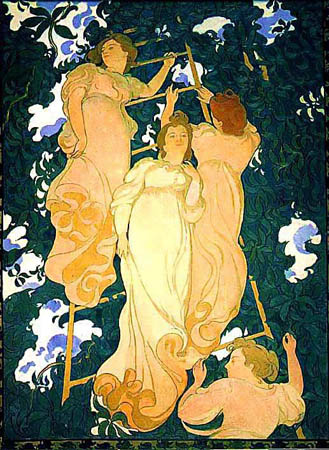
Yet it’s worth remembering another symbolist example. Maurice Denis & Paul Gaugin –two of les Nabis—were very close with Maeterlinck and his circle. Denis (who also created the cover for the first edition of La demoiselle elue) did the program for Pelléas’ premiere (the play in 1893 that is), including a fascinating image of a woman who is likely his beloved; they married later in 1893. Every woman he painted for a year or two had this same face, because she was his ideal.

Does it matter that they are all the same woman? like a dream? (click to see original article)

There are paintings where one sees a group of women, each with the same face, like a crowd of ideal women (if you like this idea), or perhaps like a group of mannequins (if you don’t).

I love it.

But excuse me if I digress, as I am sitting in a hotel room, and my mind is wandering.

A Toronto art professor coined a term for a show of Gaugin & his circle awhile ago. She called them “cloisonists”. It’s a valid description of a style where they create outlines which they colour in. You could compare their paintings to

  • cloisonné—as the professor did—the style of ceramic where blocks of a colour are separated by metal outlines
  • cartoons –a less glorified analogy—at least in the newspaper or print media, which are usually also outlines coloured in as blocks of a single colour
  • stained glass: which could be the most apt reference… I almost said “reverence”. But Gaugin at this time often painted religious allegories, so why shouldn’t his paintings resemble stained glass?

So let’s think for a minute about this composition process and what it resembles. In effect the space and figure ground relationships are all defined pretty much in the outline phase, with colour at the end. There might be scope for editing afterwards, but in effect it seems as though there’s a two- step process, where the colour is after the fact.

I may be over-simplifying, but I can’t help noticing the similarity to the two-step process of writing an opera, where at least some composers make a sketch or short-score, possibly with a piano accompaniment, before orchestrating later (or if you’re like some composers I could name, you even get someone else to do the orchestration, in which case, the piano version really IS the composer’s product). If you do an outline and colour it in later, pardon me if it reminds me of paint-by-numbers or a colouring book, that’s already finished in one sense even if it requires a last step to be fully polished.

So AtG need make no apology for a Pelléas with a piano. Whether or not it actually came to fruition that way, whether it was really staged in 1895 (i don’t think it was): that’s likely what Debussy had in mind.  It’s part of his process.  It’s very relevant to this ideal, this Pelléas

Posted in Art, Architecture & Design, Music and musicology, Opera, Personal ruminations & essays | Tagged , , | 4 Comments

Pilgrimage to Jussi Björling Museet

SAMSUNG CAMERA PICTURESOne of the first things I ask students in my opera course is whether they think more in terms of a favourite opera, or a favourite singer, as it’s a medium that can be understood in at least these two ways:

  • as a series of composers and periods and styles of opera, stories told in different ways
  • as a series of big name stars, beautiful voices, larger-than-life personalities, and yes: divas.
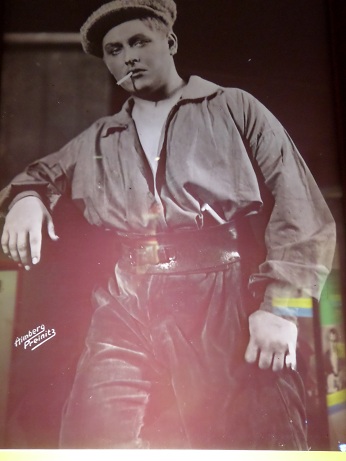
Bjorling 1934 debut in Stockholm was as Rodolfo, the role he played most often.

Bjorling 1934 debut in Stockholm was as Rodolfo, the role he played most often.

My first opera favourite as a child wasn’t an opera but a singer, a Swedish singer, namely Jussi Björling. Long before I had any inkling of music, musicology or musicianship, well before I began playing the piano (and later accompanying my older brother, who would soon be a professional) I was already listening.

I had no idea about the words or the stories or plotlines, although I’d soon be able to name the operas & composers, and even to recognize them. I sympathize with people who are tenor-centric, because that’s how I grew up, in a house with a few complete opera recordings plus a few LPs of arias & ensembles. Björling figured prominently, because he was a favourite in the house.

I hadn’t yet seen an opera. My first was sometime around my 11th birthday, a production of Il trovatore by the Canadian Opera Company starring someone whose name I remember as Francisco Lazaro, who had the unenviable job of somehow living up to what I’d heard: Jussi Björling singing “deserto sulla terra”, “ah si ben mio” and “di quella pira”, and I knew every note of those pieces his way.  It was impossible of course (for him? for me). I vaguely recall it as a disappointment (or perhaps “heartbreak” would be more accurate). I suppose he was okay, but like I said, it was a bit like asking a boy to do a man’s job. There I was, expecting something resembling what I’d heard on the recordings.  I was in a hall with terrible acoustics, but that was one more thing i’d have to learn about.

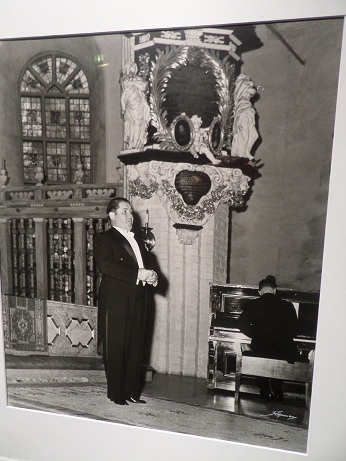
A recital in Stora Tuna Church, where his parents are buried. The caption in the Museet says "Jussi finished his programme by singing Stenhammar's "Sverige", ending with the words "...where under the graveslab our ancestors are sleeping".  This affected him so much that he only with difficulty could finish singing and then rushed into the sacristy with tears streaming down his face."

A recital in Stora Tuna Church, where his parents are buried. The caption in the Museet says “Jussi finished his programme by singing Stenhammar’s “Sverige”, ending with the words
“…where under the graveslab our ancestors are sleeping”. This affected him so much that he only
with difficulty could finish singing and then rushed into the sacristy with tears streaming down his face.”

Fast forward to the 21st century. I’ve been visiting family in Stockholm. The connection is deeper than expected. Yes I knew my brother was born here while the family lived in this city. In a curious way Björling was conflated in my head with my father, as both died in 1960, both dying far too young. I was only five years old when my father died so I hope I can be excused for making a connection that isn’t logical, just the retrospective association of a young boy.

As I sat discussing possibilities –which sights and places to go see on the trip—I wondered aloud if there might be anything commemorating Björling, and was delighted to discover that in fact there’s a museum. While there are societies to keep his memory alive (one in the USA as well as the one in Sweden), a museum can take it a step further, assembling memorabilia. Although I saw it would be a two hour train-ride north, I couldn’t resist.

I had to see for myself.

The trip was quite pleasant. The trains –like every part of Swedish infrastructure it seems—are delightful. The new cars not only have wifi but display the time & their speed. I saw 166 km at one point, which is much faster than anything we’d get in Canada. The tracks feel smooth, without any of the unfortunate rocking motions I feel in Canada even at slower speeds.

Upon arrival I was given directions to the museum when I asked; it’s a short walk in a charming little town.

Yesterday when I entered the Museet I was greeted by Björling’s voice singing one of his signature tunes.  I should have expected it, but even so, for a moment I was overwhelmed with emotion. There are several pieces that I associate directly with Björling. Most songs and arias are sung by every tenor in creation, good or bad. But there are a number of pieces that I swear nobody else sings. It’s not necessarily that the music is difficult, but these are tunes I have never heard anyone else sing. When I came in I heard him sing the song “skogen sover”, or “the forest sleeps”. Its Swedish lyricism suits the sweetness of his voice. And I heard him sing “Ah leve toi soleil” from Gounod’s Romeo et Juliette, something every tenor sings, although nobody with such ringing top notes.

I can still recall the excitement when a new LP came home. My brother did the leg work, I was just the one at home jumping up and down, and then listening to Jussi Björling in Concert. Some of it is with orchestra, some with piano. This is the recording where he does his only version of Lohengrin’s narrative, where he sings Lensky’s aria, where he sings a number of wonderful Swedish songs including “Till havs” with orchestra. There are also others with piano, from a different recital in August 1960, just a few weeks before his death in September, including an encore where we hear him announce “<Devotion>” by Richard Strauss”. Was this the very last recording before he died? The voice was phenomenal even then.

This version is from slightly before, in 1959.

And I grew up.

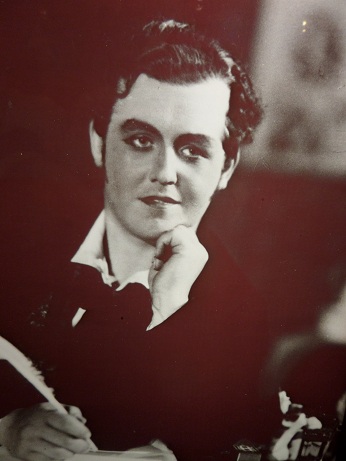
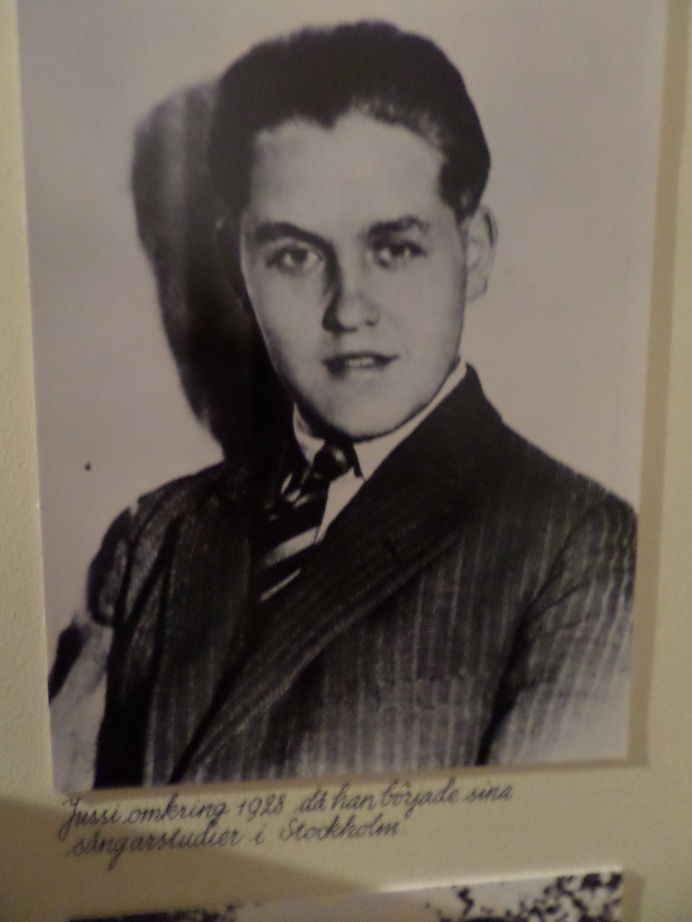
As a young man in 1928

As a young man in 1928

I’ve never heard anyone else sing “Till havs”, a song whose words I don’t know. But it’s a song about the sea as far as I know. You listen to it and tell me you can’t tell what it’s about. It may not be John Masefield, but so what. I posted a few of these on facebook when I knew where I was going earlier this week.

From Il Tabarro, 1934

From Il Tabarro, 1934

At times I was surprised by my own emotions as I walked around looking at pictures and hearing the voice. We see him as a child with his family, discover his family tree, see his teacher, but mostly we’re immersed in the career. We see a wealth of photos from productions on either side of the Atlantic, often with familiar faces from the middle decades of the century (note: except for the last photo, all photos on this page were taken by me, sometimes through glass–photos of photos– which explains why they sometimes look odd.  Please feel free to use as you wish). There’s also a library and a video room. I was surprised to see video of his state funeral, overcome with emotion for a moment when I realized I’d been too young to see my own father’s funeral, so I watched that segment twice. There’s a small map if one wants to walk or drive to his grave-site but I chose not to. There’s art –several paintings and sculptures of a famous face who was a huge star in his time and is clearly not forgotten—as well as a plethora of cartoons & caricatures.

And there’s an organization there, a friendly and welcoming group of people. I got a glimpse of how many recordings he’s made, how many more there are to hear.

I encourage you to investigate if this intrigues or inspires you to want to know more. There’s a society in the USA, another in Sweden, and the museum itself.

I am very glad I chose to visit.

Posted in Opera | 6 Comments

Richard Wagner: A Life in Music

click for more information including click to buy

I just finished Martin Geck’s Richard Wagner: A Life in Music in Stewart Spencer’s 2013 translation. Published only in 2012 as Richard Wagner: Biografie you can judge for yourself how good this book must be, that its translation was pushed along so quickly. I was fortunate to pick it up from among the new releases on display at the Edward Johnson Library.

If someone were to tell me about this book I’d be a little hesitant, wondering how one can organize this enormous mass of material into something intelligible. But that’s perhaps the greatest achievement of this book, or the reason it’s so deliciously readable, so easy to digest. Each chapter takes a period of Wagner’s life, beginning with his youth, but placing the focus on the composer’s creations from that period. For his first period, that includes his play Leubald, written in his teens and placed in context with what’s to come. While we may get glimpses of the works on the drawing board, it’s all nicely balanced around the work in question: as music, as philosophy, as politics, as Wagner’s life reflected in music.
Geck positions himself in the conversation, sometimes offering his own possible interpretations of an opera. You read about Wagner in the most elegant reconciliation of the many elements of the composer that you can imagine, touching upon his revolutionary activities, his loves & his sexuality, his religion & philosophy. But it is his operas that are the real focus, especially in the musicological treatment, placing them in context with what came before (particularly Bach & Beethoven; I am especially thankful for Geck’s illumination of Meistersinger and the ways it is both new & old), and after (thinking of Mahler, Debussy & Schoenberg). We examine Wagner not just in his time nor in ours, but across the decades of responses, including correspondence & conversations with Cosima, Liszt and Nietzsche, as well as responses in subsequent decades from admirers and critics, composers and interpreters.

And the National Socialist fixation on Wagner is discussed without degenerating into a question of blame, but rather looking at the ways in which Wagner became part of the consciousness and identity of Germans. I wrote not long ago about the failure of a major history (Abbate & Parker) apparently unwilling or afraid to reconcile itself to production & interpretation: a crucial part of the story. Geck is very different. Included in his account of each work are recent –and sometimes the most notorious— productions. For example, Geck’s caption to a photo from Neuenfels 2010 Lohengrin includes this:

The Brabantine chorus is cast as laboratory rats: creatures that can be manipulated. As such they are willing to torment Elsa whenever their superiors require them to do so.

The photograph comes after a lengthy discussion including the following:

   For me, Lohengrin is incapable of concealing its affinities with nationalism and National Socialism, for its ideological aspects not only affect its “political” dimension in the person of King Henry but are inextricably bound up with the action that is centred around Lohengrin. It is Lohengrin, after all, who installs the young Duke Gottfried as “Führer.” It was Lohengrin, too, who provided Kaiser Wilhelm II with his motto “I know no more parties” and who was able to serve as a model for the National Socialists’ attitude of “You are nothing, your people is everything.” However much we may care to stress that it is in Lohengrin’s “nature” to fail in his relationship with Elsa, and that this has nothing to do with “politics,” it remains the case that politically speaking he appears as a God-sent savior who—in the name of the “Providence” that Hitler never tired of invoking—unmasks and destroys the “false” leader of the people in order to install the “right” one.

   This interpretation is not intended as an indictment of Wagner. After all, his political ideas had a different significance in the years before 1848 than they did after 1871 or at the time of National Socialism. Nor was it possible to have predicted the disastrous turn that they would take. If it had been possible to do so, then we should also have to condemn the hundreds of thousands and even millions of Germans who, attending performances of Lohengrin in the spirit of Diederich Hessling, made Wagner’s ideological construct their own and treated it as a mainstream idea.

Between each chapter Geck offers something remarkably like Wagner’s own structuring, and very apt if we think of the book as a work of opera and its construction as a matter of dramaturgy. Geck gives us a kind of digression that reminds me of nothing so much as an orchestral interlude, an escape into a different medium, something reflective. After the youthful chapter we get “A Word about Felix Mendelssohn”, which is indeed a reflection from another angle, a charming little excursion away from Wagner that serves to illuminate the subject of the book all the same. Later “words” include Meyerbeer, Heine, Adorno, Eisenstein and Mahler. They’re like short courses that cleanse the palate and I must say very delicious. Each new chapter begins freshly with a picture (photo or portrait) that is pertinent to that period, and again offering a slightly different entry to the next section.

And now? I shall re-read the book as it’s not due back for awhile, its bibliography a roadmap for further study.

And I must find other books by Martin Geck.

Posted in Books & Literature, Music and musicology, Opera, Reviews | Tagged , , , , , , , , , , | Leave a comment

Nils Dardel and the Modern Age

One of the journeys of my life has been to reconcile myself to fame.  Not everyone gets famous, and often it’s the wrong people.  For this Canadian it is very clear at least how it doesn’t work.

  • It is not fair.
  • Itis not logical.
  • Sometimes brilliance is rewarded, sometimes it is not.
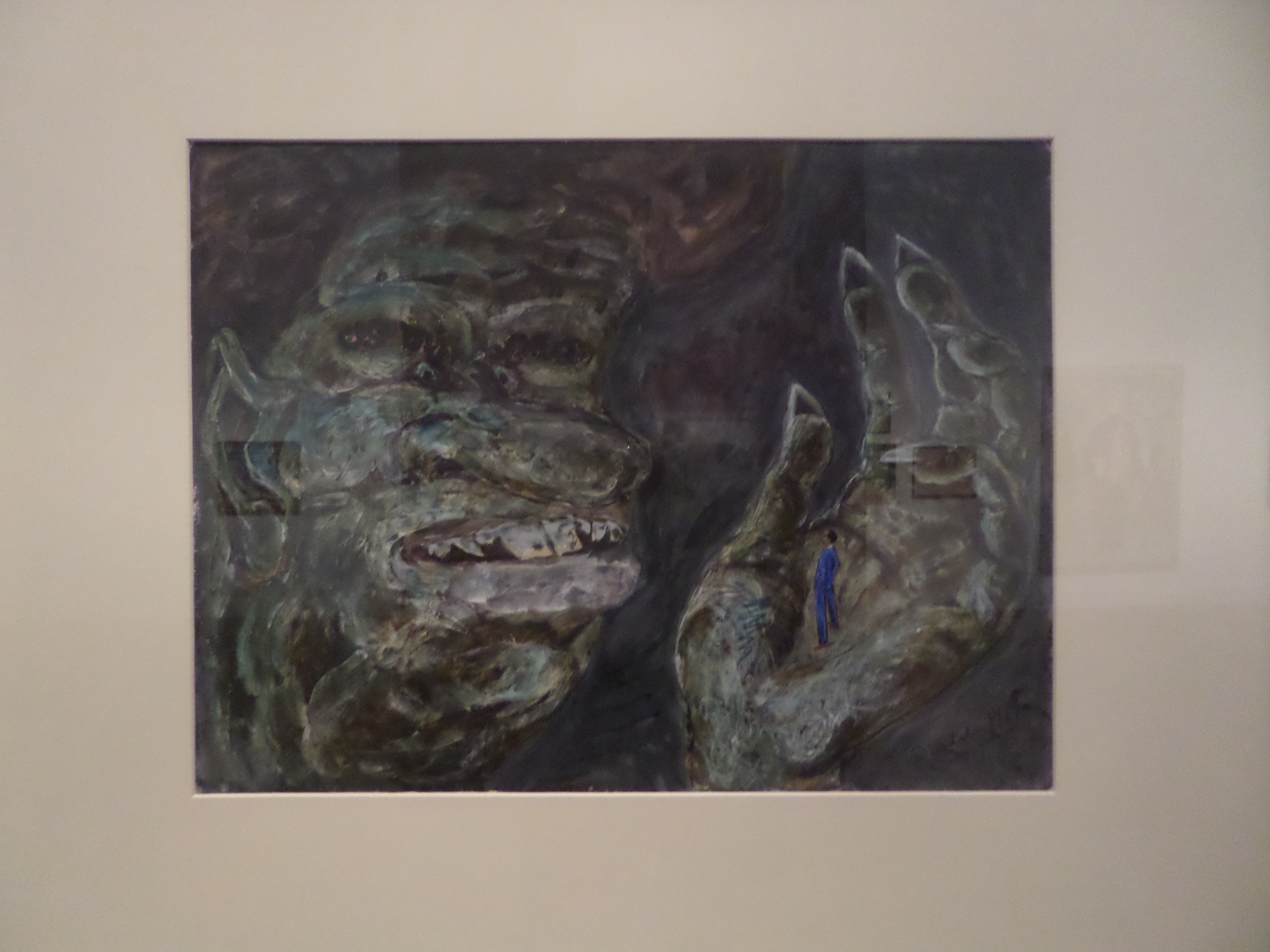
Gulliver by Nils Dardel.  Notice that the little man is a dandy

Gulliver by Nils Dardel. Notice that the little man is a dandy (photograph by Leslie Barcza)

I live close enough to one of the centres of the world (thinking of New York City) that I’ve seen how one’s perspective is distorted by being in one of those places.  NY is a place where talents compete for attention, and where it may seem that those in the limelight are automatically the best. We assume that a star in NY would be a star here or anywhere else because “if you can make it there you can make it anywhere”.

Except that it ain’t necessarily so. Each little cul-de-sac can have a local hero who is unknown on the world stage.

The internet may be eroding regional flavour, but it is still largely true. There have been barriers preventing some from achieving worldwide recognition. Language may be the biggest. Canadians and Australians regularly go to Hollywood and make a huge splash precisely because no one there realizes that theyíre dealing with foreigners. But what if you’re Hungarian? Or Swedish? Then the dynamics and the scope of fame will likely be different. You’re taken up elsewhere only when you have a champion, or when –like Franz Liszt–you make a splash in another city as Liszt did in the Paris of the early 19th Century: the NY or Hollywood of its day.

Nils Dardel is the reason for this digression on fame, the most impressive painter I’ve seen in awhile. His remarkable works are currently on display at The Moderna Museet in Stockholm.

Dardel lived from 1888 to 1943, dying in NY.  I believe it is safe to call him a dandy, considering that he painted at least one picture where he self-identified as such. I suppose I have a weakness for dandies, or a weak stomach in the presence of those who valorize the macho ideal, as we see in futurism. What kind of art do you get with Dardel? In his early art he is influenced by the post-impressionists such as Matisse or Gaugin, add a smattering of cubism, then veers bravely into surrealism.

This is a dandy’s surrealism, the wild imagery of someone well-dressed whose sensibility is informed by good food, good clothes, good manners and all things aesthetic. We could be in a theatre or at least in a place where people play-act.

If Dardel were an American? he’d be famous. His painting is very good, highly individualized & quirky. Because he’s not from a country that is mainstream to the art-world, I suppose he is relatively unknown. Dardel’s art is on display in Stockholm’s Moderna Museet until Sept 14 2014.

Knowing that I’d be unlikely to ever see it again I bought the show catalogue.  It’s very reasonably priced, wonderful reproductions and also fascinating text.

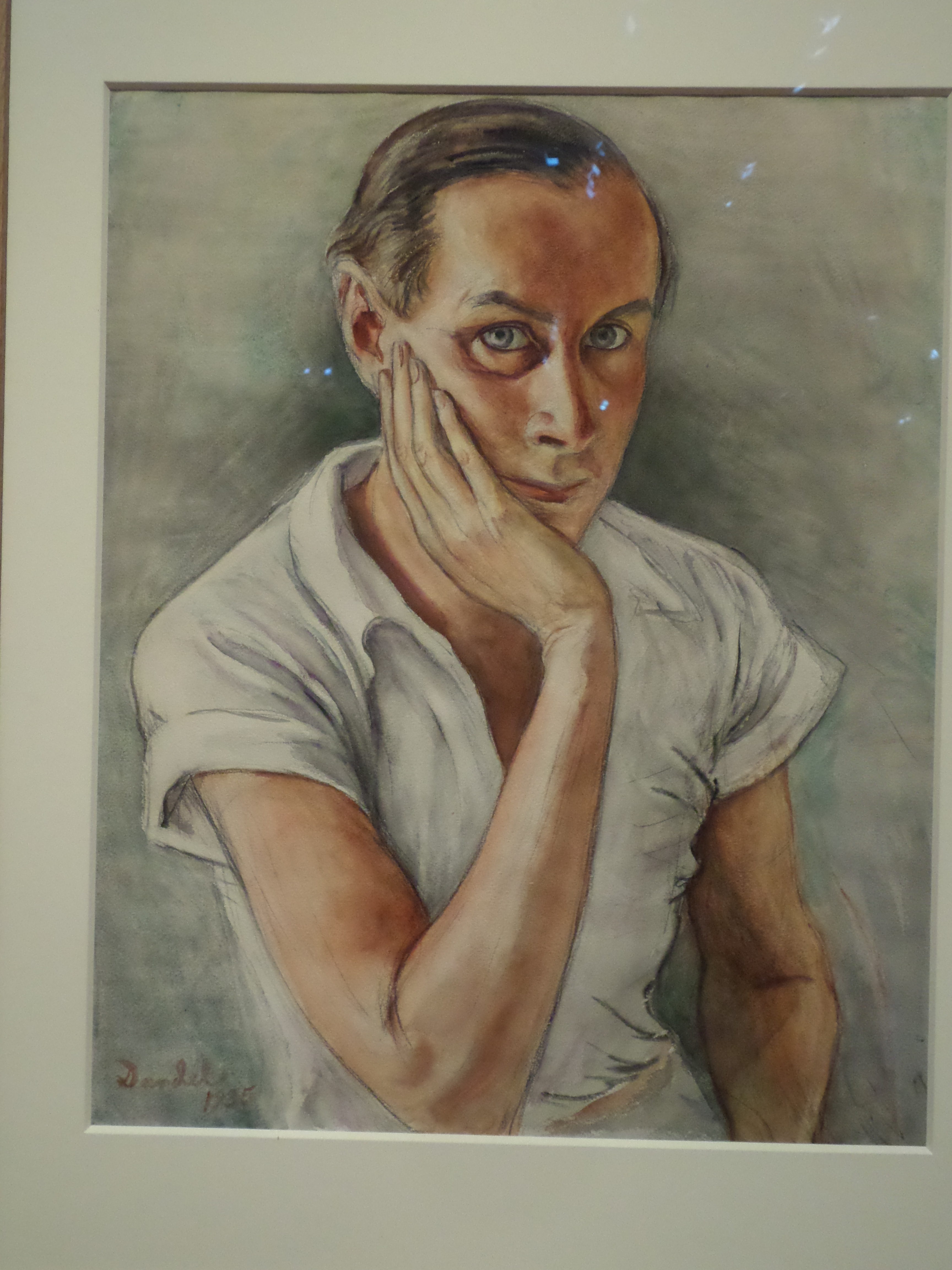
Self-portrait, Nils Dardel (photograph by Leslie Barcza)

Self-portrait, Nils Dardel (photograph by Leslie Barcza)


Posted in Art, Architecture & Design, Books & Literature | Tagged , , , , , | Leave a comment

Grey Gardens

In the 1970s two film makers made a remarkable documentary. I’d never heard of it until yesterday, but had it presented to me in all its garish intimacy. Albert and David Maysles’ Grey Gardens (1975) is a film taking its name from the estate of the same name, owned by a branch of the Bouvier family.

Yes that family, the same one that gave the world Jacqueline Kennedy Onassis and Lee Radziwill. Knowing that, it shouldn’t be surprising that the mother and daughter, Edith  Bouvier Beale –both mother and daughter are named Edith–should both be remarkably handsome women.

If you’ve seen this film you’ve seen one of the precursors to reality television. It’s a documentary like nothing I’d seen before.  Yet of course I’ve seen all too much recently: on television. The camera is unforgiving, invasively close and hungry for every absurd revelation. Celebrity is captured here in the same insane colours we’ve seen in Sunset Boulevard: except this is genuine, not fiction. And it’s even more twisted by decay & spoilage. Here’s a sample, see for yourself.

The reason I was finally exposed to the documentary was in an encounter with the other Grey Gardens, a 2009 HBO meta-drama starring Drew Barrymore and Jessica Lange. The first hour is brilliant, a clever exploration of subtexts for the wreckage we encounter in the doc. Had the film-makers had a bit more nerve they could have made something as profound as their source.  Perhaps they were held back by requirements such as delicacy or even stipulations from the owners of this bizarre story: what they could or could not say. It seems odd, considering how zany this is, that there would be any stipulations, but when we come to the last 30 minutes it’s all suddenly very careful where previously it had been devil-may-care.  Maybe the deal with HBO insisted on certain proprieties, and thereby kiboshed the result.

In a curious mirror to their source, they are undone, it appears by vanity, ego, and old-fashioned ham. It’s much too long. We were sitting there laughing through a last half-hour when we kept wishing it would be over. Drew Barrymore is an actor who carries on her family’s tradition of bravura virtuosity, but likely was the reason the project came undone in its final half-hour. The scene where the young Edith confronts a visiting Jacqueline Onassis is painful to watch for all the wrong reasons. A director with more backbone would have found another way to deliver the lines “I could have been the First Lady” than screamed into her face from three inches away.  Michael Sucsy is the director and co-writer with Toronto’s Patricia Rozema (I have to assume that everything good in the film comes for her). It doesn’t help that Barrymore shares the screen with Jessica Lange, who is her usual study in subtle integrity. On the few occasions when Lange’s delivery diverges from what we’ve seen in the original doc –and yes it’s possible to compare because several moments in the original are replicated in the new film—she makes choices of profound subtlety and stillness.

It’s a very subtle and deep problem because the younger Edith is herself a histrionic ham, someone that Drew must have felt called to play.  In the first hour especially it’s magic.  But I wonder if Barrymore considers whether a histrionic ham can be herself underplayed. That moment with Jacqueline Bouvier Kennedy Onassis (did i miss any additional surnames?) likely could have worked quietly, given the immense pain pulsing under the surface.  Or maybe the purpose was to make Jeanne Tripplehorn look good in her dignified portrayal of the former First Lady.

I recommend this film both for the brilliance of the first hour, and for the laughable last one. And speaking of ache, while the story is a painful study in what might have been –thinking of the stifled talents of the younger Edith—the same applies to Drew Barrymore, a bright shining light that continues to be misused. She needs a director willing to stand up to her.  I’ve seen the same thing with other loud talents –Al Pacino comes screaming to mind– who are loved the way family members are loved: in spite of the horrible things they do.

I keep dreaming that they’ll find the right vehicle.

Posted in Cinema, video & DVDs, Reviews | Tagged , , , , , , , | 2 Comments

A risky business

The risky business?

Posting here after going out to a karaoke bar with my daughter, here in Stockholm.

I couldn’t help noticing how unconditional the crowd were. They would have been fine if i were tone-deaf.  So i could sing in tune…? doesn’t matter.

I sang “Space Oddity”, which shouldn’t surprise you after what i wrote recently.  They didn’t have anything by Wagner on the list, so what choice did i have…? But seriously, “Space Oddity” seemed very apt.  I’ve never sung it before, had no idea if the first lines –when Bowie (and Wiig) sing it in a lower octave, before going up into space that is–might be too low for me.  I growled that part, not unlike Mr Bowie come to think of it.  When we got to go up, i was more in my element, albeit inebriated.

Earlier, we’d been to see the X-Men movie Days of Future Past, a film that reminds me a lot of a Moody Blues album from my youth.  Yes the film is supposed to take us back, so it works on several levels.  That title probably was used somewhere else.  If you were as unconditional and nice as the lovely folk in that Swedish karaoke bar, you wouldn’t judge me for not knowing this.

This is not like other Marvel films, being laden with talent.  They wrote a great script, and perhaps knew that it was going to be knocked out of the park so long as they didn’t take short-cuts (haha like my cheap city: go big or go home whether we mean infrastructure or a quality film): in addition to the usual talent (hello, we’re talking Hugh Jackman, Halle Berry, Ian McKellen & Patrick Stewart for starters), add in Jennifer Lawrence, Michael Fassbender & Ellen Page.  It’s by far the best such film i’ve ever seen.

No really.

I’ve been thinking about comic book films, horror & suspense, fascinated by how seriously they’re sometimes taken by directors & the money devoted to them by Hollywood. Sure, it’s commercial, but that doesn’t mean it can’t also be art.

A film like this one reaches people in a very special way, a society traumatized by income disparities, unemployment, climate change & the irrationalities of international politics. It’s a terrifying time in so many ways.

No wonder we need movies that grab you and scare the pants off you, to distract you from the other things that are scaring the pants off you.  I came out of this one –after i got over the terror– smiling.  I hope that doesn’t spoil the film for you.  It’s hard to see how it going to get where it needs to get.  And yes i cried as though i were sitting through Parsifal.  

Welcome to the waterworks.  Don’t say i didn’t warn you.  It’s a stunning powerful film, particularly if you like superhero movies.  And if you don’t it could still surprise you.

No wonder i had no fear about stepping up to the microphone.  I’d already faced terror in the movie theatre.

Posted in Cinema, video & DVDs, Reviews | Leave a comment

A conversation

One of the glories of travel is the encounter with the other. It’s fun to get to another country and talk to countrymen who just happen to be abroad. But that reminds me of the Accidental Tourist. Remember the film? William Hurt as a travel writer whose books prepare people to go abroad in ways that never make you feel like you’re in a foreign country. Speaking as someone who never really traveled much, I always loved the sensation of being lost, not knowing where I am in this world of GPSs and perpetual surveillance. Today, wandering in downtown Stockholm I always knew pretty much where I was, even if there were lots of surprises waiting for me around corners.

I am trying to listen rather than talk, because I can fool people easily into believing I am someone who knows something. Words come tumbling out, even as I wittily cover my blind spots. Here I am on the blog again, but this is something I wrote when I awoke at an oddly early hour due to the near perpetual sunlight here. Yes it’s amazing to be in Sweden in June, when the nights are so short you could practically blink & miss them. Last night was roughly from 11:30 to 2 am or so, then the light came back.

Upon arrival, though I did talk, before my resolution to listen rather than talk. I talked to the cab driver who picked me up at Stockholm airport. It’s always the way. Cabbies are opportunists who have usually come from another culture, assimilate what they must to survive, while figuring out the pros and cons of where they live now, vs where they were.

Last year (NYC) it was an ex-pat Egyptian speaking to me of his home, decrying the conflicts there, happy in his capitalist paradise. I can’t recall whether he was pro- or anti- Mubarek.

This time it was an ex-pat Iranian, speaker of several languages. I spoke of Canada, and he immediately spoke of the similarities between our countries. I cringed, perhaps too negative.

Life expectancy? High in both places.

Sweden is one of the places I hold out as a vision of utopia. Yet I am watching Canada turn into another USA, imitating all the wrong models, turning its back on everything it had right before. We should imitate the Swedes.

Sweden has usually been neutral. The Canada I knew under Mike Pearson was blessedly neutral, a peace-keeper rather than an enforcer. I am not sure where we are now, thank goodness. Mr Harper seems to recognize that we don’t have the money to build the armaments to be another USA. Minus the billions of dollars worth of armaments you can’t be a bully, just a target. Yet I suppose he’s right that we do need to properly patrol our northern waters, especially with climate change turning the northwest passage into something ice-free and welcoming to ships. Will we ever have the boats to back up our brave boasts? (boy oh boy that’s a lot of B words).

Sweden seems to be the ultimate socialist paradise, the place where high taxes make sense. In Stockholm you don’t have people arguing about taxes. It’s understood that taxes are needed to build tunnels & roads & infrastructure. This is a gloriously beautiful city.
Toronto’s election campaign is ass-backwards. We don’t have a good transit system, yet our mayoral candidates are all fighting to position themselves as champions of both a transit solution –usually simplistic, as in Ford’s subway plan–AND low taxes. Tory’s seems to be more thoughtful as far as its funding goes, but still is captive of the conversation that leaves me afraid that we’re not going to do what needs doing, that saving trumps investing.

But the entire conversation is misguided. Don’t you say to the electorate “I offer you leadership to rebuild this” not “I promise not to raise taxes”.

You get what you pay for. No wonder under Mike Harris that the place was such a mess. Are people amnesiac that they forget, and want to go there again? I suppose it’s a question of which skeleton in whose closet is scarier: McGuinty?

or Mike Harris?

Or Bob Rae?

In the centre of Stockholm there are several huge bridges plus tunnels to cope with the geography, the water & hills. Infrastructure can’t be ignored if you want to live in such a place. We have been able to get away with ignoring our infrastructure issues. They don’t have broken water-mains here, because they take care of their city. Watching Kathleen Wynne argue with Tim Hudak, I was appalled that the press report that pollsters claim he won the debate. She kept speaking of the need to build infrastructure: which costs money naturally. Infrastructure is essential –especially power lines—for the cheap power Hudak wants to offer to businesses choosing to relocate here. I am not even talking about the question of their divergent views on jobs, which is what everyone seems to notice.

Remember strawberries?

Remember strawberries? (photo by Leslie Barcza before he started– munch munch –eating)

At my temporary home with family here in Sweden, I went shopping. I couldn’t help noticing. These are the strawberries I recall from my childhood. They’re real, not the bizarre fakery we now see in stores.  They taste amazing. Swedish milk and butter are astonishingly good. It may be true that the cost of living here is high in some ways –for instance the taxes—and yet the Swedes really have a clear understanding of what matters. Their produce & foods & water are clean & healthy. Their roads & trains work beautifully. Their air is clean (although that may have more to do with Toronto’s proximity to the industrial Midwest than anything we do north of the border).

It’s gorgeous (I add, the next day from downtown, where I am wifi-ing this into the blog).

In the meantime I’ll enjoy myself.

Posted in Art, Architecture & Design, Food, Health and Nutrition, Personal ruminations & essays, Politics | 1 Comment

Dueling ear-worms: surrender and adventure

It ís Friday, a national holiday I am told. Does it matter why? People need to celebrate, and yes, people sometimes need to rest.

I didn’t realize how tired I was.

I boarded the plane Wednesday night in Toronto. When I saw that the fellow beside me on our 757 was watching The Secret Life of Walter Mitty shortly into the flight I asked him (in spite of his earbuds and his naive hope for privacy, poor fellow) whether he’d seen the film before. No he told me, and I promptly spoiled some of the film for him by telling him that it seemed so profound to observe, while we were flying to Reykjavik. He sort of nodded to me politely, hoping I would shut up and not make any more quixotic invasions of his space.

As the plane had gone up I’d been thinking spiritual thoughts. On take-off while I always seek a window seat, loving the views especially on landing, I was in prayerful mode. It ís not that I was really fearful, so much as I was thinking of family, connections to those I am visiting on this trip and those from before. I sometimes find Wagnerian associations comforting, in my own internal Gesamtkunstwerk of self-celebration.  Yes when I think about it RW is more than anything the ego supreme, whether or not you know your Wagner. How do I love Mein Self? Let me count the ways.

1-Wagner? me uber alles, my loud music that drowns out all resistance. If you’re thinking but I prefer heavy metal / rap / Bollywood : if you play it loudly and proudly, you’re well on your way to being Wagnerían. If you deliberately choose it loudly to drown out your neighbours or possibly in the hope that they will be unified with you in an orgiastic celebration of a cosmic music festival?  that too is a Wagner thing. Nevermind whether anyone objects, it’s a naive sort of egomania, right?

2-Before Wagner, theatre was a free-for-all. He tells great stories in his writings of such things as a fight between performers preventing one of his works from being staged, of performers whose hammy desire to show off detracted from the beauty of the whole. Those two stories (and he has other such examples) could be subtext for his mission to unify the components. That aforementioned word “Gesamtkunstwerk” is usually translated as “total art-work”, meaning that the parts work together. We take for granted nowadays that a film or play or opera should be a unified effect, where the director’s interpretation is supported by the designers of costumes & set, where the actors and words & music all work together in harmony. But while others may have aimed somewhat in that direction, Wagner was the first to really put the ideal into words. Imagine, now, that you are a composer, also the one who writes the words, also a conductor, also a director and a dramaturg/theorist writing pamphlets about how to stage this great work. Me, me me, everywhere me..! Yes that’s Wagner.

3-And when it didn’t work out his way when debts and debtors chased him out of the country on one occasion, when his participation in a failed revolution had him on the wanted listt: he ran away. No he didn’t take his football and say nobody could play with it. But he was very much of the opinion that if he couldn’t be king of the castle, then he didn’t want to be fart the messenger to someone else.  And no wonder so many of his opera plots involve conclusions with death as a solution rather than a tragic outcome.

The last week before departure I sat down at the piano a few times to play and sing through the last parts of Parsifal, his final opera. I like the music, enjoy the way the opera ends, and cannot deny that I get a huge rush.  And I am in good company. In the 19th century, before there were DVDs or Victrolas, your only option was to get someone to play and/or sing it for you. Debussy used to play passages of Wagner operas at parties, and on occasion would go through the entire work, playing and singing (after a fashion). How well did he sing? Great question. I can’t help wondering what he would have sounded like. Before you let yourself be captured by any humorous thoughts, thinking that this would somehow be ridiculous, ask yourself what alternative people might have had. Nobody had a clue what Wagner sounded like, at least not in places beyond what we now understand as Germany (NB the country didn’t exist yet).  They hadn’t yet heard the pieces with full orchestra. And there were no recordings. To have someone sit down with a piano-vocal score and conjure up the magic of a Wagner opera? It ís admittedly an ego-fest, a trip for the performer, in their identification with the grandiose moments portrayed in the work, captured in musical climaxes that release tension and leave your body reverberating afterwards.

Even as I write this, I am hearing the passage to which I alluded a moment ago. It ís magical when music can spontaneously come into your head. If you’re Barry Manilow and you’ve written a good song or jingle (and I am not sure that there is a huge difference, as I alluded in a piece I wrote awhile ago), you are triumphant if you’ve managed to implant your song in the heads of others, like the RNA that gives your genes a kind of immortality beyond the body in the flesh of others. Fortunately I can speak of Manilow without fear, because in my recent experience serious music wins, especially if i’ve seen the score. Wagner, for example, is so solidly in my head, both my ear and visually through the score, that I can’t hear the unfortunate jingle I alluded to, but instead hear that concluding music from the opera.  And I am not alone. TS Eliot alluded to it in “The Waste Land”.  Is it five minutes long? I am guessing, as I am not sure I can describe it objectively.

Maybe I should try..?

  • Amfortas, the grail knight whose wounds won’t heal, sings one last time in defiance of the other knights. He had promised to unveil the grail, the chalice that magically restores the other knights; but that same effect reopens Amfortas’s wound, by bringing him back to life.
  • Parsifal appears holding the spear that inflicted the wound, announcing that only one thing can heal the magic wound, namely the spear that caused the wound. He announces that Amfortas is healed: and Amfortas is healed.
  • Parsifal reveals the grail, blessing everyone present.

Is that it? I am sure I am leaving parts out. It ís a unique opera because it purports to be a sacred festival drama, something like one of the mystery plays (and it sounds more like something Biblical than rational): except it is simultaneously a dissident work for some of what it says. Jesus is tormented on the cross even now because the church is corrupt. We redeem him if we transcend our sinful selves…Or something like that.

The end of the work coming from a man long immersed in a life of ongoing infidelity with multiple partners & betrayals is more Buddhist than Christian, in its vision of a peaceful redemption by overcoming the desires of the body. That spear? It is of course an image of the phallus, Amfortas’s never-healing wound is his libido, desire.

Now one doesn’t get too deeply into this kind of deconstruction when one is listening. It ís merely nice music that makes a wee bit of sense. When I sing Amfortas’s last line to start the sequence, followed by Parsifal’s final lines, while playing the piano-reduction of the orchestra, it ís a very magic experience, one that conjures images in my head. I hear the chorus, even including the children when we finally modulate into the D-flat where they float their highest notes (heard inside my head) while playing. It ís a feat far beyond selling hamburgers or feelings.

Ah what a long digression.

I was explaining the context for hearing that music from Parsifal in my head as the plane took off, and for much of the flight. Yet one popular tune did displace Wagner for awhile.
I glanced over from time to time at my neighbour’s screen. I didn’t hear any sounds, but still enjoyed watching the video minus audio for Walter Mitty. I’d seen it three full times on pay per view in the 48 hours of rental time, plus at least two additional viewings of my favourite scene, the one where the hero runs for the helicopter. I wish I could show it to you. Even as I type this, the tune is now in my head. And I should add, it ís not David Bowie’s “Space Oddity” that I am hearing, but the cover version from Kristin Wiig.

As I sit beside Mr Earbuds I am glancing over regularly. When we get to the part where Sean Penn seems to beckon to Walter, his fingers twitching almost imperceptibly in a photo, as if to say come find me, I start to watch the film, soundless but fabulous nonetheless. Until this moment my soundtrack had been the Wagner.

But now I am watching, and waiting. When we see Wiig’s character show up in the Greenland bar, a non sequitur that ís unmistakeably subjective and very Wagnerian I hear her strum those chords and sing her lines.  This is not a moment to deny libido but a moment of youthful vigor. Ben Stiller’s Mitty is so different from Danny Kayes version, boldly running after that helicopter, coming to vibrant life, as if she were strumming him and not a guitar.

It ís one of the most fabulous things I’ve ever seen in a film.

And as we fly along in our 757, watching this middle-aged guy who had seemed so scared & vicarious, I can’t help thinking that my trip really began when I saw Walter Mitty throw caution to the wind & fly to Greenland & Iceland. It seems I am on the same trip.
Nice as Bowie’s tune is, lovely as the images Stiller creates in the film, Wagner’s tunes re-surface. I don’t know that these two can’t coexist. I’ve paired them in the headline, suggesting that they’re opposites, although in a real sense Mitty’s tune is also about a kind of surrender, when Bowie’s Major Tom drifts away from ground control, letting himself be lost in his rapture of the deeps. I suppose both are adventure heroes.  Parsifal & Major Tom are Buddhist in their surrender.

I spent much of Thursday just noticing:

  • Noticing how tired I was
  • Noticing where I was
  • Noticing who I was

How drained I’d been by my trip(!).  And yet it was simply more of the same, like the trajectory of the various vectors implicit in my choices.  I had the luxury of time & space to work with, noticing that the images playing on the virtual screen that is my consciousness were a bit washed out, that the speakers or my hearing were hissing with background noise.  I didn’t eat nearly as much as usual, because I was paying attention to my appetite.  I wasn’t really hungry, yet it was just fine that I ate so little.

Thank you national holiday, I breathe and rest. It ís wonderful to be alive.

Posted in Cinema, video & DVDs, Music and musicology, Opera, Personal ruminations & essays, Spirituality & Religion | 1 Comment