Yapping dog

I m far away. Far from home. Far from work.  I’m on vacation, musing about where this compulsive blogging fits in.

Everything in a blog is necessarily about the person writing. Sure, the topic may be foreign cars or foreign affairs or just plain affairs.

But when we write about what we drive (cars), when we write about international relations (foreign affairs), when we write about relationships (affairs), we’re in there.

We’re talking about a car, and it’s about the styling –how it makes me look—the handling –how it makes me feel—or the failure to make me look and feel good.

We’re talking about foreign affairs, and it’s still domestic. I may be talking about the way this country treats its workers or that country treats its women, I am really commenting on how I feel in my own country.

As for relationships? Perhaps that’s the most honest because you can hear the baying hound most clearly.

Reviewers seem to stand beside their reviews as much as painters stand beside their paintings. The writer ostends not just a position & a viewpoint, but a persona and a presence. I alluded to this in one of my diatribes awhile ago, that writing is as much about the one speaking as what’s being said. I am never sure which is in the ascendency –writer or writings—but you can’t have the one without the other. To pretend otherwise is, well, a pretense.

catsHave I ever mentioned how much I love dogs? You’ll sometimes hear people say “are you a cat person or a dog person”, but it’s not either-or. The last pets I had in my home were cats because they were much easier to handle, namely a couple of feral cats who more or less presented themselves, because their feral mom had kitties right on the doorstep, and then tragically vanished before we could bring her inside too. The rest of the litter were given a good home, but two were welcomed. I wrote early in the life of this blog about the adventurous departure of one of the two, who likely took off through an open door when her quiet home was suddenly invaded by loud people visiting. And the second died not by choice but by the inevitability of veterinary termination. Dogs are more work, a huge commitment comparable to a child, and speaking of which, I suppose I wish I had one of those too; but then again, I wish I were young again. I loved running with my dog, I loved the way he challenged me to be faster. I loved hugging him beside me on the last day we had together, when I knew something was up, the day before we went to the vet, and he had to be put down.

I’ll have a dog again, but I am not ready yet.

When someone asks you whether you’re a dog person or a cat person, they’re really asking about you, in the same way that someone may say “what’s your sign”. Sure, it’s a conversational gambit, but it can also be a flat-out attempt to figure out who you are. It’s a relatively polite question because it tells you so little, really. The funniest such question –one I sometimes hear, that never ceases to amaze me—is “do you like music?” I am amazed by the question, I suppose, even if every answer is totally unique. People will inevitably say yes. Does anyone not like music? I have never heard a divergent answer, not once.

Ah, but what do people follow that with. Eminem or Modeste Mussourgsky? The funny thing is, this pointless question is not the end. It is very good precisely because it begins a conversation, a gentle and open-ended exchange of information. If you’re seeking a common ground, then you look for the ones you have in common. Oh you like Patsy Cline. Oh you admire Bill Evans. Joni Mitchell moves you, but you can’t listen to more than five songs at a time, anymore than you can stand to have more than five chocolates at a time. But they’d be exquisite chocolates, right?

I am recalling a song I encountered in the late 1970s, Mitchell’s Coyote. It tells a story.   There are at least a couple of versions of the song because, in addition to the studio version on Hejira. it was performed live as part of the concert captured in Scorsese’s The Last Waltz. I recall the song wistfully, because, just as the song describes a brief intense relationship between two people, the song in some ways is my keepsake from a relationship I had at the time. I don’t know where she’s gone or what she’s up to –or if she’s still alive—but hearing the song reminds me of her almost every time.  And of me, and the gulf that one finds between people.  We’re all different aren’t we?

The song is one I am thinking of now because of that one line near the end, about ego. I am sure if you don’t know the song you can find it for yourself.

Mitchell manages to bring into focus how an encounter between two people can be an encounter with self, a mirror to who we really are. I find this is true for any art, ultimately, but that the most lucid will elicit a conversation, not just about the things observed or felt, but also about the observer, who provides the context.

There’s a great moment near the end of the song when we’re played with. There’s a cadence coming –and this is obvious even if it weren’t the last of several verses, where we should by rights know the pattern by now—but it gets delayed. She uses that tension, of the expected resolution—to play with us a bit, refusing to resolve, as she speaks to the tensions of the situation.  Again, if you want to investigate, go look. Otherwise, don’t worry, it’s not mandatory. There’s no exam.

I think Mozart did something similar. “Non so piu” is an aria i’ve always connected to, since the first time i accompanied a singer (and i wonder too where she is now), not just because it speaks to both male and female, young and old.  I can see eternity in those moments near the end of the aria, when Cherubino says

E se non ho chi m'oda,      And if there's no one to hear me,
Parlo d'amor con me!        I speak of love to myself!

But lets get back to canines. I think I am a dog person because ultimately, when I look at dogs vs cats, I admire dog behaviour more. When you speak to a cat, they ignore you, running away or just staring at you as if you’re nuts. Talk to a dog and you get a response, anything from their attention to hysterical slobbering devotion. An animal mirrors you the same way a work of art mirrors. No, we must never forget that the mirror is a living creature upon whom we project our feelings, and that the narcissistic impulse never gives us the right to treat our mirror as an object. A cat is an ideal pet when you don’t have time for the serious messy relationship a dog offers. A dog is for life –which means as long as they live—and so must not be entertained without the intention of following through.   Cats are wonderfully independent, perhaps never letting you too close, whereas dogs get closer.

I wonder how much Mitchell meant to talk about herself in “Coyote”. Sure, all artists talk about themselves implicitly in their art. But this one is really about self and ego. I am thinking about this today, as I think back on the song and about the wrestling with ego thing. It’s on my mind as I begin a long vacation, trying to reconcile myself to the blog. Is it a coincidence that “blog” rhymes with “dog”? “Coyote” is a canine name, a creation who may or may not be based on a real person, a place for Mitchell to talk about herself and her relationship with the outside world. When I typed the headline “Yapping dog ” I had no idea where it was going to go, only that I was thinking of ego & dogs. I like dogs, even when they bark or yap or whine or howl. Some people will turn with a snarl of their own, when they hear a loud dog. I usually want to know the dog under the snarl or the bark, perhaps because I see myself as a dog whisperer, trying to quiet my own snarling.  No i don’t propose to whisper to feral Dobermans, and maybe it’s all a fantasy anyway, a dream of my own competence.

Nirvana? I think it is a quiet place. When peace is given its chance inside the self, the world reveals itself in all its splendour. Dogs and cats lie down, cuddly and soft & licking each other. It feels like a luxury to be on vacation because I don’t usually allow it. I take a few days here and there, usually crowding the time with shows or projects at home. But I think—as I again contemplate recreation and healing—it’s a good thing.

The ego? one I am trying to understand. I’d like to get closer to this snarling dog inside me. The blog has been a project to get comfortable with the egoist, to boldly look around and speak to the various mirrors (and the mirror can actually be the intimate pet of another artist, serving as my mirror when I go see it in a theatre or gallery) and look them all in the eye.   There’s never a better time when the dog is lying quietly by the hearth, exposing his tummy submissively.

Posted in Animals, domestic & wild, Music and musicology, Opera, Popular music & culture, Psychology and perception | Tagged , , , , , , | 1 Comment

Recreation

Eleanor Farjeon used a word in one of her lyrics, a word that always catches my eye. She is not a one-hit wonder.  She’s a two-hit wonder, and her hits are hymns. Farjeon’s contribution was lyrics rather than music. While these hymns were actually a peripheral part of her output– as a famous children’s author– nowadays it’s the hymns that are her chief claim to fame.

The first one is the advent hymn “People Look East”, written in 1928, when Farjeon was in her mid-40s, known in a setting with a wonderful old French tune.

Does it sound old? I suppose the original tune is much older than the 1920s.

Her other hit is not just a famous hymn, but also a pop song that managed to make it to #1 on the adult contemporary charts back in 1972. Okay, so in that sense hmm yes she really is a one-hit wonder. If you’re a regular church-goer and were asked to name the hymn that also made it to #1, you could probably identify it easily. I’m speaking of “Morning Has Broken”, Cat Stevens’ hit vocal with Rick Wakeman’s brilliant keyboard work. But it had been published –admittedly minus Wakeman’s clever tinkling ivories—in a 1931 hymn collection.

The single word is in Farjeon’s hit hymn, always catching my eye in the last line of the song. I’ve always assumed it’s just me, that the phrase is only problematic in my head. Here’s Farjeon’s last verse:

Mine is the sunlight, mine is the morning
Born of the one light, Eden saw play
Praise with elation, praise every morning
God’s recreation of the new day

That word “recreation” stops me every time. I think it’s meant to be understood as creating again, or a “re-creation”, something God does with every new day, and pronounced with a pair of long e’s . But I can’t help simultaneously reading it as the fun “recreation” that has a first syllable rhyming with “wreck” rather than “reek”,  meaning the thing we do for fun in order to re-build and re-create ourselves. It’s an ambiguous word, whether we’re talking about the fun we have or the fun of a supreme being.  I read that line as though God himself has his own down time, a moment to re-create himself. And before you accuse me of sacrilege or disrespect, I point you to the surprising passage in Genesis, when we’re told that, after working six days on his new creation: that God rested. God needed a rest!?? Or God stopped and so, because he wasn’t working was described to be resting. But wait, don’t mistake me for a fundamentalist. Those passages at the beginning of Genesis are among the ones I read very loosely, understanding them in a more mythic than literal sense.

In any case, the days are getting longer, and with the extra sunshine, my thoughts are turning to re-creating myself in recreation. Whichever way you read it, I’m taking a break from blogging, vacating for a vacation. I may not be far away, actually, but it doesn’t matter. Is there even a “here” to vacate? Notice that Cat Stevens, aka Yusuf Islam actually pronounces recreation with the first syllable rhyming with “wreck” rather than “reek”.

Hm maybe it’s not just me.  

Posted in Books & Literature, Music and musicology, Personal ruminations & essays, Psychology and perception, Spirituality & Religion | Leave a comment

East o’ the Sun and West o’ the Moon

This afternoon I had the pleasure of watching the new Norbert Palej opera from the Canadian Children’s Opera Company: East o’ the Sun and West o’ the Moon with libretto by K T Bryski. It is a traditional folk tale with a prince & a witch, a story of redemption from a kind of curse. But I am willing to bet it has been given a modern twist, given that it’s not a princess saved by a resourceful boy, but rather a prince saved by a resourceful girl. I’d be thrilled if that were how the folk tale actually went, but I suspect it’s instead a tale that’s been adapted and adjusted ever so slightly. Not being an expert, I can’t say for sure.

The adaptation of the story by Bryski and Palej seems to be perfectly tailored for the strengths of CCOC. There are a couple of larger solo parts and a few smaller parts, but a great deal of the opera is given over to the chorus, particularly in the dramatic second act. It’s quite wonderful when the stage is full of trolls: throngs of children with fake noses. They’re not just singers but actors as well, especially adept at portraying fantasy creatures.  I wonder whether it was more fun for the audience or the trolls on the stage.

Librettist Kaitlin Bryski, CCOC Alumna

Librettist K. T. Bryski, CCOC Alumna

Palej’s score is tuneful, occasionally chromatic but very congenial, even in the mysterious parts that had a couple of the children in the audience on the edge of their seats. The eight member pit band easily made lots of sound when they wanted to fill Enwave Theatre. At times they were soft & atmospheric, Palej’s carefully chosen timbres conjuring the Nordic climate or magic & mystery, a tight performance under the inspired leadership of Ann Cooper Gay, CCOC’s Executive Artistic Director. At the conclusion one could see that Gay is so much more than the leader.  One saw groups of children of varying ages bowing in different groups, corresponding to the actual cohorts of talent, successive groups of children succeeding one another as they move from apprenticeship to leading roles.  And then –after their time with CCOC—sometimes they go on to professional artistic life. Bryski, for example, is a graduate, the first CCOC alumna to come back to create an opera for Gay & the company.

One could easily forget that –hey—these are children singing new music. It’s not atonal-dissonant new, but still quite challenging in places. Gay kept everyone so tightly together that one could easily forget how difficult an art-form opera is. I was totally swept up in the story, when I wasn’t watching children in the audience become successively intrigued, apprehensive (concerned for the characters onstage but never really afraid), and entranced. I heard one youngster say she wanted to see it again right away, perhaps accustomed to hitting a replay button; but a live show is not the same as a DVD.

CCOC have remaining performances Saturday night at 7:30 and Sunday afternoon at 2:00 at Harbourfront’s Enwave Theatre.

Posted in Opera, Reviews | Tagged , , | Leave a comment

10 questions for Brian Current

Next week Soundstreams present Brian Current’s opera Airline Icarus, touching down in Toronto at Ada Slaight Hall.

Current’s music has been performed across North America and abroad by the Esprit Orchestra, the American Composers Orchestra (Carnegie Hall), the Oakland Symphony, the Indianapolis Symphony, the Winnipeg Symphony, the Warsaw National Philharmonic, the Vancouver Symphony, the CBC Radio Orchestra, the Nouvel Ensemble Moderne, the San Francisco Contemporary Music Players, The Calgary Philharmonic Orchestra, Symphony Nova Scotia (Koussevitzky commission), Monday Evening Concerts (Los Angeles), the VOX festival of the New York City Opera, the St. Lawrence String Quartet, Winston Choi, the Honens International Piano Competition, the Royal Winnipeg Ballet and others.

Raised in Ottawa, Current studied music at McGill University in Montreal with Bengt Hambreaus and John Rea later completing his Ph.D. in composition on full fellowship from the University of California at Berkeley in 2002, where he was also active as a conductor. He has since been featured conducting with numerous orchestras and ensembles, including the Windsor Symphony, the Thunder Bay Symphony,  New Music Concerts, the Kensington Symphonietta, Soundstreams, CBC’s On Stage, as well as with the Esprit Orchestra’s New Waves Festival. Since 2006,  Current has been the artistic director and conductor of the Royal Conservatory of Music’s New Music Ensemble, which performs several concerts per year of international contemporary works.

In anticipation of Airline Icarus I ask Current ten questions: five about himself and five more about the Soundstreams presentation.

Composer Brian Current

Composer Brian Current

1-Are you more like your father or your mother?

I’m hugely grateful to have two amazing parents who are both active in choral singing in Ottawa where I grew up.  They got me into piano early and made sure I kept practicing all the way through to university level. My mom now says she was onto me, but I like to think that as a kid I could fake her out by making up “the illusion of Mozart” at the piano instead of practicing the real thing. They also got me into singing as a choirboy in one of the downtown churches (my wife makes fun of me for how nerdy this is, which it was, but it was also a great introduction to organized music).  And they were also patient when I practiced with a local rock band in our basement. My dad would come home from work to the sounds of thumping 70s cover tunes below his floorboards.

I’m not really sure which one I’m more like, but I realize as I get older how supportive they both were and hope that I can be the same with my own kids.

2-What is the best thing or worst thing about being a composer of “new” music?

It’s the greatest time ever to be a composer. Musicians today are unbelievable and I regularly see people performing things that make your jaw drop. In fact, musicians are getting better and better, particularly the young players I see coming through the graduate program of the Glenn Gould School of The Royal Conservatory. New beautiful concert halls are being built both here and around the world and we can now broadcast our music everywhere from our phones, which was not possible even a couple years ago.

The wonderful thing about my job is that when someone asks for a new piece, it’s completely free of restrictions. They’ll request a rough amount of time – composers get paid by the minute – and a specific instrumentation: symphony orchestra or string quartet or voice, Chinese instruments and electronics for example. They never prescribe a theme or an idea that is prescriptive.  You are completely free to invent your own world and composers greatly value this freedom.

The hardest part about composing is the isolation. You sit in a room by yourself for six months.  We like to think that composers dash off symphonies during a short burst of inspiration but in reality (or for me, anyway) it can easily take months and months or longer of full time work to write out a detailed orchestra piece. No matter how many pieces you’ve written before, it’s always like pulling teeth and sweating blood.

3-Who do you like to listen to or watch?

I love to relax with Netflix, Jon Stewart or books when I’m able to. In reality, with three young kids in our little place it doesn’t really happen: we do homework, dinner, take them to soccer, put them to bed, pay a bill or two and that’s your night.

As for listening, I’m excited about all the online options that are available. I like the Rdio, NPR and TuneIn iPhone apps which I stream through my stereo while doing dishes or my headphones as I bike around the city. These apps are a great way to discover all kinds of new things.

4-What ability or skill do you wish you had, that you don’t have? 

I wish I had a better slap shot. I play hockey on Sunday nights with a great group of teachers, bankers and small business owners. We’ve been doing this for years and I greatly value both their friendship and the time on the ice where you don’t think about anything but the game.

5-When you’re just relaxing and not working what is your favourite thing to do?

When I remember to, I try from minute to minute to make the most out of hanging out with my kids. It may sound sappy, but I have a very keen sense of how quickly they grow up and leave you. I try to make the most out of every moment.

~~~~~~~

Five more concerning Airline Icarus

From the first week of rehearsal for Airline Icarus

From the first week of rehearsal for Airline Icarus

1-What are the challenges you face with opera?

One is the term ‘opera’ itself, which has so many misconceptions surrounding it.   What I really want is for people to have an immersive experience like no other. I want them to be in surrounded by sound and words and beauty and the performers’ courage.

2-What do you love about the story & subject of this opera?

I wholeheartedly believe in Anton’s premise and have championed it for years. It’s not just a play that is sung. It is completely its own thing.

The impulse came from reading an article in The Globe and Mail in 2001. In September of 1983, a Korean commercial flight was shot down over the Soviet Union’s eastern coast. They said they thought it was a spy plane. Rather than hit the plane directly, the missile struck its wing, and the plane “fell like a leaf for an excruciating 12 to 15 minutes.” I couldn’t help but to think about the people aboard for years after, and it still chokes me up to think about it today. It was important not to have this appalling event met with just silence.

Later when visiting with Anton Piatigorsky, I told him I was looking for ideas about theatrical works and mentioned the Korean airliner. Anton told me that he had just written a poem about the absurd little society we often take for granted aboard commercial flights and the unsettling mixture of hubris and technology: we’ll make small talk and watch movies while inches outside the window is a glorious cloudscape or freezing certain-death. Anton later proposed the perfect metaphor: Icarus. Icarus, you’ll remember, flew too close to the sun and his wax wings melted and he fell to the earth in a blaze of light. His father, Dedalus, looked for him, crying: “Icarus, where are you!” and “Damn this art!”

To me, one of the most interesting parts of the myth is that Icarus disappears in much of the same way that people involved in airline tragedies disappear, and the way the astronauts of the Space Shuttle Columbia disappeared in a blaze of light over Texas.
Deadalus’s cries of “Damn this art” (which is in the libretto) are heartbreaking, not so much because Icarus has crashed and died, but more that he knows that we are doomed to keep building things – airplanes, computers, operas – in an endless cycle of trial and error that sometimes leads to disastrous consequences.

The opera also simultaneously presents the other side of the Icarus story: that we can rejoice in the thrill of our power to create wonderful things, as sings the Pilot in his aria – No peace so great. No joy so pure – as soaring Icarus must have thought before the moment he disappeared.

3-Do you have a favourite moment in the opera?

Throughout the work, the airplane gets brighter and brighter and eventually disappears. The initial impulse of the piece came from composing the final 15 minutes, which is meant to be a lullaby for the people on the Korean airliner who fell from the sky for about the same amount of time, and also for people in general who disappear from our lives when technology goes wrong.

By the way, speaking of timing, the piece is about an hour or approximately the length of a flight to Cleveland from Toronto, Chicago or New York (depending on who you fly with).

BrianC-0054-Please put your feelings about new opera and new music into context for us.

Airline Icarus is meant to be accessible to everyone. It drives me crazy when composers and classical musicians are perceived as being elitist or Old Europe.  We are often pigeon-holed as all writing difficult or avant-garde music, which Airline Icarus is not.
There is no single “art-music” style. Canada’s composers produce strikingly different music from one another. It’s our strength as a community, and represents a huge and genuine musical diversity. Nearly all composers working in Canada today both consciously and unconsciously incorporate the music of many world cultures into their musical thinking, including popular and electronic music. Almost all Canadian composers would be surprised to hear that their music is thought of as European or elitist. We just write what comes naturally. We write what it feels like to be alive at this time and place in history, and generally try to build it as rock-solidly as possible so that it gives Canada and the world a musical legacy a hundred years from now or more.

5-Is there a teacher or an influence you’d care to name that you especially admire?

I’m very grateful to David Milnes, my conducting teacher at the University of California (Berkeley) who really took the time to show me the ropes and handed over the orchestra to me during the summer.

Most of all, I owe my life in music to McGill professor John Rea.  When I arrived as an undergrad I had just a vague idea that I wanted to write music, but had no awareness of the technique or tradition. John introduced us not only to how to compose, but also to why we compose, which is that we believe in a world where people create and live with courage and beauty.

~~~~~~~

click for more info

Soundstreams present Airline Icarus
Music by Brian Current, libretto by Anton Piatigorsky
Produced by Maniac Star June 3-8, 2014
Tuesday to Friday at 8pm, Saturday at 4pm, Sunday at 3pm
Ada Slaight Hall, Daniels Spectrum, 585 Dundas St E

Directed by Tim Albery
Music Directed by Brian Current
Set & Costume Design by Teresa Przybylski
Lighting Design by Kimberly Purtell
Stage Managed by Kristin McCollum
Featuring: Dawn Bailey, Vania Chan, Sean Clark, Alexander Dobson, Larissa Koniuk, David Roth, Zorana Sadiq, Geoffrey Sirett, Krisztina Szabó, Jennifer Taverner, Graham Thomson
Post-concert chats after each performance with members of the creative team.
Tickets range from $20-$75 and are available through The Royal Conservatory Box Office at 416-408-0208 or online at soundstreams.ca.

Geoffrey Sirett & Krisztina Szabó

Krisztina Szabó & Geoffrey Sirett

Posted in Interviews, Opera | 1 Comment

A Poet’s Love

Writing in Opera’s Second Death, Slavoj Zizek claims that opera served a purpose at one point, before Freud & the invention of psychotherapy.  Watching “A Poet‘s Love”, tonight’s concert from Talisker Players & baritone Alexander Dobson , I had parallel thoughts about poetry and the evolution of culture.

At one time poets may have played a key role in exploring and articulating the nature of love.  As I type this I’m listening to Dana Andrews interrogate the various suspects in Otto Preminger’s Laura (1944) on TCM at roughly 11 pm, a film where we watch not a poet’s love, but instead a detective’s love articulated, the love of a pragmatic seeker for truth.  As cultures change sophistication demands new ways to tell the same story.  The romantic sensibility as articulated in the time of Heine or Schumann is delicate & naive compared to the film I’m over-hearing.  Just as Zizek said opera died when we had a new way of achieving the same therapeutic objectives –via psychotherapy rather than dying divas–so too, I suspect, with poetry.  While Heine and his brethren were once fearless explorers on the unarticulated frontiers of our culture, we no longer see poets as authorities on love, even if their works are wonderful relics from a time when they took the first bold steps onto that frontier.  And so we sit through concerts, examining the anatomy of the human heart, via string ensemble & vocalist.

Talisker’s program was a strenuous test for Dobson, who sang a great deal tonight:

  • John Beckwith’s “Love Lines”, a diverse assortment of arranged songs reframed and re-thought for baritone & string quartet
  • Gabriel Faure’s “La Bonne Chanson” for baritone, string quintet & piano
  • Alexander Rapoport’s “Fragments of Verlaine” for baritone and string quintet
  • Robert Schumann‘s “Dichterliebe” in a recent arrangement by Harold Birtson for baritone & string quartet

The four very different compositions called for four different approaches, four different ways of signifying love for Dobson & the Talisker Players.  To begin, Beckwith sampled other composers, making something like a quilt or a collage of their diverse styles, from Handel to Gershwin, sewed together, although it was no more troubling than a medley on the radio, given that there was no real sense of a connection among the items, except their proximity to one another on the program. But don’t misunderstand this for censure, i quite liked it.  There were places where Beckwith made some wonderfully playful effects, boldly deconstructing the Handel into discreet sounds.  It managed to be new yet old at the same time.

It was a special pleasure to hear Dobson’s suave baritone again, particularly in the warm acoustic of Trinity St Paul’s Centre.  In “La Bonne Chanson” we encounter an impossible poetic ideal from Paul Verlaine, coming to stunning fruition nonetheless via Faure’s setting.  Dobson gave a very nuanced reading, sometimes soaring to sweet pianissimo high notes, sometimes boldly taking the stage in fearless declamations.

I was surprised that the most satisfactory of the four should be the composition from Alexander Rapoport, a very complementary piece to hear following “La Bonne Chanson”.  Where the Faure is already somewhat abstracted in its declarations of love,  Rapoport’s piece feels like a series of fragments, abstracted from another time or another life.  Dobson felt like a ghost witnessing moments from his own life, gently reminiscing over shards of experience that abruptly end.  This is actually wonderfully apt for a symbolist such as Verlaine, writing in a time known for fragments.   I’m very impressed both with the composition & with Dobson’s masterful handling of the work.

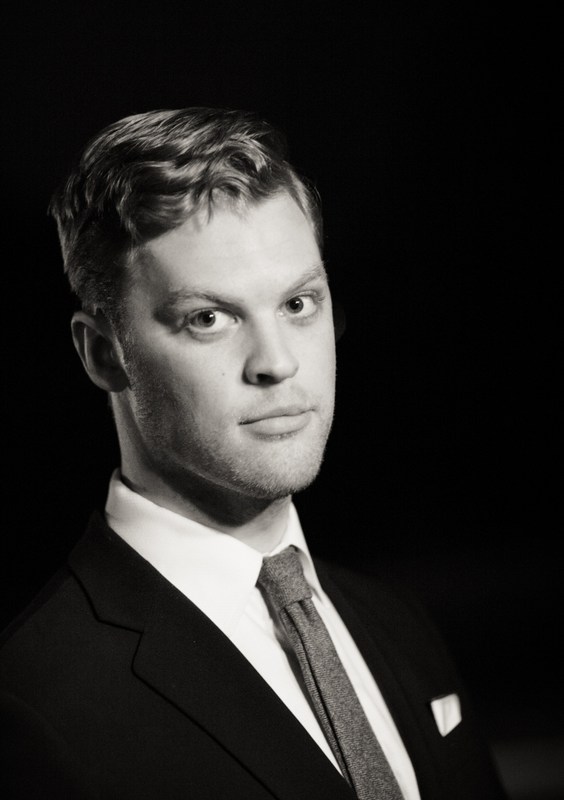
Baritone Alexander Dobson (Photo credit Jimmy Song.)

Finally we heard the work that likely gave the title to the proceeding, namely “Dichterliebe” or “a Poet’s Love” presented in a recent arrangement for string quartet.  While it’s always nice to shine new light on a familiar work, I didn’t find this arrangement especially illuminating, charming as some passages actually were.  In places the four string players had less oomph than a piano, leaving Dobson with the challenge of making drama himself.  It’s pretty, but I don’t think it does much for either Heine or Schumann, who indeed regularly pokes his head into the action in the piano commentaries, particularly the two long interludes where he seems to comment: passages that simply didn’t fly in the new version.  Dobson was again stellar, on a night when he was singing for most of a program that ran over two hours.

As usual Talisker punctuated each musical item with a dramatic reading, tonight from  Stewart Arnott.  I think one reason I was thinking these thoughts about the obsolescence of poetry may have been because I saw literary theorist Linda Hutcheon sitting nearby.  I was thinking back to one of my first lessons about love, from that great amorist Jacqueline Susanne, author of Valley of the Dolls or as David Berg of Mad Magazine called her “Jackpot Susanne”.  No wonder i’m such a mess, using trashy novels to learn about life. What is love, and who really knows it? At one time poets were our teachers to answer such questions.  Of the four treatments, Beckwith’s deconstructive comedy felt the most fresh, while the cool distance of Faure, and the hyper romance of Schumann don’t resemble any love I’ve known or seen.  I found Rapoport’s druggy glimpses of something recollected through a fog the most intense, the most genuine.

I am grateful that Talisker keeps programming music & text in such a way so as to provoke my thoughts & feelings.  I look forward to seeing where they take us next year, but in the meantime there’s one more performance of this program to come Wednesday May 28th at 8:00 pm.

Posted in Books & Literature, Music and musicology, Reviews | Tagged , , , , , | Leave a comment

Franz Liszt and Marie d’Agoult letters

I first encountered the romance between Franz Liszt and Comtesse Marie d’Agoult in Impromptu, a film full of famous artists in the script (Chopin, Liszt, Sand) and on the screen (Judy Davis, Hugh Grant, Mandy Patinkin & Bernadette Peters).  Impromptu is really a film about Chopin, with Liszt & his Comtesse as a colorful part of background, badly misrepresented in the script.  If you’ve seen the film you might use it as evidence in the question: “why didn’t Bernadette Peters have a film career?”  Neither Peters nor Marie d’Agoult do very well at the hands of writer Sarah Kernochan, who backs Peters into a screaming shrewish corner, in one of the most unpleasant portrayals I have ever seen onscreen, making Liszt look like a fool in the process.

The bicentennial year for Liszt in 2011 encouraged a wealth of scholarly activity around the composer, something like the more recent bicentennials of Wagner & Verdi in 2013.  As I’m a complete junkie for such things, I’m not sure that my perspective counts, a devoted follower, especially of the lives of the romantic composers.

click image for more information

Michael Short has assembled & translated the correspondence between Franz Liszt & The Comtess Marie d’Agoult, into an attractive oversize volume presenting all 473 letters with notes immediately below the letters.  I am in a state of shock.  I picked the book up from the library because I am always hungry for details about Liszt, Berlioz  and Wagner.

I did not expect to stumble upon a romance.  Over the course of those 473 letters, written between 1833 and 1864, we see the ups and downs of a remarkable love affair.

This is not, I must add, the reason I would expect scholars to read the book.  Correspondence of a great artist can be used to back up all sorts of positions, because they afford testimony that’s otherwise unavailable.   In addition to the simple pleasure of reading, regardless of who these people might be, there are details to the lives of famous people, sometimes including trivialities that could be important.  For example, letter 96 (by Liszt) includes the following review offered in passing:

I have finally managed to see Les Huguenots, that had not been performed since my arrival.  It contains some remarkable things.  The instrumentation and production are prodigious.

Or in letter 106 (Feb 1837), Liszt writes the following partisan report:

I have just heard Thalberg;  really it is a complete hoax.  Of all those things that are supposed to be superior, he is certainly the most mediocre that I know.  His last piece (composed recently) on God Save the King is even worse than mediocre.  As I said to Chopin: “He is a great man manqué who has turned into an artist even more manque”

Berlioz & Chopin come up from time to time, but Richard Wagner only rears his head at the very end.  The last letter, written by Liszt in 1864, is the first for almost a decade, and containing none of the obsessive romance found in most of the previous 400+.  By this time RW (or his music) had displaced Md’A as the apple of Liszt’s eye.

For the first hundred letters it’s all Liszt, Marie only appearing for the first time in letter #83.  It’s electrifying because her style is so completely different from his.  Where he’s effusively poetic she’s as direct as an amorous shark, and I can’t help envying her meal.

[Basle June 2m 1835]
Tell me immediately  the name of your inn and the number of your room.  Do not go out. My mother is here my brother-in-law no longer.  When you read this, I shall have spoken, until now I have not dared to say anything.  It is a final and testing trial but my love is my faith and I have a thirst for martyrdom.

Even so it’s hardly surprising that Short gives us mostly Liszt, given that for the most part, he’s the one whose words matter at least in the scholarly world.   Letter 113 (perhaps only the fourth or fifth specimen of her writing to this point) is one of the most wonderful letters in the book for what it might tell us about Liszt & his playing (first paragraph) even if it’s ultimately intangible and elusive information.  The  second paragraph (only presented in part) might be of more interest to literary scholars (but will they ever bother to read this book?) than musicologists, although at the end Marie seems to be telling us that George Sand is using Marie & Franz as her inspiration

    I have just received a letter from Ronchaud who tells me that the concert at the Opera has been deferred until Palm Sunday.  Would you like me to come?  For myself, I am not sure.  I fear that I might stop you working, embarrass you, be very fidgety myself, bring you bad luck.  In the end I have struggled a lot and believe that It would be better if I did not come,.  Reply to me positively: come or don’t come.  And if I am to come, get me a ticket for a ground-level box. […]
George [Sand] has fallen out with Le Monde.  The Abbe’s cuts to the 3eme Lettre a Marcie having aroused her suspicion, she wrote a perfectly nice, affectionate and reasonable letter to him [etc]
P.S. In the letter from G to the Abbe there is a very fine page about exceptional loves, noble, holy and imperishable loves, for which the inspiration is not foreign to us, I believe.

As the book progresses more and more of the letters are Marie’s for Franz, sometimes long diary entries.  Her writing is much more prosaic, whereas his flies off into poetic fancy.  This romantic tale is made three dimensional by the profound difference in their writing styles, reflecting their respective circumstances.  This letter of Marie’s from January 1840, at a time when they hadn’t seen one another for at least two years — is simple testimony to the impossibility of their lives:

Letter 170, January 6, 1835

    I have just received your letter from Pesth.  It made me cry like a baby.  How can you imagine that I am insensitive to such triumphs?  They are fine, great, poetic!  Oh if only I were there! always there!  What a pitiful role I have come to play here…..

Or letter 176, January 25 1840:

           This morning I received your letters from Pesth (please no more recommandirt letters) in which you detailed what you term household accounts.  I was sadly moved by all that.  The misfortune of only being your mistress and not your wife was rammed home to me as it had never been before, when I think that I have to stay far away from you on such days, such lovely and splendid days, my dear and great Franz, days of noble pride which You truly deserve!
What you say to me about permission to be unfaithful (in this connection I was posing a question, to which you didn’t reply, as is your wont) is full of heart and fills me with respect for you, although this way of feeling will always remain incomprehensible to me.  It is as impossible for me to conceive as that pigs may fly, and I can only allow of it as an inexplicable fact.  The final word in your letter Truth is useless.  I swear by our children that even a white lie has become impossible for me with you.  I hasten to rid myself of all my pent-up secrets and no confessor would ever have heard such a full and true confession.  If I do not write to you, it is simply because I do not know if it would not be better to talk.  What is certain is that my love, my veneration for you does nothing but increase and that your word ever and always will be the sole regulator of my actions.

As the years go by, his strength & independence grows while hers seems to wane, her obsession with him increasing.  Richard Wagner only comes into the picture in the very last letter, featuring in the last paragraph of the last letter of their 473 letter correspondence.  It is a letter consumed with musicological concerns, with no trace of the former romance, probably because by this point –many years later– the romance had died.

Correspondence of Franz Liszt and the Comtesse Marie d’Agoult, Translated and Edited by Michael Short.  Opening this book, expect to be moved.

Posted in Books & Literature, Music and musicology, Reviews | Tagged , | Leave a comment

Second time lucky

A scene from the Canadian Opera Company production of Don Quichotte, 2014. Photo: Chris Hutcheson

Presented with more or less identical performances on two different occasions, what is it exactly that can make one so different from the other? Where I whined & complained the first time, I had a wonderful experience seeing the Canadian Opera Company’s Don Quichotte a second time tonight, at the second last show of the run. All things being equal, the difference must be in my head, perhaps something I did wrong the first time. Because of course i would always prefer to have a good time (who wouldn’t?).  I want to have fun, not feel distant & estranged. Did I show up with too many stipulations? Or maybe I felt distant and estranged because I wasn’t sitting very close to the stage the first time. I’ve had this experience before with the COC & the Four Seasons Centre. I recall loving The Nightingale & Other Tales from up close, but having a completely different experience when seeing another performance, this time from afar. Tonight –sitting up close—I was just as thrilled by Ferruccio Furlanetto’s Don. He sounds wonderful, his performance a nuanced interpretation of a figure that can easily descend into mere sentimental cliché or a cartoon.

I wonder, though, if this is the same interpretation of Sancho Panza I’m seeing, or if Quinn Kelsey has grown into the role, found additional depths. He’s now a commanding presence, often more interesting than the Don, and always producing a congenial sound of warmth & full of emotion. While I also enjoyed Anita Rachvelishvili’s Dulcinée more than on opening night I think the problem was me, that I had previously been emotionally unavailable, closed off from what she and the production were doing.  The first time I’d alluded to the article I’d seen in a newspaper, writing up the Massenet opera alongside the Stratford production of the music Man of La Mancha, and how it had led me to compare the performance to a broadway musical: as though there’s something wrong with that.

Sometimes one needs to lighten up, to let go & to simply let yourself enjoy what you’re seeing.

I also should acknowledge something very positive in this production, namely the foregrounded presence of dance.

The Don & Sancho ride forth one last time on May 24th.

Posted in Opera, Reviews | Leave a comment

Media Circus 3: critical dinosaurs

In one tiny corner of the media circus, ignored by most of the audience, you’ll find a nerdy subculture, the opera lovers.  Yet many of the same influences inhere that you’d find anywhere else.

And so I’ll speak of something that’s big news in the opera world. But of course that means it’s under the radar for the other 99%, a story that won’t surprise anyone except possibly those entitled occupants of complementary seats, aka critics.

The story as I understand it is this:

  1. A series of reviews went wildly off-track, as reviewers took gratuitous pot-shots at a singer’s appearance, sometimes while acknowledging that her singing was good.
  2. Norman Lebrecht synopsised it and also published an impassioned response from Alice Coote, seen not long ago in the COC’s Hercules.

    Alice Coote as Dejanira and Eric Owens as Hercules in the Canadian Opera Company/Lyric Opera of Chicago co-production of Hercules, directed by Peter Sellars. (Dan Rest/COC)

    Alice Coote as Dejanira and Eric Owens as Hercules in the Canadian Opera Company/Lyric Opera of Chicago co-production of Hercules, directed by Peter Sellars. (Dan Rest/COC)

3.Social media have been alive with responses.

It reminds me of the climactic interview that more or less ends McCarthy’s reign of terror, the moment when Joseph Welch held up a mirror, in which the senator was shown to be a monster utterly lacking in compassion. Suddenly—at least as I hear it told—the burden of proof shifted, the red scare was no longer so scary. 

Hopefully critics will be left as high and dry as McCarthy, themselves shamed for their shaming.

I’ve long been afraid of the power of critics, the damage we can do.  My facebook cover photo is taken from Louise Hay’s page, addressed both to the students I work with and the singers I review.

I could be addressing myself. faceabook_cover_photo

I hope it’s clear where i stand on Coote’s essay.  I was appalled to read James Jorden of parterre.com post Coote’s essay to facebook with the heading “Dumpy singer takes bold stance defending the right of dumpy singers to be dumpy.”  I take offense, not just because I think Coote is beautiful.  Such language debases all of us.  I suppose it’s time I revised my “steal this page” essay, but it’s really obvious stuff.  Singers are vulnerable in a way that most people can’t understand until they try making their body their instrument.  Dancers might understand this as another group of artists who create their apparatus from the human body; but they get a free pass from most of society, living as they do on a pedestal for their physical prowess, their gorgeous shapes: an adoration entirely different from what singers usually enjoy or suffer.

Critics who put people down –and not just for their physique—are dinosaurs, somehow spared the extinction that wiped out others of their breed.  I suppose some of these reptiles have a huge following –Joan Rivers comes to mind—that isn’t about to disappear. Ha… One can only hope.

But I don’t believe opera has any need of its own fashion police.

Posted in Opera, Personal ruminations & essays | 5 Comments

Les Adieux

The Canadian Opera Company Ensemble Studio had their annual noon-hour concert to commemorate the departure of some of their members, titled “Les Adieux”. The three performers?

  • Michael Shannon, piano
  • Cameron McPhail, baritone
  • Sasha Djihanian, soprano
Baritone Cameron McPhail

Baritone Cameron McPhail

For most of the concert we went back and forth between artistic solo songs, in other words, far from the operatic idiom of the COC: until the last items on the program.  It makes sense, considering that for most of their time with the Ensemble, these flamboyant singers are often required to soldier in comparative obscurity, rarely getting the opportunity to show us what they can really do, what their voices can do, what charisma they could display if given half a chance.

That is, until the last two items. Djihanian sang & danced a broadly seductive “Meine Lippen, sie küssen so heiss” from Giuditta by Lehar, including a couple of notes that might have been high C’s, tossed off to huge applause. It was a fitting reminder.  The two youngsters singing for us were not just capable of snazzy high notes, but could take the stage with flamboyance. And to close? The pair offered us a poised and well-acted “là ci darem la mano” as an encore, the one time McPhail & Djihanian sang together. It was a fitting display of their musical dramatic skills, at this bitter-sweet moment of graduation, embarking on their careers.

Photo: Sasha Djihanian, 2013. Photo by Chris Hutcheson.

For the rest of the hour we were hearing other sorts of singing, different tests of skill.  McPhail opened with Chansons gaillardes, eight dryly ironic songs from Poulenc. They’re as much a test of your ability to keep a straight face as of vocal stylings, McPhail ever the deadpan comedian, never telegraphing the joke or tipping his hand, as suave a display as you could imagine.

Djihanian followed with a contrasting pair of Armenian Songs by Sayat Nova. Where “Kani vor jan im” showed off a rich middle voice in a moody composition that almost suggested that the soprano could sing mezzo-soprano rep if she so chose, “Kamancha” took us to a more extroverted place. She followed with Debussy’s Ariettes Oubliées, the furthest we’d drifted away from an operatic idiom, exploring varieties of internalized experience, with excellent support from Shannon. Another subdued pair of songs from Dvorak followed.

Michael Shannon, pianist & répétiteur

McPhail followed with I Was There, five powerful songs with English texts from Walt Whitman composed by American composer Lee Hoiby, requiring the singer to step forward into the spotlight.

All this variety serves to remind us that Ensemble Studio members can do much more than just opera. I wish them well in their future life.

Posted in Music and musicology, Opera, Reviews | Tagged , , , , , , , , | 2 Comments

Louis Riel

When I was young there was a phrase used so often that it became a cliché, something to be joked about. What exactly was the “Canadian identity”, and –other than hockey or maple syrup –what was Canadian culture?

click image for information about the DVD including how to obtain

As far as those asking were concerned, it hadn’t yet been articulated. Had they looked in film or literature they wouldn’t have found much back in the 1960s. Over the next few decades, though, artists did what artists do. Leonard Cohen, Joni Mitchell, Margaret Atwood, David Cronenberg, and so many more told their stories, and in so doing, gave us stories with which to tell our own story.

It’s so simple, and so recent, that perhaps nobody realizes just how precious & new it is. The Canada to which my family came –before my birth, when my parents crossed the ocean—was a bland but safe place. Trudeau had not yet appeared to articulate the ideas of bilingualism & multi-culturalism, two central tenets of modern life in Canada.

I just watched a DVD, one of a series to commemorate the death in 1999 of composer Harry Somers. They took the recording from a CBC broadcast made in 1969 of Somers’ opera Louis Riel, one of two operas premiered in 1967 by the Canadian Opera Company. It’s a remarkable historical document for a number of reasons.

  • The opera captures some of Canada’s history: not just the story of the Métis hero Riel, but the circumstances of his life & death, including a portrayal of the bigotry with which he was executed (although I have no idea if that’s something accurate or merely a creation of librettist Mavor Moore)
  • The opera was commissioned by the Floyd S Chalmers Foundation in three languages (English, French & Cree).
  • The DVD shows some of the singing talent from almost fifty years ago, including Bernard Turgeon’s definitive portrayal of the Métis leader and visionary, sung in two languages, Donald Rutherford as Sir John A Macdonald, Roxolana Roslak as Riel’s wife Marguerite, and other singers of note such as Alan Crofoot, Joseph Rouleau, Patricia Ridout, Mary Morrison, Peter Milne and Howell Glynne.
  • The CBC broadcast re-framed the historical events within a contemporary context, given that there were contemporary echoes in Québec, even citing Pierre Trudeau’s words at the beginning & end.

Some aspects of the broadcast don’t wear well with the years. The wigs / hair on some of the singers, for example look rather artificial, although I think it was one of the first times that an opera production meant for a big stage had been captured in the intimacy of a camera. In other words the DVD is likely the COC production seen from up close, and so naturally there are a few blemishes showing. For some moments the camera-work is sensitive, even though the acting is often oversized, more proper for a big stage rather than film or television.

Yet the main portrayals are superb. Bernard Turgeon is convincing in both languages (and as I didn’t follow the libretto closely he may also have some lines in Cree: I’m not sure), on the edge between a kind of vulnerable passion and religious fanaticism. The compositional style is the modernist idiom that was brand new in the first half of the century, as in Wozzeck, but perhaps conventional in some TV dramas by the 50s and 60s.  Somers’ idiom includes some dissonant brass and string chords, as well as some whimsical woodwind writing, often associated with the political discourse for the scenes in Ottawa.. Turgeon sounds very comfortable with his music, always illuminating his singing with the passions of Louis Riel, poised somewhat like Joan of Arc between inspiration and madness.

For the rest, I’m less certain as to whether the quality of what we’re seeing reflects the composition or the performer. Moore’s libretto offers several witty moments for some characters. Thomas Park plays a key role in the first part of the opera, as Thomas Scott, a quarrelsome loudmouth asking for trouble. He gets himself executed, and becomes the martyr who later brings about Riel’s downfall.  You can’t take your eyes off Park whenever he’s onscreen.

Donald Rutherford is given marvelous lines by Moore to work with, as Sir John A Macdonald. One scene ends with Macdonald singing to the Bishop Taché “touché, Taché”. In another scene, Taché arrives saying “Sir John your health is in my prayers”, to which our first PM replies “So that’s where it’s gone”. Most of the role is played with the camera in very tight, so Rutherford has no choice but to be a smooth performer: as Macdonald likely must have been.

Conducted by Victor Feldbrill I can’t find any credit for an orchestra on the DVD. While it might have been the Toronto Symphony when presented at the O’Keefe Centre, perhaps there were some substitute players, which might explain the lack of a clear credit.

I’m thinking of this now, having just posted something about the CBC and their shrinking budgets. Who will champion Canadian culture? The CBC no longer have their orchestra, likely can’t commission so many (if any) original works by Canadian composers.

Does Canada still need champions of Canadian Culture? The COC once were big champions of Canadian culture. Indeed a friend of mine recently told me that there’s a charter somewhere stating that the COC have a responsibility to uphold Canadian culture & talent. Sometimes I feel that’s what the Ensemble Studio represent, a pathway for Canadian talent, although other times I feel the studio is simply a repository of talent for the company, a ready answer to critics (like moi), even though I am often frustrated at how often the talented graduates vanish, never to be seen on a COC stage.

But in the meantime, as we wait for a newly composed main-stage opera from the COC –The Golden Ass was their last I believe—the fiftieth anniversary revival of Riel is coming soon. Rufus Wainwright’s Hadrian may not satisfy those within the classical composer fraternity who must feel bypassed by Alexander Neef’s decision to approach a popular composer. Yet Wainwright’s composition –whatever its strengths or weaknesses—is Canadian culture too.

For those who can’t wait, Louis Riel is available on DVD from the Canadian Music Centre.

Posted in Cinema, video & DVDs, Music and musicology, Opera, Politics, Popular music & culture, Reviews | Tagged , , , | 3 Comments