Inclemenza

We’re expecting snow here in Toronto, but it’s already somewhat inclement, if we think chilly or unmerciful.

I am expanding on the experience of La Clemenza di Tito Sunday in Toronto.  I was enraptured, as were the audience: until the director & his design team appeared onstage.

Some of us bravo’d enthusiastically, yet the sound was as sour as raspberry noises.  I suspect it was one loud person, perhaps with their companion.  The rest of us redoubled our effort.  Either we easily drowned then out or they were making a hasty exit.

Tonight I am thinking of this in context with the show I am working on, the lovely students & staff at this university caring so much about every little detail.  Of course our production is faithful to the text so I believe we’re safe from the textual vigilantes out there.  Still, these students would probably be stunned at the idea of supposed defenders of art booing.

Dancers backstage, Ballets Russe, “Le Sacre du printemps” Théâtre des Champs-Élysées, Paris, 1913 (click for more thoughts on Le Sacre)

In today’s discussion on the CUNY listserv  I looked back at two startling events in the history of audience protest.  One hundred years ago this year, Ballet Russe premiered Nijinsky’s ballet Le Sacre du Printemps, with a startlingly original score from Igor Stravinsky.  I reviewed a performance by Esprit Orchestra just a few days ago, so the historical significance of the performance is still on my mind.  In 1913 the audience went a little nuts, booing very early on, upset with the look & the sound of the performance.  Fifty years earlier – another great moment in audience stupidity—Richard Wagner crashed into the stubborn opposition of the Paris Jockey Club, who wanted ballet in the second act of their operas. Wagner had thought he’d made enough of a gesture in inserting a ballet into the first act of his opera.  Nope.

I believe some people believe that such events –and perhaps the booing in Toronto—are good for attendance.  There’s an old adage that says “there’s no such thing as bad publicity”.  Indeed, by writing this piece I am hoping to redeem the booing in publicity, possibly helping generate extra interest in the production.

What does it take to connect?  I notice in my church that when the children sing, everyone listens with a kind of reverent awe, and clap without judgment for the performance.  Similarly, when an old person steps forward we see something like that.  And the people who are neither very young or very old: can we not empathize with them too?

When I think of those boo-birds, I sense they have no idea that what they’re doing is a kind of heckling, that ridicules and disrupts the enjoyment of those who liked that production.  I have talked to some who boo, and they seem very civil, thinking of booing as part of the broad spectrum of audience response that includes wild applause.  In other words I suppose I can also cut them some slack, allowing for a dissenting view at the end of the show, however much I may disagree.

No matter where you go in the world some productions work, some don’t.  Opera is exciting in many of the same ways as food or sex: where good intentions and ambitions can’t always overcome weaknesses, accidents or indifference.  Steak is safe, good cuisine is riskier, surely. Here’s a paraphrase of Robertson Davies’ idea that i think i’ve cited before, namely, that

“Nine times out of ten that I go to the theatre, the experience is unpleasant; but the pleasures of that tenth time fully justify those nine other visits.”

This applies as fully to composition as it does to direction, but it applies to invention, discovery, anything risky.  Research and development entails failures, wastes of money & effort.  Not everyone could be Christopher Columbus, Bill Gates or Richard Wagner.  Some people fail.  Directors and composers may set out in search of something, but that doesn’t mean they can make it there.  A person begins such an enterprise in a spirit of hope and excitement, not one of exploitation or cheating.  It’s a sacred process. Now of course if you sit back with a sense of entitlement, insensitive to the risks these people are taking, merely demanding brilliance every time out, then of course you won’t appreciate the moderate success in some productions.  Indeed failure can be heart-breaking, and often still deserving of great respect.  I was very sad watching and hearing Deborah Voigt’s Cassandre, particularly in view of how she used to sound in this role (the Dutoit CD for instance). But she’s earned the right to get out there and sing her best, even if it’s not as opulent as it used to be, perhaps worn by the Brunnhildes; there is still much to be celebrated in her work.  Do i boo an athlete whose batting average has fallen, or a tennis player who isn’t as quick afoot as they once were? They’re still doing their best.  I understand we may want to treat them as commodities given that we buy and sell their CDs and DVDs.  Even so i believe we should honour them, rather than throwing them on the scrap heap of history.  It may require a huge act of imagination (another suspension of disbelief?) but i think we need to remember, need to presuppose that they are people not objects, that they are doing their best.  Nobody steps in front of an audience wanting boos.  They have no reason for shame, whereas the judgmental philistines?  hm…Ah now that’s another question.

“Deconstruction” gets a bad name in this.  I spoke at length about Christopher Alden‘s analytical approach to historical icons & the official story, probing beneath the surface of the perfect Tito we see in the opera’s text. Peter Sellars’ Tristan und Isolde, which we’re also seeing here in Toronto, is largely faithful to the work, even though some parts are distorted; and so in this reading all of the acts of violence become virtual (Melot barely touches Tristan: as if he were Melisande; Melot & Kurwenal die of invisible blows). Why no violence? i suppose one could quibble with it, but there is so much else in this story, so much brilliance, i am able to make it work.  Isn’t that the idea: to suspend your disbelief (as Dr Johnson described it)?

Hm, did Dr Johnson ever say anything about suspension of judgmental attitudes & prejudices? You may not be Robertson Davies, but aren’t we all going to the theatre for a good time?  If we can use our imagination to see the beautiful young woman or man (as the role specifies) rather than the aging singer, why not use that imaginative faculty (hopefully well-developed from frequent trips to the opera) to attempt to understand the relationship between the original text and the experimental reading…?  Clemens Risi, in his talk about Regietheater at the Opera Exchange Saturday in Toronto, spoke of the pleasure found in the tension between the original & the experiment, in the awareness of divergence. Sometimes experiments, like voices & banks, fail. Life is a risky proposition. It’s a very conservative idea to attempt to barricade yourself into a safe corner, to arm teachers, to demand certainty in a chaotic world.  I believe some of the original opera patrons were just like that, demanding only flattering operas from their servant composers, censoring or censuring what they didn’t like.

Have we come full circle?

Michael Schade as Tito (standing), and the chorus in the Canadian Opera Company’s production of La clemenza di Tito, 2013. director Christopher Alden (Photo: Michael Cooper)

Michael Schade as Tito (standing), and the chorus in the Canadian Opera Company’s production of La clemenza di Tito, 2013. director Christopher Alden (Photo: Michael Cooper)

Posted in Opera, Personal ruminations & essays, Politics | Tagged , , , | Leave a comment

Opera Atelier: 2013-2014 Season Announcement

 “Press releases and announcements” are presented verbatim without comment.

OPERA ATELIER

2013-2014 season features the return of two jewels in Opera Atelier’s crown
– Plus an engagement at the Palace of Versailles,France –

FOR IMMEDIATE RELEASE: February 5, 2013 (Toronto, ON) – Opera Atelier’s founding co-artistic directors Marshall Pynkoski and Jeannette Lajeunesse Zingg today announced the company’s 2013-2014 season, which will include a return engagement at the Royal Opera House in the Palace of Versailles. Thespring 2014 production of Lully’s Persée will travel to Versailles for three performances, following its run at the Elgin Theatre in Toronto (Apr. 26 – May 3, 2014). The 13-14 season will kick off in October with the return of Mozart’s Abduction from the Seraglio (Oct. 26 – Nov. 2, 2013), the runaway hit from Opera Atelier’s 2008 season.

Persée is a landmark production for Opera Atelier. The company’s 2000 production was the first fully staged incarnation of the opera since it inaugurated the Royal Opera House at Versailles in 1770 during thewedding celebrations of the future King Louis XVI to Marie Antoinette. Opera Atelier’s 2004 remount of Persée was the subject of a documentary which has subsequently become an internationalcalling card for Opera Atelier, both for the public and for presenters around the world. Following the astounding success of Armide in 2012, The Royal Opera House has invited Opera Atelier back to Versailles with Persée, which will mark the first time the opera has appeared on that stage since 1770. Persée will be performed three times at The Royal Opera House, Versailles on May 23, 24, and 25, 2014. This prestigious engagement has allowed Opera Atelier to enhance Persée’s visual elements, making it the company’s most lavish production to date. The moving story of a man’s ascension from his questionable beginnings to his rightful place as a god, Persée is a retelling of the classical Greek Perseus myth.

Persée was recognized in its day as the crowning achievement ofFrench lyric theatre,” say Pynkoski and Zingg. “We are honoured that Opera Atelier has been chosen as the company to bring Persée back to the Royal Opera House, which it officially opened almost 250 years ago.”

The role of Persée will be performed by Chris Enns making his Opera Atelier debut with his first haute-contre role. Mireille Asselin will take on the role of Andromède, whose rival Mérope will be played by Peggy Kriha Dye, who returns to Versailles after her star turn as Armide. They are joined by Olivier Laquerre (Céphée/Méduse) Carla Huhtanen (Cassiope), João Fernandes (Phinée), Lawrence Wiliford, Curtis Sullivan, Aaron Ferguson, Meghan Lindsay and Vasil Garvanliev. Persée runs April 26, 27, 29, 30 and May 2 and 3, 2014 and is sung in French with English surtitles.

Opera Atelier’s 2013-2014 season begins with Mozart’s Abduction from the Seraglio, a colourful comedy that tells of the charming antics of Belmonte and Pedrillo, a master and servant who must rescue their beloveds from the harem of the Pasha Selim. A revival of Opera Atelier’s highly successful production, this opera features some of Mozart’s most demanding arias and is grounded in the commedia dell’arte tradition, making it the perfect showcase for our artists’ vocal prowess and comedic acting chops. Appealing to children, youth and families, Abduction from the Seraglio is part of Opera Atelier’s ongoing commitment to cultivate the opera-lovers of tomorrow.

Abduction from the Seraglio will feature Lawrence Wiliford as Belmonte, Ambur Braid as Konstanze, Carla Huhtanen as Blondie, and Adam Fischer as Pedrillo. They will be joined by Gustav Andreassen (Osmin) and Curtis Sullivan (Pasha Selim), reprising their roles. Abduction from the Seraglio runs October 26, 27, 29, 30, November 1 and 2 and is sung in German with English dialogue and English surtitles.

Abduction from the Seraglio and Persée will be directed by Marshall Pynkoski and choreographed by Jeannette Lajeunesse Zingg, with set design by GerardGauci and lighting design by Bonnie Beecher. Both productions will feature the Artists of Atelier Ballet and Tafelmusik Baroque Orchestra and Chamber Choir under the baton of David Fallis.

Performances for Opera Atelier’s 2013-2014 Season will take place at the Elgin Theatre (189 Yonge Street) in Toronto with evening performances at 7:30 p.m., and Sunday matinee performances at 3:00 p.m.  Subscriptions start at $95 and are on sale now by calling 416-703-3767 x222. Single tickets go on sale on August 6, 2013. For more information visit Opera Atelier’s newly re-launched website: www.operaatelier.com.

Opera Atelier gratefully acknowledges the ongoing support of The Canada Council for the Arts, the Ontario Arts Council, and the City of Toronto through the Toronto Arts Council.

2013-2014Major Sponsors

Season Sponsor: BMO Financial Group
Abduction from the Seraglio Production Sponsor: Scotiabank

Opera Atelier is Canada’s premier period opera/ballet company, specializing in producing opera, ballet and drama from the 17th and 18th centuries. While drawing upon the aesthetics and ideals of the period, Opera Atelier goes beyond “reconstruction” and infuses each production with an inventive theatricality that resonates with modern audiences. Since 1985, led by founding artistic directors Marshall Pynkoski and Jeannette Lajeunesse Zingg, Opera Atelier has garnered acclaim for its performances at home as well as in theUnited States, Europe and Asia. 

Posted in Press Releases and Announcements | Leave a comment

Clemenza: Apollo’s Turn

After a week of thinking about Tristan und Isolde –at the COC, in the Opera Exchange, at the piano and rattling around inside my head—I was ready for something different.  Tristan is many things.  It’s humongous, it’s conceptual & symbolic, it’s almost unsingably difficult. Its dissonant harmonies point to our century, while its dramaturgy anticipates modern film & media.

Director of the COC’s Clemenza di Tito Christopher Alden

A change of pace? The COC’s other current production is Christopher Alden’s La Clemenza di Tito, originally presented at Chicago Opera Theater in 2009.  While it’s not a familiar opera, I’d swooned over the Opera Atelier production in 2011 (and saw it three times), gorgeous music by Mozart that deserves to be better known.  Where Tristan is an intoxicating experience that one could call Dionysian, Clemenza di Tito is an answer from the other side of the equation, namely the clear & disciplined voice of Apollo, ironic & incisive.

Again we’re watching a Canadian tenor sing and act brilliantly in a difficult role, namely Michael Schade.  While Tito is not Tristan – one of the hardest roles of all—I think it’s the most difficult Mozart tenor role.  Christopher Alden’s production requires a great deal of Schade, who changes over the course of the opera.

Again we’re hearing a superb performance from the COC orchestra, who seem to have hit their stride lately.  I don’t know conductor Daniel Cohen’s credentials, but the reading was often as brisk as what we’d demand from a specialist in historically informed performance.  I believe Cohen is a late replacement for Johannes Debus, himself a late sub for Jiří Bělohlávek (who had to cancel a few weeks ago due to illness).

Alden’s Clemenza di Tito interrogates history, problematizing the usual version by refusing to simply swallow tales that may be a bit hard to believe.  Biggest example is Tito himself, a figure who may be too good to be true.  I don’t want to give it all away, but for example in his first scene.

  • How it’s written:  Publio (who speaks for “the public”, and the Senate) speaks to Tito about tribute money from subject provinces being used to build a temple to Tito.  Tito redirects those funds to relief for the victims of the recent disaster of Vesuvius.
  • Alden’s take: the chorus—a sad group in quasi-modern clothing but masked—put money into Publio’s helmet, as Tito sanctimoniously speaks the same lines in front of a cynical audience of tax-payers.  Does it matter that these aren’t citizens of subject provinces? No.

In other words, while Alden gives us the opera as written he’s interrogating assumptions throughout, so that we simultaneously get history AND commentary.

Isabel Leonard as Sesto in the Canadian Opera Company’s production of La clemenza di Tito, 2013, director Christopher Alden . Photo: Michael Cooper

Isabel Leonard as Sesto in the Canadian Opera Company’s production of La clemenza di Tito, 2013, director Christopher Alden . Photo: Michael Cooper

The cast is very strong.  While I segued from Tristan via another brilliant Canadian tenor, the most interesting portrayal is Isabel Leonard as Sesto.  Before we even speak of singing or acting, you can’t ignore the persuasiveness of a trouser role (woman portraying a man) where the woman’s muscles are more prominent in their definition than any of the other “men” onstage.  While there’s no mistaking Leonard’s gender, her macho body language is remarkable.  When you add a rich mezzo-soprano voice, you have the makings of a portrayal of astonishing depth.  I couldn’t take my eyes off her.

If that weren’t enough, Wallis Giunta as Annio gives us another trouser role, contrasting Leonard with a movement vocabulary comprised of jocular poses, hiding behind nerdy glasses.  Giunta’s voice, like her body language, makes a contrast to Leonard, a subtle alternative every bit as compelling in its delicacy.  Giunta is such an amazing actor that she is almost unrecognizable as Annio.

The fourth excellent performance is arguably the single most important one in the whole opera.  Keri Alkema’s Vitellia needs to be able to make us believe that she can make a man murder his best friend out of love for her, even as she outrageously pursues someone else.  Vitellia is not an attractive human being, even though she is eventually tormented by remorse in the last part of the opera.  Alkema manages all of it: the demanding high-maintenance diva, the capriciousness, sense of entitlement, and even the birth of compassion & a human heart in the latter part of her portrayal, all sung powerfully.

Rounding out the cast are solid portrayals from Mireille Asselin as Servilia and Robert Gleadow –generating lots of laughs—as Publio.

There  are many moments of ironic laughter, with glimpses of something much deeper.  The chief publicity photo shows Leonard painting the iconic phrase “sic semper tyrannis” (or “thus always for tyrants”) onto a wall.  When we see her begin to do this during the brief insurrection in the middle of the opera, I saw that where she was beginning to paint, you could already see where the words had been written and erased before.  Mistake?  But no, come to think of it.  The residue on the wall suggests that we have had tyrants before and will see them again.

La Clemenza di Tito runs at the Four Seasons Centre until Feb 22nd.

Michael Schade as Tito (standing), and the chorus in the Canadian Opera Company’s production of La clemenza di Tito, 2013. director Christopher Alden (Photo: Michael Cooper)

Michael Schade as Tito (standing), and the chorus in the Canadian Opera Company’s production of La clemenza di Tito, 2013. director Christopher Alden (Photo: Michael Cooper)

Posted in Opera, Politics, Reviews | Tagged , , , , , , , | 3 Comments

Wagner and Adaptation: Linda’s Legacy

I use surnames in this blog.  Everyone calls him “Topher”, but when I wrote about him it was “Mokrzewski”.  Some aspects of the naming convention are absurdly obvious.  We call RW and RS “Wagner” and “Strauss not “Richard” and “Richard”, although RS can easily be mixed up with other Strausses, so one has to be careful.

Michael and Linda Hutcheon

This once I’ll make an exception because I’m speaking of someone who will always be “Linda” to me rather than “Hutcheon”, although of course –as with RS–we must distinguish one Hutcheon from another given that it’s Linda & Michael Hutcheon.

They’re an example of what citizenship entails, fabulous role models in everything they do.  They both taught at the University of Toronto.  They married and appear together in public in what seems to be the happiest and healthiest marriage I know of.  While their disciplines diverge –he’s in Family & Community Medicine, while she’s a literary theorist in English & Comparative Literature—they found common ground at night seeing opera.  No wonder they’ve written books together, the most tangible labours of love one could imagine.  Opera: Desire, Disease, Death for example, is a fascinating book right at the intersection of their disciplines.  And citizenship entails service.  They are right in the thick of it with Queen of Puddings, a company who have produced several interesting modern works, most recently Ana Sokolovic’s Svadba.

I met Linda in a course she co-taught with Caryl Clark, a graduate seminar with a title something like (as I struggle to recall it) “Opera: multi-disciplinary studies of a multi-disciplinary art-form.”  That intersection of disciplines, so germane to her collaborations with Michael, is central to her work as a literary theorist.  Two big words I associate with Linda (other than “opera” or “nice”) are “irony” and “adaptation”, as her books on those two words (Irony’s Edge and later A Theory of Adaptation: among many other books I am not mentioning) underpin everything I think as if she were Martin Luther and I’d just become a Protestant.

Saturday morning, the Canadian Opera Company & the University of Toronto co-presented the latest instalment of “The Opera Exchange”, a colloquium Linda co-founded roughly a decade ago, very much like the experience of Linda’s courses and books.  Again we’re speaking of a kind of service, a brilliant outreach to the community to help educate & prepare audiences for the operas programmed by the COC.  Today’s presentation, occasioned by the COC production of Tristan und Isolde and Wagner’s bicentennial this year, approached its target from several directions:

  • A paper by Clemens Risi concerning Regietheatre as exemplified in three recent productions, included a lovely nod near the end from Risi concerning Linda’s ideas of adaptation.  Risi offered a wonderfully simply theoretical construct, looking at the tension between theatre as museum, or as laboratory for experimentation, a tension that can be pleasureable even when there’s controversy
  • After a brief but eloquent talk about transcriptions, Topher Mokrzewski gave a masterful performance of Liszt’s transcription of the Liebestod, transcription being just another kind of adaptation.  His intro included two wonderful observations: that Liszt’s motivation may have partially been motivated by a kind of envy, in effect appropriating the compositional brilliance of others into his fingers, and that transcription is a kind of wish-fulfillment, allowing one to hear and play what’s otherwise unavailable.  Those two observations resonate beyond the pianistic world, in the larger sphere of adaptation.
  • Linda then moderated a conversation among two singers (Margaret Jane Wray & Michael Baba) & an academic (Bettina Brindl-Risi), asking a wonderfully pointed question –attributed to someone else—in a most disarmingly warm fashion. How does it feel, I wonder, as a singer in this Tristan to be the soundtrack of a video?  It was asked whimsically and with no disrespect, eliciting marvellous answers from the singers; they’re too busy trying to survive the ordeal of their roles to even notice.

Now in retirement Linda is on to her next subject with Michael, namely older artists and late style.  Notice that the subject is again multi-disciplinary, straddling the boundaries of the Hutcheons’s respective disciplines.

And as usual it’s a fascinating topic. (further reading…)

Posted in Personal ruminations & essays, University life | Tagged , , , , , , , , , , , , , | 1 Comment

Actors! at Winchester Kitchen

The show is Actors! Canadian Actors Up Close and Personal, and before I go any further I need to say that it’s not a show in the usual sense.  I hate telling you too much because I’d be stealing some of the surprise inherent in this work.  It says right on the program that it’s “part panel discussion, part scripted performance“.

True.

Melissa Major

Melissa Major of Cheshire Unicorn Theatre Company has created this mix of happening and drama.

Knowing that, I sat right at the front because I guess I am a bit of a whore for audience participation.  I grew up as my brother’s claque, bravoing loudly, and love helping a show by laughing at a good joke where the laughter can get an audience going.  I enjoy being complicit even when haha maybe nobody asked me to be complicit?

Hm…

We live in a funny world where the boundaries are already compromised.  I am Facebook friends with famous opera singers and actors I have never met and likely never will meet.  Wtf? Celebrity culture makes for a slippery slope.

Ha I almost miss-typed that as ‘slippery slop’. HA!  That too!

Once upon a time, long ago, I saw a show where the fourth wall was violated by a transgressive performer coming into the audience, asking, no demanding a response from all the scared patrons.  Once upon a time it used to make me nervous.

Now? We’re all eager for this, fascinated with train-wrecks wherever they may be. In other words, reality TV –as one of the participants remarked tonight—is something we know is bad, but really hard to resist.  Like potato chips or cigarettes, you may know it’s poison but that doesn’t stop you.

In a world of hybrid art-forms, where conventional boundaries & structures are under attack by the ongoing hunger for re-invention & re-definition that’s everywhere, it should surprise no one that theatre, too, would be subject to the same dynamic.  I don’t know what to call Actors! …except that whatever ‘it’ is, it’s fascinating and grotesque and irresistible all at the same time.  Lordy, we all seem to love train wrecks.

How cool that this one is partly real and partly scripted.

Let me just say that for those of you who fear actors pulling you into the piece, you can sit at the back and watch from safety.  Those who want to be involved?  Haha oh my God, you can sit near the front and get tangled in it to your heart’s content.  I felt a bit like a mad scientist playing with a laboratory, only the laboratory subjects are the actors. You can’t step into this (same) river twice, so my innocence is gone now that I have played in this sandbox tonight with Stephanie Seaton & Tim Walker, plus Melissa Major (maven  of mayhem).  In a way i wish i could do it again (fun!), but i can’t pretend i haven’t seen it.

Wow I had fun tonight!

By the way, Actors! plays at the Winchester Kitchen, a restaurant/bar at Winchester & Parliament.  If I hadn’t liked the show I still would have been pleased by my prix fixe dinner:

  • a turkey soup that was refreshingly low on salt but flavourful;
  • a Caesar brightened by a lemon (that is, it made the salad perfect) sculpted to look like the sun
  • a big steak I inhaled
  • a yummy dessert (sorry, i don’t know what it was called but it was pastry with ice cream on top)
  • and strong coffee

…all for a very reasonable $30.

I mustn’t give Actors! away for you except to say it’s fun, it’s deep, and it’s an invitation to play along if you’re up to it, running until February 9th.

I will be back to investigate more of the Winchester Kitchen menu.

Posted in Reviews | Tagged , , , , , | Leave a comment

Esprit : Stars, Suns, Sacre

There were three items on the Esprit Orchestra program tonight in Koerner Hall, interconnected by the laws of physics.

The center-piece was a performance of a reduced version of Stravinsky’s Le Sacre du Printemps on the occasion of its centennial.  Beginning the program was Claude Vivier’s Orion.  In between was an original commission from Esprit, namely Paul Frehner’s Phantom Suns in its world premiere.

Paul Frehner and Alex Pauk (photo: Jasmine Pauk)

Paul Frehner and Alex Pauk (photo: Jasmine Pauk)

In the pre-concert talk, Alexina Louie interviewed Frehner, who discussed his creative process.  Commissioned to share the bill with two relative heavy-weights (Vivier being a big name among Canadian composers, Stravinsky’s piece being one of the masterworks of the past century), Frehner described his thinking.  Whereas Orion is of the stars and Le Sacre is of the Earth, Frehner thought he’d aim for the sky in between.

The Phantom Suns of his composition are the phenomenon known as ‘parhelia’ (or ‘parhelion’ in the singular), also known as ‘sun dogs’, a kind of mirage in the sky seen near the sun whereby we seem to see multiple suns.  In some respects his composition showed us something just like that, as the soundscape resembled a sky awash with colours and light, as if the score had been coloured with a bright paint.  Frehner’s composition seemed to be conceived as a kind of intermezzo between two very different pieces.

To begin the evening , we heard Vivier’s Orion, a piece that I found to be the most successful piece on the program, in a reading of great transparency, wonderfully balanced and with a terrific sense of nuance.  From Louie’s words I believe Conductor & Artistic Director Alex Pauk has great sympathy for Vivier, whose life story is itself a fascinating piece of subtext for any performance of his music.  Adopted at three, gay, a successful composer recognized in his youth, but murdered at 34, Vivier’s star continues to rise worldwide.  Pauk found the wit, humour & verve in this composition, and it was clear the orchestra was enjoying itself throughout.

To close the program we heard a version of Le Sacre du Printemps for reduced orchestra arranged by Jonathan McPhee.  This is the loudest music I’ve yet heard in Koerner Hall, reduced forces notwithstanding.

Esprit Orchestra’s Artistic Director & Conductor Alex Pauk

At this moment Esprit was at their source, the beginning of “New Music”.  The Toronto Symphony plays Le Sacre, and everyone has heard this piece and knows its edgy moments.  This time we weren’t hearing an orchestra that makes its money with Beethoven and Mozart taking a walk on the wild side; no, we were hearing an ensemble accustomed to contemporary sounds & procedures, in effect letting their hair down, returning to their roots.

It was well-received by the Esprit audience, a powerful performance that belied the numbers.  At times Pauk had Esprit sounding like impressionists, the strings subtle, the woodwinds delicate, at other times the room rocked to the fulsome brass, the rhythmic pulses, the pounding percussion.  At this moment in Esprit’s 30th anniversary season, it’s worthwhile for them to check in with this piece that lets us hear them play repertoire you’d hear from the TSO.  Even with the smaller ensemble, the pristine acoustic of Koerner Hall captured their brazen & blatant sounds.  In so doing Esprit convincingly laid claim to this repertoire.

Esprit continue their 30th Anniversary Season March 28th

Posted in Reviews | Tagged , , , , , , , , , | 2 Comments

Seven Liebestod questions for Christopher Mokrzewski

On Saturday February 2nd as part of the Opera Exchange colloquium on Richard Wagner’s Tristan und Isolde, with a nod to the composer’s bicentennial, pianist Christopher Mokrzewski will be playing Franz Liszt’s transcription of the liebestod for piano solo.

Christopher Mokrzewski

Pianist Christopher Mokrzewski

Mokrzewski has had a huge role to play in the preparation of the COC production, acting as repetiteur for this, an opera he loves very much.  Later this winter, Mokrzewski will be back with Against the Grain Opera.  But in anticipation of his performance Saturday, I asked a series of questions about the pianist and the transcription.

1) what do you like to play on the piano; what do you like to listen to?

Such a tough question, right at the outset! The fact of the matter is that my interests, passions and tastes are ever-changing. I can state this outrightly: I’m not particularly interested in playing standard piano rep — except when I am!

Fundamentally, I spend most of my time and energy upon operatic and art song literature. I do, however, frequently occupy myself with other pastimes. These days, I’ve been practicing a lot of Schubert (a recent obsession… I’ll be performing one of the sonatas in April) and learning a good deal of chamber music. It is both a blessing and a curse that my work/performance schedule has become quite a serious beast to contend with and it is increasingly difficult to spend time on repertoire that is “non essential” at any given moment.

For brevity’s sake, here’s what I’ve been listening to: a ton of chamber music (with and without piano) by Mozart, Schumann, Brahms, Schubert and Beethoven; some Schubert and Schubert, Schubert and some more Schubert; a bit of Mozart (everyday), a fair amount of 20th-century French piano music as well as lots of Bill Evans (to prepare for an upcoming recital); and an insane amount of contemporary music, with a particular emphasis on Morton Feldman (a Peter Sellars recommendation). But yesterday, I fancied listening to a bit of Schicchi, so I’m really all over the map every day!

2) can you comment on how difficult this is…? IS it something you struggled to learn? are the technical challenges of this composition comparable to anything else you’d mention?

There’s so, so much to say about the Liebestod transcription and about Tristan in general. I learned Liszt’s transcription of the Liebestod nearly a decade ago, when I was 18. I was preparing my graduation recital at Eastman, the main event of which was the Liszt B minor sonata. At that point I was seriously challenging the assumption that had ruled my entire musical existence up to that point — that I was meant to be a solo pianist. Through Tristan, a piece I had fallen in love with as a youngster, I had gradually become a proper opera fanatic and, by the time of this recital, was considering making a fairly dramatic move to the much greener pastures of the collaborative field and into conducting. I reckoned that the Liebestod would serve as a lovely companion piece to the Liszt sonata and considered it a symbolic segue into my musical future.

That was all well and good in intent, but the learning of the thing was another matter entirely. I don’t remember exactly how this came to pass (chalk it up to being an irresponsible and cocky teenager) but at one week away from the recital I had not even cracked open the score. I don’t know how I learned it and I choose not to remember the number of hours I spent in a basement practice room in those last few days, but I can happily report that it went over quite well at the recital and it has been a personal favourite ever since.

3)What’s especially difficult about playing this piece? Playing a transcription are you simply playing the piece or are you aware of the orchestral original, and the resemblances: do you care how it sounds vis a vis the original?

First a story! When I was working at Calgary Opera earlier this season, I attended various rounds of the Honens piano competition. One evening there was a fellow who came out and played Stravinsky’s Trois mouvements de Petrouchka — an incredible virtuoso showpiece. I confess: yes, it was repurposed and re-crafted as a solo piece for Rubinstein by Stravinsky himself; yes, it is a transcription of sorts, but one designed with virtuosic effects for concert hall performance. It’s a piano piece in this form, but more importantly, it is a piano piece that is derived from a great orchestral masterwork! The fellow made it sound as though it was some newly unearthed version of Islamey, not by Balakirev, but Debussy. It wasn’t badly played by any means, but it was clear that he had never taken the time to listen to the actual piece. How could you not want to recreate the orchestral magic of that piece on a piano? What’s so great about the sound of a little solo piano in comparison to the woodwind section, a battery of percussion or a blasting and bopping trumpet??

All pianists love the piano — we spend too much time with it to feel otherwise — but our situation with the instrument is much akin to the second year of many romantic relationships: we’re always trying to change its fundamental character into something it is not, which we think might be better for the relationship.

Horowitz (his often brutal sound notwithstanding) always spoke of his aim to emulate the human voice when he played. Ditto Rubinstein. Numerous famous pianists have spoken this way, or have spoken of emulating the orchestra (Liszt was always going on about that!). The business of piano playing is smoke and mirrors: make a mechanized action — hammer-hits-string-sound-dissipates-immediately — sound natural, human, bowed. It’s not easy!

All this is to say, in the instance of playing transcriptions or reductions, we ought really to start with the orchestra. When I play the Liebestod transcription, or any of Tristan for that matter, I HEAR the orchestra in my mind and ears and then replicate that sound on the piano as best I can. In a way, it’s not piano playing at all!

4) do we miss the singing voice from the equation?  should we hear it in our heads as we hear you playing Liszt?
5) how would you compare playing this now… When wagner is famous
vs when wagner was unknown and liszt”s versions were like youtube, helping to popularize this unknown composer. Which would you prefer?

  • Then(when your pianism is like an evangelist spreading the message of unknown music)
    or
  • Now (when you are playing a version of a well-known piece)?

 (I’ve provided one long answer for two questions at once!)

Piano transcriptions, as you mention, no longer serve the purpose that they once did. We can hear performances of Tristan on record, on film, on the internet on demand. The evangelical thrust of a transcription is gone. On the surface, playing the lesser incarnation of a musical entity is pretty pointless nowadays. But I think there’s more to be discussed on the matter of transcriptions, especially concerning Liszt.

The fellow transcribed everything for piano: Schubert songs, all the Beethoven symphonies, Berlioz’s Symphonie Fantastique and, of course, all kinds of Wagner (we’ll not speak of the music atrocities known as the paraphrases!). Yes, Liszt sought to popularize these works in an era when there were few others ways to do so. But he was also known as an egregious egotist and it seems he sought to conquer these pieces in the arena where he was the undisputed champion gladiator: at the piano. That’s all a bit of fun speculation. But we pianists (some other instrumentalists too) spend too much of our early years in solitary confinement learning our craft and cannot be blamed for our psychological quirks!

I do think, in all seriousness, that playing transcriptions these days is much more of a personal act. It’s no longer a meaningful convention, and it likely serves no higher purpose. It’s simply an act of wish fulfillment. I learned the Liebestod transcription (and others) all those years ago because I desperately loved that music and, as I cannot play any role in a performance of the piece as an orchestral instrumentalist, as I cannot ever get up on stage and sing one of the roles (what a nightmare that would be for everyone!), I must satisfy my urge to act as a vibrant participant in this astounding music in a smaller way, at the keyboard.

When you hear this transcription, any transcription (or if you happen to be sitting in a piano rehearsal of this opera), of course you miss the orchestra. Tristan cannot be the all encompassing, life altering experience that it was intended to be without all of the elements working together to form the crushing totality.

Listening to this transcription, in comparison, is a more intimate affair. It’s an unrequited love affair, it’s love letters sent from great distances, but it isn’t The Real Thing. Perhaps there’s something beautiful about that.

6) do you practice?

As a youngster soloist, I practiced all the time. Ten hours? No problem! These days I probably spend as many hours (or more) at the piano each day, but the projects I devote my time to are many and diverse in nature. I do not think I’ll ever have time again to practice in the concentrated, monastic manner I once did. Now I always feel pressed for time, oppressed by time even, and I want to learn every little bit of music that I love so much. It’s a ridiculous and privileged complaint, to be sure. I am very lucky to be able to spend every single day devoted to the works I am most passionate about (what an indescribable joy and privilege it has been to be a part of the preparation of the Canadian Opera Company’s upcoming production of Tristan!!!). For the entire month of December I happily rose before dawn to tackle the score. I live in a very open-concept loft, so it was a relief that my fiancée also loves Wagner and didn’t mind waking up to it every day!

7) Who sings your favourite Liebestod (soprano) performance?

You never forget your first love! I’ve already mentioned how important Tristan was in my musical development. The first time I experienced this opera, and the Liebestod in particular, was through the live from Bayreuth (1966) recording conducted by Böhm and sung by Birgit Nilsson. I’ve heard many a lovely recording since then, but this one will always be my favourite.

I’d like to add, however, that Tristan is a piece that is meant to be lived, and no musical experience I’ve had in my life as yet has compared in impact to the performance (and it was only the dress rehearsal!) at the COC the other night. The cast is outstanding, Johannes and the orchestra are superb and Peter Sellars and Bill Viola’s production is a marvel. To anyone who hasn’t already gotten a hold of tickets, you would not be wrong to resort to any means necessary to acquire them.

Posted in Interviews | Tagged , , , , , , | 4 Comments

Sellars interviewed

I watched a wonderful interview tonight at the Toronto Public Library, presented in co-operation between the Canadian Opera Company and the Toronto Star.

Opera director Peter Sellars

Richard Ouzounian of The Star interrogated opera director Peter Sellars, in anticipation of tomorrow’s opening night of the COC’s Tristan und Isolde.  Sellars gave us a mix of intense statements about his beliefs as an artist and a modern man in a troubled world, as well as light anecdotes as illustration.

I was thrilled to hear Sellars more or less confirm what I’d seen on Friday in the dress rehearsal: that while eros is not absent, it’s a pathway to an investigation of spiritual matters.

It was a mixed blessing.  Let me be clear.  The dress rehearsal of Sellars’ Tristan Friday night that I experienced was a revelation.  It’s thrilling to hear a director more or less confirm what you thought you saw.  Sellars spoke of dying and dying well, placing Tristan in that context.  While I’ve understood the Schopenhauer-Buddhist connection, Sellars put it so succinctly I am embarrassed that I’ve never thought of this before: that Tristan –like Tannhaüser and Parsifal—is a sacred opera.  And recalling Bill Viola’s images in particular, I see that this is the extraordinary reading of Wagner’s opera that they’ve not only sought but truly achieved, a pathway to the sacred.

Sellars took an immense & elliptical pathway to answering Ouzounian’s first question, about the director’s path into the story.  Sellars told us that as a young man he’d been drawn to the eroticism of the story & the its yearning music, but that he didn’t understand it until he was much older.

Along the way Sellars answered a question that would later be put by an audience member, the inevitable Regietheater question.  Although it was never asked in this direct and blunt fashion, I’d paraphrase the question as “how do you reconcile the text with what you are doing, Mr Sellars?”

And so, in recounting how Sellars met Heppner, and an early experience with Wagner at the Lyric Opera of Chicago doing Tannhaüser, we heard of a modernized production, that putting it in a new time made it real.  We heard of a production where the hero comes back via an airport, that Venus is dressed up as a stewardess.

And we heard of Wagner’s tendency to make the tenor roles examples of humanity “in extremis”, suffering the outrageous challenges of the composer.

In passing Sellars also said of Wagner “you gotta love him: for someone this disturbed,” a line that drew a chuckle.

And of his own role, the biggest laugh came when he said that “”directing is a service job.”  He explained that he must always ask whether he’s being helpful, and otherwise must stay out of the way.   Patience?  Very important because singers such as Heppner are great artists, who don’t need a director to show them around, especially with works they know much better than him (and that’s true with most opera directors).

His humility seemed genuine, as he spoke of the real job of a director: not to tell them what to do, but to open pathways for the artist to discover their answers through his questions.  The more interesting the question, the better the the answer.  They have to have moment of discovery.  If you create the conditions for them to discover it they will discover it every night.  Sellars said his job is to “create trajectories of discovery”.

Sellars was incessantly positive about his process, with one negative caveat.  “You can’t do it with actors who are vain and egocentric and self centred.”

And speaking of powerful quotes, if I got this one right it’s certainly eye-catching.  The performing arts? The last gasp of the old fascist museum (did he say that? I wasn’t 100% certain although it sounded like that).

Next year? Sellars will return to the COC to direct Handel’s Hercules, in another production with a modernized setting.  It’s a revival of a co-production already mounted in Chicago, incorporating war veterans returning to modern America.

Posted in Essays | Tagged , , , | Leave a comment

Sellars market

At the intermissions of Tristan und Isolde Friday (dress rehearsal) there was madness in the air, a place rife with miscommunication.  Wagner himself said that good performances would make people mad (or crazy), so perhaps that was the problem.  A crappy production would have been safer, so maybe the COC should have a disclaimer above the door (“this production may impair your judgment, operation of heavy machinery not recommended”).  We’d been taken into a place of magic and fantasy, where drinks don’t poison you so much as open doors to other realms and dimensions.

Miscommunication is of course something central to Tristan und Isolde.  The story is built out of a series of them.  More fundamentally, however, this is a place of honour, which means that people often hold a great deal of their feelings in reserve.  In a traditional Tristan Isolde rails at the stoic knight in Act I, finally demanding he drink atonement because he’s doing the safe and politically correct thing.

Thumbnail: Video still by Bill Viola, from the Opéra national de Paris production of Tristan und Isolde. Photo: Kira Perov © 2005

Peter Sellars defies most of the usual logic in his production that’s come to Toronto after an earlier incarnation in Paris seven years ago.  With the use of elaborate video, Sellars changes the usual balance.  A conventional Tristan sees characters speak indirectly, often across great distances from opposite sides of the stage, before finally being compelled by a potion to be truthful.  It’s called a love potion but it could just as well be truth serum.

Sellars changes it up.  His characters sing Wagnerian phrases from intimate distance. Simply from the point of view of intensity it’s almost hazardous, imagining Ben Heppner taking Franz-Josef’s heart-break from inches away, right into his face.

While Tristan is often spoken of as an opera about love, I think it’s a misnomer.  Wagner was obsessed with Schopenhauer, and in this opera uses the medieval legend about the lovers to create a parable about the Buddhist ideas he was discovering at this time. Chief among the tenets of this philosophy is the futility of desire, that we are to overcome desire, and that death is our release.  The opera uses love as a pathway to enlightenment for both of the lovers.

Philosopher Arthur Schopenhauer

Bill Viola’s video seems very well attuned to Schopenhauer.  While Wagner’s music captures the Dionysian intoxication of desire, Viola gives us the deeper structure, the quest of each for the other.

While I would wish it were somehow recorded in a DVD I don’t think it can be properly captured, given that there’s so much to look at.  The eye sometimes doesn’t know where to go, which text (music, singing, words, or visual images) to follow.  It’s delightfully challenging.

And I must see it again.

Posted in Reviews | Tagged , , , , , , , | 6 Comments

10 Questions for Wallis Giunta

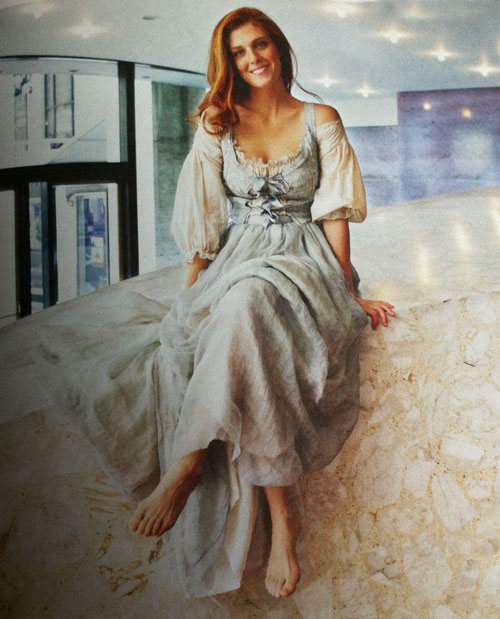
Mezzo-soprano Wallis Giunta as she appears in re:porter, Porter Airlines magazine (photo: Michael Edwards; costume by Camille Assaf)

Mezzo-soprano Wallis Giunta as she appears in re:porter, Porter Airlines magazine (photo: Michael Edwards; costume by Camille Assaf)

Have you seen this smile?

That’s Wallis Giunta, who may have caught your eye in the in-flight magazine you’d casually leaf through if you were flying Porter airlines between New York and Toronto: as Giunta herself likely does.  A graduate of the Canadian Opera Company ensemble studio (Toronto), currently a member of the Metropolitan Opera’s Lindemann Young Artist Development Program (NYC) you’ll often find the talented mezzo-soprano performing in one city or the other.

Giunta’s first appearances caught the eye of the critics in her first NY Dorabella:

  • Opera News
    “The two standouts in the principal cast were Canadian mezzo soprano Wallis Giunta as Dorabella, and Californian bass-baritone Evan Hughes, as Don Alfonso. Giunta, a saucer-eyed, red-headed stunner, sang and cavorted with star-quality grace and point and offered delicious comic timing; if anyone is thinking of making ‘Born Yesterday’ into an opera, this is your girl.”
  • Anthony Tommasini  (NY Times)
    “Wallis Giunta, with her chocolaty and penetrating mezzo-soprano voice, is a more down-to-earth Dorabella”

Clearly she’s off to a great start.

And there’s more to come.  2:00 pm March 24th at Glenn Gould Studio in Toronto is Giunta’s ‘CANADIAN VOICES’ recital.  In April Giunta makes her mainstage debut at the Met as Countess Ceprano in Rigoletto.

But first we get to see Giunta as Annio in La Clemenza di Tito, one of the moral pillars in a mad world of flattery, influence & manipulation, The production goes up next Sunday February 3rd.  By the way, I can’t tell you how thrilled I am by Giunta’s take on the role …see below.

I ask Giunta ten questions: five about herself and five about her portrayal of Annio.

1) Which of your parents do you resemble (what’s your nationality / ethnic background)?

Wallis Giunta, wearing McCaffrey Haute Couture (photo Miv Fournier)

Wallis Giunta, wearing McCaffrey Haute Couture (photo Miv Fournier)

I am a good blend of both my parents, actually. I have a few features from each of them, and therefore don’t look particularly like either one. Especially since they both have dark hair! From my Scottish/ Irish side, I got my red hair and freckles, and from my Italian side, my ability to tan, and maybe my voice?

2) What is the best thing / worst thing about being an opera singer?

The best thing about being an opera singer is that someone pays me to do what I would be doing for free anyway, because I love it so much. I suppose the worst thing could be, as a colleague recently told me, always asking for a table for one.

3) Who do you like to listen to or watch?

My favourite artists to listen to are mostly in the folk/alt-country realm. Top of the list would be Patty Griffin, and her first album, Living with Ghosts. I also LOVE Ray Lamontagne, who I just had the great honour to see live at Carnegie Hall with front row seats. Next, I could listen to Alison Krauss and her pure, golden voice all day. I saw her, along with Ray, last year at the Bonnaroo festival (heaven). Another contender would be the one-man-band, didgeridoo sensation, Xavier Rudd. I have seen him many times, and his music makes me so happy.

For opera, I love to watch and listen to Giuseppe Giacomini! Over and over. The most epic tenor I have ever heard, and so totally underrated. 

4) What ability or skill do you wish you had, that you don’t have?

In the realm of the possible, I wish I could speak all languages perfectly, and switch between them with ease. And if magic skills were an option, I would like invisibility. Hmmm, both of these skills would make me an excellent spy…

5) When you’re just relaxing and not working what is your favourite thing to do?

Riding my bike somewhere lovely, and reading in the sun!

Five more about playing Annio in the COC production of La Clemenza di Tito

1) How does portraying the trouser-role of Annio challenge you?

I think Annio is the oldest male character I have performed (and he’s only about 20), so I have to work more on the male physicality here. When you’re playing a pubescent boy, like Cherubino, you can get away with a bit less manly body language, because they’re just so awkward at that age.

2) What do you love about Annio: both the role & your part in Christopher Alden’s production?

On our first day of rehearsals, Christopher told me that my character would be based on Michael Cera’s role in Juno. If you’ve seen that movie (which you should!), you’ll know why I love this Annio so much.   Also, no matter what the take on it, he is a really good, caring, deep-feeling guy, and it breaks my heart how much he tries to help people in the opera, and sacrifice his own happiness for that of others.

3) Do you have a favourite moment in Clemenza di Tito?

Giunta’s colleague and fellow trouser-wearer Isabel Leonard (photo: Jared Slater)

Yes. Isabel Leonard’s Deh Per Questo is my favourite part of the show. She sings it so beautifully, with both strength and fragility. The power of the staging in its simplicity, and the desperation of her plea to Tito just floors me.

4) How do you relate to Annio as a modern woman?

Hmmm. The interesting thing about our production is that both of the pant role characters are dressed in a not-very-manly way. I think that allows the audience to feel more comfortable with the fact that they’re aware we are not men. And then we can just get on with it. Ultimately, this piece comes down to power and how it corrupts. I think one’s sex has no bearing on that, and I relate to it on a human level above anything to do with gender.

5) Is there an influential recording you’d care to name that you especially admire?

For this role, I didn’t consult a particular recording, as I have often done with other pieces. I guess Mozart just makes sense to me now, having done so much of it. I get the music when I’m learning it, without having to hear it all in full.

~~~~~

Yes: March means a concert in Toronto, April, Rigoletto in NYC.  But first it’s Annio in La Clemenza di Tito in Toronto.  For ticket info click here.

Posted in Interviews | Tagged , , , , , , , , , | 2 Comments