Topic of cancer

Spoiler alert: unavoidably I have to talk about the way some films end because that’s central to this discussion.  If you don’t want me to reveal how 50/50 ends please stop reading…Anyone still there?

Having seen Dani Girl, a provocative musical being presented in Toronto about a child with cancer, I decided to watch 50 / 50, a film about a young man with cancer.  Although I’d meant to see 50/50 somehow I missed it.  I think I may have been afraid of it, and so conveniently let it come and go.  I knew I’d eventually catch up to it on the small screen, where I watched it last night.

Linda & Michael Hutcheon

Linda & Michael Hutcheon

Linda and Michael Hutcheon have written extensively concerning the way disease and death are represented in opera. Their book Opera: Desire, Disease, Death (1996) looks at several topics; one section compares the way tuberculosis is portrayed in Verdi’s La Traviata and Puccini’s La bohème, suggesting that we can learn something about a culture from the changing ways a disease is represented in art.  I am mindful of their readings of different versions of TB as I ponder Dani Girl, 50/50, and think of other films that include cancer.  I don’t propose to offer comparable analyses in this small space, but I am simply remembering that Hollywood doesn’t undertake big subjects lightly.  If we notice any trends they are probably meaningful, and possible signals of important cultural shifts.

There have been films about cancer for a long time; perhaps there are several genres we can identify.

Dark Victory (1934) is an example of the malignant storyline, where a tragic outcome is more or less a foregone conclusion reflecting the usual perception that cancer is incurable.  Wit (2001) is another example of the same powerful plotline.

There are gentler ways to tell these tales.  My Life (1993) and Life as a House (2001) frame that same dark journey in terms of the impact on family and the romantic attempt to find meaning in the struggle.  These are uplifting films that make one feel better about the outcome even if cancer is still presented as invincible.

Cancer can figure prominently in the background of a film.  Terms of Endearment(1983) resembles Wit and Dark Victory in some respects, yet is largely framed by a relationship between the mother and her sick daughter, and not solely concerned with the daughter’s death. In both Stepmom (1998)  and Erin Brockovitch (2000) cancer is also key element in the struggle of the protagonist; but in all of these films, the key message is that in spite of cancer & death, “life goes on”.

I think 50 /50 is a signal of something new.  I will do everything I can to avoid being a spoiler (giving away the ending).  In 50/50 I believe we get a very realistic portrayal.  Cancer doesn’t suddenly throw a monkey wrench into an otherwise successful life, as it seems to do in Dark Victory, Terms of Endearment and Wit.   The main character in 50/50 is Adam (Joseph Gordon-Levitt), a young man who’s in an unhappy relationship with an artist who’s taking advantage of him, and has a terrible relationship with his mother Diane (Angelica Huston, in the least glamorous role I’ve ever seen her undertake).  Diane is watching her husband fade away due to Alzheimers, and so hangs on to Adam a bit harder than she might otherwise, a mom whose offers of help are almost completely unwelcome.

The catalyst for much of the dialogue in the film is Adam’s friend Kyle (Seth Rogen), offering his usual assortment of embarrassing adolescent behaviours.  Kyle is more than a confidant for Adam, as he seems to function as the voice in his ear as if he were a kind of goofy macho superego, reminding Adam of what a normal male does or does not do.  Instead of having to see Adam struggle with manhood issues, Kyle is a wonderful plot contrivance to externalize the more extreme responses that Adam –passive and ill—is largely unable to verbalize.  Similarly we watch Adam’s awkward scenes with his therapist Katherine (Anna Kendrick), opportunities for us to find out what he’s feeling as he copes with the different stages of his illness and confronts the possibilities of death.

Written by Will Reiser, directed by Jonathan Levine, 50/50 gives us a version of cancer that’s not nearly so daunting even if death is still front and centre in this film.  The title refers to the odds Adam faces with his particular kind of cancer.  Rogen & Gordon-Levitt are an intriguing team together.  I am not sure I believe that these two would really be friends, yet I’ve seen odder things in real life.

One film can’t really be understood as a trend, but a dose of 50/50 after seeing Dani Girl suggests that cancer is no longer quite the terrifying bogeyman, its invincibility now open to question.

I’m looking forward to seeing both the film and the musical again.

Posted in Books & Literature, Cinema, video & DVDs, Dance, theatre & musicals, Essays | Tagged , , , , , , , , , , , | Leave a comment

Tryst with Liszt

Neapolitan Connection presented “A Romantic Music Tryst with Liszt,” as a much a playful exploration as a concert, presented in the intimate Studio Theatre at the Toronto Centre for the Arts.

Danhauser's "Liszt at the Piano"

Danhauser's "Liszt at the Piano".

The piano was not set up for a recital, but hidden behind a curtain, which opened upon a tableau vivant, a living reconstruction of Josef Danhauser’s painting Liszt at the Piano.  The spirit of this painting—an imaginary meeting of different artists working across several art-forms—was also channelled by the performers in the concert.

We began with excerpts from the first year (“Suisse”) of Années de Pelerinage (“Years of Pilgrimage”), a kind of musical travelogue inspired by Liszt’s youthful travels and his literary & spiritual influences.  We saw Angela Park sit down to the piano, apparently in the company of Liszt’s contemporaries (George Sand, Victor Hugo, Alexandre Dumas and more, in period costumes, as if in a salon to hear Liszt playing) as well as the two key earlier influences on the wall (Beethoven and Byron).

Pianist Angela Park

Pianist Angela Park (photo by Helen Tansey Photography)

Park was particularly persuasive with “Au bord d’une source” and “Vallée d’Obermann,” confidently articulating every note.

After having heard from the expected side of Liszt –namely compositions for piano virtuoso—we went in a new direction with Park accompanying cellistRachel Mercer.  Although Liszt is known for piano transcriptions –paraphrases of opera excerpts, orchestral masterpieces, and more—that was flipped on its head, as Mercer played transcriptions of Liszt pieces (returning the favour he had offered to so many composers), by turning piano music into cello music.

Mercer gave us a very lyrical version of “La Lugubre Gondola”, a piece known for its ambiguous tonalities and subtle moods, followed by a soulful reading of Liszt’s most famous tune of all, namely his “Liebestraum #3”.

The last section of the concert featured another change of direction, as soprano Eve Rachel McLeod sang Victor Hugo Lieder, again accompanied by Park.  While McLeod has a voice of genuinely operatic power, she kept it gentle, always soaring gently to high notes while respecting the intimacy of the venue.  And she was fortunate to have a pianist—Park—who was capable of handling the formidable challenges of these song accompaniments.

Neapolitan Connection are to be congratulated, both as organizers of such an original presentation, and for bringing talented young performers before Toronto audiences.  Their next project is “French Impressions: Soirées with Debussy, Ravel & Poulenc”.

Posted in Reviews | Tagged , , , , , , | Leave a comment

Dani Girl

Dani Girl is an original musical from the young team of Michael Kooman (music) and Christopher Dimond (book & lyrics), now at the beginning of a Toronto run co-produced by Talk is Free Theatre and Show One Productions.

Kooman and Dimond

Michael Kooman (music) and Chris Dimond (book & lyrics)

Watching this show, I couldn’t help musing on the form of “the musical” and wondering about all the possible places that ambitious new composers and writers could take the medium.  Dani Girl is a curious combination, simultaneously ambitious and conservative.  Its music is very listenable, without anything radical or strange, while sounding like a lot of the musicals I’ve heard.

flyer

Dani Girl poster

Even so, I believe Dani Girl is a very challenging creation, taking the musical places it has never gone before.  And so while the unfolding story challenges the audience its score is wonderfully understated.  Kooman shows the mastery of an old pro even though he’s very young, never letting his ego get in the way of Dani Girl, but always providing support, diversion, or whatever is needed at that precise moment and nothing more.  If its musical score were also full of innovations (and it does have its share of passages in quintuple time) I believe it would be too much for an audience to handle.

How is it challenging? Nine year old Dani has lost her hair because she’s very sick and is possibly dying.  We get to know her, her mother, a hospital room-mate, and assorted creatures of her wonderfully vivid imagination as she goes on a quest for the meaning of life: and her hair.  It has to be a musical of course.

I suspect that Broadway has been hesitant, considering the sensitive subject matter, but I think Dani Girl will work at the box office once somebody gives it a chance there.  In the meantime—while we wait for someone to produce the show in NYC—cities like Toronto get productions of Dani Girl, wondering about its eventual success.

I found myself musing about the casting choices.  Of the four parts two are adult and two are children, although the “children” (who are perhaps nine years old) are played by young adults in this production.  The music is probably too difficult for a child of that age, so of course we need young adults.  But so much of this play is fantasy, the imaginative explorations inside Dani’s head, that we’re already in such an artificial world that we wouldn’t require such verisimilitude.  By having cute young adults portraying children we have another layer of artifice whereby we can feel a little safer with this material, than if we were actually watching sick children onstage.

But we are indeed swallowed up in Dani’s world.  Gabi Epstein (Dani) deserves  credit for effortlessly pulling us into the world of this wonderfully articulate child that we care about from the beginning.  Hers is a no-gimmick performance to match Kooman’s understated score, cutting to the chase.

Director Richard Ouzounian helps Epstein and company reconcile the high-energy extroversion you usually find in a musical, and the sensitive internal feelings that are at the heart of Dani Girl.  Ouzounian honours the energy in the text, never allowing the piece to sink under the weight of its subject matter, while giving it a fair hearing.

One reason Dani Girl will likely be a huge success, (at least once people get to know it) is because it manages to be so powerful while employing a tiny cast, namely the Mother, Marty (sharing Dani’s hospital room), and Rafe, a third, more elusive figure, who plays many different males in Dani’s life.

Rafe is the real star turn in the piece, as varied as an impressionist or a good sketch comedian, including moments when he is both God and Evil Incarnate.  Jeff Madden selflessly puts Rafe completely at the disposal of Ouzounian and Epstein, ready whenever he was required to suddenly inject life or humour or nastiness into the play, and then vanish into the woodwork.  Rafe is the dark underside of Dani’s imagination, and a madcap contrast to the other three figures onstage, who signify people in Dani’s life.

Amanda LeBlanc as the Mother brings a seriousness that balances the prevailing tone of playfulness in the production, and some of the nicest singing in the show.  Jonathan Logan joins Dani in her adventures as Marty, another sick child who quickly becomes an important part of Dani’s journey.

This is a small scale musical, employing a keyboardist (music director Wayne Gwillim) and percussionist (Jamie Drake) to populate the tiny space of the Passe Muraille Backspace with the many images of Dani’s fertile imagination.  While the energy is high, the predominant texture is clean & clear, never obscuring the words or the emotions, which, when I consider the complexities of the subjects that Dani Girl undertakes, is an astonishing achievement.

I think anyone venturing into the world of Dani Girl may surprise themselves at how they respond to this remarkable piece of music theatre.  I am expecting that once word gets around, the show will be held over due to high demand.  I hope so, because I want to see it again.

Dani Girl 416-504-7529  www.artsboxoffice.ca

Here’s a sample–one of the songs that’s already become well known–from youtube.  While the credit doesn’t mention it, I believe that’s none other than Kooman (pianist) & Dimond (page-turner) as part of the bargain!

Posted in Dance, theatre & musicals, Reviews | Tagged , , , , , , , , | Leave a comment

Enigmatic Liszt

Franz Liszt

A portrait of Franz Liszt

There’s more to Franz Liszt than most people realize.  If you ask a musicologist they’ll usually rattle off a series of truisms:

  • one of the first great virtuosi for the piano, possibly the greatest pianist in history
  • Wagner’s father-in-law
  • Long-lived
  • Invented the piano recital and the orchestral tone-poem

You wouldn’t normally think of someone famous as a puzzle.  But when there are so many chunks of information, both anecdotal and factual, the image can get quite fuzzy, something like being unable to see the forest for the trees.

I think the historical image of Liszt is understandable.  Scholars hear descriptive epithets that become ingrained, at least until someone comes along to challenge and possibly overturn the earlier myth.  Consider for example

  • Debussy the “impressionist” (completely wrong…although come to think of it, the word “impressionist” is itself often mis-used by those who don’t really know what it means)
  • Schumann as a bad orchestrator (rather hard to test if you’re listening to altered versions by other composers, played on modern instruments)

I only brought those up to suggest that those stereotypes are destructive and counter-productive.  No composer should be reduced to a list of bullets such as the ones I listed above.  Composers should not be compared and rated like the young talent on American Idol.  But unfortunately music education has often been influenced by a competitive model of skill and excellence, given that this was often the paradigm for training performers. 

I am particularly curious about new combinations and approaches to a composer, because they’re opportunities to hear a familiar composer with fresh ears.  I wrote about John Dowland recently, excited by a new CD of his music exploring his alleged Irish connection via a very Celtic approach.  I suggested –not entirely as a rhetorical position—that every performance or creative project is in some sense an experiment, a hypothesis put to the audience, even if the audience prefer the same old same old.

I am intrigued by an upcoming concert Sunday February 19th titled “A Romantic Music Tryst With Liszt,” hoping it will shed light on a different side of a composer who’s been stereotyped in the ways I outlined above.  Instead of the usual pianistic warhorses, we’ll get something a bit different, including songs and chamber works.

As I seek a new perspective, here are a few alternative notions about Liszt:

  • Speaking as a Hungarian, it always feels weird to me to call him “Franz Liszt” (using a German first name).  I prefer “Liszt”, if not “Liszt Ferenc” (using the Hungarian custom of reversing surname & given name).
  • Liszt was one of the first great philanthropist artists.  Long before “Band Aid” in the 80s, or George Harrison’s concerts for Bangla Desh (aka “Concert for Bangladesh”), Liszt offered his services to raise funds for flood victims in eastern Europe, or to help raise money for assorted good causes.
  • Liszt was a mentor to other artists.  While Liszt’s help to Wagner is well-documented, that’s just one case.  Liszt championed such works as Beethoven’s symphonies as well as Berlioz’s Symphonie Fantastique through his transcriptions that the pianist played all over Europe, helping in their rediscovery/popularization.
  • Liszt was a great piano teacher, wealthy from his concerts and therefore able to choose projects out of interest rather than concern for financial gain.
  • Liszt’s experiments in tonality have not been given a proper hearing, compositions anticipating the works of Debussy and even Schoenberg.

I am looking forward to discovering more about this intriguing man and his music.  A Romantic Music Tryst With Liszt is on Sunday at 3:00 pm, at the Toronto Centre for the Arts presented by Neapolitan Connection.

Posted in Essays | Tagged , , , , | Leave a comment

Unexpected Tosca

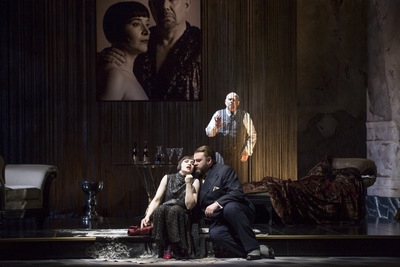
Just when you think you know how a story will turn out –because it’s such a well-known opera—they throw you a curve.  There’s no drama quite like experiencing a work you think you know, where they’ve changed the usual ending.

Before the Canadian Opera Company performance of Tosca tonight the dreaded announcement came: that Adrienne Pieczonka was unwell.  But this wasn’t the usual kind of announcement, of vocal indisposition and the need to replace the star.  No, Pieczonka would sing, but she had injured her knee, and so the announcement begged our indulgence because she would not be able to give us the usual staging.

Hm… okay.  I know I wasn’t the only one wondering what this might mean.

To be honest, I watched her come striding in after singing “Mario, Mario, Mario” (and his reply of “son qui”), and wondered if perhaps the announcement was unnecessary.  She seemed fine.

I forgot all about it except for two rather key moments in the opera.

Key moment number ONE was during the aria “vissi d’arte”, sung sitting in an upright position.  Perhaps this was the usual staging but the point is I found myself wondering about the sore knee, and whether this was being done differently.  As for the aria?  Begun very softly, Pieczonka raised her game at this point, giving us a diminuendo at the end of the aria, delicacy, and an unmistakeable sense of drama.  I know I wasn’t the only one paying special attention to her health, and feeling gratitude for her singing.

Key moment TWO? As I look back upon it, this was the obvious place where you’d expect a Tosca with a sore knee to have a problem, namely the end.  Tosca is supposed to jump off a high parapet to her death at the conclusion of the opera.  Normally this means she goes to the edge and jumps down a wee bit, into something padded.  But with a sore knee, could she even do that?  But I wasn’t thinking about this as the last moment of the opera unfolded.

The way they staged it was so clever I didn’t realize at first just what they were doing.  The pursuing police (Spoletta and members of the chorus) were confronted by a locked door, so that as we come to the key phrase where Tosca would jump, they are delayed.  They finally get that door open at the very end, pursue partway, while Tosca goes to the brink of the parapet from which a healthy Tosca would seem to jump.  Pieczonka moved a bit and then froze: a solution of elegant simplicity.  The applause in the house was marked by an audible sound of recognition as we understood, yes, she couldn’t jump, and had still managed to do something wonderful with those final moments.  While I am sorry for Pieczonka’s injury, the little drama of the ending was quite marvellous to witness and a very different experience from what i had expected.

This is my second look at this production, employing a cast that’s a complete contrast to the one I saw before.  If one were to put labels on the casts, I believe these singers –Pieczonka and tenor Carlo Ventre—who were given opening night and more performances than the other cast, would be understood as the “A” cast (Ventre with ten of fourteen performances, Pieczonka with eight of the fourteen), while the other two –Julie Makerov and Brandon Jovanovich—whom I’d seen earlier were the “B” cast.

Let’s keep this positive shall we?

The “A” cast has the two singers who probably command the higher fees and are better known.  Pieczonka can be an amazing actor, and did manage wonderfully in Act II, when she was opposite Scarpia Mark Delavan (who sang all performances).

Ventre sang with power, but unfortunately I saw little chemistry between him and Pieczonka.  I don’t think that can be explained by the knee injury, given how wonderful Pieczonka played her scenes opposite Delavan.

I prefer the experience I had watching the other cast.  The moment that sums it up for me is that passage in Act II, just after Cavaradossi has cursed Tosca for having betrayed him.

When it was Jovanovich hearing the news that in fact Bonaparte had won the battle of Marengo, he struggles to his feet, shaking with something resembling hysterical energy or shock, in the aftermath of torture.  Yes he managed the high note, singing “vittoria” fairly well, although nowhere near as loud nor strong nor nearly as long as Ventre’s high note.

Jovanovich did not climb to his feet merely to prepare his body for the best position to hit a high note.  Oh no.  I was totally lost in Jovanovich’s passion, an explosion of energy.  Scarpia’s thugs struggled to subdue him, as he was for the moment superhuman in his singing and physical strength.  Roberti finally has to inject him from behind as if he were a wild dog.  Makerov’s expressions of despair as his limp body is dragged off were the perfect match for this horrific display, the first time I have ever felt the action and singing express the music perfectly.

Ventre in contrast stands up to sing a high note, then clings to the back of the couch while the unfortunate thugs pretend to be unable to dislodge him from his prime singing location.  He is finally injected and dragged off.    If this was 1950 I believe that would mean Ventre’s approach would be preferable.  But in 2012 we expect a little more.

In fairness it’s a very difficult moment to bring off, musically difficult & a busy moment onstage as well.  Have a look at one version on video, to see just how hard it is to make it work even when sung well.

Mark Delavan was wonderful in both performances I saw, but I believe there was more subtlety opposite Makerov & Jovanovich.  Ventre & Pieczonka, standing and singing splendidly without much real interaction left him with the usual melodramatic options of a typical Scarpia.

Tosca is an incredible opera, marvellous to watch whether given the subtle ensemble treatment (which I prefer) or the star turns we saw tonight.  The COC production continues until February 25th at the Four Seasons Centre.

Posted in Opera, Reviews | Tagged , , , , , , , , , , | Leave a comment

Dowland in Dublin

A professor I once had claimed that art could be understood as a kind of research.  Something newly created is a proposition to be tested against the taste of every new audience, seeking a fair hearing and possibly a genuine connection; but it’s not science. No, the hypothesis in a novel or poem is not being proven or refuted according to the scientific method.  But there is still a kind of speculation in all art, a seeking for connections and truths.

ATMA CD Dowland in Dublin

Dowland in Dublin

This is especially the case with a new CD I’ve been listening to (my companion in the car for about two weeks, played over and over) called Dowland in Dublin, teaming young American tenor Michael Slattery with the Canadian baroque instrumental ensemble La Nef.  I wondered about the premise, whereby the songs of English composer John Dowland should be presented in a more Irish fashion.

Sylvain Bergeron of Le Nef says the following in the liner notes to Dowland in Dublin:

  The idea for this project was sparked when, at the end of a La Nef Christmas party, Seán Dagher charmed all who were listening when he took out his cittern and began to sing “Come Again” as a folk song.
Working closely with Michael Slattery, we began to strip some of Dowland’s Ayres of their complex contrapuntal accompaniments, seeking to give them a simple Celtic flavour.  We hope that the music on this CD, midway between folks songs and art songs, charm you as much as it does us.  Cheers!

I wonder if Dagher’s fun experiment came before or after they learned that Dowland may have been Irish?  I never realized this possibility until reading the notes to this recording.  For example, the dedication to the song “From Silent Night” published in a 1612 collection says “to my loving countryman, Mr John Forster the younger, merchant of Dublin, in Ireland.

The CD is less an attempt to settle the matter of Dowland’s nationality than a delightful project, exploring another way of doing some wonderful songs.

Slattery’s sweet voice is recorded with delicious clarity, always intimate rather than over-powering, but with a remarkable range of sounds, expressions, and inflections.  At times the subtleties in his delivery remind us of the Shakespearean, but we’re hearing the comic voice of Twelfth Night or The Tempest, not the elevated language of histories or tragedies. These are love songs, sometimes melancholy and plaintive, sometimes exultant and erotic.  Slattery’s boyish voice celebrates love and beauty with every phrase.

In my recent interview with Slattery, he mentioned Sting’s versions of Dowland as an influence, but not at all as I had expected:

 I have to admit, I was surprised to hear Sting’s CD of Dowland songs.  We had already begun working on this concept, so I was disappointed to think that there would be many out there who might think his CD was the reason we decided to do this.  As much as I resisted it, his CD ended up influencing me, because it confirmed for me what I didn’t want to do.  I found some of his settings very successful, and interestingly enough, they were the tracks where you could hear Sting’s influence most strongly.  Less successful for me were the times that he approached the songs in a more traditional way.  Hearing his CD gave me the courage to let go of the tradition completely and bring more of myself to our project.

I think Slattery’s words are a very good indication of what you’ll find on this CD.  On my first listen-through of the CD I was genuinely confused, at the unpretentiousness of the songs, that have the accessibility of popular music.  I need to unpack that phrase, because of course I don’t mean hip-hop or something amplified, and certainly nothing as commercial as Sting’s work.  No, I meant music that has you humming the tune afterwards, and that can be true of anything from McCartney or from Mozart.  I now have at least three songs in my head, and whenever I think of them I smile automatically.

La Nef is not to be under-rated in this project, not merely accompanying Slattery, but in fact setting the tone throughout.  Some of the songs are instrumentals, making for a marvellous serenade that rises and falls in energy and mood.  The more I listen, the more impressed I am at this creation, a wonderful piece of archaeology that seems to unearth another version of Dowland, if not the genuine original.  I don’t know whether this will strike listeners as real or alternative, but I believe it’s a valid contribution, both as a kind of speculative musicology –via performance research—and of course as a really cool CD.

I find myself taking the CD and playing it over and over, never tiring of it.  I suppose that it won’t surprise you that I believe Dowland in Dublin deserves to be heard and heard again.

Posted in Reviews | Tagged , , , | 8 Comments

Multiple voices

It’s a curious coincidence.  The two debuts in popular music that I felt at the most visceral level, even though they were separated by many years and with an ocean between them, have something else in common.  No I didn’t mean substance abuse, but rather the simple and sad fact that they both died in the past year.  Amy Winehouse passed away in July 2011, while Whitney Houston died just this past weekend, on February 11th.

I don’t remember where I was the first time I heard “How Will I Know”, nor can I give you the date, but it was in the 1980s, and “HWIK” was not just the first song I heard from Whitney Houston, but the song that made the most lasting impression on me.

And I recall the first time I heard “Rehab”, Winehouse’s first hit.  When I asked the people in the room with me about the nameless song (they had the radio tuned to a top-40 station) they had no idea because they really didn’t notice it and didn’t especially like it.  It took me several days before I was able to figure out the name of the song & the artist. While “Rehab” never made number one, it spoke as directly to me as if she and I were old friends.  In the first few seconds I thought I’d stumbled upon a song by an R & B artist who’d languished in obscurity (perhaps from the 50s or 60s) and not a new singer at all.

In the space between the songs there’s a whole world of difference that could inspire books.  But I’m musing about voice not life, so let’s forget all about substances & lives abused.  I may sound a bit unorthodox in this analysis as I go on to observe the effects some classical singers achieve using techniques that are somewhat similar if not the same.

I guess I have a thing for divas.

While “HWIK” was not Houston’s first hit in the USA, for some reason it was her first #1 in Canada, which may have more to do with the taste of the radio DJs than anything else; but I remember it as if it were her first. What grabbed me on that occasion was something I have noticed since that time in the singing in several disciplines.

Listen to HWIK.     In passing you may observe dated arrangements, clunky rhythm tracks and the cheesy synth sounds; and yes, the text that still seems very concerned about how much genuine sexuality this young female artist can show.

She has to ask a friend –“because you know about these things”—rather than show too much confidence.  Her persona flips back and forth between a strong assertive complaint (“how will I know”) and a more meek persona (“I’m too shy”).

And vocally, she flips around between at least two different approaches to the use of her registers.  Notice that sometimes Houston seems to take a decade off her age, becoming a virtual innocent in her soft cooing voice, and then a moment later suddenly sounds powerful as she belts.  It almost seems as if there were two voices inside the one woman.

Now listen to a far different kind of song, again without any visual distractions.  In the roughly twenty years between the two songs, the world had changed substantially.  Where Houston, being the first woman to achieve three number one singles from the same album, was held back at least by industry expectations if not also by cultural resistance to a strong black female asserting herself, the stage onto which Winehouse stepped in 2006 was entirely different.

“Rehab” has very little innocence to it, but even so does have moments of remarkable vulnerability.  Winehouse also shows us at least a couple of different combinations of her registers, mostly sounding empowered and obstinate, but occasionally using a sound that floats sweetly.  Once again, it’s as though there’s more than one voice, more than one Winehouse.

I don’t propose to offer any conclusions.  Instead, I simply want to observe that the vocal artistry in the popular realm has parallels in the classical realm, and to juxtapose performances to suggest ways in which these different sorts of vocalism inform one another.  Think about the ways in which Houston and Winehouse portray the passions through their voices, showing love and fear and strength and weakness.  And then, don’t be surprised when you see similar dramas acted out on the virtual stage of the voice.

Soprano Renee Fleming

Soprano Renee Fleming (Photo Credit: Decca/Andrew Eccles)

It may be hard to remember after those two songs, but at one time women were far from view, not just covered up.  In a world without pornography and media for instant gratification, women’s vocal exhibitionism compensated for what couldn’t be seen, in the sounds of passion.  A tearful heart-break sung onstage brought the voyeuristic audience into a kind of intimate union with the diva: centuries ago.

From what I understand from my reading, the performance I will post immediately below for your listening pleasure breaks the rules for proper bel canto singing: at least as far as those rules have validity.  Of course the aria I am posting pre-dates bel canto by more than a century, so the rules are irrelevant, especially considering the extraordinary eroticism one can experience in the breaking of those rules.  Is this just a modern day transgression, influenced by the brilliance of women such as Houston? or possibly a rediscovery of a way of singing that was employed before?  This is Renée Fleming singing Alcina’s lament “Mi restano le lagrime,“ tearfully accepting defeat.

Purists may dislike the way the voice freely uses dark and light colouring from the registers to add expression with the abandon of a pop singer.  Nowadays I wonder whether we’re literate in a new way, sensitive to vocal stylings and their emotional under-pinnings.  In effect every person has at least two voices inside.  We have the tough dominating voice of anger or triumph, from the adult voice of our lower register, and the gentler sounds of our youthful upper register, useful for soulful musing or surrender.  How we blend those two registers allows us several additional possibilities, and that’s before we add the inflections, expressions and interpretive extras.

Listening to Fleming in context with Houston & Winehouse, I am especially impressed.  Whatever musical idiom one works in, the voice is an astonishingly deep medium for conveying human emotion.  While we now have permission to show just about everything in film or on stage, we haven’t outgrown the pure enjoyment of the voice.

Or should I say “voices”?

Coincidentally, it’s Fleming’s birthday on February 14th.

Posted in Essays | Tagged , , , , , , , | 3 Comments

Closing the Ring

I love it.

When you’re writing about a great massive project it’s easy to be verbose, a lot harder to say something meaningful that’s brief, so let me get the most important part out of the way.  As I said: I love it.

I am writing after having seen the last of the four Ring operas in the new Metropolitan Opera productions by Robert Lepage, broadcast into movie theatres.  Wow, that’s already long-winded and I didn’t even mention the ponderous name of the opera, Die Götterdämmerung or The Twlight of the Gods.  Yet all the seats in this Toronto theatre were occupied, even on the morning after a snowstorm.

My sense that the broadcast audience is now competing with, if not actually supplanting the live audience, was confirmed again today. These broadcasts are like a modern version of the Serlian stage, which employed a kind of perspective whereby only the Prince saw the accurate perspective, while everyone else saw something a little bit distorted.  In the modern version the theatre audience enjoy the princely point of view, even though our individual seats are cheaper than those in the theatre; but our aggregate buying power represents a bigger chunk of revenue for the Met than all those at Lincoln Centre in person.

I am a bit mystified, trying to understand the ongoing negativity emanating out of New York City in response to Lepage’s work.  There are moments in this production that work, some that don’t, just as in the other three operas, just as happens in almost any opera production.  I was always intrigued, often transported to a different world, and never bored.  While it saddens me that there isn’t a large consensus in support of Lepage, I won’t let that stop me.

I  don’t believe I’ve seen any reviewer who’s happy with the way Grane (the horse) was presented, which is especially odd in a year when puppets seem to be everywhere.  I believe the choice to use this kind of symbolic approach is wonderful, given how difficult the material being presented, both in the Prologue (where Siegfried takes Brunnhilde’s horse and rides off into the sunset), and the last scene (where Brunnhilde gets on that horse, sings lovingly to the horse about the horse’s master –and her husband–and then rides that horse onto Siegfried’s funeral pyre).  Realism isn’t an option, not if you plan to ever have a second performance (!!!).

Some scenes worked better than others.  I was not thrilled by the norns, but then again if any scene is going to fail, that’s probably the best one you could choose (at the very beginning of a long work). The very end of the opera –arguably the single most difficult moment in all of opera to stage persuasively– worked fairly well, even if I’d hoped for something more apocalyptic.

I was completely enraptured watching the Rhine Maidens in Act III, scampering up the sloped set, and thereby allowing the scene to play almost as written: amazing considering that the scene takes place on the banks of the river Rhine, a conversation between three swimming nymphs and Siegfried on shore.  What Lepage gave us was playful, poetic, and so totally stunningly beautiful that my jaw was hanging open for minutes at a time, in awe.

Fabio Luisi

Fabio Luisi (photo: Barbara Luisi)

Musically? heaven.  Fabio Luisi was the chief architect of that celestial experience, with his brisk tempi.  Going quickly seemed to serve the principals well, helping Deborah Voigt to sing wonderfully, especially in the prologue duet and the swearing of oaths sequence in the Hall of the Gibichungs in Act II.  The Immolation scene to end the opera was like a vindication for Voigt, who has brought her conviction and stage sense to a new level.  I admit I had my doubts, but now am delighted to see genuine growth in this artist, a new mastery.

The most powerful performer on the stage was Hans-Peter König as Hagen. Possessed of a physical stature and huge voice, one would expect him to dominate, yet König underplayed throughout, even as his voice steadily reminded us of his presence. König has one of the great voices in the world today, and is likely to be a star for years to come.

Hans Peter Konig

Bass Hans-Peter König

There’s a great deal more in this production to appreciate.  Jay Hunter Morris was splendid dramatically as Siegfried, and sounding good for much of the opera.  Wendy Bryn Harmer’s Gutrune was a wonderful contrast to Voigt’s Brunnhilde, vulnerable, yielding and full of self-doubt, in contrast to Voigt’s passionate intensity.  Iain Paterson made more of Gunther than some, finding an intriguing combination of whiny entitlement & guilty remorse, all the while sounding quite wonderful.  In addition, there were two wonderful little cameos, namely Waltraud  Meier’s feverish Waltraute (imagine a guy named Romeo playing Romeo: as this is surely a part she was born to play), and Eric Owens’ maniacal Alberich.

I’ll elaborate on an idea about Lepage’s machine I expressed in a recent post about this Ring cycle.  Lots has been written about the machinery for Lepage’s Ring, a huge computer driven machine that changes shape, sometimes used as a stage, sometimes as a backdrop, sometimes a project surface, that’s been christened “The Machine”.  I said that the machine can epitomize this Ring, suggesting the world’s protean and changeable nature.  Erda cautions Wotan near the end of  Das Rheingold, saying “Alles was ist, endet.”  (Everything that is, ends) This is not a Ring informed by odd philosophical ideas or readings imposed upon the text.  Lepage has given us back many of the moments in the Ring that had fallen by the wayside in generations of static understatement.  Grane is back.  The forest bird AND the ravens were there.  We actually saw Siegfried carried during his funeral music, saw him on a funeral pyre, saw fire (sort of) followed by the river overflowing (sort of).  We saw gods falling after a fashion. I guess you can’t please everyone.

But I really liked it.

The complete cycle can be seen this spring for those who can get to NYC.

Posted in Opera, Reviews | Tagged , , , , , , , , , , , | 5 Comments

Opera Atelier Lays Claim to a New Period

Opera Atelier announced their 2012-2013 season, a revival of Mozart’s Magic Flute and a new production of Weber’s Der Freischütz.  This time they’re trying something new.

OA are remarkable in the way they build upon their strengths.  Over their quarter of a century of existence, they’ve gradually expanded their repertoire, one opera at a time, but carefully revisiting and improving the operas in that repertoire.

They started with baroque operas.  I think Dido and Aeneas was their first.

It’s not as if they’re done every baroque opera, as OA know their strengths.  This is not a company foregrounding vocal virtuosity, such as you’d find in Handel’s great operas.  They come instead from a wonderful grounding in movement, authentic visuals (their sets & costumes), and period performance in their longtime partnership with Tafelmusik Baroque Orchestra & Chorus.

They went beyond the baroque to Rococo, taking on Mozart operas.  They added the early French baroque operas of Lully & Charpentier—operas especially well-suited to their dance skills—and then the reform operas of Gluck.

It’s long been a matter for debate in the Toronto area just how much of OA’s interpretations can be attributed to historicity and how much to the creative whims of the co-artistic directors Marshall Pynkoski and Jeannette Lajeunesse Zingg, and such collaborators as conductor David Fallis set designer Gerard Gauci, costume designer Martha Mann.

David Fallis

Conductor David Fallis

Does it matter?  I think people waste a lot of time worrying about academic details.  As a long-time fan I believe OA seem more relaxed now, less rigorous than they were in previous decades, and as a result, more fun to watch.

Their latest step is in some ways the biggest yet.  The phrase I put in the title comes from the heading OA put on their own press release, where they say “Opera Atelier lays claim to a new period in their 2012-2013 season.“

I don’t believe OA have done any operas written more recently than the latter portion of the 18th century, in other words, during Mozart’s lifetime.  This season they’re taking a leap.  Of the two operas they’re producing, the earliest –arguably the work that would be safest—is itself one of the two operas from the last months of Mozart’s life, namely The Magic Flute.  For a company whose profile was built through historically informed productions of operas from the baroque period, this is a remarkably choice, and newsworthy.

But it’s the romantic opera Der Freischütz that is the real surprise.  I can scarcely contain my excitement.  Each year as I survey what’s coming up around the world, there’s usually an opera, perhaps two operas that capture my imagination as I eagerly wait for that work to appear.  Over the past few years that has often been a Metropolitan Opera high definition broadcast.  This season for example, I was waiting for Satyagraha, while last year I wanted to see the two Ring operas from Robert Lepage (and I’m very eager to see the last one this Saturday btw).

Next year? That all pales beside a historically informed Der Freischütz.  David Fallis will conduct Tafelmusik orchestra (pardon me of I omit the ephithet “baroque” from the sentence, as I am not sure whether it would even be accurate).

Tenor Kresimir Spicer

Kresimir Spicer, so adept in the title role of OA’s production of  La Clemenza di Tito has a voice I can hear in that heavier repertoire.  As usual, however, I am finding myself questioning the assumptions we’ve been handed after the century of Wagnerian music and opera (if we date the historically informed performance movement roughly from the 1970s).   Just as performance traditions for Handel, Mozart, Beethoven, Mendelssohn, and Brahms were gradually cleansed of that influence (in a move to smaller faster ensembles, and a cleaner sound), perhaps we’ll make comparable discoveries hearing Max (the role Spicer will undertake) or the horrors of the forest glen scene.

Ah yes, I am gleeful imagining what Gauci & Pynkoski will do with that wonderfully fanciful scene of ghosts & demons.  I expect that the production will sound and look unlike anything we’ve seen before.

I can’t wait.

Here’s an example of what that can look & sound like.

Posted in Essays, Opera | Tagged , , , , , , , , | 1 Comment

House of Dreams

Tafelmusik in Banff

From the Banff premiere of House of Dreams. Left to right: Aisslinn Nosky, violin; Christina Zacharias, violin; Geneviève Gilardeau, violin; Christina Mahler, cello; in the background: Charlotte Nediger, harpsichord; seated: Blair Williams, actor. On the screen: paintings by Vermeer.. (Photo: Donald Lee)

None of the arts exists in isolation.  While I can go to an art gallery and see paintings or sculpture by an artist, those works came from a person who ate, drank, and slept.  Chances are they read books, saw plays and operas, socialized with their friends who may also have been artists, musicians or writers.

But our classical concert practice doesn’t usually honour that richness.  We go into darkened & hushed rooms to hear music without reference to the cultural influences that not only inspired those creations, but also may be indispensable in decoding them so many years later.

This week Tafelmusik Baroque Orchestra will give the Toronto premiere of a new creation, co-produced with the Banff Centre, gathering together an intriguing combination of images and sounds unlike anything I’ve seen before.  “House of Dreams” is a concert that combines the music that might have been heard at a particular time & place, with the pictures that could be seen in there as well.

Alison Mackay, previously creator of the Galileo Project (another concert experience that helped illuminate music in a cultural context for Tafelmusik) is again bringing her special vision to the fore.

In her interview (though this part didn’t make the final cut), Alison Mackay makes it clear she doesn’t feel that great music needs “dressing up”:

“It’s not by any means that I think our music needs that [combining it with images and a script]. I love ‘old-fashioned’ concerts and I’m glad that’s mainly what we do, but it does allow us to turn a different lens on our music.”

Perhaps it makes sense that in a time when music is so ubiquitous that one can take one’s music just about anywhere (carrying hundreds of symphonies inside a tiny device), that we’re investigating the circumstances for the ambient listening experiences of people living long ago.

For a more detailed overview, have a look at Mackay’s programme notes.

House of Dreams:  Wed Feb 8 at 7pm
Thurs Feb 9, Fri Feb 10, Sat Feb 11 at 8pm; Sun Feb 12 at 3:30pm
Trinity-St. Paul’s Centre 416.964.6337

Posted in Essays | Tagged , , , | Leave a comment