Pelléas et Mélisande by Request

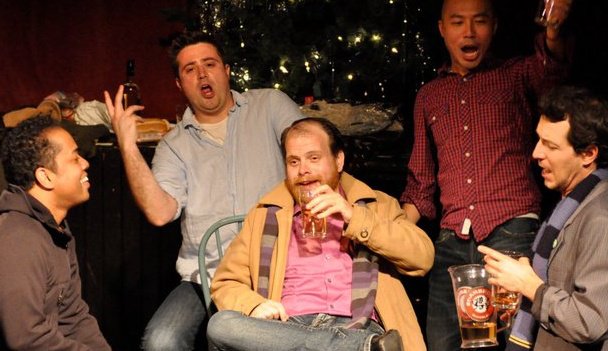
Last night Opera by Request presented Pelléas et Mélisande in concert.  When an opera is given with singers in formal attire accompanied by a pianist, we usually understand that as a compromise.  We lose the sounds of the orchestra, the illusion of sets & costumes, and the complete theatrical experience.

The one opera where you might be able to make a case for the value of a concert version is Debussy’s Pelléas et Mélisande.  I know: purists would be aghast.  Passing up the brilliance of Debussy’s orchestrations?  Losing the benefit of an atmospheric set & lighting?

But sometimes staging is a mixed blessing.  There are operas that contain action that’s impossible to stage.  Richard Wagner comes to mind, for his Ride of the Valkyries, the entry of the Gods into Valhalla on a rainbow bridge (from another opera that Opera by Request will be undertaking soon by the way).  But the actions in Pelléas et Mélisande are especially difficult.  When Golaud goes into a jealous rage at his wife Mélisande, he begins dragging her around the stage by the hair.  Earlier Golaud had come upon Mélisande and his half-brother Pelléas together in a compromising position; Pelléas had been luxuriating in her massive length of hair, which was hanging down from her window, and had become entangled in a tree.  Golaud later eaves-drops on his wife and his half brother with the assistance of his little son perched on his shoulders.  And when the two lovers finally surrender to their passion, Golaud is there in the dark to slay his half brother and wound his wife.  So no, I don’t mind if i can’t see any of that even if i do want to hear it.

Maurice Maeterlinck (who wrote the opera upon which Debussy based his opera) said that something of Hamlet dies when we see him on the stage, and he didn’t mean death by poisoned sword or drink.  Maeterlinck found the live actor distracting from his poetic reverie.  How odd, you might think, that a playwright hated live theatre; for him drama was a species of literature, and the version we read is better than the one onstage.

This is all meant as a defense of the concert version, however much we have become accustomed to the fully orchestrated/staged versions.  Forgive me for such a huge preamble for a review, but it needed to be said that this version was no compromise.

I would not be undertaking such a discussion if it weren’t for the extraordinary playing of Brahm Goldhamer, the pianist & Music Director.  On the piano, Debussy’s score is transparent, with nowhere to hide from its complexities.  But if one can play properly, you hear the work more clearly than ever before.  And so, for example, when Golaud & Pelléas emerged into sunlight after having been underground, the steady stream of sixteenth notes created a visceral sense of sunshine: especially because the notes were played perfectly.  As the drama built up in Act IV –thinking especially of the violent moments, when the orchestra would unleash primal forces—Goldhamer tossed off lightning fast passages, hammered octaves, always pressing the tempi in perfect synch with the singers, literally hours of precise playing without a wrong note.  Even without voices Goldhamer’s playing would have been a virtuoso performance.  Best of all was the elegant last page that Goldhamer articulated with the eloquence of an Olivier.

In a tight ensemble work –particularly in the intimacy of a concert performance—one hopes for casting that creates the right chemistry.  Artistic Director Bill Shookoff understands Opera by Request as a labour of love, programming operas out of genuine      interest, and by implication, employing singers who get to test themselves in repertoire choices that might represent their first brave step in that direction.

the friendly face of baritone Andrew Tees

Andrew Tees brought his friendly face and warm baritone to Golaud, taking the character in a wonderfully daring direction.  I find Tees demeanour very likeable, with a winning smile.  Golaud tends to be misunderstood as a villain, when in fact he’s much more of an everyman, always trying to make sense of the world.  I don’t think I have ever seen a Golaud who appeared so likeable in the early acts of the work.  This makes his gradual transformation all the more upsetting, and entirely believable.  Mélisande calls him a giant, and for once Tees gives us the necessary aura of physical power to look like someone who can accidentally hurt people with his strength.  The entire work turns magically on the phrase where Golaud notices that the wedding ring is missing from Mélisande’s finger; in that instant Tees & Goldhamer light an instantaneous fire of pain that swells explosively over the next acts.  I hope Tees gets to explore the depths of the role in a full staging. I’m certain he has a great deal to offer, and is at the right age for such an undertaking.

As Mélisande Kyra Folk-Farber was the mystery at the heart of the opera, the girl from nowhere with a past she refuses to divulge.  We met the other-worldly Pelléas, played by Michael Robert-Broder, as he was  about to go to a dying friend.  Folk-Farber’s Mélisande was a bit of a musical chameleon in this production.  When singing with Tees she sounded almost Wagnerian, while in her scenes with Robert-Broder we encountered the gentler dynamics of chamber music, although their love-duet did build with a volcanic intensity to its violent conclusion.

There were no weak spots in the cast.  Joel Katz brought a lovely sense of gravitas to the role of Arkel, the blind old man whose pronouncements are among the most quoted from the opera.  Erika Warder’s Yniold was especially well-sung, her expressions reflecting the growing fear of a child with an insensitive parent.  Jayne Smiley left us wanting to hear more in the role of Geneviève, but unfortunately the character only appears in the first act.  Marc McNamara’s Doctor presided gently over the final scene with Katz’s Arkel.

Opera by Request will be back soon:

  • Susannah Saturday February 19th @ 7:30 pm
  • Norma Saturday March 19th @ 7:30 pm
  • La Traviata Friday April 8th @ 7:30 pm

…and L’Elisir d’Amore & Das Rheingold still to come sometime later this spring.

Posted in Opera, Reviews | Tagged , , , , , , , , , , | 2 Comments

Kinder gentler Flute

I just saw the Canadian Opera Company’s new production of Mozart’s The Magic Flute.  Considering the reputation of its director, Diane Paulus, an American known for putting Haydn’s Il Mondo della Luna into a planetarium and A Midsummernight’s Dream into a disco, Mozart escaped comparatively unscathed.

Oh there were changes and alterations; but I like what Paulus and her designer colleague Myung Hee Cho have done.  I’m surely not the only one conflicted about this oh so popular opera, considering how often it gets changed, whether in  Ingmar Bergman’s TV version Kenneth Branagh’s film or Julie Taymor’s 100 minute family version.

Mozart & his librettist Schikaneder created an opera that’s full of misogyny and racist lines to make you wince:

  • Monostatos the Moor says “am I supposed to avoid love because black is ugly”?
  • Sarastro says “And she is a proud woman.  A man must lead your hearts,/For without him every woman is misguided…”

Paulus & Cho give us a kinder gentler Flute, rescuing us from the harsher elements in the plot through a hefty dose of theatricality.  While the Masonic rituals are still there, we’re no longer in such a sharply divided world.  Monostatos, the comic villain of the piece is no longer a Moor whose “soul is as black as his face,” but now is closer to the Nutcracker’s Mouse king, wearing a long tail and ears, prancing around the stage in a way that removes any possibility of menace or offense.

The usual presentation of the opera centres on the quest of Prince Tamino and his side-kick Papageno, where Pamina is the object of the prince’s affections.  Paulus gives us a meta-theatrical scenario, where Pamina watches an opera-within-the-opera.  Instead of Tamino’s quest being central, it’s now framed by Pamina’s story. Instead of Papageno singing his aria “Ein mädchen oder weibchen” as a musing soliloquy, he’s now surrounded by girls as he sings.  The opera is no longer so over-balanced towards the male side of the equation.

Isabel Bayrakdarian shoulders a larger responsibility than usual in this reading.  Pamina can’t simply appear for her few key moments, as would usually happen, but must also be in character persuasively every time we see her even if she’s merely in the audience watching Tamino pursued by the serpent, watching the Queen emerge (who looks directly at her daughter), watching Papageno.  The success of this production can be laid at her feet, given that she is never less than intensely persuasive, fully committed to her character, and a joy to listen to.

Opposite her, Michael Schade brings his familiar sound back to Toronto.  It’s a great feeling watching two capable local stars carrying this opera.  Schade’s strength is more vocal than dramatic, a true virtuoso performance.

In fairness, I must acknowledge that there are the usual female characters in this opera, particularly at the beginning before their power fades.  They are particularly strong in this conception of the opera:

  • first we meet the Three Ladies, who rescue Tamino from the serpent in the first scene of the opera. Their striking identical costumes, long braids and glasses, remind me of a cross between Xena Warrior Princess and Tina Fey from 30 Rock.  The result is a kind of nerdy feminist power that are the most interesting sight onstaqe whenever they appear.
  • So long as she can sing, the most memorable figure in a  Magic Flute is always the Queen of the Night, and Paulus & Cho don’t disrupt that effect.  Full marks to Aline Kutan, who powers through both arias flawlessly, aided by another stunning creation from Cho.

Johannes Debus, the Conductor & COC Music Director led a splendid reading of this familiar score.  Debus follows nicely in the same tradition as Richard Bradshaw, favoring quick tempi.  I was intrigued to hear some passages in the orchestra that were elaborated da capos, comparable to what we sometimes hear from vocalists, but this time coming from orchestral musicians.  Why not?! I’m looking forward to hearing more of that.

There’s one final thing about Paulus’s interpretation to appreciate.  The end is strongly reminiscent of the way the characters step out of character for epilogues in Don Giovanni and Marriage of Figaro. Why must the Queen of the Night, the Three Ladies, and Monostatos be banished (the way it’s written in the opera, actually!) when Sarastro preaches forgiveness?  I was very happy with the dance at the end, a fitting conclusion to a wonderful production.

The COC‘s The Magic Flute runs until February 25th at the Four Seasons Centre.

Posted in Opera, Reviews | Tagged , , , , , , | 1 Comment

Tuneful Tales


Les Contes d’Hoffmann aka Tales of Hoffmann are very tuneful.  I had forgotten how many great melodies Jacques Offenbach had given us in this, his attempt at operatic legitimacy.  Next season the Canada Opera Company will be producing Les Contes d’Hoffmann, but some of us had an early taste in concert tonight, courtesy of Bill Shookhoff’s Opera by Request.

Let me repeat what I just said. Oh my God, Offenbach can write tunes.  My head is a-buzz, as a few of those melodies refuse to let go.

Olympia’s song: 

The Barcarolle, his second best-known tune (after that can-can tune) 

The Ballad of Kleinzach:

And there is so much more, so many other melodies.  Hélas mon Coeur: http://www.youtube.com/watch?v=Z1xfCgiBkKU . Most of Antonia’s entire role: http://www.youtube.com/watch?v=6NIT5LfoAmo&feature=related

I’m grateful to Bill (Mr Shookhoff that is) for filling my head with tunes.

Offenbach’s opera is three acts of romantic disaster, wherein the storyteller –ETA Hoffmann – not only tells but lives his stories for us.  Each act represents another sort of female ideal (for soprano) and another sort of villainous nemesis (sung by a bass- baritone).  Hoffmann’s tenor heart in on his sleeve throughout.

Nicole Bower deserves particular credit in undertaking the varied and demanding female roles:

  • Olympia is a mechanical doll, singing coloratura like a tuneful machine
  • Antonia sings beautifully but sings herself to death like her mother before her
  • Giulietta is a beautiful courtesan

Henry Irwin was compelling as the villain of several guises, with several different nasty laughs and snarls, as well as a lovely sustained legato.  Jay Lambie as Hoffmann sang the demanding hero’s role, passionately enunciating his French while reaching for the vocal stratosphere.

Thanks, Bill–aka William Shookhoff, artistic director of Opera by Request— for your usual flawless piano playing in support of your  cast.

Opera by Request are back this Friday February 4th  at 7:30 pm with Debussy’s Pelléas et Mélisande at College Street United Church.  Perhaps I’ll see you there.

Posted in Opera, Reviews | Tagged , , , | Leave a comment

Neither dirty nor rotten

I saw Dirty Rotten Scoundrels last night.  No, not the Steve Martin/Michael Caine film, but the musical, presented at Hart House Theatre.

Let me say first off that I love adaptations.  Whenever I hear someone complain that the original was better—book or film—I try not to look too exasperated.   Why do some people resist a new adaptation?  I don’t get it. Surely there’s room for many versions.

There’s certainly nothing sacred about the 1988 Frank Oz film, considering that it’s a thinly disguised adaptation of Bedtime Story, a 1964 film with Marlon Brando and David Niven.

Comparing the films is as much a study of adapters as of two cultural epochs.  Both of the older continental swindlers (Michael Caine or David Niven) pretends at one point to have a dimwitted brother.

Steve Martin’s Ruprecht (who appears 1:45 into this clip)…   is completely different from Marlon Brando’s more physical approach .

A musical requires a few big ideas that can then be expanded into songs, in effect removing some of the subtlety of the original: a delicate process and not to be undertaken lightly.  The laughs of the original become a different kind of laugh, that is, if they’re not lost altogether in translation.

In the case of Dirty Rotten Scoundrels (the musical), David Yazbek (music and lyrics) & Jeffrey Lane (book) made a few clever choices.  The language is surprisingly racy, making the book often funnier than the original.  But if you consider how a film works –where you can clearly hear the lines—vs a musical—where someone singing a line may not be easily intelligible—that was a necessary choice.  I didn’t hear all the lines because there was at times so much laughter.  For example, look at the lyrics of “Big stuff,” a song that is like Freddy’s credo.

You can have a censored listen in this Tony Awards show broadcast, although two hot lines were too hot for the live TV broadcast:

  • Now I know Where I belong-A life of taste and class
    With culture and sophisitication pouring out my ass.
  • The Islands in the winter, The Hamptons in the summer,
    The fashion plate I date’ll give me Hummers in my Hummer.

or read the complete version.

That song is a big clue of a shift in the musical from the film.  Where the conflict between Steve Martin’s Freddy and Michael Caine’s Lawrence is largely a contrast between American & Brit, the musical takes a few things far deeper, and in my view far more interesting.  Our musical Freddy needs to be rough and guttural, given his earthy sentiments.  The underlying class issues of the story are closer to the surface, as Freddy’s raw greed is contrasted to Lawrence’s classy con artist.  Where Steve Martin was given a few moments to raise his voice, the musical Freddy gets to sing a virtual aria to his id, and the tone shifts as a result.   My God it’s funny.

I saw one of the last performances of the recent production at Hart House Theatre, a student production with a professional feel.  Everybody was in tune, moved well in their dance numbers, and the show’s pace never lagged.  I was especially impressed with Evan Dowling, whose Freddy reminded me of John Belushi both for his powerful singing and his physical presence onstage.  Director Jeremy Hutton, Hart House Theatre’s Artistic Director, is to be congratulated, both for this taut and hysterical production, and for consistently choosing challenging and interesting repertoire the past few years.

Posted in Dance, theatre & musicals, Reviews | Tagged , , , , , , | 2 Comments

Body of work: Aronofsky wrestles with an idea

Sometimes a superficial resemblance between two films by the same director is nothing more than coincidence; sometimes similarities are indications of important preoccupations.

Darren Aronofsky has recently been fascinated with bodily matters.  His last two films can be read as mirror images of one another.

Mickey Rourke

Black Swan (2010) might be a horror film.  Or it’s a cautionary tale about what happens when an artist goes so deeply into her role as to fundamentally confuse illusion with reality.

The Wrestler (2008) is also a sort of horror film, yet also reads as a tale of redemption.  An aging wrestler confronts the damage of his lifestyle choices, both to his own body and to his family relationships.

In Black Swan a quest for perfection by the dancer protagonist –Nina–resembles an all out war on the body.  Nina confronts the collateral damage—in her own body and impoverished personal life—as she looks around at others who have taken the same dangerous path before her.

Today I was watching Hannah and her Sisters, Woody Allen’s 1986 film featuring Barbara Hershey before her plastic surgery, which led me to a pair of parallel google searches:

  • “Barbara Hershey plastic surgery”
  • “Mickey Rourke plastic surgery”

Among the pages i found, one headline went as far as saying “Aronofsky Helps Another Plastic Surgery Victim.”  While it’s sensationally absurd, I don’t think it’s a fluke that Aronofsky cast Hershey as the vicarious ex-dancer mom in Black Swan.  The damage on Hershey’s face serves as a manifest subtext in Black Swan: a generational obsession with perfection.

Time could be a character in Black Swan— arguably the arch-villain– lurking in the background of each of the main female characters:

  • Young Nina (Natalie Portman) knows success is fleeting
  • Nina succeeds the aging Beth (Winona Ryder), both as a star and as the lover of Thomas (Vincent Cassel)
  • Meanwhile Lily (Mila Kunis), the recent arrival is breathing down Nina’s neck, ready to replace her (on stage and in bed with Thomas) if she fails
  • Erica (Barbara Hershey) who no longer dances (if she ever really did) now obsesses over her daughter, as the most visible evidence of time’s ravages

Both films celebrate physical disciplines.  Wrestlers and dancers are both practitioners who not only have objectives in what they do with the body –as dancers or wrestlers – but also in what they make of the body.  The practice of their disciplines is as much about the creation of an instrument (the body of a dancer or a wrestler) as it is about the actions done using that instrument (dances or bouts).  And any achievement is a poignant challenge to the patient attack by time.

The body is a site for their work, and in the unfortunate individuals portrayed, a site for their obsessions.  We see both abusive practices for the marginal performer (steroids, bulimia, and worse) or the careful handling of a body in the midst of a successful career (equipment, shoes, muscles, exercise, rest).  One can find both a compassionate attention to detail and horrific glimpses of a heretofore unseen world.

Aronofsky deserves credit for bringing these two films to the screen.  Painful as some aspects are, I believe we fail to come to terms with complex material when we pigeon-hole and oversimplify.  The classification of art into genres, while a useful element of marketing and a tried and true practice in the history of criticism, sometimes leads us to under-estimate the breadth of some transgressive creations.  Black Swan is much more than just a horror film.

Posted in Cinema, video & DVDs, Reviews | Tagged , , , , , | Leave a comment

Mendelssohn, the Nazis and Me (and them)

I was fortunate to stumble upon the documentary Mendelssohn, the Nazis and Me recently on TV Ontario (a public television network) in its first North American broadcast.

Originally seen on BBC, the doc is a curious mixture of music, history, and personal memoir from Sheila Hayman, the great-great-great-great niece of the composer Felix Mendelssohn.

It had me re-thinking aspects of my own identity.

Mendelssohn is a composer poised on the boundaries of Christianity and Judaism.  It’s common to speak of Mendelssohn as Jewish, yet he appears to have identified himself as a Lutheran, which would explain why he’s among the composers with a large body of work with strongly Christian associations:

  • Elijah and St Paul: two oratorios on Biblical subjects
  • Christian music including one of the best Christmas carols ever, none other than “Hark! The Herald Angels Sing!”
  • His Reformation Symphony, which includes a version of Luther’s hymn “A Mighty Fortress Is Our God

    Click on the image for the full-sized version

As it turns out, there are several Mendelssohns in the documentary.

  • Composer Felix, who lived from 1809 – 1847.  In our era of unending adolescence (speaking as someone who still doesn’t know what he’s going to be when he grows up) it’s chastening to look at yet another romantic composer who didn’t see his 40th birthday.  Frédéric Chopin died at 39 as did Carl Maria von Weber, while Franz Schubert died at 31!
  • Philosopher Moses Mendelssohn, who lived from 1729–1786.  Moses was among the first to argue for the plurality of faiths, whereby the various pathways of the great faith traditions (Christianity and Judaism in Germany, but Islam as well by implication) were all valid routes to God.
  • The recent generations of the family, including the film-maker and her father

The doc asks some big questions with an ingenuous tone and a straight face.  I find myself wondering, “what is a Jew?”  The film gives us the subjective take of the Mendelssohn family, to whom it seemed that Felix was largely assimilated into the Christian culture surrounding him in Leipzig, and a devout Lutheran.

But the facts aren’t quite so optimistic.  The commission for the Reformation Symphony (composed in honour of the tri-centennial of the Reformation) was never paid.  Although Felix missed his composition deadlines it has been speculated that the real reason he lost the commission is due to his Jewish Heritage, a potential embarrassment in a celebration honouring Protestantism.

I find myself wondering, not for the first time, at the complexity of what makes one Jewish.  It seems to be an odd club, in that sometimes people are trying to get in, sometimes trying very hard to get out.  If your mother is Jewish then you are in.  Conversions to Judaism are permitted.

Getting out?  Apparently lots of people assumed they were not Jewish –both according to the official criteria above as well as other reasons –but were blindsided by the bizarre definitions used by the Nazis.  For the first time I understand something I never got before.  Why didn’t they leave?  The simple answer: because they felt safe.  Felix did not think of himself as Jewish, and in the next generation no one practised any religion whatsoever.  Fortunately Hayman’s family survived, but not without some scares along the way.

When the Nazis wrote their history of German music it would attempt to change the truth while effacing or denigrating those like Mendelssohn whose contribution had been central to German culture for many generations.  Ha… they failed.

None of this is news.  What makes the documentary different is its personal slant, as reflected in the title, and the intriguing opportunity presented by unifying the study of several generations via the family and its history.  Instead of zeroing in on one period, we enter into several different lives within the family, different sorts of challenges, but in the end, the same questions throughout.  In telling the story many aspects of Mendelssohn’s music are illuminated.  Just as Felix sits at the boundary between two religions, the film happily straddles the boundary between documentary and art, memoir and speculation.

The documentary is available for purchase (I bought it) and bears repeated watching.

Posted in Cinema, video & DVDs, Reviews | 1 Comment

Assassins and history

Stephen Sondheim’s Assassins is a musical with history.  The play happens in an abstract space where characters from different centuries meet one another, converse, sing and dance together.  At first glance it resembles a review, a series of numbers where nothing really happens.

Perhaps I should have added the indefinite article “a”, because not only is Sondheim’s play historical, but it has a history, that tells you a great deal about the work.

It was out of step with the public when it first appeared in 1990 during the upsurge of nationalism surrounding the Gulf War.  A Broadway production meant for the fall of 2001 foundered on the even bigger wave of patriotism that followed the attacks of Sept 11th; in the fall of 2001 such plays simply couldn’t be mounted

And in the wake of the shootings in Arizona last week, similar questions have been put surrounding the revival of the Talk is Free Theatre / Birdland Theatre co-production of Assassins from last year.  On CBC Adam Brazier –the director –was asked whether any thought was given to cancelling the run.  Thank goodness the interviewer let him off the hook by saying it was too late to cancel.

And thank goodness they didn’t cancel.  While it’s true that some people find this material offensive, I think Sondheim is therapeutic.

For most of the play, we watch a kind of debate between two contrasting abstract figures, who could be virtues or vices from a morality play.  The Proprietor invites us to step up as if in a carnival shooting gallery:

Proprietor:  Hey, pal, feelin’ blue?
Don’t know what to do?
Hey, pal, I mean you—
Yeah.  C’mere and kill a President.

Just like that, the subject is there before you.  In that abstract space we’ll encounter each of the historical assassins, telling their story, and just as importantly, singing their song in the style of their era.

The other abstract figure is the Balladeer.  Where the Proprietor is brusquely theatrical, and mustn’t sound too pretty, the Balladeer is lyrical & contemplative, lamenting the sad choices of each assassin, and singing the prettiest music in the show.

But as the assassins learn that they are being left behind –in a song where we’re again implicitly in that shooting gallery, because each of them loudly demands their prize—they turn on the Balladeer.  The stage instruction is wonderfully impossible: “the Balladeer is swallowed up by the assassins and disappears“.

If there is a story, it’s a very subtle battle between words and music, where music is a vehicle for reflection, while words are a place for brutal action.  The frustrated assassins dispense with the Balladeer as surely as they dispense with sensitive reflection.

Shall we assemble the suspects in a line-up?

  • John Wilkes Booth killed Abraham Lincoln in 1865
  • Charles Guiteau killed James Garfield in 1881
  • Leon Czolgosz killed William McKinley in 1901
  • Emma Goldman was questioned following McKinley’s death, but except for one of her speeches –found in Czolgosz’s pocket at the time of his arrest– she probably had no connection to the anarchist assassin
  • Giuseppe Zangara killed Chicago Mayor Anton Cermak in 1933, but may have meant to kill Franklin Delano Roosevelt
  • Samuel Byck attempted to hijack a plane in 1974, hoping to crash it into the White House, in order to kill Richard Nixon.
  • Sara Jane Moore and Lynete “Squeaky“ Fromme both made unsuccessful attempts to kill Gerald Ford in 1975
  • John Hinckley tried to kill Ronald Reagan in 1981

Missing from that list is perhaps the most famous of all, the pivotal figure in the drama of Assassins, such as it is.

Shortly after the Balladeer is swallowed by the frustrated chorus of assassins, we meet the key figure in the last part of the musical, namely Lee Harvey Oswald, in the infamous book depository on the day JFK visited Dallas.

It’s especially powerful that for this production, the casting requires the Balladeer to reappear as Oswald.  I wondered at first if this was how Sondheim wrote it, but no, apparently several productions employed two different actors, as these are conceived as separate roles.  The first production I am aware of that used doubling to make the connection was the Broadway production employing Neil Patrick Harris as Balladeer / Oswald.  I suspect that choice will be standard from now on.  While it’s hard to explain logically, It makes complete sense at an emotional level.

The world of the play even loops back indirectly to its composer.  At one point, Byck (the failed hijacker) speaks into a tape recorder, addressing an unreachable icon, namely Leonard Bernstein.  Surely a young Sondheim dreamed of talking to Bernstein, and of course would go on to collaborate on West Side Story.  The moment is profoundly mysterious, considering the ongoing complaint of the assassins: that people won’t listen to them.  And when we remember that subtle debate between the Balladeer (music of reflection) and the Proprietor (words of action), and notice how dark this musical is, we can’t help but think that Sondheim’s identification with Byck is more than casual.

I saw the same production last year.  I sat among keen young students gasping at the audacity of Sondheim’s ideas, occasionally laughing at the most obvious gags, but otherwise like a congregation in church.

This year?   Maybe it’s just my luck but the night I went the audience felt so mature, without reverence this time, that they let their appreciation show.   I couldn’t tell whether it was the production or the audience that thwarted the laughter last year.  This year’s cast – there are a few changes—represents a subtler reading of the play.  The two women assassins — Moore and Fromme—are much broader this year, played as comic relief, and oh how welcome it is.

I wondered, though, whether current events in Arizona had strangely conspired to aid the comedy of the work.  A sensitive person needing catharsis could come to the play for therapeutic laughs.

The production had a few clear highlights and heroes.

Foremost among them must be the invisible man, namely music director Reza Jacobs.  With his small ensemble the ideal effect was achieved, whereby singers could face the audience with no pit or conductor in the way, while the accompaniment was always there in support of the actors.  The pace was wonderfully tight, while the tone was unabashedly ordinary just as Sondheim wrote it, full of rough edges and abrupt shocks.  This is not a piece written to show off singers, but a taut dramatic vehicle.  More than anyone else Jacobs made the magic happen.

Whoever made the choice to avoid using guns dodged a logistical nightmare considering how many shots are fired by so many actors in this show.  Imagine co-ordinating so many guns backstage that must fire properly.  Instead of guns we see a prop that is obviously similar yet not a gun, even if it must stand in for a gun;  at the appropriate moments the band makes all the noise we need to be jarred as if a real gun were being fired.

The Ballad of Guiteau is one of the more ambitious compositions in the musical, juxtaposing an old-fashioned hymn-tune with a cakewalk.  If you were to peruse all the different versions online via youtube –a painful prospect! –you’d quickly see just how astonishingly difficult this number is, balancing the dreamy hymn tune that verges on the lugubrious, with a cakewalk that needs to be brisk yet intelligible.

And as a complication, its combination of musical forms feels very pretentious, requiring a very subtle approach if it isn’t to vanish under the weight of its own heavy-handed text.  Steve Ross, reprising the role he first showed us last year, finds the perfect balance between comedy and pathos.  I believe this time out he’s found additional humour in some of the lines, yet he is the most authentic of the historical figures onstage in this production.

Adam Brazier, director, embraces the madness at the heart of the musical.  Brazier helped bring out the textual music to be found in the dissonance between these disparate speaking voices.  The moderns are sometimes stridently loud, especially the wonderful pair of Janet Porter’s mad hippy take on Squeaky Fromme, against the crabby suburban angst of Lisa Horner’s Sara Jane Moore (both new additions to the revival).  Ross’s Guiteau and Paul McQuillan’s Booth in contrast sound authentically 19th century.

As balladeer Geoffrey Tyler carries almost every scene he’s in, at times stealing the show with his gentle voice.  That’s doubly powerful considering the arc of the story, whereby the assassins eventually silence him, as if the music had died.  His chief adversary, the droll Proprietor, is Martin Julien, a vocal chameleon sliding through the dramatic underbrush, always able to find the right tone to blend into each scene.

Speaking of silence, the show will fall silent after its last performance January 23rd.  I believe it’s better this year than last, which probably means the tickets will soon be gone.

Don’t miss it.

Assassins runs until January 23rd at the Theatre Centre  1087 Queen St W., Wednesday – Monday at 8:00 pm as well as matinees Saturday & Sunday.  Tickets 416-504-7529, online at www.artsboxoffice.ca, in person, or at the door.

Posted in Dance, theatre & musicals, Reviews | Tagged , , , | 2 Comments

Lotfi Mansouri: An Operatic Journey

This is a book review I wrote for the newsletter of the Toronto Wagner Society.

Lotfi Mansouri: An Operatic Journey
Lotfi Mansouri with Donald Arthur

Still smiling

The grin on the cover looks the same as ever.  Can this familiar figure really be in his 80s?

You’ve probably noticed Lotfi Mansouri: An Operatic Journey in the Opera Shop in the Four Seasons Centre lobby.

It’s both a pleasure and a shock to read the story of Mansouri, one of the most important builders of opera in Toronto.  The pleasure is in reconnecting with those wonderful moments I had almost forgotten as well as discovering so much I never suspected about this icon.  And it’s something of a shock to read so many tales of conflict.

The book is a chronicle of cultural history, a reminder of how much the operatic world has changed since the 70s and 80s.  In the short time-span of this book we see Mansouri as the innovative newcomer, ascending to more responsible and powerful roles in the opera world, and then his move to the sidelines.  What seemed effortless on the exterior was achieved at a cost.  The man who once seemed to be synonymous with opera at least in Toronto (as well as a few forays into Hollywood as well), now appears to be himself a disgruntled observer from the sidelines, out of step with a world of young talent and Regietheater.

The book is indeed a magical tale of transformation, opportunities and unlikely outcomes.  Mansouri’s remarkable life is a matter of public record, yet the drama beneath the smiling surface took me by surprise.  Perhaps that’s one of the connotations of the subtitle “an operatic journey”: that his life is as colourful as a good libretto.

This is not the first memoir from Mansouri, but it’s far more comprehensive than his earlier Lotfi Mansouri: An Operatic Life, not just because that book appeared in the 1980s  before Mansouri left the COC for San Francisco.  Perhaps the key difference is that this time Mansouri has enlisted the aid of Donald Arthur.  You may recall Arthur as a guest at the Toronto Wagner Society in 2007, and know his previous work as the writer who collaborated on memoirs from Hans Hotter and Astrid Varnay.

Having read all three memoirs, one can see that Arthur seems to be a positive influence.  Nevermind that the writing has an eloquence reminiscent of Arthur’s own charming speaking voice, that he uses to great effect in his other career as a voice-over artist in Europe.  The resulting prose is at times exquisite, a huge improvement over the relatively stilted writing in Mansouri’s earlier book:

My first professional operatic appearance and my first employment by the San Francisco Opera involved carrying a spear in a performance of Otello featuring the great Chilean tenor Ramón Vinay.  My fee was one dollar, but I was becoming aware of the almighty power of make-believe.  On my way to the stage, I saw a tall guy with blond hair whose face bore a remarkable resemblance to my own—I needed a second to realize I had been walking past a mirror.

Just as with Hotter & Varnay, Arthur encourages Mansouri to trace his artistic influences and development.  We encounter far more than just biographical incidents, names and dates.  Arthur seems to bring out the best in his subjects, showing us their dreams and objectives, even when they fail.  Whereas Mansouri’s time with the COC was mostly a triumphant ascent, his experience at the San Francisco Opera is far more problematic, political, troubled.  The fact that we are not always reading a happy whitewash of events lends credence to the story-telling, even if the honesty is at times painful to behold.

It’s especially satisfying to read about the years Mansouri spent with the COC, to hear him mention familiar names from that era such as Geiger-Torel, Leberg, Tanenbaum, Southam, Bernardi.  While it’s probably true that the COC would have eventually established its own orchestra, improved its marketing and management, the change was positively revolutionary.   If you imagine the COC without an orchestra, without surtitles, without its ensemble studio and current endowment, you are in effect imagining the COC without its current success.

There is one other unavoidable element to this volume, something that I suspect may be the most delightful aspect of all.  Mansouri made many friends and more than a few enemies.  Some memoirs take the high road, only saying kind things about people, but this is not that kind of book.   I was surprised at some of the targets, such as Renate Scotto and Otto Klemperer.  I would be a liar if I didn’t also say that this is one of the chief delights of the book.  Mansouri has known a great many celebrities from around the world, and doesn’t suffer fools gladly; or is that Arthur peeking through?

Mansouri has led an amazing life, wonderfully captured in this elegantly written volume.  The book is especially important to Canadian opera fans curious about how we got to where we are now.  You must read this book, whether for what you can learn or purely for the fun of it.

5
Lotfi Mansouri: An Operatic Journey, by Lotfi Mansouri
with Donald Arthur // reviewed by Leslie Barcza
You’ve probably noticed Lotfi
Mansouri: An Operatic Journey in the
Opera Shop in the Four Seasons
Centre lobby. The grin on the cover
looks the same as ever. Can this
familiar figure really be in his 80s?
It is both a pleasure and a shock to
read the story of Mansouri, one of the
most important builders of opera in
Toronto. The pleasure is in
reconnecting with those wonderful
moments I had almost forgotten, as
well as discovering so much I never
suspected about this icon. And it’s
something of a shock to read so many
tales of conflict.
The book is a chronicle of cultural
history, a reminder of how much the
operatic world has changed since the
70s and 80s. In the short time-span of
this book we see Mansouri as the
innovative newcomer, ascending to
more responsible and powerful roles in
the opera world, and then his move to
the sidelines. What seemed effortless
on the exterior was achieved at a cost.
The man who once seemed to be
synonymous with opera, at least in
Toronto (as well as a few forays into
Hollywood, as well), now appears to
be himself a disgruntled observer from
the sidelines, out of step with a world
of young talent and Regietheater.
The book is indeed a magical tale of
transformation, opportunities and
unlikely outcomes. Mansouri’s
remarkable life is a matter of public
record, yet the drama beneath the
smiling surface took me by surprise.
Perhaps that’s one of the connotations
of the subtitle “an operatic journey”:
that his life is as colourful as a good
libretto.
This is not the first memoir from
Mansouri, but it’s far more
comprehensive than his earlier Lotfi
Mansouri: An Operatic Life, not just
because that book appeared in the
1980s before Mansouri left the COC
for San Francisco. Perhaps the key
difference is that this time Mansouri
has enlisted the aid of Donald Arthur.
You may recall Arthur as a guest at the
Toronto Wagner Society in 2007, and
know his previous work as the writer
who collaborated on memoirs from
Hans Hotter and Astrid Varnay.
Having read all three memoirs, one
can see that Arthur seems to be a
positive influence. Never mind that
the writing has an eloquence
reminiscent of Arthur’s own charming
speaking voice, which he uses to great
effect in his other career as a voiceover
artist in Europe. The resulting
prose is at times exquisite, a huge
improvement over the relatively stilted
writing in Mansouri’s earlier book:
“My first professional
operatic appearance and my
first employment by the San
Francisco Opera involved
carrying a spear in a
performance of Otello
featuring the great Chilean
tenor Ramón Vinay. My fee
was one dollar, but I was
becoming aware of the
almighty power of makebelieve.
On my way to the
stage, I saw a tall guy with
blond hair whose face bore a
remarkable resemblance to
my own—I needed a second
to realize I had been walking
past a mirror”.
Just as with Hotter and Varnay, Arthur
encourages Mansouri to trace his
artistic influences and development.
We encounter far more than just
biographical incidents, names and
dates. Arthur seems to bring out the
best in his subjects, showing us their
dreams and objectives, even when they
fail. Whereas Mansouri’s time with
the COC was mostly a triumphant
ascent, his experience at the San
Francisco Opera is far more
problematic, political, troubled. The
fact that we are not always reading a
happy whitewash of events lends
credence to the story-telling, even if
the honesty is at times painful to
behold.
It’s especially satisfying to read about
the years Mansouri spent with the
COC, to hear him mention familiar
names from that era such as Geiger-
Torel, Leberg, Tanenbaum, Southam,
Bernardi. While it is probably true
that the COC would have eventually
established its own orchestra,
improved its marketing and
management, the change was
positively revolutionary. If you
imagine the COC without an orchestra,
without surtitles, without its ensemble
studio and current endowment, you are
in effect imagining the COC without
its current success.
There is one other unavoidable
element to this volume, something that
I suspect may be the most delightful
aspect of all. Mansouri made many
friends and more than a few enemies.
Some memoirs take the high road,
only saying kind things about people,
but this is not that kind of book. I was
surprised at some of the targets, such
as Renata Scotto and Otto Klemperer.
I would be a liar if I didn’t also say
that this is one of the chief delights of
the book. Mansouri has known a great
many celebrities from around the
world, and doesn’t suffer fools gladly;
or is that Arthur peeking through?
.
Mansouri has led an amazing life,
wonderfully captured in this elegantly
written volume. The book is
especially important to Canadian opera
fans curious about how we got to
where we are now. You must read this
book, whether for what you can learn
for purely for the fun of it.
Posted in Books & Literature, Reviews | Tagged , , , , , , , | 1 Comment

The King’s Speech

We’re always hearing about the impact of media upon our world.

As anyone who has seen Singin’ in the Rain can tell you, new media –such as talking pictures in the late 1920s—can cause a complete upheaval not just within an industry, but also in the broader culture as well.

This may seem like an unlikely preamble to The King’s Speech.  Before I saw the film I read speculation that Colin Firth might be the Helen Mirren of 2010, winning an Oscar for a royal portrayal.

But nevermind Oscar & the Academy. Nevermind the art of cinema. I have to think that Marshall McLuhan would have loved this film, a virtual gloss on his ideas about media & culture.

Marshall McLuhan

…And King George VI is the collateral damage of the media revolution, a man who in a previous century could have safely kept his stammer away from the public simply by posing on his horse or on the balcony of Buckingham Palace.

King George VI: the collateral damage of the media revolution, a man who in a previous century could have safely kept his stammer away from the public simply by posing on his horse or on the balcony of Buckingham Palace.

But that’s no longer enough, as Doctor Emmett Brown told us in the first Back to the Future film.  Looking at Marty McFly’s camcorder he said “no wonder your president has to be an actor; he’s gotta look good on television.”

Reagan ascended the American throne a half-century after George VI.  Actually television is much easier now than what poor Bertie had to endure in the golden age of wireless broadcasting.  There were no teleprompters.  Radio was so new that no one really had any notion they were witnessing the birth of a new discipline with new rules.  The best professionals adapted the skillsets they’d identified for actors and orators.  No one had yet had Doc Brown’s epiphany, in recognizing that the skills of film actors would be required for world leaders in the public eye through the media.

We observe that with the paradigm shift of talkies, the silent stars Lockwood & Lamont from Singin’ in the Rain must learn the craft of speech for their new talking picture.  First, Lina Lamont (Jean Hagen) is being instructed to little effect by coach Phoebe Dinsmore (Kathleen Freeman).

Then it’s the turn of Don Lockwood. After a series of absurd tongue-twisters (such as “arr-ound the rr-ocks the rrugged rrascal rran”) Don (Gene Kelly) and his pal Cosmo (Donald O’Connor) finally erupt in a fit of absurdity against the absurdities imposed upon them by their diction teacher.

“Moses supposes his toeses are roses,
but Moses supposes erroneously.
Moses he knowses his toeses aren’t roses
as Moses supposes his toeses to be.”

I never appreciated this silly song until recently.  The song in some respects resembles a jazzy vocalise, an eruption of anarchy in response to the vocal discipline.  The voice is such a fascinating instrument –not unlike the dancer’s body—in the way the artist inhabits their instrument.  We become aware that the distinction we’ve habitually made between sense and nonsense –as in the silly song—breaks down when we deliberately work our instrument minus any content.

The King’s Speech has an additional subtext concerning ability and disability, depending on your personal history, a subtext that will be much more powerful if you see the film in a big theatre rather than at home on DVD.  If you’ve ever had an injury or helped rehabilitate a loved-one through some disability to their speech, their vision, their ability to walk, then you understand the communication barrier that sometimes separates the care-giver from the patient.

When we learn most things, our teacher can explain what we need to do, as for example when our mathematics teacher illustrates what we must do in a particular operation.  But what if we were being taught by someone whose competence places them on the other side of a virtual wall?  If the teacher asks us to take some steps without the ability to describe how we could possibly resume walking, our failure may magnify that wall in our minds.  The unrealistic expectations of doctors, practioners & caregivers of the past could be very damaging.


The King’s Speech sits on the boundary between that unfortunate past and the modern era of more compassionate caregivers.  To me this is the most significant drama in the film, even if it is resolved more or less in passing as if it were merely a sub-plot.  I think most people would say that the main action of the film concerns George VI’s role in Britain’s fight against Fascism.

And now, while we’re considering The King’s Speech, you might find it interesting to hear The King’s Speech.

Posted in Cinema, video & DVDs, Essays, Reviews | 1 Comment

December 30, 1960

December 30th, 2010 is a date of personal interest, the anniversary of the day my father succumbed to leukemia, at the very end of 1960.   I understand he had been sick for a few years.

I don’t think of my father very often, because he died so early in my life.  I was so young that I hardly have any memories of my father. There’s a conversation i vaguely recall with him and my Mom concerning my progress through school; he was very supportive.  I can’t recall the voice distinctly.  He has become an amalgam of photos and stories, an abstraction and a myth.

József or Joseph, or Joe?  “Apa” or “Dad”.  I had seen the stationery, showing his business nom de guerre, “Joe Barr.”  I suppose if Bernie Schwartz had to rename himself as Tony Curtis, why shouldn’t Barcza Jozsef as well?

Throughout childhood I’d suddenly be snatched out of what i was doing, when someone would start to tell a story.  They’d lived their lives with him, whereas I was so small when he passed away.  I found so much glamor in the stories from my mother, and from my older siblings, who knew him so much better.  My brother Peter had after all reached the advanced age of eleven and a half, but that was a massive difference compared to what i had seen and the precious little I had managed to retain.

Fifty years ago today, my family came to the end of a huge struggle.  For awhile my mother lived by my father’s side in the hospital, and so the kids went to stay with the pastor of our Lutheran church.  My father had been a prominent member, helping with the heating & air-conditioning; hm, or was it actually donating? there’s something else to ask my Mom, to untangle tales.  I love those one-on-one conversations we have where she goes into a bit of a reverie, telling me about the past.  Our conversations led to Silence is Golden, an opera i wrote about ten years ago, although I didn’t nearly cover it.  I have been trying to find out about the past my whole life, it seems.

1960 itself, while it may seem to be a bit-player in this drama, stands shoulder to shoulder with a series of blanks, because I know so little with certainty.  Other events from that year have been conflated into my life-story.

1960 is also the year of JFK’s election.  That America was orphaned by his assassination in November 1963– when i was eight years old — allowed him into my mythology: as  JFK probably had been for any other sensitive young person of the time.   We’re not talking about the modern complex figure, but rather the earlier version of JFK, a witty avatar who seemed so perfect.

Jussi Bjoerling also died in 1960.  I only discovered Bjoerling in subsequent years, particularly between the ages of 10 and 20 when our culture at home came mostly from the record player or the radio.  Astonishingly, he sounded wonderful right up to the last month of his life, in 1960.  The amazing performances –especially in his last concert in 1960– added to the aura surrounding 1960 in my head.

I conflated them all together, all those men who died young.  Bjoerling (or Björling if you prefer) was supposedly born in 1912, and so was 48 when he died.  John Fitzgerald Kennedy was born in 1917, the same year as my father.  Dad was 43 when he died, same age as the youngest President ever elected in 1960, who would be dead by the age of 46.

Needless to say the mystique the entire decade acquired –by now it’s trite and cliche to talk about the ’60s as a period for music, political ferment and more– was very personal for me.

Today, while I am aware of my father, it’s really a day for my Mom.  Every year she’s burned a candle on this day, thinking back.  Every year it’s a day to touch base, re-affirm the family connection.   For me Christmas has always had the dark cloud of mourning hanging over it, because old year really seems to pass away and in a real sense to die.  I’ve rarely had a New Year’s celebration where i fully gave in to the extroversion of the day, given the family’s habitual introspection that week leading up to Dec 30th.  But I think we also draw strength from that darkness, and enter the new year refreshed and renewed.

Happy New Year to you, and thanks for reading this.

Posted in Essays, Personal ruminations & essays | 1 Comment