Opera, made in Canada

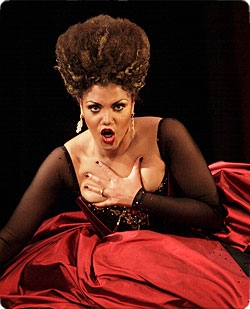
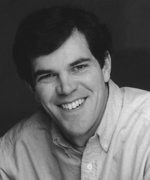
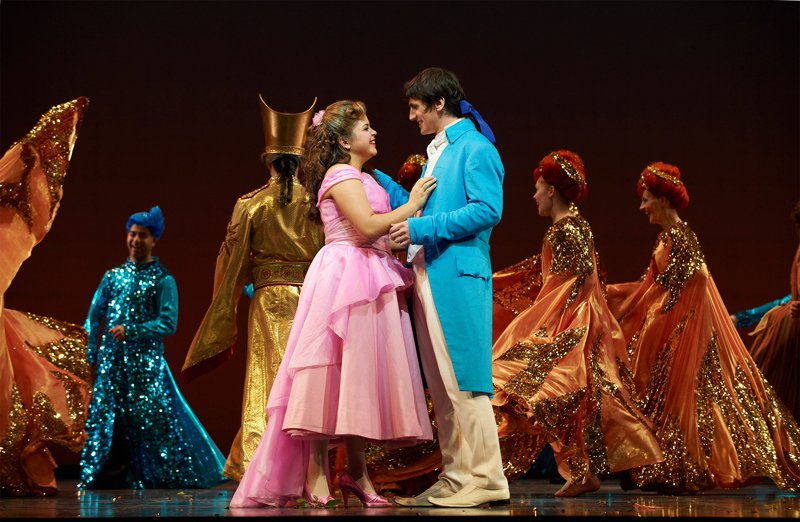
Pamina (Simone Osborne) and Tamino (Christopher Enns) in the COC Magic Flute, on until Feb 25th at the Four Seasons Centre. Photo: Michael Cooper.

What’s so Canadian about the “Canadian Opera Company”? It probably never occurs to the average person to question.  The operas are usually written by long-dead Italians, Germans, the occasional Frenchman, and sometimes we get one in English.  Nobody objects to the languages because of the glorious surtitles that –as we’re often reminded – were pioneered right here in Toronto by the COC.

Because we tend to think of opera as a European art-form, nobody makes much of a fuss when the stage is populated with foreigners.  But maybe we should.

After all, the orchestra is Canadian, and so are the chorus.  And sometimes, even the singers are Canadian.  The COC’s current Magic Flute is a good example.

In the cast employed on opening night, the two stars –Prince Tamino & Princess Pamina—were played by Canadians Isabel Bayrakdarian and Michael Schade.  The Queen of the Night, who sings the most impressive high notes of the night and if she does her job correctly, gets the applause to match, was also Canadian, namely Aline Kutan.  All three acquitted themselves admirably, and would have been warmly greeted in any opera house, Canadian or otherwise.

But alongside those Canadians, were others.  Neither the Papageno nor the Sarastro were Canadian.  We may notice that Mozart gave Papageno (that is, Schikaneder, the librettist who created the part for himself) especially easy music because the role was and is meant to be a vehicle for comedy rather than great singing; that’s hardly a persuasive argument in favour of importing someone from the other side of the Atlantic.  Sarastro is perhaps the opposite of Papageno, expected to sing impressive low notes and command with his presence on stage.

So in fact these non-Canadians in their two roles were adequate.  It didn’t occur to me one way or the other, until tonight when I went to see the “Ensemble cast” sing the very same production of Magic Flute.


First, let me explain what the Ensemble is.  It all began in Lotfi Mansouri’s days with the COC.  Mansouri was General Director from 1976-1988 (hope I got the years right).  Modeled on the Merola program at the San Francisco Opera, the Ensemble offered young singers a kind of apprenticeship in the company, giving them a salary, training, and occasional roles.   The ensemble is comprised of young singers, not ready for prime-time, or so the theory would go, and to this day is a wonderful achievement for any singer.

Last night, I saw the Magic Flute, in a cast comprised of ensemble members.  A young Canadian named Adrian Kramer sang Papageno.  Kramer has a lovely voice and was much funnier than the imported singer he replaced.  A young Canadian named Michael Uloth sang Sarastro.  In fact, the person usually singing Sarastro was satisfactory but not particularly distinguished in his portrayal (I was more impressed in those other performances by Robert Gleadow as the Speaker, a small role that should not in the normal scheme of things ever overshadow a Sarastro).  Uloth did a great job, whether in the lovely legato in both his arias, his confident low notes and particularly in the profundity of his final lines.

Simone Osborne may be an ensemble member, but she has already sung impressively in performances as an alternate in the role of Pamina.  Tonight I saw her looking more relaxed, perhaps because this time she was among her peers, anchoring the production with another confident portrayal.  Osborne always sounded fresh, and with a higher gear available for a few key moments.  Her Tamino Christopher Enns was a convincingly handsome prince.  Enns did not have the vocal ease of Michael Schade whom he replaced–but then who does?– sometimes gliding easily, while at other times sounding as though he were working hard.  Even so, the sound was often very powerful, and never unconvincing.

If success can be understood as the greatest applause for the briefest appearance, then Ambur Braid was champ as the Queen of the Night, earning huge applause for both of her arias.  She brought a seductive presence to the stage with every entrance, always the focus whenever she appeared.  Her henchwomen, the three ladies — Ileana Montalbetti, Wallis Giunta and Riab Chaieb—-brought a funnier mood to the stage than the previous cast.  Where the other ladies had been deadpan, I found these ladies much more willing to go after a laugh, and all the while singing with great accuracy & clarity.

The Ensemble has been a wonderful concept; the years a singer spends there could serve as a springboard to an international career, and that’s marvellous up to a point.  But I have to take issue when the COC brings in mediocre foreigners while ignoring talented Canadians in the ranks of their Ensemble.  I’m all in favour of importing talent if no Canadian can sing the part.  In that case please bring in a Russian or an American or if necessary, a Martian.

But it is really nice to be able to go hear Canadians singing in the Canadian Opera Company.

Posted in Opera, Reviews | 3 Comments

Nixon on the Beach


John Adams, composer of Nixon in China

Nixon on the Beach”? I saw the High Definition Metropolitan Opera broadcast of John Adams’ Nixon in China at the Beach Cinemas, my favourite Toronto theatre.  The Beach Cinemas actually have voicemail, and call you back with the most personalized service of any local cinema.  While it is meant as a joke to speak of “Nixon on the beach, ” I came out of the theatre on a brilliant sunny afternoon, looking at the expanse of water immediately to the south in Lake Ontario.  I felt wonderful.

While Nixon on the Beach is also an allusion to Philip Glass – a personal favourite  and the other great minimalist opera composer of the past quarter century, e.g. Einstein on the Beach (1975)—after  seeing Nixon in China I’m wondering if I need to revisit my earlier opinion.  As I talk about the performance I saw broadcast from the Met today, I’ll reflect on both the production and the work, evidence that there’s a new (minimalist) sheriff in town.  Famous as Glass has been, none of his operas are so easily intelligible as Nixon in China; and having said that, i believe it’s safe to predict that Adams’ popularity will continue to rise.

Here’s how I understand the three acts of the opera

  • Act I is one of optimism at this great moment in history, including Nixon’s fascination with the magic of the event, in a segment beginning with his repetition of the word “news” over and over.  The Mao we meet in the second scene is more philosopher than politician.
  • Act II takes us deeper into China, first with Pat Nixon’s face-to-face encounters with the people, then at a surreal opera-within-the-opera where the real Madame Mao shows us her true (darker) colours.
  • Act III, on the last night of the visit, is on a personal scale, concerning the juxtaposition of past and future.  Each of the leaders reminisces with his wife, while Premier Chou En-Lai ponders the future

I came to the broadcast with some trepidations, having read a number of complaints about the singing by James Maddalena, who happens to have originated the role of Nixon almost a quarter of a century ago (the opera premiered in 1987).  That leads us to the first, and possibly the most remarkable thing about Nixon in China.

Maddalena did not sound as though he’d be comfortable singing Verdi or Rossini anytime soon.  But what of that?  Maddalena nailed Nixon perfectly: in his manner, his look and his sound.  When you think about it, Nixon’s loss to Kennedy in the 1960 electoral debate was all about style.  Where JFK was cool on camera, Nixon sweated under the lights, just like any average guy.  That’s Nixon.  To portray him in an opera surely is to check your virtuosity at the door.  A polished Nixon would be a misrepresentation, if not an out and out oxymoron.  And so, while it’s true that Maddalena didn’t sound great, his sound was perfect for Nixon.

And so it is, in different ways for each of the characters:

  • Mao Tse-Tung is a heldentenor, declaiming powerfully and sometimes ironically, sung by Robert Brubaker. While this may seem odd for the frail old man we see onstage, there’s nothing frail about his ideas or their impact.
  • His wife Madame Mao is a ferocious coloratura soprano who dominates the stage whenever she is present, flawlessly sung by Kathleen Kim.

While these figures seem to push the action of the opera, just as they were agents for change in the world, two other characters represent the passionate side:

  • Pat Nixon is a soprano who sings lyrical lines, and appears to be a bit like Richard Nixon’s conscience, or at least an influence upon her husband to bring out a warmer side of him.  Janis Kelly’s Pat Nixon is a sympathetic witness to the Chinese people, and an uncooperative onlooker to the Revolutionary Ballet; her refusal to mutely sit in the audience electrifies the scene, and galvanizes Madame Mao.
  • Chou En-Lai, the Chinese Prime Minister, presents the comparable reflections to those of Pat Nixon, in the person of Russell Braun’s smooth and eloquent baritone, including the remarkable summing up at the end of the opera, when he asks “How much of what we did was good”?

I believe Alice Goodman’s libretto is strongly influenced by two prominent textual sources:

  • Mao’s “Little Red Book” was at one time a best-seller, known as Sayings of Chairman Mao.  This book was a series of aphorisms about proper behaviour in the world of Communist China.
  • The philosopher Confucius has long been known as a source, if not the traditional source of Chinese wisdom

Curiously, the libretto often breaks into streams of brilliant little aphorisms, as if we’re suddenly listening to a recitation of the little red book.  And at one point, after a comment about Confucius, Mao, Madame Mao and her followers explode into a wonderfully ironic denunciation of Confucius, in a series of aphorisms.  At this moment it’s as though we’re being treated to a fit of Confucius against Confucius.  At that moment I couldn’t help but notice how the Little Red Book is indebted to Confucius, a fact that clearly wasn’t lost on Goodman.

Nixon in China begins as though it were the sequel to the Patrice Chereau Ring, which ends (after The Twilight of the Gods) with a stage full of people staring into the audience.  Is it just a coincidence?  The revolution has happened, and there they are, the People’s Army, singing and looking the audience in the eye.

BIG ARRIVAL: Janis Kelly, far left, as Pat Nixon, Teresa S. Herold as Mao’s second secretary, James Maddalena as Richard Nixon, Ginger Costa Jackson as Mao’s first secretary and Russell Braun as Chou En-Lai. (Photos By Ken Howard/metropolitan Opera)

In the Metropolitan opera production, a second-generation interpretation from director Peter Sellars, and conducted by the composer himself, there is a strong sense of additional depth.  This is especially evident at the end, where Chou En-Lai is now shown in the process of dying from undiagnosed pancreatic cancer, an important piece of subtext that baritone Russell Braun revealed to us during the intermission.  Chou alone of those onstage muses on the meaning of what they’ve been doing, then issues stoic lines bearing additional poignancy because of the physical subtext:

Just before dawn the birds begin,
The warblers who prefer the dark,
The cage-birds answering.  To work!
Outside this room the chill of grace
Lies heavy on the morning grass.

I’m looking forward to comparing the Met’s interpretation with the Canada Opera Company’s import production directed by James Robinson.  The encore broadcast of the Met producion is four weeks away, on Saturday March 12th.

Posted in Opera, Reviews | Tagged , , , , , , | 4 Comments

If it’s Thursday it must be Zauberflöte

Last week I was watching the Canadian Opera Company Magic Flute on a Thursday, again tonight and even next week. I’m not complaining.  If this is a rut, I like it!

But whereas last week I saw the so-called “A” cast, tonight we saw a different hero & heroine.  Instead of Michael Schade & Isabel Bayrakdarian as Tamino & Pamina, the COC gave us Frédéric Antoun and Simone Osborne, with some interesting trade-offs.

Antoun with Osborne means a pair of young lovers who look the part.  Bayrakdarian is a beautiful young singer, whereas her prince, in the person of Michael Schade, doesn’t match her beauty, although he’s more than a match vocally.  But that’s the most superficial discrepancy.

This is my second look at Diane Paulus’ interpretation of Magic Flute, and I feel even stronger about it this time (and disappointed in the critics who didn’t seem to get it).  I’ve been reading a series of ongoing discussions on the CUNY opera listserv, where one of the big issues is the horror of Regietheater: when a director savages an opera in the interest of a glib concept with little or no connection to the actual text.  Paulus, to her credit, makes her concept work with the text, unlike some of the worst interpretations I could point to (including some from the COC).  One would hope that the directors who actually hammer out an interpretation that atempts to work with– rather than ignore– the text would at least get some credit.

[NOTE TO SELF: maybe one reason directors ignore the text is because nobody is knowledgable enough to hold them to account]

Central to Paulus’ reading is a different approach to Pamina, who becomes the central character of the opera.  In so doing Paulus shifts the gender disbalance in the opera.  The misogynist –and racist—lines are still there in the German, although mostly excised from the surtitles, which whitewash over the worst of them or omit them entirely.  In fairness that discrepancy (between the German text and the surtitles) is probably unavoidable, given that the singers learned their lines long ago.

Bayrakdarian’s Pamina is still, however, a largely conventional reading.  Perhaps it’s the experience factor with Michael Schade that dooms the attempt to change this couple.   Osborne & Antoun, in contrast, seem really fresh in their approach; maybe that’s also due to the willingness of young artists to comply with a director.

I was struck by one enormous contrast.  The moment before Pamina’s big aria “Ach, ich fühl’s” in the dialogue, Pamina enters upon Papageno & Tamino, who are both silent.  Bayrakdarian was probably doing what she usually does.  Within a few seconds, she was already showing signs of sadness.  The aria was immediately charged with despair.

When Osborne entered she was playful and happy.  When Tamino is silent, she’s a bit frustrated but doesn’t immediately segue into suicidal thoughts.  She turns to Papageno.  He’s also silent.  The aria then begins, with a trace of smile fading from her lips.  As a result, the aria began not at the height of despair, but as a beginning of a questioning process, with a distinct dramatic arc.  If this were an opera of an older style perhaps
Bayrakdarian’s approach would be more correct; but for Mozart’s mature style, and indeed, in a modern theatre (where people tend to make up the rules anyway), Osborne’s approach was far subtler and far more interesting to watch.  I couldn’t help but think that whereas Schade & Bayrakdarian have been doing these pieces for years, Antoun & Osborne were reading them with fresh eyes and genuine emotions.

On the vocal side, the trade-off between the casts is mixed.  Antoun seemed nervous until his second aria, when suddenly he found his voice, and some wonderful high notes.  Antoun does present a sympathetic figure on the stage, but not the commanding presence that Michael Schade offers, so at ease with the music of this role that he makes it seem second nature.

Soprano Simone Osborne

Osborne’s singing was for me the highlight of the evening.  While she’s also scheduled to sing Pamina with the ensemble cast, there’s nothing “ensemble” (in the sense of the COC’s apprentice company) about her singing.  She sang the high notes with greater ease than Bayrakdarian, and showed the ability to articulate dynamics such as long passages in a clear pianissimo.  When Osborne re-appeared for the ensemble with the three spirits, she showed us a voice with some power, suggesting her potential is enormous.  I’m looking forward to hearing her again next week in the ensemble cast.

In the meantime, Diane Paulus’s Magic Flute for the Canadian Opera Company continues at the Four Seasons Centre until Feb 25th, including the performance of the COC Ensemble cast Feb 17th.  Catch it if you can.

Posted in Opera, Reviews | Leave a comment

Opera Atelier & Glimmerglass to collaborate

Mozart's La Clemenza di Tito, upcoming in April 2011, stars Measha Brueggergosman, Michael Miniaci and Krešimir Špicer.

Opera Atelier‘s announcement of their 2011-2012 season included some interesting news:

  • two operas to be produced in Toronto
  • a new partnership with The Glimmerglass Festival

Who are these people and why would they want to work together?

Opera Atelier:

  • call themselves “Canada ’s premier baroque opera/ballet company, producing opera, ballet and drama from the 17th and 18th centuries”.
  • have a regular season in Toronto, with occasional tours outside the country, and have been in existence since 1985

Glimmerglass Festival identify themselves as

  • “a professional non-profit summer opera company dedicated to producing new productions each season. The company’s mission is to produce new, little-known and familiar operas and works of music theater in innovative productions which capitalize on the intimacy and natural setting of the Alice Busch Opera Theater; to promote an artistically-challenging work environment for young performers; and to engage important directors, designers and conductors who provide high standards of achievement.”
  • Glimmerglass have a summer season each year in July & August, and have been in existence since 1975.

Perhaps each company benefits from this collaboration.  The plan they’ve announced calls for the usual Opera Atelier season, including a co-production.  That co-production would be premiered during the winter OA season, in April 2012, then taken to Glimmerglass’s home for their 2012 summer season.  OA would get exposure & money, while Glimmerglass would get a very different kind of repertoire & experience for their audience.

The opera for the co-production is Armide by Jean-Baptiste Lully.  OA have already produced Armide before.  Glimmerglass participation will allow OA to do a more elaborate production, or in the words of the OA press release “The Glimmerglass Festival’s participation has enabled Opera Atelier to add major design elements to Armide making it the most sumptuous production in OA history.”

The Glimmerglass audience are in for a treat.  Armide, which was given it’s North American premiere in OA’s previous production is a work that deserves to be better known.  Lully’s style represents the perfect vehicle for OA, a company who sometimes seem more like a ballet company than an opera company.  They are so consumed with issues pertaining to movement, physical beauty and youth, that they are shockingly unlike what most people associate with opera. They look good, stunningly good.  Lully, who was originally “Giovanni Baptista Lulli” from Italy until he changed his name, became Louis XIV’s ballet master.  Ballet and dance runs through his operas in a way that is surprising to those who only know grand opera from the 19th Century. As a result, the operas of Lully –with their obsessive interest in dance– are the perfect vehicle to show off the abilities of Opera Atelier.

OA employ a style that is historically informed.  They do their homework, they understand the traditions and styles from the periods they are producing.  The singing, movement, dance, costumes, sets, and perhaps most importantly, the orchestral sound, are all appropriate to the time that the work was first created.  Yet OA do not slavishly imitate those periods.  There are modern elements too.

I expect OA to make a big splash at Glimmerglass.

The other opera from OA next season will be a new production of Mozart’s Don Giovanni. I find this very exciting, considering how wonderful their DG was last time.  They bring the most authentic commedia dell’arte ideas to this opera that I have ever seen, changing the opera substantially.  The opera that people think they know –with the romantic Don—is not what Mozart created.

As OA co-artistic director Marshall Pynkoski explained (from the stage during the last production) Don Giovanni is a species of the capitano character type, based on the Roman miles gloriosus.  If you’ve seen A Funny Thing Happened on the Way to the Forum you know a bit about this character type, although the one we get in Sondheim’s musical is different from what Mozart & Da Ponte created.  The point is, Don Giovanni is a bully and a braggart, who needs to be seen as a comical character in his own right, rather than as the noble and/or tragic soul we get in the more romantic readings.  As a result, much of the gravitas we’ve been always taught to expect in this opera is dispelled in a puff of comical smoke.

In the meantime – as the second part of the 2010-2011 season—I am eagerly looking forward to the first period production in North America of Mozart’s La Clemenza di Tito APRIL 22 – MAY 1, 2011 at the Elgin Theatre in Toronto.

Posted in Essays | Tagged , , , , | Leave a comment

Linda and the jokes we don’t get

I am going to talk about one of Linda Hutcheon’s ideas.

Ever notice that some jokes make you laugh, and some don’t?  Of course you do.  You probably would say it’s because some jokes are good and some are bad.  Fair enough.

But the way jokes work is partly a matter of good construction, and partly a matter of the audience.  One of my favourite sayings is “there are no bad jokes, just bad audiences”.   It’s another way of saying that a joke that works is understood to be good, and one that falls flat to be bad, even if the problem was with the match between the material and the audience.

I am no doctor of joke-ology.

Let me illustrate with something a bit different.  I was in a production of The Biggest Noise, a children’s musical I wrote a very long time ago.  In one segment, two of the actors do some acrobatics.  I taught them phonetically how to count in Hungarian as they marched (because i thought it would be really cute): “egy, ketö, harom, négy; egy, ketö, harom, négy; egy, ketö, harom, négy.”  We performed it all over Toronto, and I suppose it did okay.  One magical day we took it to a library on Roncesvalles, in the west end of town, in a neighbourhood full of eastern Europeans….(!)

WOW. The kids came to life during “egy, ketö, harom, négy”…as if to say they recognized our Hungarian acrobats, perhaps even felt they were among family.  Same performance of the same material, but different audience? bang! a very different response.

Linda Hutcheon’s book Irony’s Edge exposed me to some wonderful ideas.

Someone tells a joke.  Depending on how i understand its nuances and implications, i will or won’t laugh.  Hutcheon talks about “communities of discourse”, which is to say, areas where language and imagery and myths overlap.  When we speak the same language (share the same values & imagery), we will understand one another.  For example,  as a man, i think i understand male things, whereas i miss nuances that women get; and vice versa, right?

As a Canadian, I share certain commonalities with Canadians.  MOST Canadians love to ridicule Toronto (ha some of them seem to HATE toronto), so while i understand this, as a Torontonian i don’t usually participate.  I shared a video from a Canadian comedy program (Rick Mercer Report) doing a deadpan news report about the horror: that snow had fallen in Toronto. 

Part of the subtext was that in 1999, after our silly mayor had made huge cuts to our budgets, we were completely overwhelmed by a snowstorm, unable to dig ourselves out.  The Mayor called out the military. And ever since, the rest of canada has been laughing at us (and no wonder!).

But notice that it depends on a set of knowledge?  Americans might get the idea that it’s absurd to be so worked up over snow, but miss out on the we-hate-Toronto subtext.  Discursive community is part of anything cultural.  When i write a play and put it before an audience, i have to be mindful of how it will be received; otherwise they may not “get it.”

The thing is, people often say “that movie is terrible” or “lousy joke”, aka a judgment about what they’ve heard, when what they really are having is a response based on their discursive community.  Imagine a man thinking of telling a joke that usually would have his pals screaming with laughter; but he’s on a first date with a woman.  WARN HIM! this woman is not from the same discursive community as his pals, or in other words, the joke that has his friends high-fiving and screaming with laughter might lead to the premature end of his date.

Sunday is super sunday, the day when much of America and indeed, Canada too, come to a halt while 22 men at a time struggle for 100 yards of real estate and a hunk of pigskin, while millions watch.  To some it’s a big deal, a matter of honour, manhood, the right to claim they really understand football.  To anyone who thinks football is a stupid past-time, of course, this notion will probably seem neanderthal in the extreme.  But football is just another context for discourse.  Those who “get” the NFL will be plugged in, whereas those who do not will be oblivious.

Within the large group of football fans are micro-communities.  Some of us love the ballet of the athletes in motion, pinpoint passing, strategy.  Others love a good hit, the pure violence of the game.  Some come to the game as an arena to express their civic pride, loyal to their team whether good or bad.

Some people will wear yellow triangles on their head.  This is a visual cue meant to suggest “cheese”, which is one of the chief exports of Green Bay Wisconsin.  Loyal fans of the Packers are known as “cheese-heads”.   In the big game Sunday February 6th, the Packers face the Pittsburgh Steelers, who have their own coded fan paraphernalia, as particular as the accoutrements of a medieval pilgrim, as specific as the fashion choices of rock music fans.  While i believe it’s possible to enjoy football, rock music or a pilgrimage without declaring your allegiance in the way you clothe yourself, those who wear their discursive community on their sleeve represent a different type of fan/pilgrim.

I consider myself very fortunate that I’m a bit of an omnivore.  This past week I’ve seen operas (Tales of Hoffmann, The Magic Flute and Pelléas et Mélisande, a broadway musical (Dirty Rotten Scoundrels), a blended family comedy (Cyrus) and a silly superhero film (Green Hornet) and enjoyed them all.  I got to sing Haydn and Handel in church, played Bach & Busoni on the piano, listened incessantly to Nixon in China (a new CD i just bought), and will be singing a spiritual in church as part of our celebration of February (Black History Month).  And I will be watching the Superbowl on Sunday.

Debussy’s opera was written for a tiny group verging on a cult, namely the Symbolists.  They shared a set of assumptions.  They could be understood as a discursive community. It was (and is) a small community because most opera fans really don’t like — or get– this opera.

The opera I watched Thursday–Mozart’s The Magic Flute— has been presented in many different interpretations.  Some people insist on doing the opera exactly as written (and there’s a similar insistence in some people when you talk about film adaptation or other similar phenomena). The willingness to accept new and even radical interpretations is more likely among some people than others.  I find that some people are more resistant to radical re-imaginings of opera, just as some people are resistant to change, resistant to radical political ideas, or radical new fashions.  I don’t know how consistent these patterns are in people, but i do think there’s probably a correlation between discursive community and cognitive styles.  ‘Do mathematicians prefer Escher to Aeschylus?  I can only speculate, and admit that i find it great fun to think about such things.

I was fascinated that a film receiving terrible reviews —Green Hornet–could be so well received at the box office (it’s done rather well, last time i checked).  I confess that the main reason i went to see it is that it’s the only film at the Beach cinemas –near my home– that i either wanted to see or hadn’t yet seen.  Why Beach cinemas?  i wanted to go to purchase a ticket to the high definition Nixon in China to be shown Feb 12th (success!), and I knew i’d like the movie.

Seth Rogen is in it, and i’ve liked everything of his i’ve seen, even if goofyness is normally present in abundance (eg Superbad and Funny People).  Tom Wilkinson is in it, and in my experience absolutely everything he does is brilliant, from Batman Begins to In the Bedroom to Eternal Sunshine of the Spotless Mind to Shakespeare in Love.

Why did the critics hate Green Hornet?  i think critics are especially unhappy with films that they don’t understand.  No i don’t mean in the Ingmar Bergman – Spike Jonez – Charlie Kaufman sense of not understanding.  No, if we fail to get someone deemed to be brilliant (like that trio) we shut up about it and nod respectfully, possibly genuflecting in their direction.

On the other hand, when a self-respecting critic is mystified and sees no brilliance, they need to assert their own wisdom, and that means, according to the discursive foodchain, that they will do everything they can to devour the one to make them feel incompetent.  I believe something like that was at work with Green Hornet.  The film is sometimes hard to decode, because of its blend of styles and codes.  It crosses Rogen’s very natural comic gift with the slick procedures of super hero movies.  Rogen brings a wonderful lightness to the film, regularly saying and doing things so politically incorrect as to suggest they are mistakes.

In fact Green Hornet treads a path very similar to Batman Begins.  We get the life story, complete with a rationale for the craziness that follows.  It’s not profound.  It’s as light and disposable as a Saturday Night Live sketch.  Considering the polished surface of the film, this is very expensive junk food.  Clearly the producers & writers assessed the audience very cleverly, and in the process may even have decided that having the critics on board wasn’t necessary.

But the audience gets it.

Posted in Essays | Tagged | Leave a comment

Pelléas et Mélisande by Request

Last night Opera by Request presented Pelléas et Mélisande in concert.  When an opera is given with singers in formal attire accompanied by a pianist, we usually understand that as a compromise.  We lose the sounds of the orchestra, the illusion of sets & costumes, and the complete theatrical experience.

The one opera where you might be able to make a case for the value of a concert version is Debussy’s Pelléas et Mélisande.  I know: purists would be aghast.  Passing up the brilliance of Debussy’s orchestrations?  Losing the benefit of an atmospheric set & lighting?

But sometimes staging is a mixed blessing.  There are operas that contain action that’s impossible to stage.  Richard Wagner comes to mind, for his Ride of the Valkyries, the entry of the Gods into Valhalla on a rainbow bridge (from another opera that Opera by Request will be undertaking soon by the way).  But the actions in Pelléas et Mélisande are especially difficult.  When Golaud goes into a jealous rage at his wife Mélisande, he begins dragging her around the stage by the hair.  Earlier Golaud had come upon Mélisande and his half-brother Pelléas together in a compromising position; Pelléas had been luxuriating in her massive length of hair, which was hanging down from her window, and had become entangled in a tree.  Golaud later eaves-drops on his wife and his half brother with the assistance of his little son perched on his shoulders.  And when the two lovers finally surrender to their passion, Golaud is there in the dark to slay his half brother and wound his wife.  So no, I don’t mind if i can’t see any of that even if i do want to hear it.

Maurice Maeterlinck (who wrote the opera upon which Debussy based his opera) said that something of Hamlet dies when we see him on the stage, and he didn’t mean death by poisoned sword or drink.  Maeterlinck found the live actor distracting from his poetic reverie.  How odd, you might think, that a playwright hated live theatre; for him drama was a species of literature, and the version we read is better than the one onstage.

This is all meant as a defense of the concert version, however much we have become accustomed to the fully orchestrated/staged versions.  Forgive me for such a huge preamble for a review, but it needed to be said that this version was no compromise.

I would not be undertaking such a discussion if it weren’t for the extraordinary playing of Brahm Goldhamer, the pianist & Music Director.  On the piano, Debussy’s score is transparent, with nowhere to hide from its complexities.  But if one can play properly, you hear the work more clearly than ever before.  And so, for example, when Golaud & Pelléas emerged into sunlight after having been underground, the steady stream of sixteenth notes created a visceral sense of sunshine: especially because the notes were played perfectly.  As the drama built up in Act IV –thinking especially of the violent moments, when the orchestra would unleash primal forces—Goldhamer tossed off lightning fast passages, hammered octaves, always pressing the tempi in perfect synch with the singers, literally hours of precise playing without a wrong note.  Even without voices Goldhamer’s playing would have been a virtuoso performance.  Best of all was the elegant last page that Goldhamer articulated with the eloquence of an Olivier.

In a tight ensemble work –particularly in the intimacy of a concert performance—one hopes for casting that creates the right chemistry.  Artistic Director Bill Shookoff understands Opera by Request as a labour of love, programming operas out of genuine      interest, and by implication, employing singers who get to test themselves in repertoire choices that might represent their first brave step in that direction.

the friendly face of baritone Andrew Tees

Andrew Tees brought his friendly face and warm baritone to Golaud, taking the character in a wonderfully daring direction.  I find Tees demeanour very likeable, with a winning smile.  Golaud tends to be misunderstood as a villain, when in fact he’s much more of an everyman, always trying to make sense of the world.  I don’t think I have ever seen a Golaud who appeared so likeable in the early acts of the work.  This makes his gradual transformation all the more upsetting, and entirely believable.  Mélisande calls him a giant, and for once Tees gives us the necessary aura of physical power to look like someone who can accidentally hurt people with his strength.  The entire work turns magically on the phrase where Golaud notices that the wedding ring is missing from Mélisande’s finger; in that instant Tees & Goldhamer light an instantaneous fire of pain that swells explosively over the next acts.  I hope Tees gets to explore the depths of the role in a full staging. I’m certain he has a great deal to offer, and is at the right age for such an undertaking.

As Mélisande Kyra Folk-Farber was the mystery at the heart of the opera, the girl from nowhere with a past she refuses to divulge.  We met the other-worldly Pelléas, played by Michael Robert-Broder, as he was  about to go to a dying friend.  Folk-Farber’s Mélisande was a bit of a musical chameleon in this production.  When singing with Tees she sounded almost Wagnerian, while in her scenes with Robert-Broder we encountered the gentler dynamics of chamber music, although their love-duet did build with a volcanic intensity to its violent conclusion.

There were no weak spots in the cast.  Joel Katz brought a lovely sense of gravitas to the role of Arkel, the blind old man whose pronouncements are among the most quoted from the opera.  Erika Warder’s Yniold was especially well-sung, her expressions reflecting the growing fear of a child with an insensitive parent.  Jayne Smiley left us wanting to hear more in the role of Geneviève, but unfortunately the character only appears in the first act.  Marc McNamara’s Doctor presided gently over the final scene with Katz’s Arkel.

Opera by Request will be back soon:

  • Susannah Saturday February 19th @ 7:30 pm
  • Norma Saturday March 19th @ 7:30 pm
  • La Traviata Friday April 8th @ 7:30 pm

…and L’Elisir d’Amore & Das Rheingold still to come sometime later this spring.

Posted in Opera, Reviews | Tagged , , , , , , , , , , | 2 Comments

Kinder gentler Flute

I just saw the Canadian Opera Company’s new production of Mozart’s The Magic Flute.  Considering the reputation of its director, Diane Paulus, an American known for putting Haydn’s Il Mondo della Luna into a planetarium and A Midsummernight’s Dream into a disco, Mozart escaped comparatively unscathed.

Oh there were changes and alterations; but I like what Paulus and her designer colleague Myung Hee Cho have done.  I’m surely not the only one conflicted about this oh so popular opera, considering how often it gets changed, whether in  Ingmar Bergman’s TV version Kenneth Branagh’s film or Julie Taymor’s 100 minute family version.

Mozart & his librettist Schikaneder created an opera that’s full of misogyny and racist lines to make you wince:

  • Monostatos the Moor says “am I supposed to avoid love because black is ugly”?
  • Sarastro says “And she is a proud woman.  A man must lead your hearts,/For without him every woman is misguided…”

Paulus & Cho give us a kinder gentler Flute, rescuing us from the harsher elements in the plot through a hefty dose of theatricality.  While the Masonic rituals are still there, we’re no longer in such a sharply divided world.  Monostatos, the comic villain of the piece is no longer a Moor whose “soul is as black as his face,” but now is closer to the Nutcracker’s Mouse king, wearing a long tail and ears, prancing around the stage in a way that removes any possibility of menace or offense.

The usual presentation of the opera centres on the quest of Prince Tamino and his side-kick Papageno, where Pamina is the object of the prince’s affections.  Paulus gives us a meta-theatrical scenario, where Pamina watches an opera-within-the-opera.  Instead of Tamino’s quest being central, it’s now framed by Pamina’s story. Instead of Papageno singing his aria “Ein mädchen oder weibchen” as a musing soliloquy, he’s now surrounded by girls as he sings.  The opera is no longer so over-balanced towards the male side of the equation.

Isabel Bayrakdarian shoulders a larger responsibility than usual in this reading.  Pamina can’t simply appear for her few key moments, as would usually happen, but must also be in character persuasively every time we see her even if she’s merely in the audience watching Tamino pursued by the serpent, watching the Queen emerge (who looks directly at her daughter), watching Papageno.  The success of this production can be laid at her feet, given that she is never less than intensely persuasive, fully committed to her character, and a joy to listen to.

Opposite her, Michael Schade brings his familiar sound back to Toronto.  It’s a great feeling watching two capable local stars carrying this opera.  Schade’s strength is more vocal than dramatic, a true virtuoso performance.

In fairness, I must acknowledge that there are the usual female characters in this opera, particularly at the beginning before their power fades.  They are particularly strong in this conception of the opera:

  • first we meet the Three Ladies, who rescue Tamino from the serpent in the first scene of the opera. Their striking identical costumes, long braids and glasses, remind me of a cross between Xena Warrior Princess and Tina Fey from 30 Rock.  The result is a kind of nerdy feminist power that are the most interesting sight onstaqe whenever they appear.
  • So long as she can sing, the most memorable figure in a  Magic Flute is always the Queen of the Night, and Paulus & Cho don’t disrupt that effect.  Full marks to Aline Kutan, who powers through both arias flawlessly, aided by another stunning creation from Cho.

Johannes Debus, the Conductor & COC Music Director led a splendid reading of this familiar score.  Debus follows nicely in the same tradition as Richard Bradshaw, favoring quick tempi.  I was intrigued to hear some passages in the orchestra that were elaborated da capos, comparable to what we sometimes hear from vocalists, but this time coming from orchestral musicians.  Why not?! I’m looking forward to hearing more of that.

There’s one final thing about Paulus’s interpretation to appreciate.  The end is strongly reminiscent of the way the characters step out of character for epilogues in Don Giovanni and Marriage of Figaro. Why must the Queen of the Night, the Three Ladies, and Monostatos be banished (the way it’s written in the opera, actually!) when Sarastro preaches forgiveness?  I was very happy with the dance at the end, a fitting conclusion to a wonderful production.

The COC‘s The Magic Flute runs until February 25th at the Four Seasons Centre.

Posted in Opera, Reviews | Tagged , , , , , , | 1 Comment

Tuneful Tales


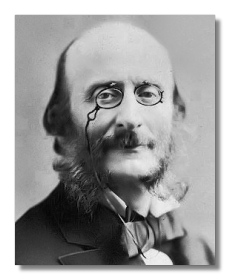
Les Contes d’Hoffmann aka Tales of Hoffmann are very tuneful.  I had forgotten how many great melodies Jacques Offenbach had given us in this, his attempt at operatic legitimacy.  Next season the Canada Opera Company will be producing Les Contes d’Hoffmann, but some of us had an early taste in concert tonight, courtesy of Bill Shookhoff’s Opera by Request.

Let me repeat what I just said. Oh my God, Offenbach can write tunes.  My head is a-buzz, as a few of those melodies refuse to let go.

Olympia’s song: 

The Barcarolle, his second best-known tune (after that can-can tune) 

The Ballad of Kleinzach:

And there is so much more, so many other melodies.  Hélas mon Coeur: http://www.youtube.com/watch?v=Z1xfCgiBkKU . Most of Antonia’s entire role: http://www.youtube.com/watch?v=6NIT5LfoAmo&feature=related

I’m grateful to Bill (Mr Shookhoff that is) for filling my head with tunes.

Offenbach’s opera is three acts of romantic disaster, wherein the storyteller –ETA Hoffmann – not only tells but lives his stories for us.  Each act represents another sort of female ideal (for soprano) and another sort of villainous nemesis (sung by a bass- baritone).  Hoffmann’s tenor heart in on his sleeve throughout.

Nicole Bower deserves particular credit in undertaking the varied and demanding female roles:

  • Olympia is a mechanical doll, singing coloratura like a tuneful machine
  • Antonia sings beautifully but sings herself to death like her mother before her
  • Giulietta is a beautiful courtesan

Henry Irwin was compelling as the villain of several guises, with several different nasty laughs and snarls, as well as a lovely sustained legato.  Jay Lambie as Hoffmann sang the demanding hero’s role, passionately enunciating his French while reaching for the vocal stratosphere.

Thanks, Bill–aka William Shookhoff, artistic director of Opera by Request— for your usual flawless piano playing in support of your  cast.

Opera by Request are back this Friday February 4th  at 7:30 pm with Debussy’s Pelléas et Mélisande at College Street United Church.  Perhaps I’ll see you there.

Posted in Opera, Reviews | Tagged , , , | Leave a comment

Neither dirty nor rotten

I saw Dirty Rotten Scoundrels last night.  No, not the Steve Martin/Michael Caine film, but the musical, presented at Hart House Theatre.

Let me say first off that I love adaptations.  Whenever I hear someone complain that the original was better—book or film—I try not to look too exasperated.   Why do some people resist a new adaptation?  I don’t get it. Surely there’s room for many versions.

There’s certainly nothing sacred about the 1988 Frank Oz film, considering that it’s a thinly disguised adaptation of Bedtime Story, a 1964 film with Marlon Brando and David Niven.

Comparing the films is as much a study of adapters as of two cultural epochs.  Both of the older continental swindlers (Michael Caine or David Niven) pretends at one point to have a dimwitted brother.

Steve Martin’s Ruprecht (who appears 1:45 into this clip)…   is completely different from Marlon Brando’s more physical approach .

A musical requires a few big ideas that can then be expanded into songs, in effect removing some of the subtlety of the original: a delicate process and not to be undertaken lightly.  The laughs of the original become a different kind of laugh, that is, if they’re not lost altogether in translation.

In the case of Dirty Rotten Scoundrels (the musical), David Yazbek (music and lyrics) & Jeffrey Lane (book) made a few clever choices.  The language is surprisingly racy, making the book often funnier than the original.  But if you consider how a film works –where you can clearly hear the lines—vs a musical—where someone singing a line may not be easily intelligible—that was a necessary choice.  I didn’t hear all the lines because there was at times so much laughter.  For example, look at the lyrics of “Big stuff,” a song that is like Freddy’s credo.

You can have a censored listen in this Tony Awards show broadcast, although two hot lines were too hot for the live TV broadcast:

  • Now I know Where I belong-A life of taste and class
    With culture and sophisitication pouring out my ass.
  • The Islands in the winter, The Hamptons in the summer,
    The fashion plate I date’ll give me Hummers in my Hummer.

or read the complete version.

That song is a big clue of a shift in the musical from the film.  Where the conflict between Steve Martin’s Freddy and Michael Caine’s Lawrence is largely a contrast between American & Brit, the musical takes a few things far deeper, and in my view far more interesting.  Our musical Freddy needs to be rough and guttural, given his earthy sentiments.  The underlying class issues of the story are closer to the surface, as Freddy’s raw greed is contrasted to Lawrence’s classy con artist.  Where Steve Martin was given a few moments to raise his voice, the musical Freddy gets to sing a virtual aria to his id, and the tone shifts as a result.   My God it’s funny.

I saw one of the last performances of the recent production at Hart House Theatre, a student production with a professional feel.  Everybody was in tune, moved well in their dance numbers, and the show’s pace never lagged.  I was especially impressed with Evan Dowling, whose Freddy reminded me of John Belushi both for his powerful singing and his physical presence onstage.  Director Jeremy Hutton, Hart House Theatre’s Artistic Director, is to be congratulated, both for this taut and hysterical production, and for consistently choosing challenging and interesting repertoire the past few years.

Posted in Dance, theatre & musicals, Reviews | Tagged , , , , , , | 2 Comments

Body of work: Aronofsky wrestles with an idea

Sometimes a superficial resemblance between two films by the same director is nothing more than coincidence; sometimes similarities are indications of important preoccupations.

Darren Aronofsky has recently been fascinated with bodily matters.  His last two films can be read as mirror images of one another.

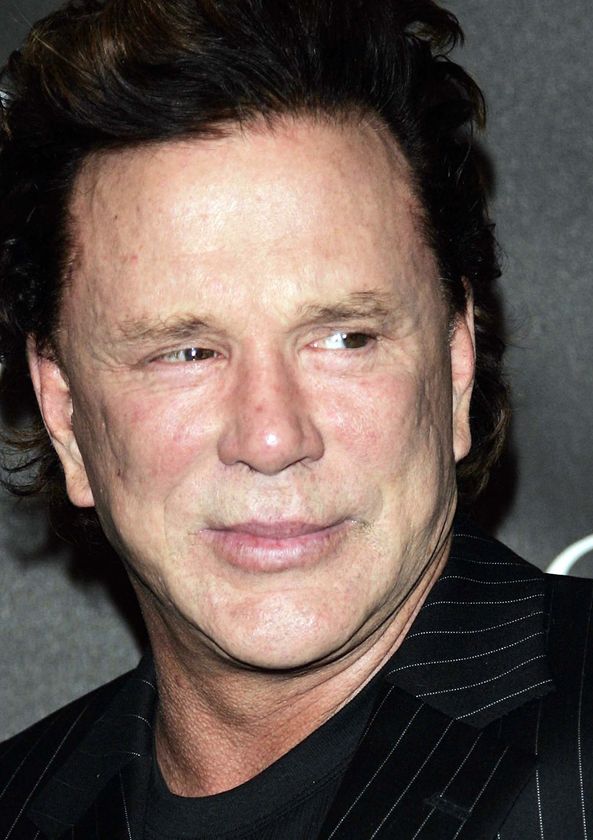
Mickey Rourke

Black Swan (2010) might be a horror film.  Or it’s a cautionary tale about what happens when an artist goes so deeply into her role as to fundamentally confuse illusion with reality.

The Wrestler (2008) is also a sort of horror film, yet also reads as a tale of redemption.  An aging wrestler confronts the damage of his lifestyle choices, both to his own body and to his family relationships.

In Black Swan a quest for perfection by the dancer protagonist –Nina–resembles an all out war on the body.  Nina confronts the collateral damage—in her own body and impoverished personal life—as she looks around at others who have taken the same dangerous path before her.

Today I was watching Hannah and her Sisters, Woody Allen’s 1986 film featuring Barbara Hershey before her plastic surgery, which led me to a pair of parallel google searches:

  • “Barbara Hershey plastic surgery”
  • “Mickey Rourke plastic surgery”

Among the pages i found, one headline went as far as saying “Aronofsky Helps Another Plastic Surgery Victim.”  While it’s sensationally absurd, I don’t think it’s a fluke that Aronofsky cast Hershey as the vicarious ex-dancer mom in Black Swan.  The damage on Hershey’s face serves as a manifest subtext in Black Swan: a generational obsession with perfection.

Time could be a character in Black Swan— arguably the arch-villain– lurking in the background of each of the main female characters:

  • Young Nina (Natalie Portman) knows success is fleeting
  • Nina succeeds the aging Beth (Winona Ryder), both as a star and as the lover of Thomas (Vincent Cassel)
  • Meanwhile Lily (Mila Kunis), the recent arrival is breathing down Nina’s neck, ready to replace her (on stage and in bed with Thomas) if she fails
  • Erica (Barbara Hershey) who no longer dances (if she ever really did) now obsesses over her daughter, as the most visible evidence of time’s ravages

Both films celebrate physical disciplines.  Wrestlers and dancers are both practitioners who not only have objectives in what they do with the body –as dancers or wrestlers – but also in what they make of the body.  The practice of their disciplines is as much about the creation of an instrument (the body of a dancer or a wrestler) as it is about the actions done using that instrument (dances or bouts).  And any achievement is a poignant challenge to the patient attack by time.

The body is a site for their work, and in the unfortunate individuals portrayed, a site for their obsessions.  We see both abusive practices for the marginal performer (steroids, bulimia, and worse) or the careful handling of a body in the midst of a successful career (equipment, shoes, muscles, exercise, rest).  One can find both a compassionate attention to detail and horrific glimpses of a heretofore unseen world.

Aronofsky deserves credit for bringing these two films to the screen.  Painful as some aspects are, I believe we fail to come to terms with complex material when we pigeon-hole and oversimplify.  The classification of art into genres, while a useful element of marketing and a tried and true practice in the history of criticism, sometimes leads us to under-estimate the breadth of some transgressive creations.  Black Swan is much more than just a horror film.

Posted in Cinema, video & DVDs, Reviews | Tagged , , , , , | Leave a comment