Mendelssohn, the Nazis and Me (and them)

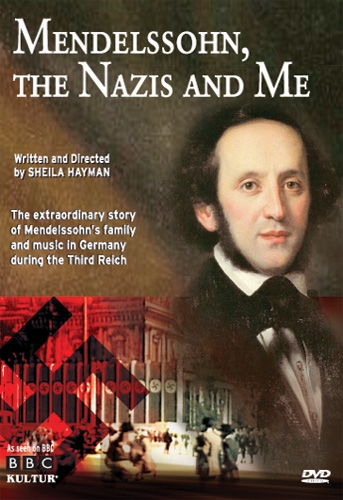
I was fortunate to stumble upon the documentary Mendelssohn, the Nazis and Me recently on TV Ontario (a public television network) in its first North American broadcast.

Originally seen on BBC, the doc is a curious mixture of music, history, and personal memoir from Sheila Hayman, the great-great-great-great niece of the composer Felix Mendelssohn.

It had me re-thinking aspects of my own identity.

Mendelssohn is a composer poised on the boundaries of Christianity and Judaism.  It’s common to speak of Mendelssohn as Jewish, yet he appears to have identified himself as a Lutheran, which would explain why he’s among the composers with a large body of work with strongly Christian associations:

  • Elijah and St Paul: two oratorios on Biblical subjects
  • Christian music including one of the best Christmas carols ever, none other than “Hark! The Herald Angels Sing!”
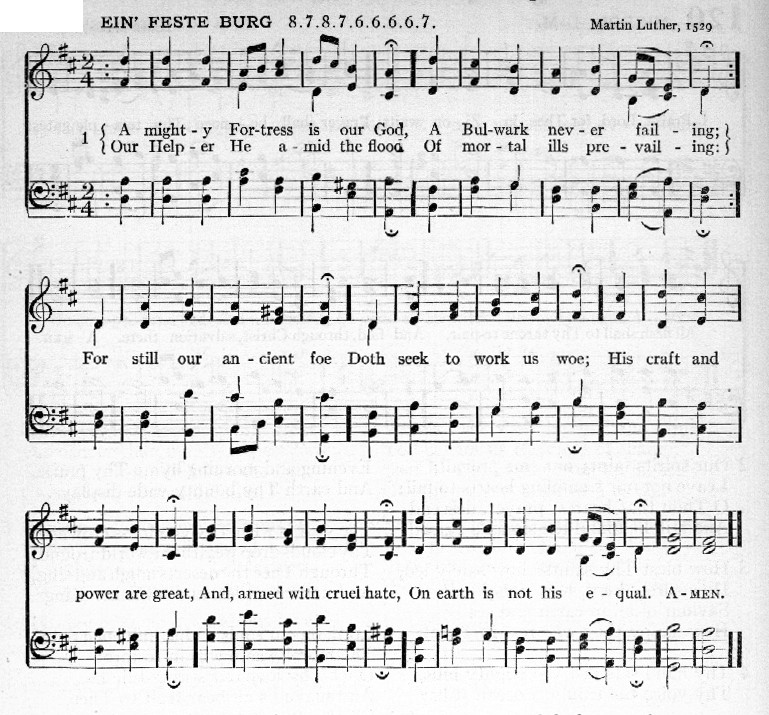
  • His Reformation Symphony, which includes a version of Luther’s hymn “A Mighty Fortress Is Our God

    Click on the image for the full-sized version

As it turns out, there are several Mendelssohns in the documentary.

  • Composer Felix, who lived from 1809 – 1847.  In our era of unending adolescence (speaking as someone who still doesn’t know what he’s going to be when he grows up) it’s chastening to look at yet another romantic composer who didn’t see his 40th birthday.  Frédéric Chopin died at 39 as did Carl Maria von Weber, while Franz Schubert died at 31!
  • Philosopher Moses Mendelssohn, who lived from 1729–1786.  Moses was among the first to argue for the plurality of faiths, whereby the various pathways of the great faith traditions (Christianity and Judaism in Germany, but Islam as well by implication) were all valid routes to God.
  • The recent generations of the family, including the film-maker and her father

The doc asks some big questions with an ingenuous tone and a straight face.  I find myself wondering, “what is a Jew?”  The film gives us the subjective take of the Mendelssohn family, to whom it seemed that Felix was largely assimilated into the Christian culture surrounding him in Leipzig, and a devout Lutheran.

But the facts aren’t quite so optimistic.  The commission for the Reformation Symphony (composed in honour of the tri-centennial of the Reformation) was never paid.  Although Felix missed his composition deadlines it has been speculated that the real reason he lost the commission is due to his Jewish Heritage, a potential embarrassment in a celebration honouring Protestantism.

I find myself wondering, not for the first time, at the complexity of what makes one Jewish.  It seems to be an odd club, in that sometimes people are trying to get in, sometimes trying very hard to get out.  If your mother is Jewish then you are in.  Conversions to Judaism are permitted.

Getting out?  Apparently lots of people assumed they were not Jewish –both according to the official criteria above as well as other reasons –but were blindsided by the bizarre definitions used by the Nazis.  For the first time I understand something I never got before.  Why didn’t they leave?  The simple answer: because they felt safe.  Felix did not think of himself as Jewish, and in the next generation no one practised any religion whatsoever.  Fortunately Hayman’s family survived, but not without some scares along the way.

When the Nazis wrote their history of German music it would attempt to change the truth while effacing or denigrating those like Mendelssohn whose contribution had been central to German culture for many generations.  Ha… they failed.

None of this is news.  What makes the documentary different is its personal slant, as reflected in the title, and the intriguing opportunity presented by unifying the study of several generations via the family and its history.  Instead of zeroing in on one period, we enter into several different lives within the family, different sorts of challenges, but in the end, the same questions throughout.  In telling the story many aspects of Mendelssohn’s music are illuminated.  Just as Felix sits at the boundary between two religions, the film happily straddles the boundary between documentary and art, memoir and speculation.

The documentary is available for purchase (I bought it) and bears repeated watching.

Posted in Cinema, video & DVDs, Reviews | 1 Comment

Assassins and history

Stephen Sondheim’s Assassins is a musical with history.  The play happens in an abstract space where characters from different centuries meet one another, converse, sing and dance together.  At first glance it resembles a review, a series of numbers where nothing really happens.

Perhaps I should have added the indefinite article “a”, because not only is Sondheim’s play historical, but it has a history, that tells you a great deal about the work.

It was out of step with the public when it first appeared in 1990 during the upsurge of nationalism surrounding the Gulf War.  A Broadway production meant for the fall of 2001 foundered on the even bigger wave of patriotism that followed the attacks of Sept 11th; in the fall of 2001 such plays simply couldn’t be mounted

And in the wake of the shootings in Arizona last week, similar questions have been put surrounding the revival of the Talk is Free Theatre / Birdland Theatre co-production of Assassins from last year.  On CBC Adam Brazier –the director –was asked whether any thought was given to cancelling the run.  Thank goodness the interviewer let him off the hook by saying it was too late to cancel.

And thank goodness they didn’t cancel.  While it’s true that some people find this material offensive, I think Sondheim is therapeutic.

For most of the play, we watch a kind of debate between two contrasting abstract figures, who could be virtues or vices from a morality play.  The Proprietor invites us to step up as if in a carnival shooting gallery:

Proprietor:  Hey, pal, feelin’ blue?
Don’t know what to do?
Hey, pal, I mean you—
Yeah.  C’mere and kill a President.

Just like that, the subject is there before you.  In that abstract space we’ll encounter each of the historical assassins, telling their story, and just as importantly, singing their song in the style of their era.

The other abstract figure is the Balladeer.  Where the Proprietor is brusquely theatrical, and mustn’t sound too pretty, the Balladeer is lyrical & contemplative, lamenting the sad choices of each assassin, and singing the prettiest music in the show.

But as the assassins learn that they are being left behind –in a song where we’re again implicitly in that shooting gallery, because each of them loudly demands their prize—they turn on the Balladeer.  The stage instruction is wonderfully impossible: “the Balladeer is swallowed up by the assassins and disappears“.

If there is a story, it’s a very subtle battle between words and music, where music is a vehicle for reflection, while words are a place for brutal action.  The frustrated assassins dispense with the Balladeer as surely as they dispense with sensitive reflection.

Shall we assemble the suspects in a line-up?

  • John Wilkes Booth killed Abraham Lincoln in 1865
  • Charles Guiteau killed James Garfield in 1881
  • Leon Czolgosz killed William McKinley in 1901
  • Emma Goldman was questioned following McKinley’s death, but except for one of her speeches –found in Czolgosz’s pocket at the time of his arrest– she probably had no connection to the anarchist assassin
  • Giuseppe Zangara killed Chicago Mayor Anton Cermak in 1933, but may have meant to kill Franklin Delano Roosevelt
  • Samuel Byck attempted to hijack a plane in 1974, hoping to crash it into the White House, in order to kill Richard Nixon.
  • Sara Jane Moore and Lynete “Squeaky“ Fromme both made unsuccessful attempts to kill Gerald Ford in 1975
  • John Hinckley tried to kill Ronald Reagan in 1981

Missing from that list is perhaps the most famous of all, the pivotal figure in the drama of Assassins, such as it is.

Shortly after the Balladeer is swallowed by the frustrated chorus of assassins, we meet the key figure in the last part of the musical, namely Lee Harvey Oswald, in the infamous book depository on the day JFK visited Dallas.

It’s especially powerful that for this production, the casting requires the Balladeer to reappear as Oswald.  I wondered at first if this was how Sondheim wrote it, but no, apparently several productions employed two different actors, as these are conceived as separate roles.  The first production I am aware of that used doubling to make the connection was the Broadway production employing Neil Patrick Harris as Balladeer / Oswald.  I suspect that choice will be standard from now on.  While it’s hard to explain logically, It makes complete sense at an emotional level.

The world of the play even loops back indirectly to its composer.  At one point, Byck (the failed hijacker) speaks into a tape recorder, addressing an unreachable icon, namely Leonard Bernstein.  Surely a young Sondheim dreamed of talking to Bernstein, and of course would go on to collaborate on West Side Story.  The moment is profoundly mysterious, considering the ongoing complaint of the assassins: that people won’t listen to them.  And when we remember that subtle debate between the Balladeer (music of reflection) and the Proprietor (words of action), and notice how dark this musical is, we can’t help but think that Sondheim’s identification with Byck is more than casual.

I saw the same production last year.  I sat among keen young students gasping at the audacity of Sondheim’s ideas, occasionally laughing at the most obvious gags, but otherwise like a congregation in church.

This year?   Maybe it’s just my luck but the night I went the audience felt so mature, without reverence this time, that they let their appreciation show.   I couldn’t tell whether it was the production or the audience that thwarted the laughter last year.  This year’s cast – there are a few changes—represents a subtler reading of the play.  The two women assassins — Moore and Fromme—are much broader this year, played as comic relief, and oh how welcome it is.

I wondered, though, whether current events in Arizona had strangely conspired to aid the comedy of the work.  A sensitive person needing catharsis could come to the play for therapeutic laughs.

The production had a few clear highlights and heroes.

Foremost among them must be the invisible man, namely music director Reza Jacobs.  With his small ensemble the ideal effect was achieved, whereby singers could face the audience with no pit or conductor in the way, while the accompaniment was always there in support of the actors.  The pace was wonderfully tight, while the tone was unabashedly ordinary just as Sondheim wrote it, full of rough edges and abrupt shocks.  This is not a piece written to show off singers, but a taut dramatic vehicle.  More than anyone else Jacobs made the magic happen.

Whoever made the choice to avoid using guns dodged a logistical nightmare considering how many shots are fired by so many actors in this show.  Imagine co-ordinating so many guns backstage that must fire properly.  Instead of guns we see a prop that is obviously similar yet not a gun, even if it must stand in for a gun;  at the appropriate moments the band makes all the noise we need to be jarred as if a real gun were being fired.

The Ballad of Guiteau is one of the more ambitious compositions in the musical, juxtaposing an old-fashioned hymn-tune with a cakewalk.  If you were to peruse all the different versions online via youtube –a painful prospect! –you’d quickly see just how astonishingly difficult this number is, balancing the dreamy hymn tune that verges on the lugubrious, with a cakewalk that needs to be brisk yet intelligible.

And as a complication, its combination of musical forms feels very pretentious, requiring a very subtle approach if it isn’t to vanish under the weight of its own heavy-handed text.  Steve Ross, reprising the role he first showed us last year, finds the perfect balance between comedy and pathos.  I believe this time out he’s found additional humour in some of the lines, yet he is the most authentic of the historical figures onstage in this production.

Adam Brazier, director, embraces the madness at the heart of the musical.  Brazier helped bring out the textual music to be found in the dissonance between these disparate speaking voices.  The moderns are sometimes stridently loud, especially the wonderful pair of Janet Porter’s mad hippy take on Squeaky Fromme, against the crabby suburban angst of Lisa Horner’s Sara Jane Moore (both new additions to the revival).  Ross’s Guiteau and Paul McQuillan’s Booth in contrast sound authentically 19th century.

As balladeer Geoffrey Tyler carries almost every scene he’s in, at times stealing the show with his gentle voice.  That’s doubly powerful considering the arc of the story, whereby the assassins eventually silence him, as if the music had died.  His chief adversary, the droll Proprietor, is Martin Julien, a vocal chameleon sliding through the dramatic underbrush, always able to find the right tone to blend into each scene.

Speaking of silence, the show will fall silent after its last performance January 23rd.  I believe it’s better this year than last, which probably means the tickets will soon be gone.

Don’t miss it.

Assassins runs until January 23rd at the Theatre Centre  1087 Queen St W., Wednesday – Monday at 8:00 pm as well as matinees Saturday & Sunday.  Tickets 416-504-7529, online at www.artsboxoffice.ca, in person, or at the door.

Posted in Dance, theatre & musicals, Reviews | Tagged , , , | 2 Comments

Lotfi Mansouri: An Operatic Journey

This is a book review I wrote for the newsletter of the Toronto Wagner Society.

Lotfi Mansouri: An Operatic Journey
Lotfi Mansouri with Donald Arthur

Still smiling

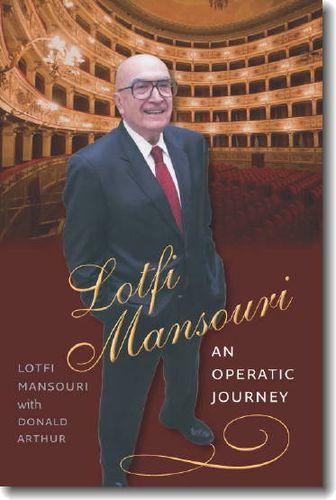
The grin on the cover looks the same as ever.  Can this familiar figure really be in his 80s?

You’ve probably noticed Lotfi Mansouri: An Operatic Journey in the Opera Shop in the Four Seasons Centre lobby.

It’s both a pleasure and a shock to read the story of Mansouri, one of the most important builders of opera in Toronto.  The pleasure is in reconnecting with those wonderful moments I had almost forgotten as well as discovering so much I never suspected about this icon.  And it’s something of a shock to read so many tales of conflict.

The book is a chronicle of cultural history, a reminder of how much the operatic world has changed since the 70s and 80s.  In the short time-span of this book we see Mansouri as the innovative newcomer, ascending to more responsible and powerful roles in the opera world, and then his move to the sidelines.  What seemed effortless on the exterior was achieved at a cost.  The man who once seemed to be synonymous with opera at least in Toronto (as well as a few forays into Hollywood as well), now appears to be himself a disgruntled observer from the sidelines, out of step with a world of young talent and Regietheater.

The book is indeed a magical tale of transformation, opportunities and unlikely outcomes.  Mansouri’s remarkable life is a matter of public record, yet the drama beneath the smiling surface took me by surprise.  Perhaps that’s one of the connotations of the subtitle “an operatic journey”: that his life is as colourful as a good libretto.

This is not the first memoir from Mansouri, but it’s far more comprehensive than his earlier Lotfi Mansouri: An Operatic Life, not just because that book appeared in the 1980s  before Mansouri left the COC for San Francisco.  Perhaps the key difference is that this time Mansouri has enlisted the aid of Donald Arthur.  You may recall Arthur as a guest at the Toronto Wagner Society in 2007, and know his previous work as the writer who collaborated on memoirs from Hans Hotter and Astrid Varnay.

Having read all three memoirs, one can see that Arthur seems to be a positive influence.  Nevermind that the writing has an eloquence reminiscent of Arthur’s own charming speaking voice, that he uses to great effect in his other career as a voice-over artist in Europe.  The resulting prose is at times exquisite, a huge improvement over the relatively stilted writing in Mansouri’s earlier book:

My first professional operatic appearance and my first employment by the San Francisco Opera involved carrying a spear in a performance of Otello featuring the great Chilean tenor Ramón Vinay.  My fee was one dollar, but I was becoming aware of the almighty power of make-believe.  On my way to the stage, I saw a tall guy with blond hair whose face bore a remarkable resemblance to my own—I needed a second to realize I had been walking past a mirror.

Just as with Hotter & Varnay, Arthur encourages Mansouri to trace his artistic influences and development.  We encounter far more than just biographical incidents, names and dates.  Arthur seems to bring out the best in his subjects, showing us their dreams and objectives, even when they fail.  Whereas Mansouri’s time with the COC was mostly a triumphant ascent, his experience at the San Francisco Opera is far more problematic, political, troubled.  The fact that we are not always reading a happy whitewash of events lends credence to the story-telling, even if the honesty is at times painful to behold.

It’s especially satisfying to read about the years Mansouri spent with the COC, to hear him mention familiar names from that era such as Geiger-Torel, Leberg, Tanenbaum, Southam, Bernardi.  While it’s probably true that the COC would have eventually established its own orchestra, improved its marketing and management, the change was positively revolutionary.   If you imagine the COC without an orchestra, without surtitles, without its ensemble studio and current endowment, you are in effect imagining the COC without its current success.

There is one other unavoidable element to this volume, something that I suspect may be the most delightful aspect of all.  Mansouri made many friends and more than a few enemies.  Some memoirs take the high road, only saying kind things about people, but this is not that kind of book.   I was surprised at some of the targets, such as Renate Scotto and Otto Klemperer.  I would be a liar if I didn’t also say that this is one of the chief delights of the book.  Mansouri has known a great many celebrities from around the world, and doesn’t suffer fools gladly; or is that Arthur peeking through?

Mansouri has led an amazing life, wonderfully captured in this elegantly written volume.  The book is especially important to Canadian opera fans curious about how we got to where we are now.  You must read this book, whether for what you can learn or purely for the fun of it.

5
Lotfi Mansouri: An Operatic Journey, by Lotfi Mansouri
with Donald Arthur // reviewed by Leslie Barcza
You’ve probably noticed Lotfi
Mansouri: An Operatic Journey in the
Opera Shop in the Four Seasons
Centre lobby. The grin on the cover
looks the same as ever. Can this
familiar figure really be in his 80s?
It is both a pleasure and a shock to
read the story of Mansouri, one of the
most important builders of opera in
Toronto. The pleasure is in
reconnecting with those wonderful
moments I had almost forgotten, as
well as discovering so much I never
suspected about this icon. And it’s
something of a shock to read so many
tales of conflict.
The book is a chronicle of cultural
history, a reminder of how much the
operatic world has changed since the
70s and 80s. In the short time-span of
this book we see Mansouri as the
innovative newcomer, ascending to
more responsible and powerful roles in
the opera world, and then his move to
the sidelines. What seemed effortless
on the exterior was achieved at a cost.
The man who once seemed to be
synonymous with opera, at least in
Toronto (as well as a few forays into
Hollywood, as well), now appears to
be himself a disgruntled observer from
the sidelines, out of step with a world
of young talent and Regietheater.
The book is indeed a magical tale of
transformation, opportunities and
unlikely outcomes. Mansouri’s
remarkable life is a matter of public
record, yet the drama beneath the
smiling surface took me by surprise.
Perhaps that’s one of the connotations
of the subtitle “an operatic journey”:
that his life is as colourful as a good
libretto.
This is not the first memoir from
Mansouri, but it’s far more
comprehensive than his earlier Lotfi
Mansouri: An Operatic Life, not just
because that book appeared in the
1980s before Mansouri left the COC
for San Francisco. Perhaps the key
difference is that this time Mansouri
has enlisted the aid of Donald Arthur.
You may recall Arthur as a guest at the
Toronto Wagner Society in 2007, and
know his previous work as the writer
who collaborated on memoirs from
Hans Hotter and Astrid Varnay.
Having read all three memoirs, one
can see that Arthur seems to be a
positive influence. Never mind that
the writing has an eloquence
reminiscent of Arthur’s own charming
speaking voice, which he uses to great
effect in his other career as a voiceover
artist in Europe. The resulting
prose is at times exquisite, a huge
improvement over the relatively stilted
writing in Mansouri’s earlier book:
“My first professional
operatic appearance and my
first employment by the San
Francisco Opera involved
carrying a spear in a
performance of Otello
featuring the great Chilean
tenor Ramón Vinay. My fee
was one dollar, but I was
becoming aware of the
almighty power of makebelieve.
On my way to the
stage, I saw a tall guy with
blond hair whose face bore a
remarkable resemblance to
my own—I needed a second
to realize I had been walking
past a mirror”.
Just as with Hotter and Varnay, Arthur
encourages Mansouri to trace his
artistic influences and development.
We encounter far more than just
biographical incidents, names and
dates. Arthur seems to bring out the
best in his subjects, showing us their
dreams and objectives, even when they
fail. Whereas Mansouri’s time with
the COC was mostly a triumphant
ascent, his experience at the San
Francisco Opera is far more
problematic, political, troubled. The
fact that we are not always reading a
happy whitewash of events lends
credence to the story-telling, even if
the honesty is at times painful to
behold.
It’s especially satisfying to read about
the years Mansouri spent with the
COC, to hear him mention familiar
names from that era such as Geiger-
Torel, Leberg, Tanenbaum, Southam,
Bernardi. While it is probably true
that the COC would have eventually
established its own orchestra,
improved its marketing and
management, the change was
positively revolutionary. If you
imagine the COC without an orchestra,
without surtitles, without its ensemble
studio and current endowment, you are
in effect imagining the COC without
its current success.
There is one other unavoidable
element to this volume, something that
I suspect may be the most delightful
aspect of all. Mansouri made many
friends and more than a few enemies.
Some memoirs take the high road,
only saying kind things about people,
but this is not that kind of book. I was
surprised at some of the targets, such
as Renata Scotto and Otto Klemperer.
I would be a liar if I didn’t also say
that this is one of the chief delights of
the book. Mansouri has known a great
many celebrities from around the
world, and doesn’t suffer fools gladly;
or is that Arthur peeking through?
.
Mansouri has led an amazing life,
wonderfully captured in this elegantly
written volume. The book is
especially important to Canadian opera
fans curious about how we got to
where we are now. You must read this
book, whether for what you can learn
for purely for the fun of it.
Posted in Books & Literature, Reviews | Tagged , , , , , , , | 1 Comment

The King’s Speech

We’re always hearing about the impact of media upon our world.

As anyone who has seen Singin’ in the Rain can tell you, new media –such as talking pictures in the late 1920s—can cause a complete upheaval not just within an industry, but also in the broader culture as well.

This may seem like an unlikely preamble to The King’s Speech.  Before I saw the film I read speculation that Colin Firth might be the Helen Mirren of 2010, winning an Oscar for a royal portrayal.

But nevermind Oscar & the Academy. Nevermind the art of cinema. I have to think that Marshall McLuhan would have loved this film, a virtual gloss on his ideas about media & culture.

Marshall McLuhan

…And King George VI is the collateral damage of the media revolution, a man who in a previous century could have safely kept his stammer away from the public simply by posing on his horse or on the balcony of Buckingham Palace.

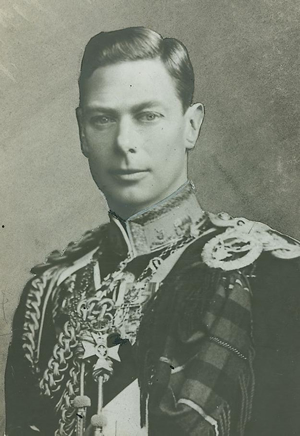
King George VI: the collateral damage of the media revolution, a man who in a previous century could have safely kept his stammer away from the public simply by posing on his horse or on the balcony of Buckingham Palace.

But that’s no longer enough, as Doctor Emmett Brown told us in the first Back to the Future film.  Looking at Marty McFly’s camcorder he said “no wonder your president has to be an actor; he’s gotta look good on television.”

Reagan ascended the American throne a half-century after George VI.  Actually television is much easier now than what poor Bertie had to endure in the golden age of wireless broadcasting.  There were no teleprompters.  Radio was so new that no one really had any notion they were witnessing the birth of a new discipline with new rules.  The best professionals adapted the skillsets they’d identified for actors and orators.  No one had yet had Doc Brown’s epiphany, in recognizing that the skills of film actors would be required for world leaders in the public eye through the media.

We observe that with the paradigm shift of talkies, the silent stars Lockwood & Lamont from Singin’ in the Rain must learn the craft of speech for their new talking picture.  First, Lina Lamont (Jean Hagen) is being instructed to little effect by coach Phoebe Dinsmore (Kathleen Freeman).

Then it’s the turn of Don Lockwood. After a series of absurd tongue-twisters (such as “arr-ound the rr-ocks the rrugged rrascal rran”) Don (Gene Kelly) and his pal Cosmo (Donald O’Connor) finally erupt in a fit of absurdity against the absurdities imposed upon them by their diction teacher.

“Moses supposes his toeses are roses,
but Moses supposes erroneously.
Moses he knowses his toeses aren’t roses
as Moses supposes his toeses to be.”

I never appreciated this silly song until recently.  The song in some respects resembles a jazzy vocalise, an eruption of anarchy in response to the vocal discipline.  The voice is such a fascinating instrument –not unlike the dancer’s body—in the way the artist inhabits their instrument.  We become aware that the distinction we’ve habitually made between sense and nonsense –as in the silly song—breaks down when we deliberately work our instrument minus any content.

The King’s Speech has an additional subtext concerning ability and disability, depending on your personal history, a subtext that will be much more powerful if you see the film in a big theatre rather than at home on DVD.  If you’ve ever had an injury or helped rehabilitate a loved-one through some disability to their speech, their vision, their ability to walk, then you understand the communication barrier that sometimes separates the care-giver from the patient.

When we learn most things, our teacher can explain what we need to do, as for example when our mathematics teacher illustrates what we must do in a particular operation.  But what if we were being taught by someone whose competence places them on the other side of a virtual wall?  If the teacher asks us to take some steps without the ability to describe how we could possibly resume walking, our failure may magnify that wall in our minds.  The unrealistic expectations of doctors, practioners & caregivers of the past could be very damaging.


The King’s Speech sits on the boundary between that unfortunate past and the modern era of more compassionate caregivers.  To me this is the most significant drama in the film, even if it is resolved more or less in passing as if it were merely a sub-plot.  I think most people would say that the main action of the film concerns George VI’s role in Britain’s fight against Fascism.

And now, while we’re considering The King’s Speech, you might find it interesting to hear The King’s Speech.

Posted in Cinema, video & DVDs, Essays, Reviews | 1 Comment

December 30, 1960

December 30th, 2010 is a date of personal interest, the anniversary of the day my father succumbed to leukemia, at the very end of 1960.   I understand he had been sick for a few years.

I don’t think of my father very often, because he died so early in my life.  I was so young that I hardly have any memories of my father. There’s a conversation i vaguely recall with him and my Mom concerning my progress through school; he was very supportive.  I can’t recall the voice distinctly.  He has become an amalgam of photos and stories, an abstraction and a myth.

József or Joseph, or Joe?  “Apa” or “Dad”.  I had seen the stationery, showing his business nom de guerre, “Joe Barr.”  I suppose if Bernie Schwartz had to rename himself as Tony Curtis, why shouldn’t Barcza Jozsef as well?

Throughout childhood I’d suddenly be snatched out of what i was doing, when someone would start to tell a story.  They’d lived their lives with him, whereas I was so small when he passed away.  I found so much glamor in the stories from my mother, and from my older siblings, who knew him so much better.  My brother Peter had after all reached the advanced age of eleven and a half, but that was a massive difference compared to what i had seen and the precious little I had managed to retain.

Fifty years ago today, my family came to the end of a huge struggle.  For awhile my mother lived by my father’s side in the hospital, and so the kids went to stay with the pastor of our Lutheran church.  My father had been a prominent member, helping with the heating & air-conditioning; hm, or was it actually donating? there’s something else to ask my Mom, to untangle tales.  I love those one-on-one conversations we have where she goes into a bit of a reverie, telling me about the past.  Our conversations led to Silence is Golden, an opera i wrote about ten years ago, although I didn’t nearly cover it.  I have been trying to find out about the past my whole life, it seems.

1960 itself, while it may seem to be a bit-player in this drama, stands shoulder to shoulder with a series of blanks, because I know so little with certainty.  Other events from that year have been conflated into my life-story.

1960 is also the year of JFK’s election.  That America was orphaned by his assassination in November 1963– when i was eight years old — allowed him into my mythology: as  JFK probably had been for any other sensitive young person of the time.   We’re not talking about the modern complex figure, but rather the earlier version of JFK, a witty avatar who seemed so perfect.

Jussi Bjoerling also died in 1960.  I only discovered Bjoerling in subsequent years, particularly between the ages of 10 and 20 when our culture at home came mostly from the record player or the radio.  Astonishingly, he sounded wonderful right up to the last month of his life, in 1960.  The amazing performances –especially in his last concert in 1960– added to the aura surrounding 1960 in my head.

I conflated them all together, all those men who died young.  Bjoerling (or Björling if you prefer) was supposedly born in 1912, and so was 48 when he died.  John Fitzgerald Kennedy was born in 1917, the same year as my father.  Dad was 43 when he died, same age as the youngest President ever elected in 1960, who would be dead by the age of 46.

Needless to say the mystique the entire decade acquired –by now it’s trite and cliche to talk about the ’60s as a period for music, political ferment and more– was very personal for me.

Today, while I am aware of my father, it’s really a day for my Mom.  Every year she’s burned a candle on this day, thinking back.  Every year it’s a day to touch base, re-affirm the family connection.   For me Christmas has always had the dark cloud of mourning hanging over it, because old year really seems to pass away and in a real sense to die.  I’ve rarely had a New Year’s celebration where i fully gave in to the extroversion of the day, given the family’s habitual introspection that week leading up to Dec 30th.  But I think we also draw strength from that darkness, and enter the new year refreshed and renewed.

Happy New Year to you, and thanks for reading this.

Posted in Essays, Personal ruminations & essays | 1 Comment

Risky performance: when it’s not just a metaphor

Will the new Spiderman musical ever open?  It’s been prohibitively expensive to marry Julie Taymor‘s  vision to the music of Bono & The Edge.  I’ve read estimates of $65 million USD: and counting.  One wonders how many years of full houses plus road-show tours it would take to make back that kind of overhead.  Wicked allegedly earned over one million dollars per week, re-couping its initial $14 million in 14 weeks.  Supposing that prices and wages and costs rise the same amount (not necessarily so but we have to start somewhere, right?) that’s over a year before you’ve made back your investment.

But speaking of overhead, there are other more literal risks in Spider Man: Turn Off the Dark. People are getting hurt doing this show.  The news reports are testing that old axiom “there’s no such thing as bad publicity”.   The injuries are real.  But the show must go on.

The incorporation of circus performance techniques into a show are not unprecedented; in fact one could even say it’s a trend right now.

After working for Cirque du Soleil, Robert Lepage seems to have absorbed circus elements into his expressive vocabulary.

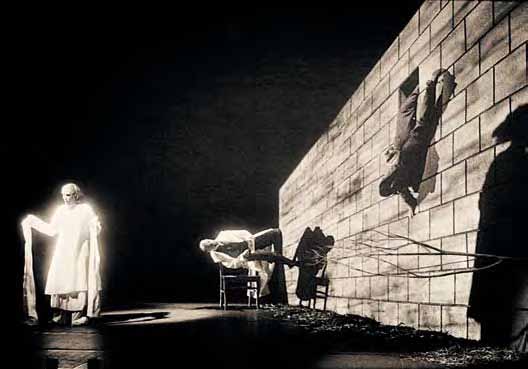
Erwartung COC 1992

Giving a whole new meaning to the expression "drives me up the wall".

But as far back as his Canadian Opera Company production of Erwartung in 1992, Lepage seemed to have a thing for people walking on walls.  At the time I was thrilled by the effect, but never expected it to become a trope in Lepage’s work.

Yet that’s what’s happened.  For example, in the Metropolitan Opera production of Berlioz’s La Damnation de Faust that premiered at the Met in 2009 (previously seen in Paris in 2001), we see soldiers on wires , and demons dancing with sylphs on those same big walls.  More recently, we’ve seen several characters from Wagner’s Das Rheingold, the first installment of the Ring Cycle, suspended from wires.  From the very beginning, when we first encounter the swimming Rhinemaidens , until we watch the Gods entering Valhalla at the end, aerial performance is a big part of the presentational vocabulary.

But that’s where the resemblance to Taymor’s Spiderman ends.  Lepage’s use of the circus element appears to be completely safe, and comfortably married to his mise-en-scène.  While there’s most definitely a whiff of the  carnival in the pure spectacle to which we’re treated, it seems to have been carefully constructed with safety in mind.  That’s perhaps the big difference, when we factor in the invisible Ex Machina contribution, from Lepage’s production company.  Taymor and company are struggling in plain view with a much riskier proposition, whereas Lepage & Ex Machina apparently worked out the bugs before exporting their work to NYC and the Met.  During the High Definition broadcast of Rheingold we were even treated to a little bit concerning the orientation of the Rhinemaidens on their first day on the wire.  These are not aerialists, but opera singers, enlisted into a new look opera, and of course it was scary the first time they were suspended in the air.   The methodical simplicity of the Ex Machina approach was never so clear as now, in juxtaposition to the struggles of Taymor and her company.

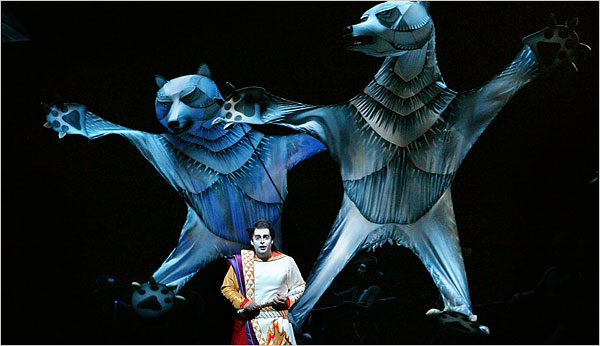
Taymor's Magic Flute

Don't look over your shoulder Tamino....

One has to wonder if Taymor has asked too much of her team, and now is trying to make too much of a literal leap ahead in stagecraft.  I love the circus & the recent infusion of aerial elements into new venues and artforms.    Taymor’s Lion King and more recently, her Metropolitan Opera production of The Magic Flute both depend heavily upon puppets and theatrical visual effects.  But the puppets are part of a poetic mise-en-scène relying first and foremost upon the imagination of the viewer.

Theatricality usually pushes my buttons, making me more engaged even while making it obvious how artificial the presentation really is.  Taymor seems to have forgotten about the role played by our imaginations, in her attempts to literally make Spiderman fly in the air above her audience.  I hope the show gets off the ground, even if the actors don’t.

Posted in Essays | Tagged , , , , , , , , , , , , , , , | 1 Comment

Mad Swan

After a post earlier this week concerning ballet, I had to go see Black Swan, a film that appears to go right to the heart of the artform or at least the concerns I spoke of the other day.

I personally avoid reviews that contain spoilers.  How do I talk about this without giving the film away?

While Black Swan may not be perfect–“perfection” being a concept haunting the film–I hope people will see the film. It’s an accomplished piece of work from Director Darren Aronofsky, including a series of performances from people who are a bit hard to recognize in their new guises.  You may remember Vincent Cassel as the Russian Mafioso from Eastern Promises, or Barbara Hershey (a huge star for such 1980s films as Beaches, Hannah and her Sisters and The Last Temptation of Christ), Mila Kunis (whom you may remember from That 70s Show), and Winona Ryder.

But they’re all spear-carriers in Natalie Portman’s film.

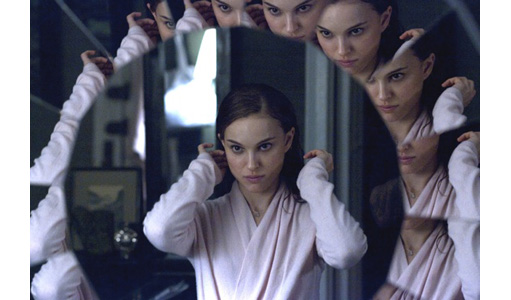
Nina --Natalie Portman-- looks into the mirror

The mirror is like another character in this film. What will Nina see?

For awhile in the first half-hour I found myself questioning how it was done, as the camera indeed played with us a couple of times, bringing the viewpoint up from the feet as if to tease us, saying “yes this really is her, not some double.”  In places one can’t help wondering how it was done, although much of the dancing is unconvincing as a representation of a real star.  But that’s a quibble, considering how persuasive much of her dancing is.  I was swallowed up by her portrayal of Nina the troubled ballerina.  If the Academy really prefers performances that cost stars a great deal—for example, Robert De Niro’s weightgain for Raging Bull.—then Portman merits serious consideration.

The movie reads a bit like a horror film.  It shouldn’t be mistaken for a film like The Turning Point or White Nights, films that explore backstage dramas in the lives of ballet dancers.  Any parents thinking this is an introduction to the ballet will drag their kids out in the first hour when they see what they’ve blundered into.  Instead, we get an intensely psychological exploration of a girl’s psychology, using ballet as both the subject and the pathway into the girl’s soul.

The question of virtuosity is central to Black Swan.  Yes i am obsessing about the subject, if you look at my previous post.  In this case, as in so many others pertaining to dance, we’re confronted with pure skill for its own sake, strutting before our eyes for no other reason than to show what the artist can do.  Why do they do it? First and foremost, they do it because they can.  Ballet is ostentatious, showing us the body because the body –in motion or merely posed delicately—is arguably the subject and object of dance.  No wonder dancers  obsess about the body, at once their instrument & their work of art, simultaneously what they’ve made and what they employ to create.

Aronofsky gets completely inside the head of Nina.  Part of the job is accomplished by Portman, part is through the ingenuity of Clint Mansell, whose score of original music is woven through with bits of Tchaikovsky.  I wonder if his achievement will be appreciated, because what he does is blend the score so seamlessly into the film as to fool us.

That being said, there are problems.  I will sound like a stickler when I say that in some respects the film is a mess.  But there’s a gaping continuity problem at one point, when we appear to be headed towards a performance and then somehow an extra day or more of rehearsals puts off the climactic premiere of the ballet.

But some of the messiness is very good.  We’re often placed in an ambiguous position, unsure what’s real and what’s imaginary, wondering whether we’re seeing objective reality or a projection from inside Nina’s mind.  I liked that, even as I heard gasps and sobs in the theatre.  In places it’s very scary.  Whether it’s in Nina’s head or not, we see an awful lot of blood in this film.

I am still stuck on the question I was turning over in my head a few days ago, concerning ballet and virtuosity.  There’s a fundamentalist streak to the art form, a feral refusal to compromise that sometimes makes the form seem to be captive of arty nerds, and at other times, to seem like a tower of integrity.  Perhaps that split personality is true to the madness that we see in this film.  It’s scary because the madness appears to be the trap lurking at the heart of the artform, a reflection of its aspirations & ambitions.

I want to see it again.

Posted in Cinema, video & DVDs, Reviews | Leave a comment

What price virtuosity, or the (body) image problem.

I used to see opera and ballet as two sides of the same coin. I understood them in terms of an obsession with power & fluidity, accomplished by ballet’s bodies, and by opera’s voices.   The dancer’s movements were what mattered above all, a manifestation of the body.  And while the singer’s voice was a comparable obsesssion it was a vessel that seemed to exist independent of the body.  Singers could be fat, and often were so large as to compromise the dramatic illusion.

See why i saw them as opposite sides of the same coin?

“Obsession” is a word meant to suggest an unhealthy preoccupation, one that comes with a price.

I believe opera has actually begun to break free, even if the change is regretted by the older generation of opera fans, the ones who speak of wanting to close their eyes and listening.

Two recent phenomena brought this back to me.  The first was Studies in Motion, currently showing at Bluma Appel Theatre.  After watching a few perfect young bodies choreographed by Crystal Pite, we see a few not so perfect bodies.  I was reminded of the casting of Pina Bausch, who was transgressive in showing us average bodies, moving without the customary virtuosity of dance soloists.  Indeed, as I read about her online –and the apparent lack of respect for her legacy– I can’t help but think that she was so far ahead of her time that nobody (except for Pite?) seems to have picked up on the possibilities she offered.

The second is a controversy swirling around a negative review in the New York Times.  Alastair Macauley said

Jenifer Ringer, as the Sugar Plum Fairy, looked as if she’d eaten one sugar plum too many; and Jared Angle, as the Cavalier, seems to have been sampling half the Sweet realm.

Does it matter that Ringer is recovering from an eating disorder?  I feel  dance is trapped in a perverse time-warp.  Macauley seems to speak for the core values of the dance world, a place inhabited by wraith-thin women and men.  The deconstructive power of a Ballet Trocadero gets its counter-discursive torque from the rigidity of the culture they have been mocking for so long.  But while people laugh at the “joke” nothing seems to change.  Dancers are still super thin and –excuse me for bringing this up — don’t resemble anyone i have ever met.  They make fashion models –one of my touchstones for the bizarre– look like people.

Pardon me if i seem to be down on ballet. I love ballet, really i do.  I am preparing to take my grand-daughter to her first Nutcracker.  I find I am interrogating the medium the way i might stare down her potential suitors.   Instead of asking when he might bring her home, I want to know what this ballet culture is prepared to offer her when she picks up on their endemic dislike of adiposity.  I hope she doesn’t internalize it.

Opera seems to have broken away from the kind of rigidity seen in dance, emulating a similar break made decades before in the realm of spoken theatre.   Brando & the Method were all about rejecting or at least concealing their virtuosity.  While purists are still reeling, there’s no denying that opera has problematized the old categories.   Sometimes opera looks great while sounding merely okay, a change that hasn’t gone over well in some quarters.  I would argue that this problematic approach is at the heart of the current love affair with opera, one that has made opera more able to live up to its dramatic promise.

In contrast, as far as I can tell, the prevailing discourse in dance is still captive of virtuosity.

Popular music has deconstructed the nonsensical fascination with chops-for-the-sake-of-chops, that used to entrap serious music in its own complex requirements.  As so many from Louis Armstrong to Frank Zappa have shown, simplicity does not preclude profundity. Mozart, Mahler & Debussy got it, even if modern music seemed to lose its way for much of the past century.

I don’t claim to have the solution, but I find it fascinating to look at the questions.  Fat ladies are no longer de rigeur at the opera: and too bad.  Opera has at times bought into the same excessive behaviour seen in ballet.  I have to wonder if some of the heavy-weight opera stars of the past would be able to make it today.  Measha Bruggergosman and Jessye Norman, and Deborah Voigt have all lost a lot of weight, as did Ben Heppner; pardon me for sounding like one of those obsessive people, but i felt the voices were better when they were fat (if i may be forgiven for using that scary F word).  I merely wish we could see a happy medium, of dancers who aren’t waifs, singers who are neither fat nor thin.

Am I asking too much in demanding a theatre that puts real people on stage?

Posted in Essays | Tagged , , , , , , , , , , | Leave a comment

A new Messiah

It might seem to be a conundrum worthy of a religious scholar: how do we know the real Messiah?  And even though we’re not speaking of a saviour but rather about Handel’s oratorio, the topic may as well be a matter of faith, given the partisan viewpoints surrounding different approaches.

The choices seem generational.  The Toronto Symphony’s partnership with the Mendelssohn Choir—billed as “Toronto’s Biggest Messiah”—is the one I recognize from my childhood, particularly Lois Marshall singing a persuasive “I know that my redeemer liveth.” That big and broad approach is also found on the classic recording conducted by Sir Thomas Beecham Messiah, including Canadian Jon Vickers’ reading of  “Ev’ry Valley.(http://www.youtube.com/watch?v=9uGCyCQ4760)

In the 1970s and 80s I had my eyes opened by a succession of recordings using an entirely different sound, purporting to use instruments played in the manner of the time.  One heard epithets such as “authentic” and “original” even though the techniques for the instruments (eg horns without valves) appeared to have been at least partially lost, given the uneven results in some of the early recordings.  But there’s no question we were being treated to an important revolution, a new valorization of the text above all, and a new understanding of performance and virtuosity.  Conductors of this generation were a new breed of scholar-conductor, looking professorial unlike the previous generation of egotistical maestros who used to strut the podium.

That new generation of musicians –who started a kind of alternative movement of performance –has in fact matured.  I couldn’t help but notice how the players in Tafelmusik appearing in the recent broadcast of Messiah on Bravo have grown up.  While Tafelmusik sometimes venture gingerly into the romantic repertoire (even though others such as Norrington & the London Classical Players have been far bolder), they appear to have a strong preference for baroque music.  Thank goodness David Fallis & Opera Atelier have coaxed them out of their apparent comfort zone to undertake a series of Mozart operas that have been nothing short of astonishing.

And now I’ve encountered a new generation.  Last night I saw & heard Aradia Ensemble under Kevin Mallon making a new claim for historicity & musicianship.  The Dublin Messiah is to be understood as the original version from 1742.  There are substantial differences from the Messiah one usually hears.  What we heard used an even smaller ensemble than Tafelmusik’s already small orchestra

  • according to Tafelmusik’s website they have eighteen permanent members, whereas Aradia played with sixteen (admittedly that doesn’t mean Tafelmusik always uses all 18)
  • Tafelmusik chorus have 20-24 singers whereas Aradia employed just fourteen
  • perhaps most importantly, we were in the intimate confines of Glenn Gould Studio which holds 350 compared to either Massey Hall’s 2700 seats or Trinity-St Paul’s 700+

I really meant what I was saying about a new generation; they’re visibly younger, or maybe it’s just that I suddenly noticed that I’m closer in age to the members of Tafelmusik than those in Aradia.

Part I was taken without any breaks for applause, and not because the audience didn’t believe they deserved it; as a result we experienced an unprecedented dramatic tension, as the drama flowed relentlessly forward.

I’ve never heard a Messiah so clearly.  According to the program notes, the size of venue & ensemble correspond closely to that of the first performance in Dublin.  As a resultas well as because of the sensitivity of Mallon’s approach, intelligibility was never an issue.  The solos were compelling monologues while the choruses were miniature dramas.

There were so many highlights, that I hesitate for fear of omitting something wonderful.  For example, the pastoral symphony that precedes the soprano’s description of the shepherds’ encounter with the angels was the most boisterous and rustic sounding sinfonia I’ve yet encountered.  Usually we get something timid and quietly respectful, as if the orchestra were afraid to wake the sleeping shepherds; not so with Mallon.

The choruses that open Part Two were extremely dramatic with a frenetic pace, and an almost painful insistence on a quick cut-off from the chorus to maximize clarity.  Sometimes Mallon allowed the chorus to be beautiful as in “Lift up your heads” and “All we, like sheep”, while at other times intelligent articulation took precedence.

Several numbers sound brand-new in this version.  Instead of the elaborate “And who may abide the day of his coming” to which we’re accustomed, the Dublin version gives us a very brief recitative before the chorus are plunged into “And He shall purify.”  With such a tiny ensemble in the intimate space one could hear every note of this choral tour de force.

Of the soloists, I wanted to single out tenor Joseph Schnurr, who sang with a kind of evangelical fervor, his face admittedly deep in his book.  Although my first impression was conflicted, in Part II his exchanges with the chorus won me over, in their resemblance to passionate Biblical readings.  I was especially persuaded by “He shalt break them”, an especially difficult piece of text that Mallon made even more angular than usual, perhaps as lead-in to his most unorthodox reading of the Hallelujah Chorus, begun almost in a whisper.  The polite audience finally came to life at this point –with a little prompting from the Maestro—in recognition of the sparkling reading.

I can’t help but wonder whether The Dublin Messiah will become an annual event.  I hope so.

Posted in Reviews | Tagged , , , , , | 2 Comments

Levesque in Leslieville

It’s midweek at Edward Levesque’s Kitchen with my friend Brian, catching up.  This is my second visit.  The first in 2009, was my daughter’s idea.  Zoe has an expat’s appreciation of Toronto and a great network of arty friends telling her what’s good to see and hear and especially eat.  When she tells me to see a film I usually check it out.  E.L’s Kitchen was one of the places we hit before she left town, so it has nostalgia value.

How could I resist a restaurant in Leslieville?  Indeed, a former employee once presented me with a street-sign he’d somehow found (haha or stolen?) embossed with the characteristic “Leslieville” name.  I’d heard the area was being reinvented; Edward Levesque’s Kitchen seems to prove that the district has arrived.  Surely restaurants of such ambient quality can’t spring up in crappy neighbourhoods, can they?  There’s much to admire about the place, yet one can park for free in front after six p.m. because the neighbourhood is still understood to be residential. Talk about the best of both worlds!

The wine list is humongous but we both had beers to start while we chatted in the empty place, having arrived early.  We took a stroll to look at the pictures on the walls: sepia photos suggesting historical colour.

I did not pay much attention to Brian’s plate – duck breasts, sweet & sour winter vegetables & something else—because I was so thrilled by what was happening for me: a seared beef tenderloin.   And then instead of the mash potato, which might have been lovely considering the excellence of everything else we received tonight, I’d made a substitution.  Don’t you love it when they let you do that? i find it’s a naughty pleasure, although i will never be as high maintenance as Meg Ryan’s character with her salad + dressing on the side, in When Harry Met Sally (and yes it was in a restaurant that she did her fake orgasm thing).

Would you believe three additional sides?

  • side one: sweet & sour vegetables;
  • side two: brussel sprouts with double-smoked bacon in little cubes.
  • side three: a very edgy rapini, sautéed with garlic & peppers.

I like variety and contrast.  While the range of flavours I’ve described already sounds like a lot, I had the additional pleasure of a California Cabernet to gently complement the beef.  The menu is a tantalizing array of choices, roads I might have traveled and will yet visit in weeks to come, such as the sweet potato/ricotta gnocchi with gorgonzola & toasted walnuts, or the lobster & white asparagus risotto.

Afterwards Brian & I shared a stilton plate: cheeses, sliced fruits, walnuts, toasts and port shooters.  Wow.

The place became crowded later, but that didn’t hurt the service one bit.   I felt quite wonderful spending the evening in E.L.’s Kitchen reminiscing.

Posted in Food, Health and Nutrition, Reviews | Leave a comment