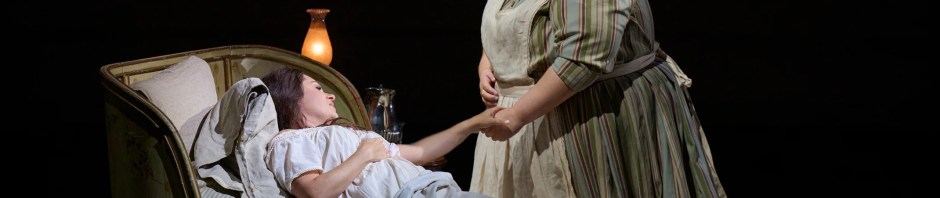
I feel fortunate that I had the privilege of seeing Verdi’s La Traviata today through the eyes of someone discovering the work for the first time, the Canadian Opera Company matinee at the Four Seasons Centre.
When I arrived Erika was already in her seat, chatting with Doug who was sitting beside us, and that’s how I know it was his first time seeing this work.
I feel sorry for the critics who will sometimes speak as though it’s drudgery to see one of the core operas that make up the standard repertoire. I never tire of these works, and feel especially lucky for the perspective I had today, watching the show and picking up on Doug’s response via my peripheral vision.
The reason these works are so frequently performed, so well-attended, so popular, is because they combine a simple story with music that captures the emotions of the story. While people sometimes take courses to learn about opera (I know because I used to teach them), the best operas work well because they need no explanation. They’re so well composed they work really well with just about any cast any set design any director.
I’m framing my experience via Doug because I had such a powerful experience, loving this cast so much that I want to recognize that at least some of my enjoyment came from getting to see it through his eyes and also via those of Erika, who also enjoyed it very much. While opera happens in your visceral response to a show it can be enlarged by the social aspect of the public performance, the way others are also swept into the experience.
I think the cast for this show was actually the #2 cast. I am a subscriber, so when I go later in October I’ll hear the #1 cast. I wanted to also hear this group, especially because in my experience, just like the ad for Avis Rent a car says, they try harder because they’re #2. I have seen it before, possibly because they have something to prove, possibly because there’s more pressure on the A cast. And it can be illuminating to see the different approaches casts may take.
Here’s how it looks in the program
(skipping the people who are in every performance):
Violetta Valéry
Kathryn Lewek
Andriana Chuchman
(Sept. 27, Oct. 2, 9)
Alfredo Germont
Long Long
Luke Norvell
(Sept. 27, Oct. 2, 9)
Giorgio Germont
Russell Braun
Reginald Smith, Jr.
(Sept. 27, Oct. 2, 9)
There are seven performances of Traviata remaining. Before today’s matinee, there were two others, so of the ten performances, there’s an alternate cast for the three principals (Violetta, Alfredo & Giorgio) on September 27, October 2nd and October 9th. This was their opening night (at 2:00 pm that is).
I may report on the other cast when I’ve seen it on the 17th, the closing performance.
Each of the three alternates offered something unique that I wanted to report.
Watching and listening to the vulnerability shown by Andriana Chuchman today, I was reminded of soprano Ileana Cotrubas, my favourite Violetta on record, who passed away just over a month ago. Let me digress for a moment to talk about the role of Violetta, doing my adult ed thing sort of like when I was talking to / talking at Doug, sitting beside me. Violetta is such a phenomenally difficult complex role, it’s been observed before that over the course of the work you might want a different singer in different acts, because they call forth a different sort of personality. For Act I especially in the bubbly extroversion of sempre libera, the ideal is vocal, someone like Joan Sutherland. For Act II it’s much more about vulnerable acting, both in her duet with Giorgio and the brief frantic face to face declaration of love to Alfredo (before she runs away, because of Giorgio’s request), where Cotrubas totally slays me. I can barely write about it without going a little wonky, and that’s what I heard from Andriana, where she mixes singing with speech, sounding a bit overwhelmed with emotion. OMG it works really well. For the last act when she’s faltering and dying perhaps one wants someone who can best do the desperation of oncoming death..? Callas in this act is the one I think of, although Cotrubas is also good. But you see what I’m getting at? Violetta is challenging vocally and dramatically. Maybe Andriana felt she had something to prove today, working hard. I was certainly blown away.
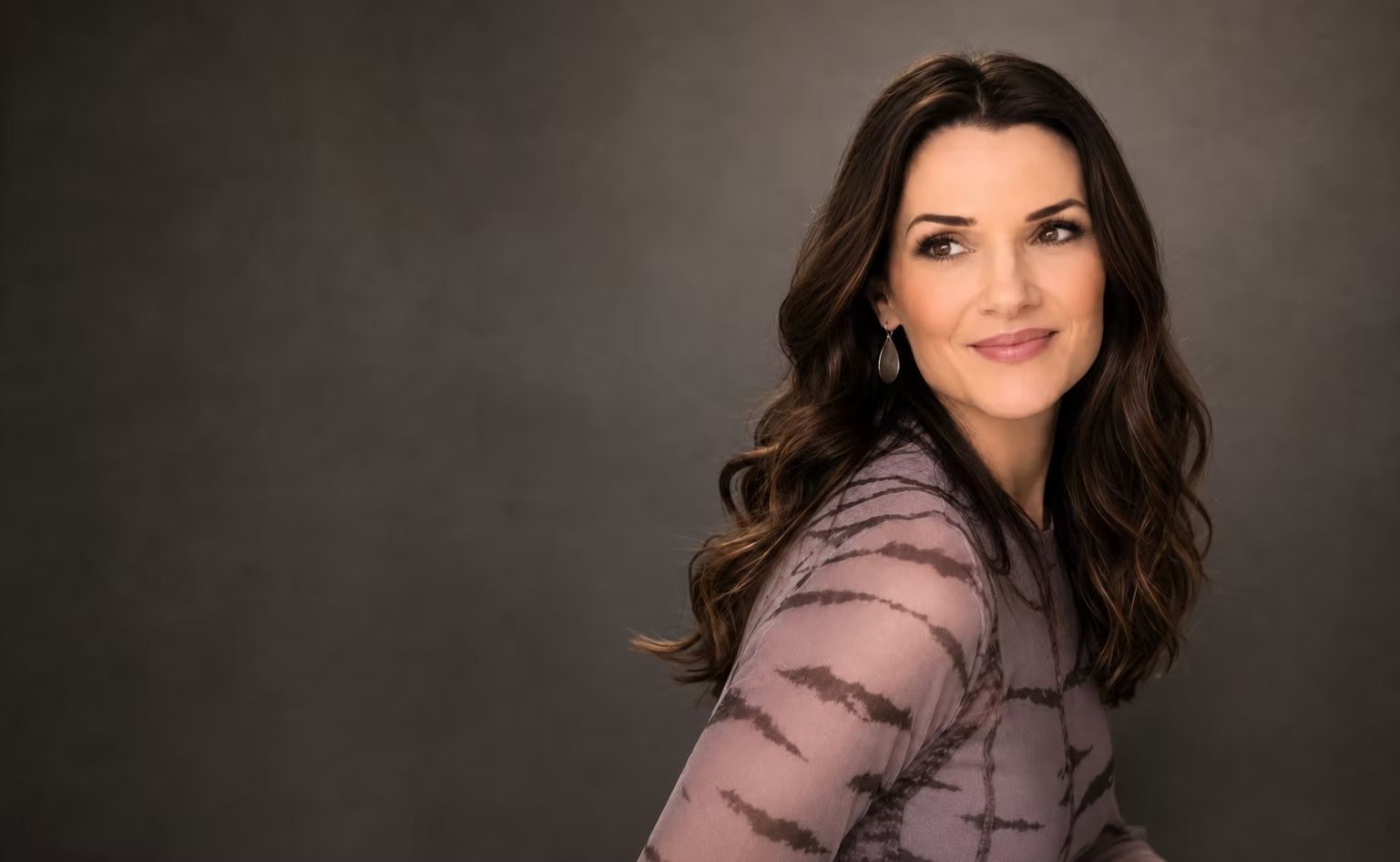
Luke Norvell is the Alfredo I have always wanted to see. I think the last one I saw at the COC had better high notes, the polished Matthew Polenzani, including a high C in the cabaletta to the big Act II aria. Opera can be a bit like a spectator sport, where we’re sitting there, hurling a bravo after the big aria to show our love & appreciation, and in the process really being fairly distant from the story. When I watch and do the traditional applause thing I am probably more alien in the Brechtian sense, distant and not seduced by the illusion. I am getting to Luke now. I have never previously seen an Alfredo that fully hung together for me. I watch the film for example –Stratas & Domingo in Zeffirelli’s 1982 film– and never really feel that I can reconcile the jerk who throws money he won playing cards at Violetta, with the one who falls for her at the beginning. Sure, that’s the way the role is written: but I want to like the character, and rarely do I like the Alfredo I see, with his fatuous displays of ego. Somehow this vulnerable portrayal from Luke, seeming so tentative in his approach rather than pushy or demanding, makes his freaking out over the money Violetta has spent on him in the 2nd act more believable and consistent to the character, and thereby helps me forgive & understand his over-reaction. The fact that Luke also sang really well helps a lot too. While he didn’t hit me with the aforementioned high C in “Oh mio rimorso”, an aria I have never particularly liked, that aria made a whole lot more sense suddenly. I felt that Luke’s portrayal hung together, Alfredo less as a series of high notes & dramatic takes than a relatable character, and yes, a likeable Alfredo. That makes the story much more enjoyable.

So that’s two excellent portrayals, and I haven’t got to my favourite yet.
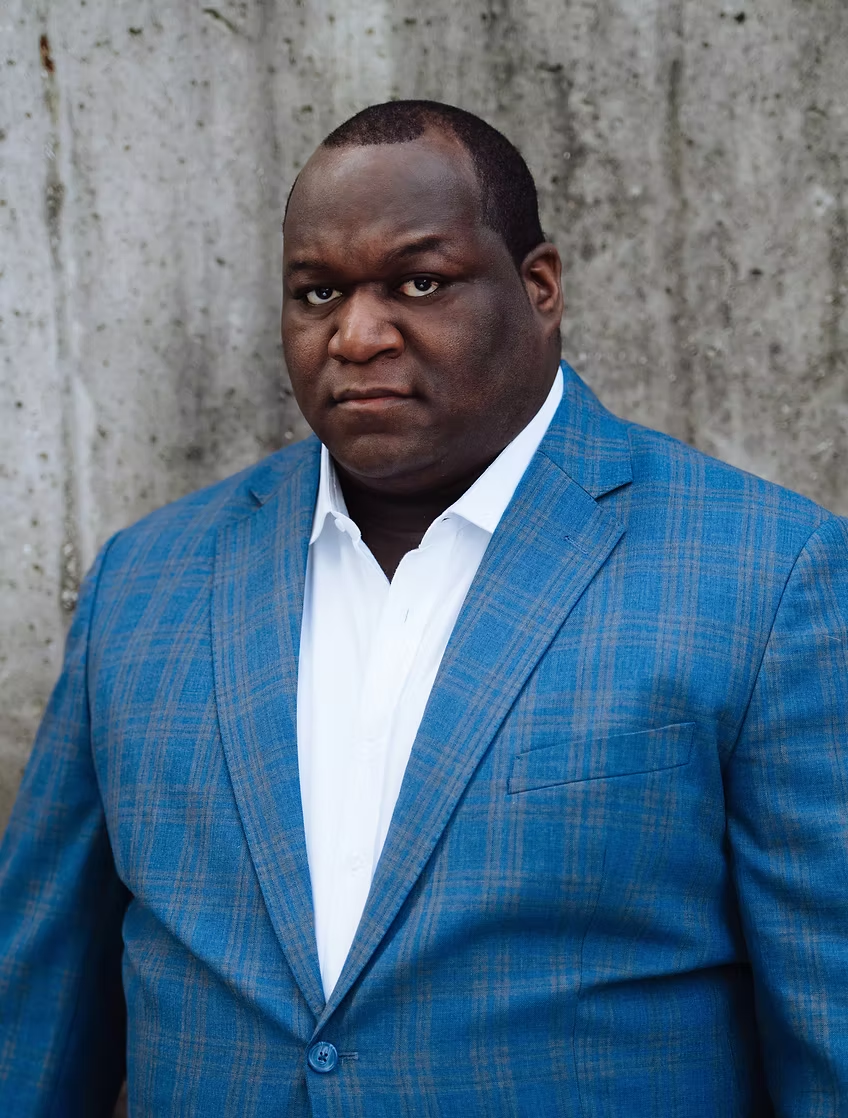
Reginald Smith, Jr. is new to me, a singer who came out onstage as Giorgio Germont more or less in the usual way for the first few lines, loudly challenging Violetta on behalf of his daughter’s honour. And before too many pages had been turned, I saw a very different Giorgio. The character, broadly speaking, usually goes in two directions from what I’ve seen. Of the two directions, one of them is usually wrong, ambitious but wrong. While it may not be something sopranos love, the ideal in Verdi’s time, I believe, was melodramatic. A big loud strong baritone such as Quinn Kelsey would in effect take over the opera as far as agency, and he’s doing it right please note. This is what the role calls for, even if people may think the soprano & tenor are the stars. Maybe I’m clear about this because I’ve been staring at the score of this opera for such a long time. Remember that melodrama was a popular dramatic form in the 19th century and likely a huge influence on the dramaturgy of Verdi and the way his singers approached characterization. Agency doesn’t come into it, cannot come into it, not when forces beyond your control –such as storms, bankruptcy, war or a nasty villain like an incurable illness–are arrayed against you. Violetta is sick and is going to die. Her happiness was always going to be limited, and then Giorgio walks into her life and destroys everything by demanding that she give up the love of her life, Giorgio’s son Alfredo. However much actors try to inject agency into the story (either of the lovers) papa Giorgio is the one who rules the story, blindly messing everything up because he doesn’t realize how sick Violetta really is. So while Quinn’s Giorgio is powerful and a bit scary, and used to be the ideal for me, Reginald showed me something new. I have to remember, Giorgio too has no real agency. Tuberculosis is taking Violetta no matter what anyone does. Ahh but there’s no reason for Giorgio to be cruel. He is conservative, he is from the provinces so he’s limited in what he knows. But he can be a nice person, a kind loving parent. Reginald is breath-taking in a role I thought I understood inside out. I’ve been accompanying my brother in this music for maybe half a century (I’m 71, we first did the aria “di provenza” when I was maybe 14 or 15). The gentle way Reginald sang so much of the role, such as the second verse of the aria, then grabbing his son by the lapel, a firm but loving gesture…! I was stunned. His singing is beautiful, unexpectedly subtle. The big notes are there, but when he decides to sing softly he is uncanny, magical. And he’s a powerful actor with presence.
So having said that, I want to offer thanks to the other stars of the show.
Conductor Paolo Carignani gave us a tight reading of this familiar score, the orchestra sounding beautiful, the singers given lots of firm support yet without any sense of the coercion conductors sometimes impose on singers especially one with cadenzas & coloratura. The COC Chorus do a lot of heavy lifting in the two acts with big crowd scenes, even though they do not get credit as soloists. Sitting up close (where I love to sit) I was delighted by their ability to make the parties look like parties, in spite of the fact that they’re working hard.
Emma Pennell surprised me. I was already an admirer of that big voice, but I didn’t expect to be so captivated by the portrayal of Annina, Violetta’s maid, particularly in the last scene. Emma is a fine actor.
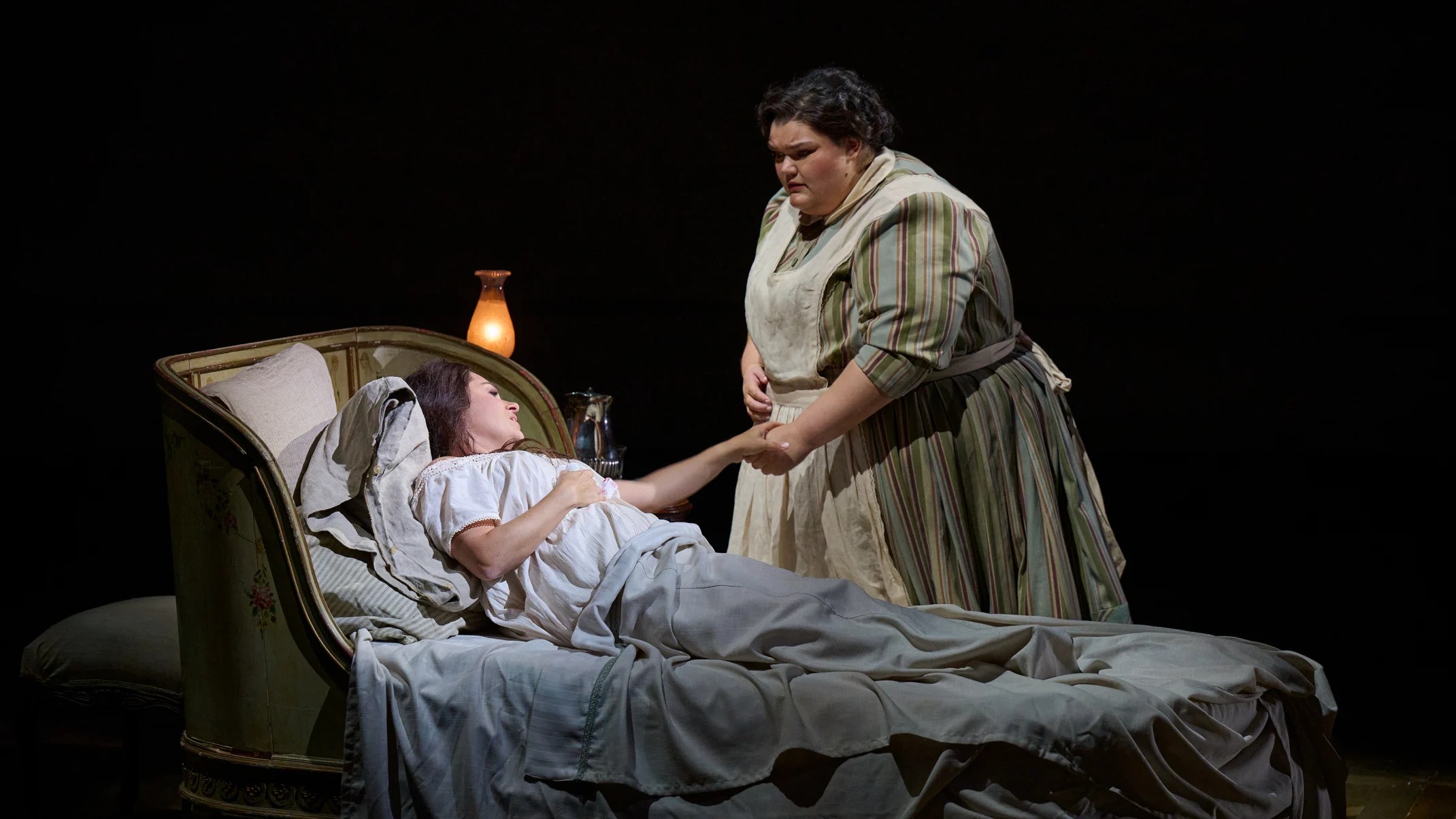
The COC’s production of La Traviata continues until October 17th at the Four Seasons Centre.

