Questions about Life Is a Dream

Aleksandar Lukac aka Sasha Lukac is a director known on both sides of the Atlantic, a former Artistic Director of the National Theatre of Serbia who now teaches and directs in his own inimitable style at York University.

Aleksandar Lukac

Director Aleksandar Lukac

I’ve had (full disclosure) the privilege of working with him, writing music for a couple of his shows as well as watching him transform an opera I wrote into something unbearably powerful.

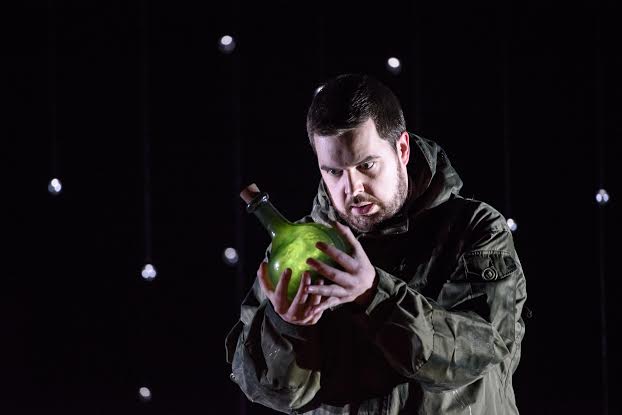
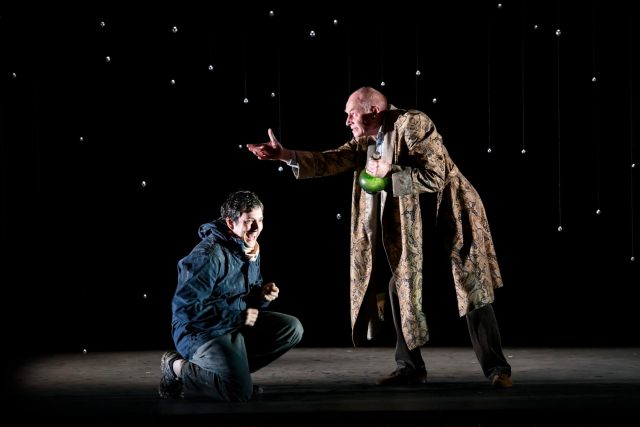
Next up for Sasha is Life is a Dream, previewing Tuesday March 8th then running March 9-12 at Theatre Glendon.

I asked him about the play and the production.

1) In your presentation of Life is a Dream how do you reconcile
Wagner (Gesamtkunstwerk: dramaturgy as in a dream, absorbing us completely in the illusion)
vs
Brecht (the avatar of self-conscious theatricality to break the spell/ illusion)
OR IN OTHER WORDS:
is LIFE presented as a DREAM, in Life is a Dream?

Well I am going completely eclectic with this production. We start with a heavy dose of Commedia and venture into some Theatre of Cruelty and then come back to Commedia. I was trying to push genres out of their place of comfort and enjoying the resistance this caused – when I say resistance I don’t mean from the performers but from the theatre rules – the connectors between the scenes of different nature are the hardest to bridge – knowing that you have established one language for the audience and then inverting it, creating a shock or the need to readjust to the new form – and then back again. In that sense it is very Brechtian.

mausmask_P1050741

2) Please talk about the style that might have been used in the original show in the 17th century, and whether this has any significance vis a vis your interpretation.

I also do not know much about the style from the period (1635) but am finding it intriguingly comical – completely different from Shakespeare even though the periods are very close. Almost as if there is a significant philosophical difference in what theatre means in general. It seems that Calderon’s theatre, despite its myriad of classical Spanish ethical motives, takes itself far less seriously then the Elizabethans did. So it was easier to throw the play through an aesthetic chopper so to speak.

poster2

3) The Eventbrite promotional message for Life is a Dream includes a very unconventional announcement, unlike the usual instruction to shut off our mobile phones before shows begin:

This performance encourages participation with the audience through the use of social media. Make sure to visit our twitter @LifeIsADream_GL and to use our hashtag #DreamGL. Cellphones are encouraged during this performance, so make sure to bring your smart phone! Make sure to stay up to date on our Facebook event page and twitter feed.

Does the social media aspect de-familiarize this world / reality, employing or reinforcing a Brechtian distancing and dramaturgy?

Absolutely – since the social media is only a part of the production – activated when Segismundo is actually released from the cave in which he had been held captive for 27 years – we are asking the audience to use Twitter to teach him about the world – what should someone waking up from this dream know about our world/time before they decide how will they conduct themselves as a king. Which rests on the original premise of the play. We are not filtering any tweets so I anticipate everything.

4) What can you tell me about what you’re exploring in this production, both for the interpretation and pedagogically with your students?

Really it is an exploration in trying to make the theatre experience relevant in today’s world. Most of educators today cannot teach without the frustration of seeing their students deeply immersed in the tiny screens of their cellphones – it is hard to talk to the tops of the heads without the eye contact. Of course I am old school but you realize that this will not change so it is smarter to try to incorporate it in the process rather than regulate it. Allowing the students to explore the potential of social media in performance is an important aspect of that incorporation. I have been doing it at Glendon Theatre for the past four years – enjoying the fact that much of it wouldn’t be possible in professional context – due to Equity rules which make live-streaming quite impossible. Our productions of Marat/Sade Occupied (2012) and WWI Revisions (2014) are still available on YouTube.

5) Why is this a good text to use in a student context?

Since I teach a political theatre course – Life Is A Dream seemed like a perfect opportunity to investigate some classical universal themes – in this case, how do we clumsily attempt to prevent political disasters which, for whatever reason, seem inevitable. Even today, we push panic buttons, build walls, imprison people for years on in an absurd attempt to force a worldview on them. King Basilio does that to his own son because of what the stars have told him and of course this experiment fails miserably. I find this very similar to western reliance on skimpy or, at best, one-sided evidence of danger, before we employ the cruellest and usually most inefficient methods of prevention.

6) Why is this a good text that an audience would enjoy?

It is actually very funny and also functions a bit like a tele-novella – so a lot of intrigue, love and honour mixed in.

7) Do you use music?

Interestingly enough our set (Design by Duncan Appleton, Tech director of Glendon Theatre) is a video game – a mash-up of Super Mario and other games with interactive videos – which is very exciting on its own – so a lot of music is directly from a number of games and other popular culture venues.

press_startP1050752

8) What do you hope to see / expect to see in the social media side..? do we get into some sort of meta-theatrical or meta-textual place with the use of twitter / social media?

Last time when we did WWI Revision we had some extremely provocative tweets that had actually helped the whole Brechtian aspect of the production. For example, at a point in the play when actors were at the most serious exploration of contemporary wars (that were arguably a direct result of the world divisions that came after WWI,) we received some inappropriate, comical tweets that actually stunned the audience in the house – particularly since we also played some actual news footage of conflicts. It left us all in shock but also made everyone think that this is exactly the world we live in – half of the planet is in total disaster and we are collectively far more worried about which Kardashian did what to whom. This collective, for lack of better word, blindness is also manifested in the elections south of our border. I am hoping that perhaps some of that will seep into the show through the audience participation.

*******

Theatre Glendon’s Life is a Dream previews Tuesday March 8th, with a run beginning Wednesday March 9th to run until March 12th and note that performances begin at 7 pm, at Theatre Glendon – 2275 Bayview Ave YH188, Toronto, ON M4N3M6, Canada

  • Livestream: https://www.youtube.com/user/TheatreGlendon
  • To tweet into the show: #HeySegismundo

life-is-a-dream-poster-3-640x1024

Posted in Dance, theatre & musicals, Popular music & culture, University life | Tagged , , , , , , | 1 Comment

TSO – Fragile Absolute

The Toronto Symphony’s three-concert New Creations Festival launched in impressive fashion tonight, a spectacular variety of styles on display in a programme with the title “Fragile Absolute”.

Before the interval felt like personal testimony from the festival’s curator Brett Dean. We segued from a mysterious performance of Kurtág’s Ligatura: Message-Hommage à Frances-Marie Uitti (The Answered Unanswered Question) without interruption, directly into Dean’s Violin Concerto. In his pre-concert remarks Dean mentioned that Kurtág had been a key influence on him, which could perhaps help decode the mystery. We heard the Kurtág –a work for two cellos, two violins and celesta—played with the four string players off-stage, and the house lights and stage lights dimmed.  The music emanated around us without a visible source. I have to think that Dean sees himself influenced by Kurtág, such that his own music seemed to come right out of the other composition, almost as if they were one idea. At the very least Dean was making a self-reflexive statement.

Dean’s concerto is a splendid composition, three very different movements. The use of the viola was at times very plaintive, the composer himself acting as soloist in a reading that must surely be authoritative.

I listened to Dean’s varied sounds, sometimes almost impressionistic and colourful, forcing me to stare desperately from player to player, trying to figure out how he achieved such subtleties of timbre. I found myself thinking “orchestration!”, impressed by his mastery of sound. Although the movements vary, from the rhetorical manner of the first movement, to the energized second, and the deeply internalized third, Dean’s viola seemed like a character in a drama.

After the interval –during which we watched a big and complicated set-up of instruments—Dean’s countryman Anthony Pateras took the stage as part of the ensemble for the North American premiere of his 2010 piece Fragile Absolute, for Winds, Percussion, Electronics and Celesta, the work giving the evening its title. I think I understand “fragile absolute” to mean that the composer had set out to let the work’s structure function in very arbitrary terms: but that exigencies conspired to compromise those plans, making the absolute—his a priori objectives—fragile, as I suspect they always are when confronted by de facto.

Pateras told us in the introductory conversation that he was influenced by Bartók’s composition Music for Strings, Percussion and Celesta. Here we were in the presence of a mass of brass & percussion without strings, but with some electronics, and with continuous action from a very busy celesta player, so much so that it could be a concerto for celesta. Where Dean’s piece had been a subtle surface of quiet murmurings, a composition that seemed internalized (much like the Kurtág), Pateras’s work was much more an extroverted exploration and seemed to be a deliberate contrast to what came before. Groups of instruments repeated patterns within a narrow band of notes, sometimes swelling in flamboyant effusion while at other times the music mostly dropped away. The celesta kept bubbling along, occasionally joined by percussion & either or both of two pianos.

In our recent interview I’d asked James Ledger about what might be a typical Australian trait in the music he and/or his countrymen compose, to which he spoke of a time when he’d been told that “only an Australian could have composed it”, possibly because distance gives them freedom, and likely less than the usual anxiety of influence. In the two pieces I’d heard so far by Australians – that is, Dean’s viola concerto and Pateras’s Fragile Absolute the music seemed to escape sounding like the typical compositions understood by the epithet “new music”. In tonight’s concert I felt a great deal of freedom.

resized  Kevin_Lau_photo_by_Bo_Huang

Composer & pianist Kevin Lau (photo: Bo Huang)

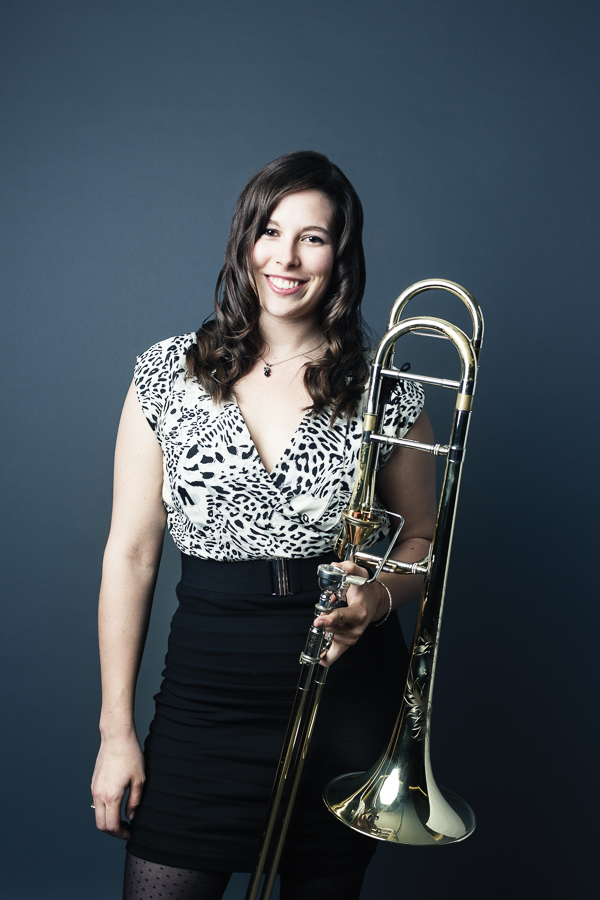
Last on the program was a World Premiere/TSO Commission by a young Canadian that brought the audience to their feet, a definite crowd pleaser from Kevin Lau titled Concerto Grosso for Orchestra String Quartet, and Turntables. My appetite was already whetted for the piece by a conversation I’d had on the bus with the cellist Adrian Fung, who also happens to be the TSO’s VP of Innovation, a musician with an MBA.  At the time I heard about Spin Cycle, an ambitious composition aiming towards an integration of styles & musical ideas that led to a JUNO nomination. Lau is on to the next stage with his Concerto Grosso, another fascinating investigation of the fusion of styles.

Forgive me if I digress for a moment, but it amazes me when I see parallel actions among several artists, as though their preoccupation has become suddenly universal

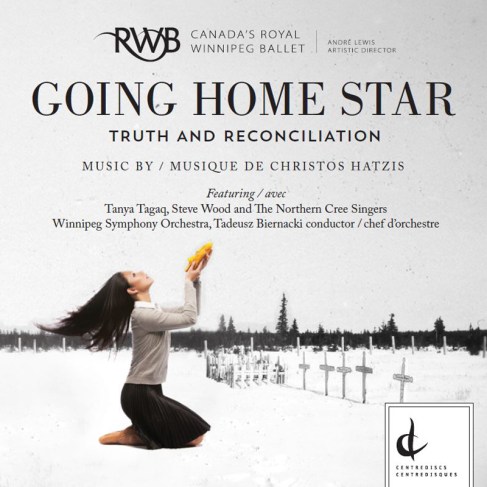
  • In Going Home Star the Royal Winnipeg Ballet brought together composer Christos Hatzis and several aboriginal musical voices seeking to embody the process of reconciliation onstage.
  • Stephanie Martin’s choral symphony Babel concerns the (im)possibility of communication
  • James Ledger’s piece to be presented next Wednesday at this same festival –his Two Memorials: Anton Webern & John Lennon—is a composition that seeks a reconciliation or at least a mix between two very different sound-worlds

And latent in Lau’s work is a question that I posed to Ledger, concerning popularity. Had I heard what Lau had composed I would have asked him the same question I fired at Ledger, concerning a piece juxtaposing austere Anton Webern and popular John Lennon, namely to ask how he feels about popular music. But the answer is right there in the music, where Lau seems very comfortable in tonality and popular sounds, possibly because he also writes film-scores, a medium that isn’t afraid of tonality or unabashed beauty.
I would love to hear the Concerto Grosso again, a piece that galvanized the audience. Lau takes us on a wonderful journey, juxtaposing the sounds of an orchestra with a DJ, in this case “Skratch Bastid”. Mediating were the four members of the Afiara string quartet, including Fung, viola Eric Wong and violinists Valerie Li and Timothy Kantor. There were two contrasting movements, namely the opening “Surface tension” and “Fusion dreams”. It’s not the first time I’ve seen a two-movement work of diametrically opposite movements, for instance Beethoven’s piano sonata op 111 resembles it, in the fury of the opening movement and the serenity of its closing.

“Surface tension” sees materials emerging in the quartet that are then picked up either by the DJ or the orchestra. If there is a conflict, it’s enacted not in classical counterpoint or pure juxtaposition, but in passages resembling an actual battle (as the sonorities reminded me of the fight in West Side Story). Lau is a real crowd-pleaser, his music always listenable and often stunningly beautiful, whether in his writing for the quartet or the orchestra. I can understand how this conflict emerges, given that an improviser such as the DJ is fundamentally alien to the notion of a work scored and determined on the page. When we came to “Fusion Dreams” we begin with a pretty little tune from the quartet picked up in the orchestra, and then riffed by the DJ without fracturing the rapport. We build to a kind of diapason, a sonic climax employing everyone… that hangs before us like the dream of a fusion of the players & styles, the hoped for reconciliation of opposites. And we are then pulled back into the quartet for a few miniature paraphrases of what came before, as though remembering the dream, and still daring to hope. The ending was like a question mark reminding me of the way Richard Strauss ends Also Sprach Zarathustra, poignant with possibilities.

For such a young composer I’m in awe, and eager to hear what comes next from Kevin Lau. Ah yes, he’s been commissioned by the National Ballet, so next is this June.

The New Creations Festival continues Wednesday March 9th with Brett Dean’s Trumpet Concerto Dramatis Personae, James Ledger’s Two Memorials, plus a live film From the Vortex PerspectiveI by Paul Frehner and Peter Mettler.

Posted in Music and musicology, Reviews | Tagged , , , | Leave a comment

The Devil Inside

TAPESTRY OPERA
presents
THE DEVIL INSIDE
A Co-commission & Co-production by Scottish Opera and Music Theatre Wales
Libretto by Louise Welsh  Composed by Stuart MacRae
Limited Run! March 10 – 13, 2016
Harbourfront Centre Theatre
“It is one of the most interesting, well sung and well produced pieces of opera that has been seen on the Scottish stage for quite a few years.” – Opera Britannia 2016

2

The Devil Inside_SCOTTISH OPERA,Music; Stuart MacRae,Words; Louise Welsh, Conductor; Michael Rafferty, Director; Matthew Richardson, Designer; Samal Blak, Lighting; Ace McCarron, Catherine; Rachel Kelly, Richard; Nicholas Sharratt, James; Ben McAteer, Old Man_Vagrant; Steven Page,

Tapestry Opera presents the North American premiere of THE DEVIL INSIDE, a new co-production by Scottish Opera and Music Theatre Wales. The latest work from Britain’s trailblazing librettist-composer team, Louise Welsh and Stuart MacRae, THE DEVIL INSIDE is a modern Faustian tale,“finely paced” and “immaculately crafted” according to a 5-star review in The Guardian (UK). THE DEVIL INSIDE marks the first time Scottish Opera has been presented in North America and the first time a UK Opera company has been presented in Toronto in over a hundred years.
Inspired by The Bottle Imp by Robert Louis Stevenson, THE DEVIL INSIDE is an imp in a bottle who can grant every conceivable desire. The bottle can be bought and sold, but only at a lower price each time.  And anyone who dies while in possession of the bottle goes straight to hell . . . forever. A compelling look at human nature from love and selflessness to greed and mass consumption.
“This is a brilliant new work that makes you think. It is spine tingling opera.” –Opera Britannia 2016
Tapestry Opera and Scottish Opera have been collaborating together since 2009 following Tapestry Opera’s international LibLab: Composer-Librettist Laboratory. THE DEVIL INSIDE is their third of four collaborations, the first being Pub Operas in 2011, followed by M’dea Undone, which had its world premiere May 2015 at Evergreen Brickworks in Toronto. Tapestry will be premiering their fourth collaboration, the co-commission Rocking Horse Winner, this May.
THE DEVIL INSIDE is also the third collaboration between Librettist Louise Welsh and composer Stuart MacRae. Ghost Patrol (2011), which followed their first partnership Five: 15 Operas Made in Scotland (2009), was a critical success and winner of the exclusive 2013 South Bank Sky Award for Opera. Also a British crime writer, Louise Welsh is the author of six novels includingThe Girl on the Stairs (2012) and A Lovely Way to Burn (2014). Scottish Composer Stuart MacRae was writing powerfully expressive works in his mid-twenties receiving commissions from such organizations as the BBC and the London Sinfonietta and being appointed as Composer-in-Association with the BBC Scottish Symphony Orchestra. His 52 completed compositions include works for opera, theatre, orchestra, ensembles and soloists.
Ghost Patrol’s director Matthew Richardson and conductor Michael Rafferty lead the cast of mezzo-soprano Rachel Kelly, a recent graduate of the Royal Opera House Covent Garden’s Jette Parker Young Artist Programme; baritone Ben McAteer, a 2015/16 Scottish Opera Emerging Artist; tenor Nicholas Sharratt (The Pirates of Penzance 2013, Ghost Patrol 2012); baritone Steven Page (The Rake’s Progress 2011, The Pirates of Penzance 2013); and players of the Scottish Opera Orchestra.
Tapestry Opera continues to drive the evolution of opera with an innovative 36th season, which concludes with the world premiere of ROCKING HORSE WINNER, another Scottish Opera co-commission, May 27 – June 4 at Berkeley Street Theatre-Downstairs.
TAPESTRY OPERA
Presents the North American Premiere of
THE DEVIL INSIDE
A Co-commission & Co-production by Scottish Opera and Music Theatre Wales
Based upon Robert Louis Stevenson’s The Bottle Imp
Limited Run! 3 Performances only!
March 10, 12 @ 8pm and March 13 @ 4pm
Harbourfront Centre Theatre, 235 Queens Quay West, Toronto
Libretto by Louise Welsh
Composed by Stuart MacRae
Directed by Matthew Richardson
Starring Rachel Kelly, Ben McAteer, Steven Page and Nicholas Sharatt
Featuring Players of the Scottish Opera Orchestra
Designed by Samal Blak with Lighting Design by Ace McCarron
Tickets available via Harbourfront Centre Box Office
1

The Devil Inside_SCOTTISH OPERA,Music; Stuart MacRae,Words; Louise Welsh, Conductor; Michael Rafferty, Director; Matthew Richardson, Designer; Samal Blak, Lighting; Ace McCarron, Catherine; Rachel Kelly, Richard; Nicholas Sharratt, James; Ben McAteer, Old Man_Vagrant; Steven Page,

 Season Subscriptions are available and can be purchased online at
For more information:
#TAPESTRYOPERA
#TheDevilInside

*******

“Press releases and announcements” are presented verbatim without comment

Posted in Press Releases and Announcements | Leave a comment

Opera as blood sport: the Hutcheons contra Regietheater

I raced at top speed, not from jungle to city but from one end of the U of T campus to the other after work, afraid I’d be late for the (lecture about) opera, somewhat like the hero of Werner Herzog’s 1982 film Fitzcarraldo.  It was a keynote by Linda and Michael Hutcheon, as close as I could get to hearing Caruso at 5 pm on a Friday in Toronto (the relevant clip is the first nine minutes).

“No work of art can withstand the alchemy of adaptation without suffering the consequences of tranformation, especially when the adaptation is from one art form to another.”

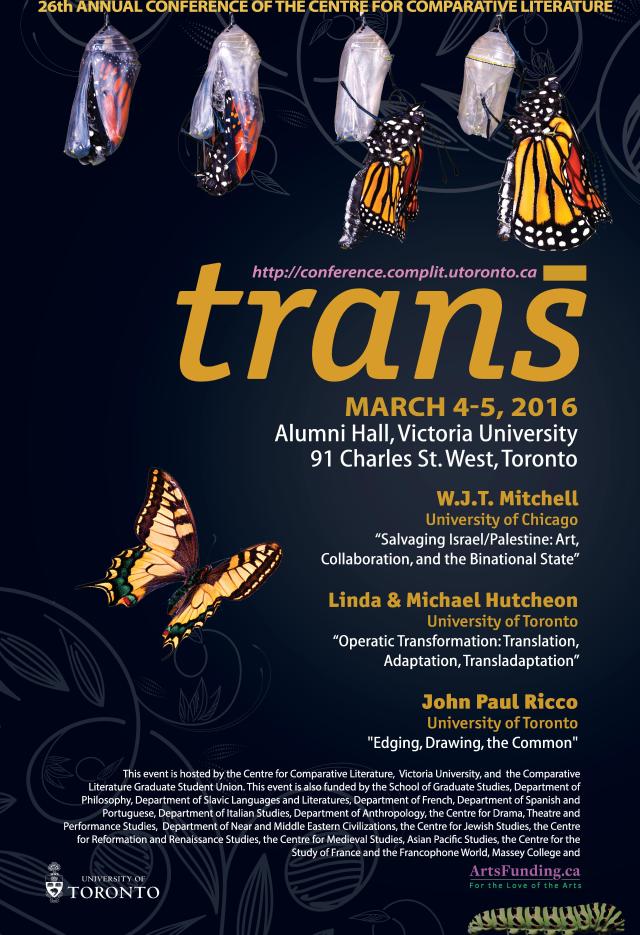
So said Nilo Cruz as cited on the first slide of Linda & Michael Hutcheon’s talk, titled “Operatic Transformation: Translation, Adaptation, Transladaptation”. Theirs was a keynote address at the Trans- Conference 2016, at the University of Toronto Centre for Comparative Literature.

I’d like to digress for a moment to unpack that by quoting the conference call for papers.

Internal and external changes. Movements outside, beyond, or within. Our annual conference explores the theme of trans– in any of its forms. Particularly of interest are explorations of the relationships between movement, position, and change. What mind shifts are required with trans– shifts? In transition, what is lost and what is gained? pIn times of increasing mobility and placelessness, how can we ensure the transmission of meaningful information between generations and across borders?
The organizing committee of this conference invites all contributions that respond to the need to think about trans- as a subject and as a prefix in our disciplines and in our world. Possible topics for presentations include, but are not limited to:
transgression Traduction Transgenre translittération transfert transformation
transport transmission Transubstantiation transversal transplantation transnational
transhumain transrationnel Transposition transcription Transaction transcendance
cymk_finalposter_conference_2016-page-001-1-1

As you can see on that poster, this is a trans-disciplinary conference, and as such an ideal venue for a conversation about operatic adaptation & interpretation. Michael & Linda situated their conversation in the collegial space that is jargon free, explaining their terms when necessary. By working more or less from first principles it made their argument all the more powerful.

After explaining history & context, they did a bit of a case study comparing two different approaches to the Mozart/da Ponte opera Don Giovanni:

  • Against the Grain Theatre’s #UncleJohn presented in Toronto in December 2014 (after an earlier workshop presentation in Banff).
  • The Canadian Opera Company’s Don Giovanni presented in January- February 2015 (which had been presented in Europe).

The COC DG was directed by Dmitri Tcherniakov, while #UncleJohn was a new translation and adaptation of the Da Ponte libretto by Joel Ivany, leading to a new word coined in response, namely “transladaptation”.

Early on we were treated to an image of the score of Don Giovanni, suddenly splattered in red, suggesting that the opera was a crime scene for this case study. There’s a word missing from the title of their CSI, namely Regietheater (or director’s theatre). I have to think this talk was a very cathartic experience for a pair of opera fans who have likely been frustrated before by invasive and transgressive directors.  Michael did admit that he was not entirely thrilled by Tcherniakov’s interpretation, likely the motivation for that bloody image.

There’s no arguing with their conclusions, contrasting the reception experience of the two operas. The Hutcheons were raising a simple question, namely when does an interpretation go so far that it’s no longer an interpretation but something else? It’s a sticky one to answer, although we were offered some criteria to work with such as the notion of “Werktreue” (a concept that could be translated as “faithfulness to the composer’s intention”).

Instead of fussing unduly over that question, we spent far more time looking at two contrasting approaches and how they impacted the audience horizon of expectations, which was understood to be the site where this battle is ultimately fought, for the hearts of the operatic audience:

  • Tcherniakov’s DG was presented by the COC with surtitles and stage action that seemed nonsensical at times. One might argue that this production was no longer the opera Mozart & Da Ponte wrote (in other words, no longer true to the work: Werktreue), but an adaptation, that deserved to be identified as such.
  • Ivany’s #UncleJohn foregrounded its divergence from the original work, declaring its differences, its bold newness,  in its name & a subtitle. I vaguely recall seeing “transladaptation” at the time, although I don’t know that I paid much attention, as I was mostly busy enjoying the production: and the work.
Hutcheons signing (1)

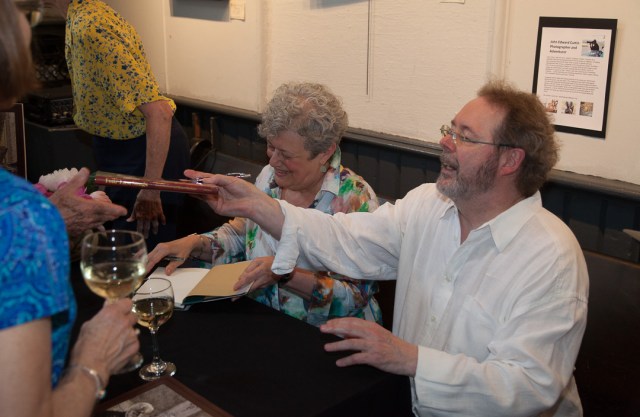
Linda and Michael Hutcheon at the launch of their new book last summer.

What seems clear is that a work honestly presented and advertised as a modernized adaptation encountered less friction than a production purporting to be the original opera. I couldn’t help wondering if the forthright communication strategy of Against the Grain is a big reason for the smooth reception (which is kind of ironic when you remember what “against the grain” literally implies). It might also be relevant to observe in passing that while Ivany’s transladaptation modernizes and juggles a few elements of the story, that it feels less divergent from the original than Tcherniakov. Perhaps the key is the avoidance of the cognitive dissonance from too much of a gap between expectation and the transgressive production, whether by means of honest advertising or in hewing close to the original.  Then again the fact that COC productions are much pricier could also be a factor. I couldn’t help wondering if the COC’s ventures into Regietheater would be easier to sell with clearer communication.

quartet

Left to right: Miriam Khalil, Sean Clark, Betty Allison and Cameron McPhail, in the December 2014 Toronto production of #UncleJohn

I was perhaps out of step with many in this room (horizon of expectation being associated with “interpretive communities”, presumably a way to separate out different history & varieties of taste), as someone who loved Tcherniakov’s DG: but then again I had seen it on TFO at least three times before I saw it live in the theatre, one of several operas of his that i had seen and enjoyed. Similarly someone called the COC’s Semele “bad”, a position I don’t share, believing it to be one of the best things I’ve seen there this past decade: but in that case too, I had advance preparation in getting to see the set from up close in a backstage preview.

But however i may rationalize those experiences, I’m grateful that this presentation today elegantly theorizes Regietheater and its reception.

Joel Ivany headshot

Director Joel Ivany

So perhaps because I saw a rationale for these two interpretations, because i’d either done my homework (watching DG on video) or been educated (by being invited backstage by the COC to see the Semele set), I was more ready to meet those works on their own terms. Divergent as they may have been I was not similarly impressed by Claus Guth’s Figaro. No wonder then – in conversations about productions eliciting varying degrees of dismay—that Against the Grain stands out as a beacon in an otherwise dark conversation.

At the back of the room sitting un-noticed was the hero of the hour, namely Joel Ivany himself. In a few days he begins rehearsals for Carmen at the COC opening April 12th (NB a standard production rather than an adaptation), while in May Against the Grain will offer their third and final transladaptation based on the Mozart- da Ponte trilogy, namely A Little Too Cozy.

Posted in Books & Literature, Music and musicology, Opera, University life | Tagged , , , , , , | Leave a comment

Questions for Stephanie Martin: Babel

Stephanie Martin is a composer & conductor, associate professor of music at York University. I heard about her because of a brief controversy that has already been settled, concerning her choral symphony Babel to be premiered at Wilfrid Laurier University in April. It was a matter of great personal interest to me, considering that just a few days ago I had a bit of an epiphany listening to a sermon in my church that also involved the story of Babel.

anthonisz_babel_grt-150x150Here’s the passage in Genesis Chapter 11, and, as we’re talking about language and comprehension I thought it might be appropriate to cite the King James Version.

1-And the whole earth was of one language, and of one speech.
2 And it came to pass, as they journeyed from the east, that they found a plain in the land of Shinar; and they dwelt there.
3 And they said one to another, Go to, let us make brick, and burn them thoroughly. And they had brick for stone, and slime had they for morter.
4 And they said, Go to, let us build us a city and a tower, whose top may reach unto heaven; and let us make us a name, lest we be scattered abroad upon the face of the whole earth.
5 And the Lord came down to see the city and the tower, which the children of men builded.
6 And the Lord said, Behold, the people is one, and they have all one language; and this they begin to do: and now nothing will be restrained from them, which they have imagined to do.
7 Go to, let us go down, and there confound their language, that they may not understand one another’s speech.
8 So the Lord scattered them abroad from thence upon the face of all the earth: and they left off to build the city.
9 Therefore is the name of it called Babel; because the Lord did there confound the language of all the earth: and from thence did the Lord scatter them abroad upon the face of all the earth.

Here’s some of Martin’s bio (a more complete version can be found on her website):

Canadian composer and conductor Stephanie Martin is associate professor of music at York University, artistic director of Pax Christi Chorale, director of Schola Magdalena, a women’s ensemble specializing in the performance of chant and medieval polyphony, and past director of music at the historic church of Saint Mary Magdalene.
Martin is widely recognized as an accomplished composer of works for both voices and instruments. …Martin holds degrees from the University of Toronto and Wilfrid Laurier University, and is an Associate of the Royal Canadian College of Organists. In York University’s Department of Music, Faculty of Fine Arts, she teaches music history and performance, harpsichord, organ and coaches historical ensembles.

To discover more about Stephanie Martin and her choral symphony Babel I asked her some questions.

1) Are you more like your father or your mother?

Ha ha! – Good question. I love both my parents. They have helped me through many a tough time and have been with me for all the truly important moments in my life. I hope I am my own person, but obviously my parents are part of who I am. My Dad is meticulous and likes to count things. My Mom is emotional and enjoys creating things. They are both sensitive musicians, life-long learners and active volunteers in their community. My Mom reads fiction, my Dad reads histories. My Dad works through puzzles in the news paper, and pursues family genealogy, while my Mom likes to be making something, like quilts or strawberry jam. My Dad likes to watch baseball, my mom likes Murdoch Mysteries. They both grew up in a close knit community and are not strangers to hard work, but they know how to have fun and enjoy a good joke. You can depend on them to follow through on their promises. I can only hope I’ve inherited a shred of their genes.

header24

2) What is the best thing about what you do?

What delights me most is seeing people becoming their best and true selves. I like bringing creative people together and seeing what results from a connection that otherwise would not have happened. It pains me when I see someone who shuts down or feels excluded, unhappy or unappreciated. It gives me great joy to see the light dawn on students, or performers who finally get it right, or successful relationships that foster the best part of people’s character.

3) Who do you like to listen to or watch?

Recordings? When I was a kid I listened obsessively to Machaut’s Messe de Nostre Dame written in the 14th century. Then I branched out to Palestrina. Today my play list includes The Chieftains’ Irish folk music, ‘The Mystery of Bulgarian voices’, Hubert Parry’s ‘Cambridge Symphony,’ Murray Schafer’s ‘Credo,’ Schola Magdalena’s ‘Virgo Splendens,’ and the British composer Alec Roth’s ‘Earthrise. ‘

TV? I actually only have bunny ears so I can watch 3 channels on TV. But I do watch lots of movies. Recently I loved “Room” and “Steve Jobs” but I could watch “Sunset Boulevard” every night.

4) What ability or skill do you wish you had, that you don’t have?

Math and physics eluded me in high school, and now that I am older I find myself wishing I knew more about the laws governing the expanding universe, string theory, relativity, gravity. Unfortunately I have no aptitude for these pursuits. I take a French course once a year at Alliance Française, but I still find myself fumbling for words when I try to communicate in our second official language – just one of many languages I wish were better at. I wish I were a better cook.

5) When you’re just relaxing and not working what is your favourite thing to do?

I have a weekly date gobbling up fabulous meals prepared by my friends Shawn and Dave (http://www.mondaynightdining.com ) and after dinner, I enjoy playing my violin very badly. Although I am at heart an introvert, I adore when my house is full of happy people eating, drinking and making atrocious music. I read poetry and I grow tomatoes from seed. I love visual art, history and architecture so if I’m travelling you’ll probably find me in a museum or art gallery, and checking out the oldest church I can find. Also, no word of a lie, I enjoy yoga, Scottish country dancing, chess, walking up hills, real ale, Shakespeare, tabby cats, Holstein-Friesian cattle, and Ontario wine.

*******

More questions for the creator of BABEL : a choral symphony

1- You are on the Faculty at York University, and are facing a kind of protest at WLU concerning your work. Please describe the protest, as you understand it.

I’m not sure that it can be called a protest anymore. There was a small group of students who found that my piece “Babel” challenged their personal, religious faith. I can understand that because the text of the piece, written by my sister Cori Martin, is very challenging and takes quite a bit of experience and worldly knowledge to comprehend. The really exciting story is that the conflict was thoughtfully and compassionately solved by Lee Willingham the conductor, and Gerard Yun at WLU. They met with the concerned students and used words to solve the conflict – amazing, right? We humans can actually solve conflict with words, and that is not a flashy news story, but I think it is inspiring. I would hold these profs up as people who are patient, intelligent, kind and demonstrate a constructive model for anyone working through a difference of opinion.

2- Please describe the poem (the text of choral symphony).

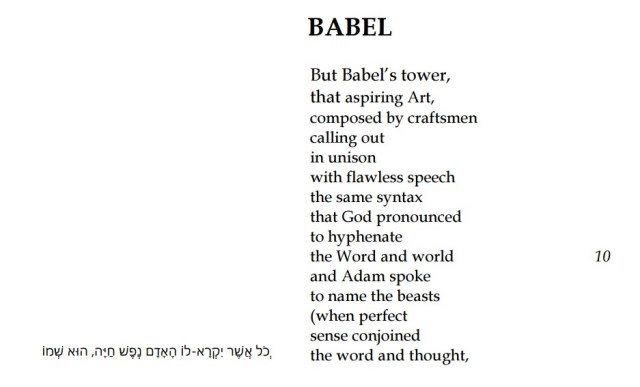
You can access the entire poem on my blog entry from March 1st You will see that the poem is 3 pages long, and has a page of notes and translations since many languages are used.

babel3

This is a tiny sample, a screen capture to show some of the poem.

The body of the poem is a profound modern reflection on the Biblical ‘Babel’ story which tries to explain why people have different languages, why we can’t communicate effectively, and why our attempts at great art usually fall short of our own expectations. I can only recommend that you read the whole poem several times and reflect on its meaning. It is truly a modern masterpiece, bathed in a lifetime of literary knowledge.

3-What kind of setting have you given the poem?

I was tasked to write a really, really big piece. It’s 45 minutes long which is the longest piece I have written, and all of the choirs and all of the orchestral instrumentalists at WLU were to be included in the piece. So it’s a massive orchestra, a double choir, with 5 soloists, and a particularly large percussion section. Since the text draws on many languages and literary influences, my music also reflects many styles. I would say you could possibly hear the influence of Benjamin Britten, Mahler, Handel, Verdi, Ralph Vaughan Williams, John Adams, alongside something like a personal style. There are some hidden messages in the music that I will let clever students discover for themselves.

If I were to simplify, one element is that the more painful the text the more dissonant the music, and when the resolution of the poem comes at the end, I hope that the choir achieves an ethereal catharsis. It’s tricky music, but the Laurier music students are incredibly accomplished, curious and willing to try new repertoire. I heard the orchestra play a new music concert in January and it was astonishing. They sounded better than some professional orchestras I have heard. Paul Pulford, the orchestral leader, deserves much of the credit for their highly skilled performances. The choirs, under the direction of Lee Willingham, are equally accomplished and enthusiastic to tackle new and challenging repertoire.

4-Looking at your website I couldn’t help noticing a great number of religious or spiritual compositions (for instance a Gloria, an Ave Maria, and several other compositions alluding to God & the spirit). Please speak of how you understand the way music works with such texts.

The human voice is a wonderful medium. There are some things we find easier to sing than to say aloud. Sacred music can go to some of those profound spiritual places we can’t visit through mundane speech.

When I worked as the organist at the Church of Saint Mary Magdalene in Toronto I was stepping into the shoes of the “Dean of Canadian music,” that is the legendary Canadian composer Healey Willan. He found inspiration within those walls, and it found me there too – a place where music had a clear role and where the listeners understood and appreciated it. My church choir there was a well-oiled musical instrument, the singers were highly intelligent and learned music quickly and sang it with sensitivity and deep understanding. So much of my music was written for that liturgical context in the years 2006 – 2012 and I am very proud of the music we made together there.

5- At the risk of asking an impossible question: what do you aim to teach your composition students?

sjm2012

It’s difficult to teach creativity, but I find there are ways to encourage, foster and enhance it. I attempt to balance strict compositional exercises with unregulated creativity. I hope the students feel they have learned something formal about their craft, but they’ve also had enough freedom to explore their passion. I also hope to share the nuts and bolts of making a living as a musician, and building healthy time- management habits. Any career in music poses a tough road if you aren’t organized or willing to work hard.

6-Is the current drama surrounding this Choral Symphony becoming a story you may one day tell in some other medium (song cycle, oratorio?)

At the moment I’d like to hide it under a rock. It’s become a tempest in a teapot! Initially I was taken aback when I heard that my work was being considered sacrilegious by a small group of students, and I felt compelled to respond. I never expected the copious online reaction. I suppose this hit a nerve, and I’m happy that the incident encouraged some thoughtful debate. I certainly hope the students involved don’t feel persecuted, since I think the whole problem has been solved beautifully by the brilliant profs at WLU. One positive outcome is that the controversy has inspired a lot of virtual “water cooler” conversations, and some delving into the issues that the work itself deals with – communication, art and conflict. This is good, because we spend most of our days just mechanically going about our business, executing our routine, and wondering when we can go home, and we don’t generally indulge in real intellectual debate with anyone in case we should offend someone. It’s actually pretty cool to be able to talk through a sensitive problem and come up with a solution that everyone can live with.

7- Is there a teacher or an influence you’d care to name that you especially admire?

I admire nurses who work long hours and deal with difficult people with grace, and treat their patients like celebrities. I admire men who have jobs out-of-doors, who work on construction sites in the middle of winter, who take their lunch in a box, and face danger every day without blinking. I admire students who support sick parents, work a part time job, and still study and hand in their assignments on time without skipping a beat. I admire journalists who put themselves in harm’s way to bring us news of what’s happening around the world. I admire people who have courage to help others without thinking about the cost.

*******

Stephanie Martin’s choral symphony Babel receives its world premiere presentations at Wilfrid Laurier University Theatre Auditorium Saturday, April 2 at 8:00pm and Sunday April 3 at 3:00pm.

Posted in Interviews, Music and musicology, Spirituality & Religion, University life | Tagged , , , | 3 Comments

10 Questions for Kevin Lau

I first encountered composer Kevin Lau on the 2012 CD PREMIERES, where I said the following:
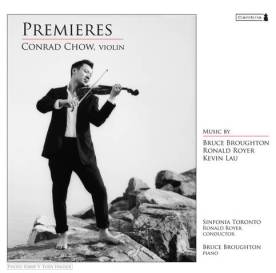
cd_bigSpeaking of happy, I find myself more and more impressed by the work of the most junior contributor, namely Kevin Lau’s Joy. I found myself perhaps a bit like that insomniac Princess of that fairy tale with the pea causing her to toss and turn in her bed.  Joy opens with several strong gestures from the orchestra, phrases reminding me of some compositions I’ve heard before –that I love—before moving through a series of moods.  After listening a few times, I’ve grown more and more impressed that Lau took the stage boldly, a self-assured voice with something to say.  Joy is a troubling piece precisely because it questions happiness and joy, teasing us with lovely moments that refuse to promise us an easy happily-ever-after.  Lau is to be commended for bravely undertaking the old romantic project of exploring philosophical truths in his creation.  I love his ambition, and even more, I believe he did a fair job in his exploration of the idea. (full review)

Kevin Lau has been commissioned and performed by over twenty ensembles including the Toronto Symphony Orchestra, Hamilton Philharmonic Orchestra, Mississauga Symphony Orchestra, Hannaford Street Silver Band, and the Afiara String Quartet. His 2014 orchestral work, “A Dream of Dawn,” was commissioned by the New Brunswick Youth Orchestra and received its world premiere in Vienna, Austria. In 2010 he received the Karen Kieser Prize in Canadian Music for his composition “Starsail,” which was recorded on Naxos Canadian Classics by the Mercer-Park Duo in 2014.  In addition to composing concert music, Kevin is also active as a film composer, conductor, pianist, and arranger.

Kevin completed his doctorate in music composition from the University of Toronto under the supervision of Christos Hatzis.  You can see the full bio here .

It’s a good time (and a busy time) to be Kevin Lau.

This summer an original full-length ballet score based on Antoine Saint-Exupéry’s novel Le Petit Prince, will receive its premiere June 4th 2016 with National Ballet of Canada.  And this weekend you can hear the World Premiere of his Concerto Grosso for orchestra, string quartet, and turntables, a TSO commission for the New Creations Festival, March 5th .

I had to interview Lau to find out more.

1) Are you more like your father or your mother?

I recognize equal parts of my mother and father in my own personality and in the ways I view the world, though there are other aspects of myself that I can’t easily attribute to either of them. Likewise, they both possess characteristics that I find myself lacking. (For example, they are both much more organized than I am, and they have a thing for spicy food, which I do not.) My father was a medical researcher at St. Michael’s Hospital and my mother worked as an administrator in Hong Kong. Neither of my parents had any formal musical training, although I suspect they are both more musical than they might think. From my father I inherited much of my physical likeness, but also my love for classical music. When I was young, I devoured my dad’s classical collection. I remember, very early on—maybe when I was five or six—watching a VHS tape of Leonard Bernstein conducting the fourth movement Beethoven’s Ninth Symphony over and over again, mesmerized by its structural quirks (which, of course, weren’t quirks to me then.) Later, we bonded over Mahler—literally, as we once listened to the entirety of Mahler’s Sixth while camping in the woods. (The weather was appropriately gloomy.)

My mother’s influence on me is more subtle, I think. She helps me to ‘keep it real.’ But I will never forget the day I overheard her humming, casually but extremely accurately, one of my compositions—which I had been improvising on the piano at least a day or two before. For some reason, that moment really surprised me; it makes me wonder what other secret musical talents she might be harbouring.
resized Kevin_Lau_2_(photo_by_Bo_Huang)

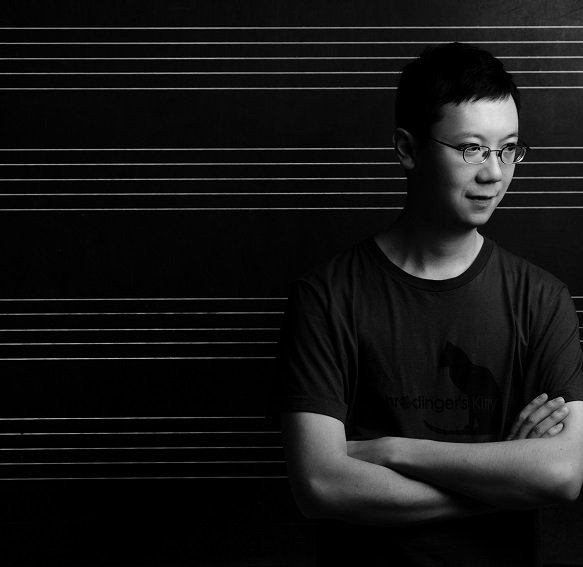
Composer and conductor Kevin Lau (photo: Bo Huang)

2) What is the best thing about what you do?

When I’m in the middle of a piece and the writing seems to be going well, the sometimes crushing challenge of composing suddenly feels like an acceptable toll. That’s the best thing about what I do—witnessing those moments where my subconscious mind does something that excites me, then documenting it as an external listener might. In order to do that, though, I have to enter into a delicate dialogue with my imagination. I will sometimes approach a piece of music with all sorts of agendas, internal and external—imagistic, philosophical, narrative, theoretical—that I will then try to weave into some sort of coherent plan of action, only to see myself throwing it all out the window as my imagination steers me toward places I never would have thought to explore.

I feel very lucky to be in a position where I can exercise this kind of creativity on a daily basis. There is nothing I love more than spending hours at a coffee shop with nothing but staff paper and a pencil (and a book, in case I get stuck.)  I do it partly because I find the white noise of background conversation soothing (as long as there’s no music playing!), and partly because I get easily distracted at home by things like the internet. When I’m in danger of getting too carried away in my own world, I teach composition. I love teaching, for reasons too innumerable to name here—but perhaps principally because it serves to remind me of how much I still have yet to learn.

3) Who do you like to listen to or watch?

I attend concerts when I can, though not as often as I’d like to. I am very much a fan of the Toronto Symphony Orchestra and the National Ballet of Canada, though perhaps I am biased in that regard…

At home, I listen mostly to contemporary composers on YouTube. There is a staggering amount of content available online, enough to keep me occupied for several lifetimes. I keep a list of composers and titles whose music I want to listen to, and that list gets updated every week. Last year I tried to habituate myself into listening to a new piece of music every day, with the intention of blogging my observations, but I found that I couldn’t do it—it was too much novelty for me to handle. Still, I try to listen to new music on a regular basis.

If I’m feeling nostalgic, I’ll turn to the classics, or I’ll listen to film music. I have a very close relationship with film music; it’s a genre that feels like an inseparable part of my identity. I also credit film scores for making me interested in composing in the first place.

4) What ability or skill do you wish you had, that you don’t have?

It’s hard to pick just one out of the many skills that I don’t have. I wish I could draw or paint, or be more tech-savvy. I wish I had better memory, especially when it comes to books; I love reading but I find that I need to read a book twice before anything will truly sink. I am not very good at learning languages, which is unfortunate because one of my life goals is to eventually re-learn Cantonese, and I’m not sure if it’s achievable. At this particular moment, I wish I could play jazz. One of my best friends is a jazz pianist, and we sometimes get together to play duets. Hearing him improvise is humbling. On top of this, he can also play standard repertoire really well. It’s a bit unfair, really…

5) When you’re just relaxing and not working what is your favourite thing to do?

I cherish any activity that allows me to spend more time with my fiancée, friends, and parents. If I’m in a more introverted mood (or—more likely—if no one is around), my favourite thing to do is to either take myself out to dinner and a movie, or to do the same thing at home—in the company of my dog.
resized  Kevin_Lau_photo_by_Bo_Huang

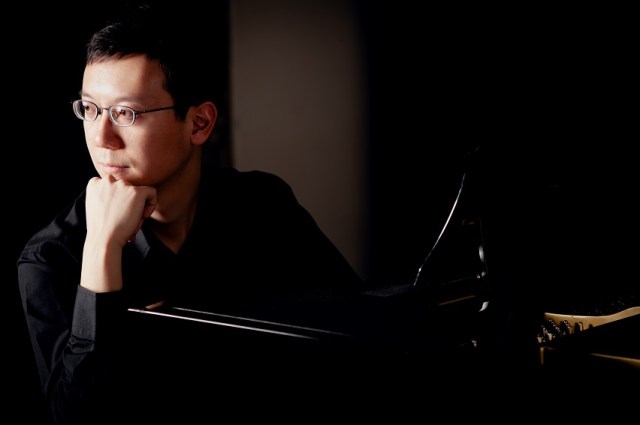
Composer & pianist Kevin Lau (photo: Bo Huang)

Five more questions about Lau’s exciting projects.

1) Please talk about the collaboration of “Spin Cycle” and the process leading to your concerto grosso.

“Spin Cycle” was the brainchild of the Afiara String Quartet and composer Christos Hatzis, who mentored the project. The goal of the project was to explore the intersection of pop music and classical music and the possibilities of cross-genre fusion, with the string quartet acting as a central hub of sorts. The quartet commissioned four composers—Laura Silberberg, Rob Teehan, Dinuk Wijeratne, and myself—to compose original string quartets, with the open suggestion that the quartets be in some way influenced by or related to pop.

The inclusion of Paul Murphy—also known as DJ Skratch Bastid—was the gamechanger in all this. Skratch is a huge force in the DJ world, and he had already worked with Dinuk and Adrian Fung (the quartet’s cellist and currently the TSO’s VP of Innovation) prior to our collaboration. Skratch came on board and remixed the four quartets (Stage Two), distilling them into their fundamental components and then expanding upon those components according to his own sensibilities. The composers were then invited to ‘respond’ to Skratch’s remixes, composing new versions—re-remixes—that could be performed live by both DJ and quartet. The premise was to bring everyone—the musicians, the composers, the DJ—out of their comfort zones and into an authentic, collaborative space.

During my last year as Affiliate Composer of the TSO, I was approached by both the TSO and the Afiara Quartet to discuss the possibility of a Fourth Stage—one that would incorporate full orchestra. The result is a new work for orchestra, string quartet, and turntables. At first, we thought I would merely be orchestrating the original quartet that I wrote for “Spin Cycle,” but once I started putting the piece together I knew I couldn’t get away with a straight arrangement. The orchestra is like a musical organism, with its own personality and point of view; a literal transformation of pre-existing material would stifle its potential. The new piece had to be conceived from the bottom up, and so I set out to create a unique discourse that would combine and develop material from the previous stages in (hopefully) fresh ways. 

2) What style of music should we expect to hear in your “Concerto Grosso for orchestra, string quartet, and turntables”

When I wrote my Third String Quartet (the original quartet featured on “Spin Cycle”), my goal was to give voice to my more primal influences. Being quite ill-versed in actual pop music, I chose to define pop as the web of subconscious, culturally-mediated musical expectations that underlies the particular way I listen to and appreciate music. While my influences ranged from heavy metal to film music to Bach, my hope was not to call attention to their differences but to find common ground, often through intuitive channels.

The Concerto Grosso is a bit different from the original quartet in that I was confronted head on by a host of obstacles—the kinds of obstacles one encounters with any attempt at deep fusion. It is hard enough to orchestrate well for orchestra and string quartet; throw the DJ into the mix and I literally had no idea how to proceed. In the end, I realized that the sheer impossibility (in my mind) of fusing these disparate forces together could itself be exploited as a metaphor for a cross-cultural impasse. What you will hear in the first movement is a somewhat caricatured portrait of the orchestral tradition—sweeping, lush, and (in my hands, at least) cinematic—being gradually undermined by the DJ, whose hip-hop-rooted style is brash, visceral, and relentlessly 4/4. The string quartet, meanwhile, acts as the uneasy (and eventually unsuccessful) mediator between both worlds.

The second movement is harder for me to describe, mostly because I have written so many iterations of it that a certain hall-of-mirrors effect is starting to set in, blurring my judgment of what the piece is about. (The main melody, a simple gigue in G minor, was composed in 2007 as part of a piece called “Winds of Change,” which was re-arranged several times before eventually finding its home in string quartet form.) All I will mention is that Christian Petzold’s Minuet in G (commonly mis-attributed to Bach) serves as the centrepiece of a rather wild transformational process that all three parties partake in.

3) How do you understand the difference between composing music for a concert such as the one March 5th and a ballet score?

The Concerto Grosso, despite its idiosyncrasies, was fundamentally an independent commission—meaning that although the process was collaborative, I was, in the end, calling the artistic shots. Though I would ask for advice from Skratch, who in turn very patiently indulged in my experiments, I alone was responsible for the structure of the piece, its internal pacing, its language, and its intent. I would edit my own work, and I’d like to think that I’m pretty hard on myself (I am not afraid to shave off minutes of music if it means improving the dramatic flow of the piece), but still, I’m relying on my own ears and my own standards, which has limitations.

Composing for ballet is very different, particularly when the ballet is based on a pre-existing narrative. There is of course the source material, the text, which guided my music in a more general way. But there is also the vision of Guillaume Côté (the choreographer), who has very specific ideas about how the dance will look, and also, in a different but equally specific way, what the music should sound like from scene to scene—both from an emotional perspective and in its relationship to physicality and movement.

Getting the right music for a particular scene or character was never a straightforward task, and we didn’t always end up going with my first approach. Because I revised the music a lot, and because there was a lot of music to write, I initially treated the project like a film score, trying to anticipate Guillaume’s wishes as best I could, writing music that I thought would match his vision most faithfully. He actually stopped me from doing this early on in the process. I remember him telling me, almost three years ago: “Do what you do best and be yourself.” It was freeing to hear that, in a way, but it was also a push—to be the best that I could be at all times. (Speaking of unfair skillsets, I should mention that Guillaume himself is a talented composer and pianist, so nothing gets by him!) He wanted me to rely on my own ideas and intuitions, and he worked with whatever I brought to the table, but at the end of the day the music had to inspire him. If something became unworkable we would discuss the possibility of rewriting the music. It was not always an easy process, but I wouldn’t have had it any other way as I have absolutely no doubt that the music is better for it.

One major technical difference I should mention is that for the ballet, I had to create a piano reduction of the score well before orchestrating anything, so that the dancers could rehearse to live accompaniment. I was initially worried about this process, fearing that my orchestral imagination would suffer, but I soon came to appreciate its primary benefit—which was that I could compose way, way faster! This, in turn, allowed me to ‘see’ the overall arc of the musical journey with much more fidelity, which I think was necessary given the sheer size of the score.

4- Please talk about the creation of the score for Le Petit Prince.

It all started with Guillaume Côté. He was given an amazing opportunity by Karen Kain (the NBOC’s artistic director) to choreograph and develop a brand new production, which would be his first full-length ballet. He chose Le Petit Prince as his subject, as the book was especially dear to him. When it came to music, he knew he needed an original score, and my name came up in discussions with David Briskin (the ballet’s music director). He listened to some of my music, and I guess he liked enough of what he heard to contact me!

We met for coffee in January, 2013. He discussed the project with me and said he would be interested in seeing what I had to offer musically. He was charismatic, his ideas were engaging, and I was both flattered and a little intimidated. The first thing I did after our meeting was go home and read Le Petit Prince. I cried at the end of the book, and then I read it a second time. Then I went and watched as many ballets as I could. The first live ballet I saw after meeting Guillaume was John Neumeier’s Nijinsky, with Guillaume dancing the incredibly challenging title role. It remains to this day one of the most powerful and devastating artistic experiences of my lifetime.

I started writing music not long afterward—concept pieces at first, just a bit of theme work here and there. Very little music survived that initial phase, with the exception of a little waltz I wrote for the Rose. I spent the next three years composing the score in bits and pieces, roughly in chronological order, while Michael Levine—our absolutely brilliant designer—worked on crafting the look of the ballet. Those years were punctuated by several workshops where we would sit together and discuss how to best translate Saint-Exupéry’s evocative text to the stage, scene by scene, from multiple perspectives—choreography, visual design, music, storytelling. Those were some fascinating sessions! The American writer Adam Gopnik was initially present at the very first workshop, and he helped us shape the first treatment of the ballet. After that, the adaptation continued to evolve in the hands of Guillaume and Michael. The workshops allowed Guillaume to experiment with choreography, and he would often choreograph the same scene to different pieces of music. During the first two workshops, I had an office where I could compose while the dancers rehearsed; very often I would write something in the morning, print off a draft, and Guillaume would rehearse it immediately with the dancers and the pianist that same afternoon.

Between workshops I kept sending Guillaume music as I wrote it. My pianist friend, Victor Cheng, played and recorded everything I couldn’t physically learn—which was almost everything! The music evolved in completely unpredictable ways. Sometimes I would compose for a particular scene, and then we would find that the music worked better elsewhere. Long-discarded themes would make an appearance years later. By the summer of 2015, the piano score was more or less finished; the full orchestra score was delivered in December. In January, David Brisk conducted the National Ballet Orchestra on a recorded run-through of the entire score—an absolutely thrilling moment for all of us. We are now in the process of trimming the score down to a reasonable length (90 minutes instead of 110!) I still have a couple scenes here and there that I need to rewrite, but the biggest part of the journey is over—at least for me. For Guillaume, this is the final stretch.

5- Is there a teacher or an influence you’d care to name that you especially admire?
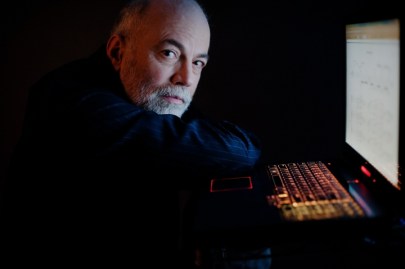
hatzis20bo20huang20thumb20nd3_5784

Composer & Composition Professor Christos Hatzis

There are many people in my life that deserve my gratitude, but I would especially like to single out Christos Hatzis for his mentorship. A word like ‘inspiring’ doesn’t come close to capturing the profound impact he has had on my life, both as a composer and as a human being. He was (and still is) a wonderful composition teacher whose musical insights were invaluable to my growth. More than that, though, I feel like he made me see the world with new eyes; my life is richer and more meaningful because of him.

*******

Kevin Lau premieres his Concerto Gross for Orchestra, String Quartet, and Turntables with the Toronto Symphony Saturday March 5th at Roy Thomson Hall. And the National Ballet have the World Premiere production of The Little Prince with an originals score by Lau June 4-12 at the Four Seasons Centre.

Posted in Interviews, Music and musicology | Tagged , , | Leave a comment

Going Home Star: against Babel

cd-cmccd_22015I’ve been listening to Christos Hatzis’ score for the Royal Winnipeg Ballet’s Going Home Star and by that I mean that it’s constantly playing in my car over the past week.
I saw the ballet earlier this month, a creation that I want to tag with powerful words that might scare you off:

  • Political
  • Inter-cultural
  • Redemptive
  • Utopian

Going Home Star is a ballet created out of the conversations surrounding the Truth and Reconciliation Commission. I went so far as to call the ballet a genuine part of the TRC, given the way it promotes conversation & healing, not unlike The Diary of Ann Frank. Yes I was intrigued by the way the story was created, the dance & spectacle, including a residential school set on fire (which may have been as cathartic to modern-day residential school survivors, as seeing Auschwitz set ablaze might be to Shoah descendants) but especially the music seemed to be of a particular interest. Hatzis’s score combines elements into a genuine synthesis of east and west. While we’re still in the mode of the dominant culture –it’s still a ballet and danced—the music is much more than just the appropriation one fears when cultures meet. Hatzis incorporates and collaborates with aboriginal musicians, creating a sonic tapestry that is a wonderful quilt or mosaic (in keeping with one of the main national metaphors of Canadian identity).

And so let’s say that Hatzis’s music is rattling around inside my head. Today’s sermon at my church –the last falling in February aka Black History Month—was an occasion for my mind to wander. I usually sit still and listen or fall asleep. Today I did something very different, namely to make notes inspired by the sermon on the spirituals that we hear at this time of year.

I was struck by the utopian possibilities of music, meaning the ideals one can glimpse only through music. Where a resistance movement can try to argue with those beating them with clubs or hitting them with water cannon, a song such as “We Shall Overcome” or “Glory Glory Hallelujah” has an entirely different sort of effect. The listener may resist at one level, their body and their soul hears the music and is at least partly persuaded. In the left-brained discourse that’s linear and verbal, there may be discord but in the right-brained non-verbal processing of the music there is unity.

I was reminded of the myth of Babel, and speaking of babbling, I took notes on my Blackberry. One of the great myths of the Old Testament concerns the Tower of Babel. I am guessing that it’s actually an older myth in the way it portrays a kind of fall not unlike the Edenic Myth. It may be just a projection of our oneness with our mothers, the natural manifestation of ego differentiation, that leads us to feel distant and severed from the oneness we had as babies when our mothers seemed to read our minds: but the Babel myth seems very timely at the moment.

In the American electoral conversation one can’t help noticing the prominence of a certain millionaire who shall be nameless for fear of provoking spontaneous nausea. The current discourse is not really a conversation at all but is more like two solitudes (to appropriate a metaphor used to describe Canada a couple of generations ago). Where legislative politics requires a back and forth, between different viewpoints (such as Republican and Democrat), there is no conversation anymore, as the GOP refuses to talk, taking extreme positions that are unprecedented, unless you want to go back to the Myth of Babel. Neither side seems to understand or to hear the other.  I believe it comes from an impatience with legislative due process, a desire to use executive action. We shouldn’t get all superior though as we saw something similar in Canada, as Stephen Harper made Parliament all but a rubber stamp, while negating conversation & discussion, aka due legislative process.

Of course there might be another way to portray the “fall” of the Babel myth. Yes there were multiple languages that may have been able to debate at one time but then grow into such discord that they no longer really understand one another. But in music there is a unified language.

Hatzis’s score seems to invoke that unity, in a discursive space promoting healing.
I am reminded of an older –more challenging—attempt at a kind of utopian healing. In the concluding pages of Ullman’s opera The Emperor of Atlantis, the onstage characters invoke Death. Note that in this story Death has gone on strike –as he might in a concentration camp—to protest. Death is invited back, to the tune of “A Mighty Fortress Is Our God”, the great Lutheran Hymn. My mind boggles imagining the performance that never happened (because rehearsals were stopped, and the composer Viktor Ullmann shipped off to Auschwitz, where he was murdered), the moment when the jews would sing this Lutheran hymn while calling for Death to release them: a song sung to German Soldiers holding guns, but still possibly possessing hearts that could be moved by the most fundamental tune of their upbringing and their religion, a tune Mendelssohn also used in his Symphony celebrating the Reformation roughly a century before this. Whenever I hear this music i see Ullmann’s utopian scenario in my mind.

There’s also a comparable scene in the movie To Be or Not to Be , as the Jewish actor gets to play Shylock’s scene directly to “Hitler” (another actor in costume), while soldiers listen. It’s a funny movie.  But a stunningly redemptive dream –comparable to that of Ullmann—underlies this moment. Can art’s ideals speak to the human inside the fascist beast, appealing to his better nature?

I think music has done this, when for example the black music of the 1950s and ‘60s thawed frozen hearts affirming a common humanity.

In the meantime I may be frustrated with the so-called debates on TV, but I shall continue to listen to Hatzis’ score in my car, one place at least where the dream is alive.

For further information about obtaining the CD click here.

Posted in Music and musicology, Politics, Popular music & culture, Psychology and perception, Spirituality & Religion | Tagged , , , , | Leave a comment

Questions for James Ledger: Anton Webern and John Lennon come together

When I go to James Ledger’s website his bio begins with “The orchestral music of James Ledger is well known to Australian concert-goers:” which sounds like an admonition to this Canadian, who doesn’t yet know his work. Ledger interests me as a composer bringing his music & sensibility to the New Creations Festival that launches this week with the Toronto Symphony at Roy Thomson Hall. Let me quote a bit more of that bio that can be read in its entirety here.

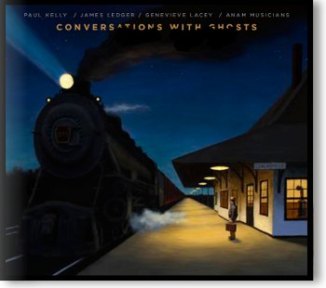
cwg“Ledger has written much instrumental music and “has established an impressive reputation as a symphonic composer” (The Australian).… In 2011, Chronicles was awarded Orchestral Work of the Year in the Australasian Performing Rights Association/ Australian Music Centre Art Music Awards. The Monthly Magazine listed the same work as one of 20 Australian Masterpieces since 2000, describing it as “a piece of emotional extremes in which everything is in balance”.…He is currently lecturer in composition at the University of Western Australia.…Ledger co-composed the ARIA award-winning song-cycle Conversations with Ghosts with singer-songwriter Paul Kelly.”
Wednesday March 9th the TSO will present the North American premiere of Ledger’s Two Memorials: Anton Webern & John Lennon. I wanted to ask Ledger some questions to find out more about him, Australian music and that intriguing piece we’ll be hearing March 9th.

1) Are you more like your father or your mother?

Both my parents are very creative. They have a great balance of imagination and pragmatism between them. My mum used to be a potter, and dad used to make all the shelves to put her pottery on. Interestingly, both of their fathers were architects, and at one point I was considering that as a career. I think architecture and composition are very similar pursuits.

James-Ledger

Composer James Ledger

2) What is the best thing about what you do?

Without doubt, the best thing is hearing a piece of mine performed. A composer spends a lot of time in “solitary confinement”, writing. Sometimes a piece can take six months to write, so it is incredibly rewarding to hear a piece brought to life by the musicians after living with a piece internally for so long.

3) Who do you like to listen to or watch?

Like most people, I listen and watch a wide variety of things. Perhaps the best way to answer this is to list the last 10 composers I listened to on iTunes:
Wagner, Ligeti, Strauss (Richard), Sciarrino, Gershwin, Jimi Hendrix, Paul Kelly, H.K. Gruber, Matthias Pintscher, The Beatles

4) What ability or skill do you wish you had, that you don’t have?

This is a very long list! But I’ll just go with being able to play the electric guitar, not just the air guitar.

5) When you’re just relaxing and not working what is your favourite thing to do?

This is where things become blurry for me. Even though my professional life involves music, I also like to play music as a way to unwind. I tend to play a lot of 80’s music on the piano – this was the decade that was probably the most influential on me growing up. Even though I do this as a form of relaxation, I know that I’m constantly thinking about how the song was put together and how the chords relate to one-another – so I’m probably still half at work most of the time.

*******

More questions for the creator of Two Memorials: Anton Webern & John Lennon

1- Your Two Memorials piece deals with a pair of composers who could be understood to be polar opposites, certainly with a gulf between them in their popularity, in their tonality and in the way they’re understood. Which one do you think you’re normally closer to in your own compositional voice, and while we’re at it, please also describe what or whose music the Two Memorials might resemble, if anyone.

I guess I’m closer to Webern as you could argue that he and I compose in the same realm – although our music doesn’t sound anything alike.

2- In describing your piece you said “To unite Webern’s volatile, even brutal music with Lennon’s psychedelic, trippy-circus music seemed too good an opportunity to pass up.“ Please unpack this a bit more for us.

I thought it would be incredibly interesting to put the two soundworlds of Webern and Lennon in a pot, stir it around and see what came out. I use an old recording trick to unify the two movements. I have recorded fragments of the Webern movement, put them into a computer and then play them back in reverse during the Lennon movement. This struck me as something John Lennon might have done himself. He (and Paul McCartney) loved to play around with tape, particular sounds in reverse. If you think of tracks like Revolution 9 (a musique concrete piece) or in the final verse of the song Rain, where Lennon’s vocals are backwards.

This piece germinated in 2011 from a late-night listening session with an iPod on shuffle. The fourth movement of Webern’s 6 Pieces for Orchestra started playing and I was gripped. It is an incredibly powerful funeral march that starts with low, ominous bells and percussion and builds up to colossal terrifying shrieks.

I remember disliking Webern when I was a student at university, but this piece really spoke to me. I also recalled that Webern had been shot to death – and so I made a link between him and John Lennon. (They also both wore small granny glasses as well, funnily enough). I was composer-in-residence at the West Australian Symphony Orchestra, and so a Lennon/Webern piece became the basis of my final piece of the residency. I soon became preoccupied with Webern’s music and listened to as much as I could. I still prefer his earlier music – the stuff that is freely atonal, rather than the more strict 12-tone music that he adopted later on. At about the same time I was disliking Webern, The Beatles music was being released for the first time on CD and I very quickly became hooked. Their songs are as broad as they are deep – they cover so many musical styles. From the early songs such as Please Please Me which has some unconventional vocal harmonies right through to the groundbreaking A Day in the Life – they genuinely kept pushing themselves musically. For me there are two quintessential Lennon songs: – Strawberry Fields Forever and I am the Walrus.

Webern’s brief and perfectly executed miniatures of expressionistic angst capture the impending doom of the time. Lennon’s music, on the other hand reflects the growing awareness and sexual liberation of it’s time. This is what I thought would make them an interesting pairing.

I think it’s a mistake to think of Webern’s music as being without melody. His music is full of them and he championed a technique called Klangfarbenmelodie. This is where a single line is shared between many instruments in succession. While the melodies might not be traditional, they are certainly there.

3-One of the exciting things about this composition, particularly in its New Creations Festival context, is the way it engages one of the oldest lurking questions about the so-called “new music”, namely the box office poison accusation against the modernists such as Webern. Whether we’re talking about Beethoven & Mozart –the kings of the classical realm—or a genuine star like John Lennon—how do you feel about the concept “popularity” and the distrust/disrespect academics directed at modern tonal /melodic composers?

Yes, the term “new music’ still sends shivers down the spine of most modern-day concert goers. Even though Webern has been tagged with the modernist label, his music is now 100 years old, (and Lennon’s music from the Beatles is 50 years). I think to be both experimental and crowd-pleasing is something we’d all aspire to. The Beatles managed to be both. And I do think the tide is turning with regard to long-running feud between the “serious” and “popular” composers. I think there’s a great deal more of acceptance on both sides than there was say twenty years ago.

4-It occurs to me that one reason I phrased that earlier question about the gulf between the composers was my sense of a space between them. And then I remembered you’re an Australian composer. In Canada there’s been a fair bit of verbiage about our place North of the USA, in the cold north, and the ways our location conditions our experience & our culture. Could you please talk for a minute, as someone who is at least physically a great distance away from either Germany & England, about the way your nationality & location might manifest itself in your music?

Two Memorials was performed in London in 2014, and I was told after the performance that only an Australian could have written it. I was perplexed by this. Perhaps Australia is far away enough from the centre of things to enable a bit more of freedom for our composers. I mean I feel if a major triad is required, then I’ll use it – if a cluster of semitones is required, I’ll use it.

5- Is there a teacher or an influence you’d care to name that you especially admire?

This WILL sound like a cliché, but I was one of the several billion kids on the planet that saw Star wars and became obsessed. (Remember this was 1978 – before the internet, computers, DVD, video etc etc.) I used to listen to John William’s soundtrack over and over and thinking I would love to do that one day.

*******

Two Memorials: Anton Webern & John Lennon, by James Ledger receives its North American Premiere at the Toronto Symphony’s New Creations Festival on March 9th at Roy Thomson Hall.

Posted in Interviews, Music and musicology, Popular music & culture | Tagged , , , | 1 Comment

Toronto Symphony and the music of change

I will eventually talk about the music performed at tonight’s Toronto Symphony Concert at Roy Thomson Hall but I must first observe a few things that were different.

At intermission I met two guys from Richmond Hill named Michael. Yes, Michael and Michael came to the concert on impulse, driving down the 404.

They told me they both like classical music but this was their first ever symphony concert, spent with the TSO tonight.

Unfortunately they weren’t in time for the beginning which meant they watched and listened to Beethoven’s Leonore Overture #2 on a monitor in the lobby, then were seated while the piano was moved in for the Mendelssohn Piano Concerto # 1.

They seemed to be enjoying themselves.

michael_and_michael

Michael and Michael at their first TSO concert

Wonderful as it was meeting and hearing from Michael and Michael, they were not the first thing in the concert that was new for me.

Jeff Melanson’s introductory talks have been a regular feature of the TSO for the last few months, themselves replacing  the intro talks Peter Oundjian used to give.

Tonight?  Neither Oundjian nor Melanson, but Vanessa Fralick, Associate Principal Trombone came out instead..!

vanessa-fralick

Vanessa Fralick, Associate Principal Trombone of the Toronto Symphony

I wondered if Melanson was on vacation, but wow, how interesting that now we were hearing not from the CEO or the music director, not just an instrumentalist but a woman as well. Interesting because  (as i keep repeating  obsessively) Melanson aims to be the most innovative & inclusive orchestra in the world.

When I accosted him in the lobby with “aha you’re not on vacation” (yes Melanson clearly was present and i clearly have a gift for stating the obvious), i asked about letting someone else do the intro talk.  I wondered whose idea it might be, and Melanson confessed it was from one of his regular lobby circuits. It’s true, I‘ve accosted him myself (as I did tonight) on his orbits of the Roy Thomson Hall lobby. He seems to be genuinely curious about what the customers have to say. One of them politely said that while they enjoyed his little intros, how about letting someone else do it?

Apparently Fralick is the fourth so far. And they’re volunteers, given a chance to prepare.
And prepare she did! Fralick told a delightful anecdote about her life before the TSO, being conducted by Peter Oundjian when she was much younger, as well as time served as a Roy Thomson Hall usher.

Apparently section L6 is the best place to hear trombones!

Michael and Michael weren’t the only ones enjoying this, judging from the great response Fralick got from the audience. It’s great that we get a chance to get to know the players of the TSO.  Or as Melanson calls them “your TSO.”

Oh wait, there was also a concert. Yes I suppose I should mention that too, a concert that was once again sold out, a winning streak that they’ve been on for the last few months. It was a concert of romantic music, very much the music of change even as the two stories I told suggest that the place and the institution are genuinely undergoing transformation: a culture change.

It was perfectly encapsulated in the second movement of the Schumann 4th Symphony, a pair of exquisite solos from two of the young principals, namely Joseph Johnson’s cello solo in minor followed by Jonathan Crow’s violin solo in major. With Johnson, Crow and Fralick –just to name three—the orchestra is literally undergoing a culture change. The skill level of this orchestra has been raised with each successive arrival, making for a wonderful blend of youth and experience.

The program was well conceived, from the second Leonore Overture of Beethoven, to the 1st Mendelssohn piano concerto to the 4th Symphony Schumann. The three Leonore Overtures share many of the same tunes and dramatic effects, even as they proved somewhat futile in their tendency to steal the opera’s thunder, overtures so powerful that you almost don’t need the opera thereafter. While the Fidelio Overture is a much better preparation for the comic scene with which the opera opens, each of these Leonore overtures (NB Fidelio was called Leonore in its earlier incarnations) is a stunning piece to hear in concert. Conductor Louis Langrée led a stirring reading by the TSO, as one couldn’t miss the obvious rapport between the French maestro and the players of the orchestra.

Marc-André Hamelin then appeared to play the Mendelssohn, a work that I’ve never seen handled with such subtlety. It contains some of the same bombast as the Beethoven overture, in the powerful first movement particularly, before transitioning to something more lyrical in the second movement. In the final movement I was particularly impressed by Hamelin’s delicacy, putting me in mind for once of Mendelssohn’s Midsummernight’s Dream music, a resemblance I’ve never spotted before tonight, possibly because pianists don’t usually play with such transparency.

Langrée led a mostly spirited reading of the Schumann Fourth Symphony, one of those performances where you have to believe the orchestra was having fun. The last two movements were especially quick, yet the ensemble was tight. I’m hoping Langrée will be back.

Speaking of “new” March comes in with the New Creations Festival, beginning Friday March 5th curated by Brett Dean.

Posted in Music and musicology, Opera | Tagged , , , , , , , | Leave a comment

April Fundraising Concert

From Vasilisa Atanackovic:

*******

I am having a fundraising concert on Saturday, April 2 to raise money for my performance journeys in Italy through to New York.

I have been given the lead roles in two musical productions in Sicily this summer with mentors, conductors, and professors from the Metropolitan Opera, the Yale School of Drama, and the Teatro Alla Scala. This is a 2 part performance experience, with the first being in Sicily for 2 months (July and August), and the second being in New York starting September of this year.

The concert will take place at The Hamilton Conservatory for the Arts (126 James St. S) at 7 pm. It will feature a variety of talented and successful vocal artists and styles including: classical voice, musical theatre, pop, and jazz!

Tickets are 20$ each, and anyone can purchase a ticket by emailing me at: Vasilisa5@hotmail.com .

Thank you

Vasilisa

*******

“Press releases and announcements” are presented verbatim without comment

Posted in Personal ruminations & essays, Press Releases and Announcements | Leave a comment