I’m thinking about two competing narratives lately, as I alluded at the beginning of my review of Singing the Earth. Is transcendent activism possible? Nelson Mandela seems to say yes. Rob Ford would agree, although he sees himself as an activist fighting overspending at city hall. Claude Debussy –one of my heroes—was a snob, an elitist, but I forgive him. I love his music and understand his insecurities, a home-schooled child of a pardoned war criminal, nursing his secret shame.
We all have our secrets, right? The hero of The Great Gatsby, like his antagonist, has secrets.
Rob Ford, Tom Buchanan, Jay Gatsby, Claude Debussy, it’s much the same. Whether we’re speaking of the style or the content, snobs live and die by disparities & distance, keeping secrets and preserving illusions. Creatures of sophistication cannot reconcile their sense of privilege and entitlement with inclusiveness. Our upward mobility may depend upon our ability to keep certain things locked inside a closet. Our credibility may depend on how well we can make people believe that we are higher than others, an ascent that may require us to climb on top of others. A genuine snob? one who –like Tom–sees the others trying to climb, and resists. But sometimes it’s very hard to tell who belongs and who is just a pretender.
In the opera world things flip back and forth between two contrary impulses. Some want textual fidelity, both in the accurate reproduction of the music, and in the staging. Others see the work as a departure point, for the director’s theatre, for the exploration of the possible high notes in the s core.
I haven’t seen anyone attempt to compare the politics of opera production to what we see in cinematic adaptation, but Luhrmann is in his way against the current grain. Like Ken Russell, a director notorious for his adventurous departures from the original story a generation ago (and who died almost exactly two years ago), Luhrmann’s brand is associated with outrageousness. Hm, thinking of the radical subtext of this film, a fictional study of disparities of wealth and the injustice of the rich, is it a coincidence that in the critical world it appears that minds are closed & hearts hardened?
I can’t help but think that criticism is often a test of snobbery. You show your own sophistication by what you exclude, what you put down and criticize yourself. That word itself, suddenly strikes me as madness. If we make something modern, by modernizing, what do we do when we criticize? Do we make it better? Clearer? Critics show their sophistication by lining up good and bad works, because of course, criticism is as much about the critic as it is about the word being criticised. I talked about this a bit last year during one of the inevitable controversies (the COC Clemenza di Tito…deja vu. Nobody but me seemed to like it).
I am ready to love this film, but sad that so many are terrorized, denying their feelings with rationalizations. I am reminded of what was said about Ken Russell, as though Luhrmann or Russell were the filmic equivalent to tiramisu or bacon, an indulgence to be resisted or avoided. In some respects we are like the puritanical teetotallers afraid of taking a drink, which is particularly funny considering how bootlegged alcohol runs through Luhrmann’s film like a boozy leit-motiv. When you’re breaking the rules you can get a little– uh oh– drunk with power. Give me another drink, Baz. On balance I’d rather have Luhrmann’s drunken spree anyday.
Has there ever been a time of such disparities of wealth? The gap between rich & poor is currently huge, reminiscent of other times of impossible gaps between rich & poor. No wonder Baz Luhrmann comes to his adaptation of The Great Gatsby aiming to show us that –hey—it’s just like our own time. The music is sometimes clearly jazzy, but often more like a hip-hop version of an old tune, making the party scenes very fresh, and yes, sexy. The art direction brazenly breaks all the rules, unapologetically colourful. While the puritans will cover their eyes, it’s beautiful to see. Now of course you shouldn’t let a critic tell you what to like. But wait, i believe everyone did just that. You didn’t see the film, did you..!? I know i didn’t (until tonight, on the small screen alas).
I didn’t see a single review liking the film. Honestly I didn’t read much of any of those reviews, stopping once I saw another negative headline. I regret that i didn’t see it on a big screen because it’s seriously gorgeous. Why did i let the reviews dissuade me? Sigh…
Click for more of F Scott Fitzgerald
Luhrmann’s Gatsby is far better than the 1974 attempt with Robert Redford & Mia Farrow, an adaptation so respectful for F Scott Fitzgerald’s novel that you can hear the pages turning, and possibly the sound of the author rolling in his grave. There’s accuracy, sure, but no life, no sense of what’s really informing the novel. Gatsby is a romantic dreamer, a lot like Luhrmann himself. There’s something curiously apt about the failure of this film, the critics putting a bullet in the film as if they were like Tom, seeking to stop any upward mobility.
But Luhrmann knows he’s making a film. The opening boldly gives us a pretense for Nick Carraway’s narration and the frame of a novel, to set up the stunning last few minutes of the film. If you know the book you know it’s violent and messy and heart-rending, but Luhrmann manages it rather well, with far more sensitivity than one would have expected after the silliness of Moulin Rouge. Did any of those critics stick around until the end? Had they read the book? But then again, it’s very common to resist adaptations of books.
Tobey Maguire is perfect in roles such as Nick Carraway, awkwardly distant. Leonardo di Caprio? I wonder how he manages to find projects that will always have people simultaneously complimenting him on his work while shaking their heads. He has the Midas Touch in reverse, it seems. No this isn’t the break-through to win the Oscar, but I admire his performance. Isla Fisher as Myrtle? Yes she has a solid shot at an Academy Award. And Joel Edgerton as Tom Buchanan is a complete surprise, making the role much more likeable than I ever expected; no wonder Daisy goes off with him at the end.
Don’t let the critics stop you from seeing what Luhrmann did with Gatsby.
Today is a day of contrasts. The morning paper brought more revelations about Toronto’s Mayor, while this afternoon’s social media story was the passing of Nelson Mandela. While Mandela seems to embody the possibilities for heroic activism nothing suggests that his time has passed –not even his death at a ripe age—like the spectacle of Toronto politics. I wonder what kind of stories we will tell, and w(h)ither media in the aftermath?
I posed a much humbler and more provincial question earlier this week, in the wake of the Canadian Opera Company’s announcement –and the ensuing hue and cry from some in our community—of a new commission from Rufus Wainwright, to premiere in the fall of 2018. What is the great Canadian opera, I asked? There might be several candidates.
click for more information
Yet tonight after seeing Singing the Earth /Nuyam†-i† Kulhulmx [using a character approximating the one in the programme, and sorry if it looks weird], a work by Anna Höstman and Dylan Robinson, from Continuum Contemporary Music, and sung by mezzo-soprano Marion Newman I realize how pointless the question is. The great Canadian opera may as well be the great Canadian typewriter or the great Canadian raptor. Because of course opera never feels more like a dinosaur than when one sees a bold work unafraid to go way beyond its usual limits. I felt something like that seeing Lepage’s Needles & Opium, but this is not a case of bold mise-en-scène, but original dramaturgy, a fascinating assembly of materials. The word “drama” is really too weak to capture what we experienced.
If I am driven to define the work it’s only in hope of describing or understanding, both what I experienced and the possibilities it opens, far beyond typewriters or raptors. When you’ve seen something so new that it’s unknown–such as a unicorn—you have to resort to the known: horse + horn.
The Old in Singing the Earth? its preoccupation with cultures and story-telling. While I invoke opera because there is singing in the work, StE is an installation, a curated museum display combining historical impressions and a purely artistic discourse of visuals, texts & music. Höstman & Robinson combine texts and images, singing & instrumental music, to delve into various aspects of Bella Coola British Columbia. I’ve wondered before whether there’s a possibility of bringing the sensibility of documentary film to the stage (I proposed something a couple of years ago to a director who more or less thought I was nuts, but then again I had no clue, no idea how to execute the concept, although after tonight I begin to know how). I’ve seen films that tread the middle-ground between documentary and fiction. The Nasty Girl comes to mind, for example, but this is unlike anything I’ve seen before. There is a wonderful self-assurance to the work in its happy eclecticism, comfortably undefined. My whole obsession with putting a genre label on this piece is arguably a violation of its spirit –please forgive me–which is not terribly concerned with being easily intelligible. I love the fact that this work defies categorization, even as it presents a series of simple & elegant images.
I can’t help thinking that the events of the day –the fervent hope for transcendence in our history, and the possibility of activism—led me and indeed the entire audience to pay heed to this work. I can’t recall the last time I was among such an attentive bunch, sitting so still without coughs or fidgeting, as though we need this today, now. The urgent concern in this work is perhaps small compared to Mandela’s mission, yet there is nonetheless an activist heart beating inside this work. I was of course hugely influenced by the film shown beforehand –Banshi Hanuse’s Cry Rock—concerned with the vanishing indigenous oral culture of Bella Coola, as apt as though it were the program for a symphonic poem.
Partway through I found myself in the middle of extraordinary moments, hauntingly beautiful and completely new. I was thinking of the old, of history and who we are in Canada and in the world. While we’re talking about the great Canadian opera, this work is the most lucid piece of anthropology I’ve ever encountered in a live presentation, a moment inside our multi-cultural web. We were never fully in one culture, but rather inside a kind of simultaneity of several voices and discourses bouncing back and forth. If art is ever tasked with answering the question “who are we” –possibly an unfair question, but still, the kind of justification that one wants to pull out, when thanking, say, the Canada Council for their support—this is money well spent by our national funding body, the kind of thing you simply can’t do for commercial purposes.
As expected conductor Gregory Oh brought a wonderfully calm hand to the tiller, keeping everything steady. Newman’s voice was wonderfully authentic to my ear, in using an approach that was very clearly enunciated without hewing too closely to a “classical” sound. Sometimes she was wonderfully blatant, other times whisper-soft. At the very last notes of the work I couldn’t help hearing an echo that may have been deliberate, of Mahler’s “Song of the Earth” which come to think of it is like the mirror image of what this piece is named.
On a night when I prefer to let Mandela rather than the Mayor set the tone, StE is a work of hope, a direction for the future, and a beautiful pathway to our past.
The concert was titled “The Unknown Chamber Music of Nino Rota”. How could I resist, being already a fan of Rota’s film compositions? This is the man who gave us the iconic Godfather music. My favourite is his score for Amarcord, one of my favourite films.
But it wasn’t at all as I expected.
The first half of the concert was ostensibly what brought the audience, namely the chance to hear Rota’s chamber music:
• “Intermezzo” (1945) performed by Theresa Rudolph (viola) & Mary Kenedi (piano)
• “Sonata” in D Major (1945) performed by Goran Gojevic (clarinet) & Mary Kenedi, (piano)
• “Trio” (1973) performed by Amy Laing (cello), Goran Gojevic (clarinet) & Mary Kenedi, (piano)
I feel with the recent conversations about the COC’s commission of a composer known less for cutting edge composition (indeed by conservatory standards, he’s a non-starter) than tunefulness and sensitivity, I must observe that if you come to Rota as a musicologist you’ll miss everything. A musicologist might observe that none of these pieces is adventurous or ground-breaking compositions, as though newness & invention are all that matter. In 1945 Bartok passed away, after writing his “Concerto for Orchestra”, an all-encompassing project that seemed to hold his illness at bay, putting it temporarily into remission.
Here’s a quote from Federico Fellini concerning Nino Rota:
“He was someone who had a rare quality belonging to the world of intuition. Just like children, simple men, sensitive people, innocent people, he would suddenly say dazzling things. As soon as he arrived, stress disappeared, everything turned into a festive atmosphere; the movie entered a joyful, serene, fantastic period, a new life.”
And so with these charming compositions.
Rudolph’s viola in the “Intermezzo” started the concert with soul, a strong opening statement of passionate melody. I suppose it was partly the acoustics in the Glenn Gould Studio, but for a moment I did a double-take as though Rudolph had put a cello up on her shoulder: because her sound was so full & unaccountably gorgeous. Rota’s composition was a simple & direct appeal to the emotions.
Gojevic has a marvellously clean sound, embodying the clarinet’s voice as the orchestra’s natural comedian, clearly articulating every witty phrase. Laing’s cello was a contrast, offering a counter-balance, as though Rota meant for the cello to be a passionate soul rebutting the wacky clarinet.
And yet, pleasant as Rota is, I was lulled mostly by the sweet sounds.
Pianist Mary Kenedi
The second half was something else again, possibly due to allegiances. Pianist Mary Kenedi? Like me she’s Hungarian. In fact a very long time ago she was my first piano teacher. I hope that dual confession won’t invalidate anything I’m about to say.
Within sixty seconds in the second half, I had been taken to a new place, as though spirited away with the help of a transcription for piano from Kodaly’s Hary Janos. .
What was different? Where the first half was a series of collaborative pieces –each one anchored by Kenedi— this time we were hearing solos. This time we were hearing the music of Kenedi’s Motherland. No I can’t be objective –as a fellow Magyar—but Kenedi has a special authenticity to her playing, having studied in Hungary. This music speaks directly from within her.
Kennedi’s Kodaly reminded me of a cross between Gershwin & Stravinsky, whether for the bi-tonal passages, the occasional use of notes we’d hear in the blues, or for insistent dance rhythms in the left hand. I’m embarrassed that I don’t know the “Dances of Marosszek” that followed, this time music written expressly for piano rather than transcribed. HERE’s an example to give you an idea of what marvellous music this is (sorry there’s no clip of Kenedi playing this)
The next segment – 15 Hungarian Peasant Songs by Bartok—was rather powerful. I watched a young boy (perhaps eight or nine years old?) who’d come with his mom (I would assume), who sat directly in front of me, and had been sitting with an ipad before the concert. But during the Bartok? his hand pulsed in front of his face, almost as though he was having a wii fight with an invisible opponent who came into focus with the help of Bartok & Kenedi’s precise playing. I was also bouncing in my seat, captivated by the infectious rhythm.
Kenedi is known as a champion of her music –Hungarian music—just as so many others in this city show off their ethnicity as though it were a calling card. Not so long ago I wrote about Beatriz Boizán and Cuban piano music, Michele Bogdanowicz singing Chopin transcribed for the voice, just to mention the two most recent examples.
And Kenedi also champions new music written by Canadians. After a half-concert devoted to Rota and a strong display of Hungarian music, she came to the final two pieces on the program.
The first of these –and possibly the most impressive piece on the entire program—was Jack Behrens’ 1979 “Hommage a Chopin”, a conceptual item juxtaposing the left hand of Chopin’s “Berceuse” and passages from several other compositions in the right hand, including at least two in D-flat (such as the theme from the “rain-drop” prelude), but several that were jarringly not in that key. Kenedi closed with a more conventionally virtuosic piece by Marjan Mozetich.
It’s such a funky headline, almost an oxymoron. The book of Canadian operas is a slim volume indeed, but the list of great Canadian operas? Hm, are there any? Even one?
I have two names bouncing in my head right now. Not “Rufus” or “Wainwright” but “Louis Riel” & “Hadrian” (or if you prefer Louis Riel and Hadrian).
Louis Riel is there because it’s the best Canadian opera I’ve seen so far. I’ve been watching and re-watching a DVD the past few weeks, since it was loaned to me by a friend. At some point I’ll review the DVD. But I couldn’t help remembering that in that centennial opera season of 1967 (66-67 or 67-68? although I believe it was indeed winter of early ’67) when I saw The Luck of Ginger Coffey, the Canadian Opera Company had hedged their bets. Their Centennial year celebration had a contingency plan, because there were two operas rather than one created for the occasion.
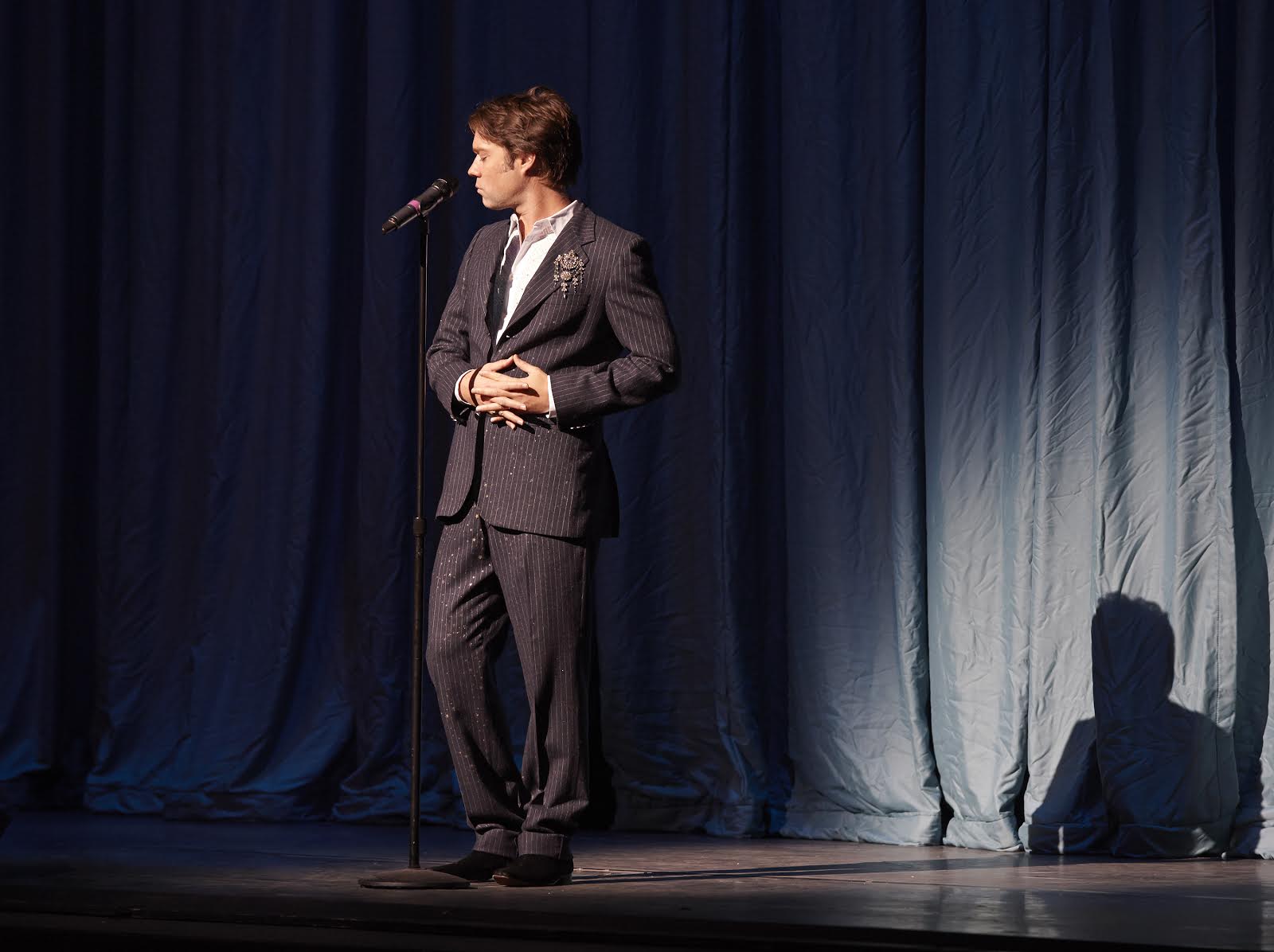
Rufus Wainwright captivated the Gala crowd at the Four Seasons Centre (photo by Michael Cooper)
Hadrian is the name bouncing all over social media because of the COC announcement of plans to premiere a new opera by Rufus Wainwright & Daniel MacIvor, on opening night of the 2018-19 season, almost five years from now.
There’s been some shock expressed. I suppose if opera is understood to be the province of classical composers, it’s simply mind-boggling to imagine someone like Rufus Wainwright composing an opera. But this will be his second. I understand that some people were decidedly underwhelmed by his first. No he’s not Wagner or Verdi, but they wrote several operas before they found their stride.
Now of course part of the problem with such a conversation is that to discuss the subject, one needs to have seen enough to make an educated commentary. While I have not seen nor heard Wainwright’s first opera, I have seen Riel, an opera that is extremely conventional for its decade. If this were a discussion of painting –as I continue to ponder the Great Upheaval show at the AGO—one would notice that anyone with a grasp of , say the previous 50 years in the medium, might be resisting anything new & interesting. Conversations such as this one are inherently political, because the terms of the discourse keep changing. To anyone who is engaged in pedagogy or scholarship, the language required simply to understand how it was done before serves as a kind of gate-keeper, pushing those away who refuse to speak the right way. Wainwright is by definition an interloper because he doesn’t speak the right lingo. This doesn’t disqualify him. I am simply explaining why he is automatically challenged.
A few days ago I posted a link to one of my reviews –the one on Lepage’s Needles & Opium—to the CUNY listserv, eliciting a response from someone who refused to entertain a comparison between the director’s work in this recent instance with his Ring cycle, because they’re apples and oranges. When people want to define a medium so precisely, we’re in trouble. We’re in trouble because the art form has narrow boundaries that can’t be transgressed. If opera worked that way the USA would be using it to stop illegal immigrants.
Anything really new can’t be judged by the old paradigm, indeed, it may make little or no sense by the old system. I’m not saying Wainwright will give us something as revolutionary as that other composer with the initials RW; but judging RW (pick your composer) by the previous paradigm is neither fair nor particularly sensible, unless of course your goal is political. I recall a review I read back in 1981–a great long one—trashing Philip Glass’s Satyagraha. The music was being excoriated for failing to do what music used to do. It’s true, nothing happens in the old sense during this long opera; but why sit watching it expecting symphonic development? Or to look at an abstract painting, wondering if the painter paints this way because s/he can’t paint the other way, as though representational painting were the only way. Isn’t it funny?
In the meantime, smaller companies are creating all sorts of things, some of which are called opera. I don’t care what you call Needles & Opium, or the upcoming Singing the Earth (which I’ll review this week), or any number of other works. It doesn’t matter how firmly one regulates the relationships between words, music, mise-en-scène, or other elements. Theatre is alive with experimentation, some of which may turn up in an opera house. I’m very eager to see Savitri & Samturn up in an opera house, although this work of Ken Gass & John Mills-Cockell likely will first see the light of day in an intermediate venue (aka a place not owned or controlled by a big opera house). There’s so much money at stake in the running of a huge company such as the COC (or the Metropolitan Opera in NYC) that they’re the last place to expect a commission of a new work. Alexander Neef is to be congratulated for making the attempt.
We have awhile to wait. Maybe there will be no premiere in 2018. But I will keep an open mind, hoping to have a good experience at the opera.
“Press releases and announcements” are presented verbatim without comment.
ActYourAge
proudly presents
The 4th Annual
AYA
Holiday Show
Waiting for CABARET
An evening of music, comedy, & stories performed by talented & well-seasoned performers… a fund-raiser for the Performing Arts Lodge & the Actor’s Fund.
Monday December 9, 2013
Cocktails 6:00 pm
Buffet Dinner:6:30 pm
Show: 7:30 pm
Tickets:$15.00
(Tickets available at the door)
Location: ACTRA Toronto, 625 Church St – 2nd Floor
I used to think I was normal. But when you see the same pattern over and over in several films you start to wonder. Every comedy seems to be using the same template.
I saw it in Bridesmaids. I saw it in Young Adult. We were watching people going through some sort of crisis, messed up, unable to function. In Silver Linings Playbook there were profoundly troubled adults of both genders. I realize now that this was a plot-line that had been used for both males and females. The Hangover series take us to roughly the same places.
Friday I watched Girl Most Likely, Kristen Wiig playing an over-the-top neurotic, as we wonder whether she’ll get her life together by the end of the roughly 90 minute film. Tonight it was Frances Ha. Where Girl Most Likely features recognizable actors such as Matt Dillon and Annette Bening, Frances Ha is populated with unknowns. Girl Most Likely and Frances Ha have in common that their plots seem destined for a downward spiral, until each protagonist finds redemption in the most unexpected ways. The title belies the fact that Girl Most Likely follows an unlikely trajectory. Frances Ha sometimes resembles a documentary, with its film noir look and painfully genuine dialogue.
The boundaries of “comedy” continue to expand, as our ideas of what the genre can include multiply. Surely we felt that something good was eventually going to happen to these characters even though they go to some very dark places along the way.
Both films speak to me because they concern the travails of artists (although they could just as well be humanities/ arts grads) in a world that seems more interested in people according to fiscal rather than human assets. By coincidence this was the week of the COC’s Ensemble Gala, a time to recall just how difficult it is to make it in the opera business. A very few will continue to make a living singing, while others become teachers or at least stagger on with the help of a dayjob. There’s a special poignancy to such films because of course many of us in the audience had our own moment when we decided we had to opt for a day-job to pay our rent, and couldn’t cut it any longer 100% from the avails of our creative work.
Even the much darker Blue Jasmine follows largely the same plot –that is, a protagonist’s journey into mental disorder—without the same easy ending.
And as I look at my own sense of who I am, calibrating “normal” according to what I see around me, I have to wonder. Am I the odd one, when Rob Ford’s excesses –his drugs, his alcohol and his stories—appear to be normal behaviour? I could measure the nature of “normal” more easily had I seen those films in a theatre, rather than at home. Do people laugh with recognition & identification at the wacky behaviour in these movies, or is it merely derision?
I loved the moments in each film –thinking especially of Girl Most Likely and Frances Ha – where I couldn’t see a pathway to redemption. The curious thing with each of these films is that the old pattern –of a plotline logically connecting character growth—is now a liability. I don’t think we foresee a happy ending so much as take it on faith; and then the story very generously hands us something gentler than what we would have expected. I suspect it’s a lot like what people are living through nowadays in their 20s and 30s. Life is crap, and then when you’ve compromised –taken a day-job or maybe stopped aiming so high—things improve after all. This kind of arbitrary plot-line is more real precisely because it’s not something you can extrapolate from what came before.
I’ll have to watch them both again, when I know how they’re going to end.
Joel Ivany’s career seems to be taking off. His work with Against the Grain Theatre here in Toronto is impressive enough, but in addition he directed the recent World premiere of Gavin Bryars chamber opera Marilyn Forever with the Aventa Ensemble in Victoria, directing a new production of Les Contes D’Hoffmann with Edmonton Opera, and revived Minnesota Opera’s Nabucco. That’s on top of writing a new contemporary libretto and directing a new adaptation of Le Nozze di Figaro, aka Figaro’s Wedding for Against the Grain Theatre.
Upcoming projects include directing new productions of The Rape of Lucretia at Western University, Korngold’s The Silent Serenade at the Royal Conservatory of Music, his American debut of Verdi’s Macbeth at Minnesota Opera and Albert Herring at The University of Toronto. With AtG he will direct Debussy’s opera, Pelléas et Mélisande in the new year, but first a staged/choregraphed version of Handel’s Messiah.
In anticipation of AtG’s Messiah I ask Ivany ten questions: five about himself and five more about this new creation with AtG.
1-Are you more like your father or your mother?
Director Joel Ivany
I like to feel I’m equal parts of them both, a moiety (having just directed Britten’s Lucretia). The last few years of directing opera has required a Type A mentality and personality, which is a gift from my mother. Without her organization, I wouldn’t be able to do the things I do. Her creativity has also been a huge blessing. I’m able to push the organization aside when I need to, and see through the artistic lens, which is what makes what I do different from someone else.
I’m more like my father when things go poorly. Instead of getting angry or upset, I feel I’m able to let things go and see the best in a situation. I’ve also inherited his humble spirit. I am very thankful for what I have, and I realize that to be able to make a career and support my family through the arts is a gift. Not everyone is as lucky as I feel.
Also, my beard is definitely from my father. I’ve only known him with one and I’ve decided to carry on the tradition. I can’t bother shaving every day.
Both of my parents work for the Salvation Army and are ordained ministers. At one point I was preparing to be a youth minister. I had worked at summer Salvation Army youth camps in both Canada and the USA for over 10 years. I was reading through Bible commentaries and learning about the history of the Salvation Army. I was a skilled tuba player (in the Salvation Army, you’re handed a brass instrument after diapers) and sang in the choir. It all shifted during a yearlong residency in London, UK while I was watching Chicago in the West End. I just decided that I wanted to tell stories, in a theatrical way. That is what I found exciting and what I wanted to pour my passion into. I came back early to Toronto, and began making connections. A very talented and creative stage director, Brent Krysa, led me to U of T’s Opera School, where I met my first mentor, Michael Albano. The rest snowballed from there!
2) What is the best thing or worst thing about being artistic director of a company such as Against the Grain?
The absolute best thing is collaborating with peers I trust, respect and admire. I will take an idea, or Toph will bring one up and then we get down to work. To see the reaction from that idea, watching it grow and having others carry it further than I thought possible is incredibly rewarding.
The last note sung or played from any AtG performance is the best feeling I’ve ever had.
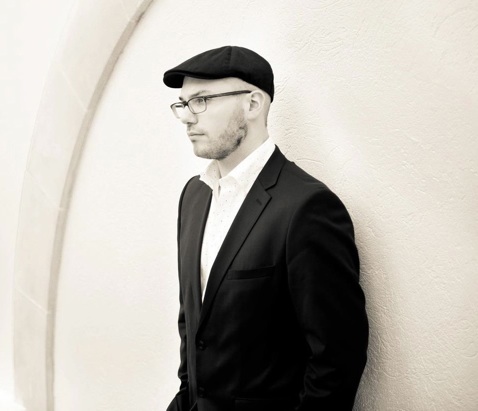
Music Director Christopher Mokrzewski (click for more)
The worst thing about AtG (though not really a bad thing) is that with each success, the demands, expectations and pressures build. Each production has grown in budget, presentation and acclaim. It was extremely difficult at the beginning as I was avalanched with fundraising, promotion, booking, scheduling, designing, website building and directing. All I wanted to do was direct. Thankfully, people saw and understood that vision. During the first year, the company grew with the help of several people, namely Carrie Klassen, Miriam Khalil and Jennifer McGillivray alongside the indefatigable Caitlin Coull and my bestie, Topher Mokrzewski. Nancy Hitzig and Cecily Carver came on board the following year and took us to incredible new heights. We’re finally ready to leap even further ahead with the help of Lucia Cesaroni, who has come on board to take charge of donor and patron relations, and Nina Draganic, who is helping us out as an artistic advisor.
There are so many incredible little details that are very important to me. People trust us with their investment. I want to make sure that we are returning that investment by truly inspiring people.
3) Who do you like to listen to or watch?
Any show with good writing and complex characters. I love Friday Night Lights, House of Cards, Breaking Bad and The Walking Dead.
Robert Wilson and Philip Glass have always transfixed me. I sat mesmerized through Einstein on the Beach when it stopped in Toronto. It was simply different and awe inducing.
I love watching sports. Hockey, basketball, baseball, football. I can do it all, it’s just finding the time that’s hard. Topher and I have an NFL pool (which I am currently ahead).
4) What ability or skill do you wish you had, that you don’t have?
I always wanted to dunk a basketball. Never happened.
I wish I could compose. What a beautiful gift composers have. There is nothing greater than a good story paired with incredible music. It would be a dream come true to write music to one of the stories I have floating in my head.
5) When you’re just relaxing and not working what is your favourite thing to do?
I spend most of my time outside of work with my family and friends. I love my family. Parents on both sides, cousins, nephews and nieces and siblings.
In this business, I find friendships come and go in waves. At times they are immediate and fruitful and then they hibernate for a season or two as gigs carry us away. I’ve enjoyed the last few years seeing friends marry (Toph and Cait’s wedding was a major highlight) and others who are now having babies.
I also love working out. Running, cycling, any sport really. Just over 10 years ago I cycled across Canada, from Vancouver to Halifax and it was one of the most inspiring trips I’ve ever made. I would recommend everyone to see our beautiful country this way.
I also enjoy reading. It’s a gift and I’m finding the time to do it rarer and rarer these days.
~~~~~~~
Five more concerning AtG’s Messiah
1-Please talk about the challenges in creating your adaptation of Handel’s Messiah in the growing tradition of Against the Grain, a company with a history of great originality.
The joy I find from directing opera is in telling a story, and the story always comes from the text. The challenge with something like Handel’s Messiah is that there is not a concrete narrative. The text is from the Bible, both Old and New Testaments. Messiah was written as a theatrical work, however through time it has evolved into performance on the concert stage.
I’m sort of a Messiah neophyte. I’ve only been to one Messiah and it was the sing-a-long at Massey Hall many years ago. I’ve sung one of the bass numbers and have played an arrangement of the “Hallelujah Chorus” in Salvation Army Brass Bands. I don’t come with any preconceived notions other than knowing that Messiah is normally done at Christmas and with soloists in front of the orchestra with binders and gowns/tuxes.
An AtG point of pride comes from finding unique performance venues in Toronto, and we’ve been dying to do something at The Opera House for a long time. This project seemed like the right fit. By pulling it out of the concert hall, I hope people will be more willing to accept this work done untraditionally.
One challenge will be the balance of musical integrity versus the movement. We’re asking our chorus to memorize the score. Our chorus is made up of 14 people who could all be soloists themselves. This presents a challenge of blending, to make 14 voices sound as one. And to ask them to memorize the music and add movement…well, I’m proud of them already.
Choreographer Jennifer Nichols (click for more info)
The movement is going to be unique. Our choreographer, Jennifer Nichols and I are splitting the numbers in half. Jenn has an extensive background in dance. She’s in the ballet corps at Opera Atelier and runs The Extension Room (a studio known for its innovative fitness classes that take inspiration from classical ballet).
The core idea of this piece for us is freedom. Removing constraints. Getting to the heart of the music, and recognizing the reason why Handel put these notes together and why it has moved people for hundreds and hundreds of years.
Jenn and I don’t know how this will work as we mesh both our visions, as it then requires coordination with Maestro Toph and an absolutely top-tier orchestra. It’s scary and exciting – but that’s what the arts should be!
2-What do you love about Against the Grain Theatre?
I love to see how it has slowly been taking shape. It has been a continuous uphill journey and I love seeing people excited about us and about the works that we’re presenting.
Everyone we work with has put in immense amounts of time. We respect the traditions of theatre and the history of how it has been presented both traditionally and currently. That is true of our designers, our performers and our core team. Though we are small, we dream big.
I also love how people love to work with us. I think that’s a testament to the team that we have. I am so incredibly proud of the people who choose to perform with us, because it’s not for the money (though we do pay everyone who works with us, and all of our mainstage roles are offered through Equity contracts). It’s for the love of what we do!
I also love to envision where it can go. We have a plan and I’m more excited than ever to get there. It won’t be for another 3 or 4 years, but that’s exciting to know that we’ll keep growing until then.
I think we’re comfortable in our place. We know what we aren’t. We know what we can’t do. That makes it easy to work with a company like the Canadian Opera Company. We can’t do what they do, but we can work with them because we’re both after the same thing. To build community through the kind of music and storytelling that can truly change people.
I also love that we can explore different artforms. We are not constricted to opera; we can explore dance, theatre and opera. When the bourbon comes out, Fancy Figaro Toph and I come up with all kinds of crazy ideas.
3-Do you have a favourite moment in AtG’s Messiah?
The opening of AtG’s Messiah will be incredible for me. Instrumentally, the most we’ve done at AtG is piano and string quartet. This time, Maestro Tophski will be conducting an 18-piece ensemble! This is a HUGE undertaking and accomplishment. This will be Topher’s first Messiah and we’re overjoyed that he will conduct it with AtG. That is one of the reasons why we are here. To pass down these great works for the first time. It all starts somewhere. For Toph, this is his. That is exciting.
As the overture flows into Comfort Ye, the Tenor soloist will have a choice. Will he continue the way he’s performed the Messiah before, or will he venture out and try something new? We will witness that choice and from there, it will be a series of inspired singing and choices from all four soloists. I can’t wait.
I’ve been listening to this music since last spring, and there is something incredibly pure and perfect about the score. Handel just knew how to write great music.
4-How do you feel about the relevance of Messiah as a modern-day citizen?
I grew up in the church. In many ways, the church and the world of opera are one and the same; our main audience is shrinking; we are desperate to find ways to make it relevant and attractive to young people; we are closing buildings because they are too expensive to keep up and/or no one is attending.
Audiences are incredibly intellectual. They can smell BS a mile away whether it’s on our stages or from the pulpit. I know that authenticity is something that we all crave. We want truth and we want realness. That is the core of Handel’s Messiah. It is a piece about freedom, hope and sacrifice.
Whether one believes the text to be truth or fiction, one cannot deny its poetic beauty. I feel that this piece is calling for a visual authenticity.
Some may prefer traditional presentations to ours, but I’m confident that everyone will undoubtedly see the uniqueness of AtG’s Messiah.
5-Is there a teacher or an influence you’d care to name that you especially admire?
Paul Curran is someone who gave me an opportunity. He is a stage director I admire, and he always took the time to treat me well. I was able to intern with him at Washington National Opera and then at the Norwegian National Opera in Oslo. I am indebted to him for showing how to respect, challenge and stay committed to storytelling.
Thaddeus Strassberger is another peer whom I admire a great deal. I met Thaddeus through Paul Curran. Thad is a gifted stage director and designer directing opera all over the world. I’ve been fortunate to work with him on a few major projects. His heart is huge and I admire him for his work but more importantly for his generosity and humour.
Through Paul Curran (again…see a pattern?) I also was fortunate to work with Robert Carsen in Oslo. I am indebted to Robert for connecting me with all of his shows here at the Canadian Opera Company. His work is amazing and I have consistently been blown away by Robert’s commitment to the project at hand and his focus on every detail.
I keep these colleagues and mentors at the forefront of my mind with each project I tackle. Would Paul like this? Would Thad find this interesting? What would Robert say about this look?
The person I admire the most is my wife, soprano Miriam Khalil. She is my sounding board for everything that I do. Many AtG ideas have come through her and she is my muse. Her creativity is boundless and I know that AtG wouldn’t be where it is without her inspiration. I know I wouldn’t achieve half the success I’ve been fortunate to have without her encouragement and support.
~~~~~~~
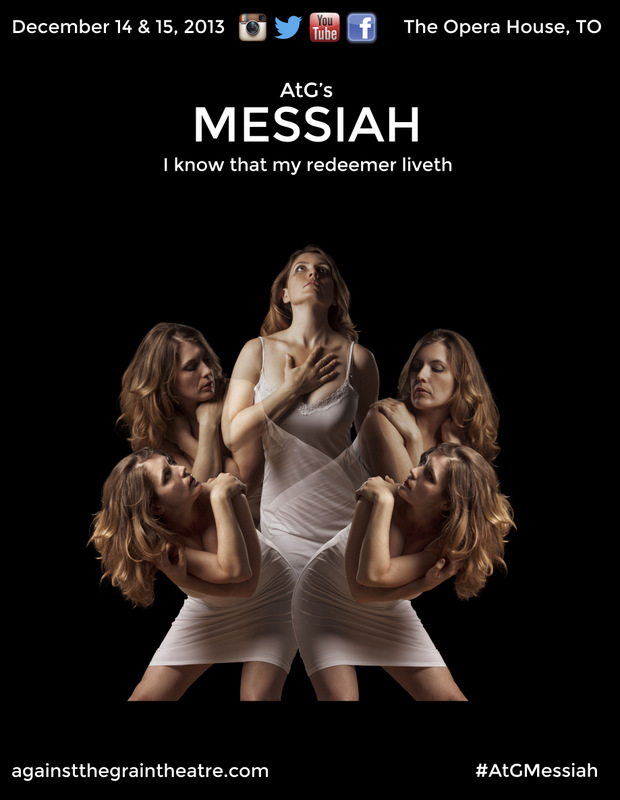
AtG’s Messiah will be presented December 14th and 15th at The Opera House (the other one)735 Queen St. E.
(Click image for further information)
Two years ago the Canadian Opera Company began experimenting with a public singing competition as the final part of the selection process for membership in the Ensemble Studio. In 2011 & 2012 the contests were held in the Richard Bradshaw Auditorium using piano accompaniment.
This year they’ve taken a quantum leap with Centre Stage, the COC Ensemble Studio Competition Gala. Instead of using a piano in the RBA, the singers stood on the Four Seasons Centre stage, accompanied by the COC Orchestra, conducted by COC Music Director Johannes Debus.
Rufus Wainwright captivated the Gala crowd at the Four Seasons Centre (photo by Michael Cooper)
And perhaps the biggest change in tone was supplied by host Rufus Wainwright, who not only brought an informal star power to the proceedings, but even added a few songs. I knew we weren’t in Kansas anymore when Debus conducted “That’s Entertainment”, followed by two of Wainwright’s own compositions. The audience ate it up.
It wasn’t all pop music, however. First –in a portion of the evening before the audience arrived—each of the contestants sang an aria with orchestra in a near-empty hall. Then, after a break, the audience arrived for the gala informally hosted by Wainwright. I wish we had someone as unpretentious hosting the Oscars, as his looseness added a lot to the fun of the evening.
Soprano Karine Boucher
On the very night when “Dancing With the Stars” is about to choose its winner (and no I am not waiting with baited breath, although –hi Mom—I do know at least one person who is), we had some of the chemistry of reality TV with the help of modern technology. In addition to the competition, the audience were asked to vote for their favourite, and –what do you know—our winner was the same as the one chosen by the expert panel, namely Québecoise Karine Boucher. It would be hard to imagine a bigger contrast in styles than what Boucher showed in her two selections. In the public portion of the competition Boucher sang an ornate aria from Handel’s Giulio Cesare, whereas her earlier piece was the luscious lute song from Korngold’s Die tote Stadt.
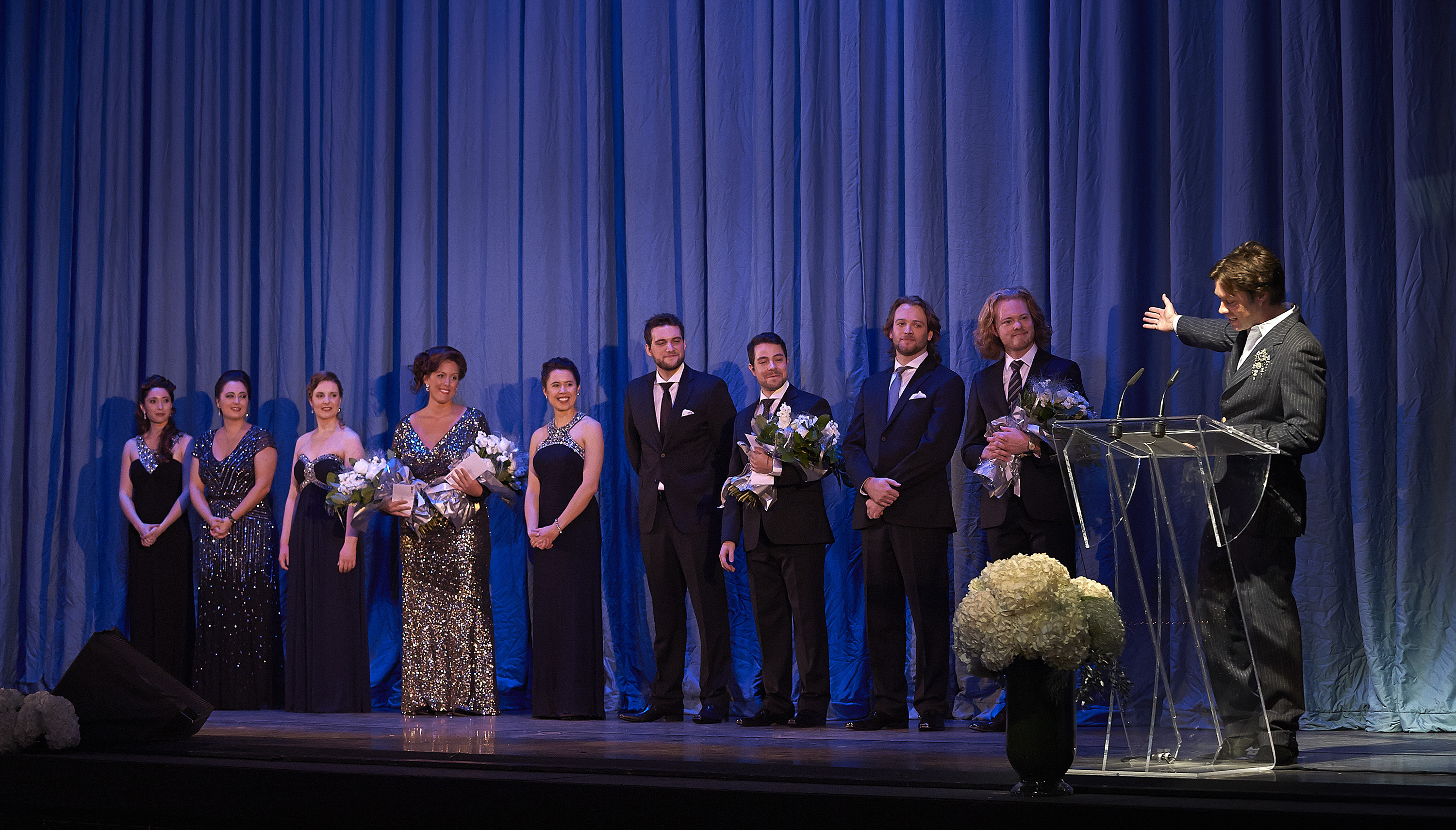
Second place went to Kitchener-Waterloo native Jean-Philippe Fortier-Lazure, while Brockville native Iain MacNeil placed third.
Yet all nine singers heard tonight were excellent. Johannes Debus & the COC Orchestra acquitted themselves wonderfully throughout. And as I write this some of the audience are still there enjoying a gala dinner.
Bravi!
Ensemble Studio Competition finalists and winners with Centre Stage host Rufus Wainwright (photo by Michael Cooper)
There’s a moment in Terry Gilliam’s Adventures of Baron Munchausen when Vulcan is pressing carbon into a diamond for his wife Venus, and of course she expresses her gratitude, a moment before handing the thing to a lady in waiting with the words “another diamond” (and it gets thrown onto a pile, unappreciated).
At the first appearance of The Great Upheaval –the new show opening at the Art Gallery of Ontario— on its home turf, namely the Guggenheim Museum in New York in 2011, the NY Times review was decidedly unimpressed. They saw it as a prudent use of the gallery’s permanent collection and not much more than that. I wonder if the New Yorkers are like Venus, bored with brilliance and unable to appreciate what they have.
No wonder the curatorial staff seemed surprised at our rapturous response here in Toronto . I have to wonder whether the riches of major centres such as NY turn people into philistines, blasé about brilliance because they’re regularly surrounded by masterpieces, and have lost their reverence for art in the process. It’s a truism that Torontonians haven’t made it until they go to the USA or Europe. Perhaps the same kind of dynamic happens in NYC as well, a place that’s too cool for its own good. The new AGO show from the Guggenheim in NYC is called The Great Upheaval, and its only foreign excursion is to Toronto.
And maybe we’re also so accustomed to language proclaiming great upheavals that we’ve become inured. I wouldn’t miss a chance to see great art from this period (1910-1918) but can any show possibly live up to such hyperbolic language? I need a new set of eyes that can see words afresh.
But The Great Upheaval is true to its promise, a show of such riches that as you come through you will be surrounded by gems of incalculable worth whether or not your husband is the God Vulcan.
Robert Delauney, Red Eiffel Tower (La tour rouge), 1911–12. Oil on canvas, 49 1/4 x 35 3/8 inches (125 x 90.3 cm). Solomon R. Guggenheim Museum, New York, Solomon R. Guggenheim Founding Collection
The story of the Guggenheim collection is in some ways a perfect parallel narrative to the story of art in the 20th century, as we see the taste of a collector identifying a wonderful new direction for art & artists. While it may not have been their original intention, The Great Upheaval is in some ways like a primal story for the collection, which began modestly in the late 1920s long before there was a building.
The organization of The Great Upheaval seems to owe at least a little to the remarkable shape of the space in NY, that long spiral corridor in that magnificent Frank Lloyd Wright building. The AGO space can’t manage the same perfect linearity, but then again, what space could? The art represented in the exhibition from 1910 to 1918 is offered up de facto, which is to say, chronologically, rather than in themed groups around movements or artists. Yes we have several artists whose work recurs throughout. But we encounter their work year by year. The result is a kind of documentary effect, as awkward as history and without any sense that the curators are interfering whatsoever.
Make no mistake, this is a powerful show. I was a bit surprised to see how quickly my media colleagues raced through. After Ai Weiwei & David Bowie, this is a return not just to first principles for the AGO, but a shift to something more substantial & challenging. We begin with Cezanne, Seurat, and Gaugin but we also see Kandinsky and Chagall. Mondrian & Picasso are there too. And there are other artists I didn’t know such as Kupka, Delaunay, Duchamp, Franz Marc and Branciusi, several -isms , such as cubism & futurism. And more.
The questions and issues underlying this exhibition feel like the central questions for all western art. The show purports to begin with “precursors” (as they call Cezanne, Seurat, and Gaugin).
Haere Mai (1891), by Paul Gaugin
But those three were themselves responding to something before,and could easily be understood as radical & avant garde. To get a real context for the actual upheaval on a trip to the AGO one could start with a quick look at examples of 18th & 19th century painting, preferably the most academic & representational examples. One wouldn’t want to look at Turner or Degas or Van Gogh, because those painters were already beginning the “upheaval” (in the same way that Cezanne, Seurat & especially Gaugin were doing).
But those three are precursors in the sense that they not only begin the break from what came before, but laid down the methodology of the avant garde. Gaugin was one of the Nabis, for example, with a manifesto from Debussy’s friend Maurice Denis (who painted the cover for the program of Maeterlinck’s Pelléas et Mélisande). Each painter would undertake a kind of journey often beginning with something academic & conservative, and then striking off into their own individual terrain, becoming progressively less representational and more quirky, stylized and yes, abstract. The manifesto became a kind of virtual rallying place, like a public square, where artists could gather OR react in the opposite direction. Movements and counter-movements became more and more normal by 1910. Many of the painters in The Great Upheaval share characteristics with one another, although I am speaking from a superficial grasp (forgive me… I just saw the show, and spout off about Debussy & Denis & Gaugin, not Kandinsky, who I know in a more superficial way). Each movement can be understood as a kind of conversation, a discursive community where some (if not all) of the terms (as well as the technical requirements of the art-form) are understood by those at the core of the group, while others around them grasp some if not all the necessary concepts. Ideally the “upheaval“ shown in such an exhibit would be more inclusive, a much bigger show, that would incorporate the entire process, beginning somewhere around the Impressionists, or perhaps only with post-impressionists such as Van Gogh, Seurat & Gaugin. But: how much can one see? In fact the show’s purview of 1910-1918 is already immense. I couldn’t really see it all in two hours. The show has me dreaming immense dreams, seeing huge patterns & synthesizing relationships and influences across a continent’s art.
Albert Gleizes: Head in a Landscape (Tête dans un paysage) 1912–13 Oil on canvas Solomon R. Guggenheim Museum, New York, The Hilla Rebay Collection
The ambitions of this show –and its title—are large, and I am above all, impressed and moved by such lofty ambitions. I believe one needs to come with an open mind, prepared to make multiple visits, as there’s a great deal of wonderful art in this show, more than you can see in one visit.
I have not yet seen enough gems to be blasé. (Click image for more information about the exhibit.)
It’s such a privilege to see a rare work. Whatever else I might say about the Voicebox/Opera in Concert presentation of Benjamin Britten’s Gloriana on the occasion of the composer’s centennial, I’m thankful for this encounter with the score.
This sample of Gloriana –an opera recounting the tale of Elizabeth the 1st and Essex—is especially precious because it’s so rarely performed. The first production, on the occasion of the Coronation of Elizabeth II in 1953, was not well received, leading me to wonder about it reception history and to listen to this performance with an ear to why it might have been judged so harshly compared to Britten’s other operas. It must have seemed like a good idea at the time, when Britten & his collaborators sought to invoke one of the greatest English monarchs when her namesake ascended the throne.
It’s not rocket science. Did Britten think to mention to those who commissioned him to write this opera, that the first act would be full of celebration, but that the last act would be a massive downer concerned with mortality, especially in context with what went before? It’s as though someone staged the Nutcracker in reverse, beginning with all the entertainments, and ending with the angst and conflict, and switching it from the PG children’s story to something much riskier.
On top of everything else—that is, having decided to adopt a scenario that begins with good-times and ends with sadness & death—it’s also a study in the nature of power relationships. That part of the opera is totally fascinating, by the way, but probably didn’t win Britten any additional supporters in the charged atmosphere of the coronation, when I’d assume that there would be assumptions of a sort of political correctness. I’m thinking of three parts of Britten’s opera in particular:
1) At one point at a party where Elizabeth has been dancing, she calls the ladies out of the room to change their linen, and then contrives to put on Lady Essex’s dress, that she’d worn a short while before, humiliating the woman. I don’t know if this incident is a historically verified incident or something invented for the opera, but either way it shows Elizabeth as a commanding personality. I imagine the young royal couple (Philip and his wife, whether it was “Princess Elizabeth” or the newly crowned Queen) squirming as they watched this scene.
2) Almost the entire portrayal of Robert Devereax, Earl of Essex, is like an ongoing display of testosterone, making him one of the more interesting characters I’ve seen onstage in awhile, even in a concert performance. We watch this macho man over-compensating from the beginning, until he’s gradually humiliated in his disastrous Ireland adventure, and executed. Again, I can’t help thinking of Philip & Elizabeth sitting, perhaps exchanging glances at one another and giggling. But the guests at the occasion? Squirming.
3) And there’s even a line that calls attention to the odd gender relationship. Elizabeth says (I don’t recall the exact words) something like “he has touched our sceptre”. It struck me as weird, as though the Queen were accusing him of touching her penis-symbol. Maybe the royals wouldn’t have noticed anything odd about this line, and maybe it’s just me.
There’s one other reason –probably the key reason—why Gloriana has been a failure, and it’s a doozey. (hmm! Spell-check seems to know that word)
We’re in the last fifteen minutes of the opera and suddenly whoops it’s as though the tracks that the express train is on suddenly end and we’re riding on dirt instead. The text in two instances screams for something sung, a major musical thought. And instead Britten asks the singer to speak instead. Elizabeth narrates a letter as though she were a refugee from a Raymond Chandler novel. And then Essex does the same.
Why?
I couldn’t help thinking that when Britten was trying to finish the end of the opera maybe he ran out of time composing his commission. This is, after all, a very extraordinary occasion. It’s not as though he could call up Mr & Mrs Mountbatten and ask for an extension, to have them put off the coronation. And so they took a shortcut borrowed from movies, and one that’s not really operatic.
That being said – that I’ve more or less sided with history’s dismissal of this opera—maybe it’s time for the public to discover what a stunning piece Britten has composed. Whatever you think of the opera as a celebration of the occasion of Elizabeth’s coronation, it’s a magnificent piece of music theatre, containing some of Britten’s most beautiful music. The cinematic ending is indeed a letdown, the last act is indeed dark –like so many other operas actually—and yet Gloriana is still a fabulous piece deserving to be produced.
Soprano Betty Waynne Allison
Now, after that lengthy preamble, I must acknowledge the impressive treatment given the work by Voicebox/Opera in Concert. Betty Waynne Allison commanded the stage whenever she appeared as Elizabeth, both vocally and physically. While some variations of the Elizabeth story include unattractive or insecure monarchs, this time we’re in the presence of a radiant Gloriana brimming with confidence. I only wish the role were bigger, given how self-assured the singing was. Adam Luther as her consort Essex was every bit her match. The role is written as a bit of a vocal show-off, with much of the role lying very high in the tenor range. Of the remaining cast Jennifer Ann Sullivan was the most impressive, both in her confident body language and her powerful top.
Peter Tiefenbach played through the score with great care & accuracy, giving us a remarkable welcome to this unfamiliar work. Robert Cooper led the Opera in Concert chorus, in a work full of gorgeous choral writing, sung with elegance & delicacy, which is probably authentic. If I have one quibble –and it would be with both Cooper & Tiefenbach—it’s that the work was so carefully re-created that it failed to seem operatic; or is that how the work is written? We were in the tiny Jane Mallett Theatre, but except for the two women I cited, the volume was so respectful that the effect was more like chamber music than opera.
But of course we need more productions of this beautiful score, more interpretations, and more opportunities to encounter this music. Thank you Voicebox/ Opera in Concert for bringing it to us.
Their season of anniversaries continues Feb 2nd with Hippolyte et Aricie on the 250th Anniversary of Rameau’s death, and Stiffelio March 23rd commemorating Verdi’s bicentennial. Continue reading →










 barczablog