Caird & Farley’s Conceptual Bohème

A great director: John Caird

The Canadian Opera Company opened their 2013-2014 season tonight with Puccini’s La Bohème at the Four Seasons Centre.  It’s a new COC co-production with Houston Grand Opera & San Francisco Opera directed by John Caird & designed by David Farley.

Like anyone who has seen a lot of Bohèmes, I enter the theatre wanting the familiar score to somehow seem fresh and new.  While I am open to directorial intervention, I hope it won’t come between me and the many favourite moments the opera promises.

Given that almost impossible challenge – of making the familiar new while still preserving the favourite moments—I am pleased to report that Caird & Farley have accomplished something so remarkable as to verge on the miraculous.  I would say to the cynics who are Boheme-phobic that you should try this production, as it delivers many of the delights you had when your first experienced the opera.  This one defamiliarizes you just enough in places to make it feel new.

Because their concept comes from within the text, it is so reasonable as to be almost invisible.  I am sure many viewers didn’t even notice.

Caird explains it in his program note this way:

For this production, designer David Farley and I have chosen to imagine that the characters of he opera may act as our inerpreters.  If Schaunard, the composer, is represented in the pit by Puccini himself, the scenic world that the bohemians inhabit is as if painted by Marcello. Every surface of he set is a canvas drawn from the same rich and chaotic pictorial world as that of Toulouse-Lautrec—a contemporary of Puccini and an artist who was himself obsessed by the bohemian underworld of Paris.

The resulting effect has a surprising depth.  Rodolfo isn’t just writing, but also in effect telling the story of the opera, as when Mimi sings her reminiscence of their first meeting off the pages she finds in his hand.  When Schaunard has his one genuinely musical moment in the life of the opera –listening to a merchant play an instrument he was considering for purchase at the beginning of Act II (and dismissing with the line “Falso questo Re”—Caird makes sure that there’s actually someone blasting an out-of-tune note.

Marcello does the lion’s share of underpinning the concept.  In each scene we see a set made up largely of paintings as if to suggest glimpses of the bohemian world through the eyes of an artist.  Marcello often paints as he observes this world, right down to the last magical moments of the opera.  This perspective alienates us just a tiny bit, distancing us oh so slightly, giving us a brand new perspective.  But if you were a real painter watching Mimi die, you’d be moved, but you’d also be capturing it with your brush or pencil.

It works.

It helps that the cast are youthful and beautiful to look at.  Dimitri Pittas offers a method-style Rodolfo, feeling his way from the inside of each lyrical moment, including a very convincing last scene.  Grazia Doronzio is a sympathetic Mimi, very musical but powerful when necessary.  Joshua Hopkins –as Marcello our conceptual painter, and the one whose part seems most different from the usual—was every bit as lyrical as Pittas.  Joyce El-Khoury’s Musetta was one of the classiest Musetta’s I’ve ever seen, side-stepping many of the usual mannerisms, and avoiding the mugging & over-acting that often mars Act II of Boheme.  We didn’t get the usual laugh upon her appearance, but instead a red-hot moment of eye contact between her and Hopkins.

There are several moments that dodge the clichés.  Speaking of the directorial concept, I believe the one time we are reminded overtly of Colline’s calling as a philosopher –when Schaunard alludes to Socrates, leading most Collines to loudly bray “qui”—Caird chose to do something subtler.  Christian Van Horn, possessed of a lovely rich bass voice opted to almost whisper in the place where others shout.

Van Horn and Phillip Addis as Schaunard inhabit the comical centre of gravity for most of the opera, allowing Pittas & Hopkins to be more serious.  The cast shows a wonderful sense of depth, strong top to bottom, partly because Addis and El-Khoury change roles later in the run, as Addis becomes the painter Marcello, while El-Khoury becomes Mimi.  In other words there are no weak voices anywhere in this cast.

Carlo Rizzi conducts the COC orchestra.  The tempi for the first two acts were on the fast side –how I prefer it usually—although this made the task of the children’s chorus in Act II especially challenging; they came through wonderfully.  In Act III, though, Rizzi slowed things down, making the series of emotional duets very clear & emotionally powerful.

Yes yes I cried, both in Act III and IV.  It felt very fresh and new, so I suppose I was particularly vulnerable.  El-Khoury is very take-charge in the last act, which is how I believe Musetta’s written.  The sequence of discoveries through the cast at the end, from Addis through Hopkins, and then with the exchange among the other three was very simple and direct, Rizzi bringing things to a gorgeous conclusion.

It’s a wonderful way to start the COC’s new season.   The Canadian Opera Company’s production of La Bohème continues until October 30th including some cast changes. Click photo below for additional information.

From left (at the Cafe Momus) standing foreground Grazia Doronzio touching Dimitri Pittas, Phillip Addis & Christian Van Horn upstage, Joshua Hopkins being brushed by Joyce El-Khoury, and downstage on the right, Thomas Hammons, from Act II of COC’s La Boheme, directed by John Caird, set and costume designed by David Farley, lighting designed by Michael James Clark. Photo: Michael Cooper,

Posted in Opera, Reviews | Tagged , , , , , , , , , , | 1 Comment

Headache

The New York City Opera is bankrupt. The GOP has put their foot down, so it’s not clear whether the USA is even open for business.  But that’s nothing.  Let’s talk about something really important.

Hockey is showing signs that it may be ready to grow up.  Every sport has a history of fisticuffs, ragged uniforms, shady relationships with gamblers and controversies over rules. At some point the crowd of ruffians get organized, and in the process legitimize their “game” into something more business-like. It can be quite beautiful.

I love many sports, but must single out two in particular.

  • I’ve watched hockey since I was a child, even if the game has changed in many ways.  I don’t watch it with the same passion because I feel the game needs to grow up…
  • I started watching football. While I used to be a stalwart CFL fan (and subscriber until i became exasperated with the tendency to let all the good players go), I’ve gradually been won over by the National Football League in the USA (who also play a couple of games here in Toronto & in London England by the way)

There are at least two inter-connect things I have long admired about the NFL.

They have been tinkering with the rules for as long as I can remember.  They do this in baseball too (once every now and then changing the strike-zone for example), but not with the ferocity of the NFL.  They are constantly changing their rule-book in the interest of a good game.

But where this gets really interesting is at the end of the season, when the playoffs begin.  What I most love about the NFL is that the rules are the same in January as they are in September.  A referee is expected to interfere in a game to stop a rule infraction even when the game is important.  Does that sound odd or strange?

But in the National Hockey League the rules that are called one way in the fall are forgotten at Stanley Cup playoff time.  As a result the Cup is a travesty.  Can you imagine a Superbowl where a rule is called differently than the way it’s called early in the year?   Of course not.  The game would be patently unfair.

But this is precisely how the NHL works.  Boston is perhaps the best example of this, a team that is a fair competitor suddenly emerges at playoff time, when truculent passive aggressive behaviour pays off.  Borderline interference that generates penalties in December or January is waived off in April or May.

I haven’t mentioned fighting, a kind of carnival side-show that is supposedly “part of the game”: even though it only happens when the game stops.  I suppose it’s part of hockey culture, which isn’t quite the same thing as being part of the game itself.

If fighting is part of the game, so too, head injuries & concussions.  Sidney Crosby is the most notable player in the NHL who reminds us that the game is dangerous, even if there were no fighting. Some would argue that without fighting there would be more head injuries, a claim that i think is false.  The NFL outlaws fighting, and just about every other kind of flagrant kind of behaviour.  A league’s culture can romanticize violence, or find a way to contain that violence within the rules, as the NFL does.

And now, as players are coming forward with their head injuries, the league can’t really ignore this anymore.  The NFL too has a lot of work to do, to ensure that our heroes don’t all end up with premature dementia or other sorts of disorders caused by their dangerous occupations.  I suppose we always knew that the high salaries are a kind of danger pay, that you wreck your knees and your back to say nothing of what the lifestyle does to you.

There are reports that the NHL is looking at banning fighting.  The reason they’re slow? Manhood issues and the box-office value of fighting in places (US markets in other words) where the game was sold on the basis of the side-show, not the game itself.  In fairness, the NHL has tried many rule-changes, with good intentions. But at playoff time it all gets watered down, when referees are unable to see muggings right in front of them, looking the other way.

Considering it?  Please.  Consider growing up, NHL.  Fights or no fights, the game should be the same at playoff time as in the exhibition season.

Grow a pair: all of you.

Posted in Sports | 1 Comment

Soprano Miriam Khalil and pianist Julien LeBlanc

“Press releases and announcements” are presented verbatim without comment.

Soprano Miriam Khalil and pianist Julien LeBlanc present recital at West end art gallery

TORONTO – Soprano Miriam Khalil and Acadian pianist Julien LeBlanc will bring their recital Airs Chantés to Toronto for one performance on Oct. 24, 2013. Featuring music by Ravel, Debussy, Poulenc and the rarely heard Seis Canciones Castellanas by Jesus Guridi, the recital takes place at Gallery 345 in Toronto’s West end.

The program comprises French and Spanish art songs of the Impressionistic and 20th-century period.  The first half of the recital will include excerpts from Ravel’s Shéhérazade, Debussy’s Ariettes Oubliées and will conclude with Poulenc’s well-known song cycle Airs Chantés. The second half is rounded out by three French melodies by Massenet, Ravel and Delibes in a Spanish style, Jesus Guridi’s uncommonly performed Seis Canciones Castellanas and three songs from Obrador’s Canciones Classicás españolas.

The performance begins at 7:30 p.m. with doors opening at 7:00 p.m. Tickets are $25 and are available at www.miriamkhalil.com and at the door.

About Miriam Khalil and Julien LeBlanc

Miriam Khalil and Julien LeBlanc have been collaborating since their first meeting at the Glenn Gould School of the Royal Conservatory of Music. Since graduating they have both enjoyed successful careers in Canada and abroad.

Khalil grew up in Ottawa and obtained her bachelor’s degree in music at the University of Ottawa. Praised by Opera Canada for her “gorgeous, romantic, arching sound that immediately commands the ear” and a “beautiful and distinctive voice”, she is a graduate of the prestigious Canadian Opera Company Ensemble Studio. She has sung with companies across Canada and the UK, including Opera Edmonton; Pacific Opera Victoria; Opéra de Montréal; Opera Lyra; Opera in Concert; Opera Hamilton; Aldeburgh Connection; Hamilton Philharmonic Symphony; Windsor Symphony; Nova Scotia Symphony; Victoria Symphony; Against the Grain Theatre; and the prestigious Glyndebourne Opera and Aldeburgh Festivals.

LeBlanc is a highly sought-after soloist, chamber player and accompanist. Currently living in Montreal, LeBlanc has performed for audiences from coast to coast. He is co-artistic director of l’Été Musical de l’Église de Barachois, a summer concert series. He has also recently appeared as a guest pianist and collaborative artist at several Canadian music festivals including the Indian River Festival; the Elora Festival,; Music and Beyond; the New Brunswick Summer Music Festival; Festivoix in Trois-Rivières; Toronto Summer Music Song Academy; Festival de musique de chambre de la Baie-des-Chaleurs; Festival de musique de Lachine; and Festival Acadien de Caraquet.

For more information please visit: www.miriamkhalil.com and www.julienleblanc.com.

Video of Khalil in concert can be viewed at http://www.youtube.com/watch?v=2EtGglnkaCI

Posted in Press Releases and Announcements | Leave a comment

In Pace Requiescat

“Press releases and announcements” are presented verbatim without comment.

In Pace Requiescat

Opera 5 Returns
With Edgar Allan Poe-Based Operas
in a Haunted House
October 27th, 30th, 31st 7:30PM
Arts and Letters Club 14 Elm Street

Tickets Online $25.00 Students/$30.00 Adult  http://o5inpace.eventbrite.ca
Tickets at Door $25.00 Students/ $30.00 Adult (Cash and Credit)

Toronto, ON – Toronto opera company Opera 5 launches their production season with an
evening of operas based on the works by Edgar Allan Poe. Timed to coincide with Halloween, the evening will begin in the lobby of the Arts and Letters Club with a Haunted House by local visual artist Nicholas Comeau. Halloween-themed cocktails will be served, and closing night will include a costume contest and dance party. The three works featured will be The Cask of the Amontillado by Daniel Pinkham, La chute de la maison Usher fragment by Debussy, and the world premier of Canadian composer Cecilia Livingston’s The Masque of the Red Death. All three pieces will be directed by Opera 5 Artistic Director Aria Umezawa, with Musical Director Maika’i Nash, and Production Design by Matthew Vaile.

This production marks a return to the stage for Toronto-based soprano Lucia Cesaroni. Joining her is American baritone and recent Tanglewood fellow David Tinervia; and COC Ensemble graduate Adrian Kramer. The adaptation of The Masque of the Red Death will be accompanied by the Toronto Pop-Up-Orchestra, with movement coaching by Natalie Brucker – Co-Artistic Director of GeoMetriX Dance Crew.

“Edgar Allan Poe’s stories are very theatrical, and lend themselves well to the operatic medium.” says Opera 5 Artistic Director, Aria Umezawa. “Even his dialogue reads like a libretto, so the transition from the page to the stage feels very natural. What with his stories being so eerie, and because of his reputation as a horror writer, it seemed like a great fit for a Horror-themed evening at the opera – elegant, but spooky. What better way could there be to spend Halloween?“

Opera 5 is quickly establishing itself as one of the top producers of opera in Toronto. It is
currently run by three operatic GTA musicians: Rachel Krehm, General Director; Aria Umezawa, Artistic Director; and Maika’i Nash, Music Director, with a goal to find new audiences through the engagement of the five senses & other art forms. The company is known for its popular web series titled “Opera Cheats,” which deconstructs opera plots and opera-going rules with a humorous twist. You can check them out at http://www.youtube.com/user/OperaFive.

Posted in Personal ruminations & essays | 1 Comment

Ready for Prime Time: Savitri & Sam

Okay, maybe the headline tells you what show i am about to watch on TV, coming home from a (hint hint) Saturday night opera.   But i really mean it, they’re ready. Tonight I went to see a public presentation of portions of Savitri & Sam at the end of a week-long workshop, presented by Canadian Rep Theatre & Savitri Project Collective.

I heard 90 minutes of a much longer work: an opera.

It felt like perhaps 20 minutes as it went by.

Perhaps I should explain where I’m coming from, as my credentials may be suspect.  I am usually so positive –avoiding negative commentary—that I may seem to be incapable of anything else.

I’ve been listening to Louis Riel after having read a review by John Gilks on his Operaramblings blog.  I’d seen it twice very long ago, and wanted to recalibrate my sense of it.  I’d sounded off on Facebook to say that the Canadian Opera Company needs to stage this opera again.  In 1967 two operas premiered as a centennial project with the COC:

  • The Luck of Ginger Coffey, which I saw, starring Harry Theyard (who I mention because it’s his birthday according to Charlie Handelman)
  • Louis Riel which I didn’t see at this time (our family subscription didn’t have enough tickets to permit me to see it this time…i was a child!), but I would see it in a remount a couple of years later, AND I’d see the TV version, which is the basis of the DVD I’ve been watching in 2013

Riel is the one that’s remembered.  In places it works very well, although in some places it’s wooden, a relic of a style that had once been in fashion.  It feels dated, it’s most interesting elements in the libretto’s treatment of a national myth, not its music.

Composer, musician, innovator, teacher John Mills-Cockell

Composer, musician, innovator, teacher John Mills-Cockell

I am quite certain that Savitri & Sam is better.  It doesn’t feel derivative, even if it does remind me in places of Pelléas et Mélisande, another opera telling a story of forbidden love.  But while it’s often as beautiful as Debussy it avoids the effete & precious stillness that mars that work, perhaps the least operatic opera ever written.  The score by John Mills-Cockell is often tonal, but with depths & complexities matching the ambiguities of the story.  The best operas undertake big themes, complex subject matter that can unfold within the abstraction of the music, ideally with profound symbolic undertones that aren’t easily pinned down, demanding multiple articulations in different interpretations.  I feel that about S & S.

Librettist & director Ken Gass

The words of Ken Gass’s libretto were almost entirely audible in the workshop, presented without any subtitles.  That’s a tribute to the elegance of Gass’s lyrics, the clarity of Mills-Cockell’s textures (admittedly presented in an electronic orchestration that might sound fatter with an orchestra) and the enunciation of the cast.

One of the most original features of S & S is the use of chorus.  In this tale of honour killing by the father of a Punjabi girl who had been with a Native Canadian boy, we are reminded throughout that everyone –girl, boy, father and mother—are acutely aware of their ancestors as voices in their heads.  This chorus might be the ideas from  the past that influence them, or ghosts of ancestors, or perhaps a kind of articulation of culture itself.  If that—one of the most original and exciting things I’ve encountered in an opera in a very long time—weren’t enough, there’s more.  There is also a very tonal non-verbal choral pattern heard at least a couple of times that might represent acceptance and oneness with one’s culture, that we hear during a very original love duet.  Can you name even one love duet that isn’t unbelievable by reason of all those words at a time when the lovers should be getting physical? this is the first one i’ve ever heard that takes me somewhere believable, a magical non-verbal place: because we’re not listening to silly poetry.  We hear a few words of love, and ohh-ing and ahh-ing, and…even in this semi-staged reading i was hypnotized, enthralled completely.

Semi staged, partly off book, the performance featured wonderful work from Zorana Sadiq and Michael Barrett as the two young lovers, with Giles Tomkins & Marion Newman as her parents.  Gregory Oh did a remarkable job of conducting the live singers, working from a series of recordings of the orchestra parts (synthesized) & chorus.  Considering that they assembled this in a week, it’s a stunning achievement.  The music is very complex in places, although I can’t really tell how difficult it is to sing (for instance, how high the voices were forced to go).  Maybe the score isn’t that daunting and the singers did well, or maybe the score is tough and the singers were heroic; either way they sounded wonderful.

I was at Tapestry Briefs only a few days ago, watching a series of little bits and pieces, none of which was as cogent (that is, with an inseparable relationship between the music & words) as any five minutes of this 90 minute presentation.  Is that an unfair comparison?  But seriously, the ninety minutes went by like a flash.  I got lost in the lusciousness of the sound, and (aside from liking the performers & their performances) I liked every character, including the one who ends up being a killer.

I am now impatient to see this opera staged.  I won’t hold my breath for the COC, who aren’t even jumping on Riel’s bandwagon let alone a new work; yet this opera is as Canadian as apple pie or maple syrup.  The music is really beautiful.

Someone, ANYONE! please stage Savitri & Sam..! I need to see it and hear it.

Soon!

Posted in Dance, theatre & musicals, Opera | Tagged , , , , , , , , , , | 3 Comments

Bohemian courtship: being Rodolfo, winning Mimi

Dimitri Pittas

Who is Rodolfo? He is a young poet in love.  And he is the hero of Puccini’s La Bohème, opening in a new Canadian Opera Company production on October 3rd at the Four Seasons Centre.

In this production, three different singers undertake the poetic lover: Dimitri Pittas, Michael Fabiano and Eric Margiore.  Each of them gets to woo Mimi. This is an old-fashioned romance.  Mimi and Rodolfo are brought together by chance, not by choice.  They will argue and fight, yet their love is true.

How is it for the singers coming together onstage?  Yes, it’s theatre, not real love.

Eric Margiore

Or is it?  When three different Rodolfos each romance and win Mimi, can we think of a kind of competition, at least for the hearts of the audience, if not for the love of Mimi herself?

I couldn’t help thinking of something much newer than the fin de siècle in Paris.  What if this were the dating game?  Instead of calling them “Bachelor #1”, “Bachelor #2 and “Bachelor #3” let’s imagine Mimi, asking questions of each of her possible Rodolfos, asking them to win her over.

No we won’t actually have her pick one and reject the other two: because in fact, all three will play Rodolfo.  But let’s imagine Mimi asking her suitors questions, and see what they will say.

MIMI:

Michael Fabiano

Rodolfo, I am knocking at your door.   And OH NO, my candle has blown out!  You’re all alone in this big apartment.  I’ve heard your voice for awhile but we’ve never met.  So tell me,…How can you help light MY fire, Rodolfo as played by ERIC MARGIORE!?”

Eric Margiore as Rodolfo:

Well, Mimi, that is a lovely name.  I believe that I can help light your fire, especially on those cold winter nights of Paris. I am really quite swell with the kindling and I must admit that I love to cuddle, so it seems that I am your man! Since I am a poet, I would love to just sit by the fire and look at you to become inspired.  I believe that you will find significant warmth in my words…

MIMI:
“Mmm thanks Eric!  Now,
“RODOLFO—as played by Michael Fabiano:
same question…!?

Michael Fabiano as Rodolfo:

My heart is a hearth.
Let us rejoice in the
exudence of our
permeating souls . . .

MIMI
(Ahhh nice!):
And how about RODOLFO—as played by Dimitri Pittas….?

But tonight Dimitri Pittas is in Amsterdam tonight (Sept 27th) and Sunday Sept 29th singing the Verdi Requiem with the Concertgebouw.

MIMI: Hm, Dimitri, you’re not here(!!?)….Well then next question:
I want you to imagine you love me.  We’re so in love! And: you see me in a cab with ANOTHER man.  Tell me how this makes you feel!!!
Rodolfo played by Eric Margiore.,.?

Eric Margiore as Rodolfo:

Well, I do become incredibly jealous! I am so intensely passionate about our love that when I see other men even looking at you, I cannot handle it!  I know you love me deeply and I cannot picture anyone else with you.  I will fight for you and protect you with all of my soul because you inspire me so deeply.

Mimi smiles.  “Thank you.  Michael Fabiano, same question.  We’re in love and you’ve seen me in a cab with another man.  How does this make you feel?!!!”

Michael Fabiano as Rodolfo:

A thousand arrows pierce my bleeding soul.
My ire points to its zenith.
Willow, o willow, will you hear my plea?
My being faces the abyss . .
.

Mimi would like to ask Dimitri Pittas the same question about jealousy, but… he’s not here!

So she goes on.   Mimi wants to know.
“You’ve told me you’re a poet.  Can I be your muse?

Eric Margiore as Rodolfo:

The woman that I am in love with will be my greatest muse. You will inspire my thoughts and I am incredibly grateful to you for that. I see you in my dreams that I wish always to dream and I am rich beyond compare from the privilege of looking into the jewels that are your eyes. When I touch your tiny hands I feel and see the extraordinary clay from which humankind was made. You give me hope for the future. You are my life’s blood.

Mimi:
“Mmm nice.  And what about you, Michael Fabiano as Rodolfo?

(l – r) Dimitri Pittas as Rodolfo and Joshua Hopkins as Marcello in the Canadian Opera Company/Houston Grand Opera/San Francisco Opera co-production of La Bohème. (Photo: Felix Sanchez © 2012 (Houston Grand Opera))

All is calm in the air
and the strings of my poetry
will vibrate to the bow of your hair. Blind, make me move
forward in the ecstasy of bliss.

Yes Mimi will get her turns, with Rodolfo as played by Fabiano &
Rodolfo played by Margiore.  But on October 3, 6, 9 and 12, to open the production? Mimi is with Pittas, her first Rodolfo.

And Fabiano & Margiore will get their turn..!

Posted in Interviews, Opera | Tagged , , , , , , , , , | 1 Comment

Savitri & Sam Workshop

As promised, here’s the information about the workshop of Savitri & Sam, a new opera under development, with a libretto by Ken Gass & music composed by John Mills-Cockell.

This is from Ken Gass:

…Because,
a) it’s a workshop, and we’ve been experimenting, and have only a week of rehearsal; and
b) the performance room can only seat 50-60 people,
we haven’t been publicizing the event as we might do otherwise…
As long as people understand, they will have to book a ticket (via me at ken@canadianrep.ca or andre@canadianrep.ca) to ensure we still have space, then all should be well.
Thanks, 
Ken
Canadian Rep Theatre
& Savitri Project Collective
present an opera workshop
SAVITRI & SAM
Music by John Mills-Cockell
Libretto by Ken Gass
Savitri –  Zorana Sadiq
Sam  – Michael Barrett
Manjinder  – Giles Tomkins
Sarinder  – Marion Newman
Music Director: Gregory Oh
Directed by Ken Gass
Saturday, September 28, 2013 8:00 p.m.
(reception to follow)
The Citadel (Coleman, Lemieux & Compagnie)
304 Parliament Street(at Dundas)
Toronto, ON
RSVP Required
Posted in Opera, Press Releases and Announcements | Leave a comment

The end of the beginning

I thought about what to call this, the first free concert of the season from the Canadian Opera Company at the Richard Bradshaw Auditorium:

  • Alpha & Omega? (no… too Biblical)
  • Ave Atque Vale? (no…obscure)
  • Alumni Reunion? (hm….partly)

Lotfi Mansouri (1929 – 2013), former COC General Director. Click for further information from COC’s website

The first program of the season is normally a beginning, introducing new members of the COC’s Ensemble Studio.  But it also felt like an ending, what with the passing less than a month ago of Lotfi Mansouri.  The concert, dedicated to Mansouri’s memory, was presented with a great sense of the occasion, in the presence of many of the originals from 30 years ago.

This concert was therefore more than just the introduction of the new cohort:
•    Pianist Michael Shannon
•    Soprano Aviva Fortunata
•    Mezzo-soprano Danielle MacMillan
•    Baritone Clarence Frazer
•    Bass-baritone Gordon Bintner
•    Tenor Andrew Haji
•    Mezzo-soprano Charlotte Burrage

General Director Alexander Neef & former Ensemble member Janet Stubbs both bore witness to Mansouri’s place in the history of the COC, and his generous mentoring.  The retrospective serves to remind us how far the COC have come in such a short period.

The performances were all good, although (recalling our conversation in class last night about opera singing as exhibitionism) some performers boldly embraced the occasion, taking the stage in the tiny space more confidently than the others.  I was especially impressed by Claire de Sévigné (a returning ensemble member) & Bintner, and delighted with the playing of Shannon throughout, especially in his accompaniment to the two Richard Strauss pieces on the program.

As an encore, former Ensemble member Simone Osborne (back in town for the new Boheme that opens next week) sang a heartfelt “When I have sung my songs” as a fitting conclusion to the event, accompanied by Ensemble Music Director Liz Upchurch.

However retrospective it felt, it’s a very promising beginning to the new season.

Click logo for more info on the current COC Ensemble

Posted in Opera, Reviews | Tagged , , , , , , , , , , , , | Leave a comment

10 Questions for Stuart Graham

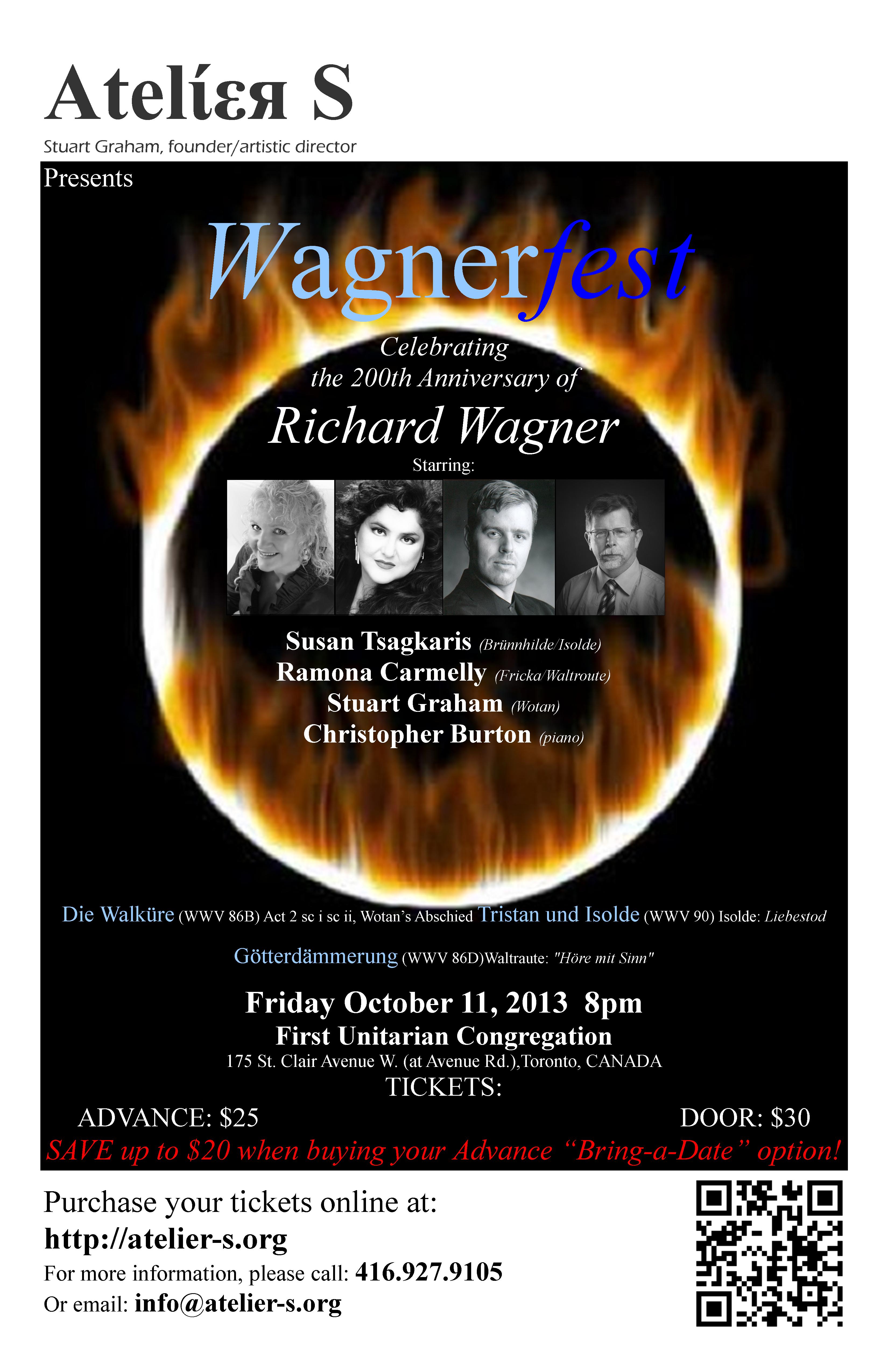
Wagnerfest 2013 posterStuart Graham is a teacher, a singer & founder of Atelier S.  The Saskatchewan born baritone received his formal education at the Faculty of Music of McGill University with  Bernard Turgeon.  Graham has been heard in recital, oratorio and in opera in Canada, the United States and in Europe accompanied by orchestras and ensembles, such as: l’Orchestre Symphonique de Montréal, Orchestre Métropolitain de Montréal, I Musici de Montréal, the Saskatoon Symphony, Silesian State Opera, Slovak State Philharmonic (Košice) and the Oakville Symphony Orchestra. His performance in the world premiere of Edifice by Arlan Schultz was broadcast by CBC, the BBC, Radio-France and the Bavarian Radio. In 1993, Mr. Graham made his New York debut as invited artist in recital as part of the Riverside Chamber Music Series (Riverside Church, New York, NY.).  His most recent solo outings include performances of “Yo Vivo” by the Spanish composer Angeles Lopez-Artiga at the Palau des Arts (Valencia, Spain), and as featured soloist, along with his colleagues of the Opera Nacional Bellas Artes (Cd. de México), in performance of Beethoven’s 9th Symphony with the Orquesta Sinfónica Silvestre Revueltas in Celaya, México (national telecast on Canal 40).

Recent solo recitals include “Destino” with Mexican pianist Eduardo Núñez in the historic Teatro de la Republica in Querétaro, Mexico (broadcast live by Radio Querétaro), “Le Chasseur Perdu”, accompanied by Claudette Denys (l’Opéra de Montréal) and narrated by Stuart Hamilton at Glenn Gould Studio and “Fate” accompanied by pianist José Hernández, with songs of Rachmaninoff, Poulenc and Mahler’s “Kindertotenlieder”.

In anticipation of Atelier S celebrating WagnerFest on October 11th, I ask Graham 10 questions: five about himself and five more about the event.

1) Are you more like your father or your mother?

Baritone & pedagogue Stuart Graham

I’d have to say that I am pretty much an even mix of both my mother and father. But, I would definitely have to say, quoting Hillary Clinton, it “took a village” to raise this one. Growing up in rural Saskatchewan, in a RCMP family, we moved often as my father’s career progressed. It was a childhood where, once I was old enough to go to school, the whole town was our playground. 10 hour games of “hide’n seek”, riding my bike 5 miles on dirt roads to visit my friends on their farms. It was a brilliant place to grow up. We were “free-range” children. They were certainly different times and everybody lived/played outside the house and interconnected with the community as a whole. But, if I ever did anything wrong, my mother would have received a dozen phone calls declaring my misdeeds before I would arrive home. Living in small towns with a population of 1200 people and 14 well-populated churches of various denominations, my mother got a lot of calls. That said, being the eldest son of the commanding officer of the local RCMP detachment, I kept my nose clean. I didn’t have a choice. I never got invited to those parties.

But, one of the most important elements and influences of my environment growing up would have to be the cultural diversity we partook in. Every town we moved to was of a different cultural root. One place would have been homesteaded by Russians, another Polish, French Metis, German Mennonite. The grand parents of my school mates were the founders of these towns I grew up in and, in that, I was immersed in their food, their music, their language and way of life. It, forever, made me very curious about different ways of life and living those perspectives.

2) What is the best thing or worst thing about being artistic director of an institution such as Atelier S?

Atelier S is an entity that really has it’s own mind and life force. It is a notion that continues to grow from a spark that ignited when I first started seriously teaching as Artist in Residence at the Centre Culturel de Drummondville in the mid 1990’s. I had just quit my corporate day job in Montreal and my partner at the time was just hired as artistic director of a dance company and artistic counsel for the Festival Mondial de Drummondville. For me, it was chance to build my life exclusively with my music both as performing artist and pedagogue. “As talent presents itself, I am compelled to find a way to present it…” was an early quote I gave in an interview in the Québec media about one of the first showcases I mounted. That pretty much says why I do what I do. Most days it’s a gift and a privilege. And there have been times that it’s been an absolute curse.

Atelier S how it is today and certainly for the programming of this season (study and performance), provides me with an enormous source of excitement. The wonderful artists and the remarkable depth of their talents that have come to this playground to be coached, challenged and mentored is humbling. With the creation of the Artist Incubator Professional Program and its growing network of internationally renowned associate faculty, I feel we are providing an important resource for the emerging artist that is seeking direction as they transition from student to professional artist.

3) Who do you like to listen to or watch?

At the end of the day, I love to listen to silence. Listen to waves. As for musical taste, I’m all over the map. Although I do draw the line at rap and anything heavy metal. But there are exceptions. I was thoroughly enchanted listening to Metallica, played by the Kronos Quartet, while browsing CD’s in a shop in Prague.

Watch? For fun? I am really into animation, with a  particular addiction to Futurama. On the more serious side, I enjoy art films.

4) What ability or skill do you wish you had, that you don’t have?

The ability to keep up with technology. Final Cut Pro is the bane of my existence!

5) When you’re just relaxing and not working what is your favourite thing to do?

Engrained from my childhood, and certainly the 15 years of living in Québec, I love to entertain, cook. Travel and immerse into new cultures. Ride my bike.

*******

Five more about WagnerFest on October 11th

1) Please talk about the challenges in running a company such as Atelier S.

I have been very fortunate for the fantastic opportunities and the many profound insights of mentorship that I have received as I have grown up musically both in N. American and in Europe and for that Atelier S has really become an “Artist Incubator”, a “Musical Playground for the Emerging Artist”.  This season I am so honoured to have the collaboration of teachers and artists that are leaders in the global industry of opera. Bernard Turgeon and Jeannette Aster have been enormous influences in my artistic life and development and I am thrilled that Atelier S is able to provide a forum where emerging talent can workshop and cocoon with these esteemed teachers. We are also very much looking forward to presenting 2 days of masterclass with soprano Lyne Fortin as part of our Bel Canto Opera Role Study Workshop.

Atelier S is a place where an artist can come and try things, play outside the box and discover “truths”. One of the great hurdles that an emerging artist has is the disappearance of that physical playground of the music school once they have graduated. We provide an environment and resources (coaching, masterclasses and public performances) where the young artist can continue their development and have a place to properly exercise and prepare for their next step.

One of the main on-going topics of conversation that I have with several of my colleagues is the so very rapidly changing dynamic of the industry of Opera and how to adjust our approach to a) get into the business, and b) stay in the business, and at the same time constantly evaluate how to remain relevant as an artist and maintain the integrity of the art. In my head, it is sometimes like an unending loop of Hans Sachs and Die Meistersinger.

2) what do you love about Wagner, as you prepare for WagnerFest

I love that one can not fake Wagner’s music. If you do, you get hurt! Wagner is like an extreme sport. It’s profoundly sensual music and it really demands that you draw upon your entire being to bring his music and vision to life. A great man once said to me… “Stuart! There is nothing more boring than a comfortable artist!” Wagner’s music certainly holds one to that task!

3) Do you have a favourite moment in your program?

Wow. That’s a very tough question. Immersed in the moment with Wagner’s music, any instant is completely mind-blowing. But my favourite aspect of this program is the collaboration with my colleagues in this project. We have all come together with an excitement for this music and for this very rare opportunity to present it. I’m thrilled, humbled and profoundly grateful.

4) How do you relate to Wagner’s works as a modern man?

No doubt the subject of Richard Wagner and his music can be very contentious and for as many people talk about it, there are that many differing opinions. Things have been said and feelings have been hurt. He didn’t have an easy life, but he had something to say and I think most serious artists can relate to that on so many levels.

For myself, a part from that and what anybody might have to say about his music, it’s about the humanity of his characters. Even as I present Wotan in our scenes from Die Walküre, a deity, what he lives, his conflicts, choices, consequences, his arguments, they are so human, visceral. The conversation is timeless.

5) Is there anyone out there who you particularly admire, and who has influenced you?

Baritone & pedagogue Bernard Turgeon

Without a doubt I have to mention my main musical parents Bernard and Teresa Turgeon. They have been the biggest influence on how I do what I do, especially as a teacher/mentor. They really brought forward the notion of “we build the voice by building the person”. Others who have been incredible and generous mentors to me are Claudette Denys, Jeannette Aster, Joan Sutherland, Diana Soviero, Jose van Damm and, currently, Maestra Teresa Berganza. These great artists pretty much share(d) a common perspective of approach to the artform. But, what spoke volumes to me and was unique to each of them individually was the glint in their eye when they shared and mentored me and my fellow artists.

To quote Bernard Turgeon from his speech at his induction into the Canadian Opera Hall of Fame last December 2012…

” We are the custodians of this art form…invest time in it …and it will give you things that you have never even dreamed of ! “

*******

WagnerFest (click for further information including artists’ bios)
Friday, 11 October 2013 at 8:00 p.m.
Celebrating the 200th Anniversary of RICHARD WAGNER  starring:

SUSAN TSAGKARIS, soprano (Brünnhilde / Isolde)
RAMONA CARMELLY, mezzo (Fricka / Waltraute)
STUART GRAHAM, baritone (Wotan)
CHRISTOPHER BURTON, piano

First Unitarian Congregation of Toronto
175 St. Clair Avenue West, Toronto, Ontario M4V 1P7

Posted in Interviews, Opera | Tagged , , | 3 Comments

Tapestry Briefs

Back i go to the laboratory.

A couple of nights ago I wrote about YouTopia and spoke of the virtues of experimentation.

The Tapestry Briefs are a dozen short works from a handful of collaborators who were paired off for one project, then –like speed dating—matched with a new partner on the next project.  It’s hard to know whether the specimens in the experiment were the new creations or the members of the audience exposed to those creations.  But we’re all given a chance to learn.

I’m possibly the wrong person to comment on such an exercise.  I don’t believe there’s ever such a thing as bad theatre, because any piece can be salvaged or appreciated in some way.  To be fair, these little pieces were handed to a phenomenally talented bunch, who surely helped shine a great deal of light on these brief fragments.  No matter what you think of the pieces being performed, the interpretations were stunning.

While I’m a fan of Carla Huhtanen, Kristina Szabó, and Peter McGillivray, this was my first time seeing and hearing Keith Klassen, completing a splendid quartet of singers, all singing new music entirely from memory, often grabbing us with the drama of their portrayals.  Jennifer Tung & Gregory Oh were their inspired music directors.

I will always defend the value of experimentation and happily validate the laboratory as a privileged place.  One must suspend judgment with anything genuinely new, because one doesn’t always know what one has. Surely it takes a few hearings to know what one really has, and in each text there are many possible interpretations.  No, I’m not saying I liked it all; quite the contrary.  But—speaking for example of the single work that bothered me the most (which I shall not name) –there is still much to learn in such encounters between text and music.  The one I liked the least, the one that leaves me saying “I would have set it differently” is, curiously, the strongest demonstration of the value of such an exercise.  Perhaps the composer is still happy with what s/he made of that libretto, a scenario that had me thinking back to Steve Martin’s line in Roxanne: “did you lose a bet with God?”  In other words wow what a difficult text to set, asking a singer to sing into the face of someone they are in the act of stabbing. Wow. And while I think I’d do it differently (why must it be so loud, at a moment of such stunning intimacy? Yes you’re killing him, but he’s not deaf, nor are we): again, that was such an impossibly challenging text to set, I would want to see it again before really passing judgment. (And isnt it amazing that one is taken to a place of insight where one second-guesses the comsposition and looks so closely at possibilities. However one feels about the results, this one shows what can be learned)  All I can really say is, i’d do it differently, (perhaps the composer thinks so too, now that s/he’s seen it?), and how else would one find this out without someone daring to set this difficult text.  It was arguably the most purely operatic moment of the evening, the most powerful five minutes of all, gripping and troubling. My reaction against it is surely evidence of a kind of success. This piece hits a nerve. How else do you find out whether your model plane will crash without attempting to make it fly?  I submit that if five people see something, and while four hate it, and the fifth thinks the plane flew, you have a success. Opera is not usually a medium for mass appeal.

Some of the subjects seemed more operatic than others.  There’s one for instance that had the audience screaming with laughter with its references to social media, that reminded me of an SNL sketch.  But I felt SNL does this better and so I wonder what you gain by setting this to music, other than proving that opera can be written about this kind of subject.  Yet again, we’re in a lab.  Maybe someone else builds on this, taking that insight and writing something amazing, bring it to the next level.  We were looking at building blocks, research for a future project.

I was most impressed with two of the pieces that undertook big themes, which is how I understand opera, by the way.  Big themes are what opera does best.  While they’re only five minutes they could easily be expanded to something much longer.  In one—libretto by Morris Panych, music by Cecilia Livingston– we hear from a person in their last moments, then discover the darker perspective of the attendant who witnesses death on a daily basis.  Livingston’s score differentiated their mental states & moods in a properly Wagnerian way, very subtly making magic in just a few short moments, the words & music effortlessly flowing.  And it was over.

The other was from librettist Nicolas Billon & again scored by Livingston, where a woman’s sleep is disturbed by voices she’s hearing that her husband can’t hear; as with Joan of  Arc we may wonder whether she’s hearing angelic messengers or is simply mad.  And as with her other opera, Livingston creates two parallel dramaturgies, one in the fanciful sounds & textures of the woman & the accompaniment, the other in her husband’s banal voice of sanity.

There are at least two wonderfully funny works.  There are a couple of very daring pieces, very original in their sonic landscape.  None of these is boring, although –as I mentioned—there’s one that I quibbled with, a very powerful piece of music-theatre.

I have one last thought to put out there, and this shouldn’t for a moment be thought of as a rejection of the exercise.  It’s the agnostic admonition I recall from someone in the educational world, commenting on IQ tests.  People sometimes mistake IQ tests for intelligence tests, where what they really test is your ability to take IQ tests.  In other words these collaborative exercises are wonderful for building skills in collaboration, musical scene building, problem solving (how do I set X to music? How do I organize this thought into text that might be singable?)… and how to write a five minute opera.

That’s not quite the same thing as writing an opera that can hold the stage for an evening.  But I suppose it’s probably a good skill that  can’t hurt.

Tapestry Briefs continues until September 22nd at the Ernest Balmer Studio at 9 Trinity Square in the Distillery District, a great deal of music and drama, a wonderful assortment of talent.

Soprano Carla Huhtanen (photo: Tobin Grimshaw)

Soprano Carla Huhtanen (photo: Tobin Grimshaw)

Posted in Opera, Reviews | Tagged , , , , , , , , , | 2 Comments