Ready for Prime Time: Savitri & Sam

Okay, maybe the headline tells you what show i am about to watch on TV, coming home from a (hint hint) Saturday night opera.   But i really mean it, they’re ready. Tonight I went to see a public presentation of portions of Savitri & Sam at the end of a week-long workshop, presented by Canadian Rep Theatre & Savitri Project Collective.

I heard 90 minutes of a much longer work: an opera.

It felt like perhaps 20 minutes as it went by.

Perhaps I should explain where I’m coming from, as my credentials may be suspect.  I am usually so positive –avoiding negative commentary—that I may seem to be incapable of anything else.

I’ve been listening to Louis Riel after having read a review by John Gilks on his Operaramblings blog.  I’d seen it twice very long ago, and wanted to recalibrate my sense of it.  I’d sounded off on Facebook to say that the Canadian Opera Company needs to stage this opera again.  In 1967 two operas premiered as a centennial project with the COC:

  • The Luck of Ginger Coffey, which I saw, starring Harry Theyard (who I mention because it’s his birthday according to Charlie Handelman)
  • Louis Riel which I didn’t see at this time (our family subscription didn’t have enough tickets to permit me to see it this time…i was a child!), but I would see it in a remount a couple of years later, AND I’d see the TV version, which is the basis of the DVD I’ve been watching in 2013

Riel is the one that’s remembered.  In places it works very well, although in some places it’s wooden, a relic of a style that had once been in fashion.  It feels dated, it’s most interesting elements in the libretto’s treatment of a national myth, not its music.

Composer, musician, innovator, teacher John Mills-Cockell

Composer, musician, innovator, teacher John Mills-Cockell

I am quite certain that Savitri & Sam is better.  It doesn’t feel derivative, even if it does remind me in places of Pelléas et Mélisande, another opera telling a story of forbidden love.  But while it’s often as beautiful as Debussy it avoids the effete & precious stillness that mars that work, perhaps the least operatic opera ever written.  The score by John Mills-Cockell is often tonal, but with depths & complexities matching the ambiguities of the story.  The best operas undertake big themes, complex subject matter that can unfold within the abstraction of the music, ideally with profound symbolic undertones that aren’t easily pinned down, demanding multiple articulations in different interpretations.  I feel that about S & S.

Librettist & director Ken Gass

The words of Ken Gass’s libretto were almost entirely audible in the workshop, presented without any subtitles.  That’s a tribute to the elegance of Gass’s lyrics, the clarity of Mills-Cockell’s textures (admittedly presented in an electronic orchestration that might sound fatter with an orchestra) and the enunciation of the cast.

One of the most original features of S & S is the use of chorus.  In this tale of honour killing by the father of a Punjabi girl who had been with a Native Canadian boy, we are reminded throughout that everyone –girl, boy, father and mother—are acutely aware of their ancestors as voices in their heads.  This chorus might be the ideas from  the past that influence them, or ghosts of ancestors, or perhaps a kind of articulation of culture itself.  If that—one of the most original and exciting things I’ve encountered in an opera in a very long time—weren’t enough, there’s more.  There is also a very tonal non-verbal choral pattern heard at least a couple of times that might represent acceptance and oneness with one’s culture, that we hear during a very original love duet.  Can you name even one love duet that isn’t unbelievable by reason of all those words at a time when the lovers should be getting physical? this is the first one i’ve ever heard that takes me somewhere believable, a magical non-verbal place: because we’re not listening to silly poetry.  We hear a few words of love, and ohh-ing and ahh-ing, and…even in this semi-staged reading i was hypnotized, enthralled completely.

Semi staged, partly off book, the performance featured wonderful work from Zorana Sadiq and Michael Barrett as the two young lovers, with Giles Tomkins & Marion Newman as her parents.  Gregory Oh did a remarkable job of conducting the live singers, working from a series of recordings of the orchestra parts (synthesized) & chorus.  Considering that they assembled this in a week, it’s a stunning achievement.  The music is very complex in places, although I can’t really tell how difficult it is to sing (for instance, how high the voices were forced to go).  Maybe the score isn’t that daunting and the singers did well, or maybe the score is tough and the singers were heroic; either way they sounded wonderful.

I was at Tapestry Briefs only a few days ago, watching a series of little bits and pieces, none of which was as cogent (that is, with an inseparable relationship between the music & words) as any five minutes of this 90 minute presentation.  Is that an unfair comparison?  But seriously, the ninety minutes went by like a flash.  I got lost in the lusciousness of the sound, and (aside from liking the performers & their performances) I liked every character, including the one who ends up being a killer.

I am now impatient to see this opera staged.  I won’t hold my breath for the COC, who aren’t even jumping on Riel’s bandwagon let alone a new work; yet this opera is as Canadian as apple pie or maple syrup.  The music is really beautiful.

Someone, ANYONE! please stage Savitri & Sam..! I need to see it and hear it.

Soon!

Posted in Dance, theatre & musicals, Opera | Tagged , , , , , , , , , , | 3 Comments

Bohemian courtship: being Rodolfo, winning Mimi

Dimitri Pittas

Who is Rodolfo? He is a young poet in love.  And he is the hero of Puccini’s La Bohème, opening in a new Canadian Opera Company production on October 3rd at the Four Seasons Centre.

In this production, three different singers undertake the poetic lover: Dimitri Pittas, Michael Fabiano and Eric Margiore.  Each of them gets to woo Mimi. This is an old-fashioned romance.  Mimi and Rodolfo are brought together by chance, not by choice.  They will argue and fight, yet their love is true.

How is it for the singers coming together onstage?  Yes, it’s theatre, not real love.

Eric Margiore

Or is it?  When three different Rodolfos each romance and win Mimi, can we think of a kind of competition, at least for the hearts of the audience, if not for the love of Mimi herself?

I couldn’t help thinking of something much newer than the fin de siècle in Paris.  What if this were the dating game?  Instead of calling them “Bachelor #1”, “Bachelor #2 and “Bachelor #3” let’s imagine Mimi, asking questions of each of her possible Rodolfos, asking them to win her over.

No we won’t actually have her pick one and reject the other two: because in fact, all three will play Rodolfo.  But let’s imagine Mimi asking her suitors questions, and see what they will say.

MIMI:

Michael Fabiano

Rodolfo, I am knocking at your door.   And OH NO, my candle has blown out!  You’re all alone in this big apartment.  I’ve heard your voice for awhile but we’ve never met.  So tell me,…How can you help light MY fire, Rodolfo as played by ERIC MARGIORE!?”

Eric Margiore as Rodolfo:

Well, Mimi, that is a lovely name.  I believe that I can help light your fire, especially on those cold winter nights of Paris. I am really quite swell with the kindling and I must admit that I love to cuddle, so it seems that I am your man! Since I am a poet, I would love to just sit by the fire and look at you to become inspired.  I believe that you will find significant warmth in my words…

MIMI:
“Mmm thanks Eric!  Now,
“RODOLFO—as played by Michael Fabiano:
same question…!?

Michael Fabiano as Rodolfo:

My heart is a hearth.
Let us rejoice in the
exudence of our
permeating souls . . .

MIMI
(Ahhh nice!):
And how about RODOLFO—as played by Dimitri Pittas….?

But tonight Dimitri Pittas is in Amsterdam tonight (Sept 27th) and Sunday Sept 29th singing the Verdi Requiem with the Concertgebouw.

MIMI: Hm, Dimitri, you’re not here(!!?)….Well then next question:
I want you to imagine you love me.  We’re so in love! And: you see me in a cab with ANOTHER man.  Tell me how this makes you feel!!!
Rodolfo played by Eric Margiore.,.?

Eric Margiore as Rodolfo:

Well, I do become incredibly jealous! I am so intensely passionate about our love that when I see other men even looking at you, I cannot handle it!  I know you love me deeply and I cannot picture anyone else with you.  I will fight for you and protect you with all of my soul because you inspire me so deeply.

Mimi smiles.  “Thank you.  Michael Fabiano, same question.  We’re in love and you’ve seen me in a cab with another man.  How does this make you feel?!!!”

Michael Fabiano as Rodolfo:

A thousand arrows pierce my bleeding soul.
My ire points to its zenith.
Willow, o willow, will you hear my plea?
My being faces the abyss . .
.

Mimi would like to ask Dimitri Pittas the same question about jealousy, but… he’s not here!

So she goes on.   Mimi wants to know.
“You’ve told me you’re a poet.  Can I be your muse?

Eric Margiore as Rodolfo:

The woman that I am in love with will be my greatest muse. You will inspire my thoughts and I am incredibly grateful to you for that. I see you in my dreams that I wish always to dream and I am rich beyond compare from the privilege of looking into the jewels that are your eyes. When I touch your tiny hands I feel and see the extraordinary clay from which humankind was made. You give me hope for the future. You are my life’s blood.

Mimi:
“Mmm nice.  And what about you, Michael Fabiano as Rodolfo?

(l – r) Dimitri Pittas as Rodolfo and Joshua Hopkins as Marcello in the Canadian Opera Company/Houston Grand Opera/San Francisco Opera co-production of La Bohème. (Photo: Felix Sanchez © 2012 (Houston Grand Opera))

All is calm in the air
and the strings of my poetry
will vibrate to the bow of your hair. Blind, make me move
forward in the ecstasy of bliss.

Yes Mimi will get her turns, with Rodolfo as played by Fabiano &
Rodolfo played by Margiore.  But on October 3, 6, 9 and 12, to open the production? Mimi is with Pittas, her first Rodolfo.

And Fabiano & Margiore will get their turn..!

Posted in Interviews, Opera | Tagged , , , , , , , , , | 1 Comment

Savitri & Sam Workshop

As promised, here’s the information about the workshop of Savitri & Sam, a new opera under development, with a libretto by Ken Gass & music composed by John Mills-Cockell.

This is from Ken Gass:

…Because,
a) it’s a workshop, and we’ve been experimenting, and have only a week of rehearsal; and
b) the performance room can only seat 50-60 people,
we haven’t been publicizing the event as we might do otherwise…
As long as people understand, they will have to book a ticket (via me at ken@canadianrep.ca or andre@canadianrep.ca) to ensure we still have space, then all should be well.
Thanks, 
Ken
Canadian Rep Theatre
& Savitri Project Collective
present an opera workshop
SAVITRI & SAM
Music by John Mills-Cockell
Libretto by Ken Gass
Savitri –  Zorana Sadiq
Sam  – Michael Barrett
Manjinder  – Giles Tomkins
Sarinder  – Marion Newman
Music Director: Gregory Oh
Directed by Ken Gass
Saturday, September 28, 2013 8:00 p.m.
(reception to follow)
The Citadel (Coleman, Lemieux & Compagnie)
304 Parliament Street(at Dundas)
Toronto, ON
RSVP Required
Posted in Opera, Press Releases and Announcements | Leave a comment

The end of the beginning

I thought about what to call this, the first free concert of the season from the Canadian Opera Company at the Richard Bradshaw Auditorium:

  • Alpha & Omega? (no… too Biblical)
  • Ave Atque Vale? (no…obscure)
  • Alumni Reunion? (hm….partly)

Lotfi Mansouri (1929 – 2013), former COC General Director. Click for further information from COC’s website

The first program of the season is normally a beginning, introducing new members of the COC’s Ensemble Studio.  But it also felt like an ending, what with the passing less than a month ago of Lotfi Mansouri.  The concert, dedicated to Mansouri’s memory, was presented with a great sense of the occasion, in the presence of many of the originals from 30 years ago.

This concert was therefore more than just the introduction of the new cohort:
•    Pianist Michael Shannon
•    Soprano Aviva Fortunata
•    Mezzo-soprano Danielle MacMillan
•    Baritone Clarence Frazer
•    Bass-baritone Gordon Bintner
•    Tenor Andrew Haji
•    Mezzo-soprano Charlotte Burrage

General Director Alexander Neef & former Ensemble member Janet Stubbs both bore witness to Mansouri’s place in the history of the COC, and his generous mentoring.  The retrospective serves to remind us how far the COC have come in such a short period.

The performances were all good, although (recalling our conversation in class last night about opera singing as exhibitionism) some performers boldly embraced the occasion, taking the stage in the tiny space more confidently than the others.  I was especially impressed by Claire de Sévigné (a returning ensemble member) & Bintner, and delighted with the playing of Shannon throughout, especially in his accompaniment to the two Richard Strauss pieces on the program.

As an encore, former Ensemble member Simone Osborne (back in town for the new Boheme that opens next week) sang a heartfelt “When I have sung my songs” as a fitting conclusion to the event, accompanied by Ensemble Music Director Liz Upchurch.

However retrospective it felt, it’s a very promising beginning to the new season.

Click logo for more info on the current COC Ensemble

Posted in Opera, Reviews | Tagged , , , , , , , , , , , , | Leave a comment

10 Questions for Stuart Graham

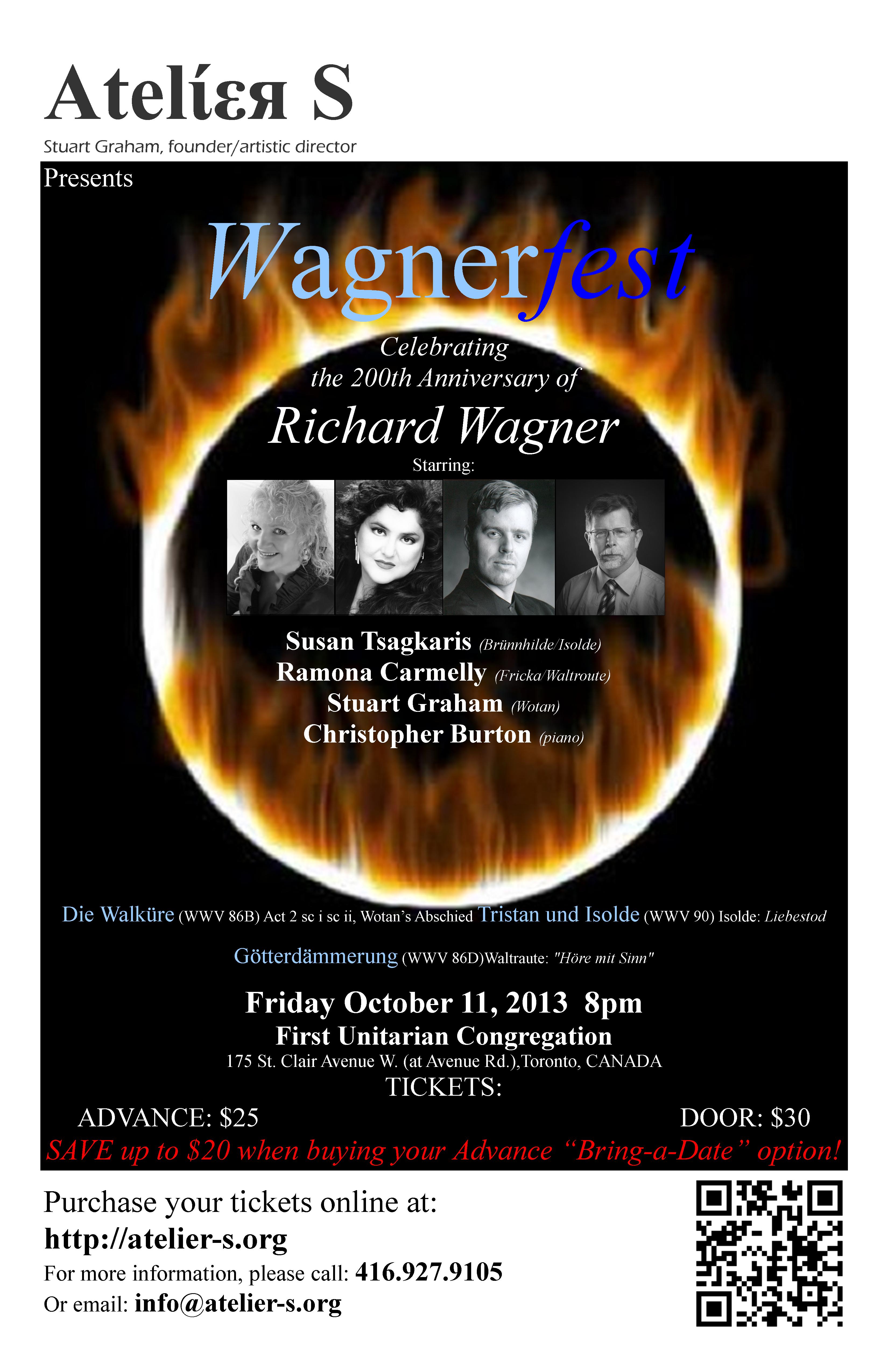
Wagnerfest 2013 posterStuart Graham is a teacher, a singer & founder of Atelier S.  The Saskatchewan born baritone received his formal education at the Faculty of Music of McGill University with  Bernard Turgeon.  Graham has been heard in recital, oratorio and in opera in Canada, the United States and in Europe accompanied by orchestras and ensembles, such as: l’Orchestre Symphonique de Montréal, Orchestre Métropolitain de Montréal, I Musici de Montréal, the Saskatoon Symphony, Silesian State Opera, Slovak State Philharmonic (Košice) and the Oakville Symphony Orchestra. His performance in the world premiere of Edifice by Arlan Schultz was broadcast by CBC, the BBC, Radio-France and the Bavarian Radio. In 1993, Mr. Graham made his New York debut as invited artist in recital as part of the Riverside Chamber Music Series (Riverside Church, New York, NY.).  His most recent solo outings include performances of “Yo Vivo” by the Spanish composer Angeles Lopez-Artiga at the Palau des Arts (Valencia, Spain), and as featured soloist, along with his colleagues of the Opera Nacional Bellas Artes (Cd. de México), in performance of Beethoven’s 9th Symphony with the Orquesta Sinfónica Silvestre Revueltas in Celaya, México (national telecast on Canal 40).

Recent solo recitals include “Destino” with Mexican pianist Eduardo Núñez in the historic Teatro de la Republica in Querétaro, Mexico (broadcast live by Radio Querétaro), “Le Chasseur Perdu”, accompanied by Claudette Denys (l’Opéra de Montréal) and narrated by Stuart Hamilton at Glenn Gould Studio and “Fate” accompanied by pianist José Hernández, with songs of Rachmaninoff, Poulenc and Mahler’s “Kindertotenlieder”.

In anticipation of Atelier S celebrating WagnerFest on October 11th, I ask Graham 10 questions: five about himself and five more about the event.

1) Are you more like your father or your mother?

Baritone & pedagogue Stuart Graham

I’d have to say that I am pretty much an even mix of both my mother and father. But, I would definitely have to say, quoting Hillary Clinton, it “took a village” to raise this one. Growing up in rural Saskatchewan, in a RCMP family, we moved often as my father’s career progressed. It was a childhood where, once I was old enough to go to school, the whole town was our playground. 10 hour games of “hide’n seek”, riding my bike 5 miles on dirt roads to visit my friends on their farms. It was a brilliant place to grow up. We were “free-range” children. They were certainly different times and everybody lived/played outside the house and interconnected with the community as a whole. But, if I ever did anything wrong, my mother would have received a dozen phone calls declaring my misdeeds before I would arrive home. Living in small towns with a population of 1200 people and 14 well-populated churches of various denominations, my mother got a lot of calls. That said, being the eldest son of the commanding officer of the local RCMP detachment, I kept my nose clean. I didn’t have a choice. I never got invited to those parties.

But, one of the most important elements and influences of my environment growing up would have to be the cultural diversity we partook in. Every town we moved to was of a different cultural root. One place would have been homesteaded by Russians, another Polish, French Metis, German Mennonite. The grand parents of my school mates were the founders of these towns I grew up in and, in that, I was immersed in their food, their music, their language and way of life. It, forever, made me very curious about different ways of life and living those perspectives.

2) What is the best thing or worst thing about being artistic director of an institution such as Atelier S?

Atelier S is an entity that really has it’s own mind and life force. It is a notion that continues to grow from a spark that ignited when I first started seriously teaching as Artist in Residence at the Centre Culturel de Drummondville in the mid 1990’s. I had just quit my corporate day job in Montreal and my partner at the time was just hired as artistic director of a dance company and artistic counsel for the Festival Mondial de Drummondville. For me, it was chance to build my life exclusively with my music both as performing artist and pedagogue. “As talent presents itself, I am compelled to find a way to present it…” was an early quote I gave in an interview in the Québec media about one of the first showcases I mounted. That pretty much says why I do what I do. Most days it’s a gift and a privilege. And there have been times that it’s been an absolute curse.

Atelier S how it is today and certainly for the programming of this season (study and performance), provides me with an enormous source of excitement. The wonderful artists and the remarkable depth of their talents that have come to this playground to be coached, challenged and mentored is humbling. With the creation of the Artist Incubator Professional Program and its growing network of internationally renowned associate faculty, I feel we are providing an important resource for the emerging artist that is seeking direction as they transition from student to professional artist.

3) Who do you like to listen to or watch?

At the end of the day, I love to listen to silence. Listen to waves. As for musical taste, I’m all over the map. Although I do draw the line at rap and anything heavy metal. But there are exceptions. I was thoroughly enchanted listening to Metallica, played by the Kronos Quartet, while browsing CD’s in a shop in Prague.

Watch? For fun? I am really into animation, with a  particular addiction to Futurama. On the more serious side, I enjoy art films.

4) What ability or skill do you wish you had, that you don’t have?

The ability to keep up with technology. Final Cut Pro is the bane of my existence!

5) When you’re just relaxing and not working what is your favourite thing to do?

Engrained from my childhood, and certainly the 15 years of living in Québec, I love to entertain, cook. Travel and immerse into new cultures. Ride my bike.

*******

Five more about WagnerFest on October 11th

1) Please talk about the challenges in running a company such as Atelier S.

I have been very fortunate for the fantastic opportunities and the many profound insights of mentorship that I have received as I have grown up musically both in N. American and in Europe and for that Atelier S has really become an “Artist Incubator”, a “Musical Playground for the Emerging Artist”.  This season I am so honoured to have the collaboration of teachers and artists that are leaders in the global industry of opera. Bernard Turgeon and Jeannette Aster have been enormous influences in my artistic life and development and I am thrilled that Atelier S is able to provide a forum where emerging talent can workshop and cocoon with these esteemed teachers. We are also very much looking forward to presenting 2 days of masterclass with soprano Lyne Fortin as part of our Bel Canto Opera Role Study Workshop.

Atelier S is a place where an artist can come and try things, play outside the box and discover “truths”. One of the great hurdles that an emerging artist has is the disappearance of that physical playground of the music school once they have graduated. We provide an environment and resources (coaching, masterclasses and public performances) where the young artist can continue their development and have a place to properly exercise and prepare for their next step.

One of the main on-going topics of conversation that I have with several of my colleagues is the so very rapidly changing dynamic of the industry of Opera and how to adjust our approach to a) get into the business, and b) stay in the business, and at the same time constantly evaluate how to remain relevant as an artist and maintain the integrity of the art. In my head, it is sometimes like an unending loop of Hans Sachs and Die Meistersinger.

2) what do you love about Wagner, as you prepare for WagnerFest

I love that one can not fake Wagner’s music. If you do, you get hurt! Wagner is like an extreme sport. It’s profoundly sensual music and it really demands that you draw upon your entire being to bring his music and vision to life. A great man once said to me… “Stuart! There is nothing more boring than a comfortable artist!” Wagner’s music certainly holds one to that task!

3) Do you have a favourite moment in your program?

Wow. That’s a very tough question. Immersed in the moment with Wagner’s music, any instant is completely mind-blowing. But my favourite aspect of this program is the collaboration with my colleagues in this project. We have all come together with an excitement for this music and for this very rare opportunity to present it. I’m thrilled, humbled and profoundly grateful.

4) How do you relate to Wagner’s works as a modern man?

No doubt the subject of Richard Wagner and his music can be very contentious and for as many people talk about it, there are that many differing opinions. Things have been said and feelings have been hurt. He didn’t have an easy life, but he had something to say and I think most serious artists can relate to that on so many levels.

For myself, a part from that and what anybody might have to say about his music, it’s about the humanity of his characters. Even as I present Wotan in our scenes from Die Walküre, a deity, what he lives, his conflicts, choices, consequences, his arguments, they are so human, visceral. The conversation is timeless.

5) Is there anyone out there who you particularly admire, and who has influenced you?

Baritone & pedagogue Bernard Turgeon

Without a doubt I have to mention my main musical parents Bernard and Teresa Turgeon. They have been the biggest influence on how I do what I do, especially as a teacher/mentor. They really brought forward the notion of “we build the voice by building the person”. Others who have been incredible and generous mentors to me are Claudette Denys, Jeannette Aster, Joan Sutherland, Diana Soviero, Jose van Damm and, currently, Maestra Teresa Berganza. These great artists pretty much share(d) a common perspective of approach to the artform. But, what spoke volumes to me and was unique to each of them individually was the glint in their eye when they shared and mentored me and my fellow artists.

To quote Bernard Turgeon from his speech at his induction into the Canadian Opera Hall of Fame last December 2012…

” We are the custodians of this art form…invest time in it …and it will give you things that you have never even dreamed of ! “

*******

WagnerFest (click for further information including artists’ bios)
Friday, 11 October 2013 at 8:00 p.m.
Celebrating the 200th Anniversary of RICHARD WAGNER  starring:

SUSAN TSAGKARIS, soprano (Brünnhilde / Isolde)
RAMONA CARMELLY, mezzo (Fricka / Waltraute)
STUART GRAHAM, baritone (Wotan)
CHRISTOPHER BURTON, piano

First Unitarian Congregation of Toronto
175 St. Clair Avenue West, Toronto, Ontario M4V 1P7

Posted in Interviews, Opera | Tagged , , | 3 Comments

Tapestry Briefs

Back i go to the laboratory.

A couple of nights ago I wrote about YouTopia and spoke of the virtues of experimentation.

The Tapestry Briefs are a dozen short works from a handful of collaborators who were paired off for one project, then –like speed dating—matched with a new partner on the next project.  It’s hard to know whether the specimens in the experiment were the new creations or the members of the audience exposed to those creations.  But we’re all given a chance to learn.

I’m possibly the wrong person to comment on such an exercise.  I don’t believe there’s ever such a thing as bad theatre, because any piece can be salvaged or appreciated in some way.  To be fair, these little pieces were handed to a phenomenally talented bunch, who surely helped shine a great deal of light on these brief fragments.  No matter what you think of the pieces being performed, the interpretations were stunning.

While I’m a fan of Carla Huhtanen, Kristina Szabó, and Peter McGillivray, this was my first time seeing and hearing Keith Klassen, completing a splendid quartet of singers, all singing new music entirely from memory, often grabbing us with the drama of their portrayals.  Jennifer Tung & Gregory Oh were their inspired music directors.

I will always defend the value of experimentation and happily validate the laboratory as a privileged place.  One must suspend judgment with anything genuinely new, because one doesn’t always know what one has. Surely it takes a few hearings to know what one really has, and in each text there are many possible interpretations.  No, I’m not saying I liked it all; quite the contrary.  But—speaking for example of the single work that bothered me the most (which I shall not name) –there is still much to learn in such encounters between text and music.  The one I liked the least, the one that leaves me saying “I would have set it differently” is, curiously, the strongest demonstration of the value of such an exercise.  Perhaps the composer is still happy with what s/he made of that libretto, a scenario that had me thinking back to Steve Martin’s line in Roxanne: “did you lose a bet with God?”  In other words wow what a difficult text to set, asking a singer to sing into the face of someone they are in the act of stabbing. Wow. And while I think I’d do it differently (why must it be so loud, at a moment of such stunning intimacy? Yes you’re killing him, but he’s not deaf, nor are we): again, that was such an impossibly challenging text to set, I would want to see it again before really passing judgment. (And isnt it amazing that one is taken to a place of insight where one second-guesses the comsposition and looks so closely at possibilities. However one feels about the results, this one shows what can be learned)  All I can really say is, i’d do it differently, (perhaps the composer thinks so too, now that s/he’s seen it?), and how else would one find this out without someone daring to set this difficult text.  It was arguably the most purely operatic moment of the evening, the most powerful five minutes of all, gripping and troubling. My reaction against it is surely evidence of a kind of success. This piece hits a nerve. How else do you find out whether your model plane will crash without attempting to make it fly?  I submit that if five people see something, and while four hate it, and the fifth thinks the plane flew, you have a success. Opera is not usually a medium for mass appeal.

Some of the subjects seemed more operatic than others.  There’s one for instance that had the audience screaming with laughter with its references to social media, that reminded me of an SNL sketch.  But I felt SNL does this better and so I wonder what you gain by setting this to music, other than proving that opera can be written about this kind of subject.  Yet again, we’re in a lab.  Maybe someone else builds on this, taking that insight and writing something amazing, bring it to the next level.  We were looking at building blocks, research for a future project.

I was most impressed with two of the pieces that undertook big themes, which is how I understand opera, by the way.  Big themes are what opera does best.  While they’re only five minutes they could easily be expanded to something much longer.  In one—libretto by Morris Panych, music by Cecilia Livingston– we hear from a person in their last moments, then discover the darker perspective of the attendant who witnesses death on a daily basis.  Livingston’s score differentiated their mental states & moods in a properly Wagnerian way, very subtly making magic in just a few short moments, the words & music effortlessly flowing.  And it was over.

The other was from librettist Nicolas Billon & again scored by Livingston, where a woman’s sleep is disturbed by voices she’s hearing that her husband can’t hear; as with Joan of  Arc we may wonder whether she’s hearing angelic messengers or is simply mad.  And as with her other opera, Livingston creates two parallel dramaturgies, one in the fanciful sounds & textures of the woman & the accompaniment, the other in her husband’s banal voice of sanity.

There are at least two wonderfully funny works.  There are a couple of very daring pieces, very original in their sonic landscape.  None of these is boring, although –as I mentioned—there’s one that I quibbled with, a very powerful piece of music-theatre.

I have one last thought to put out there, and this shouldn’t for a moment be thought of as a rejection of the exercise.  It’s the agnostic admonition I recall from someone in the educational world, commenting on IQ tests.  People sometimes mistake IQ tests for intelligence tests, where what they really test is your ability to take IQ tests.  In other words these collaborative exercises are wonderful for building skills in collaboration, musical scene building, problem solving (how do I set X to music? How do I organize this thought into text that might be singable?)… and how to write a five minute opera.

That’s not quite the same thing as writing an opera that can hold the stage for an evening.  But I suppose it’s probably a good skill that  can’t hurt.

Tapestry Briefs continues until September 22nd at the Ernest Balmer Studio at 9 Trinity Square in the Distillery District, a great deal of music and drama, a wonderful assortment of talent.

Soprano Carla Huhtanen (photo: Tobin Grimshaw)

Soprano Carla Huhtanen (photo: Tobin Grimshaw)

Posted in Opera, Reviews | Tagged , , , , , , , , , | 2 Comments

Tafelmusik Beethoven 1 & 2

Tafelmusik Baroque Orchestra could drop the word “baroque” if they wanted.  Tonight I heard more evidence that they can play just about anything.

Their program was all Beethoven, namely the first and second symphonies, plus the overture to Creatures of Prometheus, a natural curtain raiser because it’s in the same key as that first symphony.

The evidence continues to mount that they’re not just purveyors of historically informed performance from the Baroque, even if they recognize this as a core competency, and the music that has served them well over the decades of audience building.  In May 2012 they played Beethoven’s Eroica symphony & Mendelssohn’s Italian symphony, and last winter offered a powerful version of Mozart’s Requiem with Tafelmusik baroque choir.  And in perhaps their boldest venture, they gave us Weber’s Der Freischütz with Opera Atelier.

So even if they can play romantic music, why change a successful formula, after all?  Audiences haven’t complained.  But I must sound as though I am complaining (I am a shit disturber) maybe because I like romantic music much more than baroque.

Tafelmusik sound different from what we may be accustomed to, with (for example) the Toronto Symphony, or the sounds of modern orchestras playing Beethoven on recordings.  It’s a sweeter, more plangent sound.  At times the brass can be jarringly loud.  And curiously, so too the strings, at least when they’re playing a lot of notes, as happens in the last movement of the 2nd symphony of Beethoven, a rushing rustling sound like water, something you feel because it’s very subtle.  There’s a fullness to the music that simply can’t happen with a modern orchestra.

There is an assurance to their performances of Beethoven that suggests they should play more of this repertoire.  I see the smiles on the players’ faces at times during the performance.

One of these seasons Tafelmusik should program a complete Beethoven symphony cycle.  They would never throw down the gauntlet, and lay claim to being the best orchestra in Toronto because it’s not their style.  Perhaps it’s a matter of testosterone (Tafelmusik has been led by a woman rather than a man) taking a more feminine approach in sharing leadership among several artists, such as Bruno Weil for Beethoven, Jeanne Lamon (for many years), Ivars Taurins for Messiah and great choral works, and David Fallis with Opera Atelier: and they are the richer for it.

Of course there’s room in Toronto for more than one great orchestra.  But I am frustrated, wanting to hear them undertake so many more works of the period.

  • Schubert’s symphonies?
  • Schumann’s symphonies & piano concerto
  • Mendelssohn’s other symphonies & overtures, and perhaps the music from A Midsummernight’s Dream
  • Berlioz… but his works require too many players, I fear

Conductor Bruno Weil

In the meantime, I am always eager to hear their Beethoven.  Bruno Weil leads crisp readings on the fast side, as one would expect in a historically informed performance such as this one.  At times Weil encourages powerful climaxes & a dissonant approach that seems to want to show us how daring Beethoven could be. To me it sounds very fresh, very new, yet elegant, balanced, witty and as brilliant as we’d expect Beethoven to sound.  Dare I say it: this is the real Beethoven.  Tafelmusik make it their own.

Tafelmusik’s concert of Beethoven Symphonies 1 & 2 continues this weekend on Sept 20th & 22nd at Koerner Hall.

Posted in Music and musicology, Reviews | Tagged , , | Leave a comment

The Patriarch

David Warrack is writing an oratorio on the life of Abraham, the Biblical patriarch.  I’m thrilled to be participating in a concert presentation of excerpts.  We’ve had some rehearsals, with about a week to go until the concert at Metropolitan United Church on September 23rd .

Warrack explains the context this way:

Abraham sits at the base of three great religions, Christianity, Judaism, and Islam, with intriguing connections to other faiths as well.  This oratorio tells the story of this historic figure, but also uses the opportunity to ask why we cannot work together when we all come from the same place. Based in history, and believing in the essential goodness of man, the message of this work is that by reaching out, we can find solutions.

Composer David Warrack

The project is much more than music & words, but an excuse for interfaith dialogue.  The composer wants to get a conversation going, so it’s no wonder that the work concerns communication and debate.

Here’s the plan for the next couple of years:

  • Preliminary presentation of 4 selections at Metropolitan United Church on September 23rd with appearances by Moshe Hammer & Jackie Richardson, as part of an interfaith conference.
  • 3 performances in early 2014 in a church, a synagogue, and a mosque, with 5 soloists, a small combined choir, a chamber ensemble, and organ
  • Full performance at Massey Hall or the Sony Centre in the 2014/2015 season

Warrack’s plan is as much about religion as it is about art.  It’s delicate.

Delicate?  Some people don’t care who they offend.  For instance. I’m reminded of a moment in Richard Strauss’s opera Salome.  The Jews in Herod’s court have heard that the captive John the Baptist has supposedly seen God, leading to a debate about the nature of God.  It’s very dramatic, and undignified, as the music seems to mock them and their intense faith. Some call this scene anti-Semitic.

Faith & religion are a delicate matter!  Now imagine the delicacy of Warrack’s task, in seeking to present something that can be shown to three faith communities, not only without giving offense, but in hopes of sparking dialogue.

I jumped at the opportunity to participate in this presentation of excerpts of the work on the occasion of the interfaith conference.  And so it seems that the oratorio probes and enacts the interfaith question, as though the oratorio itself were an inter-faith conference.  But in another sense the oratorio is meta-faith or pre-faith, asking some fundamental questions about our natures and how we approach such questions, both within and outside our faith communities.

Warrack’s music is predominantly tonal, very chromatic, and not at all like his usual music-theatre idiom nor his jazz music.  The chorus we were working on today is precisely the opposite of what Strauss wrote, because it dignifies everyone involved.  At times we’re asked to sing dissonant music; there’s one place where I sing with another tenor a semi-tone away, while another place the basses are a major seventh away.  At times we’re echoing phrases from other vocal parts a beat or two later.  It’s a dense web, but each of us with conviction whether we arrive at discord or harmony.

Metropolitan United Church

It’s new.  There’s something magical in bringing a new piece into the world, particularly when it’s not derivative.  There are passages whose complex textures remind me of Paul Hindemith, one passage that suggests Frank Zappa, and yes, there are places where the disciplined modernist Warrack becomes the romantic Warrack.  The ambiguous harmonies and extended chords lead us (the choristers) a merry chase.  Our adventures in tonality are a perfect parallel to the discussion.

The first excerpts of David Warrack’s oratorio on Abraham will be presented September 23rd at Metropolitan United Church, 56 Queen St East.

Posted in Music and musicology, Personal ruminations & essays, Spirituality & Religion | Tagged , , , , , , | Leave a comment

YouTopia

Bruce Barton: playwright & artistic director of Vertical City

Tonight at a performance of Bruce Barton’s YouTopia I was reminded of the difference between the mandate of University of Toronto’s “Drama Centre” (recently renamed “Centre for Drama, Theatre & Performance Studies”) and various theatre schools such as Ryerson or York, where actors learn their craft.  No, this was no training ground for thespians; we were in a kind of laboratory exploring the possibilities of drama.

The work –or should I call it an installation?—is subtitled “A Vertical City Performance” and not, please note, a student show, as far as I could tell.  As the program tells us

Vertical City is a professional Toronto-based interdisciplinary performance hub that has been operating since 2007, initially inspired by the desire to confront aerial movement with theatricality.  Vertical City now focuses on a broad cross-section of intimate interdisciplinary intersections.

Yes, it looked like a laboratory.

YouTopia is many things:

Kiran Friesen and Adam Paolozza

  • Sci-fi homage to the 1960s, complete with references to films & music
  • A complex inter-disciplinary piece dense with meanings
  • An enactment of a society out of balance. If we are on the verge of a  precipice, how better to show that than to enact the physical reality of that precariousness in the air above our heads?
  • The most meaningful use of aerial work I’ve ever seen.  Vertical City supposedly seek to “confront aerial movement with theatricality” (or so it says above), but this goes one step beyond, inserting aerial movement as an essential expressive element.

It reminds me of opera.  While singers tell stories with their singing, operas are usually written as a pretence for singing.  There’s often a tension between singing for the sensuous pleasure of vocal beauty, and the drama being enacted (some works being more at one extreme than the other).  Similarly in dance or ballet, we have works that use movement or dance for drama, balanced with dance that is an end in itself. And as with opera (at least), there is a back-forth between different discourses that build and release tension, one for action, one for passion.  But instead of recitative and aria, we have cerebral (dense layers of speech plus some music) and physical (aerial movement) as the two chief discourses playing off one another.

While I was watching aerial movement –mostly Kiran Friesen—I couldn’t help thinking that the whole piece was a great excuse to get lost in watching the accomplished handling of bodies in the air, to marvel at clever compositions and configurations.

Entering the space, one is confronted with an astonishing construction filling the performance space.  The set design is by Sherri Hay.  I was reminded of two different Ring cycle designs and a current AGO show:

  • Robert Lepage’s Machine, a representation of the protean world, but especially scary (to performers or traditionalists) in how it demoted the singers. As with Lepage, this machine is the real star.  Much of the time Lepage’s set is like an installation, an ongoing meditation on the meaning of the operas in concrete form.  So too, with Hay’s set, a kind of sculptural treatise on our material world.
  • Michael Levine’s design for Die Walkuere for the Canadian Opera Company’s Ring Cycle

    Michael Levine’s Ring set is much more representational, but still at times a mixture of abstract & concrete, and often a big mess.  At times it looks unsafe to walk on for the performers.  That’s what I felt with Freisen and Adam Paolozza, bravely clambering around in this bizarro world.

  • Ai Weiwei’s monumental piles of material came to mind.  This is a very ambiguous set, that simultaneously seems infatuated with itself –a big technological aggregation—and ironic – as Murphy’s Law begins to rear its head, machines that break down.

Barton’s text is a funny mix, sometimes bleak & dystopian, but as often, invoking children’s stories & films.

YouTopia continues until September 22nd at the Studio Theatre, 4 Glen Morris Ave.
www.totix.ca

Posted in Dance, theatre & musicals, Reviews, University life | Tagged , , , , , , , , , , , , , | 2 Comments

10 Questions for John Mills-Cockell

I only found out who John Mills-Cockell was after the fact of encountering his music without knowing who he was.  A tune by Syrinx –“Tillicum”— was my first encounter with sounds that have been near & dear to my heart, a composition with an Eastern flavour showing the protean utility of electronic sounds.

Many especially in the Toronto area will recall the television series The Stationary Ark, with Gerald Durrell, for which JMC supplied engaging music.

JMC has been a pioneer of electronic music in Canada and around the world.  I read in his bio that he presented what’s called the first real-time music synthesizer performance in the 1960s with Buckminster Fuller.  JMC has been an explorer, teacher and pathfinder ever since.  His music is heard in film, TV, radio, and live theatre, with commissions to write original dance scores for the National Ballet, Royal Winnipeg Ballet & Toronto Dance Theatre, and he seems to have worked with most of the important directors in Canada, such as Brian Richmond, Peter Hinton, Ken Gass, Guy Sprung & Richard Rose.

Savitri and Sam is an opera JMC has been developing with a libretto by Ken Gass.  After their workshop back in 2008, Gass & JMC revised the work, and are now ready to put it back into workshop the week of September 23rd in Toronto.  That’s the occasion for me to ask John Mills-Cockell ten questions: five about himself, and five about the work on Savitri and Sam.

1-Are you more like your father or your mother?

Composer, musician, innovator, teacher John Mills-Cockell

Composer, musician, innovator, teacher John Mills-Cockell

My mother, Emily, died when I was 6 months and because my father was poor and trying to establish a career for himself, devastated by the loss of his wife, I went into an orphanage for a couple years . Finally he married the young nurse who cared for me during that time, Cynthia.

My father was a violinist in a Palm Court type trio for several years before he had to concentrate on raising a family. He frequently played with friends who came to our house when I was a boy. I have 2 younger brothers and we all took music lessons, but for some reason I’m the one who carried the torch. However, Dad travelled a great deal. He was in fashion and spent much time in Europe, New York, Montréal to buy dress fabrics.

Am I more like my father or my mother? I don’t know, but obviously the fact that he was a musician and that music was always part of our daily lives was seminal.

I joined a church choir when I was 5 and learned to read music. This probably would not have happened without him. He was a regular in the choir. Cynthia attended church only occasionally.

2- What is the best thing or worst thing about being a composer?

Labels are certainly a trap. Even after all these years one feels hemmed in and limited by them. Interesting that you have picked this particular ‘worst thing’.

The best thing is clearly the incredible opportunity I have to express myself for others’ pleasure & interest. I love creating music in all contexts.

3- Who do you like to listen to or watch?

Of course I’m passionate about theatre, just as much as I am about music. Almost everything else I choose to spend time doing is directed towards feeding my desire to create music: concert music, and music in various multidisciplinary settings: theatre, film, dance, whatever; music in all forms and genres. It is a mistake to dismiss any possibilities for expression without at least having a crack at it. The only problem is that our time here is limited.

4- What ability or skill do you wish you had, that you don’t have?

For the next 2 weeks I’m facing an ensemble of singers in the recording studio with only rudimentary skill in conducting, even though I have acted as musical director in a variety of contexts for most of my life! Even though I’m considered by some to be a pioneer in electronic technology used in music creation, every time I use my smartphone it’s an awkward battle

5- When you’re just relaxing and not working what is your favourite thing to do?

I walk my dog at home on Vancouver Island. Cook with my partner, Jean. Drink coffee.

 ~~~~~~~

Five more about the creation of Savitri and Sam for Factory Theatre

1-How does scoring Savitri and Sam challenge you?

Although it is a large scale work incorporating various musical & theatrical traditions, I believe Savitri & Sam is not difficult aesthetically compared to some contemporary operatic works. The story, dramatically and deftly depicted by Ken Gass, is so compelling. The characters are both operatically theatrical and believable so that audiences will care about them and hopefully be swept away by their performances.

The work is comic as well as tragic, powerfully resonant for anyone concerned with human rights. It’s themes resonate universally, far beyond the multicultural backgrounds of the characters and the panoramic setting of northern British Columbia.

Librettist, director, and teacher Ken Gass

2- What do you love about composing music, particularly collaborating with Ken Gass?

I am incredibly fortunate that Ken agreed to work with me on the project. He has a much needed instinct, developed through years of play writing and directorial experience, for creating clearly delineated characters who can express complex human situations through a dramatic & meaningful narrative.

In Savitri & Sam we had an opportunity to create a libretto that combines realism with poetic imagery & expression. I think he has done so beautifully. It was an ongoing joy to set the text. Beyond that, Ken has indisputable experience producing many kinds of theatre with many performing artists & designers.

One of the reasons I wished to compose an opera, beyond this amazing and powerful story, was to have an incentive to imagine and set forth dramatically exciting music. Having a narrative like this one was my portal to discovery, forcing me to find fresh colours, melodies, & rhythms.

The poetic clarity of Ken’s text and the incisive quality of his characters inspired whatever I have been able to do with the score.

Of course it is a collaborative process. Inevitably there is a great deal of back and forth about pretty much every detail of the work, from story line, to timing, dynamics, every breath and sigh!

3-Is there a moment in the work that you’re especially eager to see or hear?

The climax of the piece, not to give away too much, is a powerful and violent scene set above the raging waters in the Fraser River Canyon at Hell’s Gate. This is the penultimate scene of the opera and Ken has created a marvellously dynamic spectacle of human passion bordering on the edge of madness. That said, every scene that leads up to this one and to the denouement that follows are hopefully just as gripping in their own way. They are certainly as necessary as the ‘big scene’.

4- How do you relate to the modern world of music as a 21st century man?

When I was a maverick electronic renegade & 12 tone composition student, everything seemed easy. We never though about being ‘modern’. It was simply what was happening, the zeitgeist.

Exciting: Karheinz Stockhausen’s talk on Max Neuhaus’ performance of Kontakt at U of T, Cage & Feldman at Knox-Albright, Zappa at Convocation Hall, later Einstein on the Beach, etc, etc. Now so much feels pretty conventional to me, but it takes great courage and imagination to break free in order to make something ‘new‘ that is ‘meaningful’ and inspiring to audiences. This must come not only from the artist (we must make opportunities as well as dream up works), but also from facilitators, individuals & organizations who lay the groundwork for exciting new art to occur.

5- is there a colleague or teacher you especially admire?

Samuel Dolin (click photo for more information)

The colleagues, other artists mostly, who inspire me are way too numerous to mention. It would be just one or two whom I might think of right this minute. People in my past that had a direct influence on my personal development: Dr Samuel Dolin, my composition teacher, Myron Shaffer who got me into graduate electronic music studies with Gus Ciamaga, composer Ann Southam, composer Udo Kasemets, sculptor Michael Hayden, producer Felix Pappalardi. Only a few.

Information concerning the workshop:

JMC:
The second workshop Ken & I are about to hold after many, many months of preparation, casting, calling favour, interruptions, is an important step in the development path of this work. We’re both excited about it and looking forward to what emerges. At the same time, in parallel, we have been working with record producer William Blakeney at Grant Ave Studio on a complete recording of the piece. Next week I’ll be in the studio with a very fine ensemble of singers to lay down the chorus parts on the instrumental tracks already recorded.

LB:
The workshop is to be held the week of September 23rd, with a public performance on Saturday Sept 28th.  Details (how to get tickets) TBA.

Posted in Interviews, Opera | Tagged , , , , , , , , , , , , , , , , , | 6 Comments