Mad Swan

After a post earlier this week concerning ballet, I had to go see Black Swan, a film that appears to go right to the heart of the artform or at least the concerns I spoke of the other day.

I personally avoid reviews that contain spoilers.  How do I talk about this without giving the film away?

While Black Swan may not be perfect–“perfection” being a concept haunting the film–I hope people will see the film. It’s an accomplished piece of work from Director Darren Aronofsky, including a series of performances from people who are a bit hard to recognize in their new guises.  You may remember Vincent Cassel as the Russian Mafioso from Eastern Promises, or Barbara Hershey (a huge star for such 1980s films as Beaches, Hannah and her Sisters and The Last Temptation of Christ), Mila Kunis (whom you may remember from That 70s Show), and Winona Ryder.

But they’re all spear-carriers in Natalie Portman’s film.
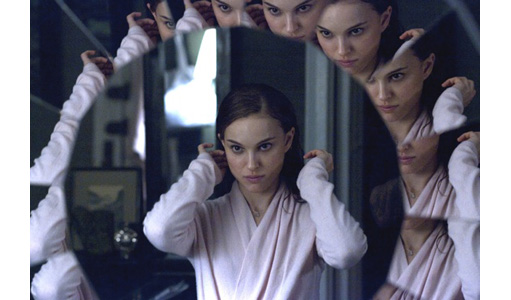
Nina --Natalie Portman-- looks into the mirror

The mirror is like another character in this film. What will Nina see?

For awhile in the first half-hour I found myself questioning how it was done, as the camera indeed played with us a couple of times, bringing the viewpoint up from the feet as if to tease us, saying “yes this really is her, not some double.”  In places one can’t help wondering how it was done, although much of the dancing is unconvincing as a representation of a real star.  But that’s a quibble, considering how persuasive much of her dancing is.  I was swallowed up by her portrayal of Nina the troubled ballerina.  If the Academy really prefers performances that cost stars a great deal—for example, Robert De Niro’s weightgain for Raging Bull.—then Portman merits serious consideration.

The movie reads a bit like a horror film.  It shouldn’t be mistaken for a film like The Turning Point or White Nights, films that explore backstage dramas in the lives of ballet dancers.  Any parents thinking this is an introduction to the ballet will drag their kids out in the first hour when they see what they’ve blundered into.  Instead, we get an intensely psychological exploration of a girl’s psychology, using ballet as both the subject and the pathway into the girl’s soul.

The question of virtuosity is central to Black Swan.  Yes i am obsessing about the subject, if you look at my previous post.  In this case, as in so many others pertaining to dance, we’re confronted with pure skill for its own sake, strutting before our eyes for no other reason than to show what the artist can do.  Why do they do it? First and foremost, they do it because they can.  Ballet is ostentatious, showing us the body because the body –in motion or merely posed delicately—is arguably the subject and object of dance.  No wonder dancers  obsess about the body, at once their instrument & their work of art, simultaneously what they’ve made and what they employ to create.

Aronofsky gets completely inside the head of Nina.  Part of the job is accomplished by Portman, part is through the ingenuity of Clint Mansell, whose score of original music is woven through with bits of Tchaikovsky.  I wonder if his achievement will be appreciated, because what he does is blend the score so seamlessly into the film as to fool us.

That being said, there are problems.  I will sound like a stickler when I say that in some respects the film is a mess.  But there’s a gaping continuity problem at one point, when we appear to be headed towards a performance and then somehow an extra day or more of rehearsals puts off the climactic premiere of the ballet.

But some of the messiness is very good.  We’re often placed in an ambiguous position, unsure what’s real and what’s imaginary, wondering whether we’re seeing objective reality or a projection from inside Nina’s mind.  I liked that, even as I heard gasps and sobs in the theatre.  In places it’s very scary.  Whether it’s in Nina’s head or not, we see an awful lot of blood in this film.

I am still stuck on the question I was turning over in my head a few days ago, concerning ballet and virtuosity.  There’s a fundamentalist streak to the art form, a feral refusal to compromise that sometimes makes the form seem to be captive of arty nerds, and at other times, to seem like a tower of integrity.  Perhaps that split personality is true to the madness that we see in this film.  It’s scary because the madness appears to be the trap lurking at the heart of the artform, a reflection of its aspirations & ambitions.

I want to see it again.
Posted in Cinema, video & DVDs, Reviews | Leave a comment

What price virtuosity, or the (body) image problem.

I used to see opera and ballet as two sides of the same coin. I understood them in terms of an obsession with power & fluidity, accomplished by ballet’s bodies, and by opera’s voices.   The dancer’s movements were what mattered above all, a manifestation of the body.  And while the singer’s voice was a comparable obsesssion it was a vessel that seemed to exist independent of the body.  Singers could be fat, and often were so large as to compromise the dramatic illusion.

See why i saw them as opposite sides of the same coin?

“Obsession” is a word meant to suggest an unhealthy preoccupation, one that comes with a price.

I believe opera has actually begun to break free, even if the change is regretted by the older generation of opera fans, the ones who speak of wanting to close their eyes and listening.

Two recent phenomena brought this back to me.  The first was Studies in Motion, currently showing at Bluma Appel Theatre.  After watching a few perfect young bodies choreographed by Crystal Pite, we see a few not so perfect bodies.  I was reminded of the casting of Pina Bausch, who was transgressive in showing us average bodies, moving without the customary virtuosity of dance soloists.  Indeed, as I read about her online –and the apparent lack of respect for her legacy– I can’t help but think that she was so far ahead of her time that nobody (except for Pite?) seems to have picked up on the possibilities she offered.

The second is a controversy swirling around a negative review in the New York Times.  Alastair Macauley said

Jenifer Ringer, as the Sugar Plum Fairy, looked as if she’d eaten one sugar plum too many; and Jared Angle, as the Cavalier, seems to have been sampling half the Sweet realm.

Does it matter that Ringer is recovering from an eating disorder?  I feel  dance is trapped in a perverse time-warp.  Macauley seems to speak for the core values of the dance world, a place inhabited by wraith-thin women and men.  The deconstructive power of a Ballet Trocadero gets its counter-discursive torque from the rigidity of the culture they have been mocking for so long.  But while people laugh at the “joke” nothing seems to change.  Dancers are still super thin and –excuse me for bringing this up — don’t resemble anyone i have ever met.  They make fashion models –one of my touchstones for the bizarre– look like people.

Pardon me if i seem to be down on ballet. I love ballet, really i do.  I am preparing to take my grand-daughter to her first Nutcracker.  I find I am interrogating the medium the way i might stare down her potential suitors.   Instead of asking when he might bring her home, I want to know what this ballet culture is prepared to offer her when she picks up on their endemic dislike of adiposity.  I hope she doesn’t internalize it.

Opera seems to have broken away from the kind of rigidity seen in dance, emulating a similar break made decades before in the realm of spoken theatre.   Brando & the Method were all about rejecting or at least concealing their virtuosity.  While purists are still reeling, there’s no denying that opera has problematized the old categories.   Sometimes opera looks great while sounding merely okay, a change that hasn’t gone over well in some quarters.  I would argue that this problematic approach is at the heart of the current love affair with opera, one that has made opera more able to live up to its dramatic promise.

In contrast, as far as I can tell, the prevailing discourse in dance is still captive of virtuosity.

Popular music has deconstructed the nonsensical fascination with chops-for-the-sake-of-chops, that used to entrap serious music in its own complex requirements.  As so many from Louis Armstrong to Frank Zappa have shown, simplicity does not preclude profundity. Mozart, Mahler & Debussy got it, even if modern music seemed to lose its way for much of the past century.

I don’t claim to have the solution, but I find it fascinating to look at the questions.  Fat ladies are no longer de rigeur at the opera: and too bad.  Opera has at times bought into the same excessive behaviour seen in ballet.  I have to wonder if some of the heavy-weight opera stars of the past would be able to make it today.  Measha Bruggergosman and Jessye Norman, and Deborah Voigt have all lost a lot of weight, as did Ben Heppner; pardon me for sounding like one of those obsessive people, but i felt the voices were better when they were fat (if i may be forgiven for using that scary F word).  I merely wish we could see a happy medium, of dancers who aren’t waifs, singers who are neither fat nor thin.

Am I asking too much in demanding a theatre that puts real people on stage?

Posted in Essays | Tagged , , , , , , , , , , | Leave a comment

A new Messiah

It might seem to be a conundrum worthy of a religious scholar: how do we know the real Messiah?  And even though we’re not speaking of a saviour but rather about Handel’s oratorio, the topic may as well be a matter of faith, given the partisan viewpoints surrounding different approaches.

The choices seem generational.  The Toronto Symphony’s partnership with the Mendelssohn Choir—billed as “Toronto’s Biggest Messiah”—is the one I recognize from my childhood, particularly Lois Marshall singing a persuasive “I know that my redeemer liveth.” That big and broad approach is also found on the classic recording conducted by Sir Thomas Beecham Messiah, including Canadian Jon Vickers’ reading of  “Ev’ry Valley.” (http://www.youtube.com/watch?v=9uGCyCQ4760)

In the 1970s and 80s I had my eyes opened by a succession of recordings using an entirely different sound, purporting to use instruments played in the manner of the time.  One heard epithets such as “authentic” and “original” even though the techniques for the instruments (eg horns without valves) appeared to have been at least partially lost, given the uneven results in some of the early recordings.  But there’s no question we were being treated to an important revolution, a new valorization of the text above all, and a new understanding of performance and virtuosity.  Conductors of this generation were a new breed of scholar-conductor, looking professorial unlike the previous generation of egotistical maestros who used to strut the podium.

That new generation of musicians –who started a kind of alternative movement of performance –has in fact matured.  I couldn’t help but notice how the players in Tafelmusik appearing in the recent broadcast of Messiah on Bravo have grown up.  While Tafelmusik sometimes venture gingerly into the romantic repertoire (even though others such as Norrington & the London Classical Players have been far bolder), they appear to have a strong preference for baroque music.  Thank goodness David Fallis & Opera Atelier have coaxed them out of their apparent comfort zone to undertake a series of Mozart operas that have been nothing short of astonishing.

And now I’ve encountered a new generation.  Last night I saw & heard Aradia Ensemble under Kevin Mallon making a new claim for historicity & musicianship.  The Dublin Messiah is to be understood as the original version from 1742.  There are substantial differences from the Messiah one usually hears.  What we heard used an even smaller ensemble than Tafelmusik’s already small orchestra

  • according to Tafelmusik’s website they have eighteen permanent members, whereas Aradia played with sixteen (admittedly that doesn’t mean Tafelmusik always uses all 18)
  • Tafelmusik chorus have 20-24 singers whereas Aradia employed just fourteen
  • perhaps most importantly, we were in the intimate confines of Glenn Gould Studio which holds 350 compared to either Massey Hall’s 2700 seats or Trinity-St Paul’s 700+

I really meant what I was saying about a new generation; they’re visibly younger, or maybe it’s just that I suddenly noticed that I’m closer in age to the members of Tafelmusik than those in Aradia.

Part I was taken without any breaks for applause, and not because the audience didn’t believe they deserved it; as a result we experienced an unprecedented dramatic tension, as the drama flowed relentlessly forward.

I’ve never heard a Messiah so clearly.  According to the program notes, the size of venue & ensemble correspond closely to that of the first performance in Dublin.  As a resultas well as because of the sensitivity of Mallon’s approach, intelligibility was never an issue.  The solos were compelling monologues while the choruses were miniature dramas.

There were so many highlights, that I hesitate for fear of omitting something wonderful.  For example, the pastoral symphony that precedes the soprano’s description of the shepherds’ encounter with the angels was the most boisterous and rustic sounding sinfonia I’ve yet encountered.  Usually we get something timid and quietly respectful, as if the orchestra were afraid to wake the sleeping shepherds; not so with Mallon.

The choruses that open Part Two were extremely dramatic with a frenetic pace, and an almost painful insistence on a quick cut-off from the chorus to maximize clarity.  Sometimes Mallon allowed the chorus to be beautiful as in “Lift up your heads” and “All we, like sheep”, while at other times intelligent articulation took precedence.

Several numbers sound brand-new in this version.  Instead of the elaborate “And who may abide the day of his coming” to which we’re accustomed, the Dublin version gives us a very brief recitative before the chorus are plunged into “And He shall purify.”  With such a tiny ensemble in the intimate space one could hear every note of this choral tour de force.

Of the soloists, I wanted to single out tenor Joseph Schnurr, who sang with a kind of evangelical fervor, his face admittedly deep in his book.  Although my first impression was conflicted, in Part II his exchanges with the chorus won me over, in their resemblance to passionate Biblical readings.  I was especially persuaded by “He shalt break them”, an especially difficult piece of text that Mallon made even more angular than usual, perhaps as lead-in to his most unorthodox reading of the Hallelujah Chorus, begun almost in a whisper.  The polite audience finally came to life at this point –with a little prompting from the Maestro—in recognition of the sparkling reading.

I can’t help but wonder whether The Dublin Messiah will become an annual event.  I hope so.

Posted in Reviews | Tagged , , , , , | 2 Comments

Levesque in Leslieville

It’s midweek at Edward Levesque’s Kitchen with my friend Brian, catching up.  This is my second visit.  The first in 2009, was my daughter’s idea.  Zoe has an expat’s appreciation of Toronto and a great network of arty friends telling her what’s good to see and hear and especially eat.  When she tells me to see a film I usually check it out.  E.L’s Kitchen was one of the places we hit before she left town, so it has nostalgia value.

How could I resist a restaurant in Leslieville?  Indeed, a former employee once presented me with a street-sign he’d somehow found (haha or stolen?) embossed with the characteristic “Leslieville” name.  I’d heard the area was being reinvented; Edward Levesque’s Kitchen seems to prove that the district has arrived.  Surely restaurants of such ambient quality can’t spring up in crappy neighbourhoods, can they?  There’s much to admire about the place, yet one can park for free in front after six p.m. because the neighbourhood is still understood to be residential. Talk about the best of both worlds!

The wine list is humongous but we both had beers to start while we chatted in the empty place, having arrived early.  We took a stroll to look at the pictures on the walls: sepia photos suggesting historical colour.

I did not pay much attention to Brian’s plate – duck breasts, sweet & sour winter vegetables & something else—because I was so thrilled by what was happening for me: a seared beef tenderloin.   And then instead of the mash potato, which might have been lovely considering the excellence of everything else we received tonight, I’d made a substitution.  Don’t you love it when they let you do that? i find it’s a naughty pleasure, although i will never be as high maintenance as Meg Ryan’s character with her salad + dressing on the side, in When Harry Met Sally (and yes it was in a restaurant that she did her fake orgasm thing).

Would you believe three additional sides?

  • side one: sweet & sour vegetables;
  • side two: brussel sprouts with double-smoked bacon in little cubes.
  • side three: a very edgy rapini, sautéed with garlic & peppers.

I like variety and contrast.  While the range of flavours I’ve described already sounds like a lot, I had the additional pleasure of a California Cabernet to gently complement the beef.  The menu is a tantalizing array of choices, roads I might have traveled and will yet visit in weeks to come, such as the sweet potato/ricotta gnocchi with gorgonzola & toasted walnuts, or the lobster & white asparagus risotto.

Afterwards Brian & I shared a stilton plate: cheeses, sliced fruits, walnuts, toasts and port shooters.  Wow.

The place became crowded later, but that didn’t hurt the service one bit.   I felt quite wonderful spending the evening in E.L.’s Kitchen reminiscing.

Posted in Food, Health and Nutrition, Reviews | Leave a comment

Studies in Motion decidedly Electric

The presentation of Electric Company Theatre’s Studies in Motion is superficially important as part of the reinvention of the Canadian Stage brand in Toronto.  I’m grateful to CanStage for giving us another look at one of the important companies working in Canada.

I had this curious sensation in my stomach, as if I felt the centre of the country shifting to the west.  Dissing Toronto is as Canadian as hockey and poutine, yet I’ve had little reason to regret being a Torontonian.  While Ex Machina advertizes the brilliance of certain Quebecois, Lepage’s shows always seem to follow the money to Vegas, to the Metropolitan Opera House in New York, and to Toronto.  Electric Company Theatre are simply better than what we’re seeing in Toronto, which is why i felt the earth move.

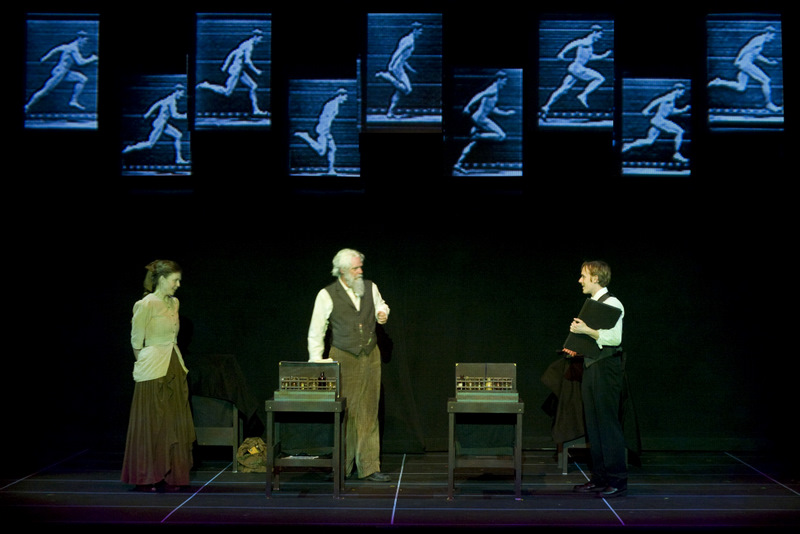
There are so many ways to understand Studies in Motion. It’s an eclectic mix of dance, spoken theatre, music, projections in elegantly simple mise-en-scène.  We see a meditation right on the interface between science and art, on the nature of beauty, and the mysteries of time forever slipping away like a river.  There’s nudity and a stunning combination of delightfully normal bodies reminiscent of Pina Bausch’s Wuppertal Tanztheatre, who dared show us average people moving and dancing.  The mix of disciplines isn’t quite like anyone else, no matter how many reminiscences they may call to mind.

When I see something really brilliant I wish I could somehow be involved in the magic.

And yet, while I enviously googled the “Electricians” (as they call themselves on their website), I stumbled across something to erase any jealousy, an unbearably painful loss at the heart of the company.  The husband and wife team identified by the company as their Artistic director & Artistic Producer, namely Kim Collier and Jonathan Young lost their only daughter, one of three young family members lost in a cabin fire in 2009.

While I understand that there’s an earlier version of the play, I can’t help wondering whether the solidly grounded sensibility of this creation begins in the agony suffered in the summer of 2009 by Collier & Young.   I came away with a sense of the sacredness of life in the moment, in their un-sentimental meditation on what it is to be a human animal.

I thought I was going to talk at length about the buttons Studies in Motion pushes for me, the influences I think I see.  But in the end I wonder if any of that matters.  For example, there’s an earlier piece from the 1980s with music by Philip Glass call The Photographer concerning the same subject, namely Eadweard Muybridge.  Musical minimalism –which in Glass’s case means a lot of repeated patterns of eighth-notes—seems particularly well-suited to a visual subject consisting of endlessly repeated patterns of single frames that combine in a way analogous to what the music does.  And some of the music in Studies in Motion could be called minimalistic.  But after seeing Studies in Motion I don’t believe the Electricians were influenced by Glass’s work, if they were even aware of it, given that the music in Studies in Motion is perhaps its weakest link.

The title says it perfectly: “studies in motion”

The work exhibits the tension-release pattern we see in opera (thinking of baroque opera with the recitatives and arias) or in musicals (where numbers are separated by patches of dialogue).  At times Studies in Motion resembles these other multi-media theatrical forms, as the two (or more) types of discourse carry key functions in partnership, where the text would advance the story while the movement supplied what the words could not,  articulating passions, emotions which could not be articulated in words.

When media are mixed I demand more than just eclecticism for its own sake.  In some productions one encounters, the eclecticism can feel like mere eye candy; for example, that was my impression of the period dance in the Tarragon Theatre’s production of Sabina Berman’s Molière in 2008.  I remember Peter Hinton once saying that the musical elements in a work must be inevitable and inescapable or at least seem that way: otherwise why bother.  Sometimes it seems that music theatre or puppets or circus are just what we do, a pathway of procedures and a culture of shared assumptions without the kind of illumination Hinton demands.  Electric Company seem to be truly eclectic, bringing all those separate pathways and subcultures together.

I was persuaded by the combinations Electric Company employed.  In an exploration with such a strongly physical element –concerning movement and its analysis—the absence of choreography and a thoughtful vocabulary of movement would be unthinkable.

Perhaps it’s a sign of my age, the biases of someone much older than the creators of this work, but I found the balance a bit off for my taste.  Whenever the bodies were moving without any speech or text, it was pure gold (ha… or maybe more of a sepia?).  Studies in Motion concerns bodies moving in time, a subject that was fully comprehensible in what we saw, wonderfully choreographed by Crystal Pite; but movement is also foregrounded by the staging, lighting, by the rhythms of Studies in Motion.  At times I felt the text explained a bit too much, as if we couldn’t be trusted to decode the profundities before our eyes.  If, as I suggest above, the work is operatic in balancing words and movement, where the movement corresponds to the passionate arias and ensembles, Electric Company have included too much recitative, more exposition than necessary.  While one needs some explanation, their words strip some of the mystery from the work; but then again I love opera, a medium where we’re accustomed to printed synopses spelling out impenetrable plots & philosophical overtones that are otherwise impossible to discern upon a first viewing.  Electric Company made everything very clear, including multiple layers of meaning concerning life and death; I should be grateful.

Another problem is that words are much more finicky than mute bodies; when an actor says something like “let’s do this”, a colloquialism that sounds ridiculously current, it pulls me out of the illusion with its accidental anachronism.  Music and movement, being more purely abstract are more forgiving.

Even so I am quibbling.  There is much to admire in the work: beauty and depth that has me wanting to return for another taste.  Studies in Motion continues at Canadian Stage until Dec 18th at the Bluma Appel Theatre.

Posted in Dance, theatre & musicals, Reviews | 2 Comments

Into the sunset: cue heroic music

I’ve been talking to friends about the missing cat.  The cat is not here.  Why?  she sauntered or dashed or flew through an open door.  Her name is Tara, while her sister is Scarlette.  Scarlette is still here, while Tara has departed for parts unknown.

Tara is the little one, while Scarlette is the big bad alpha of the litter.  Tara weighs eleven pounds, while Scarlette is roughly double that size.  Since Tara’s departure Scarlette seems upset, and isn’t eating with her customary gusto.  She’s not the only one.

As I confront my feelings –sadness, shock, frustration– at the departure of a cat that is one of my favourite people (you won’t see that as a contradiction if you have a pet) , I am trying to put a frame around the event, trying to make sense out of what happened.

In the context of the two cats arrival –feral kitties persuaded to come in out of the wild outdoors for the comforts of a Scarberian home–this is an unexpected turn of the tail… er- tale.  The life expectancy of outdoor cats is nowhere near as long as that of cats inside a house (as I speculated in yesterday’s post).  Starving feral kitties at death’s door, brought indoors to stretch out in well-fed comfort was the expected story-line, and might still be the story for Scarlette.

But how do we understand what’s happened with Tara?  She went through the open door into the wild.

This is not what we expected.  It feels tragic or at least, sad and upsetting.  The open door can be a synonym for “incompetent owners”.  It’s a pointless waste of a life if she dies, although i am hopeful that she can survive for at least awhile, and maybe just maybe, either be coaxed back inside or be found at the animal shelter.

There are shelters, and cats are sometimes brought in.  We’ll see if Tara allows herself to be caught.  It depends on how well her adventure goes, on whether she’s able to forage, or if instead the adventure becomes more perilous than she expected when she followed her nose out into the fresh air.

And maybe that storyline is a bit selfish.  Who’s to say whether it was even a good thing that Tara (to use the name we hung on her) came inside? She was always wilder than her big sister, and maybe more feral than we realized.  Funny how one thinks about such things later, as a kind of post mortem (although she’s not dead as far as we know).

I was watching a youtube video of Peter Hofmann, the heldentenor whose untimely death was reported today.  In the linked scene, Siegmund is told by Brunnhilde (goddess, and unbeknownst to Siegmund, his half-sister) that he’s appointed to go to Valhalla: tantamount to an announcement of his impending death.

One of the big differences between real life and art is those frames that are put around events.  Not only is Siegmund confronted with the end of his life story, but this opera –like most– is structured around deaths & big events in the lives of the protagonists.

I wonder if the actual event for poor Peter Hofmann was more like that of Siegmund or like that of Tara: coming at the expected place in a big story, or a sudden absurd event with no apparent logic?

I don’t really know whether Tara has ended, or merely gone off into the sunset, possibly with heroic music on her internal soundtrack.  And yes she did hear all that Wagnerian stuff in her time.  Sometimes it was coming out of the TV + DVD. Sometimes it was coming out of the piano & out of me, playing & singing.

There are two versions of my favourite piece of music.  Hm i feel a bit nervous typing that but come to think of it, yes i know it without hesitation at this moment.  While my thesis concerns Debussy, and i have had warm fuzzy moments with his Nocturnes, his piano music, even withPelléas et Mélisande (subjects of that aforementioned thesis), like Debussy himself, since childhood, I’ve had a weakness for Richard Wagner.

There’s one tantalizing composition that exists in at least two versions.  I first encountered Siegfried’s Rhine Journey as a child.  I had no idea what it was about, because i had yet to encounter even my first Wagner opera.

Later, I started working through the Ring cycle, beginning with Die Walküre. By the time I got to Das Rheingold I was fortunate to get the London recording (aka the “Solti” because of the conductor), which came with a marvellous little extra.  Wagner’s themes were explained, and then, like a magical gloss, as one followed the libretto, they’d prompt you, that we were hearing the theme associated with the Rhinemaidens, the gold or the Ring.  Wow.  Before long I started to realize that the cool piece of music —Siegfried’s Rhine Journey— contains lots of those themes.

I discovered that the excerpted version of this orchestral interlude sometimes has a concert ending that is substantially different than what we get in the opera from which it is taken.  The first version i heard seemed to show a happy ending, as if Siegfried happily rides off into the sunset.  The version we get in the opera confronts us with something disturbingly different: that Siegfried is going to die.  We know it at this moment at the beginning of Act I, long before the actual catastrophe.  In death, Siegfried gets a death scene and music befitting a hero.

Hofmann & Tara, unlike Siegfried, can’t get that kind of treatment in real life.  Even so I am trying to picture both Hofmann and Tara riding into the sunset, a happy ending to their adventures.

Posted in Animals, domestic & wild, Essays | 2 Comments

Comfort ye

The tenor soloist in a Christian Church during Advent Season sometimes gets to be an ambassador of hope.  The text for Handel’s Messiah comes directly from the Bible:

Recit: Comfort ye, comfort ye my people, saith your God. Speak ye comfortably to Jerusalem, and cry unto her, that her warfare is accomplished, that her iniquity is pardoned. . . .The voice of him that crieth in the wilderness, Prepare ye the way of the Lord, make straight in the desert a highway for our God.

Air:Every valley shall be exalted, and every mountain and hill made low, the crooked straight, and the rough places plain.

I was privileged to play that role this past Sunday even though i was acting.  It’s not that i find it difficult to sing this text with conviction, but rather, that I was not feeling hopeful.

Scarlett & Tara are two feral cats who have been living indoors since 2007, when they were coaxed away from the wild, to the warmth one finds indoors.  While Scarlett is still inside, Tara somehow got outside last week.  She’s three years old, small, and I don’t believe she’s really prepared for the cold nights we’ve been seeing.

What’s more I live in a rough neighbourhood.  I’m very fond of the Scarborough Bluffs, and unfortunately, so are pet owners looking for a place to release unwanted cats.  The parents of Tara & Scarlett were probably released into the wild, although it’s hard to know how many generations back the feral part of the family began.

The past few days I have been making posters with Tara’s sweet expression, hoping to catch the attention of anyone walking by.

Reason would argue that Tara’s survival is unlikely.  My heart wants to believe that she can find a place to hide at night, to avoid the hazards of the neighbourhood

  • fast cars
  • coyotes, foxes, raccoons
  • pets and feral cats
  • the coming winter

I will continue to hope that Tara might be out there somewhere, that she’s tougher than she looks.  The drama of her accidental release may be a misreprentation; maybe she chose the wild, and is bravely adventuring after too much comfort and warmth.

I am reminded of Achilles, who chose a short life of heroic adventure over the long life in tranquil obscurity.  There is also the line in Blade Runner.

The candle that burns twice as bright burns half as long.

The life expectancy of a cat in the wild seems to conform to the choice that confronted Achilles.  Whatever the truth might be, I would be happy if someone else welcomed her inside, even if I’ll never know for sure.

My fondest hope is to persuade her to come back inside again.

Posted in Animals, domestic & wild, Essays, Spirituality & Religion | 2 Comments

Feasting and saying thanks

In the book Authentic Happiness by Martin Seligman, we read about the psychological benefits of saying thank you.  He calls them “gratefuls”, a good daily ritual that can help make you healthier.

And so, as a kind of prayer, I try to look back on my day and find three things for which I can be grateful.  This daily exercise is supposedly helpful in making us more resilient, and –dare I say it – happier.

Sometimes I recall an exchange with a customer, and how fortunate I feel that it went well, or at least didn’t go horribly wrong.  I will recall something a staff member did and thank my lucky stars for that person and for their contribution.  I may simply recall a moment when i narrowly escaped a car accident, or a lunch with my daughter or a phone call with my Mom, or a beautiful piece of music I heard performed.   The more you do this as a habit, the more automatic one’s sense of gratitude.

Today is the day my friends are calling “American Thanksgiving”.  Canada has its own harvest festival roughly 10 days into October, given our shorter growing season.  Both countries had Thanksgiving celebrations at diverse times of year, until the American holiday was fixed in 1863; in comparison our own festival only goes back to 1957.   I associate the holiday with a series of funny movies, as Hollywood does very well sending up the seriousness of the season:

  • Planes Trains & Automobiles, starring John Candy & Steve Martin
  • Home for the Holidays, starring Holly Hunter & Robert Downey Jr.
  • Addams Family Values… for that wonderful thanksgiving pageant where the Indians –particularly the revisionist Pocahontas played by Christina Ricci– decide not to trust the pilgrims

Last night I saw Last Holiday, a movie that seems perfect for the more serious sort of reflection one may make at Thanksgiving, whichever version you see.  In its 2005 version, Georgia (Queen Latifah) is a woman who has been told she will die within a few weeks.  She decides to enjoy her final days, quitting her job and blowing her money in a last holiday.  The film enacts that old saying “live each day as if it were your last day”.  Georgia begins to astonish people because she’s lost her fear.  It’s funny because of course we’re all going to die, but don’t know when.  Who would expect that knowing you’re about to die might be liberating, and that enjoying right now could actually be spiritual?

One of the marvels of the film is to watch the scenes with food.  Georgia enters into ecstatic dialogues with Chef Didier  (played fulsomely by Gérard Depardieu) concerning food and the enjoyment of life.  The joy they take in preparing and consuming food is like a lesson in the meaning of life.  The film is a sentimental echo of La Grande Bouffe, a much darker film from the 1970s, where the ruminations on hedonism, life and death are much more extreme.

The gentler pleasures of Last Holiday were just what I needed to put me in the mood for being taken to lunch at the Gallery Grill. Oh boy, another reason to feel grateful.  Before Michelle and I began our meal, we had the pleasure of perusing a menu as rich in its way as the bounty of our wonderful country.

I opted for a hefty portion of something called “Sherry-spiked lamb soup”.  I was reminded that sometimes extracts and reductions are better than the original.  I remember as a boy being disappointed that no apricot matched the intensity of a dried apricot.  Similarly this soup gave me the angelic essence of the lamb, idealized in the warm glow of sherry.  Michelle had a tour-de-force of a salad, leaving us wondering how they shaved the zucchini so thin as to justify being called “ribbons”; I know they didn’t use a slap-chop.

For mains we again diverged.  My whitefish rested atop a spicy apple salad in thin slivers and tiny cubes of boar bacon, a tower that was as impressive for its architecture as for the unexpected harmony of the tenants.  Michelle’s Porchetta (a clever trick to subvert kosher rules… are you allowed to eat pork if you give it a fancy name?) rested on an unlikely foundation of beans and warm rapini salad.

And to finish I had several flavours of sorbet & ice cream to choose from, opting for

  1. pralines & cream
  2. roasted apple with lavender
  3. rhubarb sorbet

I came away very happy to be alive, and not just because I was high on the sugar and several coffees.  Thank you Gallery Grill. Thank you Michelle.  As Georgia might have said, “Thank you Lord, for letting me see another day.”

Posted in Essays, Psychology and perception, Spirituality & Religion | 4 Comments

In our closet, Freddie Mercury

Are Don Cherry and Ron McLean hard of hearing? When –on Hockey Night in Canada– McLean interviews Cherry in the segments known as “Coach’s Corner” the entire conversation is loud.  While they claim to be friends they seem to be shouting at one another the whole time.  Why are they shouting? Their conversation is during intermission, so it’s not as if the crowd noise will drown them out.

Rodney Dangerfield, bless his heart, can be thanked for one of the most charmingly witty remarks about the Canadian national game.  “I went to a fight the other night, and a hockey game broke out.”

Hockey continues to struggle with its identity, lacking the clarity one sees from the National Football League.  Fights are rare on the gridiron even though the full contact violence of football occurs on every play.

If you’re sitting in a hockey arena anywhere in North America, some things are  guaranteed

  • you’ll hear a national anthem
  • you’ll see a Zamboni clean the ice between periods
  • you’ll hear music meant to whip up the enthusiasm of the crowd

But there’s a big irony lurking in the playlist.

Methinks they protesteth too much. At the core of that playlist I mentioned is an unlikely figure.   In this shrine to heterosexual masculine values, you will hear at least one Freddie Mercury song.

When the going gets tough, the song whips up a frenzy of stomping and clapping.

Buddy you’re a boy make a big noise
Playin’ in the street gonna be a big man some day
You got mud on yo’ face
You big disgrace
Kickin’ your can all over the place

We will we will rock you

Buddy you’re a young man hard man
Shoutin’ in the street gonna take on the world some day
You got blood on yo’ face
You big disgrace
Wavin’ your banner all over the place

We will we will rock you

Buddy you’re an old man poor man
Pleadin’ with your eyes gonna make you some peace some day

You got mud on your face
You big disgrace
Somebody better put you back in your place

We will we will rock you

I never could understand what that song was really about. It’s a painful scenario, like a snippet from a nightmare.   I don’t know that anybody really pays attention to those lyrics when they’re screaming and cheering, all they really want to say is “we will we will rock you”.  It’s directed at the visiting team, an anthem that says “YOU ARE NOT WELCOME HERE.”  I suppose that’s what partisanship is all about.

It seems like a fitting day to remember Freddie Mercury.  He died nineteen years ago today.  There’s a movie in the works.  I hear it will star Sacha Baron Cohen.

Is Freddie Mercury and his sexuality ancient history? I had always heard he’s gay and that he died of AIDS, but to be fair, i know less about him than about Mozart or Beethoven, men who died a very long time ago.

I just wonder if a movie might encourage all those people at hockey games to think about what they’re cheering for.  I love hockey. Why do people need to fight at a hockey game?

Maybe Rodney was onto something.

Posted in Essays, Popular music & culture, Sports | Leave a comment

Mamma Mia! from Glee Across the Universe to Rock of Ages

That was not an attempt to jam as many titles into one sentence as possible.  Okay, maybe I was playing a bit but that’s not all I was attempting…

I am sitting watching Glee as I write this.  When the show first appeared I cringed at the publicity, the pictures I’d seen of Sue (Jane Lynch) in the “L” for loser posture.

I didn’t get it.  How could I? at least not without having a look.  And if you haven’t seen it, I hope this essay makes some sense.   But I had heard the buzz, especially through my music-theatre friends on Facebook.  And so I had a look, and just from one episode succumbed to the fascination.

It’s odd.  I don’t watch television, except when I want to check the weather report.  No that’s a lie.  I always make time for special events: operas, championship sporting events, election debates, walks on the moon.  And to that list let’s add Glee.

The show is a double threat (and all you triple threats out there, please hear me out).

The plot is a loosely constructed premise for a series of songs, confronting us with the eternal balancing act of the musical, and come to think of it, opera as well.  The best operas or musicals do not struggle to find that balance, because they seem to flow organically.  And their songs don’t remind us of the arbitrariness of the form.

That’s what’s different in Glee, and come to think of it, a whole series of recent musicals, including Rock of Ages, Mamma Mia and Across the Universe.

If I am watching West Side Story, and Tony begins to sing Tonight, he is singing a song that was written for Tony by Leonard Bernstein, a song –at least as far as I know –with no prior life before West Side Story.  When I encountered I Feel Pretty during the film Anger Management, on the other hand, I had to mentally filter the song’s previous life –in that same 1950s musical West Side Story—with the more recent comedy starring Jack Nicholson and Adam Sandler.  It’s a curious mix of the two.

Linda Hutcheon, the celebrated Canadian literary theorist & scholar, described this effect when we encounter an adaptation.  She used the analogy of the palimpsest, a page where we can see one text written over top of another; the point of the analogy is that with this kind of adaptation it’s as if we’re looking through layers, seeing both the original version and the newer one.  And so for example, the experience in Anger Management is enriched by our ability to see these two very different moments simultaneously, remembering for example, that a room full of Latinas sing the original song, not two churlish men in a car.  It’s curious that it doesn’t really matter whether Jack Nicholson and Adam Sandler sing the song with skill.  The shy tentative start from Sandler’s character is a perfect mirror to our own doubt about the suitability of the song, which seems so unlikely in this situation.

I believe that’s what we’re working with in Glee.  For example, there was an episode with Brittney Spears as guest, whereby the plot contrived to give three different characters dreams each starring Brittney singing one of her songs in an ensemble with a cast member.  The awkwardness of that combination –the highschool students in Glee and, oh my, Brittney Spears?—was precisely what made it jarring, and meant that whether it was well-sung or not, we’d accept the mashup. It’s a hybrid, a remix, and no longer like either of the things we had before, and definitely greater than the sum of its parts.

Rock of Ages and Mamma Mia are similar, in taking songs that we already know, and giving them new life in a dramatic treatment.  It doesn’t matter that the story is obviously constructed for the express purpose of connecting the songs.  It’s clear that we’re there to hear the songs, no matter how the plot turns out.  This is easy enough to confirm by asking anyone who has seen the plays the following loaded question. What do you remember better: the characters and contours of the plot on the one hand? or the songs?

Julie Taymor’s Across the Universe is a film musical cut from the same cloth.  While Taymor does manage to cobble a skilful story connecting some of the best known songs of the last half-century – in other words, songs so central to our sensibilities as to resist the comparatively weak pull of the story—the effect is largely the same as for Rock of Ages or Mamma Mia.  We emerge from the theatre remembering a few great moments.

I find that operas constructed of obvious segments, that are not as through-composed, seem to invite us to a similar GLEE-full space, where we are aware of the aria and the performer, and also aware of the sometimes weak connective tissue contrived to get us from one glorious aria to the next.  When the musical form successfully integrates the elements into an organic unit that isn’t obviously just a loose collection of songs, we start to have a different relationship to the show and its performers.   Chances are a musical or opera that is a loose collection of songs can be an excellent star vehicle; and therefore the stars singing those songs (or arias) are the selling point.   When the form matures — for example, when the opera or musical is a more accomplished composition, we start noticing the composer as well as the singers, and that person also becomes the selling point.

Posted in Dance, theatre & musicals, Essays | Tagged , , , , , , , | Leave a comment