#COCgingerbread: Joel Ivany softens a Grimm tale of cruelty

It’s called “Hansel and Gretel”, not “kill the witch”. And in the original the witch isn’t even the nastiest character.

You may already know that the new Canadian Opera Company production of Humperdinck’s Hansel & Gretel modernizes the setting to a city like Toronto. But director Joel Ivany does a whole lot more than that.

Joel_cover

I tried to avoid spoilers in my review of the opening. I’ll do my best not to give too much away, but the main thing I want to observe concerns Gertrude, the mother of the two children.

In the Grimm version? Let’s look at a sample in translation.

Next to a great forest there lived a poor woodcutter with his wife and his two children. The boy’s name was Hansel and the girl’s name was Gretel. He had but little to eat, and once, when a great famine came to the land, he could no longer provide even their daily bread.

One evening as he was lying in bed worrying about his problems, he sighed and said to his wife, “What is to become of us? How can we feed our children when we have nothing for ourselves?”

“Man, do you know what?” answered the woman. “Early tomorrow morning we will take the two children out into the thickest part of the woods, make a fire for them, and give each of them a little piece of bread, then leave them by themselves and go off to our work. They will not find their way back home, and we will be rid of them.”

“No, woman,” said the man. “I will not do that. How could I bring myself to abandon my own children alone in the woods? Wild animals would soon come and tear them to pieces.”

“Oh, you fool,” she said, “then all four of us will starve. All you can do is to plane the boards for our coffins.” And she gave him no peace until he agreed.

Read the rest here .

The opera is a somewhat gentler version, as we see Gertrude erupt in anger when she comes into the kitchen while Hansel & Gretel are playing. In the ensuing confrontation, the milk jug falls & breaks. When Hansel laughs, she loses her temper, sending the two children off into the forest to find strawberries, threatening to whip them if they don’t bring back a full basket.

You might well say that we have no right to judge Gertrude for her reactions, not when they’re so poor as to be facing death from starvation.

I have been thinking about gender politics in how the parents in this opera are portrayed, especially as I look at the alterations Ivany made in his modernization.

As a parent I’ve often been troubled by the unfairness of it all, even though I have a huge advantage as a male.

  • Mothers?
    They are the ones placing the hard limits on their children. As a result they face the most push-back, the most bad press.
  • Fathers?
    Because fathers are rarely the ones asked first, they can come into the picture to fix things, show up as givers of unconditional love, the purveyors of fun. Ah the joys of fatherhood. We’re the good cop to mom’s bad cop, which surely isn’t fair, especially not to mom.

You see it in the way the brothers Grimm and later librettist Adelheid Wette tell the story.  We might say that the mother is a bitch, bad tempered: but that’s part of the unfairness of it all. The father gets to be the kind loving understanding one, coming home later with his cheerful song and avoiding the conflict.

I’ve been intrigued by the fact that Joel Ivany is a dad, awaiting his second child with his wife soprano Miriam Khalil. Watching Russell Braun as Peter (the father) and Krisztina Szabó as Gertrude (the mother), I wondered about Ivany’ thought process as he played with the original. There’s not much Szabó can do with the character in that first scene, as it more or less requires Gertrude to send her children out into the forest, possibly to their deaths.

(SPOILER ALERT…if you don’t want to know what Ivany does to change up the story stop reading now!)

Still there?

Of course the big thing Ivany is doing here is all about make-believe, turning the story into an exercise in pure imagination, and thereby taking the sting out of the children’s ordeal.

  • The kids don’t go into a forest to hunt for strawberries, they go to different floors of their apartment building
  • The witch isn’t a real witch
  • The children aren’t actually lost, as the parents set it all up

Instead of the usual adventures in the forest we’re watching a sandman & a dew fairy played by someone who lives in that same apartment building, putting on a costume.

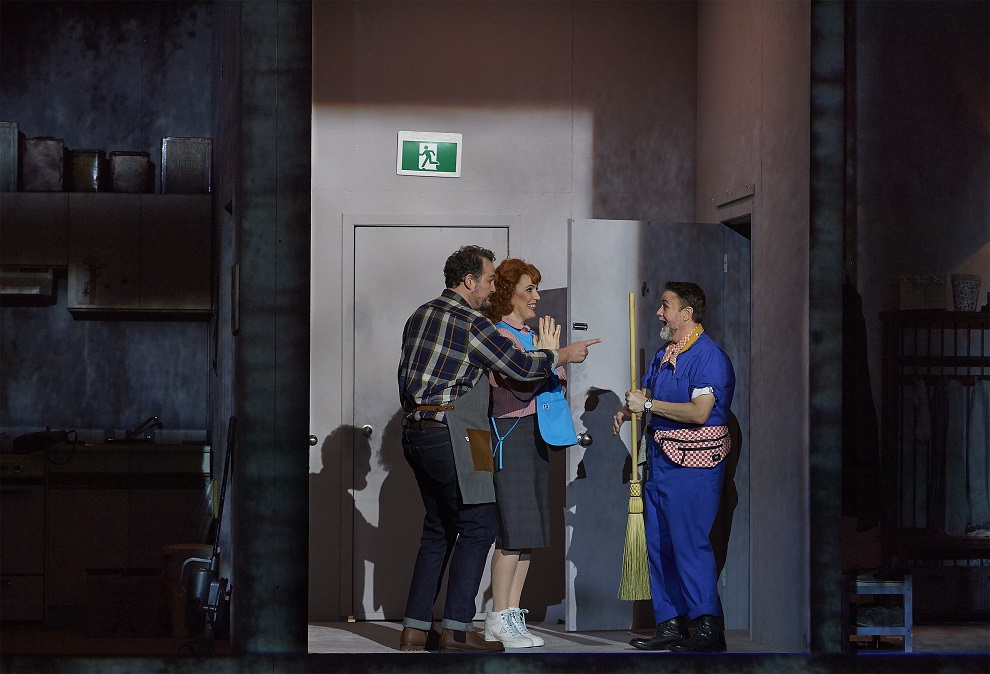
Instead of a witch seeking to cook & eat Hansel, we watch a neighbour who has been colluding with the parents, who are playing along.  You don’t have to believe in the witch, not when children might believe.

19-20-04-MC-D-0499

(l-r) Russell Braun as Peter, Krisztina Szabó as Gertrude and Michael Colvin as The Witch (photo: Michael Cooper)

There’s lots more I could give away but I’ll stop there. The main thing is that Peter & Gertrude didn’t send the children off to die in the forest. Even so there’s only so much you can do with the text, although in places they did alter the surtitles (such that the words we see projected are not actually a translation of what’s being sung).

If it were up to me I’d take that much further. For instance when Gertrude supposedly sends the children into the forest to get strawberries the surtitle could just as easily say “go upstairs and beg for food from your generous neighbours” since the action now calls for them to stay inside the apartment, an imaginary forest perhaps but not a real one.

But ahh it isn’t up to me, is it…

There’s lots to admire in this production, many moments of great beauty, some tremendous laughs. At the beginning of each scene we’re watching projections on the scrim that suggest children’s drawings, including a marvelous stylized Earth that we zoom in on during the overture. Seeing it today for the second time I still got all teary-eyed at S Katy Tucker’s images & exquisite taste.

It was lovely seeing Russell Braun for the second time today onstage, after running into him this morning at the celebration of Errol Gay’s life at St Clement’s Anglican Church. Russell sounds so comfortable & happy in this role.

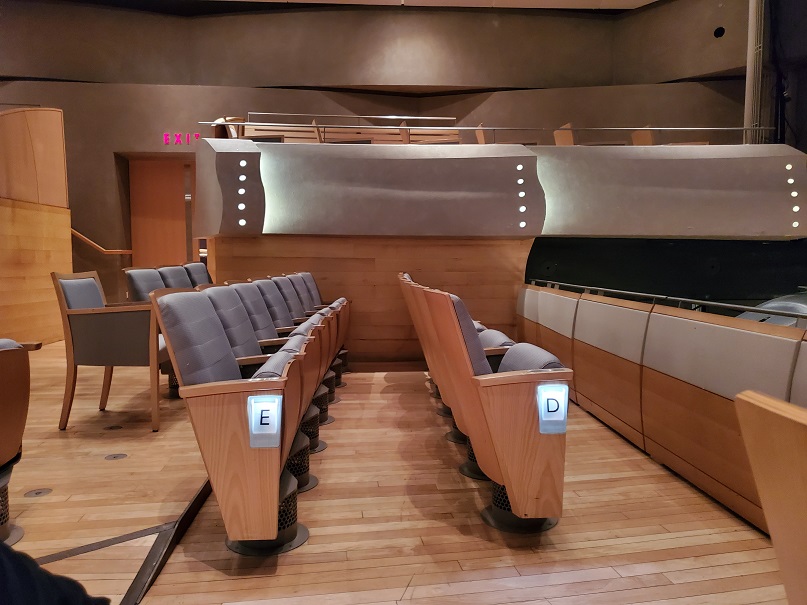
Sitting in the second row we noticed a couple of things.

The sections of seats at either side are being left empty because of compromised sight-lines.
empty_seats

It was wonderful watching Simone Osborne and Emily Fons up close, a very believable pair of children whether pouting, dancing or eating. Anna-Sophie Neher’s fairy & sandman were even more adorable in a closeup view. Everyone was more relaxed and self-assured today.  I’m sure it will continue to get better.

Hansel & Gretel continues until February 21st.

Posted in Opera, Personal ruminations & essays | Tagged , , , , , , , , , , , , | Leave a comment

Vittorio Ghielmi dreaming Jupiter

“Dreaming Jupiter” is the name of the concert program this week from Tafelmusik at Jeanne Lamon Hall, that might epitomize everything about their approach to making music.

Where the Toronto Symphony are lately the place you go hear the pieces you know and love played by a modern orchestra, Tafelmusik are the opposite. TSO build their audience via a mainstream approach, Tafelmusik appeal to the hardcore afficionado,  offering music we’ve probably never heard on instruments we don’t know too well, played by a virtuoso instrumentalist.

We listen with an attentiveness bordering on religious fervor, and we’re rewarded with unique performances of rare beauty.

Tafelmusik assembled two contrasting types of music working in a kind of dialogue, back and forth between Vittorio Ghielmi’s solos for viola da gamba and flamboyant orchestral pieces, an evening of contrasts and drama. The title alludes to the composition with which we closed, namely an original adaptation by Ghielmi of Forqueray’s Jupiter.

Before we got there we listened to Ghielmi demonstrate the range of possibilities in the instrument, sometimes plaintive soft lyricism, sometimes quick ornamented passages.

I’m challenged to rethink or reframe my understanding of the baroque, having heard a whole new kind of playing tonight. Ghielmi takes the stage with his solos as though performing a soliloquy or an opera aria, but gradually working through its nuances without seeming to show off. There’s a kind of understated eloquence at work that reminds me of Stanislavsky or The Method, as though he were coming at baroque expressiveness not from an extroverted mandate of display for display’s sake, but, dare I say it, from the inside. There’s a genuine impulse that’s properly discursive like a conversation or dramatic dialogue, whether in his louder or soft moments. As a result I see so many more possibilities, not just in what he was playing but in other baroque composers as well.

The solo jewels from Ghielmi’s hands were set against a backdrop of orchestral outpouring from the operatic realm, as though his solos were shining jewels, to contrast orchestral numbers like masses of dark velvet.

I’ve heard some of these pieces before but never quite this way as Ghielmi exhorted Tafelmusik to bring extraordinary fire to these pieces, towering moments of larger than life drama.

I’m hoping Marshall Pynkoski comes to hear this program as we are again teased (or tormented?) with the stunning beauty of seven examples of Jean-Philippe Rameau’s orchestral brilliance. I’m hopeful that Opera Atelier will undertake one of these marvelous operas.

ghielmi_Twitter

Vittorio Ghielmi, viola da gamba virtuoso

Posted in Music and musicology, Opera, Reviews | Tagged , , , | 2 Comments

TBA

On Monday February 10th the Canadian Opera Company will tell us what they’re producing next season aka  their “Season Reveal” aka #2021COC.  It’s a celebratory moment, and can feel a bit like Christmas morning as we unpack the goodies, for those of us who love the opera, those of us who go regularly, those of us dying to see certain shows, especially the ones that have been promised through the subtext in co-productions produced elsewhere.  I saw the video of Girard’s Parsifal and liked it so much I bought the DVD. And there’s the recent Wozzeck high-def broadcast. 

On Monday will we get great stuff in our stocking? Or socks & underwear?  I’m remembering Charlie Brown who (trick or treating) said “I got a rock”.

It’s all to be revealed very soon. “TBA.”

It’s an extra-special reveal, given that this is the last time it will be a COC season under General Director Alexander Neef.  We’vealready been teased just a few weeks ago with the prospect of the Parsifal production, perhaps as his grand farewell gesture.

It can be a bit of a sport, a bit of fun to predict what’s to come.  John Gilks regularly offers his take, always amusing.
https://operaramblings.blog/2020/02/04/coc-in-2020-21/

His season prediction:

New productionsParsifal, The Old Fools (just maybe Only the Sound Remains), La forza del destino
RevivalsMadama Butterfly, Lucia di Lammermoor, Idomeneo (or maybe Orfeo)

I don’t mind getting socks or underwear at Christmas if we can’t afford extravagance.

In other words, while I love a good show my first concern is the health of the company and the stewardship of opera in Canada.

For comparison, let me dip into the October 2019 press release announcing Karen Kain’s departure from the National Ballet of Canada, I will quote her words as she takes a well-deserved bow, with a focus on two things.

Item #1
We have fostered Canadian talent through CreativAction, the appointment of Choreographic Associates and Innovation, our all-Canadian programmes.

Item #2
“When I step down in January 2021, I know I leave a financially stable company with the very best dancers in the world, one of the most diverse and coveted repertoires and an international reputation for the highest level of excellence.

We are coming up to a comparable moment in the life of the Canadian Opera Company as Alexander Neef bids the COC goodbye.  Will he issue a comparable statement to what Karen Kain issues, before rushing into the arms of his colleagues at the Paris Opera?

neefLR_SamGaetz

Alexander Neef (Photo: Gaetz Photography)

Last year I posted a nationalistic diatribe in response to the COC’s season announcement for 2019-20, that I put alongside KK’s item #1 above, as a kind of question.  The COC just opened Hansel & Gretel last night with a Canadian cast: and it was wonderful.

As for item #2, I only wonder what shape the COC will be in after Neef’s departure.  What incentive does he have to leave the company in great financial shape?

It’s impossible to answer those questions right now.  Pardon me for asking them, but I think they’re just as important to ask as “when do we get to see Parsifal“, especially if Parsifal is too expensive.

We shall see.

Posted in Opera, Personal ruminations & essays, Politics | Tagged , , , , , , | Leave a comment

Make-believe Hansel and Gretel

Oh to be a child again.

I saw the opening night of the Canadian Opera Company’s new Hansel and Gretel tonight before a delighted sell-out crowd at the Four Seasons Centre. While there were children present both in the show & in the audience, we were all given ample opportunities to regress a few years.

It’s a make—believe Hansel & Gretel because we’re encouraged to use our imaginations.
While a romantic & realistic staging –where you see woods & angels & witches –might offer more in the way of story-book magic, there is ultimately something stultifying about a literal rendition of such an opera, to say nothing of the risk of kitsch.

19-20-04-MC-D-0438-443

(foreground) Krisztina Szabó as Gertrude and Russell Braun as Peter with (background, l-r) Simone Osborne as Gretel and Emily Fons as Hansel in the Canadian Opera Company’s new production of Hansel & Gretel, (photo: Michael Cooper)

Director Joel Ivany and his creative team – Costume Designer Ming Wong, Lighting Designer JAX Messenger, and Set & Projection Designe S. Katy Tucker –went in an entirely different direction as we heard in Ivany’s recent interview.

portrait

Joel Ivany, artist in the city

The opera is set in modern-day Toronto. How does one reconcile that with the fairy-tale, the witch, and the forest? I think if you’re a child this is less of a problem. Indeed maybe that’s a lesson for those resistant to Regietheater & modernized interpretations. If you watch through the eyes of a child, you’ll have a much better time.

You have nothing to lose but your stipulations.

19-20-04-MC-D-0499

(l-r) Russell Braun as Peter, Krisztina Szabó as Gertrude and Michael Colvin as The Witch (photo: Michael Cooper). This picture is a big clue to Ivany’s interpretation.

I was especially taken by the performance of Russell Braun as Peter, the children’s father, a baritone who’s been mostly playing tortured unhappy people for the COC over the past decade. I was reminded of his lovely singing as Chou En Lai in Nixon in China when he is the gentle voice of kindness & hope. The voice rang out tonight with a beautiful colour, no doubt helped by the acoustic support offered by the set design.

But it’s a team effort. Krisztina Szabó as Gertrude is a perfect partner for Braun.   Simone Osborne as Gretel looked & sounded wonderful. Emily Fons as Hansel was a remarkable actor, although I think we all enjoyed Michael Colvin’s Witch the most, both dramatically and for some brilliant singing.  Anna-Sophie Neher was enjoyable as The Sandman & Dew Fairy.

Johannes Debus led the COC Orchestra in a lyrical reading of the score.

I’ll be seeing it again, and suggest that anyone with imagination check this out.

Posted in Opera, Reviews | Tagged , , , , , , , , , | 1 Comment

Joker reminds me of….

Resonance is a function of history, right? You’ll pick up allusions and associations depending on what you usually see.

So of course it’s no wonder Todd Phillips’ 2019 film Joker reminds me of Wozzeck as someone who’s more likely to see an opera than a first-run film.

03wozzeck

Peter Mattei in Wozzeck at the Met. (Photo: Paola Kudacki/Met Opera)

I only caught Joker this week in the immediate lead-up to the Oscars, a film with multiple nominations. While poverty and wealth disparities are central to the story, I don’t feel any connection between this violent superhero spinoff with its tenuous and understated connections to the Batman franchise, and either Porgy & Bess that I saw on Saturday or Humperdinck’s Hansel & Gretel that I will be seeing later this week from the COC.

Why Wozzeck?

Both stories concern protagonists clinging tenaciously to their sanity, feeling betrayed & oppressed, violated, mocked & finally provoked to violence.

Both incorporate elements of comedy into a story with elements of tragedy & social satire, so much so that we get messed up about what is and isn’t comedy.

Both are very dark.

And Joker makes me think of Karl Marx, who thought –erroneously –that the proletariat would rise up in western societies. Revolutionary uprisings are a fantasy by and large, unlikely in America. Gotham looks a lot like NY: until we start seeing something like a social uprising. Sorry Todd, you’re making the same mistake Marx made. Earlier today I was looking at pictures of armed men walking into a legislature in Frankfort Kentucky, outraged at the possible erosion of their rights under the Constitution, just as we saw earlier in Virginia. So long as they get to keep their guns? They’re happy.

NY (the place that is represented by Gotham City)? Nope. It’s gentrified and heavily policed. I don’t see uprisings happening there unless someone takes their Starbucks away, even in a week when many on social media at least were lamenting the end of democracy.

I wish I were joking.

This is so different than Little Women. If the Academy Awards ceremony were in some sense a bellwether for the upcoming election, Joker winning, with its ugly reflection of an unhappy country furious with its leadership, might seem to predict the fantasy of Democrats stopping Trump’s re-election: except as the video above might suggest, they’ve misread the mood in America.

And of course they’re just films and November is a long way off.

I can’t help thinking of other previous films, possibly reminded by the presence of Robert de Niro.

There’s that film from 1982 about an ambitious comedian. I can’t help remembering Scorsese’s King of Comedy that starred De Niro in the role that’s analogous to what Joaquin Phoenix plays in Joker. It’s remarkable how similar the plots are. A failed comedian living with his mother has an encounter with a talk-show host.  There’s a criminal edge underlying the story that could be the seed of Joker.

And there’s also Scorsese’s Taxi Driver from 1975, starring De Niro again.

If it were 1990, they’d pitch Joker as a comic-book King of Comedy with some dark Taxi Driver energy. I know some people might think that the difference in 2019 is that the times are so dark that film-makers have to go for your jugular or risk being accused of being soft.  And of course comic franchises are so big in 2020 that no one even seems to remember the two Scorsese films.

Does Phoenix deserve an Oscar? You’re asking the wrong person. I dislike competitions & awards, because you can’t tell me that you can really compare them. By all means, celebrate excellence and applaud all of the nominees. But don’t try to persuade me that one is better than the others, especially when the choices are political.  Now of course the Academy messed up in not giving him the award for his portrayal of Johnny Cash in the 2005 film Walk the Line. I can’t help remembering that Phoenix stopped acting for a little while, maybe because of a serious car accident, possibly for other reasons. This award would seem to be the climax of a comeback, a kind of vindication. I’m happy if there’s a story arc of redemption. But he was already a great actor years ago, for instance in Gladiator.

I wonder if this is also the beginning of a different franchise, a new way to explore Batman via the super-villain? Given Joker‘s success, we can expect a sequel.

Posted in Cinema, video & DVDs, Opera, Personal ruminations & essays, Politics, Popular music & culture, Reviews | Tagged , , , , , , , , , | Leave a comment

TSO and the joys of youth

At its height one isn’t aware of it at all, but only when it’s fading or gone. The word gets thrown about mostly by those who don’t have it anymore, enviously looking back.

(guilty)

But the weekend’s Toronto Symphony concert at Roy Thomson Hall gave me two reasons to ponder questions of youth and the pleasures thereof.

First, there was the program featuring the following three works:

  • Smetana’s “The Moldau”, the most popular of the tone-poems of the six in Má Vlast
  • Dvořák’s Cello Concerto, in B minor
    (intermission)
  • Mendelssohn’s “Scottish” Symphony

And second, the subject was inspired looking upon our conductor, the fearless 31 year old Aziz Shokhakimov. And while TSO principal cellist & the concerto soloist Joseph Johnson may be quite a bit older, he too looks very young.

feb1_2020_TSO_JJ_JAG_7394_Jag_Gundu

Joseph Johnson, cello, the Toronto Symphony and conductor Aziz Shokhakimov (photo: Jag Gundu)

I love the pieces on the programme and we came especially to hear Joseph Johnson play the concerto.

I’ve been listening to “The Moldau” since childhood. My mom used to sing it after a fashion, picking up on the main theme based on a Swedish folk song. To the child of a Hungarian family growing up in Canada it didn’t matter where the tune came from. Smetana’s sentimental tone-poem is perfect precisely as a vague reminder of some ancestral home back in Europe. In 2020, while Brexit may signify turning back the clock, the boundaries have mostly come down and so specificity is a curious relic from a time of fervent nationalism. And ditto hearing Dvořák’s invocations of folk music or Mendelssohn soaking up the local colour while touring Europe.

Shokhakimov was not at all what I expected, bringing a wonderfully distinctive vision to everything he touched, exuding a confidence belying his age.

I’ve never heard the opening to the Moldau played in such an original manner. If we’re seeking to visualize flowing waters as in a river, then Shokhakimov’s approach to the opening notes was the most natural I can imagine as the woodwinds did not enforce accents to telegraph where the bar-lines are, so indeed it was as disorienting as being immersed. I wonder if this is simply how it’s written? But the effect was delicate & felt brand new, illuminating as though from first principles a piece I’ve been listening to since I was a child myself.

Shokhakimov took me in an unexpected direction. Earlier this week I heard a performance that might be the fastest I’ve ever found, conducted by Ferenc Fricsay: quick & light and before you know it, it’s finished. Imagine my surprise that the young Shokhakimov should put me in mind of an old-school conductor such as Otto Klemperer in his deliberate tempo & respectful approach to the voices. When the main theme appeared it was one of the slowest I’ve heard, clear & very musical and with an unexpected gravitas. We were hearing the melody articulated with great patience, thoughtful as meditation.

Shokhakimov clearly knew what he was doing. The pace picked up, which was also a bit of a surprise. Old-school conductors more or less stick to the same tempo; whether they begin fast or slow, that’s usually how they finish. But no. Shokhakimov made something quite special out of each of the episodes in the tone poem. The Slavic dance music that we get was also on the slow side: and clearly articulated, down to every little grace note & drum beat, sounding so much more enjoyable at this speed than what I heard from Fricsay for example. As we came to the dreamy mermaid-music (a tune that reminds me of Lohengrin’s narrative; is that a coincidence?), the brass were brilliantly restrained, soft as the ramparts of castles seen in the distance at sunset, gradually emerging through the clouds. For whatever reason, the rapport was strong, the orchestra committed at every moment for Shokhakimov.

Or was it all meant for Joseph Johnson? It’s a special thing when a section leader plays a concerto. Everyone showed up eager & ready to play, as we would hear in the next piece, the Dvořák. The performance was a lovely reading of a majestic piece. Johnson’s tone sang out very directly, while Shokhakimov mostly kept the orchestra at bay so that we could always hear the cello clearly. It was remarkable as much for the pleasure of the music as the intense circle of community one sensed around the soloist, both in the orchestra & the audience, a circle of love.

Shokhakimov showed more of himself in the Mendelssohn that followed the intermission. We began the slow introduction to the first movement very slowly working without a baton, reminding me of the version I used to listen to when I was young, that super-slow Otto Klemperer (the old school conductor I spoke of previously). In this kind of reading we’re in the realm of introspection, as though the brooding piece has become a site for self-revelation. And yes, it makes the piece feel more profound, more philosophical.

And then he picked up the baton to use in subsequent movements, taking a much faster approach requiring precision. This isn’t how other conductors usually approach this movement, not when the brass bursts out overpowering everyone else: a macho & even phallic display of action if ever there was one. It was a bit hair-raising in its intensity. The reflective third movement adagio pulls back, again seeming to ponder rather than to act, inside the head rather than boldly venturing. Each inner voice came out clearly. And when it builds to its climax the brass were again over the top, as though a reminder of youthful vigor. The allegro vivacissimo was true to the name, lively, energetic, bravely played. And then the symphony pulls back for one last bit of reflection before the final allegro, bringing it home with heroic playing.

I wondered about the horn-players’ chops at the end, having been asked to play boldly all night. For the closing symphony Joseph Johnson was back leading the cellos in his usual place across from Jonathan Crow at the head of the 1st violins. I must credit Shokhakimov for his role as inspiring leader, bringing out the best in everyone, as each section had moments to shine.

It was such a wonderful concert I’m hoping the TSO will bring Shokhakimov again soon.

Posted in Music and musicology, Reviews | Tagged , , , , , , | Leave a comment

Brilliantly Problematic Porgy & Bess

Don’t let the headline fool you.

When you see that the Metropolitan Opera are producing The Gershwins’ Porgy & Bess for the first time in almost thirty years, seemingly selling every ticket to every performance, you might well ask them: “hey what took you so long”?

It’s a hit. The principals are brilliant singing actors. The staging, sets & costumes are conservatively faithful to the score as written.

The high definition camera gave us an intimate look at a pair of remarkable performances.  I remember watching Angel Blue as Mimi here in Toronto, so totally enraptured that I dared believe she might survive at the end, and here I was again daring to dream about a happy ending as we see Bess go off to NY with Sporting Life & a nose full of happy dust.  The voice is superb but she’s especially sympathetic in such a complex role.    We’ve seen Eric Owens’ towering presence as Alberich changing the landscape of the Ring Cycle.  The Canadian Opera Company brought him in to play Hercules a few years ago.  The voice is still there, even more expressive now that he’s singing in a language where I can understand his subtlest nuances.

Frederick Ballantyne was a remarkable Sportin’ Life, explaining in the intermission interview that he’d been given some latitude to improvise some of his performance, especially the call & response of “It Ain’t Necessarily So”.  The tightness of the ensemble is crystal clear in his quirky phrases, always perfectly echoed by the chorus.  And yes, that chorus plus the dancers are like another character, singing some very difficult music, always part of the action and sometimes taking over.  Director James Robinson and Choreographer Camille A Brown emphatically brought the town of Catfish Row to life although at times the show becomes more artificial & stagey, whereas the three principals I named are always persuasive even in close-up.

gershwin

George Gershwin

The Gershwin stipulations represent a kind of trap. They (composer George & librettist Ira) insisted that the cast must be 100% Afro-American. While it gives the show authenticity it means that if your company can’t come up with the required black principals & chorus, they can’t mount the show. And that’s why we haven’t seen more productions of Porgy & Bess.

There are two intriguing exceptions to that rule to mention.

1) During the intermission we heard from Golda Schultz, the South African singer who played Clara, aka the one who sings “Summertime” as a lullaby to her baby. So while Porgy & Bess may be a rarity in North America (for instance the Canadian Opera Company wouldn’t be able to produce it without violating the Gershwins’ stipulations) Schultz told us that Porgy & Bess has been staged a fair bit in South Africa, which of course makes sense.

2) The other one isn’t nearly so nice. You may recall the furor over a production in Hungary done with an all-white cast, and as a Hungarian-Canadian I’m very conflicted about the conversation. Director Szilveszter Ókovács had the nerve to suggest that the Gershwins were being racist. The author György Lázár explains the rationale as follows:

“Ókovács… called Gershwin a “Jewish genius” while blasting his casting requirement. Connecting Gershwin’s Jewishness to the all-black cast requirement has a hidden message in Hungary: Jews are oppressing Whites; racism is their fault. This is eerily similar to the mantra of American fascist David Duke. It is important to note that Ókovács was hand-picked for his post by right-wing Prime Minister, Viktor Orbán who thinks that “ethnic homogeneity” is key to Hungary’s success. He opposes race mixing in Hungary.”

But here we are in 2020 and perhaps the world has caught up to the Gershwins. There are now plenty of good black singers in the USA. Perhaps this production will play every season, becoming a cash-cow for the Met.  I’d like to see it again and I’m sure I can’t be the only one.

And there are other problematics at work.

One is right in the work’s history. I can see it for myself in the score that I took out of the library, published in 1935 and therefore still using the language of the premiere. Ira Gershwin & DuBose Heyward wrote the libretto. In the versions extent since 1951 the N word has been removed, replaced by other safer epithets: or so I’ve read.  That early score though is full of language that’s no longer permitted.

And as I alluded in a recent piece I wrote about the Cambridge Companion to Gershwin, the composer and his music faced challenges from the more conservative musical establishment.

For a first opera, it’s an amazing and original piece. I can’t help imagining what his later work might have sounded like, knowing that he died at the age of 38.

The story of the opera is a troubling one.

The score has several melodies that stick in my head. Between “Summmertime”, “It ain’t necessarily so”, “Bess you is my woman now”, “There’s a boat that’s leavin’ soon” (my personal favorite) or “I got plenty of nuttin’” one or more is always rattling around inside me afterwards: but not the final number. If Gershwin wanted us to believe that Porgy was going to find Bess, he needed to write a better number than what he creates for his finale.

I heard that the box office for the run of Porgy & Bess is over 100%, a remarkable achievement. They extended the run. I’m sure we’ll see the production again, perhaps next year, perhaps every year. Why not after all. We’ve been watching Zeffirelli’s bohème for years, why shouldn’t we get a chance to watch this genuinely American opera?

There will be encores of Porgy & Bess available. See it, see them, if you can.

Posted in Books & Literature, Cinema, video & DVDs, Dance, theatre & musicals, Music and musicology, Opera, Reviews | Tagged , , , , , , , , , | 3 Comments

The Lost Karaoke Tapes

I’m impressed. Nicole Lizée has more reason to be pompous & full of herself than any composer or performer I know. But she seems to be totally unpretentious.

Exhibit “A”: the piece we saw & heard tonight is called “Karappo Okesutura Volume 3”. The word “karaoke” is buried in there, but perhaps more important?

Just try to say that first word out loud without laughing.  I dare you.

Tonight we watched a powerful hour of music performed by the composer plus the Australian Art Orchestra presented by Soundstreams, including a remarkable video from the composer accompanying the composition. OR is the music accompanying the video? They were created at the same time, inextricably connected.

Nicole_Lizee_Murray_Lightburn

Composer Nicole Lizée (photo: Murray Lightburn)

We the audience experienced something deep & powerful. One might not expect profundity from karaoke.

In the talkback Lizée admits she has a fascination with karaoke even though she dodged the obvious question when asked if she likes karaoke.

Did I mention that she’s unpretentious?

Exhibit “B” could be the excerpts of the songs that we encounter suggesting an autobiographical subtext: except that might be taking it too seriously.

  • “You’re the one that I want” from Grease, arguably the most popular film musical of all time and certainly popular when Lizée was young.
  • “I wear my sunglasses at night” by Corey Hart
  • A little bit of Mr Dressup with Casey & Finnegan
  • “Turn me loose” by Loverboy, especially a bit of the bass & the synth from the beginning
  • The theme from St Elmo’s Fire for piano, the distinctive sound of the ‘80s courtesy of David Foster (as I wondered in this tune without a vocal: was this something Lizée played at the piano herself? I recall having had an arrangement of the tune. Or maybe she was just fishing for something evocative and yes, with a Canadian connection).
  • “Ironic” by Alanis Morissette: but only a bit of the loudmouth in the loud green sweater part (in the backseat)

I may have missed a couple..?

In the talk-back afterwards we were told that this, the third installment in the series of pieces exploring Karaoke (something I need to explain more fully), was meant to have a Canadian connection.

But from what I’ve said you’d never guess at the depths, the remarkable music made from the source material. I’m scrambling for reference points, to attempt to properly do justice to what we saw & heard.

In the talkback Lizée used a word I was thrilled to hear namely “foreground”, suggesting at the very least that she’s thinking in terms of visual art or film as she composes &  conceptualizes the music. I’m reminded of minimalists such as Philip Glass or Bernard Herrmann, whose texture might remind you of an accompaniment looking for a melody, with nothing really in the foreground: just endless background.

But we didn’t just get pattern music. There’s so much more. So let’s go back to what one gets in karaoke. Remember first of all that pop songs are designed to be simple,  transparent rather than full in texture. Now imagine that you’ve taken that frail little construct and you removed the chief point of interest, namely the vocal line.

What’s left? When they remove the melody leaving only the backup bass & percussion plus possibly some accompaniment, there’s really not much there.

I love the nerdiness of this ongoing project, that she could make those bare hulks (meaning karoake accompaniments) the basis for her compositions. You have to love the elegance of it, making music from something that’s in a sense anti-musical, a crude commercial product as the basis for something beautiful.  It’s like making a cordon bleu quality meal using Kraft cheese. I haven’t heard the earlier episodes, so I can only imagine. But what we heard and saw was gripping & powerfully absorbing. There’s a word I must use that is regularly misused that applies here. Lizée deconstructs these pieces into their constituent parts: or at least some of them. At times we’re still hearing something sufficiently recognizable to be able to laugh about it.  At least that’s how the first song (the one from Grease) came across, with plenty of Olivia Newton-John & John Travolta smirking & posing, even as the song wasn’t really allowed to play. We were being teased at this point, and it would go much further.

The songs at times resemble covers or adaptations: but we’re in different territory now, as the results aren’t intelligible in the usual ways. There are places where the ensemble, including vocalist Georgie Darvidis, would seem to be impersonating the effect of someone messing with playback as one does when one scratches a turntable or messes with the speed of a tape: but as Lizée admitted in the talkback it’s all scored. Those places where the orchestra and vocalist all seem to shudder in synchronization, adjusting pitch & pace: are all clever effects on the page.

Speaking of visual art, I’m reminded powerfully of Maurice Denis’ admonition, that might irritate Lizée (and I’m not sure she’ll like me bringing this up). Denis said
“Remember that a picture, before being a battle horse, a female nude or some sort of anecdote, is essentially a flat surface covered with colors.”

When we hear all those fragmentary phrases, while watching all these fractured movements and smeared colours on the video, one might want to go in the direction of Robert Wilson, as in Einstein on the Beach, where the movements suggest pure movement & energy without motivation or subtext random numbers & phrases. We might: until we see one of Lizée preoccupations. She’ll have a video of someone (Alanis or Corey Hart for instance), and we’ll see the face and then a little shovel comes and digs into the surface on the image. Denis could scream with indignation, that Lizée would posit something deep. She said “We go down a rabbit hole and out the other side.” However shallow the images may seem she wants us to know that they have depths and are not just surfaces, and too bad Denis if you think otherwise.

The performance matches that quest for depth, the commitment of the players. As Lizée said in acknowledging her collaborators from down under, the music “needs a special group of players to breathe life into it.” And so it was.

I’ve heard her music before, but this time was different. In all the others, I never actually saw her play, notwithstanding that wonderfully hands-on image of the composer holding a tape-deck.

Here she becomes more of a Liszt or a Gershwin, the composer as virtuoso albeit not in the pianistic way of those two men. We are again in that wonderful threshold between popular and serious that we visited with Scott Walker. But while we are given a whiff of popular culture we are exploring something very deep. If I may invoke Liszt again, I’m reminded, with the music built of semi-recognizable fragments, of his Valses oubliées, that are about memory & forgetting, about cliché and style that at times invoke the whole question of perception & even dementia as we confront the limits of our brains.

Holy cow this is amazing music. Sorry there was only one concert. But she’ll be back, perhaps with this music, certainly with other works.

Posted in Art, Architecture & Design, Music and musicology, Personal ruminations & essays, Popular music & culture, Psychology and perception, Reviews | Tagged , , , , , , , , , , , , , , , | 3 Comments

Money is the root of all opera

You probably didn’t expect that did you? Did you anticipate where that sentence was going?

It starts like a truism that we hear so often about money being the root of all evil, which I can relate to heartily.

How might money be the root of all opera?

It’s expensive.

Without money you will have a tough time doing a real opera. Orchestras are expensive, and even if you’re using a piano, hey, last time I checked, pianos are expensive. And that’s before we consider the musicians playing in those orchestras or on those pianos. If you’re doing Aida with elephants & spectacle, perhaps you can do it all through projections & CGI. That may be cheaper than real live pachyderms but still doesn’t come cheap.

Money comes up in the story.

The operas I’m seeing in 2020?

I just saw Wozzeck.  The main character sings an aria in the first scene, “Wie arme leut”, which can be translated as “we the poor”, a sad manifesto.

In The Barber of Seville a rich count pursues a beautiful young girl whose guardian wants to marry her for her money. In the current wacky COC production we see that rich count throw wads of money at everyone and everything, including us in the audience at the final curtain.

closeup

If Rossini wasn’t one of the Fathers of Confederation, maybe he should have been. 

Porgy and Bess, coming up on February 1st in the next Metropolitan Opera high definition broadcast concerns the poor and their lives in a small town.


Hansel and Gretel is a story driven by poverty, the poor kids in the forest (or in the modernized versionJoel Ivany and the COC will offer, in the city) are starving. A witch tempts them with sweets.
Joel_cover

It’s amazing considering how few operas concern actual poverty, that I’m having this interesting run (admittedly by choice).  As the entertainment for middle class viewers aspiring to something better in the 19th century, as the medium for princes to assert their power in allegories of divine right or pageants of military might, one would see the bourgeois or kings & princes, princesses & goddesses.

Real people were left out of the mix.  But more recently? At the end of the 19th century it’s front & centre in La bohème or in Madama Butterfly. In a scene of Debussy’s Pelléas et Mélisande we actually see homeless people sheltering silently in a cave. In Amahl & the Night Visitors, Menotti’s TV opera from the 1950s, we see a poor boy & his mother meet the 3 Kings en route to their rendezvous with Jesus. But those are the exception to the rule.

More typically we’ll see the pomp & majesty of triumphal marches such as what we get in Aida (upcoming from the COC in their spring season).

Even so, I suppose for drama to be human at all it must touch on the realities of the human condition, whether it’s in the surfeit or the shortage of the silver.

Am I foolish to suggest that someone needs to write more operas reflecting current realities? Or do audiences prefer to hide away from the truth, watching pure escapism instead?

Posted in Music and musicology, Personal ruminations & essays, Politics | Leave a comment

Parenthood, poverty, Hansel & Gretel: a conversation with Joel Ivany

In a few days Joel Ivany, Artistic Director of Against the Grain Theatre, will be premiering his new Hansel and Gretel at the Four Seasons Centre, in a Canadian Opera Company production. Singled out for last year’s Against the Grain creations (Figaro’s Wedding and Kopernikus), impressive in his COC debut (and managing to make a well-worn opera such as Carmen seem fresh & new), this is his eagerly anticipated return.

It’s a pleasure & a privilege to get a chance to ask him about the new show that opens February 6th.

portrait

Joel Ivany, artist in the city

BB: Whose idea was it to do the opera? Did you come to Alexander Neef (the COC’s General Director) and say “I’m dying to do this” or was he doing it anyway and plugged you in?

JOEL: He approached with the title. We had always talked about the Carmen [that Joel directed at the COC in April 2016], and he knew of my desire to do something new.

neefLR_SamGaetz

Alexander Neef, Canadian Opera Company General Director (Photo: Gaetz Photography)

He approached with this piece, and considering where I was at in life, it just made a lot of sense.

BB: Your relationship with the company is a really interesting thing. I’m not saying Alexander is like your dad, as he’s closer to being your brother, but it seems that the COC have mentored Against the Grain and on a separate pathway, yourself as a director.

JOEL: Yeah… my first relationship with the company was as a light-walker and then as a supernumerary, at the O’Keefe Centre. I was also fortunate to see all the dress rehearsals of the Ring Cycle back in 2006. When Alexander started, I had my first assistant job working on their Bohème. He saw AtG’s original Bohème…so all those things, it all started together.

BB: So… you’re a dad. The second child is on the way. But is that the main lens? You’re not “just” a dad. Do you have a special relationship with the father in this show?

JOEL: Sort of. This opera and its characters are so familiar.

Even my son (5 years old) knows this opera through a kids’ TV program. There’s one episode of Curious George where he goes to the opera and it’s Hansel and Gretel in English.

He knows the tunes and some choreography. The whole episode is 15 minutes, but they’re able to get quite a bit across. So I can’t help bringing my life into the production based on who the characters are in the opera, bringing this family dynamic.

BB: Are you doing it in English or German?

JOEL: Our production has both. They have an English performance for schools but also one in German for the subscribers.

BB: So the cast has to learn it in both?

JOEL: The Ensemble is doing the English one. But they’re also covering the German one. They’ve got two versions bouncing around in their heads.

BB: That’s hard.

JOEL: And they don’t get much time on stage, so they’re getting put through their paces.

BB: Great idea though. So glad to hear that the Ensemble Studio get to do a show. That’s something that was missing the last couple of years.

JOEL: They’re doing two performances, February 13 & 15. One is for schools and then one is on a Saturday for families.

for_young_audiences

BB: Do you find yourself troubled in your gut with where the story goes?

JOEL: Sort of… In the Grimm fairy tale it’s a step-mother who sort of … life would be easier without her kids so she leads them off into the woods (!). I believe that humans in their heart do have good natures. But the Grimms’ tale was difficult to reconcile. The librettist of the opera removed that aspect of it and made the story with a husband & a wife. Her intentions are not meant to be so evil.

BB: It’s very Christian too. Can we talk about that? You have pagan stuff, faeries, you have a witch(!), and angels. And it’s modernized. So could you speak to where pagan & Christian shake down in this morality play, in a modern version?

JOEL: Yes, it’s a thing where in Toronto, we’re not living in a Christian-valued city. (while a lot of it kind of conservatively is). That’s a tricky thing to reconcile in the arts, because one way to move forward is that we have to be as inclusive as we can be. And that can be hard as the text is so explicitly mentioning these angels & God…

BB: You could cut stuff out. They did that with Magic Flute. The surtitles omitted the racist parts. Has there been any talk about adjusting the text?…either in the titles or what’s actually sung?

JOEL: Yes, in the English performances we’re looking into keeping what they meant while seeing about leaving out intentional Christian words. The German is trickier because of how authentic the company is in producing these works.

BB: So let me back up again. The modernization. You’ve got this big picture on the front of the theatre… Is this an opera for children? Or is it an opera that mature children can handle? It’s right on the boundary.

JOEL: It’s a good question, one I’ve tried to have in the forefront. Companies all across North America program this opera for children. Often they are turned into smaller school tours. There have also been interpretations that have been strictly for adults.

So our team – we’ve tried to make it so that a 9-year old could be as entertained by it as the 9 year old that is inside the thirty-year or seventy-year olds as well. We did a room run-through just before we moved into the theatre. The childrens choir were watching the scenes they weren’t in, and again to have them laughing at certain parts where the adults weren’t laughing is a good thing, because they’re getting something we’re not and vice versa…

BB : I want to ask you about the character of the witch. Are we talking about someone who is kind of a theatrical over-the-top grotesque? OR someone who is a manifestation of –dare I say it—evil? I guess it’s a matter of how you frame it.

JOEL: So…what you may see is a bit over the top.

BB: making it fun, wacky rather than too scary? To make it safer.

JOEL: Yes, a lot of people have asked how the witch’s end is met, in this opera. What’s important with her character is how important it is to conquer evil, to be faced with it, yet knowing that the kids can win over that evil. It’s a powerful thing for kids to see.

BB: Are you having individual meetings with your cast, to work through their motivation?

where_wild_thingsJOEL: Right away we met with the cast, and looked through the whole text. For example, we take a different approach in Act II. A lot of what we’re after, was inspired by reading Where the Wild Things Are. It’s a book that I’ve read to my son.


For the cast, we had someone read it to all of us. The hope was to trigger something, to remember. This is the power of imagination and make-believe. When a child imagines something it’s real to them, even if we don’t think it is.

BB: a child’s understanding of reality is different than an adult’s.

JOEL: Yes . So for this production, we’re living through their eyes.

BB: So Hansel & Gretel is an opera that’s concerned with poverty. And it’s right there on the first page.

score

Poverty is prominent in the story from the first pages of the score. They joke about it.  (“The geese are running barefoot because they’ve no shoes.”)

How do you modernize that? Poverty in a forest home is distant & safer, but if you put it right in Toronto? that’s scary. Do you frame it as a neighbourhood in Toronto? is it like Regent Park?


JOEL: Well it certainly triggered memories. In my 20’s I was much more heavily involved in the Salvation Army. My parents still work for the Salvation Army and we were all more heavily involved with ministry in Regent Park.

BB: It’s such an interesting place.

JOEL: We did a lot of kids programming there. There’s obviously hundreds and hundreds of kids in these neighbourhoods. And you’re seeing generational impact. How did these communities form? At some point the government said “these sort of buildings will fix this issue”. And fifty years later they destroy it all, to make it brand new.

So we looked at brutalist government housing. Even right around the COC rehearsal spaces there are many low-income houses. Those communities played a part in what we were doing, and they’re all over North America.

BB: Is it kind of a universal look, how the set is designed? Does it seem “Torontonian” or is it more North American?

JOEL: North American. There will be some specific references that will show that it’s Toronto. But those could easily be adapted.

BB: Do you think this show could have a life somewhere else, as a co-production, exported to other cities, the way the COC has the Barber from abroad?… take Toronto to Madrid or NY?

JOEL: Perhaps.

BB So can I ask you about the opera itself? What’s your favorite scene? [no answer] Do you have a favorite scene?

JOEL: Ha… that’s a good question. Maybe this is a cop-out answer, but it’s very blocky, like little chapters. But they all flow really well, one into the other. And we have lots going on while one scene is equally going on at the same time. We’re lucky to have so much tech-time, to sort out how sharp we make those other stories, if that makes sense…?

BB: like projected stuff?

JOEL: That, and new stories. This opera is typically set in one house set in the woods. For us it’s set in an apartment building where you know most of your neighbours.

BB: Did you grow up in a building like that?

JOEL: We moved around a lot, because my parents worked for the Salvation Army. I don’t think we ever lived in a building like that. But we visited many…

BB: it’s nice to have that sense of trust. Would you say that underlies your work… like a social contract we would see onstage. The world is a safe place: did you used to play on the street as a kid?

JOEL: Yeah!

BB Me too.

It’s a hard thing to reconcile in my head, having had to drive the kids everywhere, because it was deemed unsafe for them to walk to school. This sense of safety underlies our sense of trust though, doesn’t it.

JOEL: Yes…and that’s an overarching theme in this production.

BB: another way to put it, you have scary movies that teach children to be viscerally afraid. I don’t think that’s what you want to do. You want it to be a safe world.

JOEL: Yes.

BB: BUT watch out for people offering you nibble nibble mousekin treats.

JOEL: And that’s a great question for adults too. Is the world safe? How safe is it?

BB: I think that underlies a lot of the political splits you see, between liberals and conservatives in Canada & the US. Are we going to be xenophobic? Are we going to slam the door and not let anyone in who comes from another country? In modernizing, you’re dealing with a story-book mythic aspect to the story. It’s not “once upon a time” anymore. Do you have an element of storybook magic around this, or does it… become like a “panto”?

JOEL: That’s been brought up. Even this over the top stuff…We’re viewing it through their eyes. How they draw. And what does that drawing look like?

BB: is there actual drawing happening? Are the kids doing what kids do..? they’re on the floor sketching?

JOEL: yeah. And that’s becoming part of the projected world that we’re showing as well.

BB: wow so it’s self-reflexive.

JOEL: And it was –my five-year old—who helped inspire. It’s also special that he is in the show as well. As a super.

BB: Awright!

Sammy_Ivany on setJOEL: At one point he was looking at the set. He kind of sketched the set on a piece of paper. And he called it his “battle plan”. We had also just watched Home Alone. There’s one scene where Kevin sets up all the rooms and what he would do. Well that’s kind of like what it is. The kids leave Act 1 on a mission. Mom told us to get food. How are we going to do that? Where can we get food nearby? So we’re looking to involve elements of their adventure.

BB: so: your cast. Are the angels dancing? Or children singing?

JOEL: so there’s a 30 person children’s chorus. For the two English performances the company is working with assembling a community choir of an additional up to 70 kids who will come in. So for those two performances there may be 100 kids, and for those 70 they’re coming in the day before to get familiar with the stage, and be on the stage of the Four Seasons Centre. It will be very powerful.

Others in the cast, well I’ve never worked with Russell Braun or Michael Colvin. They’re very different from what I thought, but not in a bad way. It’s just they’re very kind and they’re very playful too. I thought they’d be very serious.

BB: And you’ve worked with Krisztina Szabo before.

JOEL: yes it’s always nice working with her, this time in a different capacity.
And Simone Osborne, she was the Micaela when I did Carmen here, so now to see her embodying such a different character is very much a testament to her performance.

15-16-05-MC-D-4225

Simone Osborne as Micaëla and Russell Thomas as Don José (Photo: Michael Cooper)

So she’s great. So when she and Emily Fons (a joy to work with) are being brother or sister, eight & nine year olds they can really … when they commit to going after it it’s really amazing.

BB: Is that how you’ve identified it, for them? That they’re playing an eight or nine year old?

JOEL: And young enough to still believe in witches.

BB: Are they like twins or do you see one being older than the other?

JOEL: I had an older sister so I view it that the sister is just a little bit older.

BB: Even if they were twins, girls are a bit faster to develop, usually more mature at the same age. They know all the rules. I have an older sister too, so I can relate.

And so the musical side is just rolling merrily along I guess?

09-10-S-01-MC-D-

The COC Orchestra and Conductor Johannes Debus. (Photo – Michael Cooper)

JOEL: That’s been good, yeah.

Another artist I’ve been wanting to work with: Johannes Debus.

And so to be able to do that, and he’s been so open to meshing this contemporary world to what he’s doing. The story-telling that the parents do, it’s been a lot of fun.

“Collaborative” has been the key word.

BB: Someday Against the Grain will do their version?

JOEL: someday maybe. It would be fun.

BB: so….Every Christmas they hand over the opera house to the Nutcracker. A lot of opera companies put on Magic Flute or Hansel & Gretel: because it earns money for the company while also recruiting young audience members. I’m sure they’re being paid well for the ballet rental.  But… it would be interesting if they could slide some opera performances in there.

JOEL: well I do think they’re hoping that this will be something that can come back easily.

BB: say on March break…?

JOEL: Maybe. We are hoping that it can connect with the kids and parents alike. As I mention to others, one theme that I keep coming back to is how we were all kids at one point. From how we are raised is kind of where it branches off. Diversity is a strength, but in many ways, we all started the same way.

*******

The Canadian Opera Company’s new production of Hansel and Gretel opens Thursday February 6th at the Four Seasons Centre.  For further information click here.

Joel_cover

Posted in Books & Literature, Interviews, Opera | Tagged , , , , , , , , , , , , , , , | 2 Comments