Laird’s new Leonard Bernstein biography

2018 is the centennial of Leonard Bernstein’s birth, as I’ve mentioned in reviewing recent commemorative performances of Candide by TIFT, TOT and the TSObernstein_bio

Anniversaries usually trigger a flood of books as well.  I’ve just read one of them cover to cover in the past 24 hours, an absorbing 212 pages by Paul R. Laird, in the “Critical Lives” series from Reaktion Books. (click for more info or to purchase)

I was sucked into the book immediately by the way it’s written.  Or maybe it’s the way Bernstein lived his life?  We’re in a breathless account of someone who is

  • A pianist
  • A conductor
  • A composer
  • A teacher
  • A celebrity
  • Sexually active
  • A married man with children

This is neither an apology for the man nor a critical hatchet job, but a balanced account that channels much of the native self-doubt Bernstein lived with, as a composing performing commercially successful Jewish homosexual.  What I found extraordinary about this book that I was unable to put down all day was how Laird managed to create a truly multi-faceted portrait, reconciling if not balancing so many aspects of this complex figure.  Laird met Bernstein, but clearly spent a great deal of time studying and coming to understand the man.  Perhaps the reason it works so well is because this is no PhD thesis,  nor an attempt to prove a point or achieve anything revolutionary.  I was at times almost breathless turning the pages, waiting to discover what might happen next. We watch Bernstein live his life, month by month, year by year, as he conducts this, composes that, says this, broadcasts that, screws this person (sometimes surreptitiously, sometimes within the boundaries of marriage), flies here: and so on.

That isn’t to say there aren’t places where Laird zeroes in on something. There are segments where a composition’s creation is described via the people involved in the collaboration or the steps in the process. It’s very de facto, very matter of fact, as we glimpse a life of unrelenting activity.  I used to think Bernstein didn’t compose very much but reading this I realize wow considering how much else he was doing, he composed plenty.  And indeed when we’re down to the last years of Bernstein’s life we encounter a sad fact, that the conductor was the chief champion for the composer.  The late works haven’t been heard so often because: they’re still relatively new.

If you have any interest in Bernstein –as a fan of his compositions, or admirer of his conducting—you will encounter something you didn’t know.  I’m surprised how much I learned about him today in my dash through this book, how many things I need to revisit or seek out in the library.  Laird’s bio is not a portrait to distort your understanding of Bernstein.  We hear some fierce critiques of his superficiality, of his enjoyment of popularity.  There are places where Laird shows his interest in the music, but I wouldn’t call him an advocate.  And as far as the conducting Laird seems to be an agnostic, reporting the gigs without attempting to analyze Bernstein’s style.  But then again to do so would have slowed the book down considerably as we dashed to the sad conclusion.

Laird closes (after describing the last year leading up to Bernstein’s death) with a chapter called “A Final Evaluation”.  Much as I loved the book, at this point –meaning the final evaluation—I was disappointed at what Laird seemed to miss.  This is a matter of fact description, possibly conditioned by Bernstein’s celebrity.  I find myself once again irritated by the paralysis musicology seems to experience in the presence of popularity, as I recall Kerman’s inadequate response to Tosca.  While Laird does get some things right, for instance his praise for Bernstein’s promotion of classical music through his broadcast legacy, and his fascination with his celebrity, I find the language somewhat faint-hearted when it’s time to assess the artist, or the value of his eclectic sounds.  Throughout we hear admonitions quoted about the conducting style, but almost nothing about why his conducting might have been influential, if not loved by some (me for instance); admittedly it’s a tough subject, but the evaluation is missing a great deal in this area.  Similarly for the composer, we hear of the classical musicians uptight about rock or jazz, without anyone to talk about what’s brilliant in his output.  Yes many of us are reading this book because we love Bernstein:  the conductor, the composer, the broadcaster.  The book tells us about his life, but in my view it understates his greatness.  While we get an evaluation of his life, his art is presented as a fact.  I suppose it’s of a piece with what’s in the book.

I need to read it again, as there are scores I didn’t know about that I will now have to hunt down in the library.

I Hate Music?! Trouble in Tahiti.  A White House Cantata.  …And so much more.

The book is most persuasive because there’s no attempt to persuade. How ironic.

Consider me persuaded.    (click for more info or to purchase)


Posted in Books & Literature, Music and musicology, Popular music & culture, Reviews | Tagged , | 1 Comment

Ensemble Showcase 2018

An Evening With the Ensemble Studio is a special opportunity. It’s interesting to get a closer look at the members of the Canadian Opera Company’s Ensemble Studio. For most of the year they’re confined to small roles in the mainstage productions, but on a night such as this they take on bigger roles, a taste of prime-time. And for us, it’s the chance to see so much more of what they can do, their potential realized. We see that they’re ready.

In past years this meant a performance cast with Ensemble members, but beginning in 2017 they’re doing a showcase in formal attire instead, a new concept that I think they are still figuring out: as in, sometimes it works and sometimes, not so much.

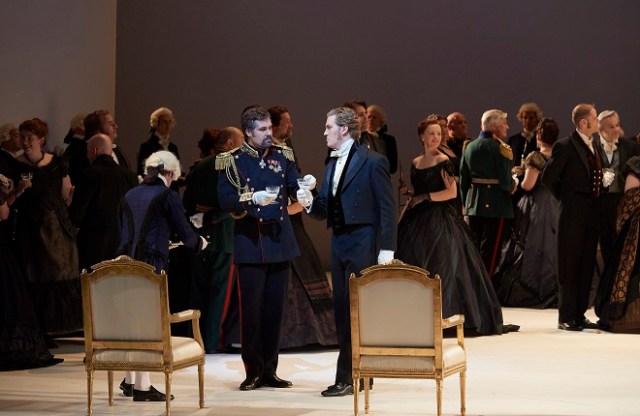
There were two parts to tonight’s show. After intermission we saw one of the glories of the operatic stage, namely Purcell’s Dido & Aeneas in a well-conceived production that didn’t require costumes but did entail some clever use of the Anna Bolena set (designed by Benoit Dugardyn), a production that stands with some of the best work I’ve seen from the COC. I loved it so much possibly because it was so much better than what we’d seen before the intermission.

We began with a series of scenes from Mozart’s Cosi fan tutte that pale in comparison to the tight organic performance of Dido. It was the same group of singers before & after intermission, sounding marvelous on the whole and accompanied by the COC Orchestra led by Johannes Debus. If you ask me (and nobody did), if opting to present only part of an opera, the choice of scenes needs to be more carefully thought out than on this occasion, as the Cosi scenes were to my eye rather awkward. We began in media res, handing things to a character who is always liked –Despina—while expecting the four lovers to grab us without any exposition, no chance to create a through line either with us or for them with their character. I think this choice was simply too difficult for the singers, and of dubious value in the creation of a micro-characterization.

But let me get back to Purcell, the wonderful and indeed indestructible Dido. Every moment was gold, the orchestra sounding delicate & committed. In fact part of my problem with the Mozart might be that I felt it was a bit brusque, barely intelligible, whereas I caught every syllable of every word in the Purcell: something that owes as much to Debus’s sensitive ear as to the enunciation of the singers. Was Debus preoccupied, perhaps mindful of a farewell he would be making to some of the members of the orchestra?  Of course there is value in the experience, as singers tell horror stories of unsympathetic conductors (part of the job, right?). They mostly kept it together. All I know is that everything was a thousand times better after the interval, although the fact we were dealing with a complete work in a well-conceived production, surely had a lot to do with it.  In the program one sees “Dramatic Consultant –Anna Theodosakis”, leading me to wonder how this was done. No actual director credit? Were the Ensemble Members only getting advice without actual direction? Ah well. ‘Tis a mystery.

And hindsight is 20-20 of course.

DSC_3895_preview

Soprano Danika Lorèn and soprano Lauren Eberwein in the Canadian Opera Company’s An Evening with the Ensemble Studio, 2018, with the COC Orchestra conducted by COC Music Director Johannes Debus. (Photo: Gaetz Photography)

There were some wonderfully original touches such as the meta-theatrical choice to have Dido onstage watching the witches, as though they were haunting her dreams. And while this wasn’t a period approach, when Lauren Eberwein said “remember me” staring directly into Danika Lorèn’s face, I totally lost it. The two of them had genuine star power throughout the evening, Loren effortlessly switching from the wackiness of Despina to the darker shades of Belinda.  I was mindful too of the question of vocal type, after having heard Keri Alkema’s thoughts just a few days ago about changing from a mezzo-soprano to a soprano.  Eberwein herself has made such a switch (notice that she’s called “soprano” in the COC photo credit) even though Dido is usually understood to be a mezzo role: but embellished by some higher notes.

Everyone had their moments though. Bruno Roy was strong as both Don Alfonso & Aeneas, Megan Quick dominating the stage as the Sorceress, Samantha Pickett & Simone McIntosh delightful in their witchy machinations (and which seemed so much more fun than what they were given to do as Fiordiligi & Dorabella), aided and abetted by Samuel Chan who then slipped into the sailor’s role (although everyone was in formal attire).

Maybe I ask too much, but I think less is more. If I had only seen Dido tonight I would have been more impressed by the COC’s Ensemble Studio than what I saw. Yet it’s a work in progress. It will be interesting to see what they’ll do next year.

Posted in Music and musicology, Opera | Tagged , , , , , , , , , | Leave a comment

Keri Alkema: A Journey of Transformation

Today’s noon-hour recital at the Richard Bradshaw Amphitheatre aka the foyer of the Four Seasons Centre was unlike any we’ve seen before.

Readers of this blog may recall that I’ve expressed my admiration for Keri Alkema in my reviews of her Tosca last year, her Vitellia from a few years back and again in Anna Bolena a few weeks ago.  There was no way I would miss the chance to hear and see her up close.

16-17-05b-MC-D-1890

Kamen Chanev as Cavaradossi and Keri Alkema as Tosca in the Canadian Opera Company’s production of Tosca, 2017, photo: Michael Cooper

I came expecting to hear Keri Alkema’s beautiful singing, but that was just part of it.  The program on the page was unlike any other:

  • “All’afflito è dolce il pianto (Roberto Devereux) – Gaetano Donizetti
  • “Mi tradi quell’alma ingrata” (Don Giovanni)—Wolfgang Amadeus Mozart
  • “Morrò, ma prima in grazia” (Un ballo in maschera)—Giuseppe Verdi
  • “Salce, salce…” (Otello)—Verdi
  • “Che tua madre dovrà” (Madama Butterfly)—Giacomo Puccini

I was tempted to call this “Keri Alkema, this is your life”, as we were taken along on a musical journey, ably supported by Rachel Andrist at the piano.  Not only did we hear the arias but we heard a great deal of personal commentary in this most informal and relaxed concert.  The transformation? From mezzo-soprano into soprano.  The Donizetti aria with which we began is a mezzo-soprano aria, one from earlier in Alkema’s career.  Her role as Giovanna Seymour in Anna Bolena¸ the opera she’s currently singing with the COC, is also a mezzo-role.

In addition to the arias, the recital included anecdotes – for instance the time her Otello accidentally smacked her so hard in the face onstage as she sang Desdemona that she literally saw stars, and wondered if she’d be able to even open her mouth to sing —and a series of questions & answers from the audience.

I was astonished by something else Alkema brought to the stage, namely a complete commitment in each of the arias.  She joked about the vulnerability she felt in this venue & in this program, her first such recital in awhile.  That was another aspect of the concert that was unique.  We could see her sweat, and at one point in the final aria, she thought that we saw her sing a note slightly less than perfectly.  Frankly, I think the note was fine, but what was extraordinary was to observe her portrayals in an exposed & genuine method-acting approach and up close.  Alkema was wonderfully at ease, unprotected by a costume or an affected attitude. Many of my favourite singers choose to take on a kind of stylized facial expression that owes at least something to the ancient Greek masks, that can be as blank as pure abstraction, and therefore freed of anything too personalized.  One can disappear into such a mask, but one can also hide behind it, especially if one might have a moment when one wonders about the voice.

Not so Alkema.  In each instance, Alkema gave us another sort of transformation, namely that of her portrayal, vanishing into the character instantly.   Donna Elvira had a heroic ferocity, her Emilia, a desperate regret, her Desdemona, a wonderful panorama of emotions, as she told the story of Barbara and her willow song, jumping fearfully at the sounds at the window, and closing prayerfully.  And then her Butterfly illustrated one of the great challenges with Puccini’s opera, of keeping the mask in place, of portraying without reacting to the music & the emotions one is signifying.

We heard a great deal about mentors such as Marilyn Horne & even Sondra Radvanovsky who currently portrays Anna in the same production at the COC.  I was struck by Alkema’s genuine humility as she spoke of colleagues and influences, as this is a singer who has a great deal to offer the younger ones coming up.  That next transition is still to come, the natural culmination of development when one begins to give back to the next generation.

Today’s concert was like a workshop on the mezzo-soprano voice, an intriguing combination of vocal demonstrations and discussion.  I was hooked, not just because I love her voice, but also because I find the mezzo voice to be one of the most intriguing of all operatic phenomena.  I grew up accompanying a baritone, and attempting to sing, first as a baritone then as a tenor, so I am always curious about the parallels in the mechanics of the female voice-types.  Alkema sings as a soprano, but began the recital with a mezzo aria. I wondered if that might change the way she sang in subsequent numbers.

Was I imagining it, when I heard the lower parts of “Mi tradi” seemingly emphasized (so rich & full), while the higher notes were sung with at least thoughtful care rather than wild abandon?  I found myself identifying what it must have been like the first few times venturing up above the treble clef to those high notes.

Alkema was so vulnerable in telling us about the adventure, particularly in Ballo, which is one of the toughest roles of all.  What’s it like to discover doubt and fear in the middle of a role, and how does one surmount that?  It was quite a story.

I hope the COC will bring Alkema back so that we can see the next phases of her development.  But first? Keri Alkema & Sondra Radvanovsky have two performances of Anna Bolena left this week.

ANDRIST_KERI

Rachel Andrist (piano) and Keri Alkema perform in the Richard Bradshaw Amphitheatre, 2018 (photo: Kevin Lloyd)

Posted in Music and musicology, Opera, Reviews | Tagged , , , , , , , , , , , , , | 1 Comment

Questions for Bruno Roy

Time flies.

It seems like it was only yesterday that baritone Bruno Roy was a finalist in Centre Stage, the 2015 Ensemble Studio competition. The new voice that we had never heard before? He is now about to make his final appearance as a part of the Ensemble’s annual showcase concert, “An Evening with the Ensemble Studio” on Friday May 25th.

Of course I had to ask him a few questions.

danika_bruno

Danika Lorèn and Bruno Roy perform during An Evening with the Ensemble Studio, 2017 (photo: Bronwen Sharp)

Are you more like your father or your mother?

I would say I am a good blend of both of them, although I am a spitting image of my mother (many have called the resemblance uncanny). Both of my parents are French Canadian and my affinity for the French language has always been a core element of my musical identity. My mother is a small business owner so we now share that business acumen and my father is a hard working person who can fix literally anything (I still have much to learn from his mechanical ability, something we unfortunately do not share.)

What is the best or worst thing about being a singer?

I would say that the best part is that I get to do something that I really love as a job, it’s something that makes me feel quite blessed; entering university there was a great uncertainty as to whether I could make a living of this field but I now feel more confident about it. The discipline required is difficult sometimes. Some days it might mean that I need to talk less, or shouldn’t go out to see a movie or help a friend move – when it comes to singing, we need to be kind to our bodies as that is our instrument.

Who do you like to listen to or watch?

I listen to music of all types, from hip hop to post rock and experimental music and I really do think that when it comes to listening, variety is the spice of life and all musical genres can have an influence on my mood and even my musical artistry.If I listen to opera, Gerald Finley is one of my favorite singers, still active today, and his artistry transports and inspires me to be a better artist. I had the opportunity to meet and participate in a masterclass with him a few years ago and I will forever remember it as a highlight of my university career.

What ability or skill do you wish you had, that you don’t have?

Like many I think I would like to be able to teleport. In our business and also with the way that our generation is much more mobile travel can really be a chore, especially when the distance also separates us from loved ones. In a more realistic sense being able to know more languages could always prove useful.

When you’re just relaxing and not working, what is your favourite thing to do?

In my time off I love hanging out with friends, going for nature walks with my girlfriend when we can and also staying in and bundling up to watch a movie with a tea and some snacks. I have no shame in saying I am a little bit of a home body at times but reading a book, listening to music and enjoying the company of people who are dear to me is a good time – I guess I’m easy to please!

DSC_4514

Bruno Roy, 2017 (photo: Gaetz Photography)

*******

More questions for Bruno Roy about life in The Ensemble Studio, as we come up to his final appearance as a member in the May 25th Showcase, “An Evening with the Ensemble Studio”.

Now that you’ve come to your last months, please reflect back on the competition & the process of getting into the Ensemble Studio, including any advice you might have for young singers. 

The competition was an amazing introduction to the company. It was an opportunity to meet all of the trainers and artistic heads of the company and everyone was very welcoming and supportive. I must admit that stepping onto the Four Seasons stage with orchestra in the pit was pretty intimidating but the support I felt during the callback week definitely helped make me feel confident to take centre stage. Prior to the audition and callback I was fortunate enough to still be in school and having the necessary time to prepare my two arias. I worked double time with my coach Michael McMahon and I think ultimately the repetition and detail work I did on those pieces of music really helped me feel comfortable by the time I arrived in Toronto. As I move forward and find myself splitting between many projects, I think back to how important that preparation had been. Everyone’s path is different but I know that work helped me stay flexible when it came the time to present the arias with the COC orchestra.

2017-09-26-FCS-Ensemble-130

Bruno Roy and Stéphane Mayer (background), 2017 (photo: Chris Hutchenson)

Talk about your time in The Ensemble Studio. What was it like?   

Being part of the Ensemble Studio was overall a big change for me. I had never moved away from home (Montreal, where I also attended McGill University) and initially the studio was a lot of hard work. When I joined the studio I had to adjust to a new lifestyle and was also developing a new, more critical perspective on my vocal technique. I was becoming much more aware of what I needed to work at to reach the next level and felt an inner push to constantly better myself alongside the multiple assignments. Thankfully I was surrounded by a wonderful group of colleagues who welcomed me to this city and I have loved my time in Toronto. Although it was a lot of hard work there are special moments I will always remember: being on stage as the Jailor in Tosca as Adrianne Pieczonka sings a glorious high C before plunging to her death, feeling the rumble of the COC orchestra from the pit at the beginning of Rigoletto, performing music that my colleagues had written for a concert in the Richard Bradshaw Amphitheatre, getting the opportunity to work one on one with singers like Jane Archibald, Russell Braun and Roland Wood, and so many other moments that sculpted my time at the company.

Maker:S,Date:2017-8-12,Ver:6,Lens:Kan03,Act:Lar02,E-Y

As part of Jane Archibald’s artist residency, she set aside time to share her knowledge and experience with the next generation of emerging artists —pictured is a session with baritone Bruno Roy.

What does the Ensemble Studio mean to a singer’s future? 

The Ensemble studio really helps bridge the gap between school and the profession for young singers. It’s a way of getting our craft out there, both by getting singing opportunities on the Four Seasons Stage and also by getting to audition for various companies and industry leaders that find their way through Toronto. Getting a chance to be in the ensemble was a great experience, it is a special feeling knowing the company respected what I was doing with my craft and wanted to support me in my training. Moving forward I will now have a network of contacts and colleagues that can support me once I leave the studio. Knowing of all the singers that have been through this program and the success that they have had through hard work I felt very inspired and blessed to be able to take part in this program.

Please talk about what you’re going to perform in the Ensemble Showcase May 25th 

The Ensemble studio will be performing excerpts from Mozart’s Cosi fan tutte in addition to the entirety of Purcell’s Dido and Aeneas. We have been working at this program (which will be presented with full orchestra) for a while now and we are very excited to present something of our own alongside the COC’s regular season. I will be performing Aeneas in Dido and Aeneas; this will be my first time stepping into the shoes of a heroic character and I am definitely thrilled and looking forward to it! I am taking on Don Alfonso for the Cosi scenes and although I may not be quite ready for the full role, Alfonso’s music feels comfortable and he is a fun character to embody! My ensemble studio colleagues have a put in a lot of work into their respective characters, both in their characterization and the ever important diction (with an English opera we want to make sure the audience understands every word) and it has truly been a treat to be able to prepare my final performance at the COC with them.

Can you tell us of anything of your life after the Ensemble Studio ? 

I am leaving soon after the Ensemble showcase for Montreal where I will be performing in a chamber opera titled “Nero and the Fall of Lehman Brothers” by American composer Jonathan Dawe with a company called Ballet Opéra Pantomime. It will be my first professional engagement in Montreal since I left for Toronto two years ago. I will also be performing in Haliburton, Ontario with the Highlands Opera Studio as Marcello in their production of La bohème in August; I’m very excited to sink my teeth into that role and make new connections with other singers. In the fall I am also moving to Frankfurt, I will have a lot of free time and am excited to start making new connections in Germany. I will be back in Ontario in the spring of 2019 for concert work and I do intend to try and perform in Canada as much as possible even though I will be settled overseas with my partner.

The singing actor is a curious hybrid creature. Some people come to it via music, some via theatre leading me to ask about your personal equation, and your background as a stage performer. 

My way into opera was through singing initially. I performed in a big youth choir throughout elementary and high school and had barely any acting experience by the time I got to university. Although I dabbled with theatre late in high school and we had intro to acting classes in university it was really only when I was assigned my first opera roles that I began thinking of myself as an actor. I’ve always used music and text as my first step into acting, what I could learn from what my character and those interacting we’re saying will always be what I go to first. As opera singers we are fortunate since the composer can sometimes give us a clear picture of the emotion or state of mind of character with the line, rhythm and dynamics indicated in the score. I learn something new about the acting process every time I step into a new role and throughout my time in the studio I have felt these acting instincts grow; for me nothing beats the experience doing, it is how I learn the fastest.

Do you have any stories you could share from your time in the Ensemble Studio? 

When I think back on my time in the studio, there are a lot of things that come to mind. Some were stressful in the moment: when we were out on school tour in the Kingston area, some of the wrong costumes had been brought – the cast rallied to make the best of it as we could not get the costumes and that definitely helped us bond;  we also delivered on a great show that day! Other times I felt like I was part of something bigger than I was: sharing a drink with visiting artists, feeling an artistic connection and camaraderie with people sometimes twice my age, feeling part of the global opera world. Many of these things I didn’t expect to feel as a young artist and the ensemble studio made me feel like a true professional. There are so many anecdotes, jokes and moments when everything could go wrong on stage and hopefully I will get to share more of those moments with these colleagues again.

What roles do you see yourself undertaking?  

I do see a lot of French opera roles in my future. Because of my background and high placed baritone I feel like I have an affinity for this repertoire and thankfully I also love it! Pelléas from Debussy’s Pelléas et Mélisande is definitely a dream part. I am also fascinated by grand opera, be it the French operas of Rossini and Verdi as well as those of Bizet and Gounod; I do hope that one day I may find my way to this repertoire. Interestingly though I know that I will learn to love most of the repertoire that comes my way and I may even find a new dream role by exploring other repertoire.

Who is your favourite composer, AND (not necessarily the same question)whose music do you think sounds best in your voice? 

As I mentioned earlier, the music of the French composers really suits my voice. Debussy, Ravel and Poulenc’s music has always been an easy fit and the language seems to bring out a natural quality in my voice quite well suited for this repertoire. On the other hand, Verdi is one of my favorite composers and I think the way he managed to tie beautiful music in with the drama has always fascinated me. I think everyone would agree that the man knew how to write a tune! After singing in Rigoletto this season at the COC, I am excited about the next time I can dive into Verdi’s world; luckily he even has a few French operas!

purdy

Professor Winston Purdy

Is there a teacher or an influence you’d care to name that you especially admire? 

My teacher Winston Purdy, who passed away last fall, was one of my biggest influences. I will always remember his love and passion for the song repertoire and his grounded, relaxed teaching. I am reminded of his wisdom every day and he is definitely one of the main reasons I keep pushing myself to explore and discover my musical identity.

*****

Bruno Roy joins his colleagues for one last time as part of An Evening with the Ensemble Studio,7:30 p.m. on Friday May 25th at the Four Seasons Centre.


Posted in Interviews, Opera | Tagged , , , , , , , , , , , , , | Leave a comment

Hockey Noir

I love ambition.

Tonight I was plunged into a world completely unlike anything I’ve encountered in opera, and it will be replayed tomorrow.  Okay, performed again I should say, even if it does feel like a hockey game at the Jane Mallett Theatre.

There are red and blue lines, boards, and lots of passion (as you can almost glimpse in this picture).

damphousse

You can see a bit of the stage, although the main reason for this picture was the charming sweater of the gentleman directly in front of me.

Start with this premise:

  • that we recall the rivalry between Toronto & Montreal in hockey from the era of black and white television
  • that we make a kind of film noir story out of that rivalry by injecting some romance
  • and it’s an opera

So did you get all that? They’re presenting a 1950s film noir about the hockey rivalry between Toronto & Montreal.  That’s what I mean by ambition.  You don’t get much more Canadian than that, especially when it’s in both official languages with splashes of Joual.
And it’s a collaboration between Continuum, Ensemble contemporain de Montreal (ECM+) and the Toronto Comic Arts Festival giving it great flair visually and aurally.  It was not so much a film noir as a graphic novel, sepia images reminding me of old black and white TV hockey broadcasts. Still images or animated ones were projected onto the screen behind the live performers.

ECM+ filled Jane Mallet Theatre, a string quartet, keyboards and percussion, conducted by Veronique Lacroix.   The opera is an 80 minute collaboration between librettist Cecil Castelucci (who has several graphic novels under her belt) and composer André Ristic, who has several previous commissions with ECM+, in four acts.

hockey-noirAnd like any good film noir it’s narrated from the point of view of a detective, this time Detective Loiseau.   I was immersed in something unlike any opera I’ve ever seen.

I love its ambitions even though the hockey fan in me quibbles with its anachronistic errors.  For instance, “slot” and “slapshot” were words that were never heard before 1960, coined much later; and the image onscreen of a goal-crease is round… I just looked up a goal by Guy Lafleur from 1979 on youtube and even then the crease was still rectangular.

Forgive me! I am a stickler. NB the teams in the opera can’t be Leafs or Habs likely due to copyright concerns (as you can see in the picture above)


Even so this was a magical opera presentation.  We were re-enacting Richard Wagner’s point, from Opera and Drama, that opera was not a form employing music for dramatic ends, so much as a form using drama for a musical end.  We were immersed in passionate singing about love and relationships and yes, sometimes about the game.  Much of what we heard was marvelous, especially coupled with the sophisticated visuals. We were in no danger of mistaking this for real life because it was so stylized, surrounded by the magnificent projections.

I could be wrong but I think Quebec society & culture are more laid back, less likely to give too sh**ts over what some hack writer like moi should have to say about anachronism and opera.  They took their concept and ran with it, which is what we need to see more of here in Toronto.  The adaptors were as bold as Mafia hitmen (yes that was in the story too), making no apologies for their eclectic mix of styles.  The audience—who must be the youngest audience I’ve ever seen at an opera that wasn’t geared for children—totally ate it up, likely because they were nerdy young graphic novel fans, entirely in their element.

It’s like nothing I’ve ever seen, and I think that’s a good thing.  Continuum / ECM+ are back Friday night at 8 pm for another performance at the Jane Mallett Theatre.

Posted in Music and musicology, Opera | Tagged , , , , , , , | 1 Comment

Questions for David Fallis: Toronto Consort & Monteverdi’s Orfeo

When I interviewed David Fallis five and a half years ago concerning a period production of Der Freischütz my first sentence said that he “is surely one of the most important musical minds in Canada,” an assertion that has only gathered weight with every passing year.

Have no fear, he’ll still be prominent in Toronto’s musical life. While David’s tenure as the Artistic Director of Toronto Consort ends this season, he’ll continue to work with them, as well as in his roles as Musical Director for Opera Atelier and Choir 21.

David closes his final Toronto Consort season as Artistic Director with three performances of Monteverdi’s Orfeo at Jeanne Lamon Hall at Trinity St Paul’s Centre beginning May 25th.  I had to ask him a few more questions.

G.Dou, Spitzenkloepplerin - G.Dou, Lace maker -

David Fallis (Photo credit: Paul Orenstein, digital work by Ross Duffin, background by Gerrit Dou 17th century, Dutch).

1. What has the Toronto Consort meant to you?

The Toronto Consort has been an exciting place to explore so many repertoires of music which are too little heard today. I say repertoires, in the plural: since we perform music from roughly 1150-1650, there are many styles and developments to come to understand (sometimes lumped together as “early music”), and it has been great to have a vehicle for constantly discovering new and beautiful music. This is thanks to our strong base in Toronto, where an appreciative audience comes back year after year, but they naturally want to hear new music each season.

The ensemble has been blessed with great, committed performers over the years, and it has been a privilege to work with them, and get to know them so well.

Since early music is often unknown, we’ve always felt that it is important to give the audience a context, and this has led to great collaborations with actors, dancers, visual artists, world musicians, etc., and to the chance to create scripts and stories which can add so much to the concert experience.

2. As you look back at your years with Toronto Consort, do any concerts stand out, perhaps for the piece being presented, perhaps for the guests or the performance?

This is a hard one! A few possible candidates:

  • our most recent version of the Monteverdi Vespers of 1610, which sounded even more magnificent than before in the newly-renovated hall at Trinity-St. Paul’s Centre, with Charles Daniels leading a team of fabulous singers, and Bruce Dickey leading a group of fabulous players
  • the feeling of having the audience join in on “In dulci jubilo” at the end of the Praetorius Christmas Vespers has always been magical, achieving the sense of community participation which we strive for in that concert
  • it was a dream to perform “The Play of Daniel” with a youth choir, and to hear them all sing the Te Deum at the end, with the bells ringing around the church, is something I will never forget

    DSC0166_2

    From The Play of Daniel in 2017: Belshazzar – Olivier Laquerre (l) Noble – Bud Roach (r) (photo: Glenn Davidson) . Olivier Laquerre and Bud Roach appear courtesy of Canadian Actors’ Equity Association.

  • the serenity and beauty of “A Medieval Christmas”, curated by Katherine Hill, with images projected in the darkness
  • countless opportunities to sing great one-on-a-part vocal music with such a great vocal consort – it’s like working in a string quartet: challenging but one of the most rewarding things for a singer

3. Recalling all the different roles with the Toronto Consort, as performer & curator, and impresario, and knowing that you don’t have to do all that for much longer, please reflect, which parts did you find most rewarding, and are you breathing a sigh of relief as far as any part of the job is concerned?

Choosing a program of early music has many challenges. You have to find a theme, find the sheet music itself, decide if it is good music, decide if it can fit the Toronto Consort, make lots of decisions about scoring/arrangements, etc. I have always felt that the beauty and quality of the music must be of first importance, so it’s not always easy to find the perfect piece for a certain moment in every program, but when it works it is wonderfully rewarding. I will miss the “thrill of the chase” in that sense – finding something which is worth hearing that not many other people have noticed.

But I know that there are lots of great ideas and musical programmers in the Consort, so I know that tradition of “searching for gold” will continue.

4. Help us to understand what’s involved in being a curator/ impresario for music that existed so long ago.

As I mentioned above, the quality of the music is #1. Then, like a curator, you have to set the piece in the right place, with the right light on it. This means spending a lot of time organizing the order of the pieces to create a sense of wholeness to the evening’s program, with enough contrast, enough common ground, between pieces.

Of course, there is a lot we do not know about musical performance so many years ago, but I like to be inspired by what we do know, and then commit to whatever equivocal decisions we have to make. Especially in the Middle Ages, I think music was often heard and understood differently than today, but that “strangeness” can be very mind-opening if you are willing to explore it.

5. Out of the complex planning and development cycle, what’s your favourite moment when you mount a concert or an opera?

You hope to reach a moment when you feel that the order of the program is settled, and that it has a rhyme and reason. For opera, it is always thrilling when, after weeks of staging rehearsals, we add the orchestra and suddenly the colours in the composer’s ear are revealed.

6. What do you love about the repertoire you’re playing & discovering?

It depends on the particular rep, but in renaissance music, I love the directness of the rhetorical quality. I love the fact that what’s on the page is only the beginning of a piece of music. Almost like jazz musicians today, we are expected to add and create new things, guided by the original piece of music. I love it when what was, only a while ago, some scribbles in an obscure source have become a living piece of music.

7. Do you have a favourite moment in Orfeo?

Another tough one. Again, some possibles:

  • the messagiera scene, where Eurydice’s death is told by an eye witness
  • Orpheus’ response to hearing this news: “Tu sei morta” and his resolve to go to the underworld to get her back
  • Persephone’s pleading with Pluto to let Orpheus into the underworld (“Signor, quel infelice”)
  • “Possente spirto” with its singing, the echoing solo instruments, the harp solo, the slow harmonic pace, the magic of the music as it creates this eerie underworld scene
  • the brass sinfonias, and male choruses which end Acts 3 & 4, so solemn and so different from the lively choruses earlier

8. Please talk about the cast in Orfeo and what we’ll be hearing.

Charles Daniels is divine in this repertoire, and it’s really his piece.

pudwell_laura

Mezzo-soprano Laura Pudwell

And we have a great cast around him, with Laura Pudwell as Messagiera, Katherine Hill as Musica, Michele DeBoer as Persephone, Kevin Skelton, Cory Knight and Bud Roach as shepherds.

The instrumental colours are also magical in Orfeo. The theorbos, harp, harpsichords, organs, strings, recorders, cornetti, sackbuts are all used in wonderful ways, and the sounds of the orchestra is constantly shifting.

9. Is there a reason why Orfeo seems like a fitting conclusion for this chapter of your life? [or am I reading too much into this..?]

Well it depends what you are reading into it 😉

[When I was young Orfeo was known as the first opera, a notion that has since been overturned, so it seemed fitting / symbolic. Oh well…]

I’m glad to be ending with Monteverdi, one of the greatest of early music composers, and glad to be ending with such a great team of musicians.

10. How do you relate to Medieval and Baroque music & opera as a 21st century man?

There is a wonderful balancing act you do as a 21st-century musician dealing with repertoire that is so old. On the one hand, you want it to be comprehensible and moving for a modern audience; on the other you also are intrigued and curious about the “otherness” of early music. You are always struck by similarities with the modern condition, and by differences.

With lots of medieval and renaissance music, you know you are often presenting music that much of the audience is hearing for the first time, sometimes because it may indeed be the first time it’s ever been heard in Canada! So you enjoy the spirit of discovery and newness.

Which leads to:

11. You’ve divided your time between older works –both with Toronto Consort & Opera Atelier—and newer ones, as the Music director of Choir 21 (a choir specializing in 21st century compositions). Going forward, will we see you with those three ensembles?

Maybe it’s the same spirit of discovery which has attracted me to both early music and contemporary music.

And, yes, I’m not retiring, only stepping down as AD of the Toronto Consort, so besides my continuing on the team of Artistic Associates at the Consort (next year I will be leading the Praetorius Christmas Vespers for the Consort in December, and doing a program of modern music written for the Consort in February), I will still be working with Opera Atelier and Choir 21.

12. Your music direction & performance of Ulysses (with Opera Atelier), a more mature opera by Monteverdi, likely stayed in your head while you were rehearsing Orfeo. You are acquainted with Monteverdi on so many levels, as teacher & practitioner. Please reflect on our understanding of Monteverdi, the difference between the two operas (reflecting his growth & development but also the growth of opera itself) and how that informs your process.

Orfeo was written for a courtly/academic milieu where the rich orchestration and the beautiful sensitivity to the elegant poetry was central. By the time of Ulysses, opera was being performed in a public theatre trying to turn a profit, so the focus had changed somewhat. The orchestra was reduced, the storyline features more “action scenes” etc. Orfeo has almost the quality of a religious rite, where Ulysses is very much a human, even domestic, drama. But Monteverdi’s sureness in creating drama and bringing the text to vibrant life with his music never falters.

*******

David Fallis conducts Toronto Consort’s concert presentation of Monteverdi’s Orfeo May 25 & 26 at 8 pm and May 27th at 3:30 pm at Trinity-St. Paul’s Centre.

And next season David will be back:

  • a double-bill of two short operas in the fall, namely Charpentier’s Acteon & Rameau’s  Pygmalion  October 25 – November 3, 2018,
    and Mozart’s Idomeneo in April 2019 with Opera Atelier
  •  Praetorius Christmas Vespers in December 2018 with Toronto Consort
Posted in Interviews, Music and musicology, Opera | Tagged , , , , , , , , , , , , | 2 Comments

All –Beethoven Tafelmusik Finale

Tonight’s programme from Tafelmusik was the first of their season-ending concerts at Koerner Hall. We heard Beethoven’s violin concerto & the Pastorale symphony.

Thinking about moustaches & tears earlier this week, it felt serendipitous to be studying the same sort of phenomenon tonight.  Both the guy sitting next to me and I were fascinated to watch a child so moved by the Beethoven that they danced around in their seat, at times resembling a ping-pong ball boing boing boing-ing, first left, then right, then left, and so on, from one parent to the other and back and forth with the energy only a child high on Beethoven can muster.

Tafelmusik always strikes me as a kind of phenomenological laboratory, wherein we explore the creation of the music they are presenting.  To hear Beethoven played on their more natural instruments isn’t quite as perfect as what you’d hear from the modern instruments of –say—the Toronto Symphony or the Canadian Opera Company Orchestra—because of the riskier sounds produced in those old-style instruments.  And so I feel we’re brought into the presence of Beethoven as he was, the new & dangerous composer, that radical of the early 19th century. Sure, it sounds a bit ludicrous to say, when these compositions are over 200 years old, but we become blasé hearing perfect performances on the modern instruments with valves and metal strings, not recognizing how daring these works were when they burst upon the world.  To hear this orchestra risk so much in performance? That brings Beethoven to life like nothing else I’ve ever encountered.

Okay, so that’s the usual laboratory for me, hearing Beethoven or Mozart as if from first principles. But in addition we were presented with a miniature psychological experiment that echoed some of what I wrote about a few days ago. This time it wasn’t a question of weeping (although I was momentarily blind-sided by tears watching the child bouncing around), but joyous phenomena:

  • dancing
  • singing
  • laughter
  • applause

Think about it.  These are all the things we suppress in a classical concert, as though we were checking our humanity at the door, hung up with our coats & scarves. And so of course, the parental units were not entirely amused, although I was mightily impressed with how they handled their little firecracker, who looked to be 6 or 7 years old.  I wanted to surrender myself, wanting to applaud after the first movement –the way any normal person would have applauded in 1805—and indeed after the wonderful cadenza, again as any normal person would have done, back in the day.  We’ve had our spontaneity curtailed by the conventions we now agree to in 2018, although had this been a rock concert? I think the woo hoos would have erupted spontaneously.

I’m going to see this program again on the weekend.

First we watched Elisa Citterio play the Beethoven Violin Concerto.

elisa_citterio_tafelmusik_music_director_designate

Violinist Elisa Citterio, Tafelmusik’s new Music Director

Is this the best of all the violin concerti? Maybe not. But it is my favourite because it has such drama, appearing out of the slow plodding figure in the timpani, a sweet slow melody with great passion, energies held in check but explosive under the surface.  The cadenza that Citterio created was every bit as profound as the movement from which it emerged, including a wonderful statement of the main theme in a contrapuntal creation back and forth between two adjacent strings.  As I said, I wanted to applaud the cadenza, and again at the end of the movement. Only in the third movement –when the child started to dance—did the passion find legs.  Conductor Bruno Weil gave us a wonderful series of tempi, always keeping things moving, with spirit yet always eloquent. My one discouraging word would be that Citterio’s matching cadenza for the third movement was probably too long & fraught.  My opinion? Perhaps, but the child stopped dancing, stopped cold by all this ambivalence & chromaticism in a movement that is mostly diatonic. Indeed I’d say that’s the concerto’s real dramaturgy: that it tortures us with chromaticism for the first movement, gradually emerging into the clear air of the diatonic particularly in the last movement. To insert all that angst in the last movement? Out of context, I feel. Movement One is perhaps like Chekhov or Pinter, but movement three?  Not so dark or complex.   Even so the concerto is magnificent, the performance a watershed for Tafelmusik working with their new Music Director. The smiles! those erupted from faces all through the orchestra.

Beethoven-Symphonies-Bruno

Conductor Bruno Weil

After the interval came the 6th Symphony, another beautiful performance from Tafelmusik.   I went looking for what I wrote about their complete symphony recording that I reviewed a few months ago, conducted by Bruno Weil.

Weil does not suppress one part to help bring out another. What’s daring and new for me in these recordings is that I can hear every little part.  I can’t help thinking that this is what Beethoven must have sounded like in his first appearance: that is, in the performances before conductors started regularly “interpreting” symphonies in particular ways (aka distorting and changing the music). (review)

So too tonight, especially in the third movement, when Weil allowed all the various voices to have their turn without picking one to be the “melody”.  It’s fabulous. I can’t help thinking it might be closer to what Beethoven created in his own time, before conductors started “interpreting”, aka distorting the music.

And at the end I was shaken thinking about this hymn to nature and ecology, wondering if the shepherd who celebrates the Earth’s renewal in the last movement could have imagined climate change & whales choking on plastic.  Is there a possibility for the planet’s renewal or are we in a death spiral?  Listening to this lovingly presented antique, namely the careful performance from Tafelmusik & Weil, it’s especially poignant.

I recommend you go hear this concert if you can.  I’m going again on the weekend.

Posted in Music and musicology, Psychology and perception, Reviews | Tagged , , , , , , | 2 Comments

Cry for me

Some actions are startlingly ambiguous.  Right now for example I’m not shaving my upper lip. Am I growing a moustache –which would be an action—or am I simply not shaving my upper lip?

I had that thought, thinking about a topic that reared its head a few days ago, in passing, at the beginning of an opera review, where I spoke of crying.

I’d mentioned crying in response to opera.

And the next day a friend spoke to me about her husband, who had seen the review and was delighted because he also cries at the opera. And like me, he is of a generation reared to conceal such feelings.  Two other gentlemen also spoke to me about crying.

So I thought I’d talk about it a little bit.  When I started I thought I wouldn’t have more than a couple of paragraphs. Surprise surprise, the floodgates were open, and I am working hard to stop this from turning into War & Peace.

And so as it turns out, we’re speaking of another thing like my shaving example, hm, and here I am thinking of that proverbial stiff upper lip.  I suddenly have a new perspective on the metaphor.

I have to ask, is it that we sometimes cry, or that we sometimes don’t stop ourselves from crying?

The analogy goes further.

There’s a kind of choice between a natural process and an intervention, refusing nature’s pathway.

The hair growth is the process that happens naturally, even, gulp, after we die (or so I have read). Shaving is a revolt against nature, an attempt to civilize the caveman, trimming and mowing the chaos of a facial garden.

Similarly, the emotional response –whether we mean the tears or something more extreme like sobs—is a natural eruption like a rainstorm.

But I am far less lucid about the alternatives, the choices for this one. I remember being teased for my tears as a child.

Boys don’t cry, I was told.

Men don’t cry, I heard.

And it gets messier because of course I transgressed. While I may have been told I wasn’t supposed to cry: I did anyway.  I was perhaps one of the lucky ones, because I was exposed to things that would make me cry involuntarily.

Now imagine that you’re older and you discover via books or in conversation reasons to doubt what you learned before. Maybe you start to wonder if your previous conditioning was wrong.  Can you allow yourself to cry, to surrender to those impulses, however taboo or forbidden they may feel?

Or maybe you think about it: but aren’t able to do so.

It’s a deep-seated set of messages that aren’t overturned easily. I’m reminded of the stutter we saw in The King’s Speech, a kind of visceral battle of wills, between one older set of instructions at a gut level, and new injunctions at a more superficial level of conscious thought.

I can’t help thinking that opera and classical music are really good for me: because they help overturn those old faulty messages.

Wagner’s operas, especially Parsifal, were among the first works to help subvert all that bad conditioning: softening me up.


In time I have found more and more. Beethoven leads me back to my true self.  Poulenc strips away the BS and reminds me of who I really am.  Debussy too. And John Lennon.

I’m lucky that so many different media & styles move me so much. I cry for baseball movies like Field of Dreams, or the politics of The Post or JFK. It was helpful to watch Dumbo as a dad with my daughter: which stripped another layer off of me.   

One can read about the physiological processes of music.  This is your brain on music, we would discover.  There is something called a “Mozart effect”, someone claims.

So I would add my own little footnote at this point.  Perhaps there is something redemptive about music, indeed, about the arts, in restoring ourselves to ourselves and subverting the false conditioning that may have been imposed upon us.

A stoic warrior is one who denies his or her feelings in service of their higher cause: because something important was needed, that precludes the luxury of feelings & tears. At times civilization demands such sacrifice, or maybe one thinks it’s necessary in the trenches of our 9-5 lives.  And it is one’s humanity itself that is sacrificed.

Sometimes humanity needs tough heroes, and sometimes the gentler person that feels and cries, that is vulnerable and malleable.  I think nasty impulses sometimes begin in the fear of exposure, fear of being shamed. If we are given space to be ourselves in whatever failed versions, we can find a happier reconciliation of our impulses.  I recognize that what I am talking about in my personal restoration project is to redress the balance, to be less a pure warrior, less likely to sacrifice myself for a cause (and one where the enlisting was imaginary; nobody really asked me to enlist), and more likely to take care of myself.  When push comes to shove, the warrior is still there, but he is no longer perpetually at attention, guarding the citadel of visceral emotion against anything soft & tender.

In case you’re wondering, the headline isn’t like the song in the musical, and Argentina doesn’t come into it.  I am explaining what I do. I cry for me the way I run for me or lift weights for me or eat kale & krill oil for me.  I do it because it feels good, and to block the impulse is harder and harder, finally.

One of the things I do on this blog is suggest films, CDs, operas, plays, books, that you might enjoy.  Chances are you already know this phenomenon But if you’re like me, someone who was led astray when you were younger, crying might be something you’d really enjoy.

Posted in Cinema, video & DVDs, Music and musicology, Personal ruminations & essays, Psychology and perception | Tagged , , , , , , , , , , | 6 Comments

Anna Bolena: saving the best for last

Sondra Radvanovsky is the story.

Anna Bolena

Sondra Radvanovsky as Anna Bolena in the Washington National Opera’s production of Anna Bolena, 2012. (Photo: Scott Suchman)

There is no better singing in an opera in Toronto than what you’ll hear if you go see Anna Bolena with the Canadian Opera Company, and she’s not the only great voice.

I can talk about the number of times I was moved to tears. (I’m of a generation reared to believe guys aren’t supposed to cry openly, and opera is one of the safe places for me to let it out: and I do)

How many? Nine times, nine different places in the opera. Not all of them were Sondra’s doing, although by 6 or 7 I was thoroughly tenderized for the emotional last scenes.

Spoiler alert: they’re all dead. But that’s because this is an opera based on historical figures who died hundreds of years ago. Some of the characters in the opera are to be executed although I won’t tell you whether we see anyone die or not.

Did I mention that there are some amazing talents in this production?

Sondra isn’t just a great singer but also an amazing actor. From time to time she blind-sides me with a facial expression or an interpretive choice that moves me very much. Sondra plays Anna, aka Anne Boleyn. If you just arrived in Toronto or haven’t been paying attention, Radvanovsky is a world-famous star who happens to have blessed us by choosing to live in the GTA, and choosing to make herself available. Lucky us!

There’s another wonderful soprano role in this opera, namely Jane Seymour, aka Giovanna aka Seymour, portrayed by Keri Alkema. Alkema was a remarkable Tosca last year (unique intelligence in her portrayal) and a fabulous Vitellia in 2013. She makes an intriguing contrast to Radvanovsky, a worthy addition to the ensemble.

While you might believe the show is built around Radvanovsky because she’s such a megastar, it’s not so. Yes Anna Bolena is largely composed around the title character. But for most of this opera, the key character is King Henry the Eighth aka Enrico, in the big physical presence of Christian Van Horn. While he might be taller than anyone else in the show, he is often lounging in a chair while being pushed about the stage. No wonder he gets fat later in life, although at this point he’s still a handsome figure of a man. He’s also a scary piece of work who always gets his way, and has no scruple about who might get hurt.

17-18-06-MC-D-0624

From left, Allyson McHardy is a boyish Smeton, Christian Van Horn as Enrico VIII reclines centre and Jonathan Johnson as Hervey, far right in red (Photo: Michael Cooper)

Tenor Bruce Sledge is Ricccardo (Richard) Percy, once betrothed to Anna and still in love with her, singing some of the prettiest music of the night. Jonathan Johnson is Hervey, who is the ears and eyes of the King, in a slippery portrayal that had some people hissing at the curtain call: which tells you he did a great job.

Allyson McHardy looks like a handsome boy when she wears the right sort of wig in the aptly named role of Smeton, a young man who is indeed smitten: with Anna. McHardy’s luscious voice reminds you of her gender whenever she starts singing.

And so the last two Canadian Opera Company productions have now opened. Two weeks ago they gave us the premiere of The Nightingale & other short fables, a production where the visuals in Robert Lepage’s concept take you back to childhood in a series of departures from usual practice in an opera house. Today it was time for something more normal, namely opera relying upon the singing voice & musicianship in Donizetti’s Anna Bolena, the second Donizetti opera of the season. Depending on what you like in an opera, they’ve saved the best for last. While I am a total sucker for the visuals in The Nightingale, a perfect first opera, a wonderful production for children, I’d have to crown Anna Bolena the best thing I’ve seen from the COC all year.

This is Stephen Lawless’s production, to complete his take on Donizetti’s Elizabethan trilogy presented in recent years. We had Roberto Devereux also starring Radvanovsky in 2014 and Maria Stuarda in 2010. Lawless & his set designer Benoit Dugardyn remind us of the Elizabethan theatre in their staging concept. That we are looking at a playing area enclosed as though it were the Globe Theatre makes sense when we see that the King, his women (Anna & Jane) and the courtiers all thrust into a kind of performance role, their every word scrutinized and judged. We watch from our side across centuries while another audience of his contemporaries onstage looks upon the courtiers & the King, sometimes straining to hear what’s being said, voyeurs in the lives of the great & powerful: just like us.

17-18-06-MC-D-0095

Notice the resemblance to the Globe Theatre in Benoit Dugardyn’s design for the Canadian Opera Company’s production of Anna Bolena, 2018. (Photo: Michael Cooper)

Like the Lepage show it’s a great piece of theatre, although Lawless is just one piece of what makes Anna Bolena so good. Conductor Corrado Rovaris led a taut reading, the COC Orchestra shining brightly throughout, while the COC chorus were fascinating both for their musical contribution but also in their regular visits upstage as that mysterious audience.

We even see the young Elizabeth, a non-singing role.

Anna Bolena continues until May 26th at the Four Seasons Centre.

Posted in Opera, Reviews | Tagged , , , , , , , , , , , | 5 Comments

Against the Grain Orphée+

Orphée+?

That plus sign might signify an opera updated, enlarged, perhaps even reformed(?). The “+” means some remarkable additions and changes from Gluck’s original, Orphée et Eurydice (or the Italian version aka Orfeo ed Euridice). Gluck created more than one version, but the + is a 21st century incarnation whose pluses include adventurous mise en scene, electronic guitar, and a virtual chorus, who aptly mirror the isolation of so many in the modern world addicted to our phones. There are some marvelous ideas vying for our lonely broken hearts. It’s a colossal team effort, involving singers, dancers, musicians, designers, directed by Joel Ivany,  choreographed by Austin McCorrmick, a co-production between Toronto’s Against the Grain Theatre, Columbus’s Opera Columbus, The Banff Centre for Arts and Creativity and New York’s Company XIV. This is the biggest collaborative effort we’ve seen yet from AtG and expensive considering how beautiful it is in so many ways, appealing to all of our senses.

For anyone who knows Gluck’s opera this is familiar turf. The story gets told with some intriguing wrinkles and embellishments. Love (aka “Amour”) is the most flamboyant character in the story and in the production, sung, acted and… okay I have to stop and pose a question.

What is the verb for what an aerialist does? I googled and found a wonderful plethora of words and images describing the moves, a reflection of a burgeoning culture that’s far from the operatic world. Because aerials have rarely been integrated into another medium such as opera, the vocabulary is unfamiliar outside that realm. There are moves and positions that have names within the community, the same way that figure skating or dance has given names to the positions or the leaps. Just as we learned what a death spiral or an arabesque looks like, so too eventually for a single knee hang, shoulder balance or so many more. But when I start dropping the names I’ve become the sort of snob I hate (I loathe jargon on principle): so I’ll stop.

Of course part of the problem may be that it’s hard to talk when your mouth is hanging open, silenced but for a few gasps. I guess I need to get out more.

ORPHEE_497_preview

Marcy Richardson is Amour (Darryl Block photography)

Marcy Richardson is the best reason to go see Orphée+, as though the plus-sign were the twinkle in her eye. Marcy is an aerialist, dressed as Love with wings and sequins and looking like a slim petite version of Mae West (please note, I speak as a huge fan of Mae West, the under-rated and empowered sex goddess from another century). Did I mention that Marcy also sings? And that she does it while suspended upside down ten feet above the stage? So in other words we’re talking about a remarkable feat verging on a circus stunt, something that might even be called dangerous or death-defying.

All in a day’s work if you’re an immortal goddess.

You will never see or hear anything like this in your lifetime, at least not until singers routinely incorporate aerials into their training. But I wouldn’t hold your breath for that possibility. It’s not impossible I suppose. I remember being taken aback by Barbara Hannigan doing the role of Lulu on her toes, so perhaps there will be another rare multi-talented performer like Marcy Richardson.

We’re in a very interesting time for displays of beauty. One of the things I love about burlesque, invoked in the costuming and in the movement style of Company XIV, is the aura of empowerment that totally deconstructs the old-fashioned objectification of women we used to see in the 1950s and before, when a performance like the one I saw tonight could elicit wolf-whistles: but in places far removed from the operatic stage. This is a relatively new notion of beauty, an inclusive image that isn’t sizist or sexist, although it remains to be seen whether age or disability can also be transcended as well. As the bodies on this stage from Company XIV conform to the thin athletic ideal, I can’t say Orphee+ is a fully inclusive display of that sort even when the 21st century burlesque aesthetic suggests something more broadly accepting; and we did venture into ambiguous territory when dancers paired off & moved in ways to signify intimacy, at least avoiding the hetero-normative displays one sometimes sees in ballet & theatre.

What Marcy and her Company XIV entourage pulled off is stunning and apt for this opera, where she is the redeeming goddess who rescues the other two protagonists. They say love conquers all, and on this occasion it was so.

I’ll continue to harp on a theme I keep bringing up, that opera is theatre above all. We are immersed in a powerful spectacle, not just in the form of Marcy’s magnificent movement, but in the stage picture incorporating wonderful CGI on a stunning set, all designed by S. Katy Tucker. Long before we see Mireille Asselin perform Eurydice, we’re seeing her face projected in different ways, haunting poor Orphée, played by Siman Chung. All three are wonderfully musical, emerging out of the soundscape conducted by Topher Mokrzewski, an orchestral texture including keys and guitar. John Gzowski’s contribution is lurking throughout, a sound design that gives the piece an edge. When I say it sounds like hell I mean it in a good way, in an opera showing us the afterlife. The addition of electronics plus a virtual chorus may represent departures from Gluck’s original, but the goal is theatre & magic.

It’s the morning after (I set aside my review late last night) and I woke up thinking about Opera Atelier, suddenly appreciative of what they achieve and thinking of how hard it is integrating dance into the story-telling, making the dance inevitable and cathartic. They do it by relentlessly forcing everyone—dancers, singers and maybe even the stage-hands—to conform to the same consistent movement vocabulary. In places the Orphée+ dance –beautiful and skilful as it was–seemed extraneous rather than organically linked to the story-telling. Perhaps I’m caught up in the visual aesthetic & its fashionable appearance, but these dances felt more like accessories, scarves and fascinators, adornments rather than an organic living part of the whole. When I went to bed I was trying to find the right way to express what I felt was missing. But I think the key is that Gluck is known as a reformer, his Orphée sometimes austere and dry (thinking for instance of the minimalist version we saw from Robert Carsen at the COC), a reform of the excesses that preceded him in removing divertissements and extraneous decoration. The + in Orphée+ seems to be the attempt to put a lot of the stuff back in that Gluck sought to remove, a counter-revolution against the reformer. I wouldn’t object if I felt it hung together better, but my sense of the + as excess came to me after the interval. Where the first half cohered beautifully (and isn’t it always the way with daring adaptations?), the longer we went on, the more I felt that the different parts –and collaborating companies—almost seemed to be in competition rather than accord.

So in other words I think Orphée+ is AtG’s bridge too far, biting off more than they can chew, in the collaboration between one company too many, a brave attempt that still hasn’t quite gelled. So many of their productions are near-perfect especially in their ability to pull it all together around a few key ideas. On this occasion, while there is so much that’s brilliant, yet the performance felt very uneven to me, spectacularly breath-taking when Amour is onstage but far less exciting when she’s not there. We had tantalizing guitar work, some loud electronics in the scenes with the furies, and tantalizing dancers. Go big or go home I wanted to say, because I felt the negotiation underway between the existing text and the desire to make it bolder and newer. Hell could be so much more seductive, so much louder and nastier. I felt that what we got was so respectful of Gluck, in the way that a project requiring so many players –onstage and in the pit—with so many pages of musical score, must negotiate between daring adventure and more cautious steps in the service of organization & intelligibility. I wanted more adventure, more daring wild spirit. We came to pages of recitative that honour Gluck, but plunked on a guitar (or was it a keyboard? I couldn’t see for sure) rather than the usual way: a collision between the desire to innovate vs the published score by Gluck. I wondered about their creative process, commissioning John Gzowski as a sound designer, whose work was very self-effacing, peering through the pages of the score from time to time, when I wished he had been turned loose to do more re-imagining. It felt too respectful to me. And at the very end the lovely tableau was so tantalizing as we all silently stared, gradually realizing that alas the show had ended and had segued into the curtain call.

ChristopherMokrzewski

Against the Grain music director Topher Mokrzewski

Yes it’s very cool that they used burlesque in an opera. In fairness it’s from a time when opera was normally in parts & chunks, when eye candy was the reason you went to the opera in the first place. Gluck’s reform aimed to strip away the excess complexity to get back to the essence. I wasn’t sure who was winning in this battle for opera’s soul even as the collaboration seemed intent on turning back the clock on Gluck’s reforms. The musical side was impeccable, Siman Chung with a big beautiful tone, very accurately wielded. Mireille Asselin brought her usual beautiful musicianship, a sensitive and passionate delivery of every moment, and as mentioned Marcy Richardson was spectacular in every way. The virtual chorus plus the few actual chorus singers were beautifully integrated into the live performance, another impeccable outing for Topher Mokzewski.

And just as Gluck came back to his opera, aiming to improve it each time, I’m sure AtG aren’t finished with this either, especially given that they brought back Boheme and Messiah. But you still have a chance to see this version: Saturday night at 8 pm at the Fleck Dance Theatre at Harbourfront.

Posted in Dance, theatre & musicals, Music and musicology, Opera, Popular music & culture, Reviews | Tagged , , , , , , , , , , , | 2 Comments