What I learned from Bourdain

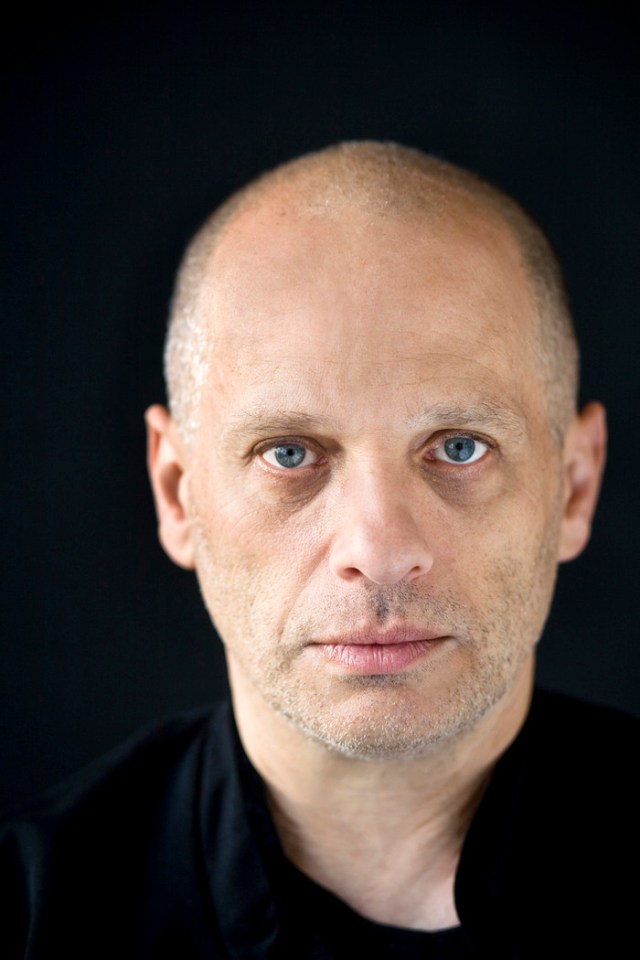
Anthony Bourdain, a man of contradictions, has died.  Yes he ended his life, but he seemed to know more about how to enjoy life than anyone I can think of.  As I watch CNN’s marathon of favourite episodes of Parts Unknown, I’m trying to pay it forward by trying to capture a bit of what I’ve learned from him, a man who was among other things a great teacher.

  1. Say “yum” or “mmm” when someone gives you a taste.  Did Bourdain ever say a critical word EVER? He takes a taste and inevitably says “thank you”.  Music critics? We could learn from this guy.  Be grateful. Getting to listen to beautiful music is a blessing.Now of course we don’t see the preparation, the research. But that only means that Bourdain & his team make sure they’re eating something wonderful before they set up the shot where everyone is moaning in ecstasy.  But it’s not so hard to stifle the negative words, is it? Smile, nod, model enjoyment & pleasure.
  2. Curiosity seems to be fundamental to intelligence.  Bourdain asks questions, always trying to figure out how things work, enquiring about what’s in a recipe and how something is made. And most fundamentally he wants to taste things he hasn’t tasted before. Remember to try something new, and when reading a menu, order the strangest thing there.
  3. Don’t stipulate. Open your heart to what’s before you. Sure, it’s all staged for TV, maybe it wasn’t like that in real life. Okay! So maybe we should pretend we’re on Parts Unknown and that we are meeting people whom we admire and embracing beauty and brilliance.  Applaud creativity, laugh at jokes, eat it up, devour what’s before you. Love it unconditionally.Later (when you’re writing about it)? then you can dissect and contemplate what might be going on. But when you’re face to face with the artists? Offer them love and support.They are apprehensive, or possibly even terrified of what you might say. Me? I’m gentle Pollyanna, so nothing to fear. But even so: be gentle, careful.

    Be nice.

  4. Be profane. Don’t be afraid of bad words. They are truthful, dammit.
  5. Listen to the person you are talking to. What do they know? where have they been? what interests them? Shut up and listen.
  6. Learn martial arts : because walking into strange places is easier if you know ju-jitsu or karate and have a wash-board tummy.  I’ll never get the rock hard abs, but it’s not a bad idea, the morning after pigging out.
  7. Eating is fun and drinking is fun and if you’re not loving it, not having fun don’t do it.  Wait until you have a good reason to eat or drink such as acute thirst or hunger.  This is really about going to see opera or a concert. What was it CS Lewis said? Fans of mystery novels should review mystery novels.  If I am a baroque and classical fan, sitting at a modern opera hating its dissonance: maybe I shouldn’t be there. Love is the answer. No I don’t know what the question is.
  8. Good cheese is better than a naked body on the beach. Although I’d love to have the opportunity to make the comparison.
  9. People are vulnerable when they are eating and  drinking.  Vulnerability? However you get it, it’s indispensable for rapport. The unmasked vulnerable person is the real person: the one you want to meetAnd know.
  10. Bourdain regularly pursues the un-commmon rather than the mainstream, the road less traveled. There’s a great episode I saw tonight celebrating examining how Marseilles is a better alternative to Paris.  So of course when he comes to Canada? he explores Québec or Newfoundland.  Of course.
  11. Compassion for the addict and their addiction: no judgment because he has been there and it could happen to anyone.  How is it that this food & travel show taught me more about heroin than anything I’ve ever seen?  Possibly because Bourdain has literally been there himself.
  12. He’s unafraid to look inept or goofy or incompetent: because he is comfortable in his own skin and in front of the camera.  I am remembering an appearance I made on CBC’s opera quiz, and how I laughed at my own ineptitude.  Nobody really cares about performance, so long as you seem comfortable in your own skin.  This is true when we’re singing or playing the keyboard.  The audience / congregation don’t want to be stressed out about whether you’re able to hit the high note.
  13. Bourdain started in the kitchen himself. He never lost his respect for the hard work of creation. Critics should have some sense of the labour involved, some respect for the work.Honouring the worker honours the work.
  14. Parts unknown? Visit them both on the map AND on the menu: explore new music new food new people new books new media.  Indeed, the parts unknown can even be ourselves. Do we know our own parts?

And why did he choose to end his life? Who knows. I am sad for such a death. But i can’t miss his love of life,  joie de vivre.

In the meantime seize the day or seize the bottle or seize the lover.  Enjoy yourself and you’re walking in his footsteps.

bourdain

Posted in Food, Health and Nutrition, Personal ruminations & essays, Popular music & culture | Tagged , , , , | 1 Comment

The Little Match Girl Passion

Tonight was the second & concluding performance for Soundstreams presentation of David Lang’s The Little Match Girl Passion, paired on the program with the world premiere of James Rolfe’s song cycle I Think We Are Angels at Crow’s Theatre.

lang1

Composer David Lang (photo: Peter Serling)

I hesitate to make too much of the similarities between the two pieces when some of them may have been forced onto Rolfe, whose commission likely was framed something like “hello James, could you please write a piece using the same personnel & (more or less the same) instruments as what we’re using for the other work we’re doing…?”   I don’t know how stringent the stipulations may have been upon Rolfe’s commission, which I think he fulfilled admirably.

The two works are similar and match rather well. Both works employ four vocal soloists, namely soprano Vania Chan, mezzo-soprano Andrea Ludwig,  tenor Colin Ainsworth &  bass-baritone Stephen Hegedus.

In addition,

  • Lang’s work included tubular bells,  a bass drum and other hand-held percussion
  • Rolfe’s work included accordion (played by Michael Bridge), bells & additional percussion
  • Where Lang writes a cappella, tonal with occasional ventures into chromaticism, Rolfe is diatonic, the voices tunefully accompanied

I was intrigued by the process behind Lang’s work, which appears to take a sentimental story by Hans Christian Andersen—namely “The Little Match Girl”—and re-tell it employing elements from a Christian passion narrative.  Lang’s dramaturgy employs at least two different modes, at times telling a story, which is certainly something we find in any of Bach’s great passions, at other times stopping the action for something more ritualized, both in language and in the setting of those words.  There are points of contact with Christian passion stories, most explicitly when a voice says “Eli”, which is how Jesus cries out on the cross, but also the beginning of a great psalm where the psalmist says “Eli, Eli, lama sabachthani” (or in other words “God, God, why have you forsaken me”?)

As 21st Century compositions it’s clear we’ve moved well beyond Modernism into something entirely different.   Not only are both of these composers comfortable with tonal writing, but we’re engaged with textual elements that I don’t think we’ve seen in decades.  The source story for Lang is as sentimental as anything you’d encounter in Puccini, mitigated perhaps by the juxtaposition with the passion story.  Even so this is a story wearing its heart on its sleeve, almost demanding that you have tears.

Rolfe’s challenge was greater I think, as his cycle takes poems that don’t have anything remotely as solid as the Hans Christian Andersen storyline; as a result it’s a series of lovely moments, without the textual unity one might wish for.  The best song cycles –thinking for instance of Frauenliebe und Leben, Dichterliebe, Die schöne Müllerin or even Strauss’s Four Last Songs are pulled together by something like a storyline.  For me that’s the chief difference between the Lang piece and Rolfe’s work.  There is something delightful about the use of accordion, which humanizes the romance that’s lurking in several of Rolfe’s songs.  I devoutly wish I could have had more preparation for this work, (perhaps a look at the song texts?) as I never really succeeded in wrapping my head around the work, lovely as it was.  I kept wondering on each successive song if it was about to be over (the lights were out so we couldn’t follow the text that was in the program).  With the Lang piece I studiously read the text, which is maybe a great way to know what’s coming although in another sense, it took away any possibility that I would be surprised.

The four singers were wonderful, particularly in the Lang, where Chan’s small barefoot presence was extremely touching, matched by a clear but delicate delivery throughout.  Ludwig, Hegedus & Ainsworth all had their moments to shine, and all four were pressed into service as instrumentalists as well.  There’s more to it than what I’ve written, as we’re watching something resembling opera; but I feel Soundstreams avoided going there, leaning more towards the realm of a concert rather than a staged piece of drama or opera.  It’s a legitimate choice, allowing for mystery and the excitement of discovery, although for the first piece I was pretty much lost, nice as the music was.

JamesRolfe_Headshot_PhotoCredit_JulietPalmer_preview

Composer James Rolfe (Photo: Juliet Palmer)

Posted in Music and musicology, Opera, Reviews | Tagged , , , , , , , , , , | Leave a comment

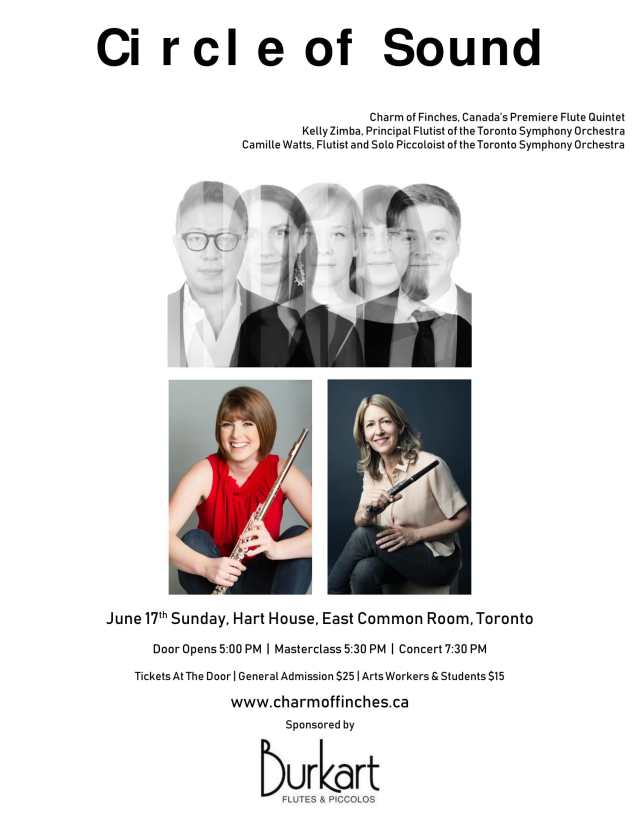
Circle of Sound – Charm of Finches


Circle of Sound Poster (1)

Charm of Finches, Canada’s Premiere Flute Quintet. Charm of Finches’ musicians are mavericks in the classical genre – all young, vibrant and electrifying musicians – and the force behind brilliant new arrangements and compositions with a reputation for delivering fresh and energetic concerts.

This concert features the Toronto premieres of Mendelssohn’s ‘A Midsummer Night’s Dream’, arranged by Gudrun Hinze, and David Heath’s ‘Return to Avalon’ for SEVEN FLUTES, joined by Kelly Zimba and Camile Watts. The programme also includes the world premiere of ‘First came the temple…’ written by Toronto-based composer, Bekah Simms. And to round off the evening with ‘Raga Terah’ by JUNO and three-time ECMA award-winning Canadian composer, Derek Chark. Don’t miss this opportunity to hear these incredible musicians up close and personal, in the intimate venue of Hart House, East Common Room.

*******

Posted in Music and musicology, Press Releases and Announcements | Leave a comment

Opera: Passion, Power, and Politics

There it all is, everything a boy or girl could want in one headline.

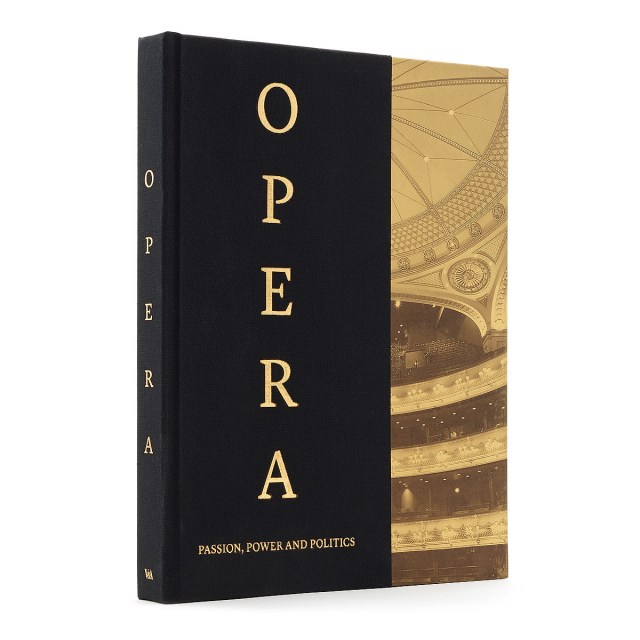
Now in fact that’s the title of a big beautiful book that I’ve been reading.  And what good is a book if it doesn’t push your buttons? This one certainly intrigues and excites me.

passionpowerpolitics_PICTUREIn my experience big luscious books about opera that are full of nice pictures rarely have the depth or intellectual heft to match.  Hm, isn’t that funny? A book will be heavy to lift but light-weight where it matters most: in the text.  Aha,  that’s the usual, but not in this case.  I saw Opera: Passion, Power and Politics on the new arrivals shelf at the Edward Johnson Library, where I find so much great stuff (for instance that Bernstein book that I devoured just a few days ago): a book that arose in context with an exhibit at the Victoria & Albert Museum that ran quite recently, from September 2017 until February of this year.

Ah, if only we had a show like this in Toronto.

When I read you the conceptual overview from the back jacket, please note that I am describing text that is embossed in gold, embedded in the fabric of the cover.  It’s almost too beautiful for me to capture the words, a wonderfully sensuous book to handle, even before you discover the beautiful pictures inside.

Here’s that blurb, which may surprise you by being quite intriguing, certainly more than any such opera picture book I’ve ever seen before. I’ll bold-face it in gold-coloured text, although this doesn’t nearly do justice to this lovely object: as in the gleaming picture above.

Focusing on seven key premieres in seven European cities, this fascinating book –published in collaboration with the Royal opera House, London– captures the passion, power and spectacle of opera over its rich 400-year history.  With introductory essays by some of today’s leading practitioners including Plácido Domingo, Antonio Pappano and Simone Young, it celebrates an innovative and complex art form that continues to inspire new generations of audiences around the world. A product of its own time, each opera also acts as a lens through which we can examine contemporary politics, culture and society.

VENICE
Claudio Monteverdi L’incoronazione di Poppea 

LONDON
George Frideric Handel Rinaldo

VIENNA
Wolfgang Amadeus Mozart Le nozze di Figaro

MILAN
Giuseppe Verdi Nabucco

PARIS
Richard Wagner Tannhäuser

DRESDEN
Richard Strauss Salome

LENINGRAD
Dmitri Shostakovich Lady Macbeth of the Mtsensk District

The jacket speaks of Domingo & Pappano perhaps because those names will help sell the book. But I’m more intrigued by Danielle de Niese talking about her role debut as Poppea, Robert Carsen musing on Rinaldo and Handel’s da capo arias, Roger Parker on the young Verdi, Michael Levine speaking of the design of Tannhäuser complete with a couple of intriguing photos, and Graham Vick speaking of Shostakovich.   It may not cover everything, but it does give you essays exploring opera in genuinely inter-disciplinary  ways.  I’m thinking of titles such as

  • Nicholas Till writing about “Vienna and the Englightenment”, aiming to put Mozart into context
  • “Wagner among the boulevards: Tannhäuser in Paris“, talking about the city and its culture as much as the opera
  • “Visions of women: Salome and Dresden”, looking at Wilde, Strauss & Beardsley (yes some lovely images), and Strauss’s opera as seen through the lens of directors Peter Brook (with help from Salvador Dali’s designs), Robert Carsen & David McVicar.
  • “Heroine, victim, or Criminal? Shostakovich’s Lady Macbeth of the Mtsensk District”, an ambitious essay from Elizabeth Wilson exploring the intersection of Soviet politics and opera.

Each of the seven pairings –an opera and a city—elicits a short introductory piece (such as Domingo’s or Carsen’s) plus a longer essay (such as the one by Parker or Wilson).

And there’s a concluding section that isn’t really necessary, that curiously reminds me of the Bernstein book I reviewed a few days ago, the way it weakens the book, perhaps by seeming to be trying too hard.

Even so it’s a magnificent book, a worthy gift for any opera lover of your acquaintance.  (if you follow the link you can see the book in soft or hard cover, an inexpensive opera tote bag and even an Aubrey Beardsley scarf.)

Oh heck, buy it for yourself. You’re worth it.

Posted in Art, Architecture & Design, Books & Literature, Music and musicology, Opera, Politics, Popular music & culture, Reviews | Tagged , , , , , , , , , , , , , , , | Leave a comment

Inglorious Women: Toronto

Toronto based performers come together as Inglorious Women: Toronto to raise funds for underrepresented women in need of legal assistance and counselling.

May 16, 2018. Toronto, Ontario: Inglorious B Productions will be donating all proceeds from its inaugural event: Inglorious Women: Toronto to the Barbra Schlifer Commemorative Clinic.  The concert, featuring established and up and coming operatic and musical theatre talent, will take place at 7:30 pm, on June 1st at St Andrew’s Church, downtown.

Co-artistic Directors Danie Friesen and Renée Salewski, have chosen to make the first event their company presents an event that gives back.  The decision was prompted by the stream of voices flowing from the theatrical and musical communities over the past year, calling out sexual harassment and assault in our workplaces.  By donating the funds raised to the Barbra Schlifer Commemorative Clinic, Danie, Renée and the over 20 performers donating their time and talents, hope make a sizable contribution to an organization that helps underrepresented women build lives free from violence by providing counselling, legal advice and fees.

Inglorious Women: Toronto will feature over 20 performing artists who will treat the audience to some of their favourite classical and musical theatre numbers, with a few entertaining surprises along the way. Kids under 12 are free at the door in order to encourage families to attend and educate kids about advocacy.

Inglorious Women: Toronto

A concert of musical theatre and opera favourites in aid of the Barbra Schlifer Commemorative Clinic presented by Inglorious B Productions, featuring a growing list of artists, including Inglorious Women: Allyson Devenish, Tina Faye, Beste Kalender, Kira Braun, Cassandra Warner, Elizabeth Polese, Annie Ramos, Allison Cecilia Arends, Danie Friesen, Cara Adams, Marcelle Boisjoli, Renée Salewski, Hilary June Hart, Ramona Joy Carmelly, Emma Char ; The Allies: Michael Robert Broder, Justin Welsh, Robert de Vrij, Cairan Ryan, Cole Kapoor, and Paul Williamson.

St Andrew’s Church 73 Simcoe Street
Friday June 1, 2018 at 7:30

Tickets are $20 at the door
Or book in advance for $15 at
Brown Paper Tickets 

*********

“Press releases and announcements” are presented verbatim without comment.

Posted in Press Releases and Announcements | Leave a comment

Orfeo and the power of music

David Fallis’s tenure as the Artistic Director of the Toronto Consort ended with today’s final concert performance of Monteverdi’s Orfeo, one of the most elaborate presentations I’ve ever seen from this group.

Don’t get me wrong. We were still in the presence of something intimate rather than overblown, the closest I’ve ever been to the Florentine Camerata in spirit if not in the actuality of the performance. For many of us, L’Orfeo was something we understood to be the first opera from our teachers & books. I had asked David Fallis whether there was anything symbolic in choosing this for his last undertaking leading the Toronto Consort.

But apparently not. He said he simply liked Monteverdi.

Okay. If there’s any extra meaning it’s in the joyful recognition that this opera is a celebration of the power of music. And that’s as true now as it was in 1607.

I invoke the Camerata as a society of friends devoted to the exploration of music and its possibilities. That’s what Monteverdi was doing and what the Toronto Consort continue to do. Jeanne Lamon Hall is small enough that you can see and hear every individual contributor (including the violinist for whom the hall is named, splendid sounding), sometimes making eye contact with singers & instrumentalists, and never in any danger that the performance would lose the sense of ‘consort’ as a verb. The formal moments –especially when the brass stood for their part in the opening Toccata or the beginning of the Third Act—were handled in such a way to remind us of music’s eternal ritual function in processions or public events. We were right on a kind of interface between music serving the drama (as we expect it to do in centuries of operatic composition) and music before the conventions of opera were drilled into us. We watched a kind of friendly negotiation, the music helping but always seeming to be freely offered rather than merely accompaniment in the service of story-telling.

Charles-Daniels-Credit-Annelies-van-der-Vegt (002)

Tenor Charles Daniels (photo: Annelies van der Vegt)

This was especially clear whenever we were watching & listening to Charles Daniels as Orfeo, a textbook demonstration of the notion that “less is more”. Sometimes he began with ostentatious pauses, sometimes singing with such softness as to compel us to pay extra attention. On occasion the voice rose in its intensity, particularly in that amazing moment in Act III when the Goddess Hope must leave him, in obedience to the dictum “abandon hope ye who enter here”; and as she abandons him, his response is unexpected and overwhelming. But he mostly sings very delicately, at times so softly as to surprise you, wonderfully expressive and always inhabiting the character.

And sometimes the greatest moments were collective utterances. Since I first studied this work decades ago, there have been parts I loved, that I eagerly anticipated in today’s concert. Every one of those was better today via Fallis, the Toronto Consort & their guest participants. I was wiping my eyes during the Toccata, smiling like a little kid listening to “Lasciate i monti”, and hollering at the top of my lungs at the end, grateful for all the many contributors. Katherine Hill as Music and then as Euridice gave us lovely moments that were wonderfully accurate, Michele DeBoer giving us a different coloration but every bit as effective as Proserpina. Laura Pudwell as Silvia, and as Speranza (Hope) brought her wonderfully rich sound, but blending beautifully when part of the chorus of shepherds, with Kevin Skelton, Bud Roach David Roth & Cory Knight. Roth as Pluto and Skelton as Apollo each were suitably godlike, while Bud Roach had some lyrical moments as well.

It was a hot afternoon in the space, yet everyone was intense in their focus, giving their all, Fallis included.  It felt like a perfect send-off, although Fallis will be back from time to time, not as the Artistic Director but still a member of the Consort.

G.Dou, Spitzenkloepplerin - G.Dou, Lace maker -

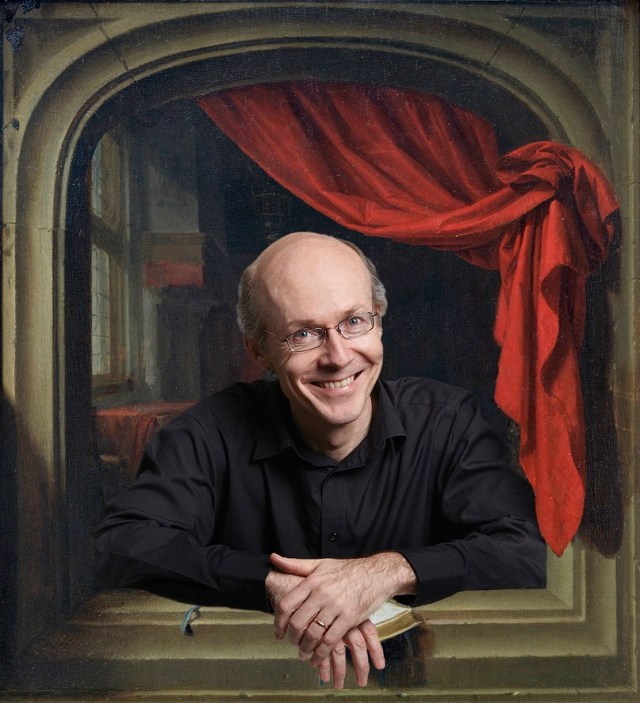
David Fallis (Photo credit: Paul Orenstein, digital work by Ross Duffin, background by Gerrit Dou 17th century, Dutch).

Posted in Music and musicology, Opera, Reviews | Tagged , , , , , , , , , , , , | 1 Comment

Laird’s new Leonard Bernstein biography

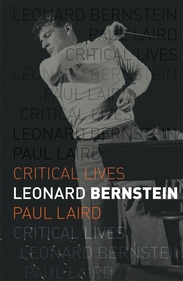
2018 is the centennial of Leonard Bernstein’s birth, as I’ve mentioned in reviewing recent commemorative performances of Candide by TIFT, TOT and the TSObernstein_bio

Anniversaries usually trigger a flood of books as well.  I’ve just read one of them cover to cover in the past 24 hours, an absorbing 212 pages by Paul R. Laird, in the “Critical Lives” series from Reaktion Books. (click for more info or to purchase)

I was sucked into the book immediately by the way it’s written.  Or maybe it’s the way Bernstein lived his life?  We’re in a breathless account of someone who is

  • A pianist
  • A conductor
  • A composer
  • A teacher
  • A celebrity
  • Sexually active
  • A married man with children

This is neither an apology for the man nor a critical hatchet job, but a balanced account that channels much of the native self-doubt Bernstein lived with, as a composing performing commercially successful Jewish homosexual.  What I found extraordinary about this book that I was unable to put down all day was how Laird managed to create a truly multi-faceted portrait, reconciling if not balancing so many aspects of this complex figure.  Laird met Bernstein, but clearly spent a great deal of time studying and coming to understand the man.  Perhaps the reason it works so well is because this is no PhD thesis,  nor an attempt to prove a point or achieve anything revolutionary.  I was at times almost breathless turning the pages, waiting to discover what might happen next. We watch Bernstein live his life, month by month, year by year, as he conducts this, composes that, says this, broadcasts that, screws this person (sometimes surreptitiously, sometimes within the boundaries of marriage), flies here: and so on.

That isn’t to say there aren’t places where Laird zeroes in on something. There are segments where a composition’s creation is described via the people involved in the collaboration or the steps in the process. It’s very de facto, very matter of fact, as we glimpse a life of unrelenting activity.  I used to think Bernstein didn’t compose very much but reading this I realize wow considering how much else he was doing, he composed plenty.  And indeed when we’re down to the last years of Bernstein’s life we encounter a sad fact, that the conductor was the chief champion for the composer.  The late works haven’t been heard so often because: they’re still relatively new.

If you have any interest in Bernstein –as a fan of his compositions, or admirer of his conducting—you will encounter something you didn’t know.  I’m surprised how much I learned about him today in my dash through this book, how many things I need to revisit or seek out in the library.  Laird’s bio is not a portrait to distort your understanding of Bernstein.  We hear some fierce critiques of his superficiality, of his enjoyment of popularity.  There are places where Laird shows his interest in the music, but I wouldn’t call him an advocate.  And as far as the conducting Laird seems to be an agnostic, reporting the gigs without attempting to analyze Bernstein’s style.  But then again to do so would have slowed the book down considerably as we dashed to the sad conclusion.

Laird closes (after describing the last year leading up to Bernstein’s death) with a chapter called “A Final Evaluation”.  Much as I loved the book, at this point –meaning the final evaluation—I was disappointed at what Laird seemed to miss.  This is a matter of fact description, possibly conditioned by Bernstein’s celebrity.  I find myself once again irritated by the paralysis musicology seems to experience in the presence of popularity, as I recall Kerman’s inadequate response to Tosca.  While Laird does get some things right, for instance his praise for Bernstein’s promotion of classical music through his broadcast legacy, and his fascination with his celebrity, I find the language somewhat faint-hearted when it’s time to assess the artist, or the value of his eclectic sounds.  Throughout we hear admonitions quoted about the conducting style, but almost nothing about why his conducting might have been influential, if not loved by some (me for instance); admittedly it’s a tough subject, but the evaluation is missing a great deal in this area.  Similarly for the composer, we hear of the classical musicians uptight about rock or jazz, without anyone to talk about what’s brilliant in his output.  Yes many of us are reading this book because we love Bernstein:  the conductor, the composer, the broadcaster.  The book tells us about his life, but in my view it understates his greatness.  While we get an evaluation of his life, his art is presented as a fact.  I suppose it’s of a piece with what’s in the book.

I need to read it again, as there are scores I didn’t know about that I will now have to hunt down in the library.

I Hate Music?! Trouble in Tahiti.  A White House Cantata.  …And so much more.

The book is most persuasive because there’s no attempt to persuade. How ironic.

Consider me persuaded.    (click for more info or to purchase)


Posted in Books & Literature, Music and musicology, Popular music & culture, Reviews | Tagged , | 1 Comment

Ensemble Showcase 2018

An Evening With the Ensemble Studio is a special opportunity. It’s interesting to get a closer look at the members of the Canadian Opera Company’s Ensemble Studio. For most of the year they’re confined to small roles in the mainstage productions, but on a night such as this they take on bigger roles, a taste of prime-time. And for us, it’s the chance to see so much more of what they can do, their potential realized. We see that they’re ready.

In past years this meant a performance cast with Ensemble members, but beginning in 2017 they’re doing a showcase in formal attire instead, a new concept that I think they are still figuring out: as in, sometimes it works and sometimes, not so much.

There were two parts to tonight’s show. After intermission we saw one of the glories of the operatic stage, namely Purcell’s Dido & Aeneas in a well-conceived production that didn’t require costumes but did entail some clever use of the Anna Bolena set (designed by Benoit Dugardyn), a production that stands with some of the best work I’ve seen from the COC. I loved it so much possibly because it was so much better than what we’d seen before the intermission.

We began with a series of scenes from Mozart’s Cosi fan tutte that pale in comparison to the tight organic performance of Dido. It was the same group of singers before & after intermission, sounding marvelous on the whole and accompanied by the COC Orchestra led by Johannes Debus. If you ask me (and nobody did), if opting to present only part of an opera, the choice of scenes needs to be more carefully thought out than on this occasion, as the Cosi scenes were to my eye rather awkward. We began in media res, handing things to a character who is always liked –Despina—while expecting the four lovers to grab us without any exposition, no chance to create a through line either with us or for them with their character. I think this choice was simply too difficult for the singers, and of dubious value in the creation of a micro-characterization.

But let me get back to Purcell, the wonderful and indeed indestructible Dido. Every moment was gold, the orchestra sounding delicate & committed. In fact part of my problem with the Mozart might be that I felt it was a bit brusque, barely intelligible, whereas I caught every syllable of every word in the Purcell: something that owes as much to Debus’s sensitive ear as to the enunciation of the singers. Was Debus preoccupied, perhaps mindful of a farewell he would be making to some of the members of the orchestra?  Of course there is value in the experience, as singers tell horror stories of unsympathetic conductors (part of the job, right?). They mostly kept it together. All I know is that everything was a thousand times better after the interval, although the fact we were dealing with a complete work in a well-conceived production, surely had a lot to do with it.  In the program one sees “Dramatic Consultant –Anna Theodosakis”, leading me to wonder how this was done. No actual director credit? Were the Ensemble Members only getting advice without actual direction? Ah well. ‘Tis a mystery.

And hindsight is 20-20 of course.

DSC_3895_preview

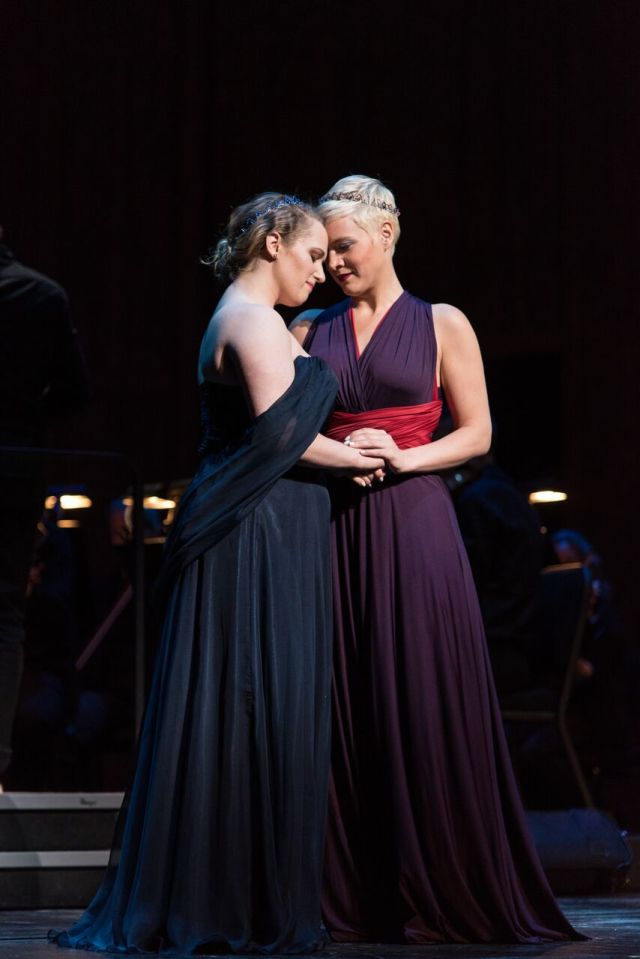
Soprano Danika Lorèn and soprano Lauren Eberwein in the Canadian Opera Company’s An Evening with the Ensemble Studio, 2018, with the COC Orchestra conducted by COC Music Director Johannes Debus. (Photo: Gaetz Photography)

There were some wonderfully original touches such as the meta-theatrical choice to have Dido onstage watching the witches, as though they were haunting her dreams. And while this wasn’t a period approach, when Lauren Eberwein said “remember me” staring directly into Danika Lorèn’s face, I totally lost it. The two of them had genuine star power throughout the evening, Loren effortlessly switching from the wackiness of Despina to the darker shades of Belinda.  I was mindful too of the question of vocal type, after having heard Keri Alkema’s thoughts just a few days ago about changing from a mezzo-soprano to a soprano.  Eberwein herself has made such a switch (notice that she’s called “soprano” in the COC photo credit) even though Dido is usually understood to be a mezzo role: but embellished by some higher notes.

Everyone had their moments though. Bruno Roy was strong as both Don Alfonso & Aeneas, Megan Quick dominating the stage as the Sorceress, Samantha Pickett & Simone McIntosh delightful in their witchy machinations (and which seemed so much more fun than what they were given to do as Fiordiligi & Dorabella), aided and abetted by Samuel Chan who then slipped into the sailor’s role (although everyone was in formal attire).

Maybe I ask too much, but I think less is more. If I had only seen Dido tonight I would have been more impressed by the COC’s Ensemble Studio than what I saw. Yet it’s a work in progress. It will be interesting to see what they’ll do next year.

Posted in Music and musicology, Opera | Tagged , , , , , , , , , | Leave a comment

Keri Alkema: A Journey of Transformation

Today’s noon-hour recital at the Richard Bradshaw Amphitheatre aka the foyer of the Four Seasons Centre was unlike any we’ve seen before.

Readers of this blog may recall that I’ve expressed my admiration for Keri Alkema in my reviews of her Tosca last year, her Vitellia from a few years back and again in Anna Bolena a few weeks ago.  There was no way I would miss the chance to hear and see her up close.

16-17-05b-MC-D-1890

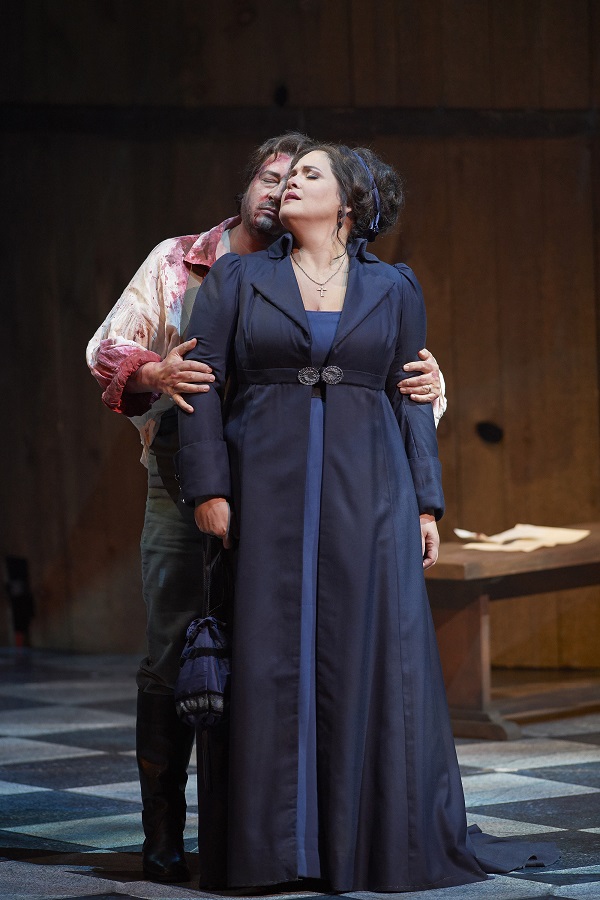
Kamen Chanev as Cavaradossi and Keri Alkema as Tosca in the Canadian Opera Company’s production of Tosca, 2017, photo: Michael Cooper

I came expecting to hear Keri Alkema’s beautiful singing, but that was just part of it.  The program on the page was unlike any other:

  • “All’afflito è dolce il pianto (Roberto Devereux) – Gaetano Donizetti
  • “Mi tradi quell’alma ingrata” (Don Giovanni)—Wolfgang Amadeus Mozart
  • “Morrò, ma prima in grazia” (Un ballo in maschera)—Giuseppe Verdi
  • “Salce, salce…” (Otello)—Verdi
  • “Che tua madre dovrà” (Madama Butterfly)—Giacomo Puccini

I was tempted to call this “Keri Alkema, this is your life”, as we were taken along on a musical journey, ably supported by Rachel Andrist at the piano.  Not only did we hear the arias but we heard a great deal of personal commentary in this most informal and relaxed concert.  The transformation? From mezzo-soprano into soprano.  The Donizetti aria with which we began is a mezzo-soprano aria, one from earlier in Alkema’s career.  Her role as Giovanna Seymour in Anna Bolena¸ the opera she’s currently singing with the COC, is also a mezzo-role.

In addition to the arias, the recital included anecdotes – for instance the time her Otello accidentally smacked her so hard in the face onstage as she sang Desdemona that she literally saw stars, and wondered if she’d be able to even open her mouth to sing —and a series of questions & answers from the audience.

I was astonished by something else Alkema brought to the stage, namely a complete commitment in each of the arias.  She joked about the vulnerability she felt in this venue & in this program, her first such recital in awhile.  That was another aspect of the concert that was unique.  We could see her sweat, and at one point in the final aria, she thought that we saw her sing a note slightly less than perfectly.  Frankly, I think the note was fine, but what was extraordinary was to observe her portrayals in an exposed & genuine method-acting approach and up close.  Alkema was wonderfully at ease, unprotected by a costume or an affected attitude. Many of my favourite singers choose to take on a kind of stylized facial expression that owes at least something to the ancient Greek masks, that can be as blank as pure abstraction, and therefore freed of anything too personalized.  One can disappear into such a mask, but one can also hide behind it, especially if one might have a moment when one wonders about the voice.

Not so Alkema.  In each instance, Alkema gave us another sort of transformation, namely that of her portrayal, vanishing into the character instantly.   Donna Elvira had a heroic ferocity, her Emilia, a desperate regret, her Desdemona, a wonderful panorama of emotions, as she told the story of Barbara and her willow song, jumping fearfully at the sounds at the window, and closing prayerfully.  And then her Butterfly illustrated one of the great challenges with Puccini’s opera, of keeping the mask in place, of portraying without reacting to the music & the emotions one is signifying.

We heard a great deal about mentors such as Marilyn Horne & even Sondra Radvanovsky who currently portrays Anna in the same production at the COC.  I was struck by Alkema’s genuine humility as she spoke of colleagues and influences, as this is a singer who has a great deal to offer the younger ones coming up.  That next transition is still to come, the natural culmination of development when one begins to give back to the next generation.

Today’s concert was like a workshop on the mezzo-soprano voice, an intriguing combination of vocal demonstrations and discussion.  I was hooked, not just because I love her voice, but also because I find the mezzo voice to be one of the most intriguing of all operatic phenomena.  I grew up accompanying a baritone, and attempting to sing, first as a baritone then as a tenor, so I am always curious about the parallels in the mechanics of the female voice-types.  Alkema sings as a soprano, but began the recital with a mezzo aria. I wondered if that might change the way she sang in subsequent numbers.

Was I imagining it, when I heard the lower parts of “Mi tradi” seemingly emphasized (so rich & full), while the higher notes were sung with at least thoughtful care rather than wild abandon?  I found myself identifying what it must have been like the first few times venturing up above the treble clef to those high notes.

Alkema was so vulnerable in telling us about the adventure, particularly in Ballo, which is one of the toughest roles of all.  What’s it like to discover doubt and fear in the middle of a role, and how does one surmount that?  It was quite a story.

I hope the COC will bring Alkema back so that we can see the next phases of her development.  But first? Keri Alkema & Sondra Radvanovsky have two performances of Anna Bolena left this week.

ANDRIST_KERI

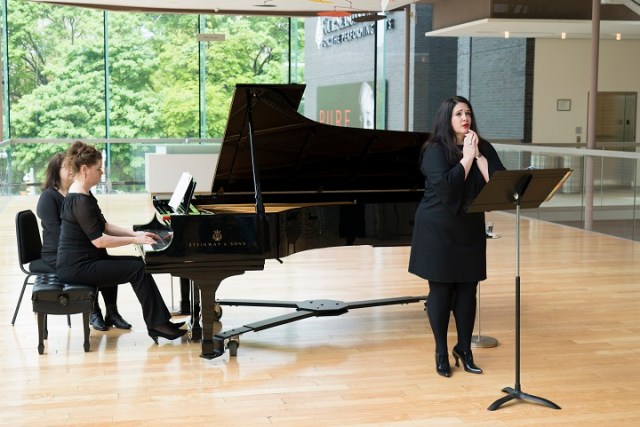
Rachel Andrist (piano) and Keri Alkema perform in the Richard Bradshaw Amphitheatre, 2018 (photo: Kevin Lloyd)

Posted in Music and musicology, Opera, Reviews | Tagged , , , , , , , , , , , , , | 1 Comment

Questions for Bruno Roy

Time flies.

It seems like it was only yesterday that baritone Bruno Roy was a finalist in Centre Stage, the 2015 Ensemble Studio competition. The new voice that we had never heard before? He is now about to make his final appearance as a part of the Ensemble’s annual showcase concert, “An Evening with the Ensemble Studio” on Friday May 25th.

Of course I had to ask him a few questions.
danika_bruno

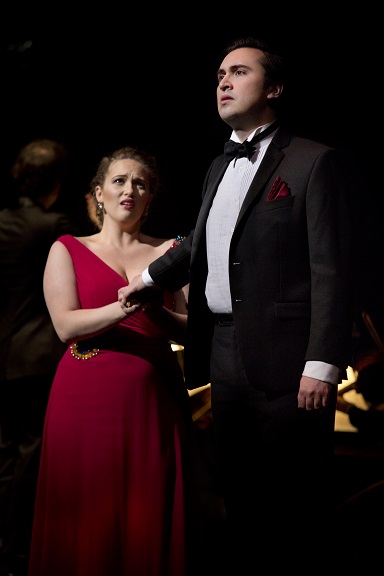
Danika Lorèn and Bruno Roy perform during An Evening with the Ensemble Studio, 2017 (photo: Bronwen Sharp)

Are you more like your father or your mother?

I would say I am a good blend of both of them, although I am a spitting image of my mother (many have called the resemblance uncanny). Both of my parents are French Canadian and my affinity for the French language has always been a core element of my musical identity. My mother is a small business owner so we now share that business acumen and my father is a hard working person who can fix literally anything (I still have much to learn from his mechanical ability, something we unfortunately do not share.)

What is the best or worst thing about being a singer?

I would say that the best part is that I get to do something that I really love as a job, it’s something that makes me feel quite blessed; entering university there was a great uncertainty as to whether I could make a living of this field but I now feel more confident about it. The discipline required is difficult sometimes. Some days it might mean that I need to talk less, or shouldn’t go out to see a movie or help a friend move – when it comes to singing, we need to be kind to our bodies as that is our instrument.

Who do you like to listen to or watch?

I listen to music of all types, from hip hop to post rock and experimental music and I really do think that when it comes to listening, variety is the spice of life and all musical genres can have an influence on my mood and even my musical artistry.If I listen to opera, Gerald Finley is one of my favorite singers, still active today, and his artistry transports and inspires me to be a better artist. I had the opportunity to meet and participate in a masterclass with him a few years ago and I will forever remember it as a highlight of my university career.

What ability or skill do you wish you had, that you don’t have?

Like many I think I would like to be able to teleport. In our business and also with the way that our generation is much more mobile travel can really be a chore, especially when the distance also separates us from loved ones. In a more realistic sense being able to know more languages could always prove useful.

When you’re just relaxing and not working, what is your favourite thing to do?

In my time off I love hanging out with friends, going for nature walks with my girlfriend when we can and also staying in and bundling up to watch a movie with a tea and some snacks. I have no shame in saying I am a little bit of a home body at times but reading a book, listening to music and enjoying the company of people who are dear to me is a good time – I guess I’m easy to please!
DSC_4514

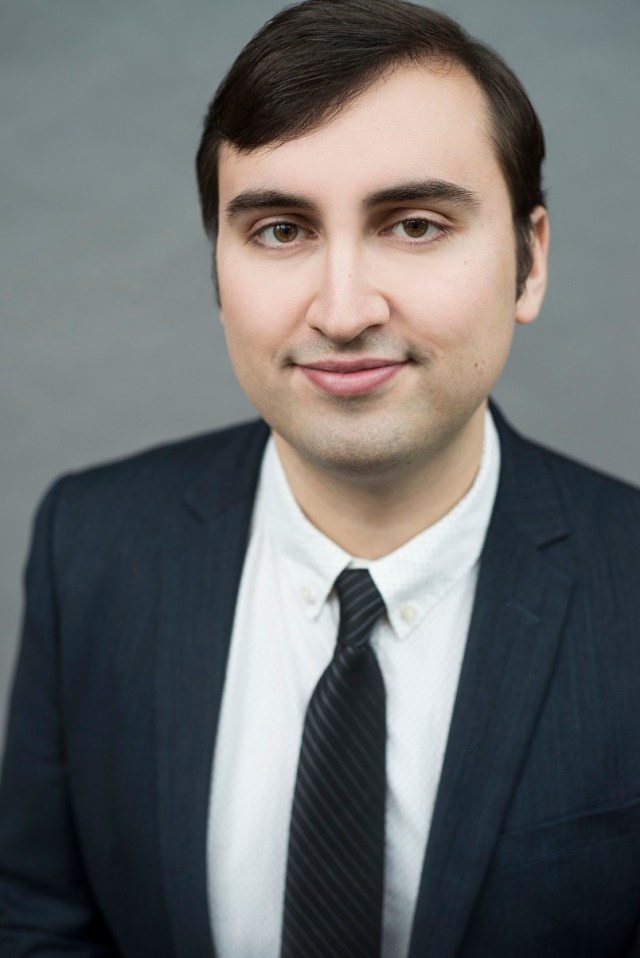
Bruno Roy, 2017 (photo: Gaetz Photography)

*******

More questions for Bruno Roy about life in The Ensemble Studio, as we come up to his final appearance as a member in the May 25th Showcase, “An Evening with the Ensemble Studio”.

Now that you’ve come to your last months, please reflect back on the competition & the process of getting into the Ensemble Studio, including any advice you might have for young singers. 

The competition was an amazing introduction to the company. It was an opportunity to meet all of the trainers and artistic heads of the company and everyone was very welcoming and supportive. I must admit that stepping onto the Four Seasons stage with orchestra in the pit was pretty intimidating but the support I felt during the callback week definitely helped make me feel confident to take centre stage. Prior to the audition and callback I was fortunate enough to still be in school and having the necessary time to prepare my two arias. I worked double time with my coach Michael McMahon and I think ultimately the repetition and detail work I did on those pieces of music really helped me feel comfortable by the time I arrived in Toronto. As I move forward and find myself splitting between many projects, I think back to how important that preparation had been. Everyone’s path is different but I know that work helped me stay flexible when it came the time to present the arias with the COC orchestra.
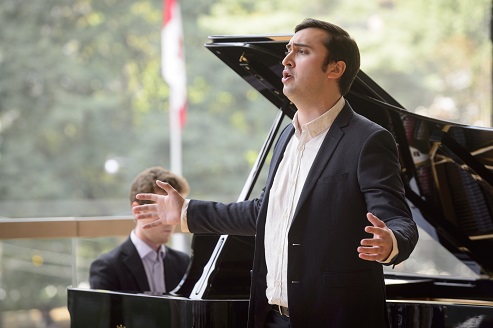
2017-09-26-FCS-Ensemble-130

Bruno Roy and Stéphane Mayer (background), 2017 (photo: Chris Hutchenson)

Talk about your time in The Ensemble Studio. What was it like?   

Being part of the Ensemble Studio was overall a big change for me. I had never moved away from home (Montreal, where I also attended McGill University) and initially the studio was a lot of hard work. When I joined the studio I had to adjust to a new lifestyle and was also developing a new, more critical perspective on my vocal technique. I was becoming much more aware of what I needed to work at to reach the next level and felt an inner push to constantly better myself alongside the multiple assignments. Thankfully I was surrounded by a wonderful group of colleagues who welcomed me to this city and I have loved my time in Toronto. Although it was a lot of hard work there are special moments I will always remember: being on stage as the Jailor in Tosca as Adrianne Pieczonka sings a glorious high C before plunging to her death, feeling the rumble of the COC orchestra from the pit at the beginning of Rigoletto, performing music that my colleagues had written for a concert in the Richard Bradshaw Amphitheatre, getting the opportunity to work one on one with singers like Jane Archibald, Russell Braun and Roland Wood, and so many other moments that sculpted my time at the company.
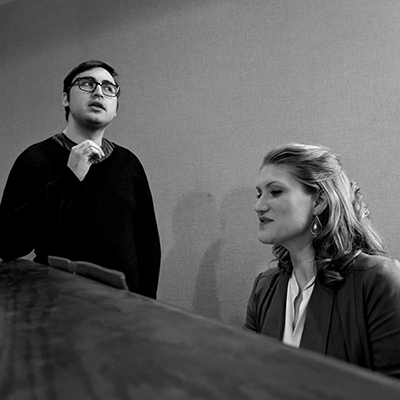
Maker:S,Date:2017-8-12,Ver:6,Lens:Kan03,Act:Lar02,E-Y

As part of Jane Archibald’s artist residency, she set aside time to share her knowledge and experience with the next generation of emerging artists —pictured is a session with baritone Bruno Roy.

What does the Ensemble Studio mean to a singer’s future? 

The Ensemble studio really helps bridge the gap between school and the profession for young singers. It’s a way of getting our craft out there, both by getting singing opportunities on the Four Seasons Stage and also by getting to audition for various companies and industry leaders that find their way through Toronto. Getting a chance to be in the ensemble was a great experience, it is a special feeling knowing the company respected what I was doing with my craft and wanted to support me in my training. Moving forward I will now have a network of contacts and colleagues that can support me once I leave the studio. Knowing of all the singers that have been through this program and the success that they have had through hard work I felt very inspired and blessed to be able to take part in this program.

Please talk about what you’re going to perform in the Ensemble Showcase May 25th 

The Ensemble studio will be performing excerpts from Mozart’s Cosi fan tutte in addition to the entirety of Purcell’s Dido and Aeneas. We have been working at this program (which will be presented with full orchestra) for a while now and we are very excited to present something of our own alongside the COC’s regular season. I will be performing Aeneas in Dido and Aeneas; this will be my first time stepping into the shoes of a heroic character and I am definitely thrilled and looking forward to it! I am taking on Don Alfonso for the Cosi scenes and although I may not be quite ready for the full role, Alfonso’s music feels comfortable and he is a fun character to embody! My ensemble studio colleagues have a put in a lot of work into their respective characters, both in their characterization and the ever important diction (with an English opera we want to make sure the audience understands every word) and it has truly been a treat to be able to prepare my final performance at the COC with them.

Can you tell us of anything of your life after the Ensemble Studio ? 

I am leaving soon after the Ensemble showcase for Montreal where I will be performing in a chamber opera titled “Nero and the Fall of Lehman Brothers” by American composer Jonathan Dawe with a company called Ballet Opéra Pantomime. It will be my first professional engagement in Montreal since I left for Toronto two years ago. I will also be performing in Haliburton, Ontario with the Highlands Opera Studio as Marcello in their production of La bohème in August; I’m very excited to sink my teeth into that role and make new connections with other singers. In the fall I am also moving to Frankfurt, I will have a lot of free time and am excited to start making new connections in Germany. I will be back in Ontario in the spring of 2019 for concert work and I do intend to try and perform in Canada as much as possible even though I will be settled overseas with my partner.

The singing actor is a curious hybrid creature. Some people come to it via music, some via theatre leading me to ask about your personal equation, and your background as a stage performer. 

My way into opera was through singing initially. I performed in a big youth choir throughout elementary and high school and had barely any acting experience by the time I got to university. Although I dabbled with theatre late in high school and we had intro to acting classes in university it was really only when I was assigned my first opera roles that I began thinking of myself as an actor. I’ve always used music and text as my first step into acting, what I could learn from what my character and those interacting we’re saying will always be what I go to first. As opera singers we are fortunate since the composer can sometimes give us a clear picture of the emotion or state of mind of character with the line, rhythm and dynamics indicated in the score. I learn something new about the acting process every time I step into a new role and throughout my time in the studio I have felt these acting instincts grow; for me nothing beats the experience doing, it is how I learn the fastest.

Do you have any stories you could share from your time in the Ensemble Studio? 

When I think back on my time in the studio, there are a lot of things that come to mind. Some were stressful in the moment: when we were out on school tour in the Kingston area, some of the wrong costumes had been brought – the cast rallied to make the best of it as we could not get the costumes and that definitely helped us bond;  we also delivered on a great show that day! Other times I felt like I was part of something bigger than I was: sharing a drink with visiting artists, feeling an artistic connection and camaraderie with people sometimes twice my age, feeling part of the global opera world. Many of these things I didn’t expect to feel as a young artist and the ensemble studio made me feel like a true professional. There are so many anecdotes, jokes and moments when everything could go wrong on stage and hopefully I will get to share more of those moments with these colleagues again.

What roles do you see yourself undertaking?  

I do see a lot of French opera roles in my future. Because of my background and high placed baritone I feel like I have an affinity for this repertoire and thankfully I also love it! Pelléas from Debussy’s Pelléas et Mélisande is definitely a dream part. I am also fascinated by grand opera, be it the French operas of Rossini and Verdi as well as those of Bizet and Gounod; I do hope that one day I may find my way to this repertoire. Interestingly though I know that I will learn to love most of the repertoire that comes my way and I may even find a new dream role by exploring other repertoire.

Who is your favourite composer, AND (not necessarily the same question)whose music do you think sounds best in your voice? 

As I mentioned earlier, the music of the French composers really suits my voice. Debussy, Ravel and Poulenc’s music has always been an easy fit and the language seems to bring out a natural quality in my voice quite well suited for this repertoire. On the other hand, Verdi is one of my favorite composers and I think the way he managed to tie beautiful music in with the drama has always fascinated me. I think everyone would agree that the man knew how to write a tune! After singing in Rigoletto this season at the COC, I am excited about the next time I can dive into Verdi’s world; luckily he even has a few French operas!
purdy

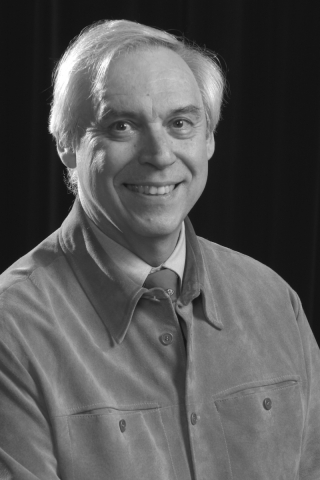
Professor Winston Purdy

Is there a teacher or an influence you’d care to name that you especially admire? 

My teacher Winston Purdy, who passed away last fall, was one of my biggest influences. I will always remember his love and passion for the song repertoire and his grounded, relaxed teaching. I am reminded of his wisdom every day and he is definitely one of the main reasons I keep pushing myself to explore and discover my musical identity.

*****

Bruno Roy joins his colleagues for one last time as part of An Evening with the Ensemble Studio,7:30 p.m. on Friday May 25th at the Four Seasons Centre.


Posted in Interviews, Opera | Tagged , , , , , , , , , , , , , | Leave a comment