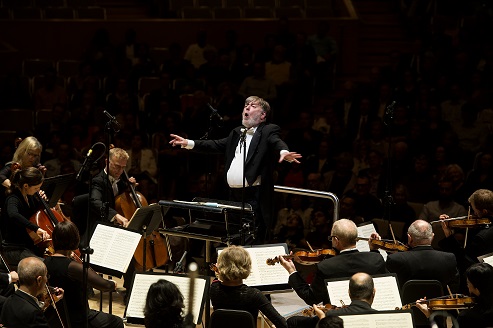
The Toronto Symphony played a mid-week concert tonight to a rapturous reception. The TSO are in a transition, awaiting their new music director while playing either with their interim Artistic director Andrew Davis, or with a series of guests. There was a great deal of electricity tonight, perhaps a combination of the new face on the podium, the repertoire, and possibly the ensemble’s readiness to embrace someone new.
Han-Na Chang led two contrasting works tonight. Hers is a very physical style, a very clear beat. I was intrigued to hear her talk about her philosophy on youtube. And no wonder the TSO seemed to respond to her.
The two works are a study in contrast even though they’re not so many years apart, seeming to epitomize radically different eras. While the big work on the program after the interval was Mahler’s 5th Symphony, one of the last genuinely heroic compositions, Ravel’s Piano Concerto in G is from a post-heroic age.
Piano soloist Javier Perianes sparkled, teaming up nicely with Chang. Ravel’s piano is more a purveyor of comic rejoinders & witty ripostes, an engine of colour. The three movements each have their own mood, the first one sounding like the jazz age with bluesy phrases that wouldn’t be out of place in a Gershwin rhapsody, the second opening with a mellow nocturne worthy of Chopin, and the last genuinely modernist, with repeating figures and splashes of colour. Perianes played with transparency & fluidity, a complete delight. Afterwards he rewarded us with a stunning encore, one of Grieg’s Lyric Pieces, exquisitely offered.
The Mahler 5 is a great test for any orchestra. Not only does it include challenging passages for every section as well as solos for trumpet, horn, timpani, (just to name a few), but to make it work the ensemble must respond to the leader. While the shortest movement is the most famous, there’s wonderful music in all five movements.
We began very deliberately in a first movement that felt epic and fearless, the drama unfolding gradually and on a massive scale. Although the tempo suggested an earlier generation of conductors, the pace was wonderfully flexible, amenable to instant organic changes. I read in her bio that Chang has led her own orchestra in Mahler symphonies, suggesting that she loves this music, and I’d present the performance as exhibit “A”, considering the intensity throughout. When we come to the third movement it’s as though we’ve suddenly burst through the clouds into bright sunlight, in pastoral evocations from the winds. But everything is bigger, a little more complex. The inner voices going back and forth were genuinely dialoguing, not so boisterous that anyone was drowned out or ignored.
We came to the famous Adagietto, the movement that sometimes gets turned into overwrought melodrama, sometimes played much too loudly: but not this time. It’s a kind of oasis, the eye in the storm if you will, surrounded by massive complexity & big powerful statements. In this soft movement, you gain nothing by bluster, other than to turn the piece into self-parody. Chang gave us a very understated reading, perhaps mindful of the movement’s purpose within the symphony, as opposed to its frequent function, as a favourite melody that provokes nods of recognition.
And then a finale to match the rest, the electricity still crackling almost an hour into the piece. Here is where you sink or swim, saved or damned by your leader. Chang clearly has a very strong picture of the movement, bringing out the important thematic statements, while getting the massive contrapuntal passages in the strings uttered with wonderful clarity. The tension built gradually to a climax matching the dignity & gravitas of the opening, every bit as noble.
The concert repeats Thursday October 4th at Roy Thomson Hall. Go hear it if at all possible, you won’t regret it.
Better late than never, the Canadian Opera Company have premiered Robert Carsen’s Eugene Onegin, a production originally premiered at the Metropolitan Opera in 1997. It’s a triumph of Canadian talent on all sides, from the sets & costumes by Michael Levine, to the performances of the principals, including Gordon Bintner in the title role, Joyce El-Khoury as Tatyana, and Joseph Kaiser as Lensky. I hoped to see the Toronto boy take a bow at the final curtain although I suppose this show is ancient history.
Conceived long before the Met began their high definition series, I think we’re again seeing a production that’s better in person than at the movies. Although I’m looking forward to seeing it again from up close (my subscription seats are right at the front) this handsome reading of Tchaikovsky’s opera is full of big moments, from the work of the chorus singing, dancing and even raking leaves, to the stunning lighting designed in the original by Jean Kalman (and for the revival by Christine Binder), especially in the duel scene. The stage picture was well-conceived and an organic part of the story-telling, often stunningly beautiful. I’m glad I was far enough back to be able to see it this way.
Coming in at just under three hours, the time flew by. Don’t miss it.
I didn’t understand Carsen’s minimalist approach when I saw it on TV, but it’s clear now that I’ve seen it on the Four Seasons Centre stage many years later.
I’ve been preparing for this all week, inflicting Tchaikovsky on my household (piano pieces) while reading an English translation of the Pushkin poem as preparation. (here’s the version I read, 170 pages including lots of marginal notes ) I’ve encountered critics opining that Tchaikovsky’s opera is not a faithful response to Pushkin. I’d direct the critics to Carsen, whose reading makes a wonderful case for the opera, especially when you consider this part of his director’s note:
Tchaikovsky’s opera Eugene Onegin, based on Pushkin’s verse novel of the same title, has come to represent Russian character and emotion at its most intense. When Michael Levine and I developed our production for the Metropolitan Opera, we sought to find a poetic response to this most intensely subjective and emotive of operas. Pushkin’s original work, however, is much cooler, distant and critical in tone, and so we also tried –where appropriate—to re-capture some of the distinctive spirit of the original.
Many essays about Pushkin’s work reference Byron. Indeed Byron turns up regularly both in the opera and the verse-novel. In the Fourth Canto Lenski calls Onegin “a true Childe Harold”, invoking one of Byron’s world-weary anti-heroes. Byron’s influence is so huge that Berlioz, Pushkin, Tchaikovsky and so many others were all falling over themselves to be more Byronic than Byron himself. A few years after Onegin Tchaikovsky would also write one of his most personal works, his Manfred symphony. Unlike Berlioz (whose Harold in Italy ends in a tumult, the hero and his viola alter-ego drowned out in the wild orgy of brigands that ends the piece) Tchaikovsky would insert a kind of happy ending, a kind of Hollywood absolution for his unhappy Byronic wanderer, a misrepresentation of what Byron wrote to make Nahum Tate blush. If there is a problem with Tchaikovsky and Byronic heroes, it’s simply a matter of his temperament & sympathies. I can’t help thinking that Tchaikovsky likes Lenski & Tatyana much better than Onegin, the Byronic antihero. Perhaps his Manfred symphony can be thought of as a rewrite of the opera, absolving the hero at the last moment.
More fundamentally, though, we have polar opposites, two different personality types that are fundamental to this opera in Carsen’s production, the director capturing something “cooler, distant and critical in tone”. It’s only clear to me now in retrospect, with the help of Carsen’s lucid production that foregrounds two very different approaches to life & love:
The direct and spontaneous style of Lenski & Tatyana: at least in her youth
The more distant and reserved approach we see from the cynical Byronic hero, Onegin.
And one might ask: and what about Tatyana in the last scene? Has she become more like Onegin in her ability to say no to her own desires, detaching herself from her feelings?
The Tatyana of the letter scene and Lenski are romantics in the old-time sense, wearing their hearts on their sleeves, rather than concealing their feelings. The Byronic approach, very much alive and well in the modern era, aka “cool”, is exemplified in Onegin, who only discovers something passionate and romantic in his later encounter with Tatyana: when she’s already married.
Gordon Bintner as Eugene Onegin and Joyce El-Khoury as Tatyana in the Canadian Opera Company’s new production of Eugene Onegin, 2018, (photo: Michael Cooper)
Gordon Bintner is very likable in a role that’s hard to like. The voice is so rich & full that even when he’s singing softly we get every note & nuance, and when he wants to, he’s the biggest voice in the show, the voice well-produced & never strident or forced even at its loudest. It’s a great pleasure to see him getting his chance at a starring role, one of the strongest recent graduates of the Ensemble Studio program. I hope we see him again, as he brings ample vocal skill, impeccable intonation and strong dramatic skills to everything he does.
Joyce El-Khoury was a favorite of the audience as Tatyana. Hers was a very literary interpretation, well thought out and making a very clear distinction in her performance between the girl and the woman we see in the last scene. I can’t help thinking that we see her through the filter of Carsen’s idea, which is that she is a creature of Onegin’s mind, seeing her in retrospect.
Joseph Kaiser is the third strong Canadian in a leading role, profoundly moving as the poet Lenski. He gave a very subtle & understated reading of the great aria “kuda kuda”. The duel scene—acting, lighting, singing—is one of the most effective creations I’ve seen on a COC stage.
Perhaps most impressive for showing us her range? Varduhl Abrahamyan, who was previously seen in 2016’s Ariodante, the trouser role of Polinesso (remember the scary preacher?), this time, Olga, Tatyana’s outgoing sister. She could have muttered “and now for something completely different”.
In the TV broadcasts, I didn’t understand what Carsen was doing with the dances in this opera: that is, until I saw them today on a full stage. I now get that his focus was on Onegin, that this is largely a subjective and retrospective reading. So the waltz is danced by the chorus, the cotillion not shown, as we watch Lenski (who’s left behind) gradually coming to a boil, the polonaise not staged because it’s done entirely as Onegin gets dressed after the duel. I love divertissement & the trappings of grand opera, so had been somewhat frustrated in my first encounter –via television—with this production, watching Dmitri Hvorostovsky getting changed when I’d wanted dance instead. Was it a cost-cutting measure? Of course not, but the first time I saw it, I really didn’t get it because I had not seen the invaluable director’s note.
When it comes into clear focus is with the two versions of the Ecossaise. The first version is a bit voyeuristic, as a solo virtuoso pair dance this frenetic piece, watched by the chorus. Onegin sees Tatyana and is inspired by the sight of her, or perhaps more precisely, excited to the point of infatuation. The young girl he rejected is now a woman, a wealthy princess, poised but more beautiful than ever. The scene ends with a reprise of the Ecossaise, this time danced by the entire chorus, as though everyone has caught the erotic fervor of the dance: Onegin sprinting madly through their midst. Perhaps it’s implicit in what Tchaikovsky wrote, but Carsen makes it explicit, with the help of choreographer Serge Bennathan.
There’s a lot more I could say but I’m worried this review is already way too long & academic. I’ll probably write again when I see the show from up close. I should also mention the excellent work of the COC Orchestra under Johannes Debus, a busy fellow because he’s conducting both of the operas this fall, one a world premiere.
Eugene Onegin continues until November 3rd. See it if you can.
A very long time ago I was a Toronto Symphony subscriber watching Andrew Davis conduct the TSO. We’re both much older now. Tonight’s concert at Roy Thomson Hall was the launch of a new season with a new leader stepping back into his former role.
“Sir Andrew Davis is the Conductor Laureate of the Toronto Symphony Orchestra where he was previously the Orchestra’s Music Director from 1975 to 1988.”
The orchestra might be 100% different than it was back then. I’d have to check if anyone in the current ensemble was around at the time, but some of the players (such as concertmaster Jonathan Crow, associate principal trombone Vanessa Fralick or principal double bass Jeffrey Beecher) look so young that they probably weren’t even born yet, as of the mid-70s, 43 years ago.
In this the first week of the post-Peter Oundjian era, we will remember some of his achievements, whether it’s the gifted group that Oundjian assembled & mentored, or initiatives such as the New Creations Festival, that featured premieres such as Jacques Hétu’s Variations concertantes, commissioned a dozen years ago by the TSO and dedicated to Oundjian.
And yet they’ve moved on. There was no sadness but a tone of joyful celebration. This TSO already knows Davis and have even recorded Handel’s Messiah with their Conductor Laureate in his bold brassy edition . This week at least we heard much more of the same, between the Hétu & a pair of powerful works by Hector Berlioz, as the orchestra seemed to be having a great time.
Sir Andrew Davis conducts Berlioz (photo: Jag Gundu)
We began with the Fantasy on Shakespeare’s The Tempest, a part of Berlioz’s sequel to Symphonie Fantastique. The sequence tonight is perhaps a big clue as to why Lelio is rarely programmed, and certainly never done as Berlioz imagined, after Symphonie Fantastique. While the Fantasy features lovely inventive timbres, especially the delightful combination of chorus & four-handed piano to open the piece, it wouldn’t work: because nothing can really follow that magnificent work on the same evening without seeming to be an anti-climax. I think it’s a big deal to hear this music (meaning the Fantasy) at all: but of course it was programmed to begin the concert rather than to follow the Symphonie Fantastique. Yes the ‘return to life’ might be an interesting concept after the nightmarish final two movements, but it’s nowhere near as theatrical or exciting in comparison.
The Hétu Variations concertantes are not out of place in this program, alongside what might be the single most original piece of orchestration in history. Yet Hétu’s recent piece stands up very well in comparison, possibly because Davis boldly exploited the score’s contrasts for dramatic effect. The work features sections where much of the orchestra would be like a pianist, accompanying with big extended chords that are almost jazzy, while solo instruments such as flute or piccolo or bassoon veer in and out of harmony. I was mindful of so many prototypes, from Bartok’s Concerto for Orchestra in the back and forth between big groups and small, but also Shostakovich or Mahler for the soulful melodies. This was much more than Canadian content, and served to honour both the composer & the dedicatee, namely Oundjian.
After the interval came the roller-coaster ride we’d been waiting for aka the piece I wrote about earlier this week. Davis brings a subtlety to the podium that is much needed. In any of the large build-ups that Berlioz wrote, where you see a minute or two of gradual crescendo & gradual acceleration—as we see a couple of times in the first and last movements—the experienced hand of Davis is vitally important. He began these passages with extreme softness & delicacy, a tantalizing resistance to the temptation to rush while gradually getting us where we needed to get to, by the time of the key climactic phrases. In other words the interpretation was quite wonderful and executed with conviction & evident joy by the ensemble.
The audience went wild of course, but that’s what one wants after a concert like this one. Davis and the TSO delivered.
If nothing else it’s going to be a fun couple of years.
Tafelmusik Baroque Orchestra are at Koerner Hall this week. I can’t be the only one noticing the parallel between the title of tonight’s concert (“Mozart 40”) & a historical note in the program (“Tafelmusik at 40”) Perhaps its an accidental echo in programming Mozart’s 40th Symphony in the orchestra’s 40th year.
There is surely cause for celebration, listening to this self-assured ensemble, a prudent organization who have not over-extended themselves. So many performing arts ensembles have precarious existences & big debt. Tafelmusik appear to be safe. They sell lots of tickets and have a huge following. Their collection of media, both audio and video recordings is increasing.
And their choice of repertoire is slowly growing, edging ever closer to the more recent centuries.
Tonight’s all-Mozart concert was rapturously received. We heard two concerti, a symphony plus a brief curtain raiser, all in Tafelmusik’s trademark style. Theirs is a gentle sound, softer than many you’ll hear playing baroque or classical on authentic instruments in a historically informed style. They underplay in their intimate venues, encouraging us to listen closely to their sweet sound.
Music director Elisa Citterio was soloist in the K 218 Violin concerto in D major. Pieces like this are important for the growing relationship between her and her ensemble, both for the ways in which she signals & they follow, whether facing the audience or the ensemble, making eye contact or being followed by their close observation of her. It’s still the honeymoon I’d say, the facial expressions from various players at different times a big part of the experience. In the slow movement there are moments of great beauty. Citterio’s cadenzas are witty commentaries upon the work, rhetorical and bold.
After the interval we heard guest bassoon soloist Dominic Teresi in the concerto K 191 in B-flat major. Teresi’s sound is unlike any I’ve ever heard. While he has the agility you’d expect from a modern instrument, which is to say fast & accurate when necessary, the tone on his instrument is much softer than what you get on a modern bassoon. He has a legato that shapes the slower phrases as though it were a singing voice, but of a dark burnished colour. In places the a piacere approach he took with the ensemble was very theatrical, keeping us at times on the edge of our seats.
Dominic Teresi performs Mozart Bassoon concerto K 191 with_Tafelmusik. Notice the eye contact. (Photo: Jeff Higgins)
To close we heard the well-known Symphony #40 in G minor. Citterio’s reading is not like their recording led by Bruno Weil, as she employs some of the same theatricality I observed in the concerti.
At times –for example when we went from the first to the second subject in the finale—the orchestra was following Citterio closely –with exquisite eye contact—as there were rhetorical pauses. While the tempi were quick, it was though we were taking a breath, pausing for a moment’s reflection before plunging back in.
When I think back on the recording I grew up hearing, namely Karl Bohm leading the Berlin Philharmonic, it was all perfect & clean: but just a bit too serious, a bit too determined. From the first note, we were hearing thematic material, notes that are part of the construction of the piece. Okay, don’t get me wrong. It’s the same piece played by Tafemusik under Citterio. But it’s a living thing, as though being thought of in the moment, the way a good actor delivers it. Those opening notes were soft & understated, so that when we get the big climactic answers from the full orchestra there’s truly a sense of question and answer: uncertainty in the air. That sense of risk & adventure suits me just fine and seems truer to the spirit of the piece. When we were in the gorgeous slow movement, I noticed how adventurous the chromaticism of this piece seems, at least for its time. I like it when music from the 18th century seems new, adventurous.
And Citterio and Tafelmusik are on an adventure together.
The Mozart program is repeated this weekend, and then Tafelmusik will be back mid—October for “Vivaldi con amore” at Trinity-St Paul’s Centre & George Weston Recital Hall.
I’m responding as much to the serendipity of timing as anything else.
Recreational marijuana becomes legal in Ontario next month.
The Toronto Symphony are about to begin their 2018-19 season with Berlioz’s Symphonie Fantastique.
Is there a connection? I think so.
Let me start by sharing the first link I got when I googled “Symphonie Fantastique drugs”, namely a fascinating essay (originally broadcast on the BBC in 2002) titled “OPIUM AND THE SYMPHONIE FANTASTIQUE”.
Please note, I am not making the same connection that Mike Jay would make.
So before I speak of Berlioz & his music, let’s talk about the word “recreation”, which underlies its usage when we speak phrases such as “the legalization of recreational drugs.”
The dictionary definition is misleading. Don’t get me wrong, I like fun as much as the next guy. The first one that came up when I asked google for “definition of recreation” was “activity done for enjoyment when one is not working.”
When we ask google for the etymology rather than definition, we get closer to my understanding of the word. The word literally means to create again, to renew.
Let me give you my personal history, and you may notice a connection to Hector Berlioz.
As a child the gym was a place I did not frequent, as I was a chubby kid, awkward. I had some fun in the gym but I understood recreational exercise as something other people did: especially the thin attractive ones.
Then a funny thing happened. I got sick. The first time the doctors had no clue. I spent my 20s and early 30s believing that I was either nuts or the doctors would never figure out what was wrong. I was finally diagnosed in 1990, after my 35th birthday, by Doctor Charles Bull. It was very cool to be able to say he was Hulk Hogan’s doctor, Wayne Gretzky’s doctor: and also my doctor.
He spotted the ankylosing spondylitis first time he saw me, from my funny posture. Dr Bull prescribed NSAIDs, which I no longer take as of 2016, but which made my life at least possible after 1990. And he also prescribed exercise, with the goal of protecting me.
My relationship with the gym changed. Suddenly I needed to exercise, and recreation was literally going on every time I went to the gym: as it does to this day. This was not just fun and games, it was recreation in the truest sense of the word. As Dr Bull explained it, I was to build a layer of protective muscle.
In 2016 I switched from strong drugs that –after so many years –were threatening to roast some of my internal organs. There had been times when my complexion was yellow verging on green, my hands a funny colour too, likely as a symptom of a liver being over-worked filtering the NSAIDs. I had begun taking CBD oil, with occasional doses of oils containing THC when I needed something stronger. I was taking them under the direction of my doctor, who directed me to a clinic that was prescribing as well as gathering research data on people like me: because this is all relatively new.
Do you see why I might quibble with the word “recreational”? My CBD oil, like my exercise, were for the re-creation of my health, re-creating me. And so yes they are recreational, even if the law’s understanding of recreation is “fun” rather than “therapy”, a crucial difference.
But here’s the thing. When Hector Berlioz was suffering from stress or anxiety in his youth, and took laudanum to make himself feel better, was he taking it medicinally or recreationally? At the time no one had made this artificial split between the medicinal and the “recreational” (meaning that modern usage of “activity done for enjoyment when one is not working.”)
What I believe will be noticed in Ontario over the next few months, is that the casual user seeking enjoyment will also get the health benefits. Relaxation is a good thing, right? Lots of my friends have back pain and knee pain, indeed it’s a normal part of aging, right? I sometimes joke that the good thing about my arthritis was the way it gave me a soft-landing on aging. I think cannabis will be helpful, therapeutic, even when people are simply after the fun of a “high”.
Nowadays people are so hypersensitive to dependency that we throw the word “addiction” around casually, perhaps not respecting the seriousness of the word. We speak of someone addicted to CNN or chocolate or blondes, when of course we mean a preference or enjoyment. Perhaps Berlioz became addicted to laudanum, over-using it and becoming dependent. But there’s’ no precise record and the language for such things didn’t exist yet.
When Berlioz took laudanum I believe he was performing recreation in the sense I have described for my own therapeutic purposes, trying to make himself feel better. Symphonie Fantastique is a work of art and shouldn’t be mistaken for a diary entry or a documentary film. But it’s worth contextualizing it. Berlioz’s SF is an example of the early romantic sensibility, that I’d put alongside Coleridge’s poem “Kubla Khan”, another work where drugs create a dream that is then remembered. As in Jane Austen’s youthful novel Northanger Abbey fancy is itself framed within a larger saner world that does not accept those fantasies. What we hear of was in the head of an imaginative fanciful person, explicable by an over-active imagination OR the drugs that induce a nightmare / hallucination. That contrasts to the pure fantasy of the high romantics: that would come later.
This is highly personal for me, given that I see exercise as recreational, in the sense that it’s both fun AND re-creates me, as a kind of therapy. And ditto for cannabis. CBD is safer than THC as far as levels of intoxication / impairment, so I stick mostly to the CBD oils, with the THC ones for weekends when pain becomes un-endurable, when I don’t have to drive, when I am trying to loosen things up. When the laws change next month, it needs to be recognized that however much doctors are involved, the “recreational” use of cannabis as most people understand it will always be helping people as well as leading them to fun. I But I don’t approve of anyone seeing any drug as a roller coaster ride. You must recognize that YOU are the roller coaster. YOU will be changed by the experience and can’t get off the ride, because you ARE the ride. This might be why some people experience paranoia, fear, anxiety, when they are stoned. One must surrender to it, trust it. And even if you have dreams like the ones in Berlioz’s SF there is a morning after.
Berlioz remains my favorite composer. Long ago I made my first acquaintance with the SF, on record and later in Liszt’s transcription for piano. The great thing about the Liszt is how it sometimes lays bare the ways that Berlioz takes us inside the druggy experiences of the SF.
Let’s set aside the last two movements, where we are obviously inside the nightmare, the druggy fantasy. I find the first movement remarkable for its intimations of what’s to come.
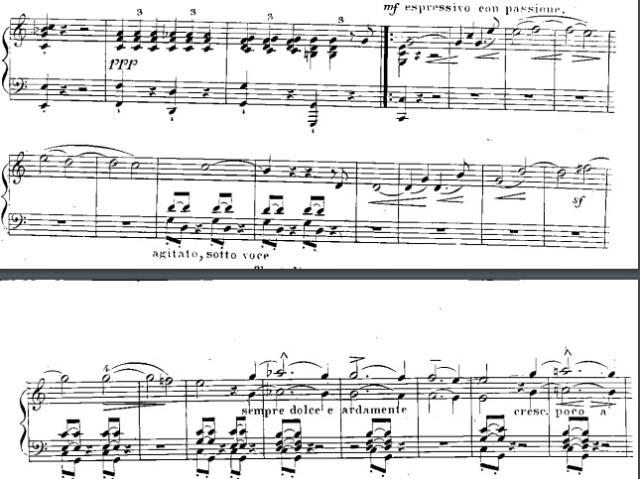
A couple of weeks ago I wrote about the song “Die Post” and its heart-beat rhythms. There are other songs with a pulse, for instance the coda to Beethoven’s 3rd piano concerto just after the cadenza. All well and good, but when did a composer ever insert a fevered pulse, a pulse that sounds obsessive or crazed? I think we have that in “Reveries – Passions”, the first movement to SF. Let me show you a bit of Liszt’s transcription, as this is the easiest way to zero in on what Berlioz was doing.
The first time we hear the main theme, that Berlioz called an idée fixe, it may be literally just that. In Liszt’s transcription we can see something resembling a duet:
A high theme in the strings (“espressivo con passione”), a melody that is an idea, and arguably in the head
Below (“agitato sotto voce”) vibrations, shivers, palpitations? Arguably the body in which those ideas are happening
If you listen to this passage, you may notice that, as the tempo increases naturally so does the tempo of the beats, which we might think of as the heart-rate of the artist whose story is being told.
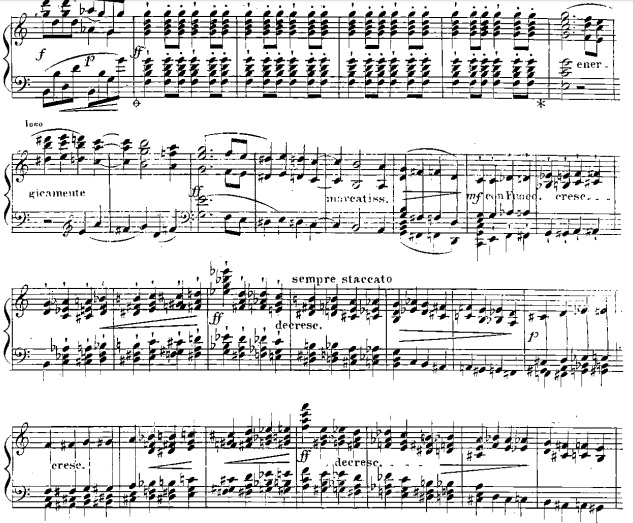
At times Berlioz is simulating the passions of his protagonist, for instance in this pair of examples below, where
1) we see the repeated chords (ff) that build suspense & excitement (top line),
or
2) in the frenetic racing from top to bottom of the staff and back (look at those notes looking like a literal chase across the page further below), punctuated by sudden spearing notes, agonized.
That frenzied duet I illustrated with the first picture recurs in an ever more frenetic form this time with the pulsing coming from above and below, the theme sandwiched in between. I have been listening to this since my teens and never fail to be astounded at what Berlioz achieved here.
Please listen to it if you can and tell me you can’t sense a heart beating, and ever faster as the tempo picks up. This passage is right at the beginning of this youtube sample from Seiji Ozawa’s Toronto Symphony recording of the SF that I had as a teen.
The Toronto Symphony has been in the news this week with the announcement of a new music director. Great. But I’m more interested, or perhaps you would say obsessed, by the upcoming concert, the return of Andrew Davis to the podium. There are other pieces on the program Sept 20, 21 and 22, but as you can probably tell I’m especially interested in hearing the Symphonie Fantastique at Roy Thomson Hall.
I just saw The Producers at the Lower Ossington Theatre. I have so many different sorts of responses, I want to keep them straight.
1. The theatre
2. The play (I know every line of the film, the play is new to me)
3. The performances
1-The theatre Yes it was a packed house in this theatre. Obviously a lot of people know about this fascinating little venue. Lower Ossington Theatre is between Queen & Dundas on Ossington, seating about 150 in a very useful configuration. Imagine seven rows of seats ascending very sharply so that absolutely everyone has a good seat. Now imagine the curtain going up on a really big stage that seems as big as the seating area. The show is loud and confident, singing and dancing right in front of your face no matter where you sit.
And this amazing little theatre lets you bring your beer or wine into the theatre with you.
And they’re doing interesting shows.
I understand that there are two venues inside. Rocky Horror has been produced there, and comes back next week at the same time as they’re offering The Producers: which I saw tonight, Mel Brooks’ musical adaptation of his own film. And their website also shows Avenue Q, Once on This Island and Newsies. I suggest you check out the website for more info if you’re curious.
2-the play
I hadn’t heard about this company from anyone, but simply decided to go see the show because
I know someone in the show (via good old Facebook)
I’ve always wanted to see this show
There are some interesting differences between film & play, and guess what, because it’s Mel Brooks he doesn’t have to ask anyone’s permission to make the changes, it’s his property to alter / adapt as he wants. Some people get so incensed by adaptations if they’re not totally faithful which is ridiculous.
Indeed he took tiny characters from his film comprised of a few brilliant lines, etching the character so indelibly in our minds that he had to expand them. Roger de Bris, Carmen Ghia, Ulla the Swedish secretary… And single lines such as ‘one two kick turn” get expanded into songs.
I know some purists likely would object, and that’s their business. But the thing is, the media (film vs stage musical ) are different. LSD (Dick Shawn’s character) in the film simply can’t work in the stage version largely because of the way the opening night unfolds. We no longer get a mass exodus of offended watchers and then a sudden reversal as people discover it’s actually funny; and meanwhile, Max & Leo drink in a bar across the street, believing they are celebrating their triumphant failure. No, it’s quite different in the musical play.
Maybe though, the biggest difference is the times. It’s now 2018, the musical having premiered in 2001 on Broadway, (made into a film musical in 2005), while the original film appeared way back in 1967. I am reminded of Linda & Michael Hutcheon’s 1996 book Opera: Desire, Disease, Death , where they compare the way tuberculosis plays out in Verdi’s opera la traviata in the 1850s vs Puccini’s la boheme from the late 1890s. It may seem like a silly comparison, but one could do a dissertation on the coded differences –for example—gay is signified in 1967 vs 2005, how the sexy blonde Swede appears, and of course, the treatment of the main plot.
Gayness was somewhat forbidden back in 1967. You may recall that Gene Wilder’s version of Leo Bloom is totally shocked to see Roger De Bris in a dress: because cross-dressing wasn’t so mainstream in 1967. By now it’s so solidly established that the gay element is given a much bigger role. Not only do Roger’s team get their own number, but Roger himself takes over the show, replacing LSD as the Hitler we see in the actual presentation of “Springtime for Hitler” in Act II.
I wonder if Brooks himself had second thoughts, in changing the way the Fuhrer is presented, going from wacky Dick Shawn’s bluesey “sieg heils” to Roger’s gayer version.
I was surprised at the other big change, which I hope doesn’t seem to be a spoiler, in a play that’s been out for more than a decade. But the conclusion of the story is substantially different. when Leo Bloom’s neurosis is apparently cured by Ulla, and Rio becomes more important to the plot, and not just a line in a song. I was surprised at how much I loved the play, fixing the parts of the film that are uneven & sophomoric. (for instance nobody tries to blow up a theatre, political as the image might be)
3- the performances
In such an intimate venue there’s no room for BS. If the performance isn’t authentic we’ll know it. Everyone was entertaining, singing and dancing as though this were Hollywood or Broadway, not Ossington Ave. For me the show was especially alive whenever the big chorus numbers happened. The funniest thing in the show is the chorus of old ladies (Bialystock’s posse of blue-haired supporters) singing and dancing with walkers, who also–much younger this time– brought the show to life in the first act when they enlivened Leo’s dream in the middle of the accountant office (a much younger & sexier group of dancers: but of course they’re the same ones we see with walkers). The music coming from music director Mike Ross—however it was created (I can’t tell from the program nor from what I heard) —was always stylish, accurate & tight with the singers & dancers.
Hugh Ritchie has an appealing voice, while taking us through Leo Bloom’s transformation from neurotic to heroic. Shalyn Mcfaul knocked my socks off in the unexpected casting as Franz Liebkind; but why not cast a woman, if she can pull it off? And she did. Benjamin Todd has the biggest toughest role as Max Bialystock, and held the show together, singing wonderfully. Mitchell Court as Roger & Hitler was especially brilliant, in a role that could easily turn into a caricature. Ryan Gordon Taylor’s Carmen and Madison Hayes-Crook’s Ulla were enormously enjoyable.
The Producers continues at The Lower Ossington Theatre until November 11th. For further information click here
There’s so much to know about some repertoire, a little flash of insight about this song or that role can get lost in the massive store-house of knowledge.
It used to be said among my circle of friends at university that Wagner was the third biggest subject in libraries after Jesus & Napoleon. I wonder now, was that English only? Were China & India included? And have more recent famous figures –such as the Beatles or Donald Trump –possibly pushed Wagner out of that position (if he ever had it)?
I enjoy working with singers, if you can call making music “work”.
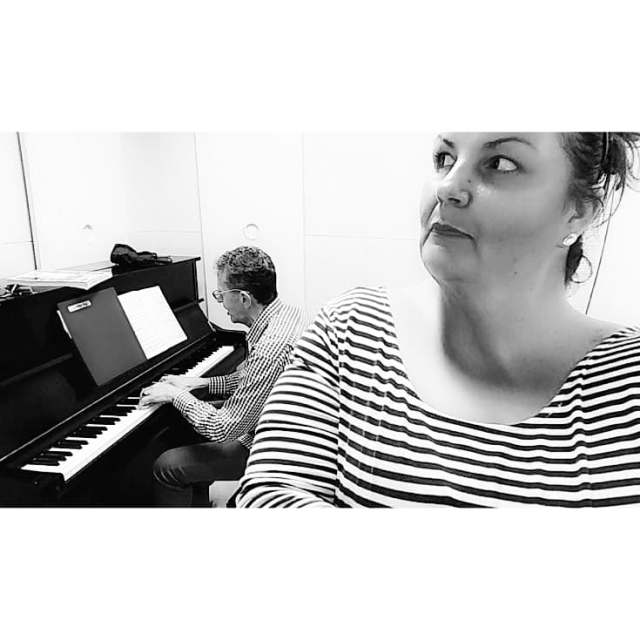
I had two very distinct revelations today, one concerning a Sibelius song, the other concerning a Wagner solo (some might call it an aria). Both insights come to me courtesy of Margarete von Vaight. You may recall an interview I did with her awhile ago. She has recently returned to Toronto after a trip to Europe.
The photo might hint at the whimsy that’s possible in a tiny room with a piano & some scores, especially when the voice is larger than life.
Margarete captioned her photo “the singer as critic”
I have loved Jussi Bjorling’s version of Sibelius’s song “Svarta Rosor” since childhood, a song I didn’t understand: even when I read a translation.
And I enjoyed the way Margarete sang it in our session this week. I don’t speak Swedish, so I’ve been experiencing this song since childhood, without really knowing what it’s about. It’s a puzzling text. Here it is, courtesy of http://www.lieder.net (who you should support if you can).
Josephson’s original poem:
Säg hvarför är du så ledsen i dag,
Du, som alltid är så lustig och glad?
Och inte är jag mera ledsen i dag
Än när jag tyckes dig lustig och glad;
Ty sorgen har nattsvarta rosor.
I mitt hjerta der växer ett rosendeträd
Som aldrig nånsin vill lemna mig fred.
Och på stjelkarne sitter [tagg]1 vid tagg,
Och det vållar mig ständigt sveda och agg;
Ty sorgen har nattsvarta rosor.
Men af rosor blir det en hel klenod,
Än hvita som döden, än röda som blod.
Det växer och växer. Jag tror jag förgår,
I hjertträdets rötter det rycker och slår;
Ty sorgen har nattsvarta rosor.
In English, the refrain (“Ty sorgen har nattsvarta rosor”) roughly translates as “for grief has roses black as night”. Svarta rosor, which is of course also the title, means “black roses”.
I never understood what this might signify, other than emotions of sadness, grief. It simmers with passion that explodes in the last phrase, whether it’s a soprano or a tenor singing that line.
Margarete offered some additional insight. I wonder indeed what Bjorling might say (were he alive) if he knew that for the Finnish Sibelius, writing this song in Swedish, there were other possible ways to read the symbolism? The mysterious & inexplicable grief she suggested that underlies the song, is politics, history. We know of Sibelius’ nationalist voice. She saw the song as an expression of the grief of oppression, a tightly controlled well-articulated anger within that context.
It certainly changes my understanding of the song to consider this added dimension, to say nothing of my respect for Sibelius…(!)
I had always wondered about what it really means., mysterious and incomprehensible, the explosion of pain & rage at the end of the song. It makes no sense to me, without something like Margarete’s additional subtext.
Her reading of it that she sang was tightly controlled, punctuated by a powerful last phrase. It was especially overwhelming in the tiny studio.
Dare I say it: I think I get the song now.
We also went through parts of Wagner’s opera Lohengrin. I sang a bit of it –when she asked me—but that was after she was done in the whimsical selfie posted above, after a ferocious bit of singing. People don’t always recognize the physical effort involved in singing but it’s perfectly clear when the sound is overwhelming. In passing, I think I understand Ortrud better than ever before.
I have been blessed with opportunities to hear Margarete’s voice at close range, including some of the most difficult soprano passages you can imagine:
• “Dich teure halle” from Tannhaüser
• The hojotoho cries at the beginning of Act II of Die Walküre
• “In questa reggia” from Turandot (bet you thought she only sings Wagner)
• Both of the big arias from Ariadne auf Naxos
• Isolde’s Liebestod as well as much of the Siegfried Brunnhilde
A soprano wouldn’t usually sing more than one of these at a time, but her voice is not the usual kind of voice.
I think what I heard this time fits her better than anything else she’s sung. I say that thinking of both the text and the singing: namely the big pieces from Ortrud:
• “Entweihte Götter” from Act II
• “Fahr’ heim” near the end of Act III (which she sang only partially…I recall some giggling and laughter too)
When we’re not making music, I might be hearing about engineering or some other aspect of her life. She is charming but speaks very directly, the quintessential example of a no BS person who tells it like it is. That quality is what came through in her Ortrud, a character who sometimes turns Lohengrin into something melodramatic, unsubtle. If her singing isn’t really excellent the opera becomes two dimensional. She is in some respects like the character Iago who must seem trustworthy to be trusted by Otello, even though we heard of evil plans. Unless those extremes can be reconciled, you make everyone else on stage look naïve. The other Ortruds I’ve heard scream their way through the part.
Margarete showed me another way to sing it, very much like the directness of her Sibelius. The first time I started playing she giggled something about my forte. I played louder: because I needed to be louder, much louder. Wow. Yes the singing was powerful but without the wobbling or struggling one gets from some singers. I have never heard such powerful singing sound so easy.
I’ve never heard such a big voice up close. My ears were ringing for awhile afterwards. It was pretty amazing.
I watched and listened to the second preview of I Call Myself Princess, Jani Lauzon’s impressive new play with opera, presented at Aki Studio in a collaboration between A Paper Canoe Projects, Cahoots Theatre and Native Earth Performing Arts.
Genre can be a slippery thing. I heard Lauzon call the work a play with opera, although it could just as easily be called a play with music, or even a musical. I think genre is most useful when it guides experience, telling us what to expect. This name –play with opera—is rather unexpected, but come to think of it, so is this work. I think we’re being signaled that something unusual is going on here. Much of the music had a life previously in another century, but that is no stumbling block, indeed this is one of the most singularly Canadian works I have ever seen. The mix confounds us by making a great deal of sense, or at least matching the odd idea of European cultural artifacts absorbing Indigenous elements. Once more I stumble over an idea Peter Hinton invoked in the Canadian Opera Company production of Louis Riel, that Canada is a Metis nation.
I’m happily reminded of Lauzon’s steadying presence onstage last year at the beginning of Louis Riel, even if this time we’re hearing her words rather than seeing her perform.
Jani Lauzon as The Folksinger and Russell Braun as Louis Riel in the Canadian Opera Company’s new production of Louis Riel, 2017 (photo: Michael Cooper)
There’s a dramaturgical strategy to Lauzon’s piece that is part spirituality, part good story-telling. We are told that Indigenous people believe that when you die you don’t go away, and this is something I’ve seen in other works, for instance Jeremy Dutcher’s performance last season, when he addressed his performance both to the living persons in the space, and the spirits we couldn’t see.
Similarly, we have a story that exists simultaneously in 2018 and 1918, as the past inter-penetrates the present. This is the way Lauzon writes but it’s reality too. When a young man in modern times is investigating his cultural heritage, discovering the ways in which his culture has been appropriated: he would wander into the past. As he opens books and plays tunes, history and his culture comes alive around him. We see his experience at the same time as we see the creations of a century ago, that were at that time ALSO appropriating his culture. It’s simultaneously a metaphor –where the present interrogates the past—and the actual mechanics of the story, a way for 2018 to literally investigate and explore 1918.
Pardon me if you can hear my mind audibly boggling in the background
This is a talented group onstage. In a way the genre choice lets them off the hook. Only Marion Newman is expected to sound operatic, whereas the others are free to be true to their character, and let me add –almost in passing– that Newman’s acting is superb, playing a kind of angelic figure of the spirit world, who sometimes becomes the performer of 1918. If Aaron Wells had sounded too accomplished as a singer of opera I think that would obstruct the story-telling and undermine the authenticity of his portrayal as a young aboriginal student exploring his past: which is central to the story. And when he sings Indigenous music towards the end it’s a highlight of the evening as his voice is most genuine. No we’re not in an opera, we’re in a play, and as such I think author Lauzon & director Marjorie Chan wanted above all that we see something genuine & moving. And that’s what we got. Yes I love opera, but I must confess that opera rarely if ever gives me the kind of vivid portrayals I saw today.
I am sad when I face this fact, that opera often falls short. And the morning after I am adding this paragraph. Do composers ask this question (one put to me by a director years ago): what are you adding with your music? Would this work better without you? are you truly taking us beyond the words into what only music can add? Lauzon made a generic choice of a pathway where the music is always illuminating her story, a wonderful hybrid that is always compelling.
Everyone sings at times. Richard Greenblatt sings & plays much of the show from the piano, a vivid image of composer Charles Wakefield Cadman, who happily appropriated Indigenous culture a century ago. Courtney Ch’ng Lancaster is Nelle Eberhart, who strikes a blow both for the equality of women and the inclusion of aboriginal stories in opera, as the librettist working with Cadman. Howard Davis plays several parts, including his role as Alex, Aaron’s lover, helping to launch the present-day storyline with Wells. The writing from Lauzon is very slick & accomplished, as we accept first the possibility that two people separated by thousands of miles can converse naturally, and shortly thereafter – with Newman’s appearance from the past, that someone from a hundred years ago can also slide into that conversation.
There’s also a really important credit in the program “Musical Direction & Composition by: Jerod Impichchaachaaha’ Tate” that I can’t properly address, because I don’t know what’s his and what’s the music from the original a century ago. All I know is that it fits together beautifully.
I don’t want to give too much away, only to say that we’re in the presence of a great deal of humour & wit to lessen the pain one might feel. And Lauzon’s plotlines embody different story arcs of liberation, for women, for blacks, for gays, as well as Indigenous people. While this was a preview, yet the work is firmly taking shape, the cast seeming very assured in the music & their lines. And it must be said that this is a substantial work, two hours to make you think, to feel, and plenty to stay with you afterwards.
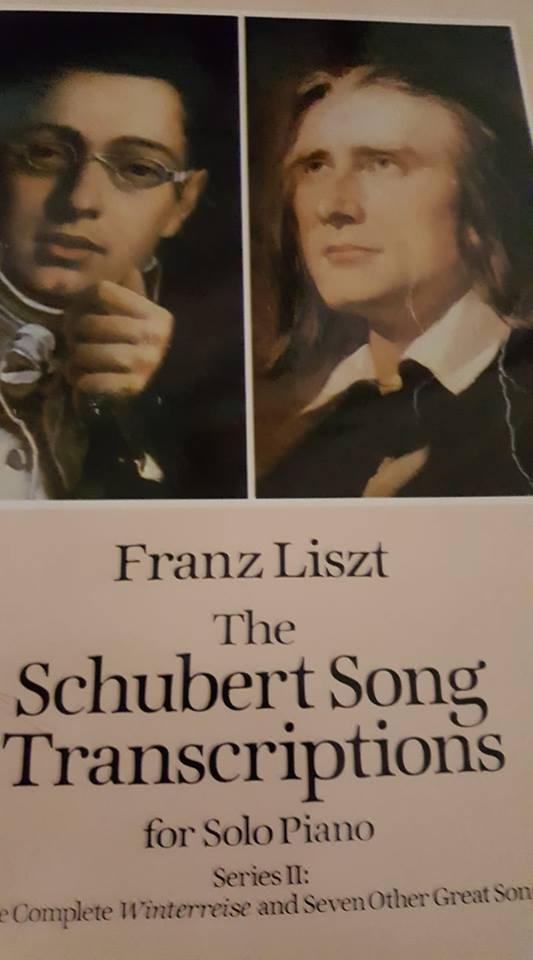
After experiencing the 24 man deconstructed Winterreise from Tongue in Cheek Productions, I’ve had all that Schubert rattling around in my head the past couple of days. Given that I had to return a couple of books anyway, to the Edward Johnson Building’s library at University of Toronto’s Faculty of Music (an amazing collection) –because they were due and I had used up all my renewals—I thought to find Franz Liszt’s version, a mere dozen songs transcribed for piano rather than the full 2 dozen.
This one is a Dover edition from the 1990s, with big easy-to-read notes, in a clear impression.
They included original title pages for each song to add to the sense of authenticity.
I played through the cycle, gently, as it was the evening. I kept it absolutely as quiet as possible even on the pages with fff dynamics. I can come back to them later, play them full volume next time. I was trying to honour what I had in my head from the cycle a couple of nights ago.
As I played I tried to imagine what it must have been like when it appeared. In 1828 Franz Schubert died at the age of 31. His cycle Winterreise was published the same year.
And so as I mull it over, please excuse me if this seems somewhat literal-minded, plodding through the score and the history. While they lived a long time ago, for Liszt who was born in 1811, Schubert was a near contemporary. Think of someone who is 14 years older than you. Is that a huge gap? But given Liszt’s longevity (so different to Schubert) we think of him as an early modernist composer (in his maturity) and a romantic virtuoso spoken of in the same breath with Chopin, Mendelssohn & Schumann, as if they were of totally different periods. In 1828 when Schubert died, Liszt was 17 years old. From 1839-40 Liszt transcribed the cycle for the piano, in other words, when he was close to the same age as Schubert at the time the originals were composed. Schubert composed in 1827-28, when he was 30-31. Liszt would turn 30 in 1841.
Now to picture the experience, we need to forget everything we’ve discovered from recordings. In the 1840s there was no such thing, no CDs no youtube no victrolas no wax cylinders. Liszt would help popularize music with his transcriptions. And of course it worked for him too, not just because it gave him something to play but because he could wrap himself up in the prestige of the composers he transcribed.
Beethoven: nine symphonies that are ubiquitous now, but at that time? Mostly unknown, although aha that’s where Liszt came in.
Berlioz: his Symphonie Fantastique that will be presented next week by the Toronto Symphony? Likely would have lain unknown at least for awhile without Liszt’s help.
Schubert: many songs were turned into piano compositions, popularizing the melodies.
I couldn’t help wondering about Liszt’s taste, his choices in the transcriptions of the Winterreise songs. In places the reproduction is accurate & under-stated. But in other places there are lots of extra notes, as though Liszt were in a czukrazda (a Magyar sweet shoppe), insisting it be served mit Schlag, in effect burying the song as though it were a cake under a small mountain of extra whipped cream. Did he feel that the bare melody couldn’t work without the extra embellishments? But he likely had never seen the cycle enacted, had no experience such as we have of a Prey or a Schreier or a Fischer-Dieskau.
If you don’t trust the simple goodness you overdo it with the extra decoration.
This might explain why some people roll their eyes at me when I speak adoringly of Liszt. But the man was bringing something unknown to the world, a popularizer who thought he knew best.
What is dignity if not a kind of self-respect. You notice it most when it’s not there, perhaps taking it for granted otherwise.
I got my hair cut on the way to a concert. In passing I want to make a comparison.
As usual I was at Lone & Co, my hair in the capable hands of Cheryl Lone after getting my hair washed & my scalp massaged by some unidentified person: who left me feeling wonderful. Now of course I recognize that massages are something most people enjoy, so you may be giggling at the thought that this is in any way unique.
Bear with me for a moment.
It struck me for the first time today to wonder: was I imagining it? Yes, it was another in a series of ecstatic hair-washings & massages that left me feeling amazing.
Here’s the thing. Until I started coming to this salon, I used to dislike the hair-washing experience. No wait dislike is too mild of a word, it’s more like detest or even hate. I remember with one of my favourite cutters, I’d always wash my hair at home to avoid being at the mercy of the salon, because the hair-washing was always unpleasant.
Why?
It’s ankylosing spondylitis, which has led to a great deal of stiffness in my neck. I feel weird talking about it because it’s a little thing. It’s awkward and humiliating sometimes, to be asked to do something you simply can’t do: such as turning your head the way most people do. Sometimes it’s painful, and not merely awkward. So normally this would mean, that I’d be struggling to get through the hair-wash experience, trying not to make the poor unfortunate washing my hair feel too frustrated at my lack of flexibility. And this would recur once I was in the chair getting the cut, unable to move my head much to make things easier for the hair-cutter, who would want me to tilt my head this way or that.
And so: I had to ask Cheryl. Is it just a fluke that I feel so great in her salon, that when I get my hair-washed it’s always a comfortable experience? I was tempted to call it something so much more, such as “empowering” or “ecstatic”, which may seem excessive, until you remember that for decades, my salon experiences were unpleasant, painful, awkward. I’d avoid getting my hair cut, and just let it grow.
So I asked her. Is it a fluke that I had this experience, or are your staff trained to deal with this?
Aha! Yes it was actually part of the training. You see Cheryl too has ankylosing spondylitis (or “AS”).
I should also explain that the concert was the one Sept 5th and I hesitated before posting this item: wanting to be certain it was permitted to talk about Cheryl also having AS. I called to confirm and she said sure no problem. I wanted to make sure I wasn’t being indiscreet (otherwise I would have published this earlier this week).
So there you have it. When I’m there, they know that I am another one with the same condition. It’s in my file, and so they‘re told to treat my neck the same way they treat Cheryl’s neck. And of course Cheryl too is sensitive, so my haircuts no longer involve any of those hopeless attempts to tilt my head in such a way to make it easier for the cutter. She knows my limits and of my possible discomfort.
She explained to me what that means. She told me how she responded once to one of the apprentices, when she asked: “so what’s it like?”
Cheryl demonstrated for her. She held her hand up against her head, and said (while holding her hand against her head) “okay now try to turn your head” (while preventing it from moving).
I burst out laughing, with recognition. Oh my God, yes that would do it! Yes that’s exactly what it’s like.
The funny thing is, I’ve been at theatres –not wanting to name any names—where there wasn’t nearly so much sensitivity shown.
A director decided that they would surprise the audience, beginning the show behind them. It’s clever. But it’s problematic if you can’t turn around. Suddenly there’s a class distinction in the audience as if some couldn’t see or hear as well as those who could. I sometimes notice such things, especially at intermission, when I see that some aren’t as mobile, struggling to get to a bathroom at the bottom of a stairway. There is a huge population of concert- & opera- goers who are advancing in age, but less & less mobile with every year.
This massage & hair-washing was ecstatic, reminding me of the innocent times of my youth when I didn’t need to think about such things.
It may seem like a little thing to be able to get a haircut and a scalp massage without feeling my physical limitations. I’m only appreciating it now because Lone & Co make it seem so effortless.