Cosi women

When you walk into the Four Seasons Centre for the new Canadian Opera Company production of Cosi fan tutte the first thing you see is a huge reproduction of Frida Kahlo’s painting Two Fridas.

I imagined what Frida might have said had she seen this.  “”HA Diego, see?! This is bigger than any of your murals!”

Frida Kahlo’s painting Two Fridas. To read more about the painting, click on the painting to go to another site.

If you know Da Ponte’s libretto you could be forgiven for thinking that these gory images of blood & surgical instruments are incongruous, as you encounter Mozart’s comedy.

If you’re like me –an incorrigible opera nerd—you probably knew that Atom Egoyan was directing Cosi, that he was attempting something ambitious.  I believe what he was attempting tonight was more difficult than either of his previous forays into opera with the COC.  Salome is outrageous while Die Walküre is automatically symbolic and deep.  Both works are dark, without a shred of comedy.

The old saying, attributed to Edmund Kean on his deathbed is “dying’s easy. Comedy’s hard” and I doubt he got a laugh.  I wonder if Egoyan realizes this, as his Cosi fan tutte is often deep, sometimes wildly funny, but just as often, very dark.  This is no light romp.

For starters, Egoyan does something that reminded me of Woody Allen.  The subtitle of the piece –school for lovers—is taken as a logical departure point for the story.  Don Alfonso’s bet with the two men—that he can demonstrate that women are unfaithful by nature—is a kind of illustration for a school.  This is no friendly wager (as it has been in some productions I’ve seen), but something darker.  Egoyan doesn’t hide from the sexism of the story, indeed he seems to underline it, and thereby to transcend it.  The women are all fascinating, because it’s their drama that is in the spotlight, while the men, in comparison, seem to be abusive libertines with all the privileges.

And so yes, I thought of Woody Allen:

  • because the women’s parts are all so interesting that the men are more or less blown off the stage, superficial and flawed, compared to these fascinating women.
  • And yes, I had that other recollection of Woody Allen, the man recently castigated as a pedophile, who married Soon Yi.  We’re all implicated in this production as we stare at a stage filled with what seem to be schoolgirls, two of whom are being pursued in this bet.  Oh sure, I know that the singers playing the parts are of age; but the costuming is sufficiently ambiguous as to invite us into a very uncomfortable place.  What’s more, the youthful mien of Fiordiligi and Dorabella makes perfect sense, when you look at their innocent fantasies; for all intents & purposes they could be children, considering their meagre understanding of the real world.

Egoyan isn’t content with that simple layer, perhaps because of the dark implications I just mentioned.  Remember the huge Frida Kahlo reproduced on the curtain that seemed incongruous?  In Act II we’re given ample reason. In Fiordiligi’s aria “Per pieta, ben mio, perdona” the painting that was already seen on the curtain, was now not only front and centre on the stage, but gradually enlarged, until the heart was almost the only thing visible.  And then our viewpoint wanders to other disturbing images in the painting, such as the surgical instruments.

Layla Claire as Fiordiligi in the Canadian Opera Company’s new production of Così fan tutte, 2014. Photo: Michael Cooper

Layla Claire as Fiordiligi in the Canadian Opera Company’s new production of Così fan
tutte, 2014. Photo: Michael Cooper

It’s a tribute to soprano Layla Claire’s performance that this odd projection gradually growing could not upstage her.  As the aria mentions her heart it did follow logically, but the conceptual shenanigans were completely redeemed by the performances.  Claire was matched by Wallis Giunta as a very playful Dorabella, their voices blending wonderfully, and looking very much like sisters.  There was so much going on at times between them, that I couldn’t take it all in.  The stage action was very rich and detailed even without including the work of the chorus.

When I think about this story, which is sometimes so glib in its treatment of genuine human feelings, I like what Egoyan seems to be doing, essentially validating the deeper feelings of all his characters, if not asking us whether true love is even possible.  The modern director usually seeks to problematize that which has been straight-forward in the past, but in this case it’s a worthwhile exercise, taking a story that is in some respects  (if you’ll excuse the choice of words) heartless.  But as I said, the story really concerns the drama of the women and their choices, not the men, who are simply predatory & exploitive.  It doesn’t leave you with a bright breezy feeling at the end, because in fact it’s just kicked you in the gut with its truthfulness and integrity.  At the first intermission I didn’t think I’d be saying this, because I was a bit bewildered by all the bells and whistles, the butterflies with pins through their hearts, the ships in hats, the loose ends that didn’t seem to be cohering.  But not only do they cohere, finally (the butterflies perhaps a reminder that we are all potential specimens to have our hearts broken), but one can even say that it does end happily enough.  We’re all challenged & implicated in various ways, so it’s a relief that there is so much laughter.  Act II is much funnier than Act I, perhaps because so much of the first act is setting up what’s to come.

I hadn’t laughed once before Tracy Dahl arrived as Despina, but whenever she appeared, the mood lightened.  Not only did she manage the usual comic bits, but she brought extra, especially in her scenes with the two young women.  It’s good to see her back on the COC stage.  I last saw her in one of my all-time favourite productions, the Mansouri Ariadne auf Naxos with Elizabeth Connell & Judith Forst in the 1980s. I am not the only one who thought so (if you’ll excuse a slight digression). I found this reminiscence online from George Heymont (scroll halfway down to the paragraph about Toronto) echoing my sense that Dahl & Connell & Forst were as good as what they offered at the Met that year.

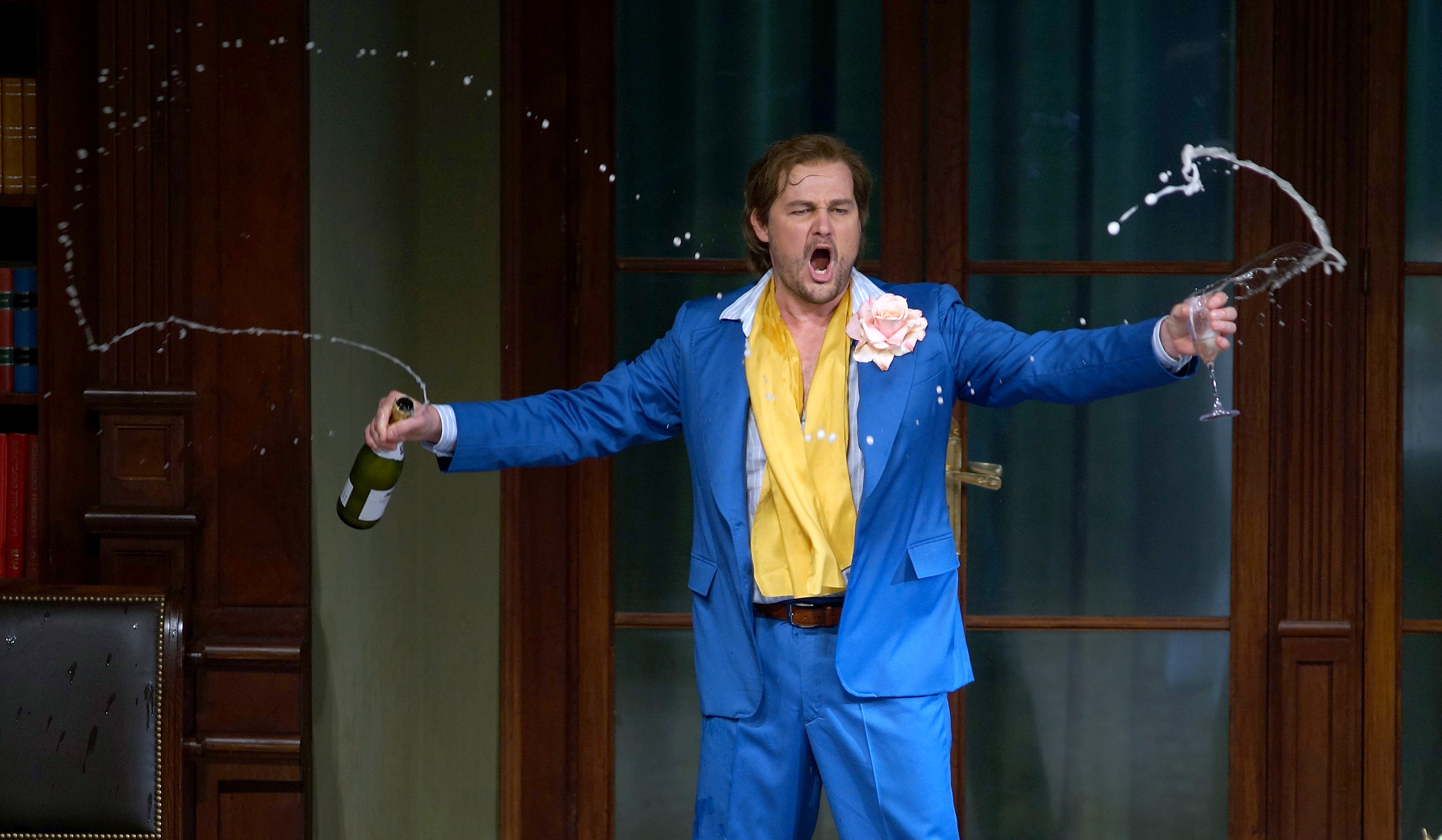
The men were certainly good too, even if I found myself almost embarrassed for my gender.  Does that make me –or Egoyan—a feminist? Perhaps, and I’d say that proudly rather than as a critique.  By the end all get their reward.  Thomas Allen’s Don Alfonso is in some respects a waste of such a profound talent, given that he’s more of a ringmaster or master of ceremonies.  The voice is as splendid as ever, the delivery full of subtleties.   Paul Appleby & Robert Gleadow each had their moments to shine, thoroughly enjoyable to watch.

I’m looking forward to seeing it again, to see how I feel about it now that I know what Egoyan was up to and where it’s going.  The COC’s Cosi fan tutte runs at the Four Seasons Centre until February 21st, including the annual Ensemble performance –with a cast comprised of members of the Ensemble Studio—on February 7th.

Posted in Opera, Reviews | Tagged , , , , , , , , , | 4 Comments

Back to school: open-hearted, open-minded

I’m inspired by last night’s announcement of Canadian Opera Company’s 2014-2015 season.  Anyone bumping into me today will see that my appetite is indeed so whetted that they might prefer to run in the opposite direction.  I can’t help myself.

Today’s reminder email from the COC concerning the Saturday opening of their new Cosi fan tutte directed by Atom Egoyan included not just a press release but the director’s note.  In my current state I’m likely to read way too much into this, but wtf, what’s a blog for if not to go off half-cocked, to propose wacky theories in plain view?  It wouldn’t be the first time.

In this state everything becomes a mirror, everything supports the argument because there is nothing anywhere that is off topic, nothing that can’t be an omen or a parable demonstrating a key message.

Egoyan’s note begins in the most concrete terms:

For those familiar with Così fan tutte, this production will be immediately surprising in two ways. First of all, we are taking the alternative title of the work and using it literally. It takes place in “A School for Lovers,” with Don Alfonso the teacher of this school in which he demonstrates to his students the laws of attraction.

Indeed.  While we will watch them in their onstage learning, we will ourselves be exposed to lessons as well.

Now picture some writers scratching their heads, attempting to figure out a daring opera production: possibly this one.  Now of course writers who are scratching their heads never say “I don’t understand” or “please help me understand”.  No, when you put a critic on the spot their default position often is defensive or dismissive.  How good are you at admitting ignorance, let alone incompetence?  Now let’s put you on the spot, working for the media and ask for your instant comments about something you didn’t understand.  Indeed, if you’re accustomed to being an “expert” you may not even be in touch with your ignorance, but may assume that the interpretation that bewilders you must automatically be bad because it was not intelligible: because you’re experiencing those odd feelings in the pit of your stomach.

I venture into this because

  • My sense of inspiration, due to the COC program announced yesterday
  • A few conversations recently with people who not only fail to share my enthusiasm (did they want to run for cover at the sight of me? Or smack me upside the head?), but remind me of the people in that paragraph above

Both the event yesterday and today’s email had me wondering if there’s a broader educational initiative underway.  PR is after all education. Propaganda? teaching with extreme prejudice.

First I’m recalling the usual (old) assumption—the prevailing philosophy in arts marketing for a generation or two—that arts audiences are built by exposing youth to art (paintings, opera, …you name it), and thereby building literacy, awareness, acceptance and eventually loyalty.  In this colonial outpost –so the thinking goes—the unwashed masses would resist, while the critics assist in the evangelism of the various arts institutions.

In theory the younger generation would be properly indoctrinated, but it didn’t quite work that way. And of course the time has come to throw the idea away.  Audiences—at least some parts thereof—have often shown themselves to be much hipper, much smarter, much deeper than the critics.  The old assumption broke down long ago.

I can’t help seeing that school onstage as a school for operagoers, a school showing both those onstage and the implicated viewers their folly, their weaknesses, and possibly, new paths.

Here’s another sentence from Egoyan’s note that again could be directed at the viewers, particularly the critics.

As Frida Kahlo’s painting “Two Fridas” makes clear, the heart can be brutally exposed, with surgical scissors in one hand, and the romantic talisman of a beloved brooch in the other.

The painting may be mentioned because it’s part of the production (possibly in the design?), but whether it’s in the opera or not, Frida’s double self-portrait has much to teach us (for example, to see the whole painting and to explore subtexts & meanings see this site).  Last night we were reminded that Egoyan is coming back to Die Walkure, that opera about love & twins. A Jungian would say that when we speak of the other, especially a duplicate other, we’re really speaking of ourselves. Are we brave enough to follow those incisions / explorations to their logical conclusion?

I admire those who are open-hearted, although there are easier ways than incisions to achieve that end.  Frida is being strong & brave in exposing her condition through the painting.  Vulnerability is ultimately strength, as Brene Brown says in her TED talk.

Do we dare come to the opera with an open heart, to learn, to feel what it has to show us, rather than sitting in pompous judgment as though we already knew everything?  In that case why go at all?

In Siegfried the Wanderer asks Mime a series of riddles, intent on helping him find out the solution to a problem he needs solved: how to repair the shattered sword.  Of course Mime is so busy showing off what he knows, rather than asking the question he needs to ask (and admitting his own ignorance), that he clumsily forfeits his own head.  When we’re in the presence of beauty or truth or goodness, are we so busy showing off, that we fail to have an open-hearted encounter?  Are we so busy in our vanity & self-love that we fail to get out of our own heads?

…and miss the show right in front of us?

Sorry if I keep asking questions where my bias shows.  I have no idea whether I will like this new production or not.  But I must open my heart & my mind too, and yes, be prepared to love it completely, prepared to let it have its way with me.  Otherwise, as I conceal a part of myself, I am not really there, not really in a position to even see and hear.

There’s one other tantalizing phrase in Egoyan’s note, even if I am likely off on a complete tangent:

For the true libertine such as Don Alfonso, the total lack of rationale behind the laws of attraction is a cause for alarm and certainly a subject worth illuminating to his students.

Now of course just Sunday night (click if you didn’t see what i wrote already) I watched Tcherniakov’s Don Giovanni, the second of three Mozart operas with libretto by Lorenzo Da Ponte.  Is Alfonso perhaps a grown up version of the Don?  Indeed at one time I wondered if for a time Mozart & Da Ponte were themselves libertines.  There’s a fascinating gap in the Mozart correspondence –nothing massive, just a couple of weeks –while Mozart is away from family, and with Da Ponte.

In parting, I offer you a glimpse of Thomas Allen, who plays our “libertine”, in another incarnation (the prequel?) namely Don Giovanni.

Posted in Opera, Personal ruminations & essays, Psychology and perception | Leave a comment

Six for COC in 2014-15

The Canadian Opera Company announced their 2014-15 season at a festive event tonight.  Yes the COC are stepping back from their recent pattern of seven-opera seasons, to offer six instead.  But this is also the year when the New York City Opera & Opera Hamilton went bankrupt.  Let’s not go crazy.  A season that’s safe yet exciting? Surely local opera fans– especially those of the hardcore variety– will be happy.

I know that I’m feeling ecstatic.

We’ll see three premieres alongside three revivals.  All six are at least partially owned by the COC, as opposed to the occasional rental we’ve seen before.  While this was played up in the presentation, it’s less important than the quality of these productions.

New?

  • Canadian director Robert Carsen

    Robert Carsen’s Falstaff, a co-production seen at some of the greatest opera houses of the world (Royal Opera, La Scala, Netherlands Opera and the Metropolitan, including a high-definition broadcast… the encore is on this Saturday by the way) starring Canadian Gerald Finley.  This will be the fourth season in a row featuring a production from Carsen, one of the most high-profile Canadian directors of opera in the world.

  • Dimitri Tcherniakov’s Don Giovanni –the same co-production seen on TFO just a few nights ago, is finally coming home to Toronto—will star Russell Braun, Jane Archibald and Michael Schade.  It’s quirky and deep.  I can’t wait to see it, particularly with Braun & Schade.

    Russell Braun as Don Giovanni from 2013 Teatro Real Madrid production, photo by Javier del Real

    Russell Braun as Don Giovanni from 2013 Teatro Real Madrid production, photo by Javier del Real

  • Joan Font of the Spanish ensemble Els Comediants brings his Barbiere di Siviglia, another co-production. This is the same adventurous team that brought us La Cenerentola back in 2011, a stylish romp of great depth.  I see no reason to expect any less this time.

Revived?

Christine Goerke, photo by Gary Mulcahey, 2013

Christine Goerke, photo by Gary Mulcahey, 2013

  • Atom Egoyan’s Die Walküre is the big news of the season because of the coup represented in the casting of Christine Goerke in her first Brunnhilde.  In passing they let us know that they’ve signed Goerke to sing the Brunnhildes of Siegfried and Gotterdammerung too.
  • Robert Lepage’s double-bill of Erwartung and Bluebeard’s Castle, seen several times in Toronto & abroad since its 1993 premiere in the unfriendly confines of the O’Keefe Centre, makes its first appearance at the Four Seasons Centre with Canadian star John Relyea as Bluebeard.
  • Brian MacDonald’s reliable Madama Butterfly is revived again with Patricia Racette alternating with Kelly Kaduce; while Racette has the bigger name, Kaduce is a terrific singer I saw in Montreal a couple of years ago.

Nationalists should take note of how genuinely Canadian this company looks right now:

  • Four of six directors are Canadian, and they’re all there on merit (Font & Tcherniakov being exceptions to the nationality of Egoyan, Lepage, Macdonald and Carsen).
  • Casting for four of the six operas is mostly Canadian, again on merit (Butterfly and Walküre are the exception to the rule).

While the move from seven to six may disappoint, this is while the COC continues to tour schools, to offer its exceptional program of free noon-hour concerts, and maintains its commitment to the Studio Ensemble.  I am expecting to enjoy every show, and indeed to love five of the six.  The Butterfly is merely a reliable production among five others that scintillate, but it’s still an opera that I love and I know I’m not alone (according to operabase.com).

click for information about next season

Not only am I thrilled by the direction that the COC is going, but I’m impatient to see their operas.    First things first, though.  Saturday night, Egoyan’s new Cosi fan tutte opens the next opera of the current winter season…arrr can’t wait!

Posted in Opera | 1 Comment

Tcherniakov’s Don Giovanni

Alexander Neef (Photo: bohuang.ca © 2012)

Dimitri Tcherniakov has been seen a fair bit on TFO lately.  After recent productions of Il trovatore and Ruslan und Ludmilla, tonight’s broadcast had special importance, a co-production with several companies including the Canadian Opera Company.  COC General Director Alexander Neef introduced the broadcast of an interpretation we can expect to encounter at some point right here in Toronto at the Four Seasons Centre.

This live performance from 2010 featured exquisite singing & the brisk tempi of Conductor Louis Langrée leading the orchestra of the Festival in Aix-en-Provence.

I feel well-prepared temperamentally for this excursion into Regietheater after yesterday’s The Last of Romeo and Juliet.  I find myself often noticing the difference among audiences for different media.  Shakespeare’s text was altered far more than what I saw tonight from Tcherniakov, who gives us almost the entire text, while playing with a few relationships.  Why do I feel this will be a tougher sell for the COC? Perhaps because the opera community is more conservative.

Whatever else one says about Tcherniakov, he’s an amazing director.  This is one of the most committed performances from a full cast that I have ever seen.  I’m not saying I love it all.  But there are some inspiring moments.  In fact, watching it via video I am very eager to see it live, because it’s hard to decode through my television. But let me repeat, Tcherniakov lights a fire under his cast, as they are stirred and shaken, brought to vibrant life from the beginning to the end.  Some moments are more radical than others.

The ending –whereby you can really measure many interpretations—reminds me a great deal of another COC Don Giovanni from a few years ago.  In that one Masetto impersonates the Commendatore, a pretend stone-guest. This one is somewhat similar, scaring the Don, who falls to the floor with chest pains.  He doesn’t seem to die, but in the final ensemble everyone looks him in the eye and shakes off his powerful influence, no longer intimidated or afraid.  It literally doesn’t matter whether he lives or dies.

I found some moments worked better for me than others.  I especially liked the interaction between Masetto and Zerlina, two characters often marred by sentimentality, as played by  Kerstin Avemo and David Bizic.  I’ve never seen such electricity, every moment pregnant with meaning.   When Avemo sings “La ci darem la mano” with Bo Skovhus’s Don, we’re witnessing something unlike any version of this duet I’ve ever seen.  Avemo is the most vulnerable woman I’ve ever seen in this scene, lying on her back as though completely ruined before he’s even put a hand on her.  And Donna Elvira peers darkly through a glass door at their interaction.

At the beginning we are told about some different relationships that didn’t fully come across to me; but perhaps had I seen it live, I’d feel differently.  Donna Anna is Zerlina’s mother, while Donna Elvira is Anna’s cousin.  Elvira is married to Don Giovanni, and Leporello is a relative.  We’re in modern times so it makes sense I suppose, given that Leporello is supposed to be the Don’s servant.

It’s all quite new, even if it’s also very different from what we expect. Is that a problem?  I don’t think so, as I love this kind of adventure, especially with a familiar text.  For example, in Don Ottavio’s “dalla sua pace”, portrayed by Colin Balzer, we get the real subtext.  Although he’s speaking of his desire to help his beloved Donna Anna find peace, we see him go into a foetal position as he sings, taking comfort from her instead.

There are some scenes that work better than others.  I find the masqued moments at the Don’s party near the end of Act I to be silly, although if I see it in person I hope it will persuade me.  This time? I was watching people pairing off in new constellations, so that when I saw Ottavio kiss Masetto I simply giggled.  I’m not saying it won’t work, but I guess I need to see it again.  Some of the changes are rather good, as for instance we’re through with Leporello’s silly catalogue, one of the more tired and overdone bits of business in the entire repertoire.

No we don’t know when this production will come to the COC, who are about to announce their 2014-15 season mid-week.  Carsen’s Falstaff’s coming next year, but as for Girard’s Parsifal or Tcherniakov’s Don Giovanni?  No one knows when we should expect them to turn up.

The COC’s future looks exciting indeed.

Posted in Cinema, video & DVDs, Opera, Reviews | Tagged , , | 6 Comments

City-building

I suppose the headline suggests something big, when all I really want to talk about is dinner in a small town.

I was in Barrie today for a play at the Mady Centre, a charming new theatre right in the centre of town.

Because the weather has been so bizarre of late –record cold this week, after an ice storm over Christmas that knocked out our power for over two days, and record warmth today—the plan was to get there early in case the driving was bad.

I recall seeing a show at the Mady Centre a couple of years ago, when it first opened.  I don’t pretend to know Barrie, but seriously, there seemed to be no place nearby to eat.

The menu (CLICK to see full-size)

Today?  We were sitting in a place called The Local Gastropub, looking at an Indian restaurant across the street.  I can’t comment on the Indian place, but that’s two more places than I was aware of on my first visit.  I believe there’s also a nice café just next door that was completely packed full.

I am reminded of a line from one of my favourite movies, a line I remember using in a 2011 review I wrote of a performance at the Greek theatre at Guildwood in Scarborough.  I said  “if you build it they will come”, speaking of Scarborough, but I could just as easily have been speaking of Barrie & the Mady Centre.

Recently, possibly because it’s the beginning of a new year, I saw writers in the Toronto Star & at CBC asking for suggestions on ways to improve our city.

And it hit me.  What’s a good way to build a city?  Here it is, in miniature.  I’m not saying it’s the only solution, but what Barrie has done is clearly transforming their downtown.  The theatre seems to be attracting people who then need to eat lunch or dinner or to have a coffee or a beer.  It’s not rocket science.  If you want people to come to a downtown to spend their money, they need something to do, some reason not to shrug after work and just get in the car to go home.

Let me pause for a moment to notice that the meal was remarkable.

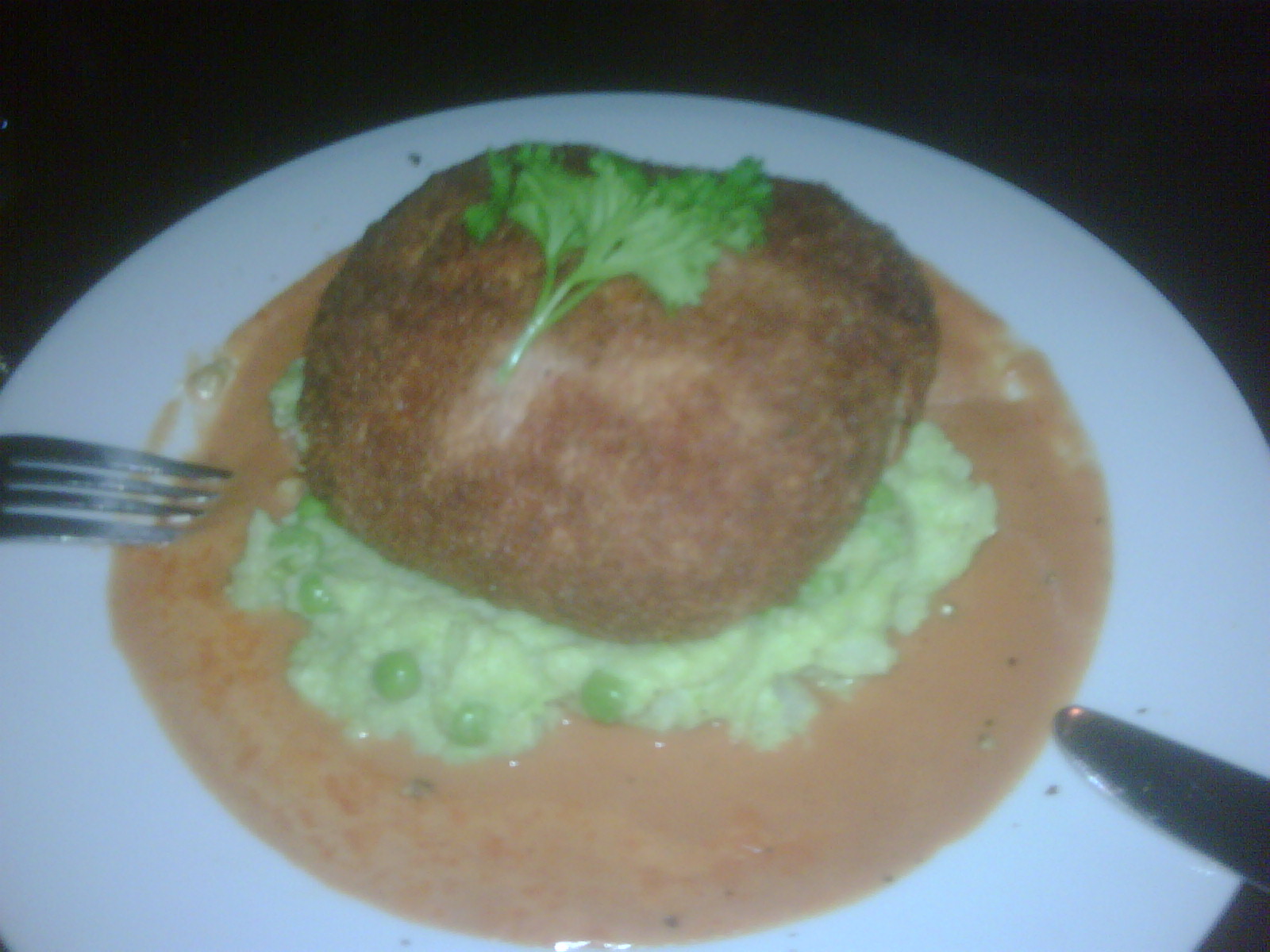
My salmon and leek cake sitting on green pea mash, surrounded by an impassable moat of whisky sauce

My salmon and leek cake sitting on green pea mash, surrounded by an impassable moat of whisky sauce

One of us had what they called “the best chicken curry I’ve ever had”, and I had a delicious salmon and leek cake, presented on top of green pea mash & a whisky sauce.  The menu is full of attractive items I didn’t try (haggis lollipops? deep fried mars bars?),  that are sufficiently enticing that I want to come back, perhaps next time I take in a TIFT show at the Mady Centre.

Barrie is a little seedling compared to Toronto, but surely what we see happening there is the same kind of process we see anywhere.  If anyone wants to help build a city –Barrie, Toronto, Kukamonga ? –they should fund the arts.  You get a lot of bang for your buck.  For every paid worker there are often others working for honoraria or even as volunteers.

(hello!)

The money spent on the arts is good for the economy.  I have another specimen besides Barrie to point to.  Look at all those European cities.  Their arts are subsidized.  Their tourism & culture are, of course, unparalleled.  You don’t go to Paris or London because you want to get deals on hotels. You’re there for the shows, the operas, the galleries: the art.

And the food before and after.

www.thelocalgastropub.com

Posted in Art, Architecture & Design, Food, Health and Nutrition | Tagged , , , | 5 Comments

The Last of Romeo & Juliet

It works.

I just attended the Saturday matinee of The Last of Romeo and Juliet by Talk is Free Theatre at Barrie’s Mady Centre for the Performing Arts.

The salient question on this occasion is the one that often comes up when a production departs from the original text, especially one that’s usually considered indestructible theatrical gold.  “With all those changes, does it still work?“

Shakespeare is usually considered fair game for directorial interpretations.  I’ve just seen a film of Coriolanus using an almost irreconciliable template of weapons & clothing superimposed on the story of  classical Rome.  After seeing today’s TIFT show I’m in the mood for Joss Whedon’s modern Much Ado About Nothing.  While neither of those films is faithful to the settings of the original you’d never know it from their titles.

TIFT has at least signalled their adventurous approach with the title.  No it’s not exactly as Shakespeare wrote it, but a kind of play using the original as our subtext, a text we know so well that you can feel the recognition of classic line after classic line.

I was fortunate to get a head-start on this, by interviewing David Ferry in December.  The concept as I understood it was that this time Romeo & Juliet are not the youngsters we know so well.  Instead we’re seeing seniors enacting more or less the same story.

But there’s a great deal more to it than that, I realize now.  Director Mitchell Cushman wrote program notes that explain it quite clearly:

To me, Romeo and Juliet has always been a play about lack of agency.  Amidst all of the brawling love and loving hate, the play gives us two protagonists not in control of their own lives.  They know what they want, desperately, but their families, under the presumption of knowing better, are pulling all the strings.  In our time, it’s a little hard to connect with the idea of adolescents being so subjugated—in fact in many ways teenagers are today’s most empowered demographic. 

So Cushman begins with a critique of the play as written, but also offers the solution:

Instead it is our elderly who often being to lose control of their own lives –especially as they move into long-term care institutions.

We’re in a similar place to Stoppard’s Rosenkrantz and Guildenstern Are Dead, which is to say, a slightly absurdist place.  Because we know the story of the play so well, they can invoke the known plot trajectories of Romeo and Juliet, although TIFT avoid the more complete deconstruction one finds in the Stoppard.  I can’t comment on certain aspects of the story without giving it all away (and I avoid spoilers at all cost), but it was magical to venture off into other Shakespearean texts.  I couldn’t help being reminded of my own fading memory, as though I myself were in such a home, hearing lines that were dim Shakespearean recollections from other plays.  This blurring was quite powerful and very beautiful to experience, which is why i won’t spoil it by giving it all away.

There’s another possible rationale that Cushman didn’t mention in his notes.  The unspoken frustration one encounters with Romeo and Juliet has to do with the main subtext of the play, namely youth & aging.  Has anyone ever seen a Romeo or a Juliet who was even close to the correct age?  Juliet is thirteen.  Romeo is older, but still young.  Imagine the best Juliet and/or Romeo you ever saw–usually much older than the way it was written–and then remember that the actors are even older now.  Actors age, even the ones playing Mercutio, Tybalt, Benvolio, even Friar Lawrence.

Arkady Spivak

Arkady Spivak

What a gift, then, to populate this old folks home with larger-than-life personalities, as though Verona were actually the Performing Arts Lodge (the retirement home for actors & singers).  I couldn’t help feeling that maybe the rationale for Cushman & Artistic Producer Arkady Spivak to revisit Romeo & Juliet is to make a kind of showcase for fabulous older talent.  As an opera fan I am very happy with set-pieces, so long as they work.

And they did

Who wouldn’t want to see Jennifer Phipps doing the Queen Mab speech?  I’ve often been disappointed at readings bemused by the speech’s faery imagery while missing the madness lurking just beneath the surface.  Phipps took us deeper and darker than I’ve ever been in this speech, without ever leaving her wheelchair.

Alex Poch-Goldin is an unexpected Capulet, this time Juliet’s son providing for his aging mother.  He’s self-effacing, almost invisible for the longest time, until suddenly –with the prospect of marrying his mom off to Paris and stopping the expensive payments for the home—he erupts, one of the most vivid and disturbingly real moments of the adaptation.

Clare Coulter is a princess of cats as Tybalt, wearing a wacky stuffed cat.  But her volcanic rages are genuinely scary, and an important underpinning of the genuine dangers in such homes.  As Cushman notes in the program, an average of five people a year are murdered in retirement homes.

Sandi Ross’s Nurse is a character unharmed by the adaptation, because of course one can easily imagine nurses in retirement homes.  She is the beating heart of the play, larger than life, regularly saying what needs to be said.  As one of the last vestiges of the comical parts of the original piece (given the darkness underlying the adaptation) Cushman relies on her to be the comic counter-balance of the work.

David Ferry

And what a gift to see Diana Leblanc as Juliet, a grown-up “gallop apace” to open the second act, and a new look at so many lines that have never felt so new as they did today.  We were in the presence of romance, between her and David Ferry, every bit her match as Romeo.  In a way he’s at a disadvantage because I think more of his role is deconstructed or altered.  In Shakespeare’s play Romeo has many lines before Juliet appears (her lines to Romeo at the party are still among her first), but as the play goes on, Juliet moves to the forefront.  Many of Romeo’s early lines are casualties in this adaptation.  When we meet Ferry’s Romeo we’re not yet immersed in the Shakespearean world that takes over once the lovers’ eyes meet.

Some aspects of the story in this new framework are easier to accept than others.  From time to time the lines scintillate, as the modernized version suddenly resonates, both with the original romance and with the desperate melodrama of this adaptation.  There are other times when the adaptation approaches parody, because the grand Shakespearean lines have been pushed into such a silly place.  But it’s never boring, and sometimes breath-takingly new.

I found myself staring at the program, not sure I knew who to credit for the script.  At times I wondered if this was a collective creation –or would we call it a collective recollection (?), of all those brilliant mature performers—but the program says “Adapted from the words of William Shakespeare and Directed by Mitchell Cushman”.  Cushman treads a fine line, ultimately giving us lots of Shakespeare, a fresh new look at the story we know so well.

Talk is Free Theatre’s The Last of Romeo and Juliet plays at the Mady Centre for the Performing Arts in Barrie until January 18th.

click for further information about the show

Posted in Dance, theatre & musicals, Reviews | 2 Comments

10 Questions for Leslie Ann Bradley

Canadian “Soprano Leslie Ann Bradley brings the stage to life whenever she sets foot into the spotlight” (Toronto Star).  Praised as a “vocal and dramatic powerhouse”, her 2013/14 season is filled with debuts and return engagements.  Her winter/spring is infused with Mozart repertoire with her Toronto Symphony Orchestra debut during their Mozart @258 Festival, Donna Elvira in Vancouver Opera’s Don Giovanni, then Countessa Almaviva with Pacific Opera Victoria in Le Nozze di Figaro.   Bradley’s full schedule will soon be readily available on her soon-to-be-launched website http://www.leslieannbradley.com

Soprano Leslie Ann Bradley (photo: Lisa-Marie Mazzucco )

Soprano Leslie Ann Bradley (photo: Lisa-Marie Mazzucco )

On the occasion of the Mozart @ 258 Festival January 15th & 16th with the TSO, I ask Bradley ten questions: five about herself and five more about singing Mozart.

1-Are you more like your father or your mother?

The word that best describes my family is “diversity.” We are all very different and yet we have managed to be a positive influence in our distinct ways.

My father is a farmer, he is one of the hardest working men you will ever meet. He is also one of the most deeply kind and generous spirits on earth. He has taught me the value of preparation, patience and endurance. A seed that is  sowed properly and tended with care will produce a terrific harvest. And should you hit rough weather, you put your nose to the grindstone and you get the job done….no matter what.  My dad’s simple farming wisdom has become the mantra of my life.

My mother works in the fashion industry. She is a stylist and she owns a ladies clothing boutique in Port Perry. She is the quintessential cool mom; fun, fearless and fabulous. She has an eye for shapes and colours. She LOVES to make women feel good about themselves and her job is her passion. So I like to think I get that passion from her – she wakes up every morning and gets to do what she loves, and so do I.

My family picture is not complete unless I tell you about my sister Betty. She shows my parents diversity in an opposite, yet complimentary way. She is a large animal Veterinarian in Southern Alberta. In fact, she was the first female partner in her practice. She spends her days “fixing cows” by doing surgeries and c-sections (you should see the size of her surgery gloves) and she is on the front lines for animal welfare.

Betty Bradley

Sister Betty demonstrates mounted shooting.

My sister is FIERCE. She doesn’t even bat an eye at a cranky 2,000 pound Bovine and in her spare time she practices “mounted shooting”, which means you ride your horse as fast as you can and shoot as many balloon targets as possible. She’s got my father’s love of animals and my mother’s flare.

My sister and I always joke that it is her job to keep me grounded and my job to keep her cultured. It’s something of a win-win.

2-What is the best thing or worst thing about being a singer?

For me, the two are the same. I LOVE process, I love to wake up every day and get better, learn something new, push my limits. But in the same breath, HOW LONG DOES IT TAKE? When do you JUST GET IT? It’s the pain and the pleasure of turning passion into craft. But that is also what excites and drives me, sometimes crazy, but ever forward.

3- Who do you like to listen to or watch?

Ok, this is embarrassing. I am what is known as a geek, at least in terms of knowledge of pop (popular) music. It’s not that I dislike pop or rock or “whatever the kids are listening to these days”, but the truth of the matter is I just don’t crave it. So I don’t seek it.

For example, last year my sister and I had a rather long drive together and so she put the radio on. She asked if the channel she chose was alright. I said, “sure, this will be a great chance for me to catch-up on a little popular music.” She looked at me mystified and replied, “uh, Les…..this is the 80’s channel.”

SO, who I am listening to right now is not exactly 2014. I love Ella Fitzgerald (I challenge anyone to find a better sense of legato than hers)….and I am currently a little obsessed with Lisa della Casa. For me she is like a singing Elizabeth Taylor; glamourous, elegant, the epitome of class and refinement. And yet, once you scratch the surface she is vulnerable, very funny and even quirky. There is an interview of her where she actually stops to light up a cigarette!!! When the interviewer asks if that is a good idea, she replies that she consulted her doctor and he assured her that “the singing is more dangerous than the smoking.” I mean, I think that is hilarious and fabulous. (not that I’ll be buying a pack of Gauloises any time soon).

4 – What ability or skill do you wish you had, that you don’t have?

HA!  Wow, I’m going to have to go with time travel.

OH, and the ability to invent a machine that washes, folds, and packs your clothes with the click of a button.

5 – When you’re just relaxing and not working what is your favourite thing to do?

I’m blessed with a great man in my life, so any free time we get, we like to just be together. We live in New York, so we love to explore the city and enjoy its endless possibilities. He is also a terrific cook, (whereas I’m lucky if I can pour a decent bowl of cereal) so we like to entertain friends.

Leslie Ann Bradley (photo:  Lisa-Marie Mazzucco)

Leslie Ann Bradley (photo: Lisa-Marie Mazzucco)

Five more about singing with the TSO at the Mozart @258 Festival

1- How does singing Mozart challenge you?

I think Mozart is the goal-post by which a singer’s technical ability is often measured. That’s why if you put a Mozart aria on your audition list, 9 times out of 10 you will get asked for it.

I believe Mozart is challenging because he is such an exquisite craftsman. He writes so perfectly that unless you are on top of your game, it’s hard to do it justice. A bit like a gorgeous painting or sculpture, you can’t just display it willy nilly, you have to prep the room to maximize it’s effect.

And that prep takes YEARS!!!! Mozart still teaches me everyday, he requires me to have better pitch, better breath, better spin…..basically he is my high-maintenance relationship. But he’s so worth it.

2- What do you love about singing Mozart?

I love that when it’s right, it’s heaven. When you sing his work and you spin his gorgeous lines and the orchestra lifts you and carries you….it’s the closest you’ll ever come to having wings. I remember listening to Kiri Te Kanawa sing “Dove sono” when I was a little girl. The first time I heard her sing , I was amazed by this simple, soaring line that just seemed effortless and endless. It was perfection.

3-Do you have a favourite moment in the program?

Well, speaking of Dove sono, the last movement of the Coronation Mass (Agnus Dei) recalls this aria. I call it my “Dove sono down a 5th.” It’s exquisite and has the added bonus of a quartet of soloists and a full choir.

But if I had to pick that one moment that just kills me, that would be bar 62 in the Laudate Dominum. The violins introduce the melody and then they pass it to the solo soprano who then passes it to the choir. But just as the choir is about to sing what sounds to be the final cadence, Mozart fools you and brings the soprano solo back in on a high f pianissimo that grows from nothing and surges upwards. It’s likes Mozart lifts us up to the heavens and then returns us to earth. No wonder the word he uses for this is AMEN.

4- Please comment on the difference between singing at symphonic concerts compared to singing opera.

Well, I’d say that in the beginning it’s quite similar. There is always the nuts and bolts preparation;  text, translation, learning your notes and singing it into the voice. I am pretty strict with myself in this. I try not to listen to any recordings, I try not to assume. I just like to get a sense of the basic structure and framework.

From that point on, the demands are quite different. With opera, there is of course the character, and this is where the journey gets interesting. I have to find out where the character is from, what their background is, what motivations they have, what they are risking: their “WHY”. I love the “why”s.

Also, depending on when the opera was written there is the temporal requirements to consider. WHEN was it written and what made it important at that moment in time? I am reading this great book by Daniel Snowman called “The Guilded Stage.” It’s a social history of opera and it is fascinating to see how the art form has moved and adapted to the times.

Opera is also more physical. You are moving on the stage, interacting with the other characters. And the physical demands vary from work to work, so I try to be aware of the demands in order to arrive with the best preparation possible. Last year, for example, I sang a show where there was a lot of dance involved, so 8 months before rehearsals I hired a dance coach to teach me some basics.

Concert work is of course more static, but that too has its challenges, because you are required to tell the story just with your voice. So it is (in my opinion) a more subtle, more nuanced genre, and often I find myself feeling much more exposed, because the communication with the audience is more direct.

There is also the wonderful connection with a conductor and orchestra. Concert work is how my career started, so whenever I get onto a stage in this way it feels very much like coming home.

5-Is there a teacher or influence you especially admire?

If I talk about one, I have to talk about all four, because I wouldn’t be where I am today without them.

My first teacher was Mary Morrison, who as we all know is a legend. I did my undergraduate degree with Mary at the University of Toronto and I couldn’t have asked for a better start. Mary knew I was keen and hungry to learn. So she helped me explore a vast amount of repertoire, from baroque to new music. She encouraged me to try everything and not to limit myself, all the while letting my voice grow in a healthy way and in it’s own time. Mary is generosity, curiosity and fun incarnate.

My second teacher was Marie Daveluy. I met her while I was singing a production of Don Giovanni and I knew instantly that she was the next step for me. So I moved to Montreal. Marie was retiring and therefore not keen to take on a new student, but before  she knew it I was at her house 3 times a week. Marie was my game-changer. She inspired the artist and the bad-ass that I didn’t even know was inside me. Scales weren’t just about perfection, they were about soul. Every sound and every word had to have vision and artistic intent. She blew my mind. I owe her so much, because she sculpted the artist I have become.

2009 was a crazy year for me. I was already into my career, when I decided to do a Masters Degree with Lorna MacDonald. I think people thought I was nuts for hitting the brakes just as things were taking off. But I knew that I was at the critical point where talent needs to become skill and Lorna was there to show me the way. To say retooling at this point in the game was difficult is not even close. It was gruelling.  To strip away bad habits and insecurities was terrifying, but Lorna, with her vocal wisdom and her thoughtful, organized calm just took me by the hand and together we fixed the cracks. I handed her my voice and my trust and she handed me back a world of larger possibilities.

Wendy Nielsen

And now, whenever possible, I work with the divine Wendy Nielsen. I met Wendy 10 years ago at her summer program in New Brunswick and our paths have happily crossed ever since. Wendy is like sunshine; warm and good for growth. She has helped me continue the process of understanding my voice and also how things work in the opera world. She has been invaluable in my preparation of my upcoming Mozart roles and just a wonderful supportive teacher and friend.

I feel so lucky as a Canadian artist that our country has these incredible ladies in it. They have my eternal gratitude and respect.

*******

Mozart @ 258 begins January 11th.  For information, including the Coronation Mass, January 15 & 16, see this.

Posted in Interviews, Music and musicology, Opera | Tagged , , , , , , | 4 Comments

Shared Dreams of Freedom

“Press releases and announcements” are presented verbatim without comment.

Shared Dreams of Freedom

The Romanian General Consulate & One Room Theatre invite you to a literary evening and a reception, which will bring together Romanian-Canadian and African-Canadian poets, celebrating Romania’s National Cultural Day and the anniversaries of Mihai Eminescu and Martin Luther King, Jr.

LOCATION: Romanian General Consulate, 555 Richmond Street, Suite 1108, Toronto.
DATE & TIME: 15 January 2014, 6:30 p.m.
TICKETS: Free
• The event will be introduced by Antonella Marinescu, Romanian General Consul in Toronto.
• Eminescu’s poems will be followed by an excerpt from King’s “I Have a Dream” speech.
• Romanian-Canadian Calin Mihailescu and Diana Manole will join African-Canadian Pamela Mordecai and George Elliott Clarke, Toronto’s Poet Laureate, voicing their own dreams through poems in both English and Romanian.
• A short reception featuring the infamous Dracula wine and tasty traditional snacks will conclude the evening, giving everyone a chance to talk to the writers and the other guests.
*Organized by Dr. Diana Manole, artistic director of the One Room Theatre, with the support of the Romanian General Consulate in Toronto.

Mihai Eminescu, who came to be called the Evening Star of Romanian poetry,
was born on 15 January 1850 in Botosani, in the Northern province of Bucovina.
A Romantic writer and a sharp journalist, his work greatly influenced the subsequent development of the national language and literature. His philosophical and romantic lyrics, including “The Evening Star” (“Luceăfarul”), his masterpiece, are some of the most famous Romanian poems. Eminescu also addressed political and historical subjects, particularly in his epic “Epistles” (“Scrisori”), as well as in “Emperor and Proletarian” (“Imparat si proletar”), but also in his newspaper articles and pamphlets in The Time (Timpul). His scorching political satire is complemented by his passionate plea for freedom and justice, as well as gentle or feisty expression of patriotism.

“What I wish for you, sweet Romania, my country of glory, my country of yearning” remains one of the most touching declarations genuine patriotism.

Martin Luther King, Jr., born on 15 January 1929 in Atlanta, Georgia, was an American clergyman, activist, humanitarian, and leader of the African-American Civil Rights Movement. Between 1957 and 1968, King traveled millions of miles and gave over twenty-five hundred speeches, while he wrote five books as well as numerous articles. King also helped to organize, in 1963, the peaceful March on Washington, D.C. There, in front of over 250,000 people, he delivered his famous “I Have a Dream” speech, considered one of the most passionate and effective political statements of the 20th century. In 1964 King was the youngest recipient of the Nobel Peace Prize, awarded to him for combating racial inequality through nonviolence.

He was assassinated on 4 April 1968, in Memphis, Tennessee, a martyr whose death testified to the truth that dreams of democratic change do not easily become reality.

“Now is the time to make real the promises of democracy,” King still appeals to us across decades in an increasingly globalized world.

GUEST WRITERS

George Elliott Clarke
Hailing from Nova Scotia, George Elliott Clarke is the author of sixteen collections of poetry, in addition to dramatic plays and opera librettos, a verse novel and a prose one, numerous journal articles and a comprehensive study of African-Canadian literature, an academic discipline he pioneered. His numerous awards include the Governor General’s Award for Poetry (2001) but also the Poesis prize for the anthology of poems Poeme incendiare (Oradea: Cogita, 2005), translated by Flavia Cosma. He is currently Toronto’s Poet Laureate and the William Lyon Mackenzie King Visiting Associate Professor of
Canadian Studies at Harvard University.

Diana Manole
Diana Manole is an award-winning Romanian-born Canadian poet, playwright, theatre director, scholar, and professor. She has published eight poetry and drama collections, poems in several national and international anthologies and magazines, as well as nine scholarly articles and book chapters. Her work has been reviewed in The History of Romanian Literature: Drama (2008) and The History of Romanian Contemporary Literature 1941-2000 (2005). She founded and is the artistic director of One Room Theatre, a company specialized in multimedia performance inspired by poetry.

Călin-Andrei Mihăilescu
Călin-Andrei Mihăilescu is a multilingual writer and a professor of Comparative Literature, Critical Theory, and Hispanic Studies at the University of Western Ontario in London, Canada. Among his many authored volumes are Ţară europsită (2002), 16-17~ Renastere, manierism, baroc (2005), and, among the edited volumes, This Craft of Verse by Jorge Luis Borges (2000) and What Was It Like? Something Like That… Memories from the Years of [Romanian] Communism (2006). His most recent book, Happy New
Fear!, came out in Bucharest in 2011.

Pamela Mordecai
Born in Jamaica, educated there and in the USA, Pamela Mordecai earned a PhD in English for a dissertation that proposes a cognitive style called prismatic vision, which she examined in the poetry of Kamau Brathwaite and Derek Walcott. She writes poetry, fiction, and plays for adults and children, as well as occasional critical articles. Her fifth collection of poems, Subversive Sonnets, was published by TSAR Publications in 2012. She lives in Kitchener, ON. http://www.pamelamordecai.com

Posted in Press Releases and Announcements | Leave a comment

Ongoing Upheaval

I had the most curious experience during my second look at The Great Upheaval, the imported show from Guggenheim’s Collection at the AGO.

The first time through I more or less bought into the official story of this show, an impressive assembly of art for the period 1910-1918.  There are overlapping stories.

  • politics
  • art
  • collectors building a collection

First time through, my big conclusion concerned the parallel narrative of the assembly of the Guggenheim Collection—a canny assembly of art that cleverly assessed the best and most important movements of the time—and the background context of political & artistic movements.  We go through the artworks a year at a time, encountering them in the  linear stream of chronology without the superimposition of layers of interpretive museology.

And speaking of linear, the show’s design echoes that perfectly linear space, the Guggenheim Museum in New York.  I get that it’s more of an ascending helix than a straight line, but I’d rather encounter art in a gentle spiral pattern rather than a truly linear space such as an airport terminal or a train station.

I’d left aside the real question connecting the history of the art & the politics of that period.  We knew that the First World War began in the middle of this period.  While the show covers roughly eight years, from 1910-1918, the period from 1914-18 is a surprisingly small part of the show. Each year from 1910-1913 merits a big space. And then the second half of the show is jammed into one little room. Jammed? no. Sparsely displayed, because even in that one room comprised of four years, there’s really not so very much on display.

I had assumed a kind of parallel narrative, where the war gets in the way of culture, stopping anything tender or sensitive, imposing a new brutality in its place.  The paucity of art for the second half of the period was an apt reflection of what was happening. Either art was no longer a priority for a world at war, or artists were dying off in the trenches.

Yet the second time through, I sensed another way of seeing this period, one that was far more troubling, particularly once i s aw the disturbing echoes of our own century.

First time through?

I thought of war as external to the show, a kind of nasty obstacle.  And more to the point, I thought of the “upheaval” as the series of avant-garde movements in the different European cities.  I figured that all that upheaving stopped dead in the presence of the Great War, the War to end all wars and to end all art.  So of course war was a perfect pretext for artists to fall silent.  War seemed to require a break in the cultural discourse, whether as a result of the guns drowning out the gentler voices of musicians & painters, or because those artists lost their audience, their preoccupations, and in the end, many of them also lost their lives.

Ah but what if war is not external at all?  The last room of the show includes several paintings where the ugliness of war is very close to the surface, if not an explicit participant in the conversation.  No, the cannons weren’t really speaking anymore than paintings or statues speak.  And the soldiers were not making artistic statements.

The Great Upheaval?  Really a series of upheavals, revolutions, explosions against a staid society.  A series of movements seeking to redefine the possibilities of art.  And I can’t forget that this is the beginning of something altogether different in art. Speaking of the helix shape, the art-world has been on a downward spiral ever since.  The upheaval was a fundamental questioning of culture itself, a movement away from everything art had once been (thinking of values such as representational, decorative, explicit, or commercial) towards more problematic and ambiguous objectives.  Among the artists mentioned in passing was Arnold Schoenberg, whose ideas are the cornerstone of a musical movement resolutely turning its back on the audience.  Cubism is certainly another such movement, leading the artists into brave new directions, often at the expense of easy popularity.

Especially intriguing among these movements is the group known as the Futurists.  Their aesthetic is one that seems to have been the most enduring of the last century. They celebrate strength and the manifest destiny of science moving towards an ideal future.  Ideal for whom? Ah, that’s a good question.  War and power were ideals some futurists clung to, a cluster of values pointing towards Mussolini and the fascists.    This aesthetic, valorizing powerful machines & sleek buildings that point to the future, sometimes seems to have a life of its own.  There’s an unexamined infatuation with the future, progress, machines and power, all as ends in themselves.  If we notice how the contention between the various manifestos and avant-garde positions resembles a debate, if not an actual war, in a real sense the futurists won the great upheaval, if not the entire century.

Walk into any store selling media devices and you’re in a kind of watered down futurist temple.  Listen to the news and you’re really listening to a kind of futurist sports report, tallying the competition in several key arenas (economy, technology and the biggest sport of all, namely war).

In the century since the upheaval, I can’t help wondering.  Has the upheaval ended? Or is it merely working its magic?  Are we now seeing more honest versions of what was merely hinted at in the artwork of the last century?

  • Life-style reality TV?
    It’s a celebration of raw media power, people so iconic, so important that we’re supposed to genuflect to their every bodily process.
  • The preponderance of violent films?
    an infatuation with power and pure strength.  Notice for example the trailer for the film Pacific Rim, merely the most extreme recent example of an ongoing competition to make the biggest and most spectacular celebrations of life and death.
  • Science fiction?
    I grew up reading sci-fi, so I’d plead that there are several different versions & flavours. But nevermind the books, look at film.  I am very conflicted by much that I see on the big screen, a prostitution of the possibilities and ideals of the texts adapted in films.

The catalogue for The Great Upheaval is a wonderfully inexpensive book, selling for less than $20 (plus tax) at the AGO bookstore.  There’s much there to ponder. The more I look the more I see its relevance to our own time.

And the show continues until March 2nd.

Posted in Art, Architecture & Design, Books & Literature | Tagged , , , | Leave a comment

(Q + A) x 300: questions and conversations

This is the moment when bloggers look at their annual stats, notice trends, and perhaps say thank you to the community that supports them.

According to my stats I posted 232 different items over 365 days. This is a moment to thank you for last year.  Thank you readers. Thank you participants.

Wallis Giunta, wearing McCaffrey Haute Couture (photo Mark Cooper)

January: Wallis Giunta, wearing McCaffrey Haute Couture (photo Mark Cooper)

Speaking of numbers & participants , thirty-two of those 232 are of particular interest. I’m especially honoured to be facilitating the conversation that one finds in the questions surveys.  In addition to a pair of offbeat surveys—one directed whimsically at the different Rodolfos sharing the COC Boheme, another for Topher Mokrzewski concerning the Liszt transcription of liebestod that he played for a Wagner conference—I directed ten questions at thirty different people.

That’s three hundred questions even without including the other two surveys.

Why a summary like this one? Maybe I’m reluctant to let go of the year.  Maybe I want to register my gratitude, but also to catalogue these creations to encourage you to either re-visit or –if you never read them the first time—to see them now, crudely categorized.  I say “Crudely” because people don’t fit into categories, and I may be dishonouring some in the process.  Some of the Canadian singers are also international, opera people are also theatre artists, singers are also musicians, and some people like David Warrack or Topher Mokrzewski occupy several categories.  But I hope the divisions are recognizable.

Bass Franz-Josef Selig (Anne Hoffmann)

February: bass Franz-Josef Selig (Anne Hoffmann)

The page is a reflection of tendencies, possibly my own. Does the preponderance of tenors and sopranos reflect my bias? or say something about the world at large? And maybe i need to correct that in future.  I have no idea whether this page will be useful to anyone other than me, but i hope people will consider using this interface to revisit some fascinating conversations.

*******

Theatre artists:
David Ferry (TIFT’s The Last of Romeo and Juliet)
Nina Lee Aquino  (fu-Gen Theatre & Tarragon’s carried away on the crest of a wave)
Melissa Hood  (Gun Shy Theatre’s Stop Kiss)

*******

April: tenor Stephen Costello (photo: Dario Acosta)

April: tenor Stephen Costello (photo: Dario Acosta)

Canadian musicians & composers:
Eve Egoyan  (piano)
Patrick Jordan (viola)
David Warrack (composer, piano, conductor)
Beatriz Boizan (piano)
Christopher Mokrzewski (piano, Against the Grain Theatre co-artistic director and music-director)
John Mills-Cockell (composer)
Cecilia Livingston (composer)

*******

Impresarios & builders:
Guillermo Silva-Marin (Opera in Concert, Toronto Operetta Theatre, Summer Opera Lyric Theatre)
Stuart Hamilton (founder: Opera in Concert, collaborative pianist & coach, CBC Opera Quiz)
Marshall Pynkoski (founder/co-artistic director Opera Atelier)

September: composer, musician, innovator, teacher John Mills-Cockell

September: composer, musician, innovator, teacher John Mills-Cockell

Nancy Hitzig (General Manager, Against the Grain Theatre)
Joel Ivany (co-artistic director, Against the Grain Theatre)
Douglas McNabney (Toronto Summer Music)
Alaina Viau (Soupcan Theatre’s Carmen)
Stuart Graham (Atelier S)

*******

International artists:
Stephen Lord (conductor)
Mark Shulgasser (librettist, writer)
Franz-Josef Selig (bass)
Stephen Costello  (tenor)
Rufus Müller  (tenor)
Keir GoGwilt (violinist)
….plus the three Rodolfos: Eric Margiore, Michael Fabiano and Dimitri Pittas (NB Pittas couldn’t be reached, but i manufactured some comedy out of that in the write-up)

*******

Director Joel Ivany

November:Director Joel Ivany

Canadian singers:
Isabel Bayrakdarian (soprano)
Carla Huhtanen (soprano)
Ambur Braid (soprano)
Christopher Enns (tenor)
Wallis Giunta (soprano)
Ileana Montalbetti (soprano)
Jacqueline Woodley (soprano)

Posted in Dance, theatre & musicals, Interviews, Opera | Leave a comment