Pomegranate

Less is more.

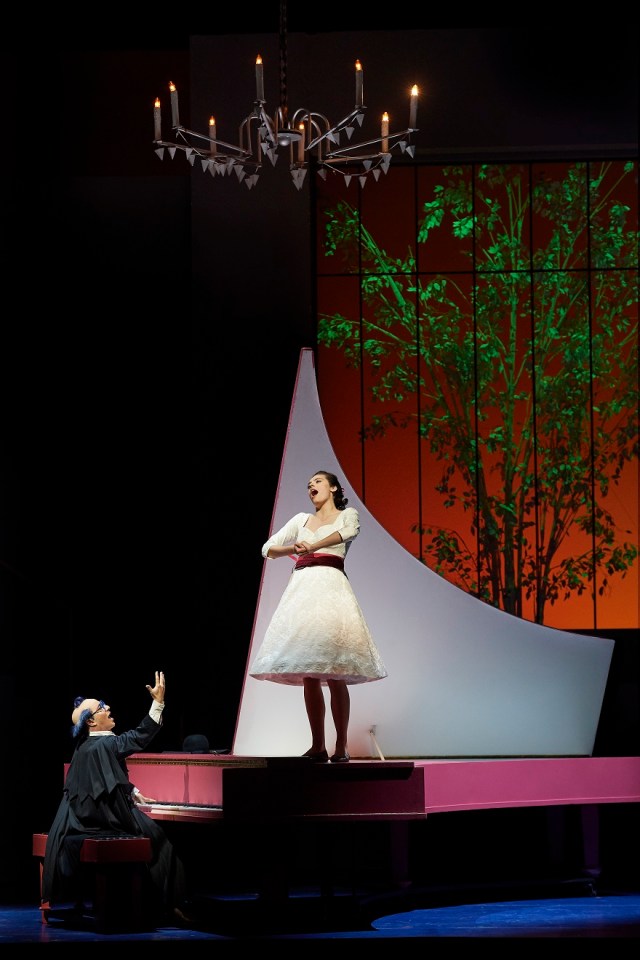
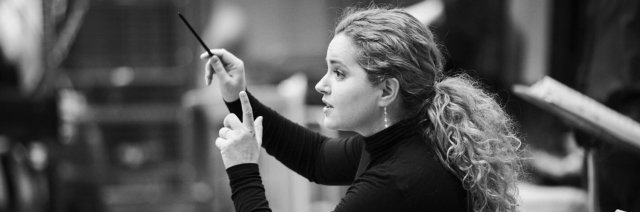
Pomegranate, bearing the epithet “a lesbian chamber opera,” is the latest specimen suggesting that grand opera is all but dead. Small is beautiful whatever your sexual politics, both for the lower price-tag and the ideal connection you make in a smaller space such as Buddies in Bad Times Theatre where the buzz is genuine, the enthusiasm palpable. Working with a seven member ensemble led by Jennifer Tung, Director Michael Hidetoshi Mori created a powerfully dramatic evening.

teiya

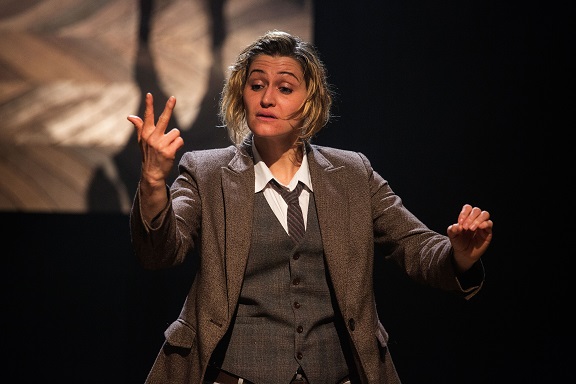
Teiya Kasahara in her modern incarnation as a bartender (photo: Dahlia Katz)

It was interesting to see mention in the program of the rarity of a lesbian opera. I was reminded of the only one I could think of, Erlanger’s adaptation of Pierre Louýs’s novel Aphrodite. Louýs also wrote the Chansons de Bilitis, adapted a couple of times by Debussy. There are some parallels between the stories for Aphrodite and Pomegranate. Besides the lesbian content, both stories go back to classical times, both concern a power struggle between male & female, that can also be seen as a kind of contest between two different faiths or cultures (for instance when the oppressive centurion Marcus keeps blustering about Apollo). As one might expect, the political aspect is front & centre.

At two hours long Pomegranate is a full meal. Composer Kye Marshall and librettist Amanda Hale created two very different acts. For the first act, when Hale & Marshall were establishing a ritualized sub-culture of Isis worshippers in Pompeii at the time of Vesuvius’s eruption, the back and forth between characters did not have the usual discursive alternation of dialogue, but instead was more like two people telling the same story together, as though they were both staring in wonderment at the same beautiful sunset. I’m reminded of a term Keir Elam used to describe the discourse of Maeterlinck’s plays (and emulated in Debussy’s setting of Pelleas et Melisande), namely “monological”. That’s what we were hearing, the rapturous exchanges between members of the same cult as though one person was singing. While it was not very dramatic, but why should it be? The effect was largely hypnotic, spell-binding and other-worldly.

Where the first act takes us to a magical world of ritual in the second act the magic has faded, as we’re very close to home, a fallen modern world that feels more like a musical than opera. The exception was a tight ensemble among family members that was the most interesting music of the night.

As I said, less is more. The text was completely intelligible, the score allowing space for the performers to act & interpret with ease. Teiya Kasahara was the most impressive presence of the night, even if her powerful voice was rarely exploited, in a score that never sounded difficult. Aaron Durand made the most of his part, especially in the modern sequence. I was intrigued by Marshall’s choices, especially in orchestration featuring a big cello sound from the small ensemble, making for a wonderful soulful effect, especially when she turned Dobrochna Zubek loose for several powerful cello solos, the nicest music of the night. Librettist Hale opted for recognizable phrases such as “My heart broke in a thousand pieces”, so that it was easier for the listener to anticipate what was being sung.  I’ve seen some choices in other libretti recently that highlight the wisdom of Hale’s choices.  I recall the longer and more poetic lines from Yvette Nolan in Shanawdithit and Sky Gilbert in Shakespeare’s Criminal, had me wishing for surtitles, because there was just too much to take in all at once. Hale’s directness is more in the tradition of Meredith Oakes in her bold adaptation of Shakespeare in The Tempest (daring to shorten iambic pentameter into brief little lines that are ideal to sing). I’m inclined to think that too much poetry in a libretto gets in the way, given that we’re listening to voices, words, instruments, watching a performance. The choice to be simple and get out of the way of your collaborators is the one that usually works the best.

For me the most important aspect of the work is underlined by the space (Buddies) & the time (Pride), namely the political implications of the work, showing the struggle against oppression in different centuries.  That’s the most compelling aspect of the work.

Pomegranate continues until Sunday June 9th at Buddies.

Posted in Music and musicology, Opera, Reviews | Tagged , , , , , , , | 7 Comments

Mikolaj Warszynski—Piano Solo

As I’ve been listening to a 2015 solo piano studio recording by Mikolaj Warszynski, I’ve found myself wondering about the process, about how music is made and how it comes to be heard.

If a pianist plays brilliantly and no one hears: is there a career? Is there even music?

Not for the first time, I’m pondering how it all works. I’ve heard stories of singers walking into auditions, knocking it out of the park but being ignored ultimately because they’re not famous. In an industry that needs stars the arrival of an unknown can be a destabilizing force, a threat to those big names. While there was a time when recording labels & publishing companies were custodians of art, stewards of excellence, lately I wonder whether anyone cares.

But these thoughts came later. First came the CD, a series of performances to raise such questions.

  • A Haydn Sonata
  • A piece by Szymanowski
  • Liszt’s Mephisto Waltz #1
  • Four pieces by Chopin

We went from the unknown (unknown to me that is… meaning both the Haydn & the Szymanowski) to the familiar (the Liszt & Chopin), all the while making something fresh & new. When I looked more closely inside the jacket, the label is Anima in Paris, but I saw that there was a crowdfunding initiative to make the recording happen. Warszynski has roots in Poland (where he was born), Alberta and Québec, and has performed all over the world. While I may have missed something what I didn’t see was even one mention of anywhere in Ontario: relevant only because I ponder this question of process. Ontario is sometimes perceived as vainly self-important by the rest of the country, and no wonder when—for example—the operas we see downtown are from the “Canadian Opera Company”, shows that then get reviewed by The Globe & Mail who proclaim themselves to be Canada’s National Newspaper. While I laugh at the idea we are the centre of the world (especially when we endure mockery not just from Canada but Americans, particularly New Yorkers), I wonder about the career process, and whether Warszynski would be advised to appear in Toronto, where we’d all be lining up to proclaim his brilliance to anyone who’s listening.

Warszynski

Okay enough about the process, and yes I can’t deny I am mystified when I listen to a CD that’s so original and so excellent that seems to have come and gone without fanfare, under the radar.

The Haydn Sonata is a glowing advertisement for the composer. A good performance should be like a speech in a courtroom advocating for the immortality of the piece & its creator, if not a testimonial to the player’s love of the music. Haydn and Mozart sometimes give us phrases that sound like people laughing aloud, full of the visceral pleasure of youthful beauty. Warszynski makes me think of Haydn on a late-night talk show, the composer’s comic phrases sounding new in the moment. The middle movement—especially in Warszynski’s pointed phrasing—makes me appreciate early Beethoven slow movements in a new way (because I should have realized the influence, made clear in Warszynski’s fascinating program note). I should have known:  that Beethoven isn’t quite as original as I thought, that maybe he’d heard something like this already from Haydn.

Warszynski could have spoken up at the keyboard and said aloud “and now for something completely different”. Perhaps in Polish?  as we went from Haydn to the first movement of Szymanowksi’s op 34 Shéhérazade. As in Prelude à l’après-midi d’un faune or Le sacre du printemps we begin with something almost improvised, like a preamble to what’s to follow, a delicate provocation to be elaborated with commentary & complication, both of the dramatic and harmonic as well. At times there are suggestions of what might in later decades be called “jazz”, even though I think it’s Szymanowski’s playful approach to sonorities & voices that takes us to that place. Need I add, where the Haydn is far from easy to execute, with Shéhérazade complex & virtuosic pianism suddenly rears its dazzling head. We are in a realm that is at times exotic at other times terrifying, which is only befitting an adaptation of this life & death love story. I wish I knew the piece better (and I’ll chase it down and attempt to play through it to see for myself), to have more of a sense as to what’s usually asked of the interpreter, and what’s original / added via the magic fingers of Warszynski.

But Shéhérazade is a very different sort of work from the Mephisto Waltz #1, not just because one was brand-new to me and the other is among the most well-known, well-worn, frequently programmed and if truth be told, critically under-estimated pieces. I put this piece in the same category with la boheme and the 1812 Overture, namely pieces so well-loved & overplayed that it’s hard to get back to the music sometimes and see it objectively. It’s in that context especially –where the music is almost like an aging movie queen in need of a makeover, turning up on late-night TV (uh oh I am repeating myself in my metaphors… perhaps this is the same show that had Haydn, as a guest? and the old dowager is on in the last 10 minutes), when the audience is all shutting off their TVs. It’s not Liszt’s fault that this piece became like the Sabre Dance or the flight of the bumblebee, an ear-worm haunting your head like Mephisto himself.  Although I suppose if you’re going to write an ear-worm (no mean feat!… what composer wouldn’t dream of this?), could the haunting ever be more purposeful? more symbolic?

What Warszynski gives us in his performance of the Liszt is counter-intuitive in its originality. Yes he plays it perfectly (like everything on this CD, regardless of its difficulty). But it’s not about the circus act element we sometimes see in a virtuoso performance, aiming for higher- faster – louder- wilder. Where I was mostly lost in the sound & fury of Shéhérazade shenanigans, again because I don’t know the work yet well enough to really experience it as a text or as a tone-poem with a story or scenario underlying its structure, Warszynski is story-telling with the Liszt. It’s a very segmented piece that can seem very wooden when there is no sense of an organic flow from one segment to the next, like a skater going from their double lutz to their triple axel double toe-loop combination. If the skating / dancing / piano-playing is really serving Liszt it must not be a series of stunts but a flowing story, a sound that serves to seduce us rather than impress us. I’ve heard a great many versions of this piece, and frankly became immune to the work for awhile: until hearing Warszynski.

And then we come to the four Chopin pieces that Warszynski would have you think of as a sonata, according to the program notes:
• Polonaise op 26 #2
• Scherzo #1
• Nocturne op 48 #1
• Polonaise op 53

It’s an interesting idea, one I don’t quite buy, but still: I love the ambition behind it. For recordings, for concerts, for church services: we are curators. Music is selected & organized for an effect. When I read the program note I don’t necessarily agree with what the music is doing, because of course we’re different people. Funnily enough I align the Chopin more with Haydn, for its neoclassical elegance & symmetry, for the delicate lines & clarity of composition, in sharp contrast to the density of the Szymanowski & Liszt. And of course the more obvious contrast is that Szymanowski & Liszt offer us program music or at least a romantic music with literary associations whereas the Chopin & Haydn are much more absolute in their conception, pure music not music seeking to tell a story. Being a Magyar I am also disinclined to see Chopin as a revolutionary, and more as an exile –not so very different from Liszt actually—which means I hear the Heroic Polonaise differently. I hear torment & conflict & celebration, as one finds in some of Liszt’s works, such as his Hungarian Rhapsody #15 (the Rakoczy March, a tune you would have heard orchestrated in Berlioz’s Damnation de Faust). After Byron, the romantic sensibility is always a painful mixture of passions.

MikolajWarszynski

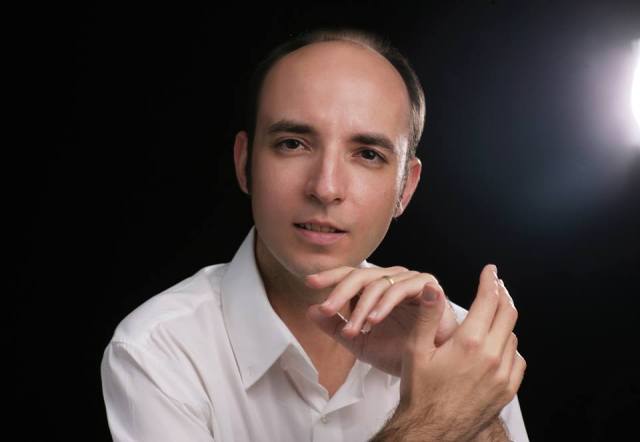
Pianist Mikolaj Warszynski

There are four performances here, all fascinating for different reasons. I’m especially moved by the Scherzo. Chopin’s four scherzi are a funny set. As with so many of these compositions, one may open the book and play through them, but one doesn’t necessarily encounter them that way in recital. The four scherzi are all stunning pieces, but the first is a quantum leap in difficulty beyond the other three. Warszynski plays what I am fairly certain is the most impressive reading of this challenging piece that I’ve ever encountered. It opens with a wild gesture that could be like a paroxysm or the grunts of animals having sex, one of the most passionate things ever written for the instrument. Warszynski makes the most of this. It’s in some ways the most frustrating piece (all four scherzi really, although for the first one, especially true), because Chopin puts his most beautiful music, bar none, in the middle of these phenomenally challenging passages. I was thinking of Brunnhilde, placed on her mountain surrounded by fire that can only be reached by a hero who does not know the meaning of fear. What did Dryden say? None but the brave deserve the fair? One must scale this rough mountain to come out into the serenity of the mountain peak where Chopin has placed his beautiful melody in all its pristine clarity. Of course the Ring cycle wouldn’t appear for decades after Chopin. But it’s the same. We can’t get to the serenity of that stunning melody in B major without transgressing the fire of the outer section in B minor, and if you just CHEAT and play it out of context it loses much of its beauty, because it is that drama, that struggle that makes that calm serenity meaningful. I’m grateful that on top of everything else Warszynski gives us a program note telling us where that charming tune came from, its associations for Chopin in his exile.

So there you have it. Warszynski is a young piano player and a professor of performance who deserves to be heard, whether in a master class or in recital. I hope he comes to Toronto sometime. He has another CD (a live performance) that I’m working at acquiring and I’m sure there will be more, as he’s yet young. The solo piano CD can be found via Amazon (click link).

Posted in Music and musicology, Reviews | Tagged , , , , , , | 4 Comments

LET’S MAKE A FUSS: A concert to benefit ALS research

image

SAVE THE DATE!
June 13, 2019, 7:30 PM
St. Andrew’s Church
73 Simcoe St., Toronto

LET’S MAKE A FUSS!

A concert to benefit ALS research at Sunnybrook Health Sciences Centre.

Sunnybrook is pioneering the use of focused ultrasound to treat brain disorders and cancers. With donor support, Sunnybrook is healing previously unreachable parts of the brain, and reducing risk of life-altering side-effects – no cutting required. With the most clinical trials in focused ultrasound of any site in the world, Sunnybrook scientists and clinicians are leading the application of focused ultrasound to diverse areas including ALS, Alzheimer’s, brain tumours, Parkinson’s disease, major depression and more.

OUR STORY
My husband, Dr. Errol Gay, and I want to share our journey with you, but more importantly we want to make sure that other families won’t have to make this journey, if at all possible. This concert has been a journey of love together with members of the TSO, COC, & various musical groups we have served in the past 35 years. All donations will go towards ALS Research at Sunnybrook Health Sciences Centre. ALS (amyotrophic lateral sclerosis) is a progressive nervous system (neurological) disease that destroys nerve cells and causes disability. Presently there is no known cure, but the ALS research team at Sunnybrook is on the brink of a possible treatment for the disease and we want to help spread the word and enable the team to continue this vital research.

“Research really is hope, and collaboration is the only way we’re going to find a cure for this horrible disease. Philanthropic investment will help break down silos and facilitate academic collaboration.”
– Dr. Lorne Zinman

ABOUT ERROL & ANN

THEM

Ann & Errol

Errol worked as a music librarian for 24 1/2 years with the Toronto Symphony Orchestra, earned a doctorate from Stanford University (CA) in instrumental conducting, taught music at various universities in Canada and the USA, served as music director-conductor for the Canadian Opera Touring Company, conducted various community and university orchestras, and is the composer of three operas written for the Canadian Children’s Opera Company. I was an organist, opera singer, conductor, taught music at the university, community, and public school levels in Canada and the USA, founded two children’s choirs in Toronto, & was Executive Artistic Director/Conductor of the Canadian Children’s Opera Company from 2000-2015. Because music has been such an important part of our lives, we are grateful to all our musician friends for their willingness to present this concert for such a worthy cause. Errol was diagnosed with ALS in July of 2016 and the journey has been a challenging one. We are grateful to be in Toronto near family and dear friends. We have recently welcomed a second baby boy into the family, so this is a joyful time in spite of the challenges. There was a sign burnt into a piece of wood in the Texas ALS clinic and it serves as a good mantra…”Keep on keeping on.” ❤️Ann & Errol

As we “Keep on keeping on,” we ask you to join us for this concert and/or make a donation to support world leading research in ALS. This will not be a ticketed event, but we do suggest a minimum $20 donation.

If you are unable to attend, donations can be made online (click here)

Please feel free to share our story and the event details with your friends and family — every bit counts.

*****

“Press releases and announcements” are presented verbatim without comment

Posted in Press Releases and Announcements | Tagged | Leave a comment

Shanawdithit in Toronto

Who would expect a new opera to affirm the value of the artform?

Shanawdithit is a new opera co-produced by Newfoundland’s Opera on the Avalon and Toronto’s Tapestry Opera. There was a workshop a few months ago, a tantalizing glimpse not so much of the work we would see so much as the process in play during the creation. Telling the story of a European encountering a vanishing Indigenous culture is in some ways a perfect microcosm for the entire settler enterprise, although usually the images are so brutal as to be unbearable. This is a gentler story because most of the slaughter is in the past at the time of this story. Shanawdithit as the last of the Beothuk could calmly answer the questions of an eager historian, whose curiosity parallels the attitude of many of us in the audience, with all our good intentions & ignorance, with most of the harm and violence left out.

Opera sometimes has a bad reputation among theorists, a medium for affirming & celebrating power, a way for nobles to lord it over the not so noble, to demonstrate class difference by forcing people in the cheap seats to sit through messages from the gods telling you that the nobles deserve their divinely ordained advantages and are really better than you.

But what if it could be re-purposed, employed to tell a different sort of story? We know opera to be a Euro-centric form often employed to celebrate the assimilation of other cultures. That very history works to its advantage in the collaborative venture that is Shanawdithit. While this may be a story of cultural imperialism & genocide, it doesn’t aim to teach the superiority of a way of life.

Yvette

Yvette Nolan

Yvette Nolan & Dean Burry are the two main creators of this new opera that premiered last week. I am reminded of the Mahler 7th symphony that I saw last week, that employs various objects to make noise as part of a musical score. Burry starts us in a borderline realm, not quite silence nor noise, but with breath and the clicking of stones against one another, before slowly leading us into music of greater conviction.

RESIZED Burry+Headshot

Dean Burry

I have to think that Burry’s experience is an archetypical demonstration of the anxiety of influence. But no it’s not the usual version of one afraid of copying, fearful of sounding like Puccini or Wagner, so much as the concern he might seem to be appropriating a cultural artifact (for instance, thinking of the song sung during Louis Riel), or at the very least, suggesting something aboriginal. Not only do we have the real music but also the offensive musics that turn up in films or sports stadiums to signify something understood as “native”, and so also needing to be dodged like explosive mines hiding under the surface.

And so no wonder that Burry’s score seemed to lean more heavily on his orchestra for expression than upon his vocalists, who often seemed to proceed with great caution through the aforementioned minefield.  Nolan sketches a story that is very generous in some ways, painting a portrait of William Cormack that verges on sainthood. I think he’s maybe too good to be true, a version of a man with great compassion and empathy alongside other settlers who are more typically bigoted.  Shanawdithit left us a series of pictures, and Cormack wrote on top of these images. Perhaps the key is to recognize that while this might be a story of an Indigenous encounter with a European who seems too good to be true in my eye, it’s told from an Indigenous perspective, which means my experience does not apply here.

Among the interviews between Shanawdithit and Cormack, we see a climactic encounter that almost made me burst out laughing at the wonder of what we saw. I don’t think I’m being a spoiler to describe the growing enthusiasm with which Cormack listens to Shanawdithit tell of her people, as the stage is filled with life. He even seems to see them all and dance along with them. And abruptly they all stop and stare at him, even though we were really watching the memories of a culture inside her head. It’s pure magic.

I am reminded of a premiere I attended back in the 1980s, a bewildering new piece that was castigated by one critic because it didn’t do what music & opera usually do. I mention this because it’s important to carefully see what the piece is trying to do and how it works, rather than taking it to task for not being what we want it to be. There is not as much conflict as some people might expect in a piece of theatre. But Shanawdithit is more celebration than tragedy, and more spiritual than theatrical.

Nolan & Burry take us back in the classical direction in sometimes employing their chorus as a greek chorus. At times I suspected that when Shanawdithit is addressing her people, whether in her family or the Beothuk people more generally –all of whom she believes to have died out—her thoughts and their thoughts are echoed in the chorus: as though we hear the spirits, the souls of those who are still alive in another realm. The opera would challenge that assumption –that the Beothuk have died out—and affirms that in some respect they live on.

I have only one small complaint, which concerns the intelligibility of the text. Often I was guessing at the meaning of lines, perhaps due to the acoustics. I would recommend surtitles especially in those moments of passionate singing, or when more than one person sings at the same time. Nolan created a wonderful libretto that I wish I could hear in its entirety. Perhaps earlier –on opening night? in rehearsals?—the cast were paying more attention to their enunciation, whereas tonight I feel they were committed to their portrayals, totally into character. The surtitles would help, as I think their singing was superb and wouldn’t want them to restrain themselves for the sake of a few consonants.

resized Marion Newman headshot

Marion Newman

Marion Newman was very powerful, in recreating Shanawdithit, in all the poignancy we might expect for someone who was the last of the Beothuk people and aware of her legacy. Nolan gives her the role of a kind of commentator or spokesperson, larger than life.  Clarence Frazer brought Cormack’s fervent curiosity to life, a portrayal of great compassion. Aria Evans plays a huge role that’s perhaps a bit difficult to describe, except to say that via dance we are given another pathway to the story, both what came before and what might yet come to pass.
(morning after: I realize belatedly that I have struggled so hard to come to terms with the piece that I omitted the conductor, the director, as well as several performers & collaborators, needing to get to bed….  If the piece works–and it does– they deserve credit)

aria

Aria Evans

Shanawdithit articulates Cormack’s interviews, his desperate attempt to capture a culture before it vanished in the last person alive. The opera takes us beyond the face to face encounter of two persons to the encounter of peoples that might lead to reconciliation, the dream of peace and acceptance.  While it may seem like an impossible dream, an artificial construct: it can work perfectly in the realm of opera.

Shanawdithit continues at the Imperial Oil Opera Theatre, 227 Front St East on
Wed. May 22,  Thurs.May 23, and Sat May 25, all at 8:00 pm. , and then on June 21, 2019
St. John’s Arts & Culture Centre.

1819_site_shanawdithit1-1

Posted in Music and musicology, Opera, Politics, Spirituality & Religion | Tagged , , , , , , | 2 Comments

I swallowed a moon made of iron: Oxymoronic, Prophetic

Njo Kong Kie has created a one man show from Xu Lizhi’s texts, that he sings and enacts mostly from the piano, I swallowed a moon made of iron, presented at the Berkeley Street Theatre by Canadian Stage. That title comes from one of Xu’s poems.  At times we get syncopated rock songs sung in Chinese, sometimes we get something more like classical lieder, a cross between Debussy & Schumann, the words taking us inside the sensuous experience of a worker in a place we can barely imagine.

No it’s not Marxist or revolutionary, these are the visceral life of a sensitive & compassionate young man rendered in verse.

Here’s the beginning of Njo’s program note:

In 2010 fourteen workers committed suicide at the Shenzhen complex of Foxconn, a major contract manufacturer of electronics for many of our digital devices. In 2014, 24 year old Xu Lizhi, working at the same plant, did the same. Xu was also a poet, known as one of the most promising young poets in China’s worker-poet literary movement, comprised of young labourers writing about the working class. His death sparked headlines in China and across the globe.

I remember in my childhood studying Arthur Miller’s Death of a Salesman, pushing the envelope of tragedy with a hero who was not heroic. Where do we go from there(?), our teacher asked. Reality TV is one logical consequence, a discourse for an era when poetry & heroism seem impossible, a time epitomized by Donald Trump. As we’ve watched the rise of information technology & the transformation of labour, I’ve long hoped to see an opera someday created from R.U.R., Karel Capek’s play from the early 20th century (“RUR” =Rossum’s Universal Robots), which long seemed to be an ideal vehicle for an opera. I wondered about possible directions for the evolution of tragedy & drama, at least as seen on the operatic stage.  Ah but I see that I’m way off in my grandiose predictions as I missed the logical trajectory. I could mention a story we saw from Bicycle Opera Project in 2017, namely Sweat, that showed us the exploitation of labour in the third world. It leads to what I saw tonight.

resized SwallowedaMoon-photobyDahliaKatz-3498

Njo Kong Kie in I swallowed a moon made of iron (photo: Dahlia Katz)

Of course it was the ultimate irony that my experience of this opera (a staged song-cycle? Perhaps genre doesn’t matter) was disrupted by a mobile phone going off beside me. For a few moments I wondered if the sound was part of the score. There we were, contemplating the life and death of someone crushed under the massive wheels of an impersonal industry, a world apathetic & distant, epitomized in that phone going off in the midst of the performance.

Does anyone care?

Pardon my tirade, it was breath-takingly perfect. The work that might sensitize the Canadian audience and would make us care, this portrayal of a brutally insensitive industrial world was captured for me perfectly in that moment.  If she had stood up in the middle of the show and walked out while she discussed where to meet for beer..? Only making it more obvious.

Njo’s music is sometimes heart-breakingly beautiful even as the text renders something unbearable. I think that’s as it must be. If instead the show went in the direction of something Wagnerian –where the music and the text and the scene all match in some sort of “total art”—you’d get something unbearable sounding & horrific looking to match the intimations of horror in the poetry. The startling contradictions of beauty bearing messages of heart-break & pain are unexpected, brilliant. That’s why it’s poetry. And that’s what I was getting at in using the word “oxymoronic”, where we have something contradictory. We are taken very sensitively into the world of Xu’s poetry by a choice in the mise en scene to illuminate the words for us, projecting chunks of text in English while at least some of those words are sung in Chinese.

resized SwallowedaMoon-photobyDahliaKatz-3420

Njo Kong Kie singing through Xu Lizhi’s text (photo: Dahlia Katz)

Njo Kong Kie’s I swallowed a moon made of iron continues at the Berkeley Street Theatre until May 26th.

Posted in Books & Literature, Dance, theatre & musicals, Music and musicology, Opera, Popular music & culture | Tagged , , , | Leave a comment

TSO + Davis = Mahler magic

I marked this one down on my calendar a long time ago, even though tonight on May 16th is a key date for other reasons…

  • It’s COC’s Operanation
  • It’s the world premiere of Shanawdithit, the co-pro from Tapestry / Opera on the Avalon
  • and by the way today was also the fabulous interview on Q of Dean Burry & Yvette Nolan about their new opera (have a listen

I opted for the Toronto Symphony at Roy Thomson Hall because they were playing one of my favourite pieces conducted by Sir Andrew Davis (knowing I could see Shanawdithit next week), and they made me glad I chose them, one of the best concerts I’ve seen all year.

I understand that Sir Andrew is not just Interim Artistic Director of the TSO but is like a curator in assembling programs such as tonight’s, a fascinating combination:

  • César Franck’s Variations Symphoniques for piano & orchestra,
  • Mahler’s 7th Symphony, which is my favourite Mahler Symphony
  • and “My Most Beautiful, Wonderful, Terrific, Amazing, Fantastic, Magnificent Homeland”: a very romantic & optimistic sounding Sesquie by Chan Ka Nin that almost sounded contemporary with the other two even with its bold quotation from “Oh Canada”.

But as Davis & the Toronto Symphony await the new conductor Gustavo Gimeno who will take over from Davis in the fall of 2020, they’re not just marking time. Oh no. This is an orchestra playing with passion & commitment, as Davis prepares them for the new regime. I’m eager to hear Gimeno who will be conducting in June, but for now this is an ensemble building for the future.

davis

Sir Andrew Davis (Photo: Jaime Hogge)

Perhaps I should explain why I was fascinated by Davis putting the Franck with Mahler. While the Franck is shorter & requiring fewer players than the Mahler, they sound good together. Although the Mahler begins in B minor its opening motto begins with an F-sharp, the same key as the Franck; if one recalls old-fashioned key relationships found in classical symphonies, this one works nicely.

I was reminded of the conductor of the la boheme seen at the COC lately. Should a conductor be noticed? Should the music flow without interruption? should we be aware of the soloists? I only bring this up because I was yanked out of the dramatic illusion at the opera a few times by a conductor imposing his ego on the natural flow of the piece, which is not how I like it. Sometimes singers or soloists ostentatiously seem to call attention to themselves by altering a tempo, by disrupting the natural flow, and if they sing well we’ll forgive them. I heard an ideal reading of the Franck tonight from Davis and pianist Louis Lortie, seemingly effortless in the give & take. Franck segments the piece in places with changes from one sort of playing to another, from one kind of texture to another sound altogether. I’ve heard it many times, and often the pianist calls attention to themself in their solo work, interrupting the flow in their struggles to cope with the score. But Lortie and Davis were so seamless I was reminded of the self-effacing approach of a film-score. They say if you’re doing it right, you don’t notice the music. On this occasion Davis & Lortie made it seem easy, even though this is a deceptively tough score. Lortie’s flow never stopped the continuity of the piece nor slowed the luscious flow of notes from orchestra & piano, as though the soloist were just another player in the orchestra, not demanding anyone shine a spotlight on him. When I say “ideal” I mean that this is the best version I’ve ever heard in decades of marveling at this beautiful piece, no ego to mar the performance. I feel lucky to have been seated in a place where I could see the wonderful eye contact & communication between Davis & Lortie.

resized_DSC7316 (1)

Louis Lortie at the piano, Andrew Davis at the podium and the Toronto Symphony (photo: Jag Gundu)

You’d think they’ve done this before, wouldn’t you…

And then on to the Mahler. I’m reminded of a TSO concert at Ontario Place back in 1980, where they also played the 7th Symphony. (can’t recall the conductor …. Hm could it also have been Davis?!). I remember that I ran into Carl Morey & Neil Crory, who both were dubious about this symphony; perhaps it was the scholarly consensus at the time? but they claimed the piece didn’t work.

Or was it that as of 1980, interpreters hadn’t yet figured it out? I had a recording I loved. I remember disagreeing with them at the time, loving this symphony in the slow version I had, conducted by Otto Klemperer. I’m much happier with quicker versions such as the Leonard Bernstein NY Philharmonic recording, that goes more like a bat out of hell.

Whatever pace you take –fast or slow – Mahler is a bit like Shakespeare, thinking of Hamlet or King Lear. Unless you have a good interpreter who can make a strong statement of the work, I’d almost say: why bother? There are many possible interpretations, so long as you HAVE an interpretation, a leader who can make a statement.

Davis? Ah, now we’re talking. The TSO have done Mahler over the past few years, and there’s a world of difference when someone comes who really has some ideas about how to do the work. What a joy watching this performance, hearing the orchestra respond to an experienced leader with a real vision of the work.

While Davis is not as quick as Bernstein he’s at the quicker end of the spectrum: which I think is preferable. The marching rhythms in the 1st movement cohere better if you push the orchestra, especially if you really seem to know what you’re asking for. When we had something schmaltzy or more introspective, Davis pulled back on the throttle, allowing a kind of meandering for those softer spots. And that made the climactic passages that much more dramatic, the last of the 1st movement being especially relentless.

I’ve seen Davis do this before, in the February Wagner concert where he demanded clean attacks, shorter notes with spaces between them to help articulation. Not only did this give us clarity but likely helped save the players’ chops, and spared our ears as well. The key passages were wonderfully big but that’s preferable than being loud all the way through.

This orchestra really seems to love playing for Davis, given their commitment tonight. And yet it wasn’t all big and bold. There was a great deal of internal detail, many beautiful solos throughout the orchestra in every movement. And the last movement was allowed to meander a bit without being rushed the way some conductors do it, so that when we finally came to the big statements at the end, there was some genuine excitement.

I’m sorry I can’t tell you to see it again, this was the second of two. But Davis & Lortie are back next week in another TSO program that includes Rossini’s William Tell overture, Saint-Saëns’s Piano Concerto No. 4 and Respighi’s Pines of Rome.

Posted in Music and musicology, Opera, Reviews | Tagged , , , , , , | Leave a comment

Boheme to close the deal

It’s that time of year when one considers renewing the opera subscription. Oh don’t get me wrong, I was going to renew it anyway.

But the comment from the Mrs today was electric. She’s so glad to know that we’re renewing our subscription to the Canadian Opera Company. Because she liked the show and so did I.  It’s great to feel connected.

Everything seems to have come together since opening night. All four of the principals (Blue, Chuchman, Meachem & Ayan) were good tonight, the smaller parts superb, and the chorus were strong in Acts II & III.

18-19-05-MC-D-2850

(l-r) Lucas Meachem, Angel Blue (background), Atalla Ayan (photo: Michael Cooper)

It was interesting to be sitting there recalling Moonstruck in Act III, and feeling connected to someone I’ve been with since that was a new movie playing in the theatres.  Yes that was decades ago.

But we’re confirmed Puccini lovers, looking forward to seeing Turandot next season.
I cried in places I haven’t cried before. The crying is very cathartic, not always a heart-break thing.

Do you like to cry sometimes? It’s really a terrific release. And there are places we laugh too. Boheme is a mix of comedy & sadness at the end. I’m not going to call it tragedy.

The COC’s La Boheme continues at the Four Seasons Centre until May 22nd.

Posted in Cinema, video & DVDs, Opera, Personal ruminations & essays | Leave a comment

Robert Lepage’s 887 this time

Have you seen Robert Lepage’s 887?

This show’s been all over the world. I missed the first Toronto incarnation in 2015 but saw it & raved about  it last time, brought to Toronto via Canadian Stage (one of the co-producers) in April 2017.

Two years later it’s back, and shouldn’t be missed.  I should be saying “he’s back”, “he shouldn’t be missed” because it’s over two hours of a one-man show, a total tour de force.  If you are an actor see it to be reminded of what an actor can do, see it and be prepared to be daunted, impressed but intimidated.

That’s the joke, I suppose, and it’s grown in the telling.

Lepage begins with the challenges of memorizing a poem. Ha-ha, he can’t manage, he can’t remember: all the while, speaking and delivering and acting this profound exploration that goes on for two hours plus. And so as we may wonder, will he ever learn that poem? he segues to bigger questions of memory & history implicit in the poem he is to learn, namely Michèlle Lalonde’s Speak White.

Is it the same as last time? Not possible. Lepage has changed and so have I. So have we all.  The country is changing, morphing everything in the process. The experience seeing it the first time of course was special. But it’s a live performance, totally different this time out.

I remember Lepage seeming calmly magisterial last time, solid and confident throughout. Perhaps I’m projecting, but I think he’s been through a great deal this year. Instead I saw a very relaxed off the cuff kind of performance this time out: that is until we get to the end. I hope it’s not a spoiler to say that eventually Lepage does deliver the poem.

But where he made it a kind of logical conclusion previously, a calm resolution to the performance, this time—at least tonight—was unexpectedly passionate. The energy Lepage brought to the two-plus hours of this piece are already impressive. But in the last part of the show he kicks it up another notch. There’s an element that might be fury or anger or terror, a desperation. He is raging against the dying of the light, where the light might be the dying aspirations of the Parti Québecois and its nationalist dream, a generation of revolutionaries, greying, losing their mojo or simply irrelevant, forgotten by an apathetic generation. Where that dream seemed to be quietly fading in 2017, held up by Lepage like an old slide for us to see illuminated, tonight it was more like a distant memory, like an unconscious patient on a table needing to be resuscitated: by Lepage’s wild energy.  I wonder what Lalonde would think of Lepage’s urgent pained delivery tonight? But he built inexorably to that climax, mindful rather than uncontrolled.

It’s an astonishing display of virtuosity that I did not expect, even having seen the show before.

Where the poem was a perfect little bit of lace or nice icing on a cake at the end of his meditation last time out, THIS TIME? he has reckless moments, jazzy and energized, knocking it out of the park, to finish the show at peak energy. I wonder if he can replicate this, yet of course I have no doubts at all.  This was planned as masterfully as anything Wagner would have composed (remembering that above all Wagner was a master-manipulator).

I can’t get over Lepage’s theatrical vocabulary on this occasion. I don’t think there are any aerials, nobody hanging from a wire as we saw in his Ring cycle operas, in Damnation de Faust or the Tempest.

BroadcastTempest2hdl1212

A scene from Robert Lepage’s production of The Tempest at Festival Opéra de Québec, 2012 © Nicola Vachon 2012

But I think he’s come at the story-telling in a different way to do many of the same things as before.

We’ve seen the shadow – puppets before, as in the Nightingale & other stories, that we saw from the Canadian Opera Company. We’ve seen models and puppets standing in for humans in the Ring operas.

lepage-rheingold

The descent to Nibelheim from Das Rheingold (Ring cycle at the Metropolitan Opera), one of several moments when you couldn’t tell whether it was a person or a puppet-double.

Yet it was very different on this occasion.

I was reminded of a few obsessive model-building movie-makers:

• Terry Gilliam
• Tim Burton
• Wes Anderson

It’s miraculous to see the same kind of micro- and macro-worlds in live theatre that Burton or Anderson have built & filmed. Lepage brings high-res cameras in close for amazing close-ups, that are bizarrely real at the same time that they scream out to us that they’re artificial and can’t possibly be real.

887_2

The big projected images are shot from a camera in the model car believe it or not (photo: Elabbe).

What’s this about? A need for control? A way to enact a kind of vulnerability? Lepage is revisiting some remarkable moments in our history, such as Charles de Gaulle’s visit to Québec, or the FLQ kidnappings & murder of Pierre Laporte.

I’ve been trying to understand a mystery lately, re-watching Lepage’s 4 Ring operas on video. There are moments that I keep watching over and over, mesmerized. I have this word I want to use that seems apt, that the images work so well as to make the meaning immanent, manifest and completely transparent. I think it’s easy to underestimate Lepage, because he’s making something so simple & concrete as to show us a physical model of an apartment building, of a parade with a crowd. But it’s not that the models are somehow going to explain, so much as they make it possible for Lepage to enact the key moments, to show us the experience from the past even though it seems to be happening again, in miniature. It’s totally surreal, totally crazy on the literal level. But at another level we’re seeing Lepage live this, that his movable apartment building is like a model of himself, a deconstruction of his childhood and his culture. He is in a real sense drilling down into himself and lo & behold, there’s always something there.

It’s breath-taking in its simplicity, astonishingly powerful. We get to have it both ways, to be on the inside experiencing it while also being alien and on the outside, critiquing.

I have been obsessively watching the Ring videos over the past few days, to see Lepage’s work again. I think people over-think this, mistaking it for something else as they demand it do what other productions & what other designs have done. That’s a fallacy I think. When Lepage is standing beside that apartment house or the parade it’s a mistake to see that as a set. They’re actually both less & more. In a sense they are like characters or installations, models of the self, or models of the culture. Lepage doesn’t quite become part of the set, but his phenomenal feat of over two-hours of intense delivery makes him both the subject & the object, the matter at hand and the means to explore that matter.

887

Robert Lepage and Ex Machina: 887 (Photo: Érick Labbé)

Nevermind that big machine in the Met Ring cycle. Lepage himself is a superb machine.

If you are old enough to remember the 70s let alone the 60s and 50s, you must see this show, a meditation on Canadian history & identity, as well as a profound investigation of memory & cognition.  887 continues at the Bluma Appel Theatre until May 12th.

Posted in Art, Architecture & Design, Dance, theatre & musicals, Opera, Personal ruminations & essays, Politics, Psychology and perception | Tagged , , , | 2 Comments

Questions for John Abberger: 4th annual Bach Festival

John Abberger, one of North America’s leading performers on historical oboes, is a familiar face locally as the principal oboist with Tafelmusik (bio), often playing key solos in concerts as he did just last week. John is also Artistic Director of the Toronto Bach Festival.

I wanted to find out more about John and to ask him a few questions about the fourth annual Bach Festival coming up May 24th -26th 2019.

RESIZED_John_Abberger_headshot_2019

John Abberger

1) Are you more like your father or your mother?

To be honest, I feel that I am an interesting combination of my parents, without any one of them predominating. My father was a thoughtful and somewhat shy person. I think in my youth I took after him more, but as I grew in my career as a musician it was necessary to find a way to overcome that diffidence, and the example of my mother provided a powerful resource upon which I could draw.

2) What is the best or worst thing about what you do?

Pretty much all of the things I do have good and bad aspects. For example, I love playing the oboe, but making reeds, not so much. But you can’t play the oboe (on a high level, anyway), without making reeds. It’s part of playing the instrument. At this point the Bach festival is being run by myself and a couple of other people who work on a very part-time basis, or who are board members volunteering their time. There are many tasks to be done, and most of them I find interesting, but there are times when I feel overwhelmed with the volume of work to be done.

(Not sure I’ve answered your question).

3) Who do you like to listen to or watch?

I don’t listen to music a lot at home. When I do, I like to listen to music I am unlikely to perform myself , such as the keyboard works of Bach, and I also occasionally listen to some of the later repertory that I don’t get to play anymore, such as Strauss and Mahler and Shostakovitch. I‘m a horrible classical music nerd, though. I like good jazz, but I don’t listen to it at home.

I love going to live theatre which I do as much as I can fit into my schedule, and I have lately been sampling some of the amazing wealth of high-quality television that is available now.

4) What ability or skill do you wish you had, that you don’t have?

I definitely wish I could play the keyboard with some minimal level of competence. I actually started my musical life taking piano lessons when I was 7, but it never seemed to captivate me the way orchestral instruments did later, and I abandoned it after a few years.

5) When you’re just relaxing and not working, what is your favourite thing to do?

Cooking, reading, going to the theatre, watching some of the above-mentioned television dramas with my wife.

More questions about preparing the 4th Annual Bach Festival May 24-26.

1) You wear several hats, playing oboe for Tafelmusik Baroque Orchestra, in the productions for Opera Atelier and annually organizing this Festival. Of the many things you do, from practicing your oboe, performing on the oboe here and abroad with other groups such as the American Bach Soloists & curating a festival: what’s the hardest job for you, and what’s the most fun thing you do?

I feel very fortunate in that I mostly do things that I really enjoy. I love playing the oboe, with Tafelmusik particularly, but also with other groups. Making reeds can feel like a chore, but that’s part of playing the oboe. I love the work of creating each festival, and the work of the musical preparation that goes into the artistic direction. There are some purely administrative tasks that I could do without, but that’s a bit like making reeds for the oboe, it’s part of the job. What’s challenging for me is when all these worlds collide, and I don’t have time to enjoy the tasks that I love because there are deadlines to meet. But that’s life, isn’t it?

2) Your Bach Festival is growing, now with the addition of concerts at the Black Swan Tavern on Danforth. Can you describe what we’d hear in the Tavern?

We are very excited to be adding this new festival event this year. We want to do something more outside-the-box, we want to present some interesting Bach-inspired repertory, and we want to create a different kind of experience for our audience, and perhaps attract some new listeners outside of our typical audience.

Elinor_Frey_BY_Elizabeth____Delage

Elinor Frey (photo: Elizabeth Delage)

The concert will feature Bach’s Sixth Suite for solo cello, which was written for a 5-string cello (rather than the usual 4), and this will be paired with two works that Elinor Frey has commissioned to be written specifically for this 5-string instrument. This will be our first venture outside of the typical concert format, and we are eager to see how it is accepted by our audiences and by the community. Bach performed a lot of his music in a coffee house in Leipzig, so it’s actually a good example of historically informed performance in action. I hope people will feel free to keep drinking, and if they want to talk quietly and get up whenever they like, I think that will be great. The hallowed silence and reverential devotion for the musical art is a Victorian construct. I don’t think that aesthetic applies generally to the way music was performed in the 18th century.

3) You describe The Mission of the Bach Festival as follows:
Seventy per cent of Bach’s music is unknown to the average music lover, yet his music stands out as one of the most profound expressions of the human spirit in western art music. The mission of the Toronto Bach Festival is to introduce audiences to lesser-known works of Johann Sebastian Bach, while presenting perennial favourites, all in historically informed performances.
Could you give examples from your program?

Our opening concert this year is a great example. It combines one of the most iconic of Bach’s works, the Brandenburg Concerto No. 5, with two cantatas. When it comes to the cantatas, the 70% figure goes down to about 97%! Of the more than 200 cantatas that Bach wrote, only about 5 are well-known. BWV 152, which opens the programme, is even more of a rarity, and is seldom performed because of its unusual instrumentation, which includes viola d’amore and viola da gamba.

The Lutheran Masses are another good example. The music is all recycled from cantata movements, so they are very similar to the Mass in b minor in that sense, but these works are not performed very often as they are overshadowed by that great work. And we are including on that programme an independent setting of the Sanctus, one of a small handful of individual sacred vocal works that seldom find their way onto regular programmes of Bach, perhaps because they are not part of a larger work.

4) Please tell us about the program in the Bach Festival this year.

LUC_BEAUSEJOUR

Harpsichordist Luc Beauséjour

Friday, May 24, 8 pm
BRANDENBURG 5
Luc Beauséjour, harpsichord soloist
Julia Wedman, violin soloist
Directed by John Abberger

JULIA_WEDMAN_websize

Violinist Julia Wedman

Programme:
Tritt auf die Glaubensbahn, BWV 152
Brandenburg Concerto No. 5, BWV 1050
Concerto in A minor for Violin and Strings, BWV 1041
Du wahrer Gott und Davids Sohn, BWV 23

smaller_Daniel_Taylor_SAME

Alto Daniel Taylor

Hélène Brunet, soprano
Daniel Taylor, alto
Nicholas Weltmeyer, tenor
Joel Allison, bass

joel_allison_Photo_Credit_Ian_McIntosh_Photography

Bass Joel Allison (Photo: Ian McIntosh Photography)

Alison Melville, recorder
John Abberger, oboe
Marco Cera, oboe
Thomas Georgi, viola d’amore

Julia Wedman, violin
Valerie Gordon, violin
Patrick Jordan, viola
Felix Deak, violoncello and viola da gamba
Alison Mackay, bass
Joelle Morton, violone
Christopher Bagan, harpsichord

Saturday, May 25, 3:30 pm
LECTURE
Bach and the French Style
Ellen Exner, lecturer
New England Conservatory of Music

Saturday, May 25, 5 pm
HARPSICHORD RECITAL
Bach and the French Style
Including
English Suite No. 3 in G minor, BWV 808
French Suite no 5 in G major, BWV 816

Luc Beauséjour, harpsichord soloist

Saturday, May 25, 9 pm
LATE NIGHT CONCERT
Elinor Frey, violoncello
Featuring the Suite No. 6 in D major, BWV 1012
with new works by Isaiah Ceccarelli and Scott Edward Godin.

johnabbenger_photo_BY_Sian_Richards

John Abberger (photo: Sian Richards)

Sunday, May 26, 3 pm
LUTHERAN MASSES
Directed by John Abberger

Programme:
Mass in G major, BWV 236
Sanctus in D major, BWV 238
Mass in F major, BWV 233

Hélène Brunet, soprano
Emma Hannan, soprano
Daniel Taylor, alto
Simon Honeyman, alto
Lawrence Wiliford, tenor
Nicholas Weltmeyer, tenor
Joel Allison, bass
Matthew Li, bass

Scott Wevers, horn
Christine Passmore, horn
Marco Cera, oboe
Gillian Howard, oboe
Dominic Teresi, bassoon

Julia Wedman, violin
Valerie Gordon, violin
Cristina Zacharias, violin
Gretchen Paxson, violin
Patrick Jordan, viola
Felix Deak, violoncello
Alison Mackay, bass
Christopher Bagan, harpsichord

5) You’re so busy! Do you find you have enough time to practice your instrument and to learn new works? Are you one of those artists like Horowitz who doesn’t practice very much? Or do you play regularly.

I don’t think there are any performing musicians (including Horowitz) who don’t practice regularly. It’s part of the job. I enjoy learning new works. That’s when I really recharge as an artist. I have been studying Bach’s works for my entire career, and although I have to look at them a little differently when I am preparing to direct a performance, it’s all a part of a process that I find intensely fascinating.

6) Has the festival with its focus on lesser-known works changed your thinking about what you play?

JS_BACH_1746

I definitely think performing more of Bach’s works provides a larger context for us to evaluate his achievement as a composer. Hearing and experiencing more of his music deepens our understanding of all of his works, both the familiar and the less familiar. I also think hearing more north German sacred music from the generations before Bach can really enrich how we hear his music. This is why I included the Passion setting by Heinrich Schütz in last year’s festival, and I hope to perform more north German sacred music at the festival in the future.

I’m not really one of the diggers, though. There are amazing scholars who devote their careers to that kind of thing, and it’s a time-consuming business, to be sure, to say nothing of the expertise necessary to do that kind of research properly. What I do is sift through the results of their work. But with Bach it’s all been examined in immense detail over the last century or so.

7) In the spirit of your festival, Are there any lesser known composers or works that you wish Tafelmusik might undertake?

Just as I feel about the Bach’s lesser known works enriching our understanding of his more familiar works, I think the same applies to larger repertories. Like any musical organization, Tafelmuisk has to balance the interests and wishes of the artistic director with the need to sell tickets to the concerts. That having been said, I think it‘s really great when we can explore lesser known composers. Even when the music isn’t “first-rate” as defined by the standards of Bach and Handel, it can really be interesting to hear, and it definitely deepens our understanding of what makes Bach and Handel so great. I’d apply this not only to early 18th century “baroque” music, but also to early classical and later 18th century music. Mozart and Haydn are great composers, but what makes them so great? Hearing more of their contemporaries can really help us to understand what makes them great, and the audience will attain this understanding on an intuitive level, without a lot of musical analysis terminology (very useful to musicians, but a real turn-off to the average listener).

8)  Is there a teacher or influence you’d care to name that you especially admire?

I guess I’d say the historically informed performance movement itself has been a profound influence on the direction my career has taken. From its roots in Europe in the 1970s, it was just beginning to make its way to North America in the early 1980s. When I finished my Masters degree at the Julliard School in 1981 I was looking for an artistic direction, and my love of Bach and baroque music in general naturally led me to explore this field, which was just beginning to bloom in New York and Boston and Toronto. I immediately felt a deep attraction to the idea of applying historical research to bring music from this period alive for audiences today. I’ve never looked back. Bach’s music (and that of his contemporaries) makes so much more sense performed this way, and I believe it gives performers a better way to communicate its profound beauty to our listeners. For me it continues to be a wonderful adventure today, all these years later.

*******

John Abberger and the 4th Annual Bach Festival are coming to Toronto May 24-26. Just click for further information about the Toronto Bach Festival

Posted in Interviews, Music and musicology, Press Releases and Announcements | Tagged , , , , , , , , , , , , , , , , , , , , , , , | Leave a comment

COC Otello

On paper the Canadian Opera Company’s new offering, an English National Opera production of Verdi’s Otello directed by David Alden and starring Russell Thomas, Gerald Finley & Tamara Wilson is as good as it gets. It’s an incredible luxury to be able to see a black man with a dramatic tenor voice sing this role, usually sung by Caucasians in blackface. And even better when that man is a good singing actor as Thomas has shown himself to be in recent outings here in Toronto for the COC.

I think it will get better, as indeed it improved after the intermission. In the first two acts the brilliant components didn’t quite gel. I wasn’t sure whether Thomas was over-parted or that the COC orchestra led by the ebullient Johannes Debus was perhaps a bit too enthusiastic, too overpowering in volume. I’m thinking the latter, given that the chorus were also sounding a bit overwhelmed in the first act, singing accurately but not as loudly as I would have expected in the heart-stopping storm scene with which the opera opens. But come to think of it, I was reminded of Measha Bruggergosman’s struggles in Idomeneo, wondering if the tentative sound from the chorus was perhaps due to the huge amount of choreography expected of them, challenging movement in places where their singing is also super challenging. They sounded accurate but they couldn’t cut loose. By the time we got to the third act the balance sounded a bit better, a scene where thankfully the direction let them simply stand and sing. Surprise surprise, the voices sounded much bigger.

There are two other important singers to mention.

This is the first time I watched an Otello with so much focus on the Desdemona, namely Tamara Wilson, because hers is a genuine old-fashioned Verdi soprano in the best sense. It was lovely to see a Desdemona looking so happy right into the last act, disturbed and shaken by her husband’s behaviour yet still showing love & kindness to him hopeful and not defeated. This approach to the arc of her character makes every moment watchable. Every little detail was right, from the smiles she had for Cassio—that infuriate her husband—to the conflicted emotions in the last act when she really took the stage, perhaps the finest portrayal seen on a COC stage this season.

18-19-06-MC-D-494

Tamara Wilson and Russell Thomas in the COC’s Otello (photo: Michael Cooper)

If you’re a regular reader of this blog you may have seen me rave about Gerald Finley before, as a singer & actor whom I admire very much. I’m very sympathetic tonight, watching him trying to cope with an odd production that pushes him very much against type vocally & dramatically. When I say that I mean that he’s a good person, being asked to play something not just evil but demonic, and I don’t think there’s any way for good singing or acting to fix that. While I usually avoid spoilers there’s a rather big difference in the way this ends. Iago normally runs away at the end when confronted. In Alden’s production it’s as though Otello & Desdemona die, the others who were observing slink away like zombies, leaving Iago onstage. The winner? In so many ways this seems to push Finley out of his normal comfort zone, because this is played in such an extreme fashion, with vocalism to match.

And that’s problematic for the dynamics of the story. I’ve talked about this before, I think. If Otello is not to look like a complete pathetic dupe, Iago must be believable, must really be “onesto Iago” that we can believe in as a trustworthy person. But this interpretation pushes a very melodramatic reading. I refer you to Tito Gobbi’s delivery of the phrase at the end of the dream aria, when he says he sees the handkerchief in the hand of Cassio, saying “Cassio” in a hushed voice followed by the tenor’s angry explosion. Finley shouts it. There’s a great deal of the portrayal that is done in this unsubtle fashion, what I’d call un-Finley like. But it’s what the production asks him to do, trapping both him and Thomas, with Thomas in a worse position. At the beginning Thomas comes in to sing “Esultate” (exhorting the people to celebrate his victory), then petulantly throws the Venetian flag at the crowd as though he’s angry at them. WTF? I suppose the director wants to signal that Otello is already crazy, so tightly wound that he’s ready to crack up. The love-duet is fabulous—Tamara & Russell sounding exquisite. But then the direction starts to get creepier and creepier. Iago lurks at the end of that duet, and will dominate the beginning of Act IV, which is normally a blessed respite from all the villainy, when we get the two vulnerable women alone in Desdemona’s bedroom, the most beautiful moments of the opera even if you don’t also have Tamara Wilson to sing it. No, Alden wants to invade that too. And of course when we get to the end, the moment of ultimate nobility, “niun mi tema” sung so beautifully by Thomas, the surrounding courtiers slink away, while Iago stares at us in triumph. I’m not sure what Alden thought he was doing, but I’ll tell you what he did for me; he murdered the tragic element in this tragedy. The music is beautiful, the moment should be noble and stirring. The one who should have slunk off, who should finally be brought to justice in the final moments of the opera seems to be gloating. The modernization in the set & costumes (bringing it into the 19th century) didn’t trouble me at all; but changing the ending?

Different story (literally).

Andrew Haji is a likeable Cassio, a perfect foil to Otello in his affability & lyrical directness. Önay Köse was a solid Lodovico. Owen McCausland was a foppish Roderigo, Carolyn Sproule a nerdy Emilia, but very strong in the last scene.

David Alden’s Otello continues at the Four Seasons Centre until May 21st.

Posted in Dance, theatre & musicals, Music and musicology, Opera, Personal ruminations & essays, Reviews | Tagged , , , , , , , , , , | Leave a comment