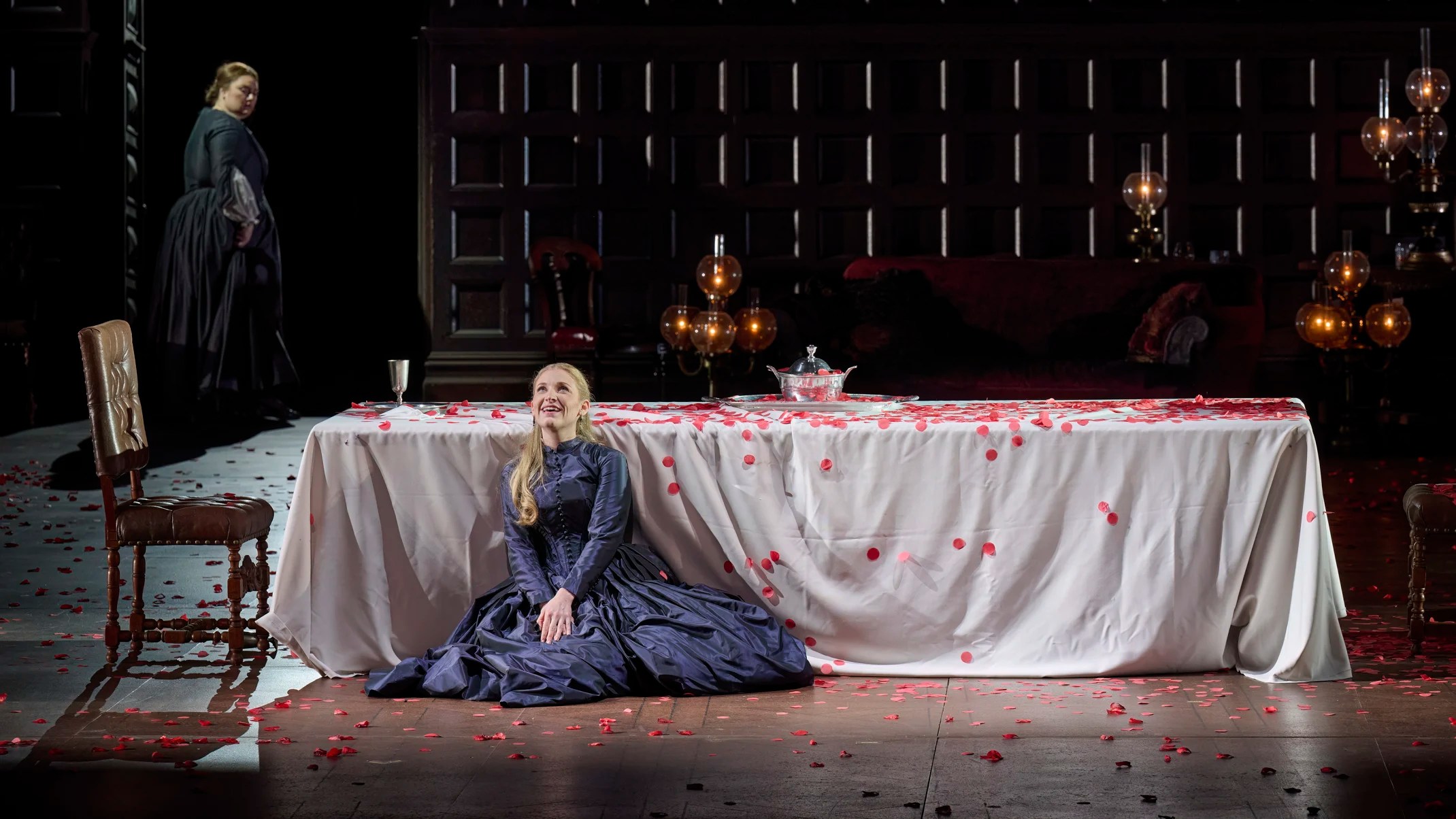
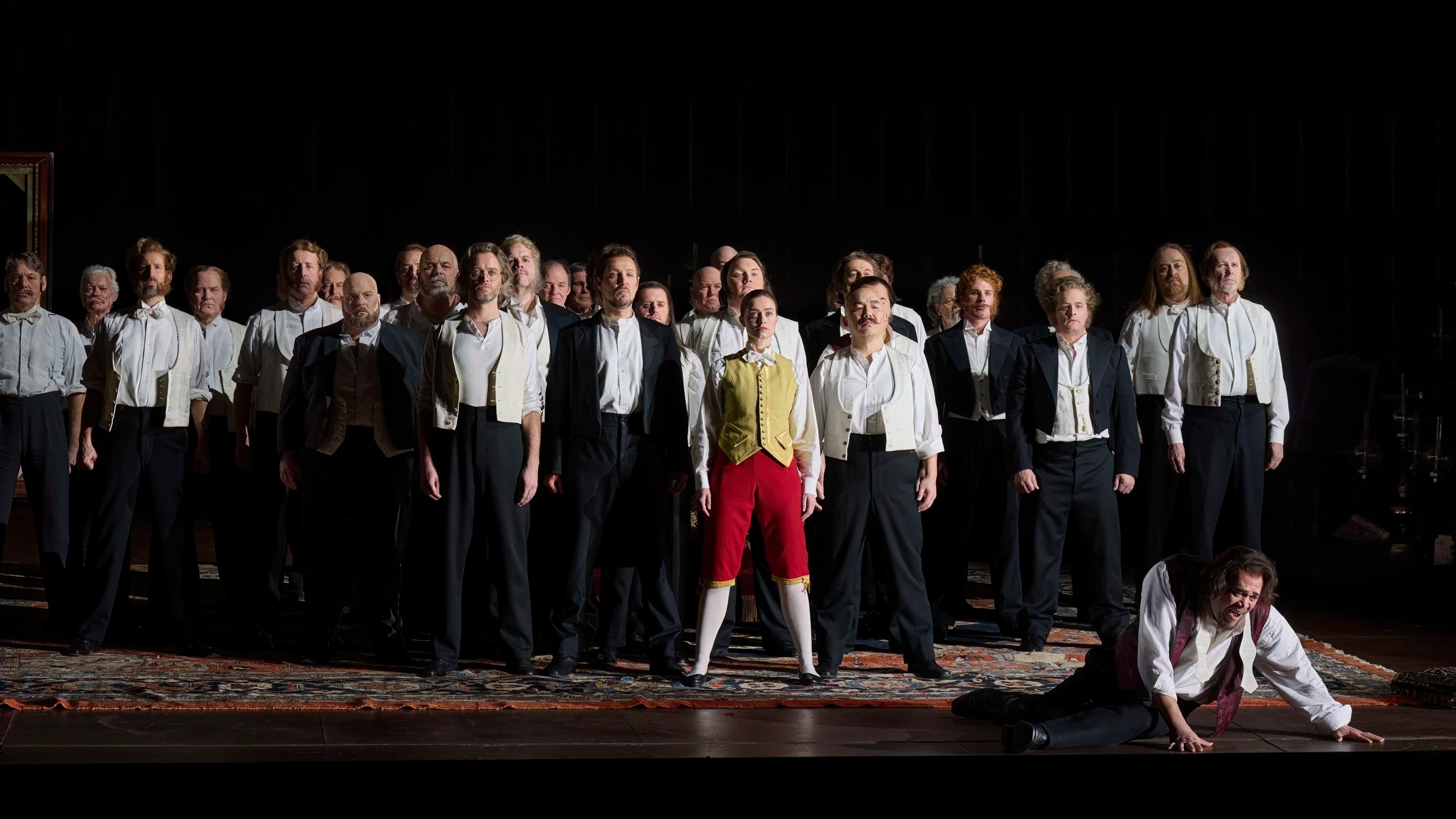
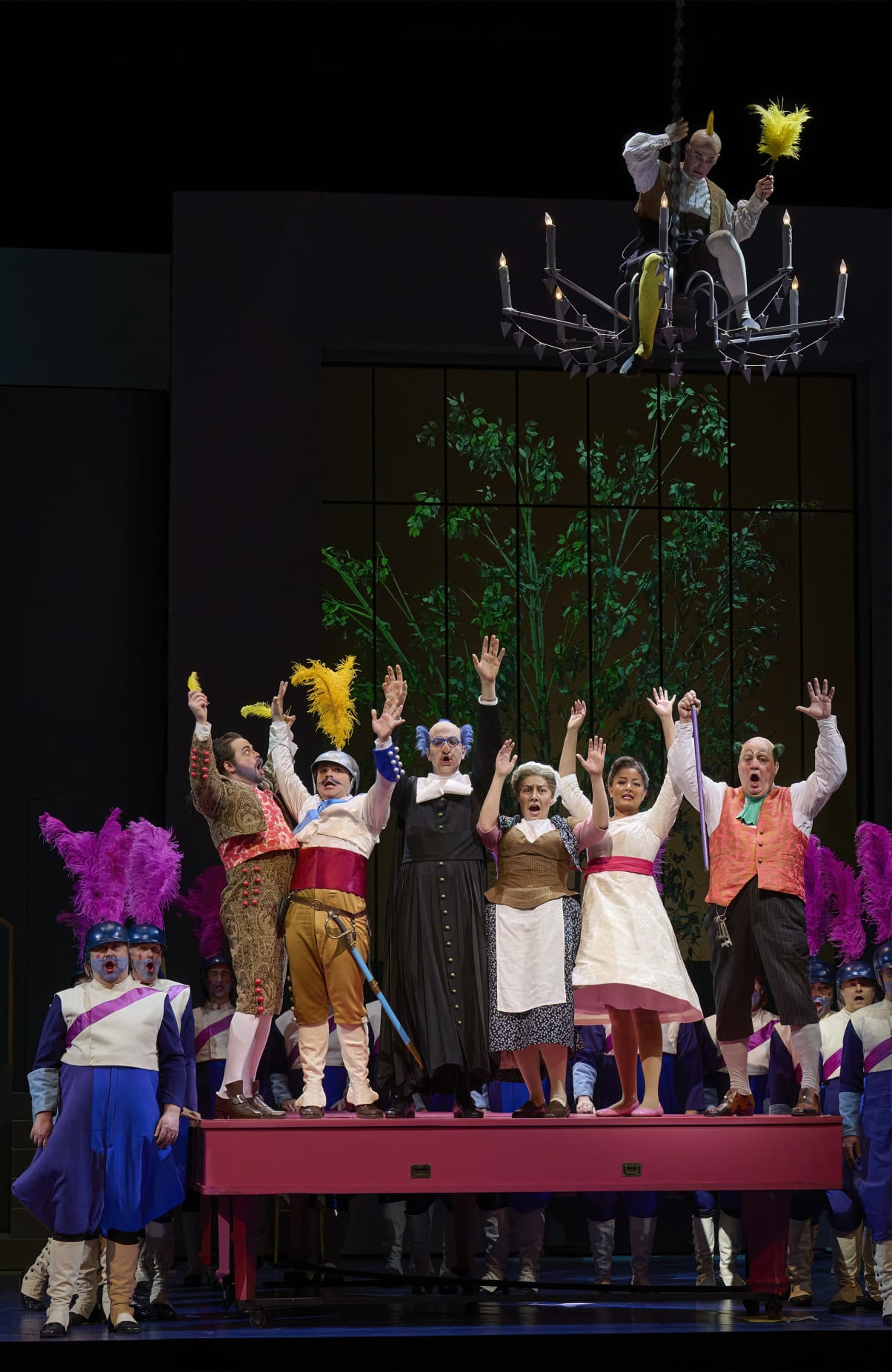
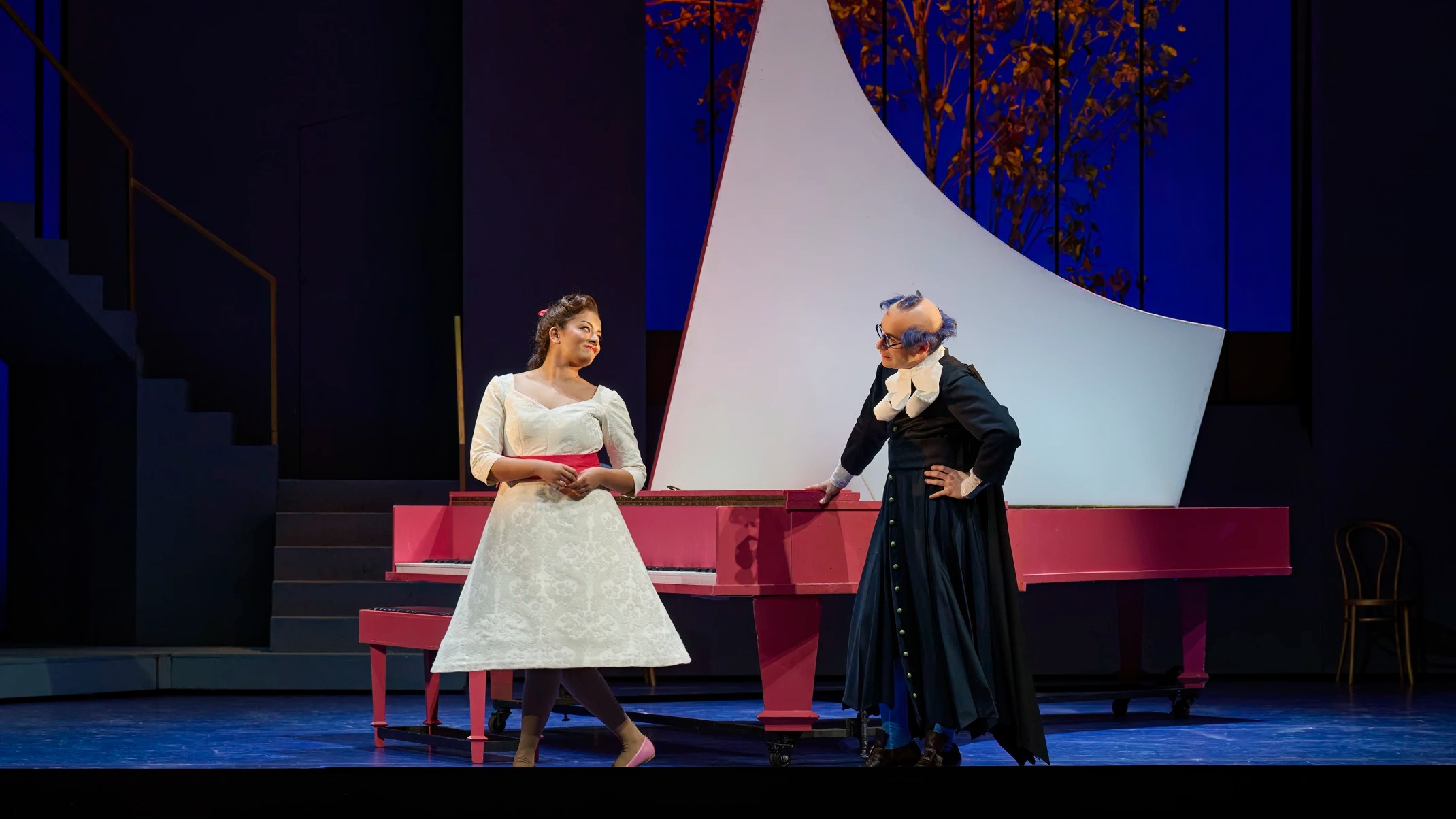
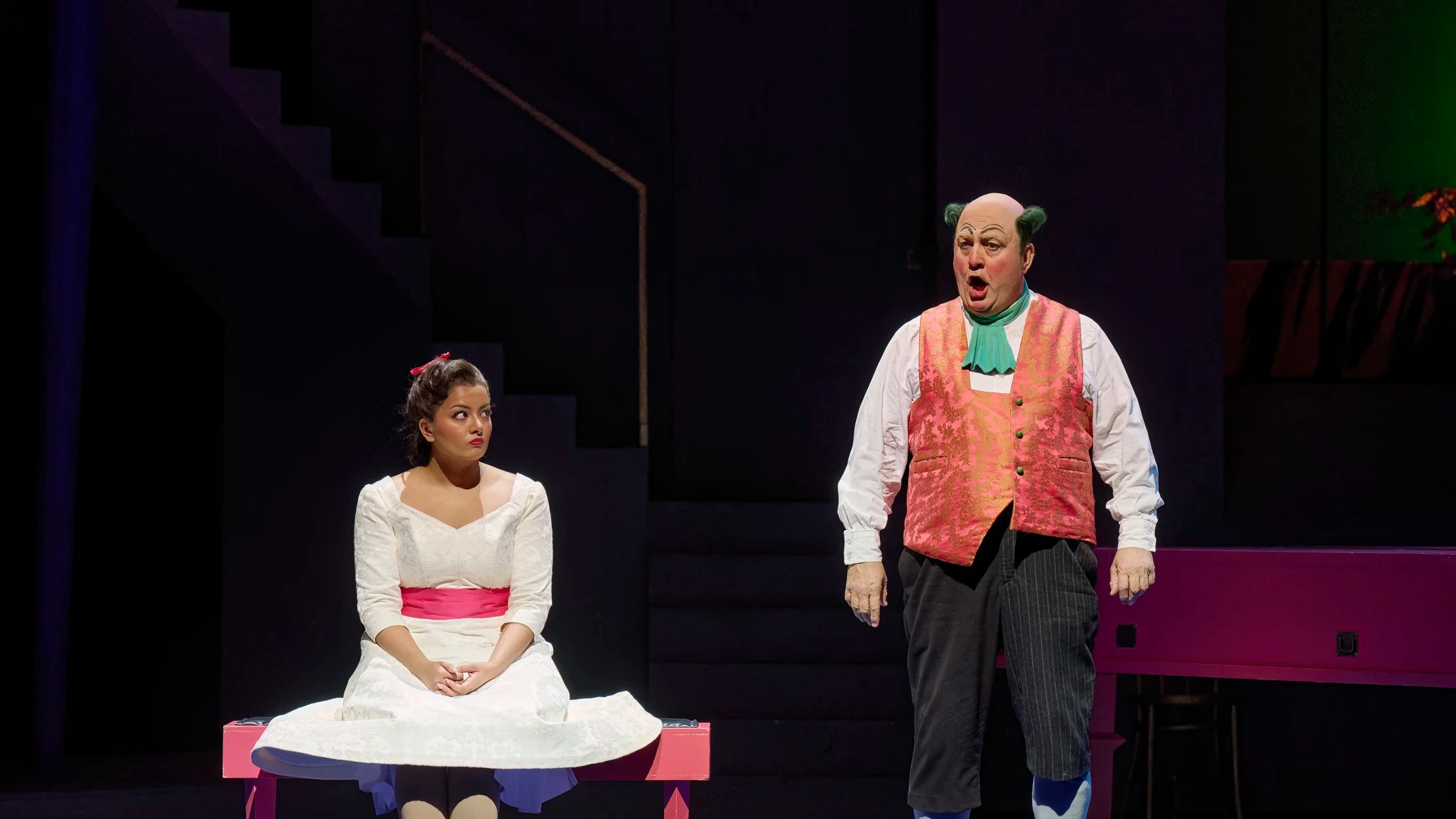
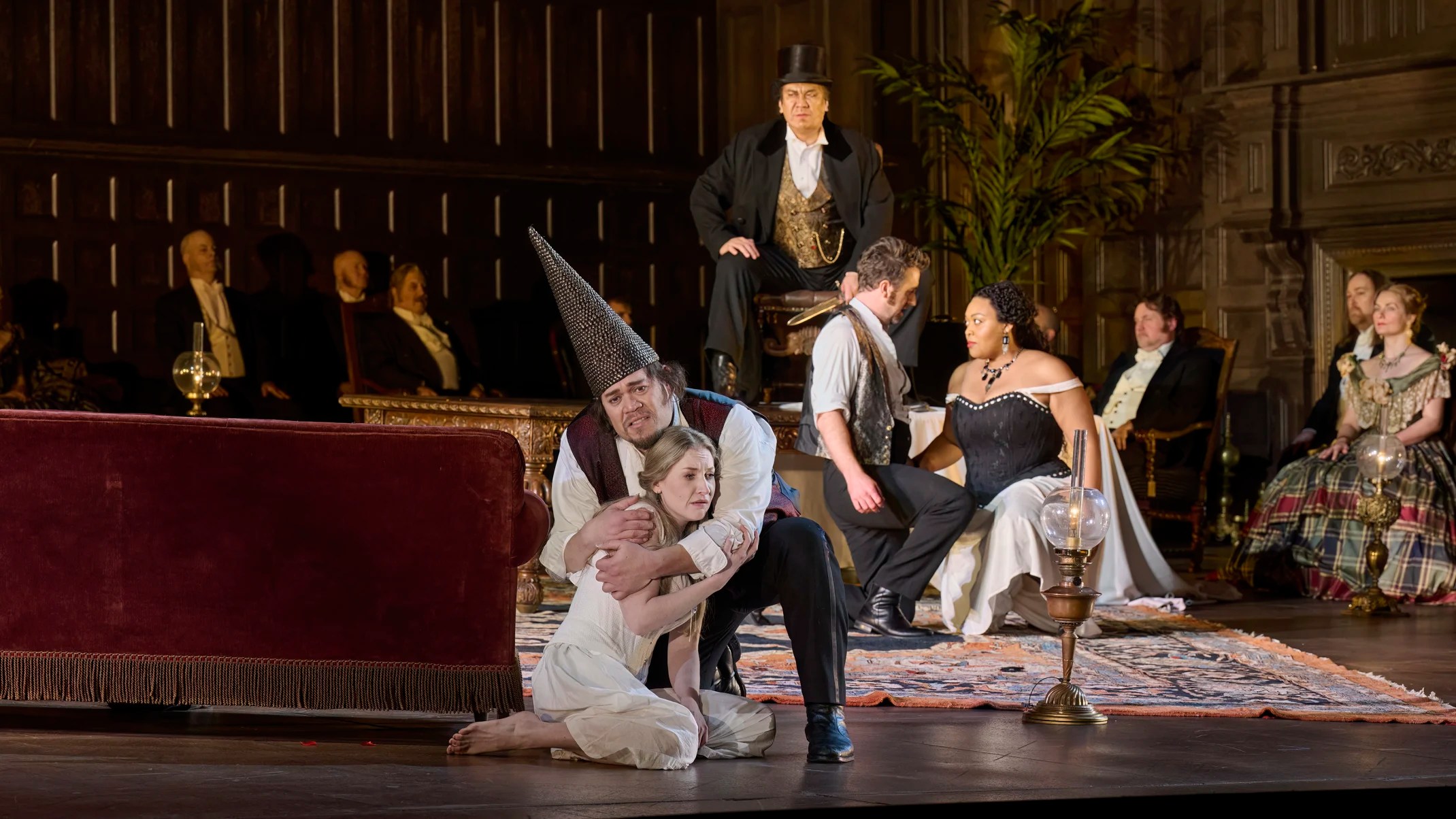
For Valentine’s Day 2026 this subscriber attended the Canadian Opera Company’s last performance of Rigoletto in their winter season at the Four Seasons Centre, in Christopher Alden’s rather un-romantic production. The rose petals fall from above as the young girl is seduced by a duke in disguise.
Giovanna (Simona Genga) observes Gilda (Sarah Dufresne) among the falling flower petals (photo: Michael Cooper).
I may be a tad compulsive about dates, observing how Monday’s Family Day holiday falls alongside this celebration of romance, just as we hit the Lunar New Year on Tuesday. The end of the Year of the Snake can also be understood as rebirth & transformation, a time of new beginnings.
The outgoing management of the COC can say “mission accomplished” as they look in the mirror, David Ferguson & his team having avoided the kind of backstage drama seen at the Metropolitan Opera, who were forced to lay off staff and cut some salaries. Speaking as a subscriber, I understood, accepted the revivals of Rigoletto & Barber as prudent measures, and as far as I can tell they made the right choice.
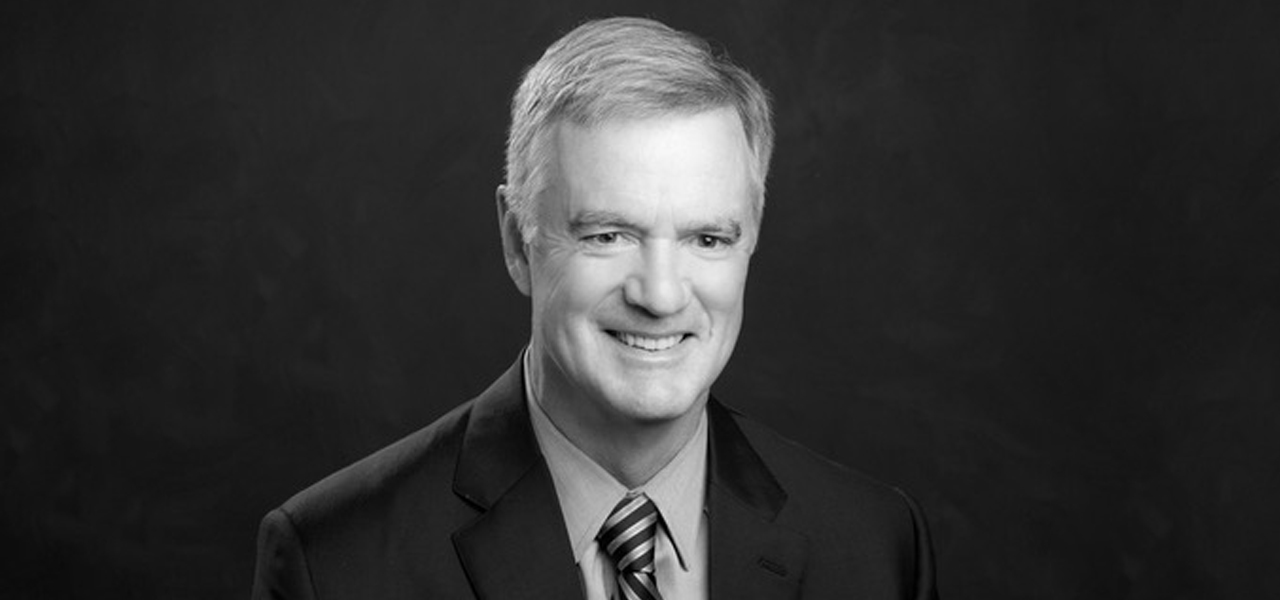
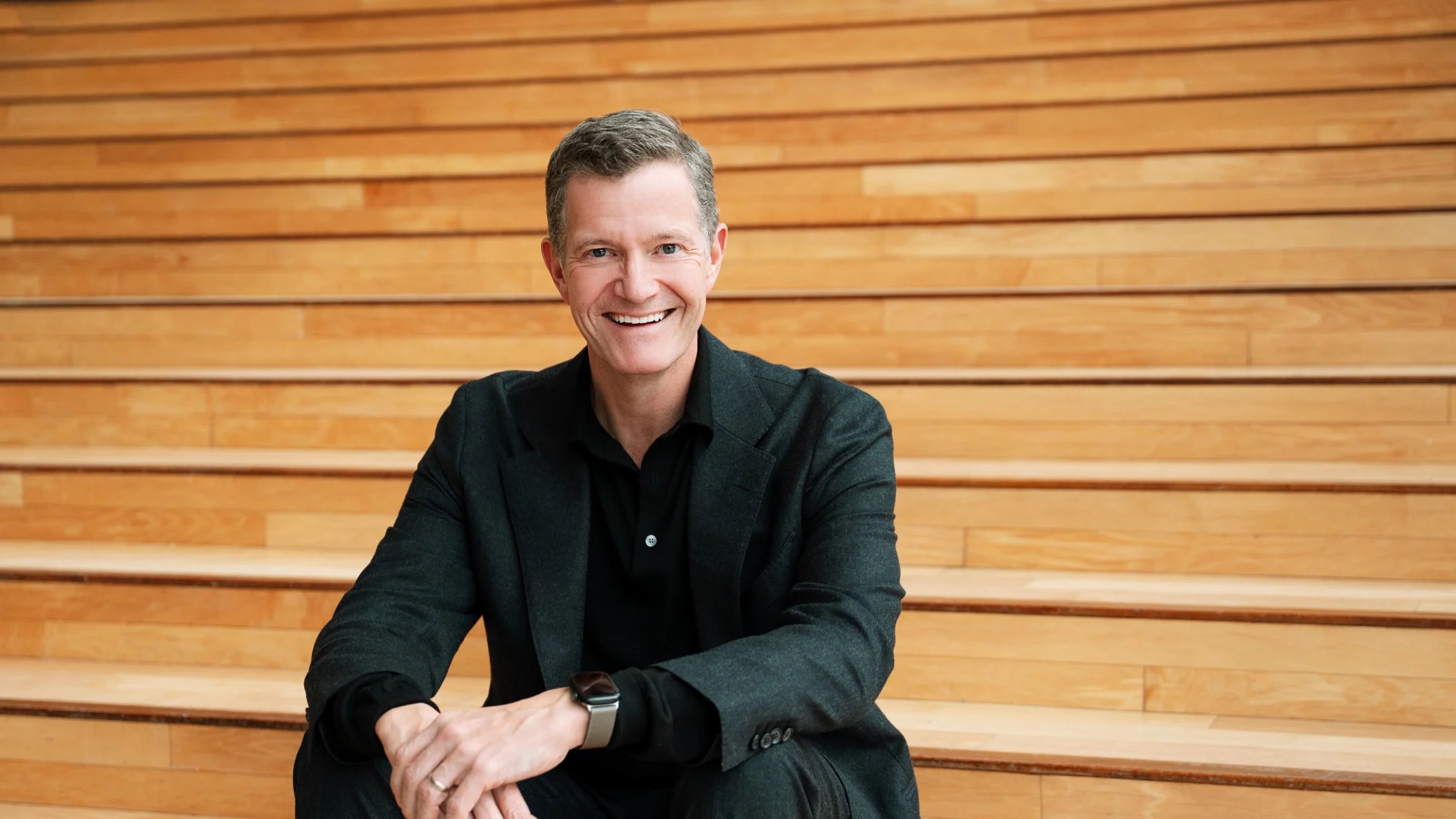
David Ferguson
In spring we get the new Canadian co-production of Werther (comparable to last year’s Canadian co-pro of La Reine-Garçon) alongside the much loved pair from Robert Lepage of Bluebeard’s Castle & Erwartung. That balance of new & old got us through. Ferguson has been interim General Director since 2024, after the abrupt departure of Perryn Leech, and continues in his role until July.
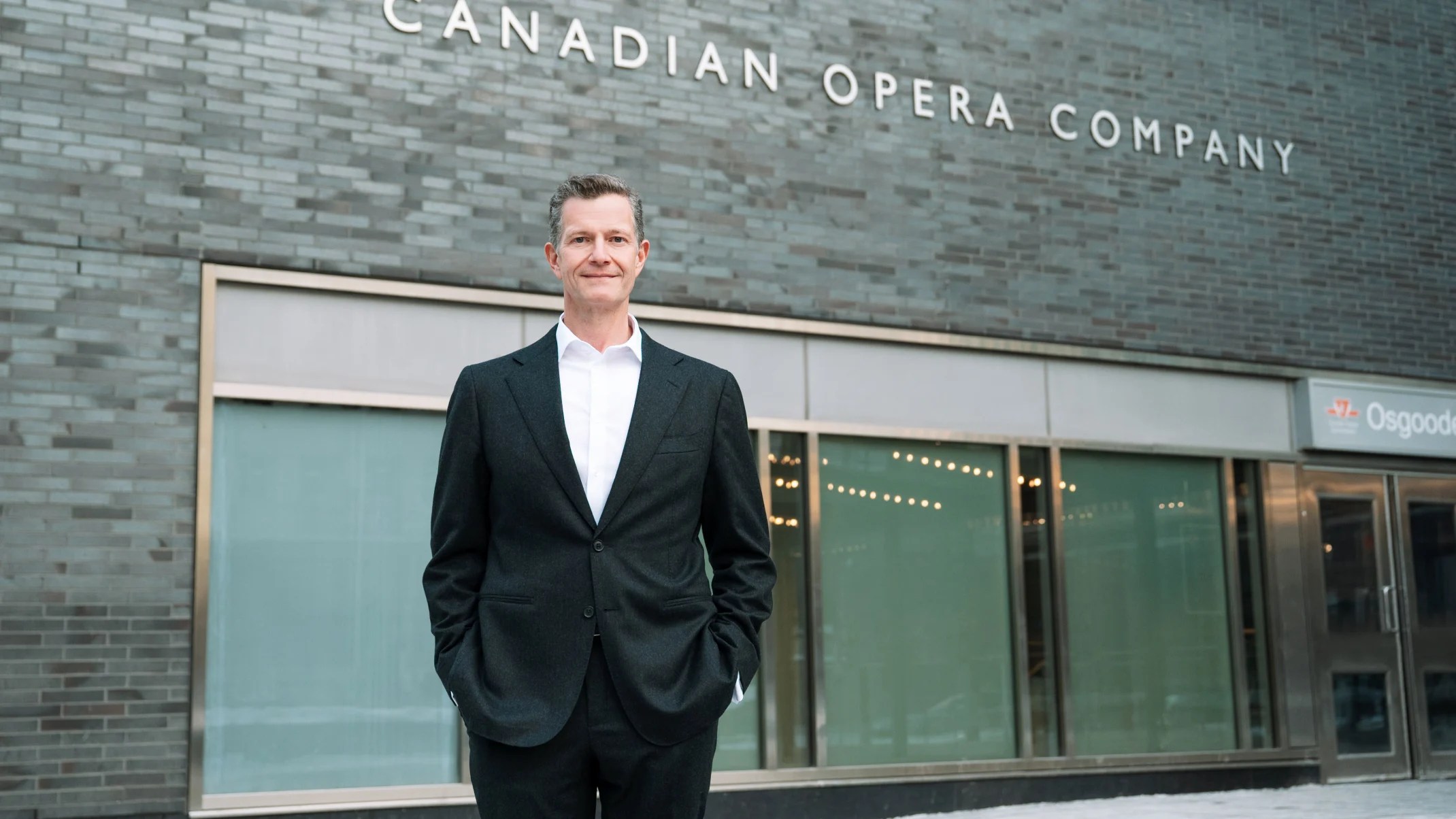
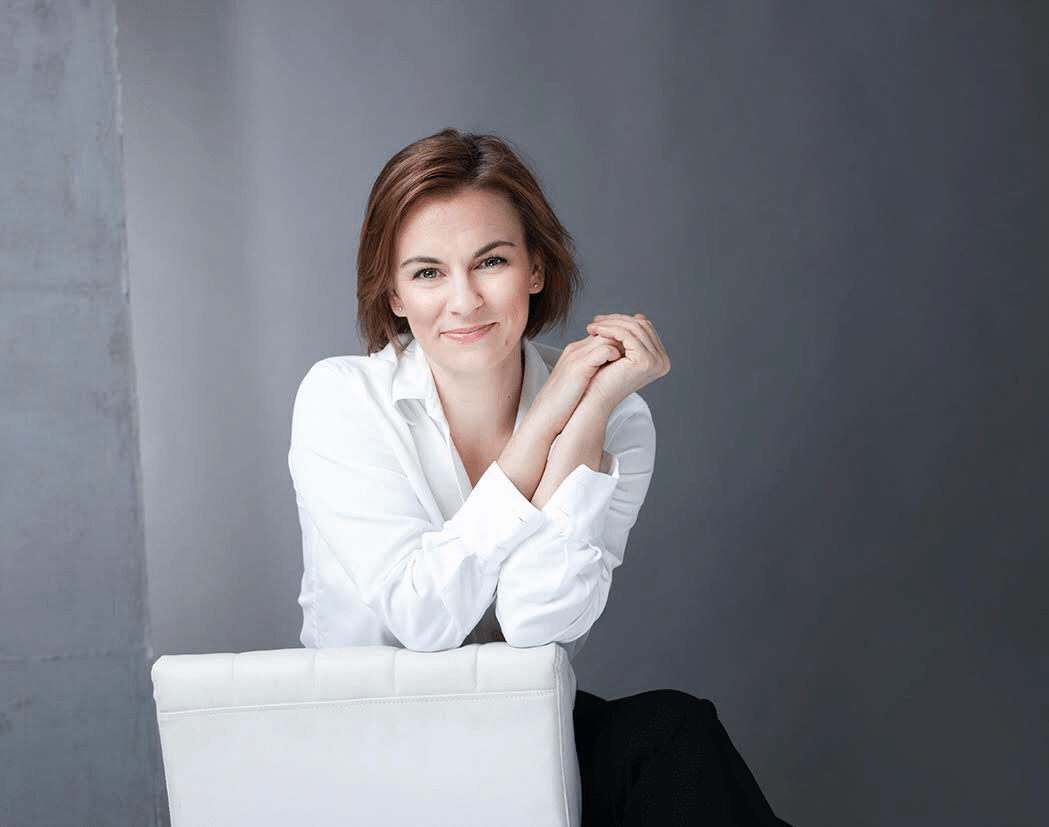
And there’s a new General Director on the horizon, namely Ian Derrer, who takes over in July.
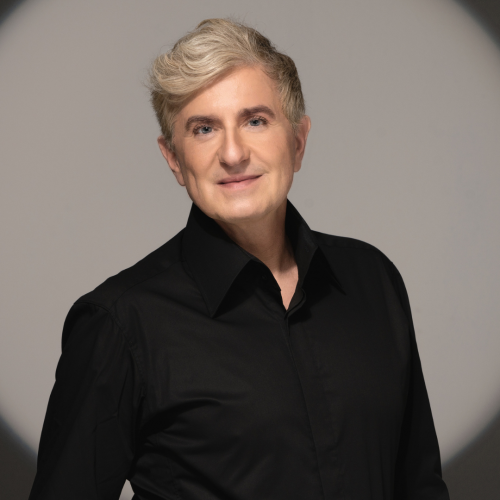
Incoming COC General Director – Ian Derrer (photo: Gaetz Photography)
I wonder how much input he will have for his first season at the helm (2026-27), that will have largely been planned already I would think. Ian’s first real season will be 2027-28. And excuse me maybe it’s my age talking: as I’ve barely managed to adjust to a year called “2026”. Those numbers feel remote.
My subscription seat in the second row is a treat for the way it surrounds me with orchestral sounds & closeup views of the action.
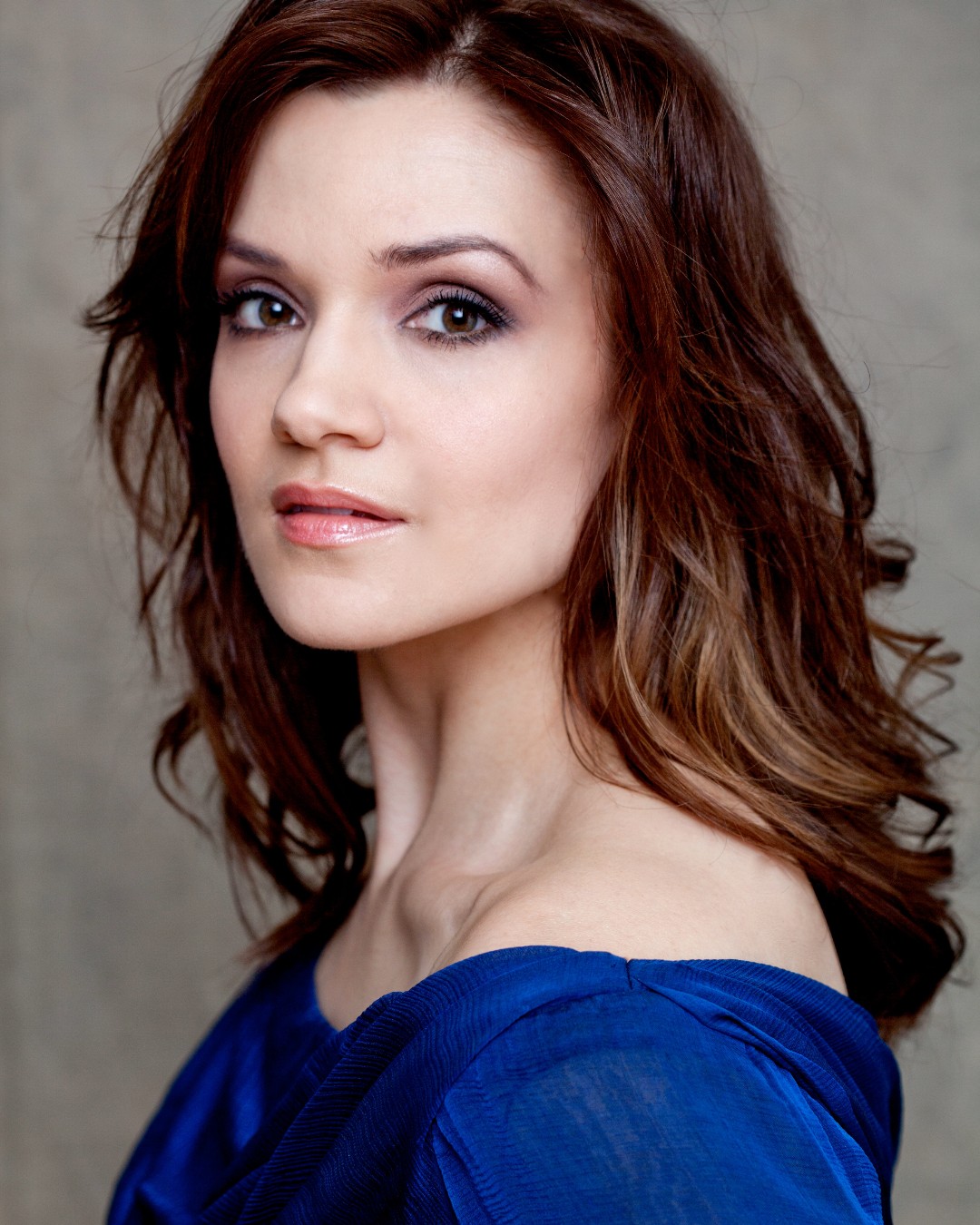
Andriana Chuchman was our Gilda for the closing performances.
Soprano Andriana Chuchman
Andriana was at times reflective, as in her approach to “Caro nome”, looking less like the teenager and more like a thoughtful young woman, which made the opera less triggering for me than what I experienced watching Sarah Dufresne earlier in the run (who looked so young & vulnerable).
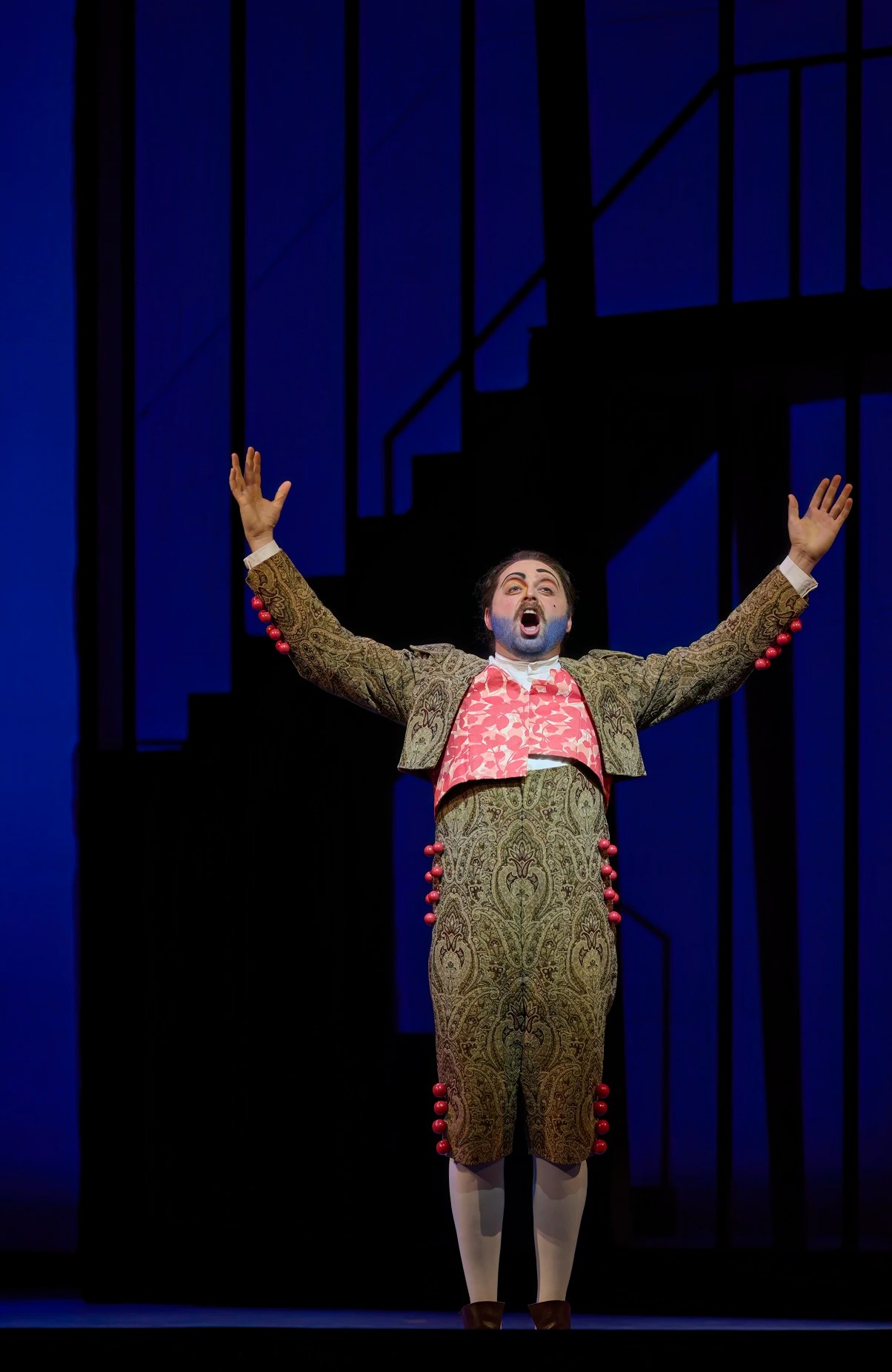
It was fascinating to watch Ben Bliss up close, as he manoeuvres one of his conquests from off his lap even while singing “questa o quella”: and still made it sound like easy singing. That’s two full performances I saw without a note sung flat. To pull that off in February surrounded by a cast likely running the gauntlet of colds & flu is doubly impressive.
As always I’m torn, conflicted by the two sides of Verdi during this period. Gilda & the Duke are still largely bel canto creations, the voices seducing us with their coloratura & their high notes. And then there are the newer subtler creations, dramatic hybrids such as Rigoletto or Sparafucile. Peixin Chen as Sparafucile gave us a grotesquely comical killer, complete with one of the best sustained low Fs I have ever heard, the role underplayed for maximum effect.
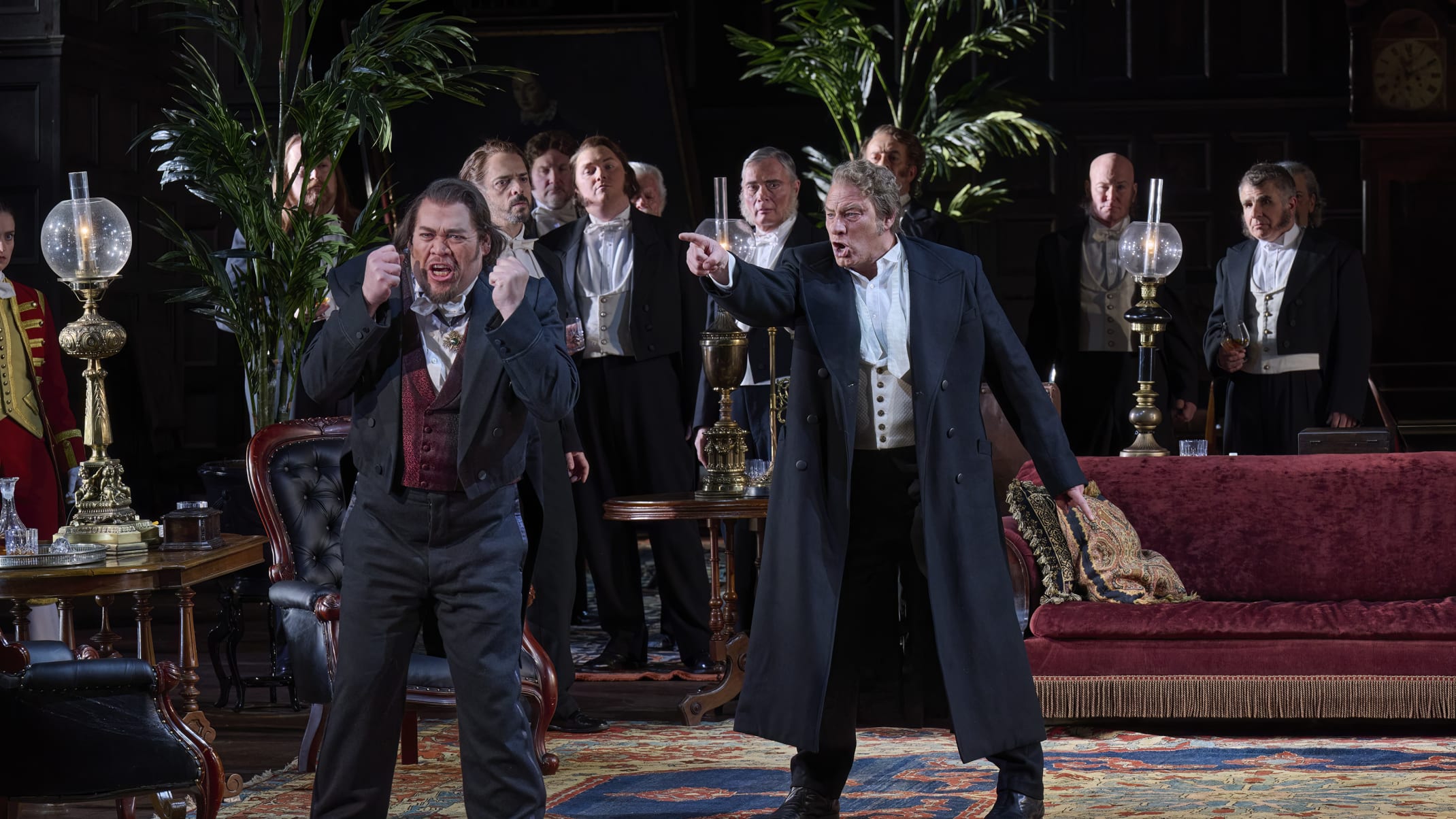
For the last performance Quinn Kelsey as Rigoletto held nothing back, and it was perfection. I was again stunned by how effortless Quinn’s voice is sounding, in a role we heard from him before. But he’s not forcing, he’s letting the sound out and at climactic moments making clear glorious sounds. The Alden production in some ways thwarts some of the usual things one sees from a Rigoletto. Instead of the prancing jester implicit in the music Verdi wrote for the scene with Monterone, Alden sits his baritone on a couch to imitate the Duke himself: an alteration that’s especially fascinating seen up close. Similarly the usual drama of the scene where Rigoletto comes looking for Gilda, the jester teasing his tormenters, is especially dark when Gilda is concealed onstage behind the implacable courtiers.
Rigoletto (Quinn Kelsey) stonewalled by the Duke’s courtiers (photo: Michael Cooper)
The great thing about this location is the chance to watch Johannes Debus conducting, while we’re immersed in the full COC Orchestra sound. I was delighted to notice the differences in interpretation, the more thoughtful reading with Andriana than with Sarah, as I wondered at the mysteries of Johannes’ process, pleased with the results either way.
Next week the Saturday 4:30 subscribers get Barber of Seville, in another closing performance to end the COC’s winter season.
And come July, incoming COC General Director Ian Derrer takes over.
Incoming COC General Director – Ian Derrer (photo: Gaetz Photography)
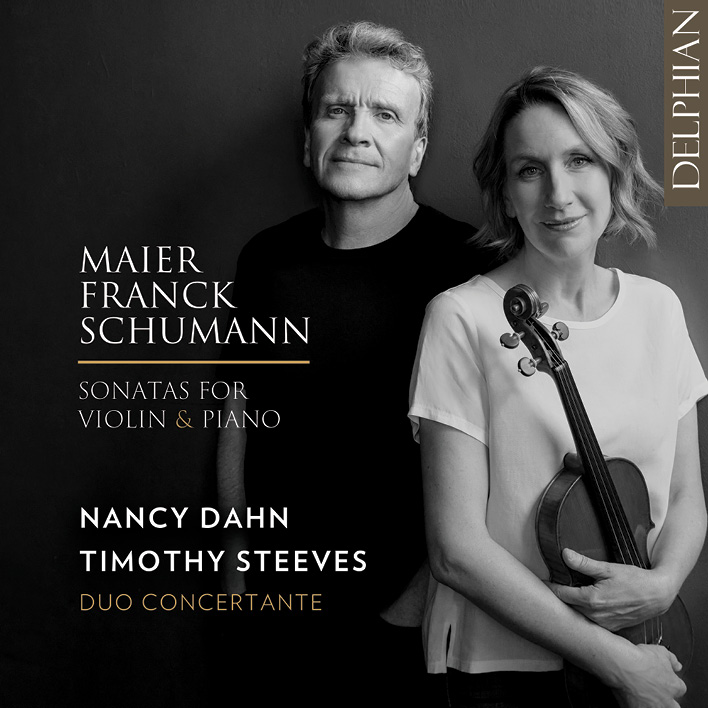
Add Nancy Dahn’s violin to the pianism of Timothy Steeves and you get Duo Concertante. I’m a fan who enjoyed their previous outings playing Beethoven and the edgier pieces on their Ecology of Being recording from 3 years ago.
Their latest creation features three violin sonatas by a trio of composers.
The recording is a reminder of the many ways we understand that word “romantic”. Guillermo Silva-Marin reminded me in his introductions at the Opera Salon of the breadth of that word, now having become so inclusive as to have almost lost its original meanings, that were shaped back in the time of the first of the Duo’s composers.
That would be Robert Schumann (1810-1856) who composed his first violin sonata in an impulsive burst over the span of four days in 1851. I am reminded of one of the attributes we find in some of those early romantics such as Schubert or Chopin, making compositions with the feeling of spontaneity, impromptu, feelings seemingly close to the surface. While there may still be structural elements of the classical period such as sonata form, that becomes the departure point for explorations, enlarged possibilities and pushing the limits of what was understood to be allowed. Romantic music grew louder than classical, the limits of the virtuoso always being revised in pieces that were more difficult to play than the previous generation. Schumann is remembered as a troubled figure, tormented & suicidal, disfiguring his own hand in hopes of increasing his own reach & strength. But while his music can be played with passion one can and must transcend pain in seeking the beauty in his melodies & his unique pianism.
The opening phrase of the violin sonata in A minor leads ambiguously away from its beginning key, as the duo build to a series of climaxes, the violin & piano surging together then pausing on a discord that brings us back to the beginning key. The second movement has an improvisational quality, spontaneous as the moment the next phrase appears, seeming brand new in the dialogue between Nancy & Timothy, delightfully bouncing off one another like a romantic conversation.
The finale is powered by a softly pulsing piano that is answered by the violin, leading to the end of the statement and then flying off into another key, very much like discourse with its resemblance to question and answer, back and forth building to bigger and bigger questions being tossed between them, until a soft lyrical passage in triple time allows a rest from the agitation. And then when we get to the cadence it starts up again with another version of that pulsing piano thing, but softly.
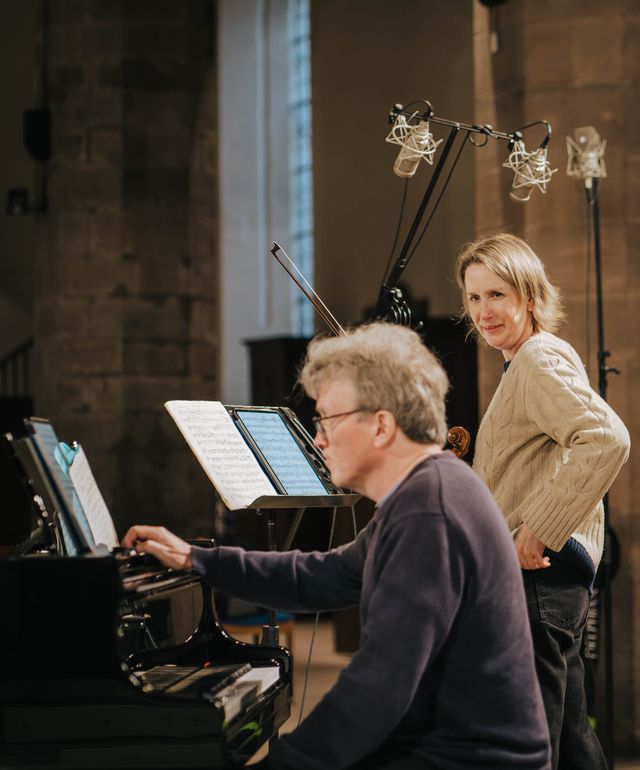
Duo Concertante: Nancy Dahn and Timothy Steeves
They are so musical together it really feels like a couple who finish sentences for each other, softly doing it in phrases that resemble a single thought shared between two people.
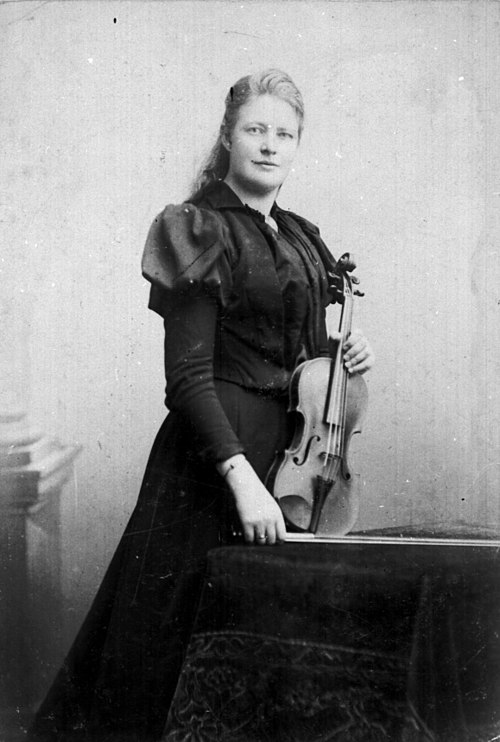
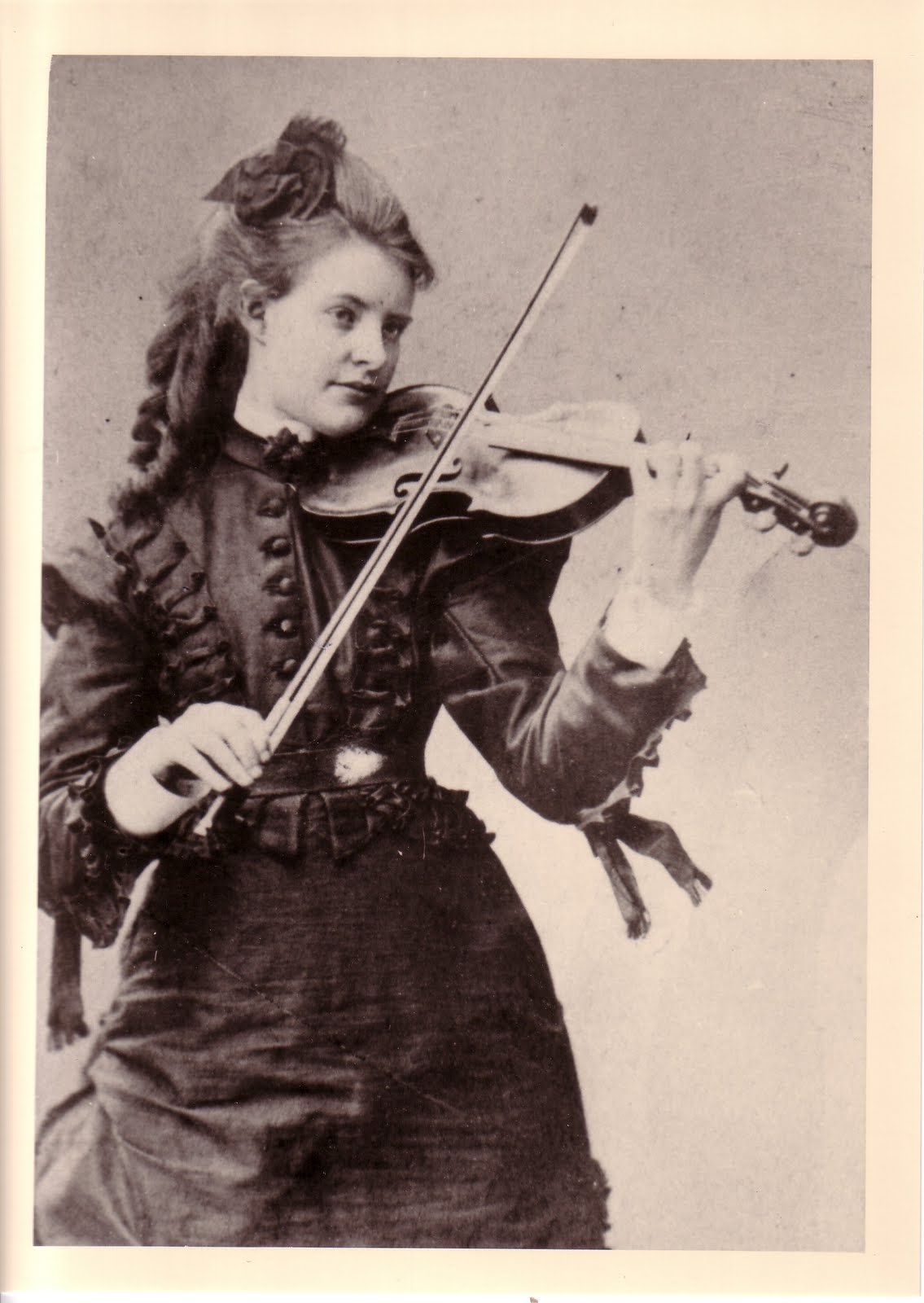
And next among the three composers on this CD, Amanda Maier (1853-1894), a name that’s new to me, a woman composer, herself a violinist among male violinists and composers. I read that she was the first female graduate in music direction from Stockholm’s Royal College of Music.
Amanda Maier
Maier died even younger than Schumann. Her sonata seems to be a contrast to that of Schumann, not a spontaneous eruption but a deliberate & carefully built work composed over the course of 1874 & ’75, a vessel to contain simple but powerful emotions, each movement’s opening phrase seemingly linked. Her sonata stands tall between two giants, a worthy peer to the famous composers on either side of her on the recording. You can read more about her in a 2009 essay I found titled “Unjustly neglected composers: Amanda Maier.”
Amanda Maier
Her B minor sonata opens with a simple phrase that becomes a building block for the first movement. The phrase is like a thought upon looking outward, that enlarges its scope, widening with every reiteration of the little idea that started it. Nancy and Timothy are together as usual, the questioning of this movement like eyes glancing left, right, wondering. The second movement’s lyricism is song-like, moving gently in triple time like a slow dance, the minor third of B-D that seats us in B minor for the first movement takes us this time into a gentle song when we’re in the key of G major, using the B-D not as tonic to mediant but mediant to dominant. The third movement to conclude has us back in B minor, including a minor third to declare the theme and our return to the opening key.
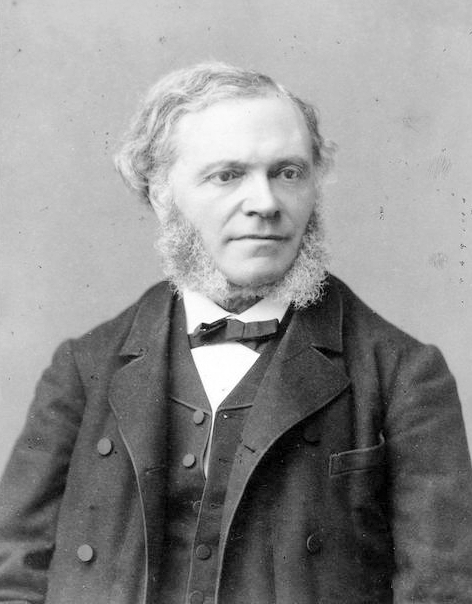
When we come to the third romantic exponent, Cesar Franck (1822-1890), we are in the presence of a sophisticated exploration of the relationship between violin & piano, their chromatic harmonies taking us further, deeper, in a four movement work.
Franck’s great work was composed for the wedding of virtuoso Eugène Ysaÿe in December 1886. The manuscript was given to Ysaÿe on the morning of the wedding by a mutual friend, Charles Bordes. Eugène practiced the work with pianist Marie-Léontine Bordes-Pène, Bordes’ sister-in-law. They premiered the work for the wedding guests, giving the public debut months later. The sonata has been understood in the most romantic terms ever since. For example Franck’s sonata was one of the last works Amanda Meier performed in concert with her husband.
César Franck
The first movement is a fantasy, a gently tentative enquiry expanding gradually into broader and bigger prospects as though opening a window or a door, looking out upon and then visiting a landscape. There’s a back and forth between violin and piano, not so much call and response as statement and echo, the replies sometimes darker. The piano for that first movement is like a foundation holding up the upward reaching violin, sometimes becoming energized.
The second movement is agitated, a powerful allegro that involves us in some ambiguities harmonically, and slowing down for passages resembling recitative, as though pondering deep questions. The piano is now driving us onward in challenging quick passages, no longer in the background. We go back and forth between darker harmonies and gentler melodies, the work building to a radiant climax, the two instruments matched finally.
For the third we are again pulling back, a series of cadenza- impromptu moments to suggest contemplation. We are hearing a simpler texture from both instruments, the piano and violin confronting the world in the gentlest terms, the questions presented tenderly, with a kind of vulnerability, even affection between the two voices.
And then we come to the final movement, surely one of the move beautiful creations for violin & piano, one voice after another answering, surmounting, complementing. While I have been listening to this piece since I was young, it sounds especially beautiful in its setting here on the recording by Duo Concertante, set up by the other two earlier sonatas. I find I play through the CD and then start over, that it’s a natural organic journey.
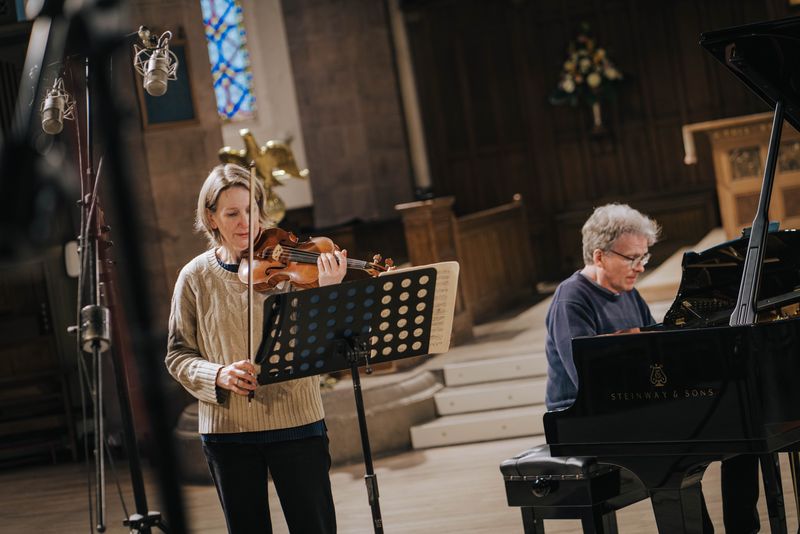
Duo Concertante Nancy Dahn and Timothy Steeves
I have been listening to their performances on CD for literally weeks, as I thought about the best way to write, hoping to capture my enjoyment. When I started listening the perception was different, orienting myself movement by movement, but as the CD became more familiar it turned into one continuous meditation, each composer adding their own perspective, their own unique answers to the questions we would understand as fundamental to romanticism.
Duo Concertante: Nancy Dahn and Timothy Steeves (Photo: Rich Blenkinsopp)
Saturday night the National Arts Centre Orchestra played their annual Toronto concert to an enthusiastic Roy Thomson Hall audience. As 2025-26 is the final season as music director for Alexander Shelley, this was his last visit at the helm of the orchestra.
There were three works on the program: Jocelyn Morlock: My Name is Amanda Todd Camille Saint-Saens: Piano Concerto #5 –intermission– Ludwig van Beethoven: Symphony #3
In his remarks beforehand Maestro Shelley spoke of the untimely passing of Jocelyn Morlock, who composed the opening piece about 10 years ago, but who died suddenly in 2023.
Composer Jocelyn Morlock
This is the third time I have heard this composition, that seemed more lyrical & elegiac for its last few minutes. Was it Shelley’s reading? or maybe it’s just that I listened more closely, thinking about the work’s creator. While the first time I heard it, there seemed to be more discord & dissonance, this time it struck me as a beautiful piece, choirs of instruments sometimes jarring against one another (as I try perhaps to find the subtexts of the piece in the music) before finally settling into something more agreeable with each other.
Jean-Yves Thibaudet was soloist in the concerto, a delightful and entertaining composition, particularly when tossed off as clearly as tonight, Shelley keeping the orchestra discreetly out of the way, and only cutting loose at the end of the last movement.
Pianist Jean-Yves Thibaudet
In response to our enthusiastic applause Thibaudet played Ravel’s Pavane pour une infante defunte as his encore, matching the plaintive tone of the first piece.
After the intermission we were treated to a remarkable reading of the Eroica Symphony, a work that’s very familiar. I was struck by how responsive this orchestra is to their music director, taking the first movement at a very quick tempo, but articulating every phrase with precise attention to the shape of the phrase. Similarly the second movement funeral march had more drama than I have ever encountered in a lifetime of hearing this piece, a true eye-opener. For the last two movements we were again listening to an orchestra willing to follow their leader exactly as he requested. I was a bit confused by something in the coda to the last movement, an unexpectedly slow pace after the whole symphony had been taken at such a quick tempo, making for a majestic conclusion. But it was beautiful all the same.
I wish Shelley all the best in his future projects, wherever he may go. He built an amazing orchestra who will have a new music director next season, and hopefully we’ll see that new person and the ensemble back next year.
On February 20th, 1626 English lutenist and composer John Dowland died in London, leaving behind a legacy that brought him fame across Europe, and left him as one of the most recognizable names in renaissance music to this day.
Jonathan Stuchbery is a founding member of Diapente Renaissance Vocal Quintet since 2023.
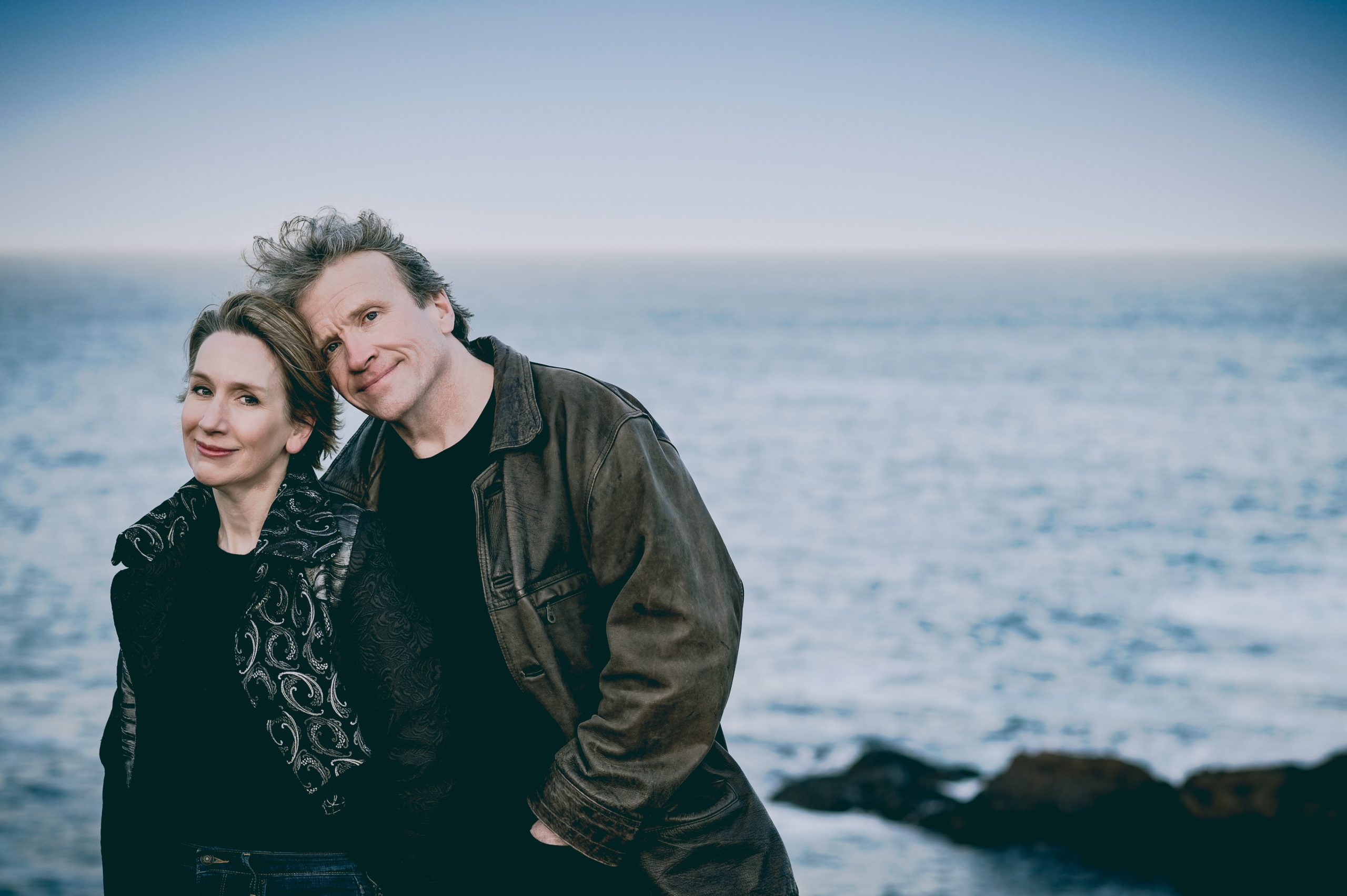
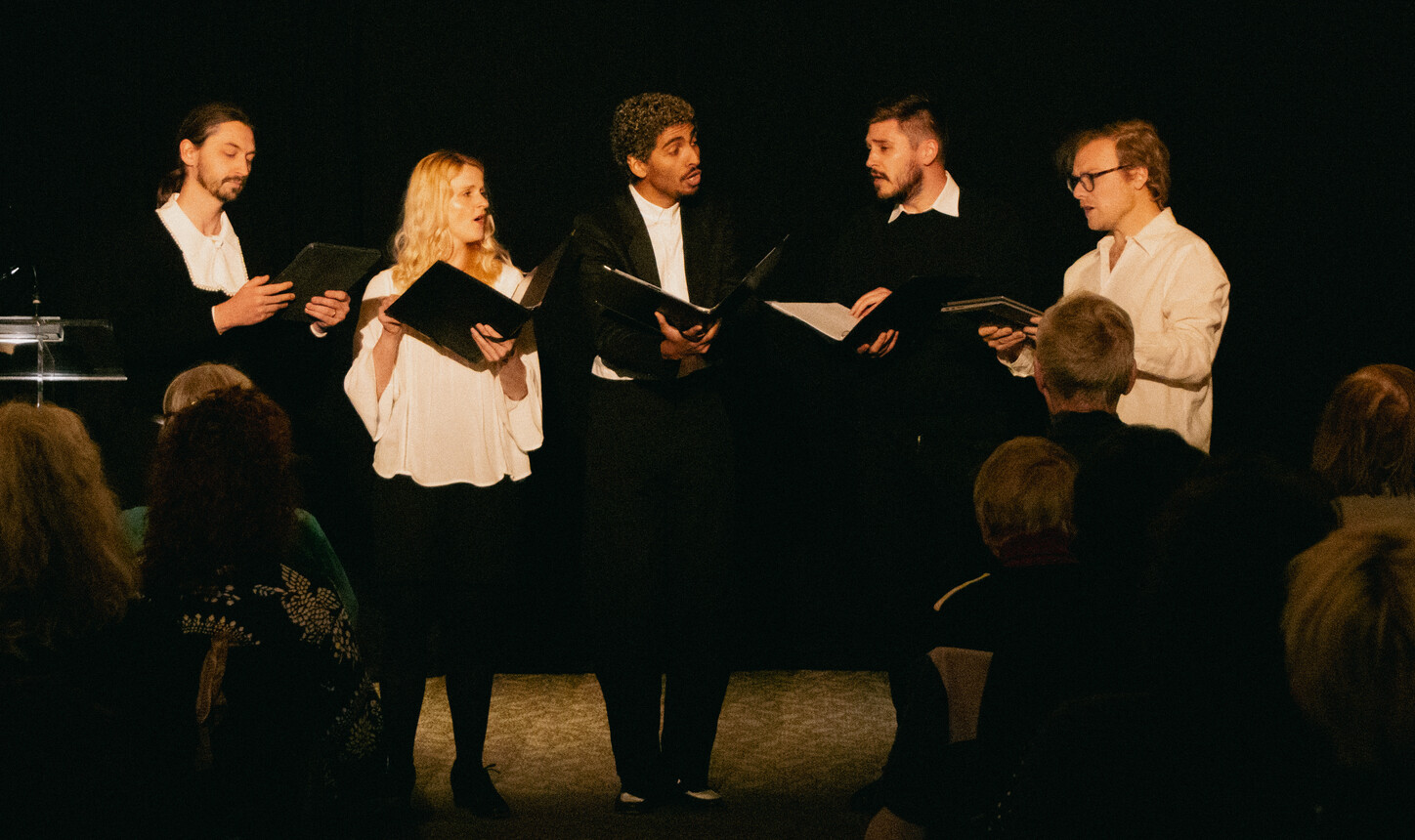
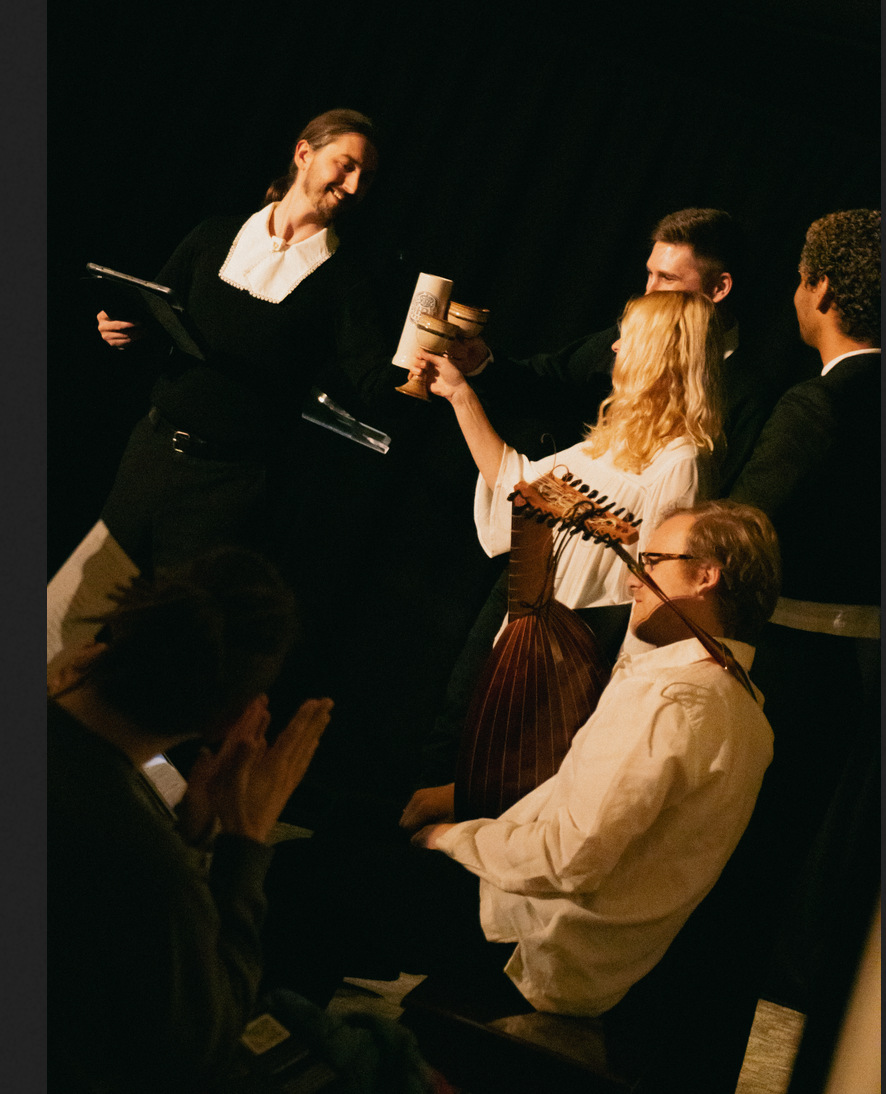
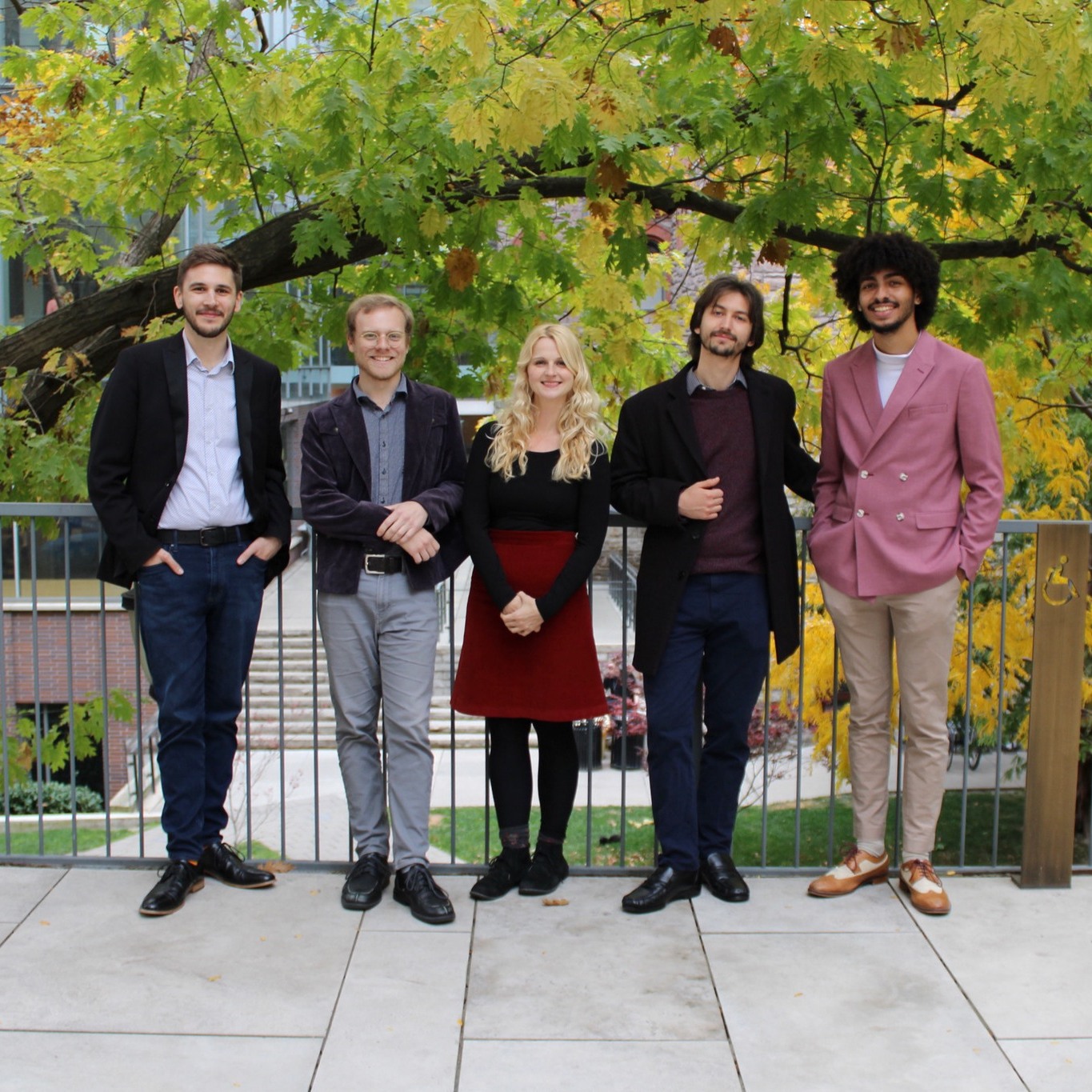
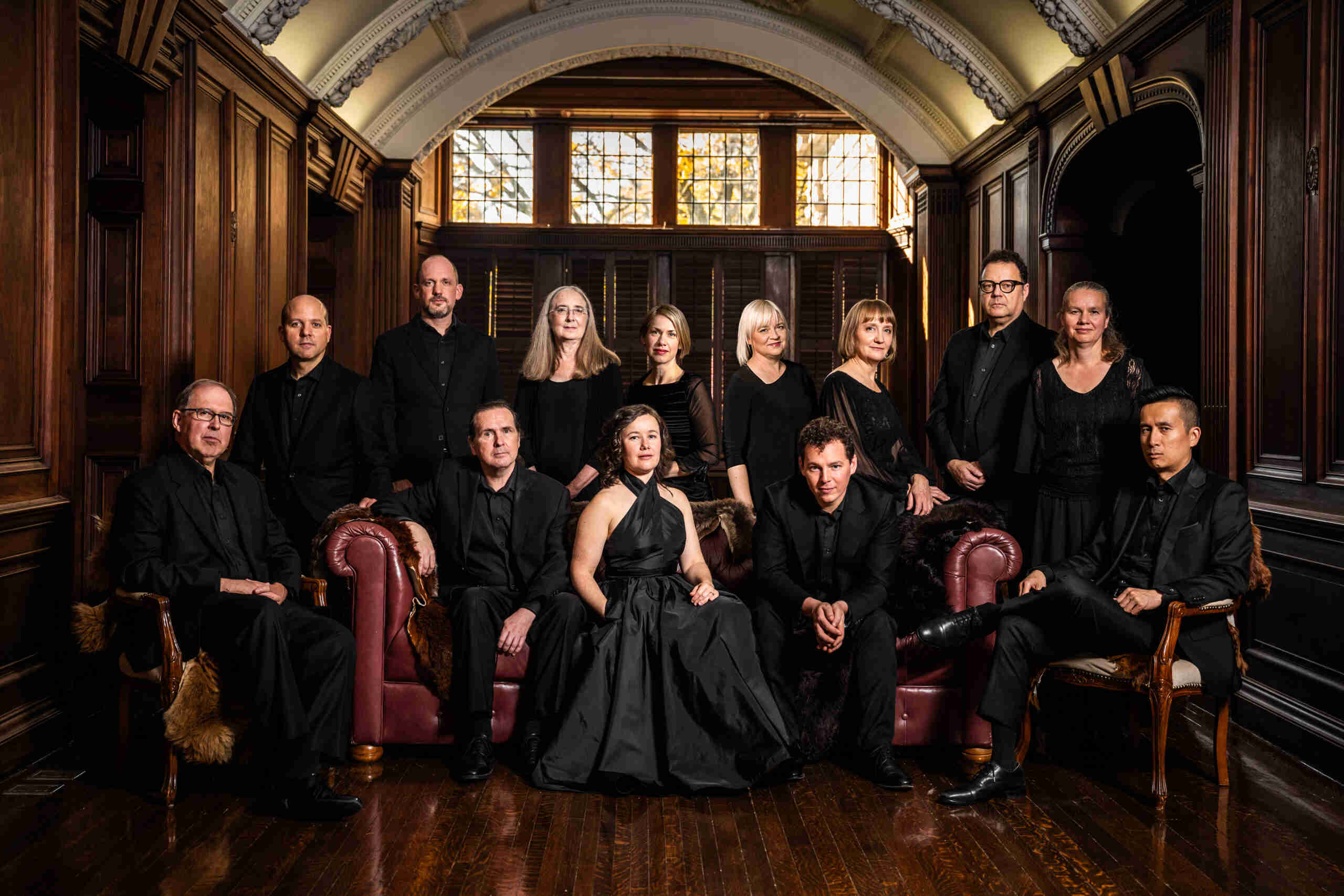
Diapente Renaissance Vocal Quintet: L-R: Alexander Cappellazzo-Tenor, Jane Fingler–Soprano, Martin Gomes-Bass, Peter Koniers–Countertenor, Jonathan Stuchbery–Tenor & Lute
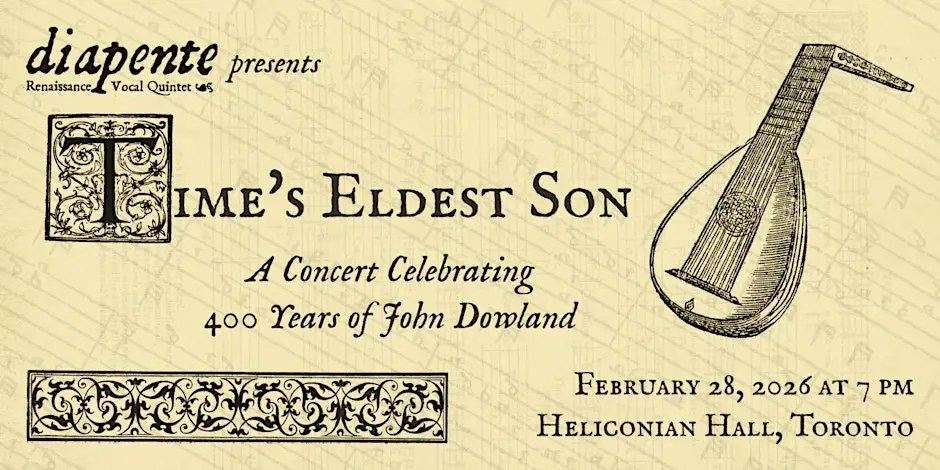
Diapente will commemorate the 400th Anniversary of Dowland’s passing with “Time’s Eldest Son”, a Concert to be presented on Saturday, February 28 — 7:00pm at Heliconian Hall — 35 Hazelton Avenue.
I had to interview Jonathan to learn more.
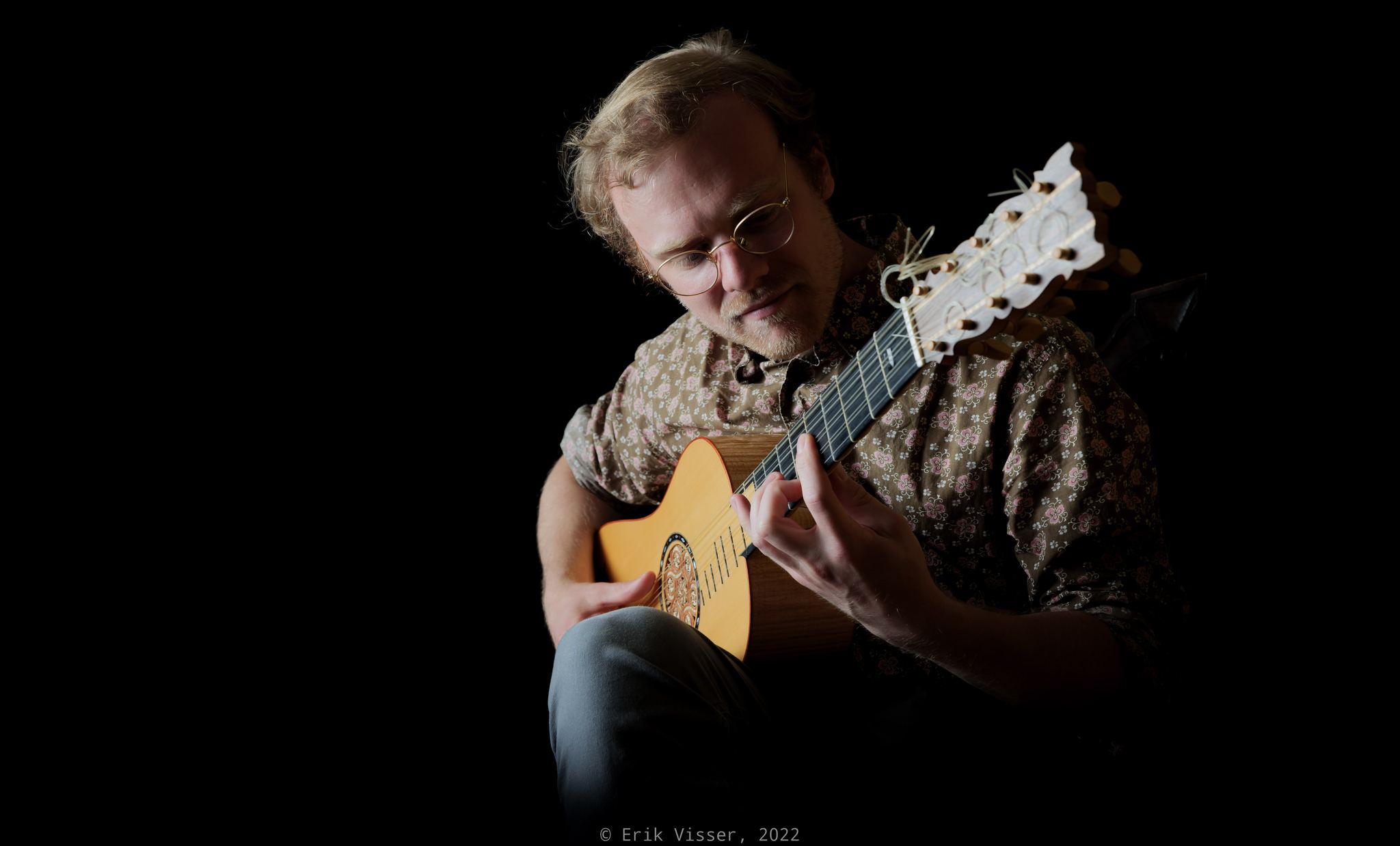
Jonathan Stuchbery (photo: Erik Visser)
Barczablog: Are you more like your father or mother?
Jonathan Stuchbery: That’s a hard question off the top! There are so many things I get from my parents. My mom is a musician, and I watched her as a pianist, teacher, music director, and choral conductor throughout my years growing up, so in the trajectory of my career I am a lot like her. That said, while my dad didn’t pursue music as a job, it was listening to him sing and play the guitar, and writing songs when I was a kid that inspired and motivated me to take up the guitar myself. That instrument has taken me down so many paths, from heavy metal and jazz, to classical music and the lutes and early instruments that I principally play today.
BB: What is the best or worst thing about what you do?
Jonathan Stuchbery: I love the dual aspect of being a performer and a researcher in being an early music musician. I get such a kick out of learning interesting facts and continually developing a deeper understanding of the world around me. The experience of discovering something new is exciting to me, and the performer in me wants to take that feeling and share it, and the fact that I can do that while also creating a sensory experience for others through the medium of performance or recording is a joy to me. In my ideal scenario a performance is a question; here’s what I think, feel, what I learned about this, and what about you? I love it when I speak to someone after a concert and they share how the music made them feel, or what was really interesting to them that they learned from experiencing it. Now, since the learning and sharing are so rewarding to me, some of the intermediary steps drive me crazy! Let’s just say I am not a passionate administrator
BB: Who do you like to listen to or watch?
Jonathan Stuchbery: I listen to a lot of different artists and styles of music. A few who are always near the top of my listening list are my teacher Xavier Díaz-Latorre, bluegrass guitarist Bryan Sutton, the ever-inspiring Jeremy Dutcher, Tuvan group Huun-Huur-Tu, and Swedish metal band Opeth. I like content that will teach me about history, and I’m currently enjoying Kevin Stroud’s ‘History of English Podcast’ about the long and fascinating history of the English language. I don’t regularly watch sports, but I do get excited when world cup rugby comes around (how about Canada’s women’s team taking second last fall!?). If that’s not enough variety, I’m also a fan of sci-fi and fantasy, my wife and I are a few years in and almost caught up with rewatching all the seasons of Doctor Who!
BB: What ability or skill do you wish you had, that you don’t have?
Jonathan Stuchbery: I wish I were better at making and building things. One summer as a kid (I think I was twelve years old) my cousin taught me how to woodcarve, and I made this wooden loon. I still have that carving sitting on my bookshelf and I’m very proud of it, but I haven’t kept up any skill at crafting like that. I always love seeing the way others can see materials and deduce how to make them into something beautiful or practical like home repairs and furniture! Maybe one day when I have more time…
BB: When you’re just relaxing and not working, what is your favourite thing to do?
Jonathan Stuchbery: I take my tea very seriously, and that’s a favourite way to pass the time. As a teenager I got interested in gong fu cha, a Chinese method of drinking tea, drinking many short infusions over an extended period of time, and taking your time to carefully taste and experience the tea. My collection of teas and tea vessels keeps growing, and I enjoy the way it slows down life for an hour or so as you focus on the drink, ideally with a companion or two! I also love being outdoors, nothing is quite so grounding to me than taking in nature. In the city I’ll go to the parks with my dog Satie, and when I can I want to get out to hike in Ontario’s amazing provincial parks and conservation areas. A few years ago I lived for a short time in Peterborough, and during my off-time I would just hop on my bike and take the trans-Canada trail east or west until I couldn’t go any further. Those were some of the most refreshing days off in recent memory!
BB: What was your first experience of music ?
Jonathan Stuchbery: That’s a hard question to answer concretely since there was always lots of music in my house growing up, whether it was my mom’s piano playing, my dad’s guitar playing, or the CDs and records that my parents listened to. Perhaps I can share a couple distinct memories. I loved to sing in the car when I was very little, and the song I co-wrote with my brother, ‘Cars and Trucks’, I’m sure would have been a #1 hit if we had the right promoter. I remember later on writing out our lyrics with him on the floor at home. My first music classes were piano lessons, but the earliest activity that really excited me was starting to sing in the St. John’s Children’s Chorus that my mom directed when I was seven years old.
BB: What is your favourite melody / piece of music?
Jonathan Stuchbery: There are so many outstanding and timeless tunes out there, but the one I’ll never be able to stop listening to is the ‘Si ambulem’ from Johannes Ockeghem’s Requiem.
BB: do you have any ideas about reforming / modernizing classical music culture to better align with modern audiences
Jonathan Stuchbery: Classical music is such a hard term to grapple with, because it is really a multiplicity of genres, and in modern day I suppose they are all more connected by a shared culture of conservatory training and concert traditions that are really barely two hundred years old than by anything else. This variety however is pretty much unknown to the general public. When people ask what I do and I tell them I play the lute, I often get, “Oh, like in DnD?”, or “Like in The Witcher?”, which well, isn’t really what I do, but saying I play classical music doesn’t really help them understand either. But if I tell them I play music from the 1400s, the 1500s, or the 1600s on reconstructions of historical instruments, it starts to make a little more sense. And I don’t mean to disparage the image of the lute in popular media like DnD or The Witcher, I love both of those entities too, and in fact because I’m been keen to play my instruments in non-traditional settings like playing in evening series at bars, I’ve met enthusiastic fans of popular media who discover a love for the living historical music as well. The enduring presence of cultural artifacts like the lute in popular media shows that the life of these traditions continues to influence our imaginations today, and evolves with society. Thinking about this has been a huge part of my initiating collaborations with modern poets and composers in creating new music for my historical instruments, music that draws inspiration from the past and today. I perform historical music because I love it, and I create new music because I love the world of today – it doesn’t have to be one or the other, and the majority of the public want to experience an artist simply doing what they love. The classical music world could perhaps rely more on personal integrity, which I believe would build more charismatic performances.
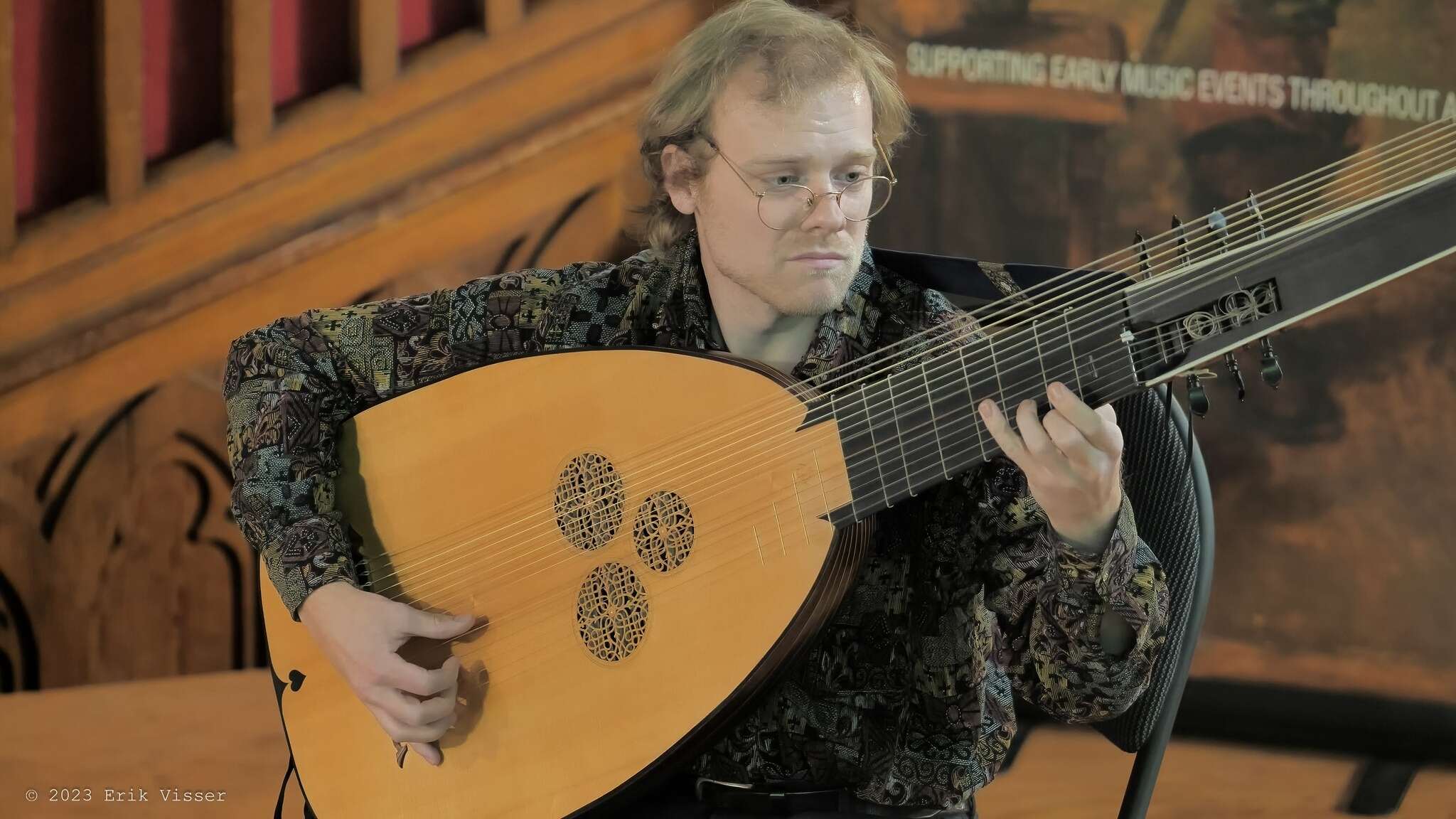
Jonathan Stuchbery (photo: Erik Visser)
BB: Talk a bit about your background training, and how you got here.
Jonathan Stuchbery: As I referred to in an earlier question, I really started to love learning music in earnest while singing in a children’s choir. A couple years later I started guitar lessons, and eventually found myself taking classical guitar lessons after some years focused on the electric guitar. Hearing the sound of classical guitar totally shifted my trajectory in music. I was completely enthralled by the sound and the wonder of hearing so many different voices coming out with such clarity on just one instrument. Though I did keep up my electric guitar playing with rock, metal and jazz bands throughout high-school, and I credit a lot of my creativity and drive to make things happen to the songwriting, socializing, and gig-seeking focus of those groups. I ended up doing a Bachelor’s degree at the Schulich School of Music at McGill in classical guitar, which is where I discovered lute playing, and the early music world. Though the guitar program at the university did not have much focus on chamber music, I was always eager to play with others and sought out as many opportunities to do that as I could. I had a trio with my brother on flute, and my (then soon-to-be) sister-in-law on violin, and we sought out every small concert series we could find to perform together, and ended up organizing a couple summer tours, including the recording of an album entirely made of music commissioned and written for us (Amalgam). This enthusiasm to make chamber music drew me to sign up for a basso continuo class part-way through my undergraduate, and through that course was introduced to Sylvain Bergeron, who teaches lute at McGill, and through him historical lutes and guitars. Suddenly it felt like I was playing with everyone all the time. Singers, instrumentalists, orchestras, you name it! After McGill I moved to Toronto for a year before starting a master’s in early music performance in Barcelona at the Escola Superior de Musica de Catalunya. That year in Toronto taught me so much as I started getting my legs as a professional musician. I learned a lot from meeting and playing with older musicians who I’m now honoured to call colleagues, and I started taking on more paid work as a choral singer in church choirs in the city. The following year in Barcelona honed my research and specialized training in this field, and introduced me to another amazing community of musical colleagues and mentors.
BB: Who is Dowland and why does he matter?
Jonathan Stuchbery: John Dowland was an English lutenist and composer born in the early years of Queen Elizabeth’s reign whose instrumental and vocal music became extremely popular throughout Europe during his lifetime and which is perhaps some of the best loved and well known music from the period in today’s musical world. While he was alive, he was the #1 bestselling composer of secular songs, and still today musicians, from world class lutenists to popular artists like Sting, record and perform his music.
Despite his popularity, Dowland’s ambitions were not always realized, and his life is a fascinating story of journeys through continental Europe, of meaningful, widespread, and powerful friendships, and near misses of being entangled in political schemes. Wherever he went he seems to have impressed with his skill on the lute and as a composer, earning generous patronages in Germany, employment from the King of Denmark, and even papal support in Rome in the form of and offer of “a large pension of the pope” (which very nearly got him in grave trouble back home in England). He left a legacy in the form of his substantial contribution to the solo lute repertoire, music for viol consort, and his beloved books of ayres. His lute music has also become standard repertoire for classical guitarists and even inspired later compositions like Benjamin Britten’s immense ‘Nocturnal’.
The richness of the poetry that Dowland chose for his songs gives us a wonderful snapshot of English literature of the time, and his frequent emphasis on intense melancholy and dramatic darkness in songs like ‘In Darkness let me dwell’ and ‘Flow my teares’ remains captivating to listeners today.
BB: What will you play at the upcoming concert.
Jonathan Stuchbery: In Diapente’s ‘Time’s Eldest Son’ concert we have selected music that helps tell the story of Dowland’s life, that demonstrates the breadth of his compositional versatility and his influence in the wider musical world.
Diapente Renaissance Vocal Quintet: L-R: Alexander Cappellazzo-Tenor, Peter Koniers–Countertenor, Jane Fingler–Soprano, Martin Gomes-Bass; foreground: Jonathan Stuchbery–Tenor & Lute
You will hear songs from the three books of songs and from ‘A Pilgrim’s Solace’ including some all time favourites like ‘Can she excuse’ and ‘Now, O now I needs must part’, alongside lesser known works like his dramatically chromatic ‘Thou mightie God’ and ‘It was a time when silly bees could speak’. The nature of how Dowland published his songs allows for many arrangements of performers, which lets us present a real variety show, from solo songs with lute, duets, lute solos, a cappella singing, and five voices with lute and viola da gamba.
This concert will show off the versatility of each individual member of Diapente, and our guest viol player Felix Déak.
Baroque cellist and gambist Felix Deak
Also included in the program are pieces by Dowland’s contemporaries, people who inspired him, and who imitated him, including Luca Marenzio, Charles Tessier, Thomas Morley, and Thomas Tomkins.
BB: How does your ensemble approach such texts?
Jonathan Stuchbery: Diapente wants to bring the art of the renaissance to life for modern day audiences, so we care about understanding and performing the music using what we have learned about the practices of these musicians who lived 400+ years ago.
Diapente Renaissance Vocal Quintet
In practice that means many things, from how we use our voices, to how the words are pronounced to bring life to the poetry, to what instruments we choose to use. Our favourite programs also tell a story, and selecting pieces that draw you into the musical world of the past, we hope, will transport you to another time.
BB: What was your first encounter with Dowland?
Jonathan Stuchbery: The first Dowland piece I encountered was a transcription for guitar of his Alman ‘My Lady Hunsdon’s Puffe’ which I learned for a regional music festival when I was 15. I loved it and asked my guitar teacher if we could work on more renaissance music. That same year we worked on one of Dowland’s Fantasias together.
BB: Do you ever feel conflicted, reconciling the business side and the art?
Jonathan Stuchbery: I often do. It’s a reality that to be able to spend as much time as needed to create the programs, learn the music, write the pieces, and rehearse, I need a steady income from doing it. But I became an artist to share with others, and I don’t think anyone is less deserving of receiving it than others. Business to me sometimes feels like taking, and art as giving, so there’s conflict in that.
BB: What if anything can classical music learn from the way popular musicians play & market their music?
Jonathan Stuchbery: Be yourself! I love artists in other popular genres through how they express their personality in performance and their media. Sometimes we as classical musicians hide behind the formality of recital traditions, but I think it is so much easier to connect and build an audience when your fans get a sense of your personality, it builds community.
BB: Since the pandemic a great many artists are working virtually, both as teachers and as performers. Do you have a preference between live or recorded performance and when you record how do you make it seem live?
Jonathan Stuchbery: I did a fair amount online over the pandemic years, teaching and performing, but have done less more recently. Interacting with others in person is more of an exchange of energy to me, whether it’s rehearsing, teaching, performing, the people I share the room with animate the space in a way that is hard to sense in a virtual setting. That lack of being energized makes it hard for me to be motivated to do things online, and I’ve certainly distanced myself from it intentionally. I would find myself in situations of recording solo recitals alone, or laying down instrumental tracks for asynchronous recordings where I just had to give attention and effort constantly, and it could be exhausting!
BB: If you could tell the institutions how to train future artists, what would you change?
Jonathan Stuchbery: I had very different experiences between my undergraduate studies and masters, which to a certain extent should be expected, and perhaps also the differing cultural expectations between a Canadian music conservatory and a Spanish institution contributed to this as well. My versatility as a performer today, being able to play in ensemble contexts on many different instruments, from duos, and smaller chamber groups, to orchestras come from accumulated experience of working with others. You need to learn your notes, and hone your technique, absolutely, but you also need to know how to rehearse, and to learn to inhabit the social scenario of working in a group. This was really not emphasized as a student in classical guitar, where the program didn’t make it easy to explore ensemble playing. Special permission was required to form a chamber group if you wanted credit and coaching, and this doesn’t even touch on my practice as a vocalist. In ‘Time’s Eldest Son’ you’ll be hearing me singing, playing, and doing both at the same time, something I was never allowed to do as an undergrad. What I experienced with my teacher as a master’s student was quite different. First of all, private classes (which were extremely demanding) were attended by the whole studio, and worked on solo repertoire, but also spent time learning techniques for ensemble playing, *and* learning how to sing improvised counterpoint (no requirements to sound good!). I think this holistic approach was so helpful in encouraging students’ creativity, curiosity, and core musical skills that would serve them in what is really an extremely multifaceted career path. I certainly learned a lot from my teachers throughout all of my studies, but the grounding I had growing up singing in choirs at church and with a teacher in high school who played guitar duets with me provided me the essential groundwork to do what I do today. So institutions, don’t silo your students! Provide them with rigorous training, yes, but the artificial homogeneity of any given program doesn’t necessarily benefit young musicians trying to figure out how to make a career out of their music after school.
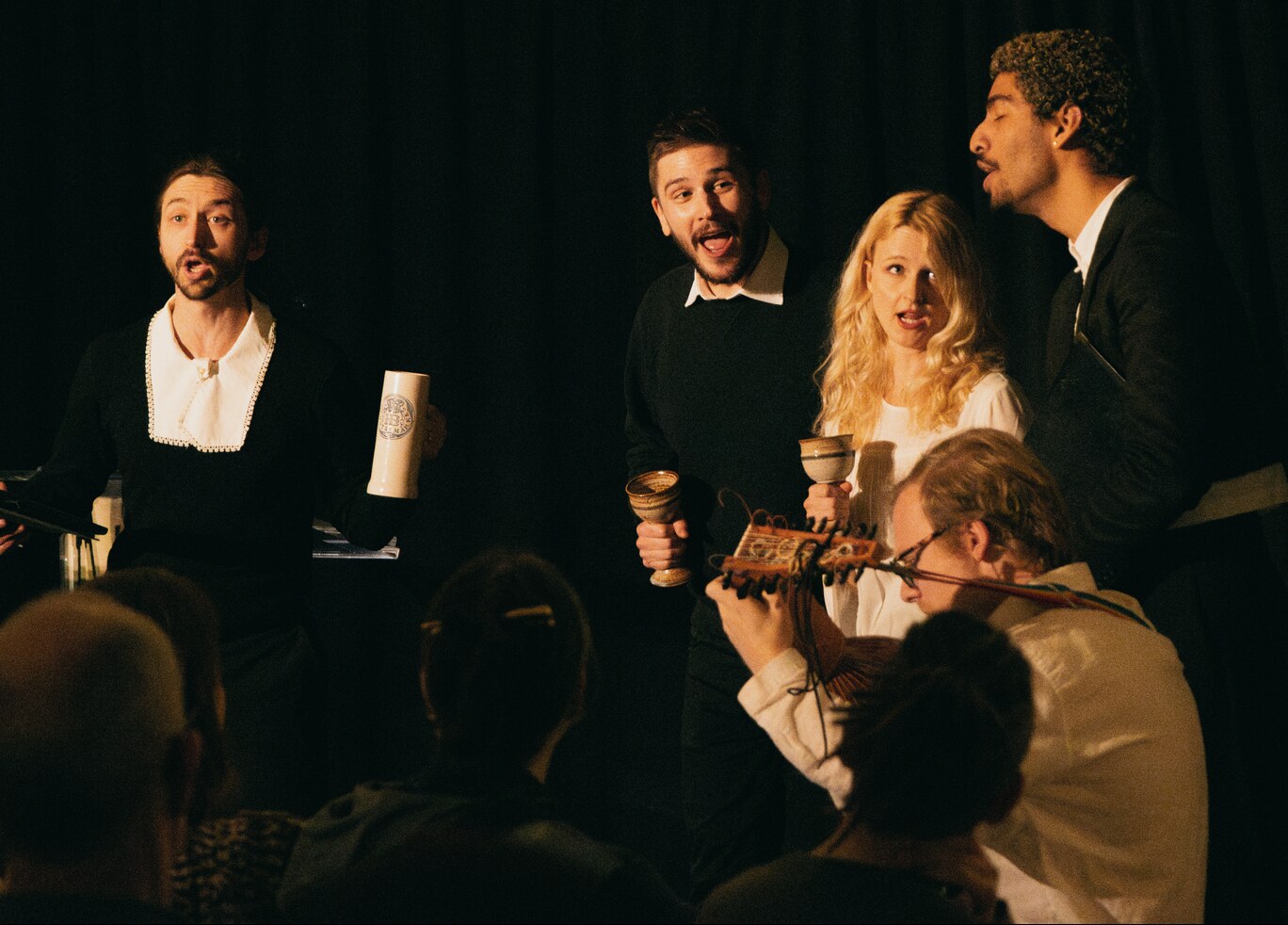
L-R Peter Koniers–Countertenor, Jonathan Stuchbery–Tenor & Lute, Jane Fingler–Soprano, Alexander Cappellazzo-Tenor, Martin Gomes-Bass
BB: What influences / teachers were most influential on your development?
Jonathan Stuchbery: I have had so many amazing mentors throughout my life. I owe so much to my first classical guitar teacher Selwyn Redivo, who not only introduced me to the instrument that really jumpstarted my musical journey, but also inspired in me so much love for the repertoire, for composing, and for playing with others. Jérôme Ducharme was my private teacher during my undergrad, and my playing developed enormously under his guidance. I also learned so much singing with the choir of Christ Church Cathedral in Montréal with Patrick Wedd. Only a few months after I moved to Montréal as an 18 year old, I approached him about singing in the choir, to which he said ‘We have a concert next week, why don’t you come for the dress rehearsal’. He was generous in offering opportunities to participate with the choir and to perform my guitar music, and I learned so much amazing repertoire in the years I sang there.
Sylvain Bergeron (photo by Didier Bertrand)
The list is long, but a few others who have been strong influences and have supported me in my career include lutenists Sylvain Bergeron, Lucas Harris, and Xavier Díaz-Latorre, and harpsichordist and head of the early music department at McGill while I was there, Hank Knox.
*******
Time’s Eldest Son will commemorate the 400th Anniversary of Dowland’s passing, a concert to be presented by Diapente Renaissance Vocal Quintet and guests artists Saturday, February 28, 7:00pm at Heliconian Hall, 35 Hazelton Ave. For tickets click here.
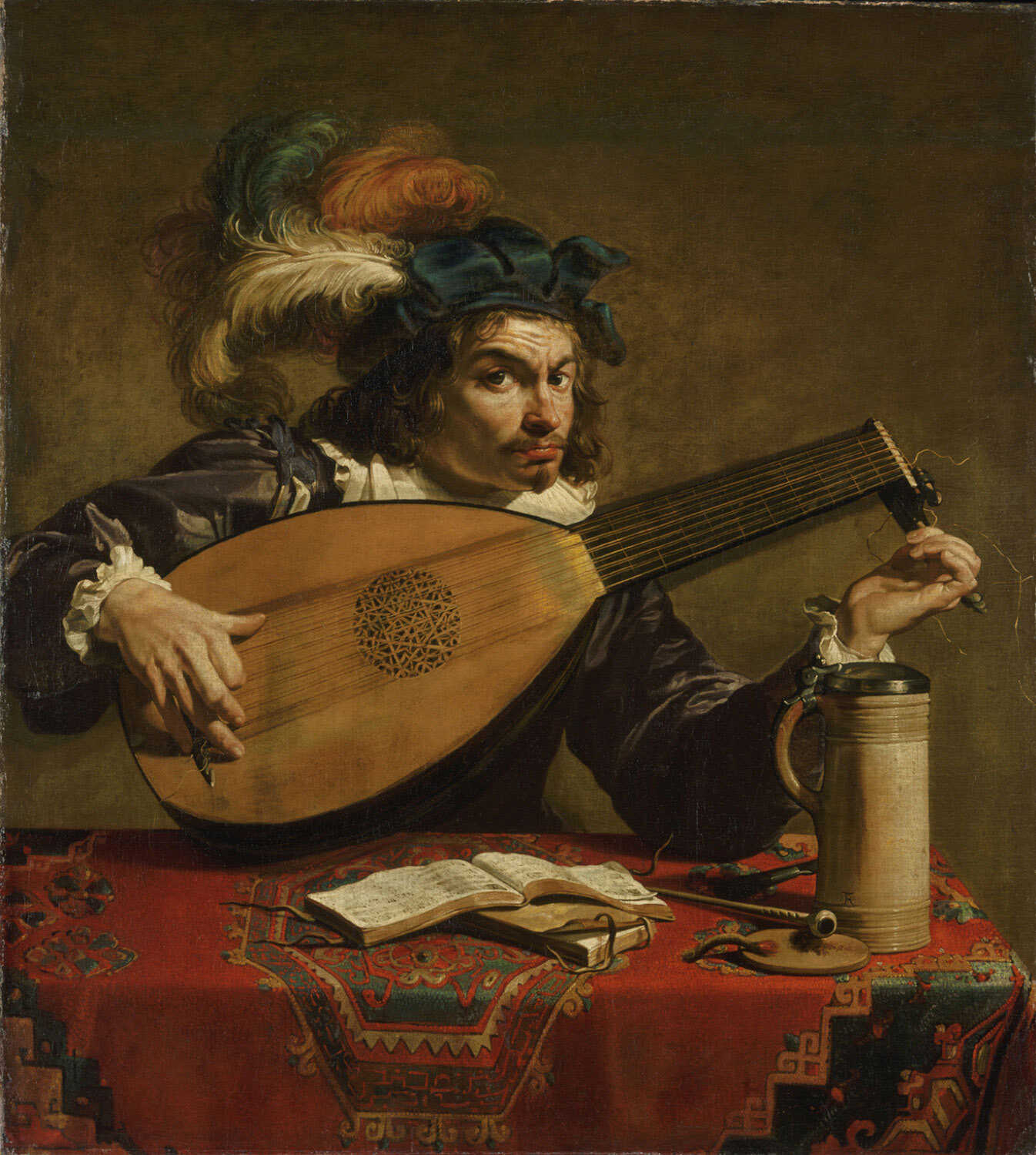
Joueur du luth, by Flemish painter Theodoor Rombouts
At first glance the two operas being presented by the Canadian Opera Company represent a contrasting pair. Last week I reviewed the dark Christopher Alden Rigoletto, being offered in a revival with a strong cast. Tonight I saw the COC’s revival of the flamboyant Els Comediants take on Barber of Seville, directed by Joan Font, with set & costumes designed by Joan Guillén staged previously by the COC in 2020 and 2015, a co-production with Houston Grand Opera, Opéra National de Bordeaux and Opera Australia.
As with Rigoletto I got lost in the beautiful music, the melodies, and unlike the Verdi opera we also had the benefit of a happy ending.
The COC’s Barber is a triumphant musical performance led by conductor Daniela Candillari at a breath-taking tempo.
The Barber cast in one of the numbers where they resemble automatons (photo : Michael Cooper)
The energetic pace is especially helpful in the numbers where the ensembles reduce the humans to automatons, robotic mechanical behaviours that are hysterically funny, especially if the conductor can keep the singers together while speeding along so briskly: as she did repeatedly.
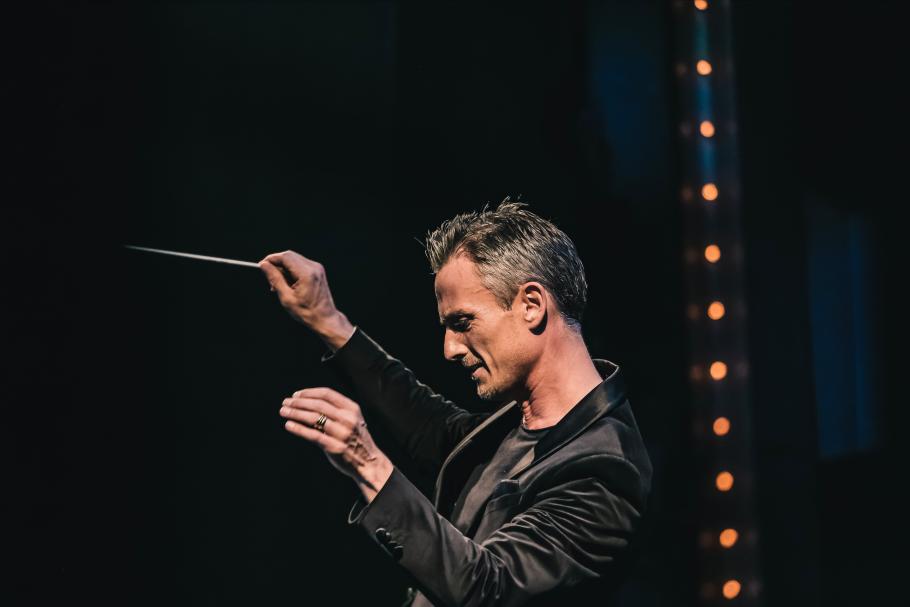
Conductor Daniela Candillari
We were treated to stylish bel canto singing.
Rosina (Deepa Johnny) meeting a disguised Count Almaviva (Dave Monaco; photo: Michael Cooper)
Deepa Johnny as Rosina was thoroughly compelling as the beautiful object of romantic pursuit by the men in the story and wonderful in her coloratura throughout.
Tenor Dave Monaco made Count Almaviva more purely fun than what was seen in the two previous versions (in 2020 and 2015), playing up the physical comedy particularly after intermission, maybe because his solid technique and effortless high notes permitted him to surrender to the situations. His was a genuine bel canto, seemingly fearless because he knew he could sing the role so well, complete with at least one ringing high C in each act.
Figaro (Luke Sutliff; photo: Michael Cooper)
Luke Sutciff was his partner in hijinks as Figaro the barber, a fuller voiced baritone than what we’d heard in the previous two productions.
Rosina (Deepa Johnny) & Dr Bartolo (Renato Girolami; photo: Michael Cooper)
Renato Girolami is back again, having been the key exponent of the buffo style in both the 2020 & 2015 productions here in Toronto with the COC, still funny although his patter in his huge “A un dottor della mia sorte” aria (when we get to the crazy “Signorina,un’altra volta”, threatening to lock her up) is getting quieter, not as audible as before. Okay so he’s older, big deal. He’s a great exception to the usual agist trend, that has singers sidelined when they still have lots of voice left. It’s always good to have a singer who offers genuine gravitas to their portrayal.
So excuse me if I take a moment to look at the two operas offered as the COC’s winter season. Perhaps nobody noticed a troubling overlap between the two operas. Barber of Seville is a quintessential bel canto comedy of Gioachino Rossini (1792–1868), while Rigoletto is understood to be tragic, a melodramatic story from the middle period of Giuseppe Verdi (1813-1901) when he transitioned away from purely bel canto operas towards something deeper. Thanks to its placement this month alongside Rigoletto in the COC’s winter season, I see so much darkness in the comedy of the Barber, noticing that the stories are like the flip-side of one another.
The Duke of Mantua desires & pursues Gilda, who is 15 or 16 years old, presented in a brutal world where she is merely the latest in a series of conquests without any consequence for his insatiable libido.
The Count Almaviva pursues Rosina, who is marriageable age, likely late teens or early 20s (okay not quite so extreme), protected by Dr Bartolo from the men who might want to meet her, locked up inside her home for the entire opera.
The Duke pretends to be a poor student when wooing Gilda, singing a serenade as “Lindoro”. Oh no wait that’s the poor student alias taken by the Count in the Barber of Seville. The Duke pretends to be a different poor student named Gualtier Maldè. It’s not the first time I watched the Barber, wondering if Verdi was in a sense sending up Rossini’s world.
There’s a storm in the last act of each opera. In Rigoletto that signals that we are in a world of melodrama, forces beyond our control where no one has agency. The Duke gets lucky, saved by Maddalena from a possible murder. While the storm in Barber is perhaps also a reminder of forces beyond anyone’s control, the outcome is a happy one, as we’re in a comic world.
When I googled “does verdi’s rigoletto make ironic comment on barber of seville” I saw some interesting comparisons that you might want to search yourself, including reference to a Jean-Pierre Ponnelle film of Rigoletto framing the Duke as a sinister version of Count Almaviva (and now I have to find that video!). We can compare over-protective Bartolo to over-protective Rigoletto, the romantic Count to the libertine Duke (and the ploys they use as mentioned above). While it makes for a fascinating juxtaposition, I wonder if the COC were mindful in their choice of operas. I know that I was troubled through the first act of the Barber, watching a woman who is locked up, being courted by a man pretending to be poor student, using exactly the same ploy as the last sneaky fake I saw in Rigoletto. I had come to the theatre needing a laugh and was in dire need of diversion. While I have loved the Barber all my life, have played the score since I was a teen (and my brother first sang the role of Figaro in Hamilton), I’ve never felt so cynical about romantic opera plots as I did on this occasion.
And here’s the thing. As Erika remarked, how is it appropriate in a comedy we watch in 2026 for a young woman to be locked in, held prisoner, as Rosina is confined? Yes such things are always relative, that what’s funny & light-hearted in one century may become troubling in another era. It felt weird in context with Rigoletto especially the Alden production that reminds me so much of the Epstein saga unfolding in the press. I suppose no one at the COC noticed the overlap, programming these two for the winter season, and maybe my grouchy mood left me out of step with the enjoyment everyone else felt, watching this brilliant show.
I will shut up with the endless questions. Yes I was eventually seduced by Rossini in the last hour, especially the exemplary presentation of the musical side of the equation and a phenomenal reading by the COC Orchestra under Daniela Candillari. Thank goodness.
If Rossini wasn’t one of the Fathers of Confederation, maybe he should have been. SPOILER ALERT this is a photo of the fake bills dropped on the audience at the end of the opera.
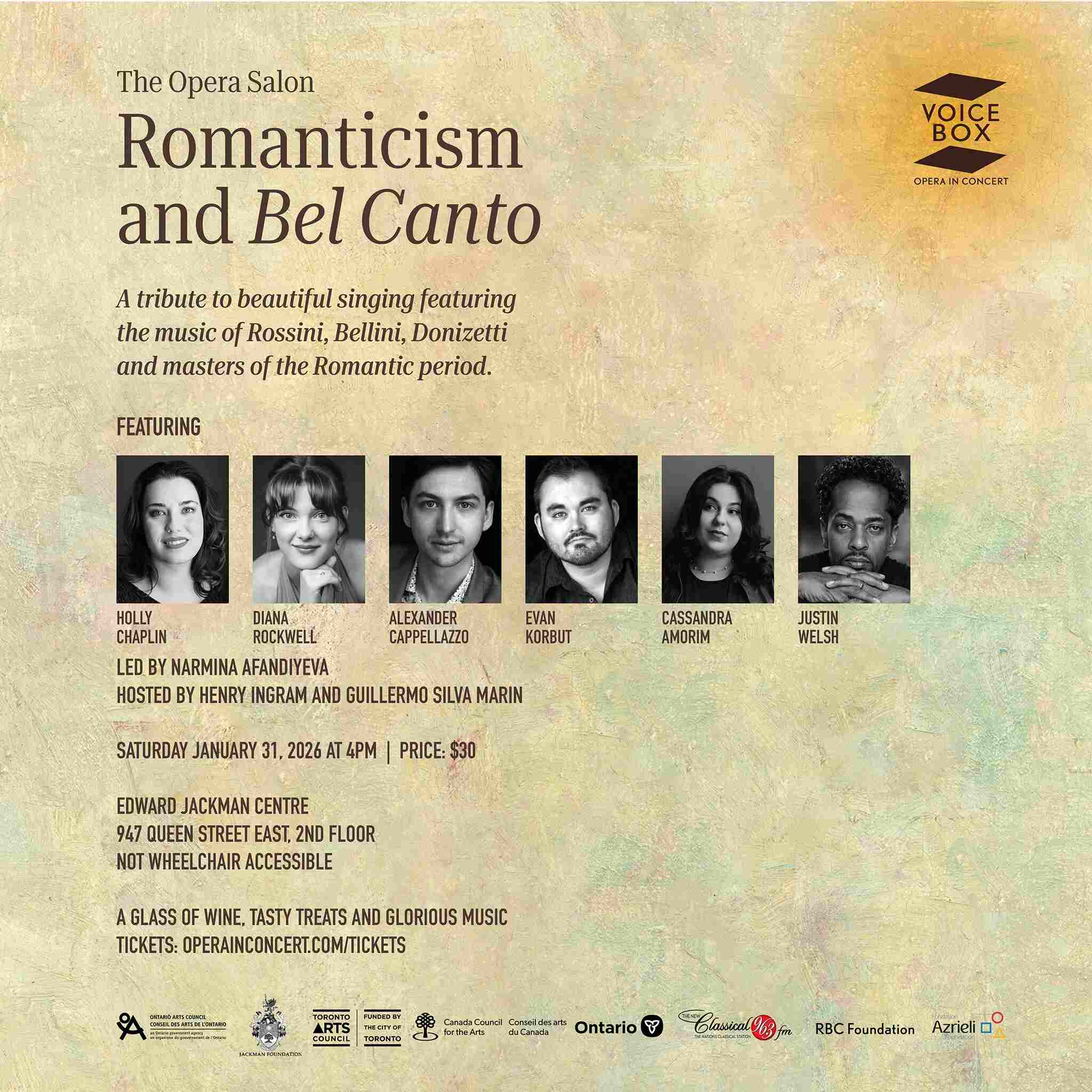
Today I attended a Voicebox: Opera in Concert Opera Salon, highlighting Romanticism & Bel Canto.
I want to see any concert or presentation that offers us a new way to offer opera and to find an audience. We’ve seen arias in bars & restaurants, this was something a little different. And I thought it works really well.
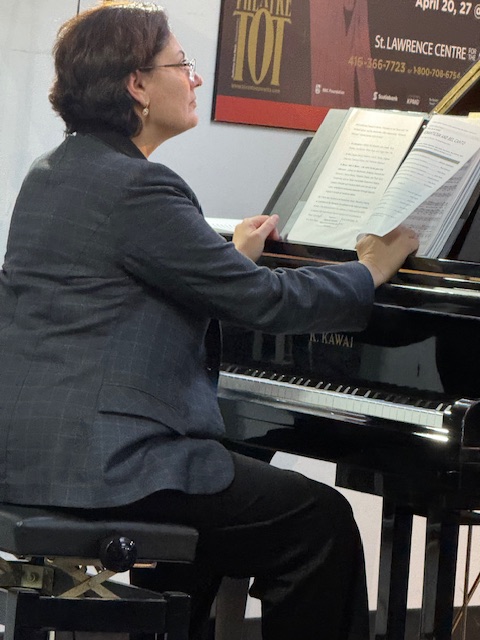
We heard solos from six artists, accompanied by Narmina Afandiyeva at the piano, organized around a unifying theme.
Narmina Afandiyeva at the piano
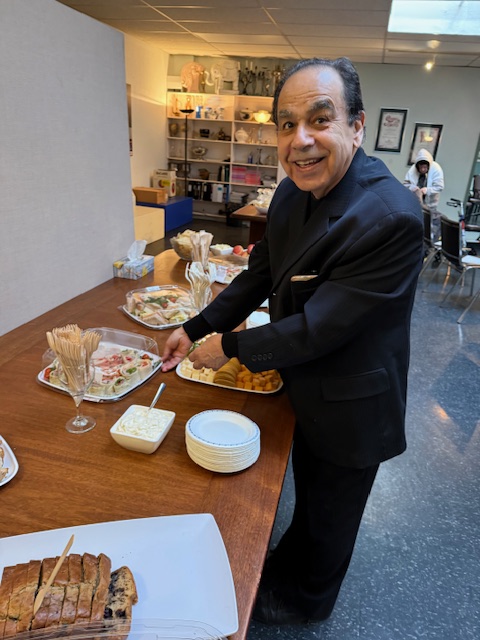
Although Henry Ingram is mentioned on that poster I shared above, he was in Puerto Rico, dodging our snow & chill (smart guy!), which meant that Guillermo Silva-Marin was our host all by himself, even arranging the delicious treats they offered to us as you see in the picture below. He was also our Master of Ceremonies, introducing the artists, telling anecdotes about artists of Opera in Concert and speaking about the history of bel canto & romanticism.
Guillermo Silva-Marin
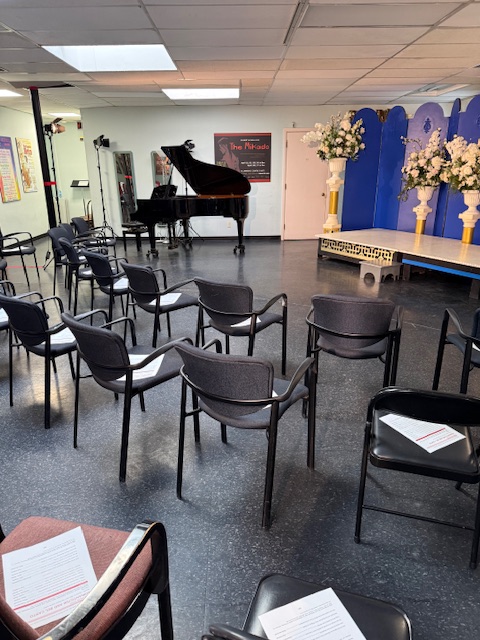
This was my first time seeing the space, an intimate venue on Queen St East near Carlaw Ave. On this occasion I think there was seating for perhaps fifty people (although I didn’t count).
The performance space for the Opera Salon at the Edward Jackman Centre
I think it has been used as a rehearsal space, but it was more than adequate for our purposes.
Here’s a list of the artists and what they sang:
Alexander Cappellazzo: “When other lips” from The Bohemian Girl and “Una furtiva lagrima” from L’elisir d’amore
Diana Rockwell: “Adieu notre petite table from Manon and “Ah non credea mirarti” from La Sonnambula
Holly Chaplin: “Regnava nel silenzio” from Lucia di Lammermoor and “Caro nome” from Rigoletto
Justin Welsh: “Cruda funesta smania from Lucia di Lammermoor and “Ah per sempre io ti perdei” from I Puritani
Cassandra Amorim: “Eccomi… O quante volte” from “I Capuleti e i Montecchi” and “Casta Diva” from Norma
Evan Korbut: “Pierrot’s Tanzlied” from Die tote Stadt and Bertrand’s aria from Robert le Diable
And to end, both before intermission and again at the end of the concert we heard “Libiamo, ne’ lieti calici” from La Traviata, sung by the entire company.
I think it’s a really good concept. I find the chance to hear an operatic voice up close a powerful experience that I highly recommend to anyone who hasn’t tried it. This isn’t to be confused with hearing opera in a big place like the Four Seasons Centre, where you’re sharing sound with roughly 2000 people, admittedly a superb acoustic considering that we get sets & orchestra. But when Holly or Diana or Cassandra hit their high notes or tossed off their coloratura, it was a fabulous intimate sound. Evan softly crooned the high note in the Korngold as though we were in a cabaret, a lovely effect. Justin gave us big notes, Alexander swooped up high to end his aria. I hope the experience helps persuade more people to investigate operas.
And we had great things to eat and the chance to drink wine (which i didn’t do, given that I live in Scarborough and had to drive home). The fact that the venue is east is something I really love, given that so many of our Toronto performance venues are west of Yonge St.
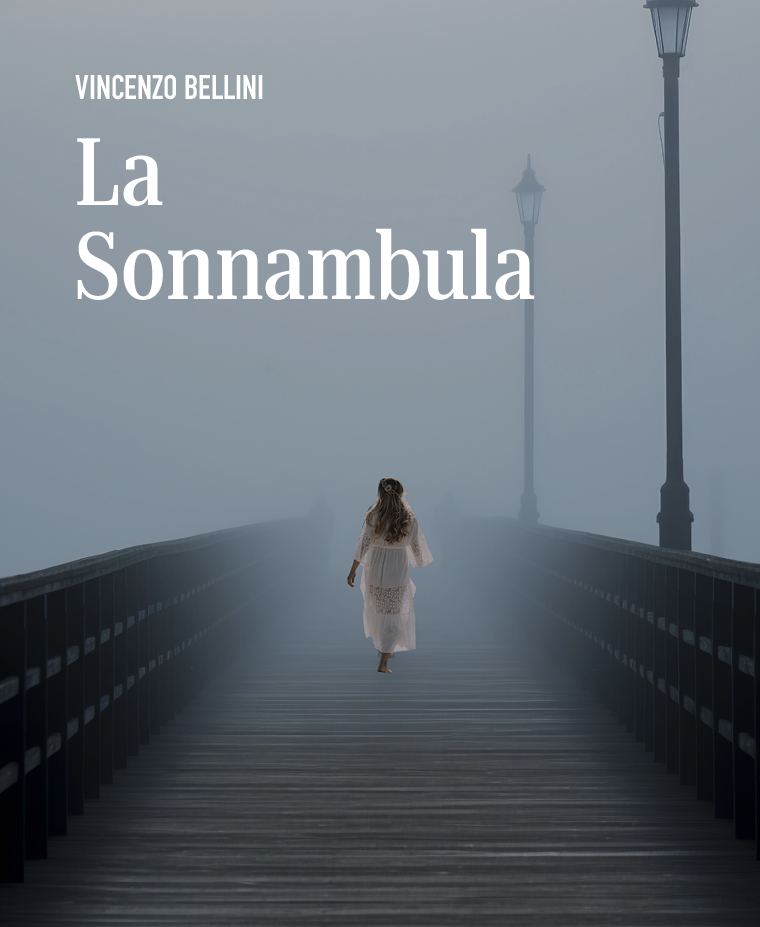
Voicebox – Opera in Concert return two weeks from today with Bellini’s La Sonnambula at Trinity-St Paul’s Centre, February 14th at 3 pm.
I saw & heard an astonishing concert last night at Jeanne Lamon Hall from Tafelmusik playing a program of well-known music by Johann Sebastian Bach. I heard four of the six Brandenburg concertos and a version of his majestic E-flat Fugue for organ, arranged for chamber orchestra.
The fame of the Brandenburg Concertos by Johann Sebastian Bach reaches far beyond Earth, when we recall that Bach was chosen to represent humankind on the Voyager space mission, now having reached interstellar space beyond the Solar System.
But this did not sound like the music performed in the 1970s when Carl Sagan & his committee gave JS the nod to be on famous golden record made for the hypothetical space aliens, who somehow would have to figure out how to play the record back. Tafelmusik aim to make something closer to how Bach might have expected his music to sound, both as far as the period instruments they’re playing and the way they are played and tuned.
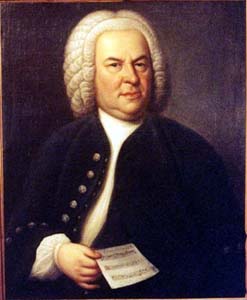
JS Bach
For Thursday January 29th we had far more down to Earth concerns than inter-planetary travel, after the snow that hit the city last weekend, yet the place was full, and buzzing with excitement.
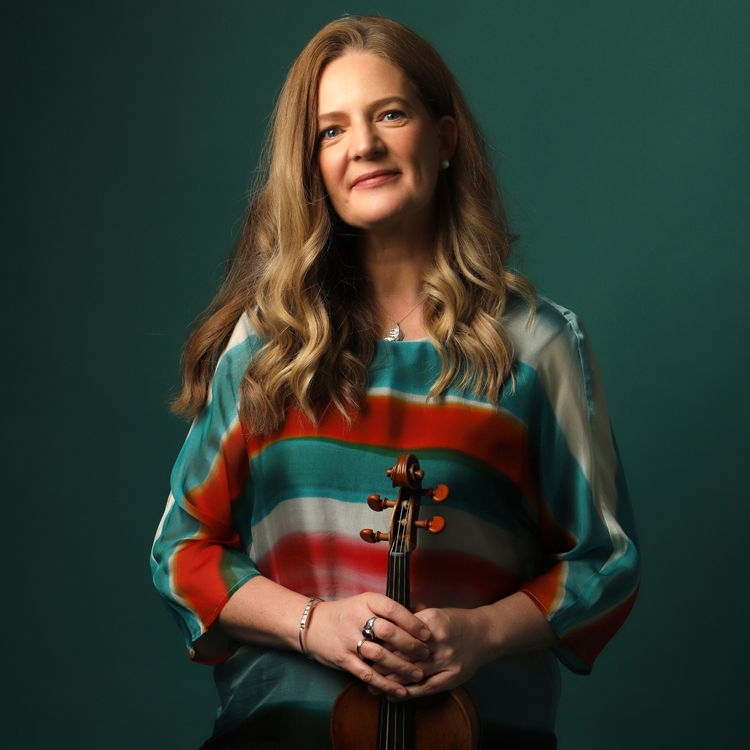
As Rachel Podger, Tafelmusik’s Principal Guest Director explained, the Brandenburg Concertos combine multiple & rare combinations of instruments with thrilling results.
Rachel Podger
The 1st Concerto included Rachel’s virtuoso performance on a 17th century piccolo violin, tuned a minor third higher and smaller than the usual size. It has a sweeter sound, even as I mused over the challenge of fingering on a smaller instrument (my fingers are humongous), and playing the piece faster than I have ever heard it played: in pursuit of the authentic style. I’m reminded of the violin my grand-daughter played on, with her tiny fingers: except this was adult music making!
Among the players for this concerto we heard a pair of horns played by Todd Williams & Micajah Sturgess, their hunting calls in arresting triplets that suggested adventure & fun, not least because the rest of the orchestra kept glancing their way, smiling. I suppose in its time the hunt meant fun and plentiful game on the dinner-table, so I suspect JS Bach meant to make this sound like party-time, but baroque.
The outcome is so much more fun than this language might suggest, the back and forth between voices transparent not just in sound but in the eye contact between sections in Trinity St Paul’s.
The next item on the program was the reason I came, namely the transcription of the great organ Prelude & Fugue by Dominic Teresi, one of the Tafelmusik Artistic Co-Directors.
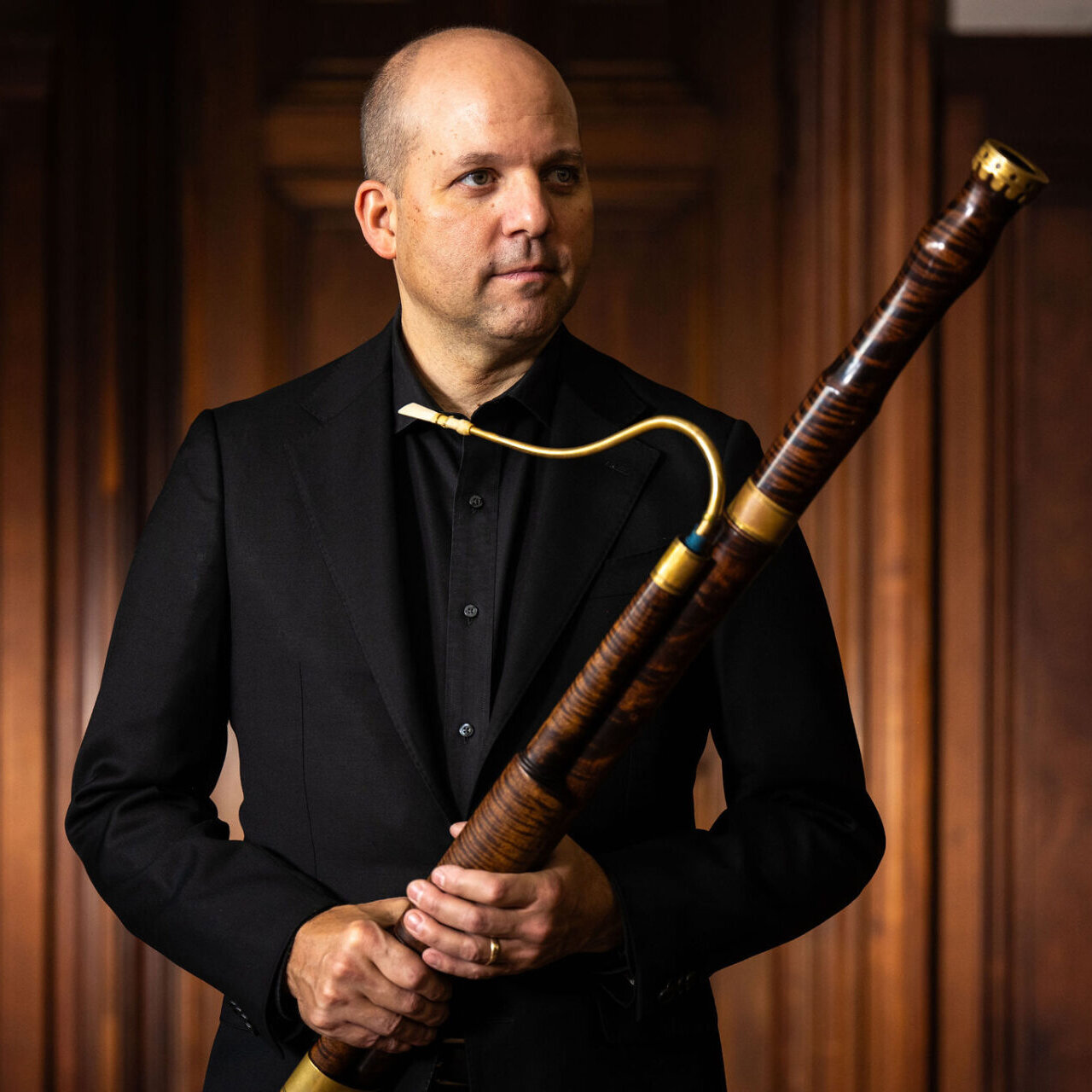
Bassoonist Dominic Teresi
I have been listening to this piece since childhood, when I stumbled upon a recording played by Helmut Walcha, from the 1970s or earlier.
More recently I discovered Busoni’s piano transcription in an anthology. So in a way it’s personal to hear Dominic’s version. There have been earlier attempts at this, for instance one by Schoenberg that is as obsolete and dated in its assumptions about Bach as the Voyager Bach that went to outer space, full of drama but turning Bach into a Wagnerian.
I wonder if Bach would even recognize himself. In fairness, we all must work with what we have and know, and for Schoenberg in his time, that was the large orchestra, using every modern instrument. If we did it now we might use synthesizers and computer technology.
But let me get back to the church space where we heard Dominic’s creation played by a small group of instrumentalists. As Rachel explained, Bach sometimes would employ a kind of musical symbolism for the Holy Trinity, apt for a performance at Trinity St Paul’s Centre with the visual reminders before us of a church organ and Christianity.
We heard Dominic’s creation programmed among the Tafelmusik Brandenburg’s, sounding every bit as authentic. I think a great deal about transcriptions, understanding them as aspirational, embodying ambition. I remember once discussing them with Professor Carl Morey, when he asked me why would anyone want to transcribe something? I think in some ways it’s a fundamental impulse. We may tap our toes listening to music (as I wanted to throughout this rhythmic concert). I remember as a child conducting the record player when I heard Beethoven. We imitate and dance along with music, and may wish to sing or play songs we have heard, to make them our own. As we grow up we learn inhibitions and lose our wilder impulses.
When Ravel made Mussorgskii’s piano piece Pictures at an Exhibition into an orchestral suite he was sharing something of the original in a new shape. There is something similar at work when Stokowski or Schoenberg take a keyboard work and turn it into an orchestral work: except that they must use the idiom and the stylistic language of their own time. I am enraptured having experienced Dominic’s version of an organ piece, recast in a manner that I feel certain would be recognizable and even applauded by Bach himself.
That was just the music we heard before intermission, namely Brandenburg #1 and the new version of Bach’s Prelude & Fugue arranged for chamber orchestra. I was already thrilled, with a great deal more brilliance to come.
After intermission we heard three more concertos in order, namely #2, #3 and #4, each with its own different assortment of musicians.
For #2, the first after intermission we had a smaller ensemble arranged across the stage, bringing us Tafelmusik’s take on the concerto that was sent out into space. I was especially stunned by the detailed horn playing from Todd Williams, given a level precision I associate with valves, rather than his older instrument, alongside brilliant play from Kathryn Montoya on recorder, Daniel Ramirez Escudero, oboe as well as Julia Wedman, Tafelmusik violinist stepping into the foreground.
For #3 it was strings strung across the stage, three trios plus the harpsichord-bass in support, with Johanna Novom, Genevieve Gilardeau & Rachel in the violin trio stage right (our left), Brandon Chiu, Patrick Jordan & Christopher Verrette, viola centre stage, and Keiran Campbell, Michael Unterman & Margaret Gay, cellos stage left. The opening allegro was as visual as was auditory, watching voices and fragments played and then answered in another trio-group. The slow movement consisted of an Adagio ad libitum like a cadenza serving as a brief intermezzo, before they launched into the stunning Allegro, some of the fastest playing of the night, everyone working their fingers off: but in a joyous celebratory movement infused with the spirit of the dance.
Finally we came to the cutest music of the night. Can I say that? I find the opening of #4 adorable like kittens and chipmunks frolicking, the pair of recorders played by Kathryn Montoya and the hard-working Dominic Teresi, perhaps wanting to show us that he didn’t mind venturing up into the treble clef for a change (after his huge role in the Prelude and Fugue, not just as arranger but his bassoon singing with a low voice). The two recorders seem to live a third apart, calm and peaceful, going back and forth with Rachel Podger’s quicksilver violin soothing or provoking between them. In the presto finale it’s a terrific release, a lovely conclusion to a superb evening of Bach.
Bach Brandenburgs will be repeated January 30 & 31 at 8:00 pm and February 1st at 3:00, in Jeanne Lamon Hall in the Trinity – St Paul’s Centre.
I can’t stop thinking about Mandle Cheung, the successful tech entrepreneur who paid the Toronto Symphony for the privilege of conducting Mahler’s 2nd Symphony last summer. I wrote a review of the concert for the Globe & Mail, and couldn’t stop thinking about him and his music-making.
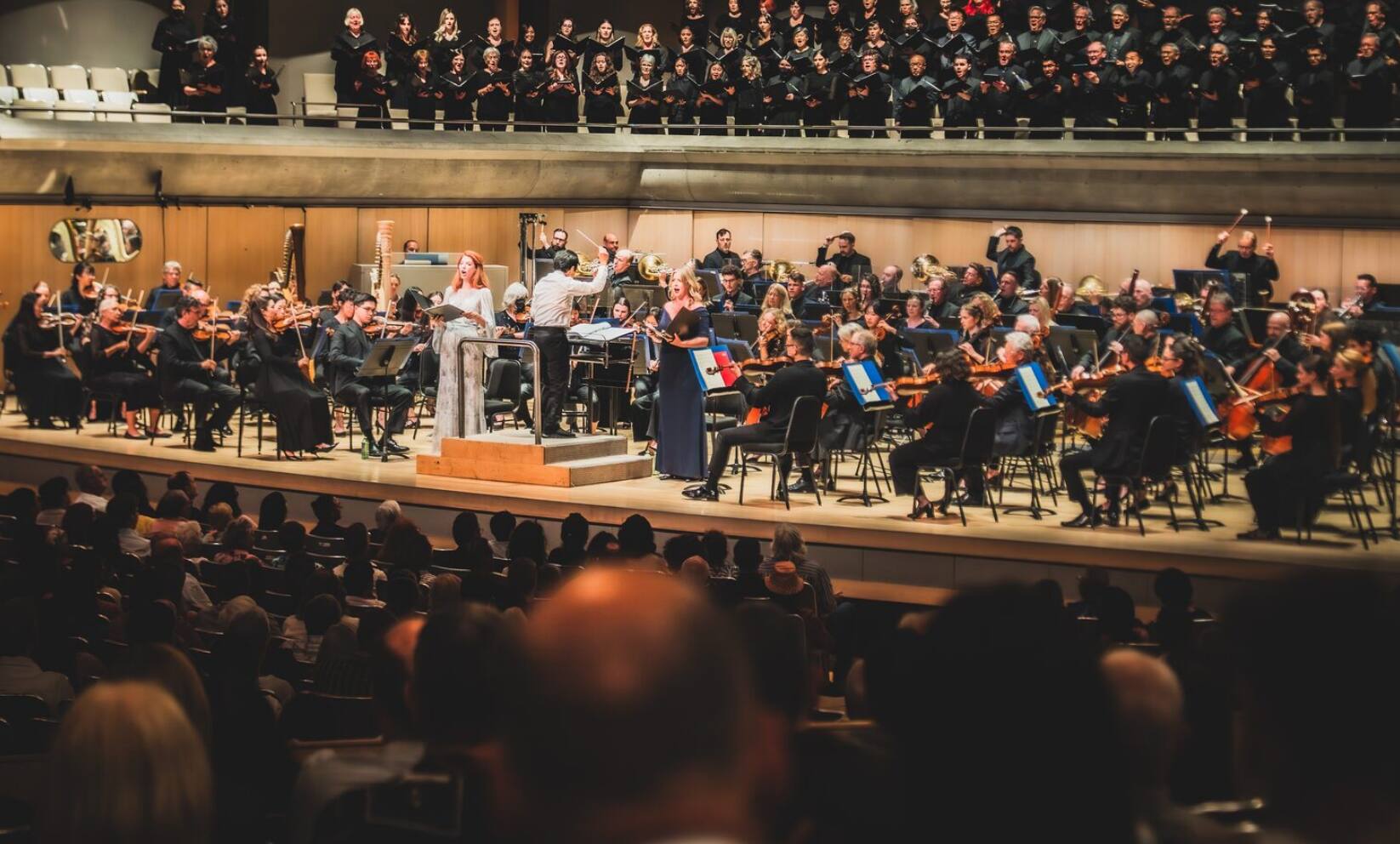
Mandle Cheung conducting the Toronto Symphony, Amadeus Choir and soloists Mireille Lebel & Kirsten LeBlanc (photo: Allan Cabral)
In my review I described my emotional response, although I didn’t tell the full story. In the article I said this while quoting the text from Urlicht, the song that’s the 4th movement of Mahler’s 2nd: “I was moved by parallels between the composer and the conductor during the concert, especially in the fourth movement when Mahler used one of the songs he had written based on Des Knaben Wunderhorn (The Youth’s Magic Horn): Da kam ein Engelein und wollt’ mich abweisen. (An angel came and sought to turn me back) Ach nein, ich ließ mich nicht abweisen! (Ah no! I refused to be turned away) Both Cheung and Mahler may have asked: Will they listen to me, or reject me? While the third movement is a comical burlesque about being ignored, this solemn song is a brave affirmation, in the face of the officious angel blocking the way.“
I had a previous experience with Urlicht, that song from Mahler’s 2nd that I quoted above. It was in church, where I was playing the piano accompaniment to a mezzo-soprano singing these words. She was partially disabled, and because of her physical challenges could not walk well enough to come out in front of the congregation to sing, but had to find a spot in the choir loft, further from me at the piano. When she sang about the angel barring the way I was shocked that we were in a sense blocking her path inside the church. This song is far more universal than I’d ever realized, speaking to anyone who has faced discrimination & dismissal. I saw a connection between what happened to our mezzo-soloist, Mahler and Mandle, particularly while listening to the same song being sung in that TSO concert, which is why I became so teary-eyed. Mahler is proclaiming redemption & resurrection while fighting against a racist & antisemitic establishment barring his path.
When I talked to Mandle a few days ago, he reminded me: 1) that his orchestra has had more than 16 concerts, 2) that for the June TSO concert he managed to fill Roy Thomson Hall 3) that the ovation after the Mahler was almost four minutes long.
The caption in the Globe & Mail for Allan Cabral’s photo said “The Toronto Symphony Orchestra performs Gustav Mahler’s Symphony No. 2 in C Minor, led by amateur conductor Mandle Cheung”.
Amateur? I wonder what the word even means. How many concerts will be enough? when — if ever– will Mandle get to call himself a “professional conductor”? I wonder is Mandle holding up a mirror to classical music?
At least there’s the original sense of “amateur” as the one who loves what they’re doing, and that’s certain with Mandle.
But there are so many questions one could ask. What does any conductor actually do? We see the performance, not the rehearsal, so there’s already a mystery. And the conductor stands before an orchestra waving their arms, sometimes holding a baton: and music erupts from the orchestra standing before them. When we get a ticket to go to a concert we’ve made a series of assumptions, that may or may not lead to pleasure & music in the performances we attend. If we blindly trust that the conductor must be good, we may have a better experience than if we show up with a series of stipulations & requirements.
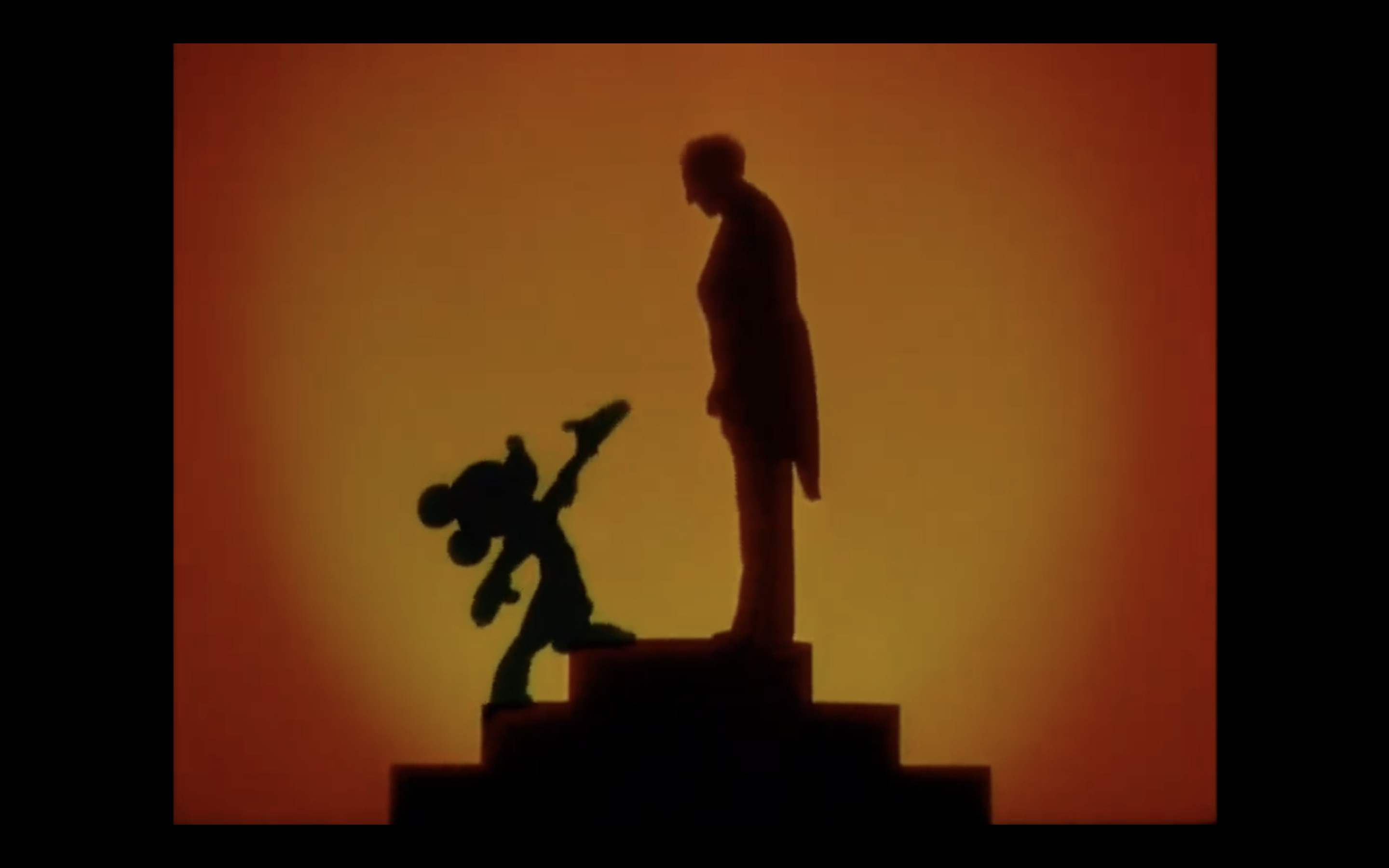
In effect a conductor performs magic. They wave their arms and for some reason a bunch of other people make music. That magic may have reached its peak with Disney’s Fantasia in 1940, aided by the great Leopold Stokowski.
Mickey Mouse thanking Leopold.
And then there’s Long-Haired Hare, released in 1949. Stokowski is the great “Leopold”. It’s not that they mock the conductor but the way he is idolized. I share this excerpt of the later cartoon to suggest some of the blind faith that goes into the music-making and listening. I believe this little sample of Bugs Bunny shows the way people may idolize a maestro.
You see the disconnect, the gap between the way this cartoon conductor is perceived and logic. Whether it is Bugs Bunny or Leopold Stokowski or any conductor waving their baton or their arms (or in Bugs Bunny’s case, waving his paws), they wave: and the music miraculously is heard. Notice that the cartoon goes for the extreme impossibility that is implicit to the newcomer, who may think that the conductor is somehow making the orchestra play this or that, their gestures steering the music to higher or lower notes, their powerful gestures controlling duration and intensity, when of course that’s something that must be established in rehearsals (if at all).
Let’s come back to Mandle Cheung, the tech entrepreneur who conducts an orchestra because it’s fun. In the weeks after that Mahler concert, I listened & then blogged about some of Mandle’s YouTube recordings with his Mandle Philharmonic, the ensemble he has assembled. You can see and hear them play on YouTube if you can’t make it to a live concert.
That word “maestro” that is used to identify a conductor is part of the dynamic. But Mandle told me he does not want to be called a maestro. Yes we can say he’s a conductor, an employer of musicians & soloists & a choir, hiring a concert hall to put on concerts.
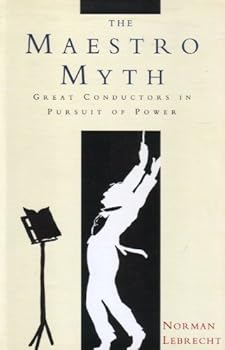
Indeed I pulled out a book I received long ago as a birthday present, indeed it was more than a decade ago (thank you Paul Babiak, great gift!), namely “The Maestro Myth” by Norman Lebrecht, a book that studies many conductors over many decades.
In the introduction he quotes Carl Flesch, who says “There is no profession which an imposter could enter more easily.” I have to wonder if this might be subtext for some of the negative responses to Mandle, who makes no false claims, who doesn’t pretend to be a Maestro. I think Flesch is touching upon a kind of tension underlying the conductor’s magic trick, the suspicion that we don’t really know how the magic is accomplished.
Lebrecht himself writes “The conductor exists because mankind demands a visible leader or, at the very least, an identifiable figurehead. His musical raison d’être is altogether secondary to that function. To the listener in the stalls, the conductor represents a dual form of escapism: the longing to lose oneself in music combined with an urge to subliamte in the actions of that all-powerful figure on the podium. The conductor is an obvious hero whose gestures are unconsciously imitated with a finger on the arm of the concert-hall seat or, back home, waving one’s arms before the bathroom mirror to the accompaniment of recorded sound. “ (Lebrecht 2-3)
Let’s talk about impulses. Children sing & dance, and at a certain point they become more socialized, they stop obeying their impulses. Perhaps that’s one of the ways we know that childhood is ending. When I was a child I used to sometimes conduct the records being played on the hi-fi. I grew up and stopped, but the fantasy didn’t die, given life by various gigs as a music director for musicals, church choirs and even a few operas while I was studying in graduate school. Mostly I sat at a keyboard but sometimes I had to conduct singers & musicians. Whenever I go to a concert and watch the performance I identify with the musicians. Do we all identify? I don’t know. But I can’t be the only one who sometimes wishes they were up in front of the orchestra conducting, enjoying the music while having vicarious feelings watching the performers.
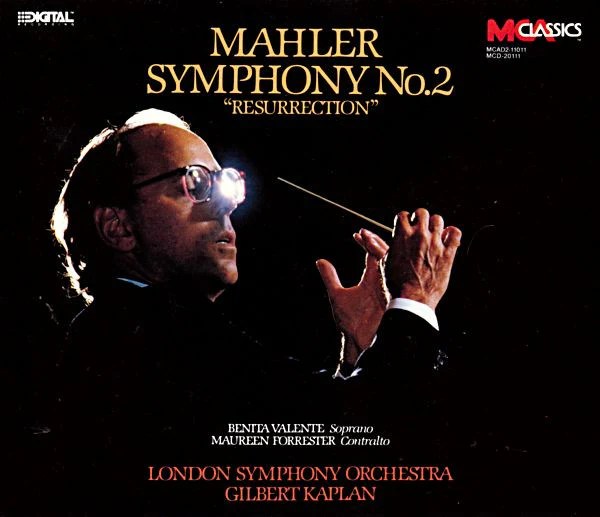
In his book Lebrecht writes about many famous conductors. He goes a long way towards unpacking Bugs Bunny’s magic trick, the trick every conductor accomplishes, when they wave the stick or their hands, and a bunch of music is heard played by other people. I wonder if maybe Lebrecht’s book needs a chapter about people like Gilbert Kaplan and Mandle Cheung. Kaplan was another wealthy conductor who hired an ensemble to play Mahler’s 2nd Symphony. I obtained the CD long ago, fascinated by the unprecedented phenomenon. Setting aside the question of the music, it was a bit of a happening, that this wealthy guy made a recording of the one piece he really knew & loved.
I would argue that the story of conductors is incomplete without the inclusion of the interlopers, the conductors who paid their way into the club, and in so doing cast doubts upon the authority of the ones who had already laid claim to leadership roles. Indeed you may question: how good are Kaplan or Mandle, are the interlopers legitimate creators of music, with the right to conduct? They certainly pay for the privilege.
Meanwhile, it’s the orchestras (as always) who play the piece, whether it’s Mahler or Mozart.
I assume Lebrecht will never bother with Kaplan or Mandle, even if I continue to be fascinated by them. So perhaps think of this interview as a kind of unauthorized appendix to a book I didn’t write, my unofficial questions like an unsanctioned addition.
Maybe the musicological questions concerning credentials are irrelevant as I point you to a quote I saw at mandlephil.com the orchestra’s webpage, that might be the key.
“Your time is limited, so don’t waste it living someone else’s life. Don’t be trapped by dogma – which is living with the results of other people’s thinking.“ Steve Jobs
As of course it was inevitable that I would eventually ask Mandle Cheung to answer some of my questions about his musical adventures. And he did answer…
*******
Barczablog:Are you more like your father or mother?
Mandle: I have to say I don’t know because I am the youngest of 17 children of my father, youngest of six of my mother. The only thing I ever done with my father I can recall is going with him, seeing a movie. And we argued about which movie to see.
BB: So this is in Hong Kong?English or Chinese?
Mandle: Hong Kong. Chinese. But I speak English in high school.
BB: How many languages do you speak?
Mandle: Oh I am terrible with languages. I speak some Chinese and some English. That’s it.
My mother is a very very sweet lady. We never had one conversation. The only recollection of her I have is she loved playing mah jong. Everybody knows what mah jong is. Little square oblong pieces…
BB: What is the best or worst thing about what you do?
Mandle: The best is building my company, from a room in a basement downtown 37 years ago, to know a hundred people, an amazing team of people, operating on their own, so I am very happy about that.
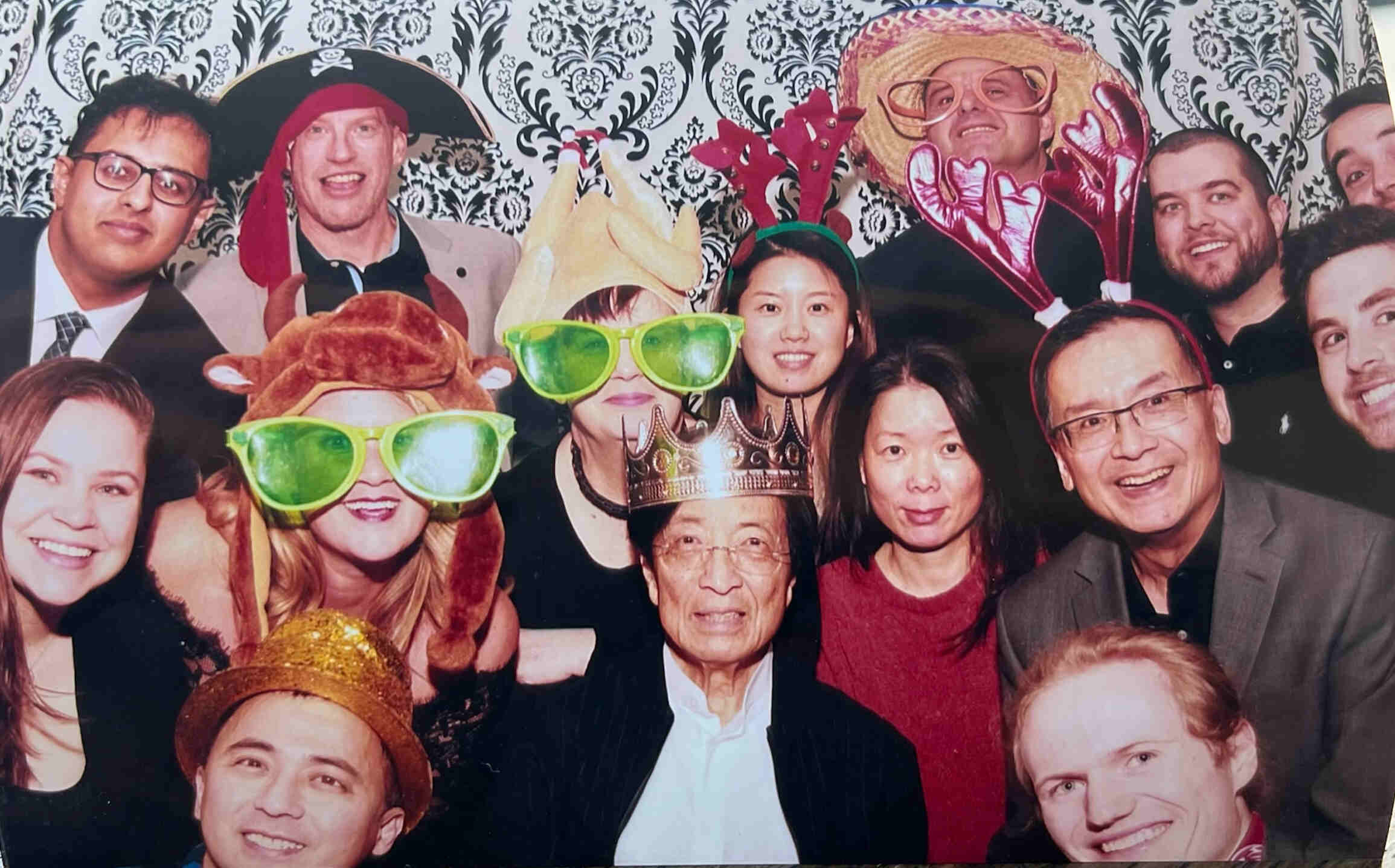
Mandle Cheung surrounded by colleagues at the company Christmas Party
BB: Is there a downside?
Mandle: Actually the one thing about our first major client, 30 years ago, three decades ago, head of the Ontario Government IT Group. The IT Group had something like 7 or 8 Chief Information Officers and one Chief Technology Officer, and he’s the chief of all the chiefs, so he’s the top man. So I knew him when he was still an analyst, in Toronto Dominion Green Line, trading over the phone. That’s when it first became our customer.
So now we hire him on contract to do a few things here and there. And someone asked him about me, and he said “Mandle’s biggest strength is people.” The team I built. He said I know how to hire people, which as I look back, is actually true.
When I hire somebody, the two questions to get answered right away, are “what they are good at doing” and “what they enjoy doing”. And if I find someone that the two answers are the same, then I got a winner! If somebody is doing what they like and they’re good at it, you don’t need to look over their shoulders.
BB: Good point.
Mandle: So the company of 100, we have no managers. And I never liked the word “manager” anyways because it doesn’t make any sense. Somebody who is really good at what they’re doing
“oh we have to promote you to be a manager”.
“Have you been a manager before?”
“No”.
So how do you know what to do as a manager? Of course I know I’m so good at it.”
BB: You’ve just explained the Peter Principle in reverse, that speaks of promoting people to their level of incompetence. Imagine: you have someone who’s good at making dinner who gets promoted, so they are then in charge of the personnel in the restaurant, and it’s a different skill! When they were cooking they were good…
Mandle: Exactly, so I take that one step further. So if you’re good at something I want you to keep doing it. I don’t want to take it away. And I will have people around you to learn from you, by learning how you do things. So I don’t call them “managers”, I call them “function owners”. You own the function because you’re good at it.
BB: What do you like to listen to or watch?
Mandle: I only listen because of Mandle Philharmonic. The only thing I listen to is Mahler 2 and Mahler 8. I just started Mahler 8 actually.
BB:That’s your favourite music?
Mandle: The ultimate in classical music. There’s nothing beyond that.
BB:But what if you did something simpler. Something like Eine Kleine Nachtmusik. You don’t like that?
Mandle: I haven’t listened to music in a long time. Mahler is sort of the end song, after Mahler there’s nothing else.
BB: It gets noisier doesn’t it? I mean if we look at music history. So there’s nothing that appeals to you? For example I play a lot of Richard Strauss. He’s in this same period when the music starts to get very noisy, dissonant.
Mandle: I love Strauss.
BB: He’s a contemporary of Mahler, they were friends.
Mandle: If I have the energy I will conduct some Strauss.
BB: I mean maybe one of those tone poems. I have piano versions of some of them, and it’s so exciting to be able to do a reduced version…!
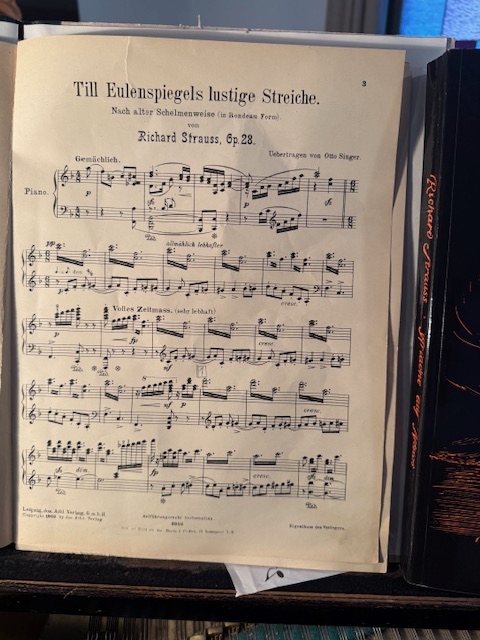
(I went over to a piano, and played the opening phrases of Till Eulenspiegel…in a piano reduction)
(I stopplaying) You know that piece…?
Mandle: Of course.
BB: (I am going back and forth between my interview / conversation with Mandle, and some analytical thoughts like this one that I am adding after the fact. Because they’re in a real sense “parenthetical” I put them into brackets just like this)
I think my desire to play these huge pieces on the piano is similar to your desire to conduct the orchestra. I played it for you because I thought you could relate to it. I have started using a word to describe my ambitions namely “aspirational”. I think playing these pieces as I dream of the orchestral sound is aspirational, trying to make a sound at the piano while I imagine the orchestra. When I am sitting at the piano it’s a fantasy, not always about playing perfectly, and more like imagining the orchestral piece.
(It’s the reason I play pieces like Pictures at an Exhibition, or that I love to play transcriptions of orchestral works, and also love opera at the piano. That was my first big fantasy, because I would accompany singers while trying to impersonate their orchestral accompaniment. It’s fun! Of course I have fewer options, because I am not a wealthy man. But the desire to play a reduction is I think similar to that impulse to conduct or to sing along. It’s normal I think, that people hear music and want to share it, join in, or perhaps to dance. When we sit like zombies silently? that’s un-natural. Applause between movements of symphonies, too, while it’s bad form to do that, it’s a child’s impulse and that can’t be bad. We want to make music. The impulse of the child to sing or dance or wave their arms like a conductor may be something we think of as “childish” or “immature”, but it’s a real natural thing that maturity stifles, whether through inhibitions we acquire or simply because we lose the ability to be like a child. )
When I was a kid, Mandle, I used to conduct along with the Beethoven on the record player. To want to conduct or to dance or sing along: surely that’s a normal impulse, even if our normal experience is often to be told by peers or teachers that we’re not good enough, stifling the natural impulses, teaching us inhibitions, making us forget our childish delight.
At the piano (thinking of a reduction of the big orchestral piecelike TIll Eulenspiegel) it can’t really be played.
Mandle: You need an orchestra.
BB: Playing a big piece at the piano is a bit like pornography, a fantasy.
(laughter in the room)
…because you’re fantasizing about doing something with someone else (at the piano dreaming of the orchestra making the big sound). In my head I hear the orchestra, and of course that’s a fantasy. It’s just a soloist at the piano. It’s like when I was a kid conducting along with the orchestra on a record. It’s a fantasy. Did you ever conduct along with a record as a child?
Mandle: Not really.
BB: I did as a kid.
Mandle: I think I may have bought a baton.
BB: I know at one point you may say “who’s the interview with, is it you or is it me?” …because I like to put myself into the questions, to make it relatable. It’s a conversation, but also because I am trying to analyse and understand. I think when we think of the conductor as a kind of everyman, who acts out our fantasies for us..? No matter how well they conduct, the audience watches the conductor and projects, identifies to some extent.
Mandle Cheung rehearsing the Mandle Philharmonic
BB: So, we were talking aboutwhat you like to listen to.
Mandle: The very first classical music I listened to was on a little FM radio with an antenna and earphones that I listened to in the backyard when I was thirteen years old. I still remember the moment, it was Saint-Saens 3rd Violin Concerto. Bang! that’s it. After that all I listened to is classical.
BB: Would you ever conduct Saint-Saens? For instance that 3rd Symphony with the organ, would be a great project for your orchestra. Or the 2nd piano concerto (one of my favourite pieces).
Mandle: If I have the time & energy, because I have so many things I want to conduct. There are at least 30 pieces I would love to conduct.
BB:Could we make a list? because maybe that tells us the future of Mandle Phil, no?
Mandle: No, the future of Mandle Phil is Mahler 2 and Mahler 8, that’s it. I am conducting the Royal Philharmonic, in London August 21st, Friday.
BB: Wow… so what are you going to conduct?
Mandle: Mahler 2 of course. (giggles)… because there’s is nothing after the Mahler 2 & the Mahler 8.
BB: Did I ask you what is the best or worst thing about what you do?
Mandle: There’s the company and then there’s the orchestra. I came up with the idea in 2015. I started talking to a couple of people in 2016. In 2017 we put a few musicians together. In 2018 we had our first concert at Glenn Gould Studio, a pay what you can. Since then I think we did our 18th or 19th concert this last December, the Beethoven 9th and Carmina excerpts and some Christmas carols.
BB: So do you have a program for the coming year?
Mandle: I was going to do a couple, of Stravinsky, but I cannot afford to divert my attention. Mahler 8 is just too big. I don’t even know if I can do it. It’s huge.
BB: It’s a challenge to be sure.
Mandle: And I really have to be ready for Royal Philharmonic. And we also spoke to the New York Philharmonic. (laughter) You wanna guess the price they quoted us?
BB: That’s a good question. Erika googled the TSO price. Is it higher than the TSO?
Mandle: (laughter)
BB: Is that a yes? (more laughter) Is it a multiple of the TSO? More than twice..? Were they maybe trying to scare you away?
Mandle: No.
BB: They were serious?
Mandle: Very serious. He’s responsible for raising money for the orchestra. You know all about the kefuffle with the TSO? You don’t get surprised at my age but that one just totally caught me off guard.
BB:I’m still asking the first questions, what’s the best & worst thing about what you do…
Mandle: I don’t have any negatives.
BB: There have been other people who say this, you’re not the only one. If you’re enjoying your life and you don’t see any negatives that’s fine, a valid answer.
I asked you what you like to watch. What’s your favourite?
Mandle: TV shows. I haven’t got a good one for awhile. My all time favourites were “Evil” and ” Nip-tuck.”
BB: Nip tuck, I remember that was a great show!
Mandle: Oh there are a couple of shows we watch. The Voice, the singing competition. America’s Got Talent. The judges they have on The Voice are good. They actually know what they’re doing. The judges on the other one…. so bad!
BB: But it’s still entertaining. Bad judges…. like bad critics. Remember that guy who used to be on American Idol? Simon Cowell…
Mandle: Oh i don’t like him at all. The one who kept his accent.
BB: (laughter) He was mean. …So can I ask you what your favourite song or melody is?
Mandle: Mahler 2.
BB: What ability or skill do you wish you had, that you don’t have?
Mandle: ability to recall ! Mine is average at best
BB: When you’re just relaxing and not working, what is your favourite thing to do?
Mandle: when I try to relax, thoughts will keep popping into my head. If it’s before 8:00/9:00 pm, music will always be playing, I’ll go thru my projects, there are so many, and I enjoy all of them. I may play some iPhone games. I may work of music for up coming concert. After 8/9, I may switch on Roger’s or Apple TV. Or organize phone calls and text exchanges, work with ChatGPT.
BB: Do you have a favorite conductor?
Mandle: Karajan who is dead. Today I watch Berlin Phil videos. I didn’t search for other orchestra apps.
BB: What instruments do you play (if any)?
Mandle: when I was in high school, I played in the harmonica band. And Arthur Benjamin harmonica concerto with CBC symphony orchestra 1971-12-09
BB: What was the first piece of music that you conducted and when?
Mandle: 1969/70 University of Manitoba, school of music, Beethoven piano concerto #3, performance by graduate student soloist.
BB: What does a conductor really do? (a rhetorical question?)
Mandle: I’m not aware of any great orchestra concerts or recordings that were performed without a conductor ? None. Zilch.
Great conductors are a rare breed. Besides their amazing knowledge of the music, they bring energy.
The 3 min 55 second standing ovation is for the energy that the audience felt !! As NaomiBuck described (in the Toronto Life article), they sprang to their feet. Note that Naomi is someone who doesn’t know what a conductor does, as you can read in her article. She thinks it’s the musicians that carried the music. You absolutely must have the best musicians to play the best music. You need to add an exceptional conductor to produce extraordinary performances. There is no exceptions to that.
BB: What don’t people understand about being a conductor?
Mandle: I learned the answer to this question first hand during the less than 20 Mandle Philharmonic performances.
You need to be a musician that plays in an orchestra. Musicians follow the conductors baton. All musicians.
I actually don’t have a clue what Mandle Philharmonic musicians think of me. They kept returning. We have a group of core players that’s been with us since 2017/8/9. They play for Canadian Opera and National Ballet. We can’t rehearse or perform when those two are in town playing. I tell them what repertoire I want and they reach out. It’s the same small pool of musicians.
BB: How is building & leading an orchestra as a conductor different from, or similar to building & leading an IT corporation?
Mandle: (setting me straight): I don’t have an IT corporation. I have a technology company that has an IT department like all small and large corporations do.
By leading I assume you mean conducting? It’s totally different. No similarities I would say.
Conducting an orchestra is real time. If you screwup, there is no place to hide. Everything is instant. I said that in the Toronto Life article. For 20 min 45 min 90 min, you are totally absorbed. It is surreal. Compare to racing cars perhaps? But that’s minutes. I can’t think of anything else. You are not performing by yourself. The orchestra of 50/100 is your instrument.
You try to think about next bar next note next phrase next sound next instrument or combination of instruments. The phrasing the tempo the dynamics the sound … staccato legato … one instrument is forte while another is pianissimo.
BB: Please talk a bit about the politics of being a conductor.
Mandle: I have been told many times, I’m not like conductors that all the musicians are familiar with. I don’t feel vulnerable because I am vulnerable. I talk about my screw-ups openly with my musicians. Often they will point out when I screw-up. That’s not the behaviour of a conductor.
Mandle Cheung conducting the Mandle Philharmonic
BB: Conductors usually are long – lived because the physical part of the job is exercise using your arms. As a physical feat, how hard is it to conduct an 80 minute symphony such as Mahler 2? How tired were you after finishing that TSO concert?
Mandle: it is a work out :):) no question about it !!! I was happy 🙂 Soooo happy when the cheering started.
BB: Is any of this scary for you? if so what’s the scariest part?
Mandle: most definitely 🙂 when I lost my place in the score and conduct totally from memory :):)
BB: what music will Mandle Philharmonic do in 2026? I think you mentioned Mahler 2 & Mahler 8: but anything else, short pieces?
Mandle: Mahler 8 is monumental. I printed the score few days ago. Will start studying soon.
Talking to Budweiser about a major outdoor concert in June. Just started.
Royal philharmonic in London, Friday August 21. Mahler 2. I’m already nervous 🙂
Thought about a Stravinsky concert but I’m glad I dropped the idea.
June and October we may have two RTH dates to do Mahler 2. Still discussing with my team.
BB: symphony orchestras sometimes program lighter music, as in Boston Pops, music that isn’t as dissonant or edgy as Mahler. Would you ever put something on a program from that category?
Mandle: Georges Bizet, Carmen Suite No. 1 and No. 2
Alexander Borodin, Polovetsian Dances
Antonin Dvorak, Slavonic Dances Op 46 /8
Modest Mussorgsky, Night on Bald Mountain
Camille Saint Saens, Bacchanale from Samson and Delilah
Bedrich Smetana, Ma Vlast: Moldau
John Williams, Star Wars Suite Main Theme
BB: some pieces are done without a conductor, for instance Bach, Vivaldi or Mozart concerti are sometimes led by the soloist (playing violin or piano). Would you consider undertaking any pieces from earlier periods?
Mandle: no
BB: You’re from Hong Kong, do you have any interest in music from China or Asian countries?
Mandle:did one piece !!:):) Li, Spring Festival Overture
BB: There’s a new genre of music emerging over the last decade, as it’s gaining fans & admirers, namely film music, the music in popular films. Do you have any interest in film music?
Mandle: Star Wars is as close as i got :):) I do want to produce West Side Story.
BB: After Mahler 2 & 8 there are other pieces you admire. What are they and would you consider conducting any of them?Mahler 3 or 5 or 9?
Mandle: I considered 5 but again want to focus.
BB: Do you like any operas or oratorios, that you would consider conducting?
Mandle: not really
BB: Do you have any vocal or choral music you would consider conducting with Mandle Phil..?
Mandle: We have done Beethoven 9, Carmina Burana excerpts, and Borodin Polovetsian Dances
BB: Do you have any ideas about reforming / modernizing classical music culture to better align with modern audiences?
Mandle: Adding narratives is something i try to do before each piece.
BB: Yes I noticed in the Beethoven’s 9th concert at Koerner Hall.
BB: What if anything can classical music learn from the way popular musicians play & market their music?
Mandle: the sheer size and length make classical challenging.
BB: Do you have any teachers you would like to acknowledge, who have helped you?
Mandle:Arthur Polsen was concert master of Winnipeg symphony when i studied at University of Manitoba back in late 60 early 70’s. He picked me to conduct Beethoven third piano concerto, with a piano performance student as soloist, in graduation concert. Then the Arthur Benjamin harmonica concerto with the CBC orchestra, same players as Winnipeg Symphony.
*******
Mandle enjoys conducting, and he’s picked music that he loves. It’s not rocket science, he’s doing what he loves.
June 25 2025 – Mandle Cheung & Toronto Symphony (Photo: Allan Cabral)
The passion & pleasure Mandle experiences conducting is what we sense watching him, the surrender to a simple impulse of enjoyment & pleasure.
Although the Mandle Phil website does not yet have dates for the Mahler, if you want to attend, follow the link, as this is where you will see the dates and be able to get tickets.
The Canadian Opera Company are reviving the Christopher Alden Rigoletto, last seen in 2018 and first seen here in 2011. I have always been conflicted about it, a production that in some ways shows the real story that composer Giuseppe Verdi & librettist Francesco Maria Piave couldn’t give us.
Rigoletto is jester to the Duke of Mantua, a total beast of a seducer, who screws every woman in sight and then has the nerve to sing “la donna è mobile”, suggesting that women are fickle. He’s a man whore, and (in case you can’t tell) someone I dislike with a passion. Rigoletto may be a father but he shows no sympathy for Monterone, another father whose daughter becomes one of the Duke’s conquests, leading Monterone to curse the Duke and his Jester.
Rigoletto (Quinn Kelsey) being cursed by Monterone (Gregory Dahl, photo: Michael Cooper)
When the Duke goes on to seduce Rigoletto’s daughter Gilda, the jester pays a hit-man to kill his boss, but Gilda is so in love with the beast she substitutes herself as the victim of the hit.
Foreground: Rigoletto (Quinn Kelsey) embraces his daughter Gilda (Sarah Dufresne), as behind them the Duke (Ben Bliss) kneels before Maddalena (Zoie Reams), observed by Sparafucile (Peixin Chen, photo: Michael Cooper)
In places Verdi & Piave held back a bit, likely due to concerns about censorship, the morality of the audience in the 1850s, so that the courtiers surrounding this whorish Duke sing in a chorus that’s jocular but relatively clean in how they express themselves, and what we actually see.
Alden’s Rigoletto is as blunt as a Housewives of Tulsa episode: as it was in 2011 & 2018. The music isn’t changed, but the visuals are crystal clear, so much so that there’s no mistaking this nasty story for a happy romance.
What is so different this time, leading me to call it a Rigoletto for our time? Our time. In 2026 I’m finally ready for this production. Maybe it took awhile for me to learn how to see it correctly or maybe the thing that trained me was watching current events.
Tonight Gilda was played by Sarah Dufresne, who for once gave us a Gilda who looks as young as the character is written to be. When the Duke (Ben Bliss) pushes his Gilda onto the couch in her underwear, looking like a 15 year-old, it could be right out of the headlines. The Duke is like Epstein or one of his pedophile cronies. Perhaps Giovanna (sung by Simona Genga) is like Ghislaine, as the role is far beyond the usual house-keeper of the original, an enabler and another lover of the Duke (at least in her own mind).
Sparafucile (the hired killer, sung by Peixin Chen) argues with his sister Maddalena (sung by Zoie Reams, so impressive a couple of years ago in Medea), who has also fallen in love with the Duke. When she suggests that Sparafucile can kill the Jester instead, and take his money, Sparafucile replies that he is no bandit, a grotesque moment that made me laugh out loud.
I’ve seen a lot of productions of this opera. It feels so jarringly real, a community of sycophants & enablers trying to please the powerful pervs, just as we see in the news. When I first saw this production it seemed like a revelation even though there were moments that rubbed me the wrong way, but I think the world has worn down my resistance, as the news is now nastier than this story, that actually felt like escapism tonight.
Let me add, that the singing and the musicianship is superb led by conductor Johannes Debus.
Quinn Kelsey’s voice in the title role seems to be in a groove, the sound lighter and more truly bel canto than previous times I have heard him, as though he were rejuvenated. The high notes are all there, the voice opens cleanly and precisely on pitch, the soft passages float while the big moments hit hard. I’m glad I will hear him again. He is very believable as the Jester who is cursed, and is sounding especially good this year.
Sarah Dufresne sang well as Gilda. There were a couple of places where I thought she was being rushed by the pace coming from the podium, where a more sympathetic slower tempo could have helped. Gilda has some of the prettiest music that Verdi ever wrote, but is also pressed into a melodrama in the last part of the opera. I don’t think the role is written to give a singer the chance to really seem like a teenager, given the sophisticated situations & moral complexity in which she’s caught, but Sarah looked very much the part, doing as much with the role as possible, especially the frenetic action Alden asks of her.
All three of the main principals sang on pitch, although I think the most impressive for me was Ben Bliss as the Duke, in a role that’s not just difficult to sing but can be unbelievable to watch. Or maybe it’s just that the production, showing us in a kind of creepy men’s club, with courtiers seemingly helping the Duke in his horny pursuits, helps the opera to click perfectly for me.
Conductor Johannes Debus took us swiftly through Verdi’s tuneful world, keeping everyone tightly together, the men of COC Chorus having some great moments especially in the first act. Rigoletto continues at the Four Seasons Centre, with five more performances between now and February 14.
Rigoletto (Quinn Kelsey) gets no sympathy from the Duke’s courtiers (photo: Michael Cooper)
I wanted to interview Nicholas Rice, intrigued by the show he’s doing at Red Sandcastle Theatre, Another Side Of Rice. He’s a story-teller and an actor.
I had to ask him questions. I also plundered his Facebook profile, concluding with some of his poetry, that perhaps represents a different side of Nicholas Rice.
Nicholas Rice
*******
Barczablog: Are you more like your father or mother?
Nicholas Rice: Now there’s a neat question.
From my mum I think I get a sense of wackiness, a love of wordplay. She was a lexicon into herself – the English language was her silly putty. I’m grateful to her for that.
From my dad – there’s a sense of gentle-manliness, of gentlemanliness. I address this in my show, in fact. I lost my dad when I was still very little. I’ve spent my whole life trying, with varying degrees of success, to be like him.
Nicholas Rice
BB: What is the best or worst thing about what you do?
Nicholas Rice: That thing I do – there’s just something so sweet about standing before an audience (or before a group of students) and playing to them – embracing them with my eyes and my voice. I do mean ‘sweet’ – this is a sweet spot for me. Storytelling allows me to share the warmth of my heart. And man oh man, we’re in an abysmally dark age. Does our world ever need hefty doses of warmth and light right now.
BB: Who do you like to listen to or watch?
Nicholas Rice: I’m an old Boomer. I can’t get enough of the Beatles or the Stones. I love Billy Joel. Stephen Sondheim – there are some magnificent interviews with him on YouTube. And I love watching old Dick Cavett YouTubes, two in particular: Don Rickles and Beverly Sills in the same episode – and in another episode, Oscar Peterson.
Don’t faint, but I actually hold a second-degree Black Belt in goju-style karate. For many years I was a real keener, training several days a week. I no longer train, but I still value my association with the dojo, and I maintain that the karate dojo is the best acting class I ever attended. Truth is, I have little aptitude for the sport – yet it doesn’t matter. Just show up, keep showing up, chuck your fear away and cherish the practice-time: you’ll improve!
Nicholas Rice
BB: What ability or skill do you wish you had, that you don’t have?
Nicholas Rice: I wish I were a quicker study. It takes me a long time to learn a chunk of text. I need constant repetition. Yet I try not to be afraid of the process – see my ‘karate’ answer above.
Nicholas Rice
BB: If someone wanted to be a story-teller, how would you suggest they start.
Nicholas Rice: Find some storytelling events and put your name in. Or go to a few of these events first, see what they’re like, and then put your name in. You may be scared, but that’s fine, everyone is. Hell, I’m scared right now. How to start? Just start!
Nicholas Rice: John Travolta was the best colleague imaginable – funny, supportive, warm.
And so was Kirstie Alley, may she rest in peace. Our first day on set, I asked her if she’d had much time to see Vancouver. She said no, they just had to concentrate on the shoot. Then she asked about me – I was out west with my wife and daughter, settling up my mum’s estate. “How old is your little girl?” Kirstie asked. Eighteen months, I said. That was on Day One. Several weeks went by, I had tons of down time, and then finally it was my last shoot-day. I did my final shot, it was a picture-wrap for me, and I gave Kirstie a kiss on the cheek and thanked her and wished her well. She said, “You take care of that little girl of yours now, y’hear?” She’d remembered. I was deeply touched by that.
BB: Do you have a favourite story-teller?
Nicholas Rice: There’s a terrific Fringe artist, T.J. Dawe. He’s Vancouver-based, I think. His work is constantly enthralling. If you find he’s playing at a Fringe near you, run to see him – you’ll be a Dawe-fan for life.
BB: Wowzers… He’s done a lot. Here’s an example.
BB: Red Sandcastle Theatre is a very small venue, as intimate as a classroom.
Nicholas Rice: I did my original solo-show, A Side of Rice, at the Sandcastle last March. I love the intimacy of the place.
The good thing about A Side of Rice and Another Side of Rice is that these shows are just me telling stories to people I regard as friends. The show is clean and simple. There are no sound cues or lighting cues, no pyrotechnics. There’s no amplification. So many shows these days are mic’d to death, mic’d into unintelligibility . It’s ironic – the more amplification there is, the less an audience is able to understand.
BB:I hear you!
*******
Another Side of Rice is coming January 29, 2026 – February 1, 2026, the first three at 8:00, the last one a matinee at 2:00. Click here for tickets.
*******
I found these on Nicholas Rice’s Facebook profile.
Sonnet: I’d last put on a pretty pair of Pumas and worn ‘em till that cataclysmic day; and now, despite all pessimistic rumours, they fit upon my feet again okay.
Perhaps you will recall the end of summer when all my normal calm intelli-gence deserted me and, temporarily dumber, I vaulted off a godforsaken fence.
Unprecedented pain was instantaneous as was a long ferocious flood of swearing to mark my comminuted right calcaneus which swelled till it was well past all repairing.
And yet the time has hobbled on, and now the Pumas seem to fit again somehow.
A view of the Pumas (NB “Puma” is a brand of shoe)
Sonnet: At Princess Marg
I’ve never seen the waiting-room so crowded — can cancer have run rampant overnight? A sense of grave uncertainty has shrouded us men who claim survival as our right.
The system, as we know too well, is flawed; far better to be sick in Scandinavia — and yet our land still owes a loving nod, a bow to Tommy Douglas as a saviour.
For now my current state of mind is calm; I try to stay considerate and kind — my teacup runneth over, says the Psalm; my pee-cup doth as well, but never mind.
And thus your correspondent sits and waits, in gratitude he’s not now in the States.
Nicholas Rice
Sonnet: for Joe Rice and Asher Rose
A twenty-dollar ticket at the Roy? I’d willingly have paid five times as much. My bubbe might have murmured “Bozhe moy, this Manny Ax has such a subtle touch!”
To sit amid a concentrated crowd as part of a divine collective ear — I tell ya, hive, it makes a fella proud to savour phrases effortless and clear.
It’s true Toronto’s not the town it was; the traffic-jams alone are cause for fleeing, and yet I hesitate to leave because at times there’s this exquisiteness of being.
So try to snag a seat at the last minute; for twenty bucks it’s heaven and you’re in it.
Nicholas Rice
BB:I saw this picture on his Facebook profile, posted at the end of October, commenting on Movember, as you can see in the caption he posted.
Movember again. I’ve had prostate cancer. I was diagnosed in 2008. Had surgery and radiation in 2009. Been on a regimen of hormones since 2015.Sounds scary, perhaps – yet my life has never been better. Creeping into my mid-70s, I continue to act, teach, and write. There’s even a new solo-show in the works. Please don’t be afraid. If you have questions or concerns, I invite you to call, write, or visit: no subject is off-limits, and my ears, heart, and arms are open. Let’s affirm Life – let’s celebrate it – not just in Movember, but right through the year. With my love.