There’s a moment in Richard Strauss’s adaptation of Hugo von Hofmannsthal’s libretto for Elektra that tells you everything you need to know. This is the same family constellation we know from the aftermath of the Trojan War. Agamemmnon is dead, Elektra mourns him in defiance of her mother Klytemnestra: who lives alongside Aegisthus with whom she murdered Agamemnon.
But at the telling moment the chorus have been singing “Orest” in the distance, ever more insistently & clearly. And when Elektra says “Hörst du nicht, so hörst du denn nicht?” (or “Don’t you hear? Don’t you hear it?”) She answers her own question saying “Ob ich nicht höre? ob ich die/Musik nicht höre? sie kommt doch aus mir.” Or in other words “How should I not hear? How should I Not hear the music? It comes from me.”
The Canadian Opera Company opened their revival of Elektra tonight at the Four Seasons Centre, and NO this is not exactly Sophocles. The music comes from her, as surely as the sounds of the huge COC Orchestra led by Johannes Debus comes from the orchestra pit. This is expressionism, which means that we are watching something hyper-symbolic, Wagner on steroids. The larger than life emotions of this mad family horror story are immediately registered by the 100+ players, via Strauss’s edgy score. Debus and that orchestra paint the pictures of the wild visceral responses of a bunch of crazy people in luscious colour.
It’s scary beautiful.
I am glad I read James Robinson’s director note, as it helps me understand my feelings tonight after the show. The opera is a tour de force, an endurance test for the soprano undertaking the lead role, Christine Goerke, who has been arguably the biggest star for the COC in three previous winters as she undertook each of the Brunnhildes successively in January 2015, ’16 and ’17, in three of the finest productions ever seen from the COC. She’ll be going on to sing Brunnhilde at the Metropolitan Opera this spring.
I wish this had been as magical for me as her previous three portrayals. I had watched Birgit Nilsson on DVD a few nights ago, and have to say that whereas Nilsson was frequently imprecise, when Goerke sings “Allein” to begin her marathon, it’s chilling, very moving. When she utters her father’s name, in a motif we hear regularly throughout the evening, I was gradually brought to tears watching her sing the opening lament for her dead father. And yet there’s a problem. I’ve been seeing her Facebook jokes. I adore this woman. But the thing is, she’s not larger than life in this show, she’s become my friend in the superficial Facebook sense to me and thousands of other people. So I was watching her, worried that she’d get her high notes (which she mostly did), worried about her big dance at the end (which she executed well). Social media is problematic, because it takes away the mystique.
I can’t help wondering, too, if her weight-loss has hurt her vocal production. She looks amazing. But I am reminded of Deborah Voigt, another Brunnhilde, another singer who lost weight and in the process perhaps has lost some of the vocal heft.
The main thing though is what I saw in Robinson’s directorial note. He explained that this time around –a revival from a season when the COC also did the Egoyan Salome—they were less interested in edginess and angularity and more interested in exploring the family relationships. All well and good. But as a result, we have a very sympathetic Klytemnestra sung & acted with great subtlety by Susan Bullock, a likeable Aegisthus masterfully played to comic effect by Michael Schade (what a voice!), when –pardon my savage language—I want the opera to make me crave their deaths. I need to hate them. Forgive me that I sound like an old-fashioned fool but the way the opera is written, we should be seething with outrage watching what’s being done to Elektra. We should be angry, upset, and when the tide turns and Orest arrives to reverse Elektra’s fortunes, he must be an avenger, a welcome agent of justice. But because the costumes deconstruct the usual relationships –Elektra usually looks very gross and dirty, whereas Goerke looked quite nice—much of that was missing for me. I need to hate Klytemnestra, I need to ache for Elektra so that when Orest is reported dead, I want to cry with the sisters. And when the murders happen, they should seem just. Actually, I sat listening to the lovely orchestra, where all the real feeling resides in this production, but not caring terribly much about what’s going on in the staging.
Now of course, this was also my problem with Egoyan’s Salome, that a story of crazy obsessive people was upended. Please note, I adore Egoyan’s Cosi fan tutte, that opens in a few days, a very different sort of production from his Salome. But I mention this because I didn’t have the usual catharsis. I sat watching Goerke sing and dance, loving Debus and the orchestral magic.
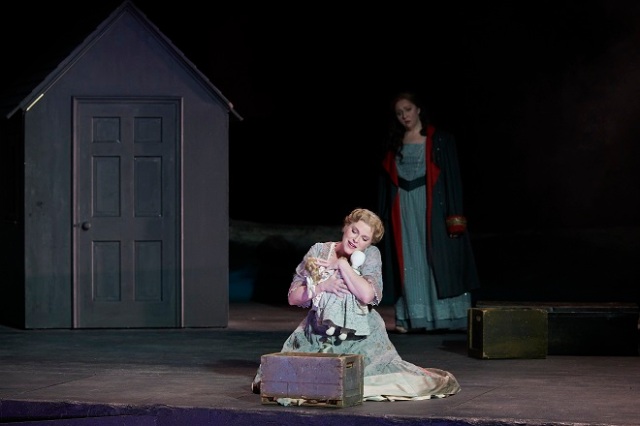
Erin Wall as Chrysothemis (foreground) and Christine Goerke as Elektra in the Canadian Opera Company’s production of Elektra, 2019 (photo: Michael Cooper)
There was one character who is not hurt by the deconstruction, for whatever reason. I adored Erin Wall’s take on Chrysothemis, a performance of wonderful depth and authenticity. I am perhaps prejudiced because Chrysothemis has so much of the pretty music in an opera that is mostly crazy, the one sane person in the room. She wants a family while her sister craves murder and her brother then enacts it: although again I rolled my eyes that the director chose to dramatize this by asking her to hug dolls… some of us actually understand the implications in the text without a dumb-show thanks very much! Wall was heart-breaking nonetheless, especially as she sings the last notes of the opera, crying to her brother.
Deconstruction is a funny thing. Relationships change. So some of the subsidiary roles stood out, precisely because things had been juggled and re-framed. Lauren Eberwein was wonderful –again in one of the few moments when Hofmannsthal shows us a sane person—as the fifth maid, when Strauss stops the torrent of dissonance for a few welcome moments of glorious melody. Klytemnestra’s sidekicks, played by Simone McIntosh & Lauren Margison, were deliciously odd, emerging from the background.
That aforementioned choral moment was especially magical, as the COC chorus sang their intimations of justice being done from behind us. It was a highlight.
This is great theatre, a tight evening’s entertainment. Imagine Dysfuntional Family Feud, the Cage Match edition. The comedy that’s implicit in Hofmannsthal’s libretto emerges in this reading. The scene where Elektra toys with her mother (about the necessary sacrifice to end her bad dreams) is delicious and hysterically funny. Goerke has a real gift for this, for irony & comedy.
Elektra continues at the Four Seasons Centre until Feb 22nd.
North American Premiere of From Treblinka to Auschwitz
Vasily Grossman and Primo Levi: a dialogue between witnesses
A theatrical reading with live music for Holocaust Remembrance Day
With Michael Miranda and Martin Julien, actors
Robbie Grunwald, piano | Drew Jurecka, violin, clarinet
January 29, 2019, 6:30 PM at Alliance Française
Free admission | Registration required
“Why remember? It is the writer’s duty to tell the terrible truth, and it is a reader’s civic duty to learn this truth. Those who would turn their backs or close their eyes or pass over this truth offend the memory of the fallen.”
—Vasily Grossman, 1944.
The Istituto Italiano di Cultura Toronto presents the North American premiere of From Treblinka to Auschwitz: a dialogue between witnesses on January 29 at 6:30 PM in honour of Holocaust Remembrance Day. This theatrical reading of excerpts from Auschwitz Testimonies by Primo Levi and Leonardo De Benedetti and The Hell of Treblinka by Russian writer and journalist Vasily Grossman, takes place at the Alliance Française, 24 Spadina Road, and admission is free with registration.Actors Michael Miranda and Martin Julien interpret text by Levi and Grossman respectively, while klezmer music performed by Robbie Grunwald, piano, and Drew Jurecka, violin and clarinet, underscores the readings. Read more about the artists.
The presentation of these first-hand accounts of the of the worst mass murder in history takes on even greater poignancy against the backdrop of a recent study that found that nearly half of the Canadians surveyed lack basic knowledge about the Holocaust.
The texts for From Treblinka to Auschwitz were written by two Jewish authors born 14 years apart who lived under politically oppressive regimes: Vasily Grossman in Stalin’s Soviet Union, and Primo Levy in Fascist Italy under Mussolini. Though they never met or read each other’s work, they share the distinction of having written pivotal eye-witness accounts of the Holocaust. The works of Levi and Grossman describe, in granular detail, the very texture of life and death in the concentration camps and are considered essential and seminal writings on this topic.
The Hell of Treblinka was written in the autumn of 1944 by Vasily Grossman, a war correspondent with the Red Army. The very first article published about a death camp, it was subsequently submitted at the Nuremberg Trials as evidence for the prosecution. The Hell of Treblinka “remains on the finest [accounts], providing firsthand forensic documentation—Grossman meticulously lays out the physical dimensions of the camp, down to the square footage—and then icily explaining the engineering of genocide.” (The New Yorker)
Primo Levi was a 23-year old chemist who was arrested and transferred to Auschwitz in February 1944, where he remained until the camp was liberated on 27 January 1945. He wrote to ensure that the world would never forget the “insane dream of building a thousand-year empire upon millions of corpses and slaves.” Levi, whose centenary is being celebrated worldwide in 2019, is recognized as one of the most important literary figures of the 20th-century.
Texts to be presented on January 29 include excerpts from The Auschwitz Report by Levi and surgeon Leonardo De Benedetti. Written in 1945 upon request from the Red Army, it was the first scientific account to analyze the structure of a concentration camp. With rigorous and unflinching detail, The Auschwitz Report uncovers the pseudo-scientific deception that was integral to the extermination procedures.
From Treblinka to Auschwitz is a joint project by the Turin-based International Primo Levi Studies Center and Study Center Vasilij Grossman, with texts selected by authors and literary critics Domenico Scarpa and Marco Sisto. The event premiered in January 2017 at Teatro Carignano and is presented for the first time in North America in collaboration with the Istituto Italiano di Cultura Toronto.
Listing Information:
The Istituto Italiano di Cultura presents From Treblinka to Auschwitz
Vasily Grossman and Primo Levi: a dialogue between witnesses
A theatrical reading with live music for Holocaust Remembrance Day
with Michael Miranda and Martin Julien, actors | Robbie Grunwald, piano |
Drew Jurecka, violin, clarinet
ABOUT THE ISTITUTO ITALIANO DI CULTURA
Established in 1976, the Istituto Italiano di Cultura is the Cultural Section of the Consulate General of Italy in Toronto. The Istituto is a centre for cultural and academic activities, a school of Italian language and civilization, a source of information about contemporary Italy, its regions and its multilayered cultural heritage as well as a venue for art exhibitions, lectures, films, and video screenings. The Istituto also provides opportunities for cultural collaboration between Italian and Canadian organizations and individuals, to facilitate exchange in the field of theatre, music and cinema. It offers information and logistical support to both Italian and foreign public and private operators interested in Italian cultural events in Canada. The Institute supports initiatives which favour intercultural and multilateral dialogue based on the principles of democracy, reciprocal respect and international solidarity and it is often involved in events organized by other cultural offices of EU countries.
*****
“Press releases and announcements” are presented verbatim without comment
In a week juxtaposing new (21C festival) and old (the Toronto Symphony playing Mozart with Pinchas Zukerman), I came finally to see The Harlequin Salon by Tafelmusik Baroque Orchestra, including a great deal of theatricality to complement their music. While I seemed to be moving back in time with the progression of the week, the show tonight might be the newest and freshest of all.
Conceived and performed by Marco Cera in the main role, The Harlequin Salon is that rare creature, a multi-media presentation where all the media are essential and perfectly linked together.
We were watching
Harlequin as portrayed by actor Dino Gonçalves,
his master Pier Leone Ghezzi, a caricaturist and amateur musician as portrayed by oboist Marco Cera who sketches guests in his home (the salon); we see the sketches take shape through miracle of digital images, projected above the stage thanks to Patrick Lavender & Ramon Cespedes. The guests we meet?
Vivaldi as portrayed by Tafelmusik violinist Elisa Citterio
the great singer Faustina Bordoni, portrayed by guest artist soprano Roberta Invernizzi
composer & cello virtuoso Giovanni Bononcini as portrayed by Tafelmusik cellist Felix Deak
Bordoni –playing a trick on the amorous Harlequin—disguises herself as the famous castrato Farinelli, again portrayed by Invernizzi
the staging is directed by Guillaume Bernardi, while the music-making directed by Tafelmusik artistic director Elisa Citterio
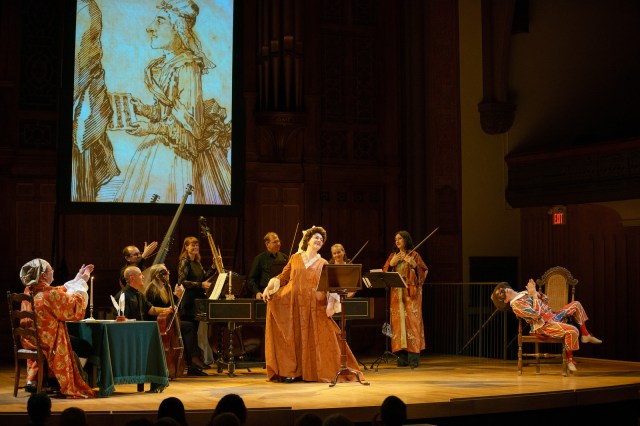
Here’s some idea of the flamboyance of the Harlequin Salon from Tafelmusik. We watch Marco Cera as Ghezzi sketching his guests including Roberta Invernizzi, while sitting at the table. The sketches appear on the screen above. Dino Goncalves is Harlequin (right). Photo: Jeff Higgins.
It was never dull, and at times, exquisite, simultaneously a complex piece of theatre & musical performance plus video art. At times there was so much going on –caricatures taking shape, acting & comedy, all in context with some magnificent music-making—that one didn’t always know where to focus one’s attention. The last part of the concert, as Invernizzi sang a Pergolesi aria accompanied by Cera’s stunning oboe obbligato is one of the most beautiful things I’ve heard in a long time. Not only have I discovered new music, but a new singer as well (both worthy of further exploration).
It’s a bit of a trip down memory lane, vivid reminders of what I learned about Commedia dell’Arte in graduate school. Near the beginning Gonçalves gave us the classic lazzo of the fly. A lazzo is a comic routine, and this one is such a chestnut that it’s been around for hundreds of years. Even so Gonçalves got laughs as he mimed chasing the fly, and eventually eating it.
Harlequin is always hungry.
Okay, some of the lazzi (the plural of lazzo) are old, such as the one with the mimed fly, or another one opening & re-sealing the master’s mail. But they did an original lazzo with a music-stand, a clever use of the available prop for a quick laugh.
Speaking of memories & grad school, their Commedia dell’Arte consultant was Domenico Pietropaolo who taught the CdA course I took during my MA, and who is now Principal of St Michael’s College at the University of Toronto.
I repeat what I hinted at earlier. While it appears superficially that I was going back in time as the week progressed (21C being 21st century music, Mozart composing in the latter part of the 18th century, and this program coming from the first half of that same century): yet this was actually the newest, the most theatrical, most daring programming of all.
We seem to be in the home of a man, watching a few musicians (only 9 of Tafelmusik’s players, and some in costumes for roles), while the sketches being created apparently in the present by Ghezzi were drawn anew on the big screen above. It was wonderfully intimate, very informal & playful, and at the same time, full of wonderful music. Tafelmusik continually challenge themselves with their inventive programs like this one.
You can visit The Harlequin Salon Saturday January 19th at 8pm or Sunday January 20th at 3:30pm Jeanne Lamon Hall, Trinity-St. Paul’s Centre.
How do people meet, and what’s involved in making connections? I keep asking this question about the arts because in case you haven’t noticed, you can’t do it alone. Yes there are people like Beethoven who work in solitude, people like Richard Wagner who write the music and the words. But Beethoven was deaf, Wagner was a political exile, so there were reasons why they didn’t work with others. And even then yes they did work with others. Theatre is collaborative.
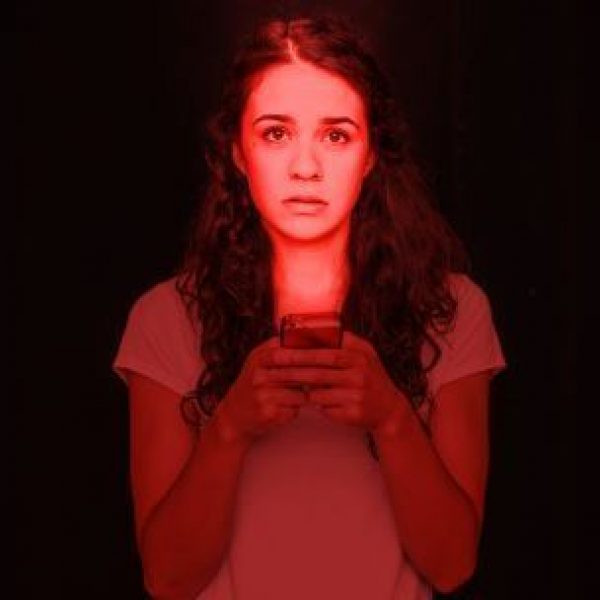
So the undercurrent to my questions to Julie Tepperman & Chris Thornborrow –creators of Hook Up, a new musical theatre piece about relationships in the modern era that’s opening January 30th (previewing Jan 29th)– is to ask about connections and collaborative relationships.
I probably should know both of these people better by now.
I missed Julie Tepperman’s Bandits in the Valley in the summer of 2017, done with Tapestry Opera (an important connection too). She’s playwright in residence with Theatre Passe Muraille, who are teaming up with Tapestry on Hook Up.
Librettist Julie Tepperman
And she came up in my interview with Sara Schabas roughly a year ago, when Sara said this:
Aaron Willis, our director, was introduced to me through his wife, Julie Tepperman – librettist for Bandits in the Valley. Aaron and Julie are the co-artistic directors of Convergence Theatre, and Aaron has directed for numerous esteemed companies around Toronto including Soulpepper and Theatre Passe Muraille. He’s also involved in the Toronto Jewish community, and he and Julie wrote and starred in a comedy called Yichudabout an Orthodox Jewish couple a few years ago, which received wide-ranging praise.
Hm… more connections…people working together on projects they care about deeply.
Composer Chris Thornborrow
I don’t feel that I know Chris Thornborrow well either. I recall getting very excited at a Toy Piano Composers concert, the record launch that included a piece by Chris back in the summer of 2017. I’d previously encountered his work through the Bicycle Opera Project’s 2014 tour, a short work about relationships called A Little Rain Must Fall, and one that I’d seen previously at (you guessed it) another Tapestry LibLab.
And so now in anticipation of the encounter between Julie & Chris in Hook Up that opens January 30th at Theatre Passe Muraille, I had to ask them to talk about their work & coming together on the project.
BB: What is the best or worst thing about what you do?
CHRIS: My favourite thing about my work is collaborating. It is so fulfilling to collaborate with other artists to bring a work to life — particularly in film, opera, and theatre. I love working on projects artists of different disciplines whose work comes together to be greater than the sum of its parts.
JULIE: I agree! So much of my work as a playwright happens in isolation until the draft is in a place to start inviting a director, actors, and designers into the process. But in order to create an opera, the composer and librettist are in it together from day one…which is thrilling.
BB:Who do you like to listen to or watch?
CHRIS: I have pretty eclectic tastes in music. I listen to quite a bit of contemporary classical music, generally leaning towards minimalist and post-minimalist aesthetics (John Adams, John Luther Adams, Nico Muhly, Caroline Shaw). I also listen to a broad range of folk music, indie pop, some electronic stuff. I have a soft spot for Sibelius, which coincidentally is also my notation software of choice.
JULIE: I rely on people way cooler than me (Chris!) to introduce me to new music. In terms of theatre, I love shows that immerse me in a world. In the case of Hook Up, our director and design team is making really cool use of screens, projections, social media, and the entire mainspace of Theatre Passe Muraille, so that scenes pop up in unexpected places.
BB: What ability or skill do you wish you had, that you don’t have?
CHRIS: Time travel.
JULIE: I can kinduv sing, but I wish I could really sing…like the cast of Hook Up! And tap dance.
BB: When you’re just relaxing and not working, what is your favourite thing to do?
CHRIS: I love exploring the city (via bicycle), and when possible, traveling. I am also a pretty avid reader, movie watcher, and video game player. Although I love it, my enthusiasm for basketball far outweighs my skill in actually playing the sport.
JULIE: A year ago I would’ve said, “I’m never NOT working on something!”…but now I have a 15-month-old daughter who is pretty fun to hang out with…she’s the perfect antidote for a workaholic like me.
BB: How did you meet & come to collaborate on Hook Up?
CHRIS & JULIE: We met in August 2013 where we were one of four playwrights and four composers across Canada selected to participate in Tapestry Opera’s 10-day “LibLab” program. LibLab is designed like “speed-dating” — pairs of librettists and composers are matched for two-and-a-half-days of creation, with the task of creating 5-minute operas. When it was our turn, we instantly hit it off.
Chris had recently composed a children’s opera about two girls facing off against zombie pirates, was interested in continuing to explore women’s stories and also issues important to youth – a demographic Julie felt is often ignored in the operatic and classical music world. Meanwhile, Julie had spent the last three years building a theatrical piece that explores rape culture, and working with middle and high school students on various acting and playwriting projects as a guest artist in their classrooms, where this topic always seemed to come up. We were both intrigued by the others’ passion for working with youth
And so, a 7-minute piece they called “Cindy + Mindy = BFs 4EVR” was created and selected to be performed as part of Tapestry’s “Opera Briefs” in September 2013. It focused on a live Facebook chat that 17-year-old best friends Cindy and Mindy were having in their separate bedrooms, “slut-shaming” a girl at school they’d named “Ho-bag Heather”. At the time, we were motivated by the then-recent suicides of Canadian teenagers Rehtaeh Parsons (April 2013) and Amanda Todd (October 2012) after both of them endured endless in-person and online sexual harassment and bullying. This was the springboard for what would become Selfie, a roughly 75-minute piece that was written and composed over two-and-a-half years which explored teen cyberbullying.
After a rigorous process of development and workshops, including some sharing with invited audiences (which included teachers and teenagers), we got very stuck, and ultimately decided not to continue developing Selfie. In the fall of 2016, director and dramaturge Richard Greenblatt was brought onboard to help us refocus and reinvigorate.
Richard Greenblatt, Director & Dramaturge
We eventually landed on a theme that we had kept passionately returning to in conversations and in the sharing of research, even while working on Selfie – rape culture and consent, at large, but more specifically on university campuses. And so, facilitated by Richard over a period of several months, we created a new outline for a new story that involved three 17-year-olds navigating their first semester at a (fictional) Canadian university.
BB: Tell us a bit more about Hook Up as a piece of music-theatre.
CHRIS: Hook Up straddles the world of opera and musical theatre. Structurally, it is through-composed. Thematic material is used to augment the emotional and psychological states of the characters and the plot. There are no traditional musical theatre numbers (e.g. verse chorus structure). Aesthetically, the piece leans towards musical theatre. The singers, for example, will be miked. The story moves forward faster than most traditional opera. There, orchestration includes sounds and musical aesthetics you might hear on a university campus or college party today.
JULIE: With regard to the story, it focuses on young people navigating their first semester at university and being thrust into adulthood.
Chris and I have a shared desire to tell a story that puts complicated and complex young women at its centre, and pushes the boundaries of traditional operatic forms in an effort to tell a story of our time. The setting of our opera may be a college campus, but we believe that rape culture and consent are incredibly pervasive issues throughout society, as evidenced by the groundswell of the #MeToo Movement, and the rigorous conversations taking place around the globe thanks to the strength of women like Christine Blasey Ford. Sexual assault remains a brutal reality of modern campus life; we hope that our opera is the beginning of yet another vital conversation that we need to be having in our homes, schools, communities, and in society at large.
BB: The genre question becomes more and more tricky with every passing decade, as the difference between “opera” and “the musical” narrows or overlaps. Please talk about how you understand Hook Up, in terms of its origins, its development (when it may have changed in your hands), your objectives and the possible expectations of audiences.
CHRIS: It’s interesting that this question about the difference between opera and the musical as genres keeps coming up, even as those aesthetics have become increasingly interwoven (not to mention the cross pollination that is ubiquitous in virtually all musical genres, which doesn’t seem to get the same kind of scrutiny. Jeremy Dutcher, whose Polaris Prize winning album Wolastoqiyik Lintuwakonawa combines opera, pop, and Wolastoq folk-song. Does it ever enter into the discussion that this kind of musical blending and exploration of “genres” as tricky?) It wasn’t helpful for me to think in terms of, “Is this a musical or is this an opera?” It was more useful for me to think of the work as a piece of theatre. In developing what Hook Up sounds like, I asked what would be the most authentic, compelling way to tell this particular story through music. Furthermore, this project is of special interest to me as an artist because I am eager to fill a void in opera: I want to create an opera that connects to a young adult audience by addressing contemporary issues that are important to them, while at the same time refuting traditional operatic narrative tropes. All too often, the harm done to women who are subjugated by men in the stories of historical operas is portrayed uncritically. This is problematic. Creating a story that places the experience of women at the centre of the narrative is my way of addressing this issue.
JULIE: This is a high-stakes issue and opera lends itself to high-stakes scenarios, and big emotions. It is certainly experimental, and lives in a unique place compositionally; hard core opera aficionados will likely accuse us of creating musical theatre, but because there are no traditional musical numbers, musical theatre fans will likely relate to it as contemporary opera! Chris’ music is certainly pushing the boundaries of traditional operatic forms, and in doing so he’s created a musical world that is accessible, authentic, surprising, and fully supports and reflects the emotional stakes and states of being of the characters and situations. Opera also requires the librettist to be economical with language; if this were a play, it would be written very differently. Rather, it’s been written with the intention of it being sung, and so intentionally leaves room for the music to enhance the emotional journeys. This kind of brevity is also very true of on-line communication – 140 characters! – and in that sense opera lends itself perfectly to the style and form of this piece. Ultimately, music has the power to deeply connect both artist and audience with their emotions in a visceral way, and in doing so music can elevate the piece, and enrich the audiences’ overall experience.
BB: The Canadian Opera Company Atom Egoyan production of Mozart’s cosi fan tutte explores the idea of a “school for lovers”; does Hook Up function as a modern version, even if it’s a cautionary tale?
CHRIS: I’m not sure how to answer this question, because we didn’t really set out to position ourselves in the context of traditional operas. We were definitely interested in telling a compelling story about what young people experience on college and university campuses today. We want to create an opera that connects to a young adult audience by addressing contemporary issues that are important to them, while at the same time veering away from some traditional operatic narrative tropes.
BB: In bringing Hook Up to life, especially as far as the relationship between the two of you, please talk for a moment about the role of your dramaturg (mediator or midwife?). [please be as elaborate or as brief as you wish.]
CHRIS & JULIE: Our dramaturge, Richard facilitated what we as the writer/composer team wanted to say. This includes clarifying, asking questions, and helping us dig deeper into our material. We have a tremendous respect for each other, and so mediation was never really a part of it.
BB: Are there any influences you would care to mention, that might be relevant to someone coming to Hook Up that might be useful for them to recognize what they’ll be seeing & hearing?
CHRIS & JULIE: We’re going to be annoying and avoid this question in terms of musical influences, but we will say that a tremendous amount of research went into the writing of this piece. News articles, journals, books of non-fiction and fiction have been poured over, and of course talking with young people. The result: Hook Up is an unflinching examination of issues around consent, shame, and power, specifically on North American university and college campuses. We imagine it as a catalyst for discussion about difficult topics. We have included a content warning that the show contains explicit language, discussion of sexual violence, and sexual consent. In light of some of the difficult subject matter, we have planned several post-show talks facilitated by CANVAS Arts Action Programs, an organization that uses arts-inspired programs to educate on gender equity, consent, and LGBQT2S+ inclusion. Further written support material is available by request at the theatre’s box office.
*****
Hook Up, a Tapestry Opera Production in partnership with Theatre Passe Muraille opens January 30th, previewing Jan 29th at 16 Ryerson, running until February 9th. For tickets & further information click here.
While tonight’s Toronto Symphony all-Mozart concert, conducted by violinist Pinchas Zukerman was 180 degrees in the opposite direction from what they were up to yesterday at Koerner Hall, launching the 21C Festival of new music, there were some interesting points of contact.
I had mused about the notion of the virtuoso & the functions of virtuosity last night, contemplating the brilliant work of Stewart Goodyear as composer & piano soloist. Sometimes a new piece tests what’s possible on an instrument, what a player can do. That can be a very serious endeavor.
I was thinking last night that maybe at times it’s too serious. The difference between high art and something commercial? If you come up with something brilliant that might become an ear worm, and you repeat it insistently? That’s what a popular composer does, what a Richard Strauss, a Giacomo Puccini, a Camille Saint-Saens, a Pyotr Ilyich Tchaikovsky or a Sergei Rachmaninoff might do. Perhaps more serious composers think of that as “selling out”..?
But the ear wants what it wants.
I couldn’t help noticing the joy in Zukerman’s playing tonight, music from 1775, and it was infectious.
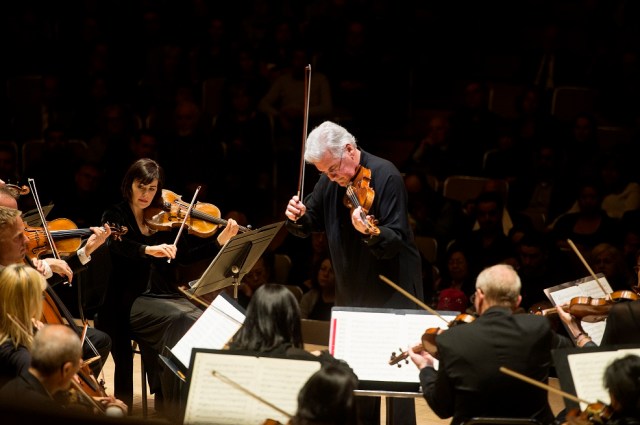
Pinchas Zukerman plays Mozart (photo: Jag Gundu)
Who could blame him? I’m thinking particularly of the second half of the program, when he seemed to push himself to a higher level, inspired by what he was playing. There was no mistaking the enjoyment in his reading of the Violin Concerto #3, one where all three movements have memorable melodies, remarkable drama between the soloist & orchestra.
I didn’t want that third movement to end, it was so magnificently played. Zukerman was playing with us in more ways than one. In the back and forth dialogue between his solo lines and the accompanying ensemble he played up the comedy. For instance he might play the line straight (as written) the first time, then add a portamento (slide) the second time, and a touch of real schmaltz the next time, thoroughly enjoying the chemistry with the orchestra and an audience who were eating it up, not knowing what exactly to expect but enjoying the game.
Virtuosity is not just chops, the skill in one’s fingers & hands & arms. Zukerman took the stage with all the charisma of a vaudevillian playing his favourite routine for his fans. The swagger was contagious. Now please understand, this is a different kind of music and a different century from last night’s music. What was intriguing to notice was that Zukerman –a mature artist, in total contrast to the athletic young pianist from last night—really knows himself so well, so relaxed up there it was quite astonishing. During the first of two concertos he played (#5 was first, #3 second), he actually came out onto the stage with his violin, walking through the applause into the space amidst the strings to begin the first movement orchestral introduction, making the downbeat while still walking, the applause not quite dead in the hall. Was he seeking to surprise or startle the orchestra? I think so. That concerto before the interval was not as inspired as the one after intermission.
Did Mozart write with any other players in mind, or just himself? I can’t help wondering. But oh my that concerto –#3 I mean—is so enjoyable for everyone. If you were ever to ask “why compose music” there can be at least a couple of answers:
You’re trying to make money as a composer ( not a good answer in my opinion)
It’s what you do for a living (again, not a good answer)
You love the sounds you’re creating and want to hear them (that’s more like it)
It’s fun and you want to hear people play what you write (surely that’s the dream…)
You want to give singers & musicians & dancers something to sing / play / dance
When a child hears music like this concerto, one can imagine them deciding they want to learn the violin, to play this someday. I know that there are pieces that when you hear them, you want to play them because they are beautiful, you want to hear them again because you can’t get the melody out of your head. That’s what I came for tonight and (wow) that’s exactly what I got. Lucky me.
They warmed up to it, as parts of the first half of the concert were not quite as superb, perhaps a little too mellow for my taste. Maybe I am spoiled by the historically informed super fast approach of Tafelmusik and ensembles like them. That these were a little slower, more in the tradition of the Mozart I grew up with as a child, such as Karl Bohm’s Mozart (I had his Magic Flute and his symphonies #40 & 41) doesn’t mean they couldn’t be great fun. But they were romantic readings, the sound big and muscular, a pompous sort of fun. This Mozart makes you love the symphony.
Zukerman and the TSO are back Friday & Saturday with the same program at Roy Thomson Hall.
Tonight the Toronto Symphony joined forces with members of the Glen Gould School to launch the 21C Festival at Koerner Hall.
We heard six works including two world premieres to conclude:
Terry Riley: “Half-Wolf Dances Mad in Moonlight” (string orchestra)
Dorothy Chang: “Northern Star” from True North: Symphonic Ballet
Dinuk Wijeratne: “First Winter” from True North: Symphonic Ballet
-intermission-
Jocelyn Morlock: Nostalgia (string orchestra, I think..?)
Emilie LeBel: They do not shimmer like the dry grasses on the hills, or the leaves on the trees (world premiere)
Stewart Goodyear: “Ur-” (world premiere)
There were reasons to be enthusiastic at every moment of the program. I enjoyed everything although there was a great deal of variety.
I cannot deny that the main reason I attended was to hear the final piece on the program, not just composed by, but also played by Stewart Goodyear, a pianist I think of as one of the pre-eminent players in the world. He burst on the local scene with his awe-inspiring Beethoven Marathon. I am thinking too of Neil Crory who passed away earlier this week, who helped launch Stewart, as the producer of the phenomenal set of Beethoven sonatas.
Here’s an example.
So now that Stewart has shown us his ability with Beethoven (and writing some brilliant liner notes as well), with Rachmaninoff and his original piano transcription of Tchaikovsky’s Nutcracker, perhaps he needed to show us something else. He is also a composer, with several commissions already to his credit.
Pianist & composer Stewart Goodyear
Goodyear’s new piano concerto might be a bit of a reminder. The word “virtuoso” has lost much of its lustre, as the world doesn’t always remember that virtuosity in a player could be linked to great compositional ideas, from Liszt to Stravinsky to Messaien & Ligeti. One of the great questions has always been to ask: what are the expressive possibilities of an instrument? What are the limits? Watching –yes watching because one wants to see how he does it—the hands move over his Steinway, I wonder how difficult this concerto might be. We begin with some clusters up and down the keyboard, as I wondered about the tonality of what we were to hear. There was a lot of hand over hand movement with fast repeated notes, such as one sees in the closing section of Rhapsody in Blue (not the same sort of music, but a similar effect). At times I was reminded of 20th century piano music, for instance Khatchaturian or Stravinsky. The energy of the piece and the pianist raised the roof. No wonder I want to hear it again. I believe it deserves to be programmed.
There’s another thought I meant to include –but couldn’t articulate last night when I wrote this– that I am adding in a Thursday morning addendum (this paragraph). There’s a section about a minute or so from the end of the piece, full of energy but especially interesting as Goodyear creates a kind of pattern that might almost be called an ear-worm, but deliciously elusive, a back – and- forth that reminds me of the best moments of certain pieces, where there’s something you want to hear again, to hear it in more detail. Every now and then one hears something like this. And that especially –to repeat what I said in the previous paragraph– makes me want to hear it again.
Goodyear’s work was a total contrast to the piece immediately before it, from Emilie LeBel. The piece felt so much like anticipation, a rhetorical framework leading onwards, restrained and beautifully coherent from beginning to end.
The second half began with a fascinating piece from Jocelyn Morlock, “Nostalgia”. I was struck by how much she put into this short piece, so energetic in its first minutes, gradually slowing and becoming reflective and even a bit passive, as the title might suggest, putting me in mind of tone poems that become introspective towards the end, such as the Siegfried Idyll. We were at times self-referential, sometimes with suggestions of something old, perhaps a neo-baroque using the rhetorical devices such as phrasing and ornament to suggest an older sort of music-making. And at the end we were in a very abstract place indeed.
Tania Miller conducted all but one of the pieces heard tonight. Simon Rivard, newly appointed as Resident Conductor at the TSO, stepped forward for the penultimate work on the program.
Conductor Tania Miller
To begin we heard Terry Riley’s ”Half-Wolf Dances Mad in Moonlight”, lovely string playing to begin the evening, from an older composer who has likely influenced everyone else on the program. Dorothy Chang’s “Northern Star” might have been a contemporary bit of impressionism – if you believe there is such a thing (there’s a controversy… I’ll write about it one of these days). We heard lucid solos emerging from extended harmonies that wouldn’t be out of place in the work of Debussy or the young Stravinsky. Dinuk Wijeratne’s “First Winter” employed ostinati (although I think everyone in this concert used some sort of ostinato, some more than others). These were tight little cells, sometimes to create a kind of sonic wash as though background. And then suddenly Wijeratne offered powerful bold statements from the full orchestra. I loved how sudden they felt, how he had sloughed off the template of the usual or the predictable, to make something crystal clear & as audacious as his subject.
Goodyear return tomorrow (Thursday) for more of his compositions, while Terry Riley will be back on Friday. Meanwhile the TSO are playing Mozart for the rest of the week at Roy Thomson Hall.
Toronto celebrates the artistry of Jessye Norman, Winner of the Twelfth Glenn Gould Prize, with a series of events starting February 11th
January 16, 2019 – TORONTO – Toronto celebrates the life, art and works of Twelfth Glenn Gould Prize Laureate Jessye Norman, the iconic American opera star, humanitarian and civil rights activist, through a series of events starting Monday, February 11th, 2019. Visit www.glenngould.ca for details on all the events.
Divine: A Jessye Norman Tribute
TIFF Bell Lightbox, 350 King Street West
Monday, February 11 to Wednesday, February 13
Presented in partnership with the Toronto International Film Festival, this special tribute features three screenings and a candid live conversation with Jessye Norman. Film screenings include: The Tales of Hoffman (1951), directed by Michael Powell & Emeric Pressburger (February 11 at 6:30 PM); Jessye Norman Sings Carmen (1989), a behind-the-scenes documentary directed by Albert Maysles of Norman’s recording of Bizet’s opera with conductor Seiji Ozawa, followed by Oedipus Rex (1993), director Julie Taymor’s theatrical adaptation of Stravinsky’s opera-oratorio featuring Jessye Norman as Jocasta (February 12 at 8:30 PM); Diva (1981), an exhilarating fusion of high culture and pulp thriller directed by Jean-Jacques Beineix (February 13 at 6:30 PM). Tickets are $14 Adult, $11.50 student/senior and $10 Child/Youth.
In Conversation With…Jessye Norman
Tuesday, February 12 at 6:30 PM
This in-depth conversation between Jessye Norman and Canadian Opera Company General Director Alexander Neef will focus on Ms. Norman’s tremendous career in opera, her own experience in film, and the ability of gifted filmmakers to translate the operatic art form into the medium of cinema. Tickets are $23.75 Adult, $19.25 student/senior.
Jessye Norman Master Class
University of Toronto – Faculty of Music
Walter Hall, 80 Queen’s Park
Friday, February 15 at 3:00 PM
Jessye Norman, John R. Stratton Visitor in Music, is one of the world’s most celebrated performing artists and a passionate advocate of arts education. Ms. Norman will lead a rare public 3-hour master class for Voice and Opera students from University of Toronto’s Faculty of Music. The master class is open to the public. Free general admission.
Black Opera – Uncovering Music History
Toronto Reference Library, Bram & Bluma Appel Salon, 789 Yonge Street
Saturday, February 16 from 11 AM to 5 PM
This symposium, presented in partnership with Toronto Public Library, traces the heroic struggles of pioneering artists of African origin to enter the operatic world, their fight for acceptance and recognition, their triumphs and accomplishments.
11:00 AM Opening Concert with soprano Nadine Anyan, tenor Tristan Scott, baritone Korin Thomas-Smith and pianist Angela Park.
11:30 AM Black Voices in the Opera – A conversation with Dr. Naomi André, author of Black Opera and Dr. Gregory Hopkins, Artistic Director, Harlem Opera Theater, moderated by Dr. Melanie Zeck, Center for Black Music Research, Columbia College.
1:00 PM Three Scenes from Black Opera that Changed the History of Music – Dr. Gregory Hopkins and performers from the Harlem Opera Theater.
2:30 PM Not Your Music: A Conversation on Cultural Appropriation – A discussion with writer and broadcaster Robert Harris and Dr. Naomi André.
3:45 PM Concert Performance
4:00 PM A Conversation with Twelfth Glenn Gould Prize Laureate Jessye Norman
Freedom Through the Arts Workshops
In 2003, Jessye Norman helped establish the Jessye Norman School of the Arts in her hometown of Augusta, Georgia, to provide arts education to students from economically disadvantaged neighbourhoods. In 2011, following the presentation of the Eighth Glenn Gould Prize to Dr. José Antonio Abreu, Sistema Toronto was founded to bring the power of music education into the lives of children from the city’s priority neighbourhoods. Partnering with both the Jessye Norman School of the Arts and Sistema Toronto, The Glenn Gould Foundation will bring fifteen students from Augusta to Toronto for four days of workshops and collaboration with the students of Sistema Toronto in what promises to be a transformative cultural exchange.
The Glenn Gould Foundation thanks its Creative Partners of The Twelfth Glenn Gould Prize Celebrations: Canadian Opera Company, Toronto International Film Festival, Toronto Public Library, University of Toronto – Faculty of Music, Sistema Toronto and the Jessye Norman School of the Arts.
These events culminate with The Glenn Gould Prize Celebrates Jessye Norman concert on Wednesday, February 20, 2019 at 7:30 p.m. at the Four Seasons Centre for the Performing Arts (145 Queen Street W., Toronto). The evening features performances by the COC Orchestra, soprano Nina Stemme, lyric soprano Pumeza Matshikiza, tenor Rodrick Dixon, bass-baritone Ryan Speedo Green, soprano Sondra Radvanovsky, mezzo-soprano Wallis Giunta, mezzo-soprano Susan Platts, American jazz singer Cécile McLorin Salvant, and The Nathaniel Dett Chorale directed by Brainerd Blyden-Taylor, with conductors Bernard Labadie, Donald Runnicles, Jean-Philippe Tremblay and Johannes Debus. Viggo Mortensen, Chair of The Glenn Gould Prize Jury, will be among the presenters at the event. Ms. Norman will be present to receive her award at this ceremony.
Tickets to The Glenn Gould Prize Celebrates Jessye Norman gala concert can be purchased through the Four Seasons Centre Box Office and are available by calling 416-363-8231 or online at coc.ca. Tickets start at $45. Gala tickets which include invitations to the post-concert Gala Reception may also be purchased through the Four Seasons Centre Box Office. Sponsored boxes are also available from The Glenn Gould Foundation. Proceeds help to continue and advance the work of The Glenn Gould Foundation.
The Glenn Gould Foundation gratefully acknowledges the support of TD Bank, The Globe and Mail, Azrieli Foundation, Michael & Karen Vukets Family Foundation, Yamaha, Council for Canadian American Relations, Bâton Rouge Steakhouse and Bar, Haynes-Connell Foundation, and gratefully acknowledges the ongoing support of Power Corporation of Canada and BMO Financial Group.
ABOUT JESSYE NORMAN
Jessye Norman made her operatic debut in 1969 at the Deutsche Oper Berlin and has since won acclaim for her performances in a wide range of leading roles with the world’s premier opera companies, in solo recitals and in concerts with preeminent orchestras around the globe. Her exceptional artistry has earned her the reputation as one of the most versatile concert and operatic singers of her time. She has more than seventy-five recordings of her eclectic repertoire to her credit. She is well known for her mastery of the music of Richard Strauss and Wagner, two of Glenn Gould’s favourite composers. Given the exceptional range of her voice, she has sung soprano, mezzo-soprano and alto repertoire throughout her career. Ms. Norman is the recipient of many international awards and honours including The Kennedy Center Honor, five Grammy awards including the Grammy Lifetime Achievement Award for Classical Music, more than 30 honourary doctorates, the NAACP’s Springarn Award and The National Medal of Art, presented to her by President Barack Obama.
A true global citizen, Jessye Norman has sung at two Presidential Inaugurations, President Jimmy Carter’s Nobel Peace Prize Ceremony, Queen Elizabeth’s 60th birthday concert, the 70th birthday concert to free Nelson Mandela (seen by 600 million viewers), the first commemorative concert at Ground Zero following the 9/11 attacks, and was chosen by France to sing La Marseillaise for the bicentennial of the French Revolution.
Known as a devoted mentor and generous supporter of young artists and emerging talent, Ms. Norman is also admired for her humanitarian contributions and her passionate advocacy of arts education which includes helping to establish The Jessye Norman School of the Arts in her hometown of Augusta, Georgia.
ABOUT THE GLENN GOULD FOUNDATION
The Glenn Gould Foundation honours Glenn Gould’s spirit and legacy by celebrating brilliance, promoting creativity and transforming lives through the power of music and the arts with the Foundation’s signature activities, including The Glenn Gould Prize. An international symbol of creative excellence, The Glenn Gould Prize is awarded biennially to a living individual for a unique lifetime contribution that has enriched the human condition through the arts. Prize laureates include Jessye Norman (2018), Philip Glass (2015), Robert Lepage (2013), Leonard Cohen (2011), Dr. José Antonio Abreu (2008) founder of El Sistema, Pierre Boulez (2002), Yo-Yo Ma (1999), Oscar Peterson (1993) and Lord Yehudi Menuhin (1990). For more information visit www.glenngould.ca, follow us on Facebook: TheGlennGouldFoundation or Twitter: @GlennGouldFndn.
*******
“Press releases and announcements” are presented verbatim without comment
I came out of the matinee of Kiviuq Returns: An Inuit Epic in an altered state of reality. It’s new but it’s old, it soothes you even as it challenges you. They set the bar very high for what’s to come in 2019.
See it if at all possible.
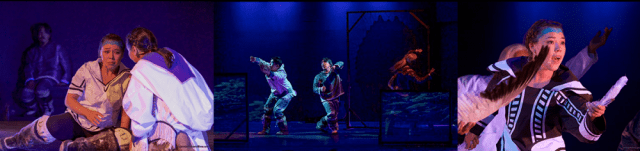
Created by The Qaggiq Collective, directed by Laakkuluk Williamson Bathory, produced by Qaggiavuut! and presented in the main space of Tarragon Theatre, I experienced the story as an epic in every sense.
Kiviuq Returns is based on legends shared by elder storytellers.
The performance is partially enacted by six actors (Keenan Carpenter, Vinnie Karetak, Avery Keenainak, Charlotte Qamaniq, Christine Tootoo and Natar Ungalaq), and partially re-told by the elders speaking to us on video. When we see them all gathered for a group shot near the end as the live performers kneel in homage, I was reminded of that beautifully sentimental moment near the end of Return of the Jedi (speaking of epics): also a gathering of wise elders. At times Kiviuq reminds me of clever Odysseus of the Odyssey or Aeneas of the Aeneid, a hero seeking to get home. We see storms at sea killing everyone but the hero. We encounter monsters and lovers.
The entire show is in Inuktitut. I am reminded of opera in the days before surtitles. One would read the synopsis and one listened carefully . While it’s much easier in Italian or German, where one often has phrase & sentences one recognizes, this wasn’t difficult really. The structure of the presentation was such that we regularly came back to a reading by one of the elders, when the lights would come up somewhat, allowing us to check our programs and in effect to know what was coming.
Director Laakkuluk Williamson Bathory
The director’s note recapitulates a theme I’ve heard before (for instance in Jeremy Dutcher’s album Wolastoqiyik Lintuwakonawa ) about the need to reclaim one’s linguistic heritage as a response to cultural genocide:
Inuktitut is the language of Kiviuq Returns. Let it wash over you. Look for the intent, listen for the emotion, hear the cracks of smiles, the lines of sorrow. Feel the corners and curves of our holophrastic way of speaking. Close your glottiss around the sounds “qi-qu-qa” and hiss without using your teeth for “lli-u-lla” Inuktitut is a river; it flows from a lake that is our histories and dreams, it bends around the land that is our daily lives, hardships and joys and it pours into the ocean that is the working of our minds, our creativity. With this performance we immerse you in our language..Inuktitut.
By being together in this theatre, we have all engaged in an agreement: you agree that it is vitally important to hear and see Inuit theatre professionals working in their own language and we agree to work hard on expanding our use of the language, reclaiming the space it has always taken in this place called Canada. As a group of Indigenous people who have faced the theft of our lands, culture spirituality, music, stories, histories and language and who rage against the colonized pull of suicide and loss, we wrap ourselves in the practice of Inuktitut theatre. Our repeated actions on stage are healing. Our connection between our elders and young people is deepened. Humour balances our sadnesses. This play creates safety like the blocks of sod that insulated the houses of our ancestors.
—Laakkuluk Williamson Bathory
I love that the director’s note proposes a kind of contract with us, that our attention at least would suggest that we agree that their language is important to hear, as a project to reclaim what has been lost.
I would solemnly agree.
There is much beauty in this performance. Several images are engraved in my memory, unforgettably powerful. The six performers will hold your attention.
There are at least two things to mention from my classical – opera background.
1-The voices are doing amazing things that we don’t usually hear in the classical realm. More than once, I found myself asking “how do they do that?” Some of it is inevitably related to the way they phonate and speak, but even so, wow. When I recall performances by Tanya Tagaq I am hungry for more, wondering what else these voices can do.
2-The genre of the performance feels something like opera, at least in the broad sense that Robert Lepage used, when he called opera “the mother of the arts” (or some phrase like that), although I don’t think it matters what we call it. Dance, music, singing, masks & theatre all work together in Kiviuq Returns.
And it’s clear when I google Qaggiavuut that they merge tradition with new theatre in exciting ways.
As part of today’s Toronto audience eating it up I know that there’s a genuine appetite here, a hunger to see and hear more.
In past years my annual review was out in December, but this time it’s later than usual: because I’ve had a real holiday this year, more sleep and more silence than usual, dodging the viruses & germs pursuing other members of my clan.
Does it matter? The question has been a recurrent one this year. We’re living in a world that bounces back and forth between films, operas, plays, performances & art containing edgy political commentary and silly escapes from reality. Forgive me if my usual mantra (“I’m a lucky guy”, meant to focus me on gratitude) has been displaced by a phrase I heard from Jessica Chastain on Saturday Night Live early in 2018. (using this url because youtube or NBC have not yet chosen to make the video available to Canadian viewers)
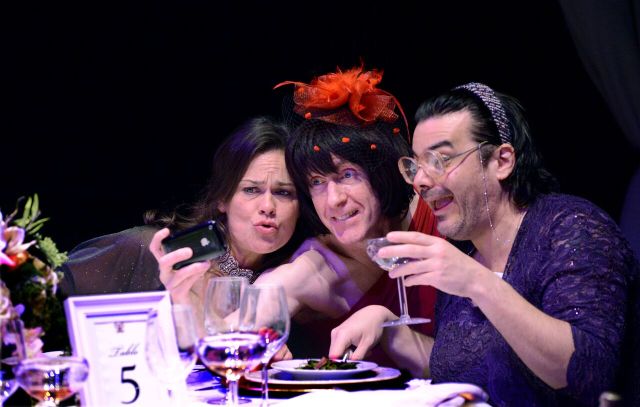
And so it’s been back and forth, between the attempts to be meaningful and the moments of pure silliness. 2018 was book-ended by the two best things I saw all year. At the beginning of the year it was the mad shenanigans in the Talk is Free / Crow’s Theatre co-production of The Wedding Party.
Playwright Kristen Thomson, Tom Rooney, Jason Cadieux (Photo: Guntar Kravis)
Princess Jenora, Hjalmar Pomeranki + Emily Trueheart (Mairi Babb, Eric Woolfe + Lisa Norton), photo: Adrianna Prosser
Thank you to both for so much blissful escapism.
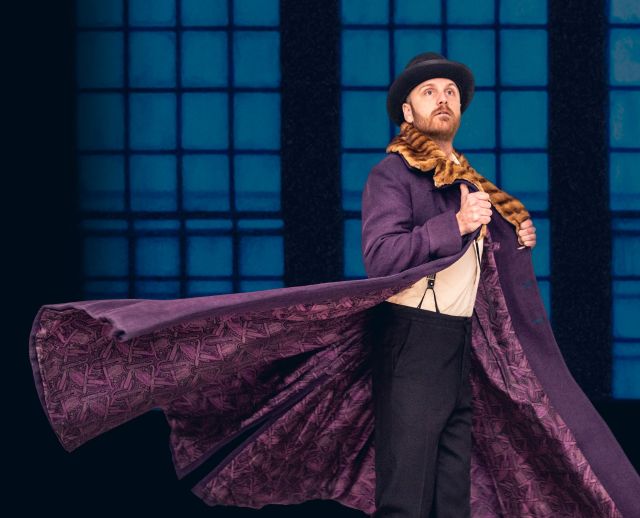
And a bit less silly, but more in the spirit of Chastain’s mantra, there’s The Overcoat, A Musical Tailoring, the remarkable co-production between Vancouver Opera & Tapestry as part of Canadian Stage’s 30th Anniversary Season, James Rolfe & Morris Panych adapting Gogol’s story “The Overcoat”.
Geoffrey Sirett as Akakiy in The Overcoat A Musical Tailoring (Photo: Dahlia Katz); his performance was a highlight of 2018.
I am reminded of another mantra I used to live by, namely “less is more” (pun intended of course). Where others seem to be exploding out of the box of opera in their attempts to be meaningful (thinking especially of Rufus Wainwright’s attempts to show that yes he can write an operatic score, even if the libretto is a travesty), Rolfe and Panych let some of the air out of that fraught balloon: and as a result it mysteriously floats up into the sky. Nonsense sometimes makes sense.
Perhaps it’s the fact that so far I have not learned the lessons of the contestants on that show on the SNL video (above). Has the bar been raised? Good performances (singing –acting- playing an instrument) aren’t enough. I feel hungry for something more, because I’m desperate to see evidence that yes things still do matter.
The films that moved me the most this year all had a political edge. There must surely be films like Isle of Dogs, The Post, The Death of Stalin and BlackkKlansman every year, right? Was it only my appetite that changed this year? Or perhaps the changing times are changing the artists.
Wajdi Mouawad (photo: Jean-Louis Fernandez)
And it’s the same for live theatre. Nothing got under my skin and into my head like the powerful works of Wajdi Mouawad last winter, from his Abduction from the Seraglio at the Canadian Opera Company, his film Incendies (several years old, but found in the library) and his play Scorched, presented in March at the University of Toronto.
The conversation and quest for reconciliation with indigenous peoples seems to be ongoing when I look back at shows such as Victor Davies’ Ecstasy of Rita Joe presented by Opera in Concert / Voicebox, Jeremy Dutcher’s concert at RBA (launching his brilliant CD Wolastoqiyik Lintuwakonawa ); I Call Myself Princess, Jani Lauzon’s new play with opera (a collaboration between A Paper Canoe Projects, Cahoots Theatre and Native Earth Performing Arts) and the workshop of Shanawdithit, a new opera being developed by Tapestry Opera and Opera on the Avalon in partnership with Native Earth Performing Arts, music by Dean Burry & libretto Yvette Nolan.
Brilliant native artist Kent Monkman put in an appearance in the summer, another wonderful show full of irony, wit and pain.
There were other moments with a political edge, such as Yom Shoah, a concert of remembrance for the Holocaust from Sara Schabas featuring Jake Heggie’s Another Sunrise; Safe Haven an intriguing multi-media performance exploring the ideas of exile & welcome from Tafelmusik curated with love & intelligence by Alison Mackay; a semi-staged performance of Stephanie Martin’s new opera Llandovery Castle, the concert presentation of Yiddish Glory , and the CD that I reviewed a few weeks later, BOUND v 2 from Against the Grain Theatre alongside their new recording of Ayre (capturing a wonderful performance from late 2016), Atis Bankas giving us a remembrance of Kristallnacht in concert; and finally Helen’s Necklace in a new translation, presented by Canadian Rep Theatre.
Forgive me, I mean no disparagement in foregrounding my hunger for something political, and thereby excluding some excellent work.
I’ll have more to say in a moment about the many other outstanding performances of 2018, but first wanted to call attention to those who were missing. First after an intense summertime farewell to Peter Oundjian, I was surprised at how keenly I felt his absence this autumn from the Toronto Symphony. And second, Jennifer Nichols had some misfortune last spring and perhaps as a result, hasn’t been quite the ubiquitous presence onstage that she had been in previous years.
Other highlights of the year?
• H̶a̶m̶l̶e̶t̶ from Tarragon: a successful telling of the story
• Anna Bolena from the COC, the best singing of the year, and thank you Sondra.
• Orphée+, another celebrated production from AtG.
• Of the three wildly divergent productions of Candide I saw in the first half of 2018 aka Leonard Bernstein’s centennial, the Toronto Symphony’s semi-staged production was the most effective & the strongest argument in defense of the score.
• The Return of Ulysses from Opera Atelier, thinking especially of Mireille Lebel as Penelope, the MVP performance of the year raising that production to another level.
• Mass in B Minor from Tafelmusik especially Charles Daniels
• Hockey Noir was a great idea at least.
• Orfeo from Toronto Consort, especially Charles Daniels again
Tenor Charles Daniels (photo: Annelies van der Vegt)
• Another new company has taken its place in Toronto, namely Tongue in Cheek productions. They gave us two fascinating events, namely Winterreise, with 24 singers instead of one, and Verbotenlieder from a female group of performers.
• Actéon & Pygmalion from Opera Atelier were wonderful in so many ways. It’s a curious irony that after so many years when OA have been (rightly or wrongly) associated with a homoerotic aesthetic, that these 2 erotically charged operas should arrive at exactly the moment when the COC were presenting a pair of operas by gay composers.
I’d like to think that we’re sufficiently mature now that sexual orientation isn’t such a big deal. But oh wait…. next paragraph.
It’s 2019. Will this be a year vacillating between silly and serious, meaningless or meaningful? Forgive me if I oversimplify, I miss a lot. We’ve had the Ontario election and the rapid-fire actions of the new government, and guess what!? there’s another election coming in the fall that might be every bit as overwhelming, as frustration with a liberal government leads to a mindless stampede off a cliff. Are we better off without Kathleen Wynne? And why was she and her party annihilated. I fear it was at least partially motivated by an over-reaction to her sexual orientation, as I thought she was doing a good job.
I miss you Kathleen Wynne
You won’t persuade me that things are better now under the Conservatives. Arts funding & support for the CBC are not part of the conservative agenda, and so I’m very nervous about what’s ahead if Scheer takes power federally.
Have I scared you yet?
And when I can’t take it anymore, I hide out in beautiful performances such as Tafelmusik’s Beethoven concert in the spring or various takes on Messiah, each wonderful in their own way.
At least they haven’t taken away our hiding places.
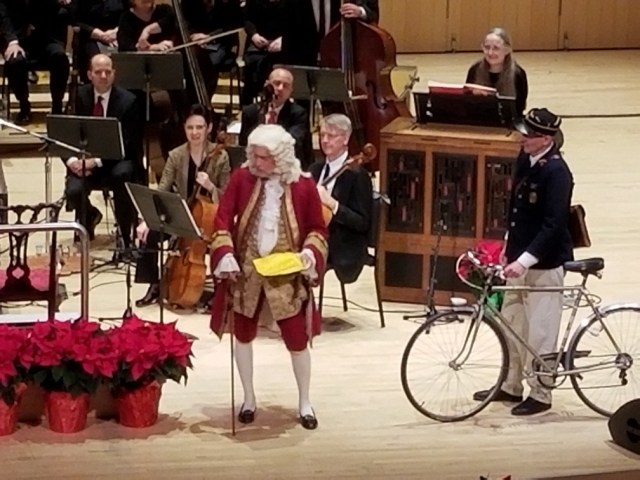
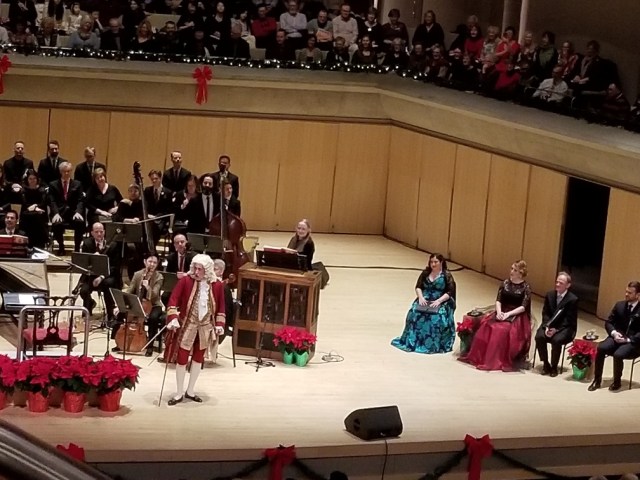
You can change the location but the song remains the same. Tafelmusik Baroque Orchestra & Chamber Choir led by Herr Handel himself gave us their annual sing-along Messiah.
The previous 37 have been at Massey Hall, but this time renovation forced us into Roy Thomson Hall instead.
Playful old George Frideric had some fun with the name of the venue. Last year he called it “Roy Rogers Hall.” This year he got a little closer, calling it “Tom Thomson Hall” before finally explaining who Roy Thomson was, admittedly with help from above.
Herr Handel stares off into space, disconcerted to receive a special message telling him that no it’s not Tom Thomson Hall.
Above? The telegram is ostensibly from the creator, and helped set Herr Handel straight. He also told us that when God is displeased he addresses him as “George”. Because as we all know, God is an Englishman.
I had a bit of an epiphany, and not because the creator sent me any special messengers. No, I was just taking it all in, in the lobby, in the bathroom, in my seat, wherever I went, I couldn’t help noticing the nerdy energy.
I had observed the special audience this past Wednesday at Tongue in Cheek’s Verbotenlieder: everyone at Lula Lounge knew the music being presented. But that small gathering of aficionados was nothing compared to what we saw today at Roy Rogers Hall.
If people can sing Bohemian Rhapsody (and they did so long before the film about Freddie Mercury) or Rocky Horror Show or Mamma Mia: why shouldn’t we do it for Messiah? This crowd of 2000 + armed with scores and seated by section are riding the same kind of high, except we get a bit of extra juice from the Christmas Season.
I feel like a bit of a fraud, I must say. I’ve stopped being a paid church-choir soloist because my singing isn’t what it used to be. While I still can honk out a few high B-flats if necessary (and church solos never get anywhere near that high) I used to have a D-flat, a C, a B…but gulp no longer. At one time I could sing through all of the Messiah choruses without getting very tired, but that was then. Now I am a spent force by the time of the tenor high ‘A’ on the last page of the “Amen” (that echoes the soprano ‘A’ a bar earlier). This year, just like last year, I sat in a mixed section rather than among tenors because I wasn’t sure what I’d be able to hit. At times I had to falsetto my high notes because I was just too pooped.
Yet the people sitting nearby were so gracious it’s amazing. It was a very Toronto kind of moment, to feel such warmth from total strangers, even as I was grateful to be there at all. People are nice here and you really see it at events such as this.
Aiding and abetting the warmth were the four soloists.
Tenor Charles Daniels gave us the first solos. I wonder if someone has ever done a dissertation on the ways in which one sings “Comfort Ye”, as today’s examples from Daniels were exemplary. In his improvisatory passages, themselves a brief sermon on taking comfort from the good news he brings, I heard the most remarkable bold explorations of comfort and peace, as enacted in his few calming notes. And in the cadenza to finish his opening aria “Ev’ry Valley” I believe I heard the highest note I’ve ever heard interpolated, namely a brief high B. It’s a bit of a mind—boggler that the baroque virtuoso impulse that might direct our gaze to the soloist as a showoff is so perfectly compatible with the message in the text: when carried out by someone as scrupulous as Daniels.
Krisztina Szabó might be the most versatile singer I know in Toronto. One of the go-to performers when it comes to new music, having made her mark at Covent Garden recently in George Benjamin’s new opera, that doesn’t preclude regular appearances in works such as Messiah. Hers is a voice and a mind of great accuracy. To this day I’m certain I’ve never heard her sing off pitch. As with Daniels, there’s a textual integrity alongside the musicianship. I was not surprised to find myself tearing up as she sang “Behold your God”, barely able to sing because my voice is all coming apart and emotional as we (the chorus, on the very next page) answer about good tidings. It’s such an insane thrill to be singing in the same show –admittedly from the 2500 or so in the audience—and not like anything else I know of. It’s a good thing there are so many other voices to cover up my mistakes.
Similar pleasures lie in wait when we meet our soprano, Sherezade Panthaki. The recitatives of the soprano telling of the shepherds & angels on Christmas Eve are some of the most remarkable writing of anything from Handel. No it’s not Wagner, but wow, the music has such suspense and excitement, the pace & the accompaniment raising one’s heart-rate even before she sings “And suddenly there was with the angel a multitude of the heav’nly hosts, praising God and saying…“ Much as I enjoyed watching this performed a few days ago by the TSO, there’s no comparison between watching, as opposed to following this in your score, and then getting to answer as part of a huge multitude singing “Glory to God, glory to God, glory to God in the highest!… and peace on Earth”. It’s also very cool that the tenors are (I think) the only section who get to be BOTH in the higher voiced group saying “glory to God” as well as the calm answering lower voices saying “And peace on Earth”. Yes I know it’s a vicarious thing, just like what I spoke of on Wednesday, the envy of one who wishes to be in the show. The singalong impulse is the most natural thing. Of course Panthaki sounded marvelous, although it’s hard to be objective about such things when you’re singing such exciting music.
Likewise baritone Drew Santini: who sang the solo number that received the highest applause, as with last year’s singalong. “Behold I tell you a mystery” followed by “The trumpet shall sound” is one of the climactic numbers in a work that goes far beyond telling a mere story. I remember the first times I encountered this number played on historically authentic instruments, as you find in an ensemble such as Tafelmusik: when there were fluffs aplenty. In those days the trumpet did indeed sound: but not necessarily in tune. The Toronto Symphony could always be secure in the knowledge that their sound—from modern valved brass instruments—were at least more accurate in intonation. That was the trade-off in the old days: that while modern isn’t what Handel had, at least they’d play it right, and sounding better than the authentic instrument. But I don’t think that logic applies anymore, not when Tafelmusik have someone who can play the old style trumpets brilliantly.
Excuse me if so much of this review seems self-centred, as though I’m reviewing myself and the way I sang the choruses of Messiah. My head was mostly down in my Novello score, at least during our choruses. When we were singing of course that means we couldn’t hear the Tafelmusik chorus as well as we would had this been a regular Messiah. They’re a magnificent ensemble, who we could hear and rely upon to help us when we got lost (as I did a couple of times when I didn’t turn the page fast enough). They’re accurate & have a beautiful sound. I should also mention that other Tafelmusik namely the orchestra. Of course I think they sounded great, and again I wasn’t paying them much attention, even in the solo numbers.
Next year I want to do this again, but I will look the music over, making sure I actually know my part. If you’re a church chorister or soloist who knows some of this music, you should consider taking in the Sing-along.
Soloists (l-r) Sherezade Panthaki, Krisztina Szabo, Charles Daniels & Drew Santini, taking in one of Herr Handel’s tirades. AND the program reminds us: “Any resemblance of Mr Handel to any persons living and/or dead, in particular Tafelmusik Chamber Choir director Ivars Taurins, is unintentional, bot not entirely coincidental.”






 with a series of events starting February 11th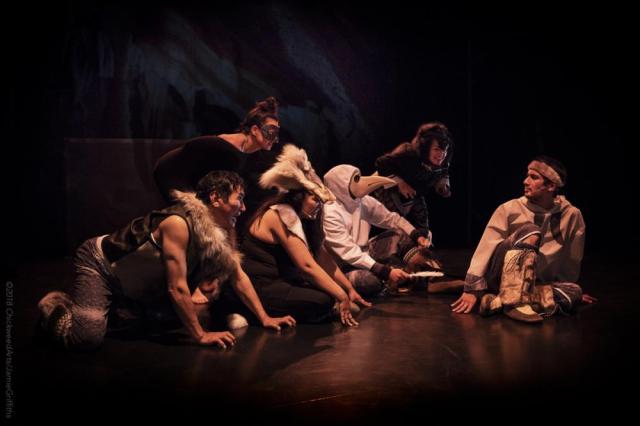



 barczablog